

simple request for a glass of water should have been exactly that—simple.
Yet in seat 3A, it ignited a tension that spread through the entire aircraft.
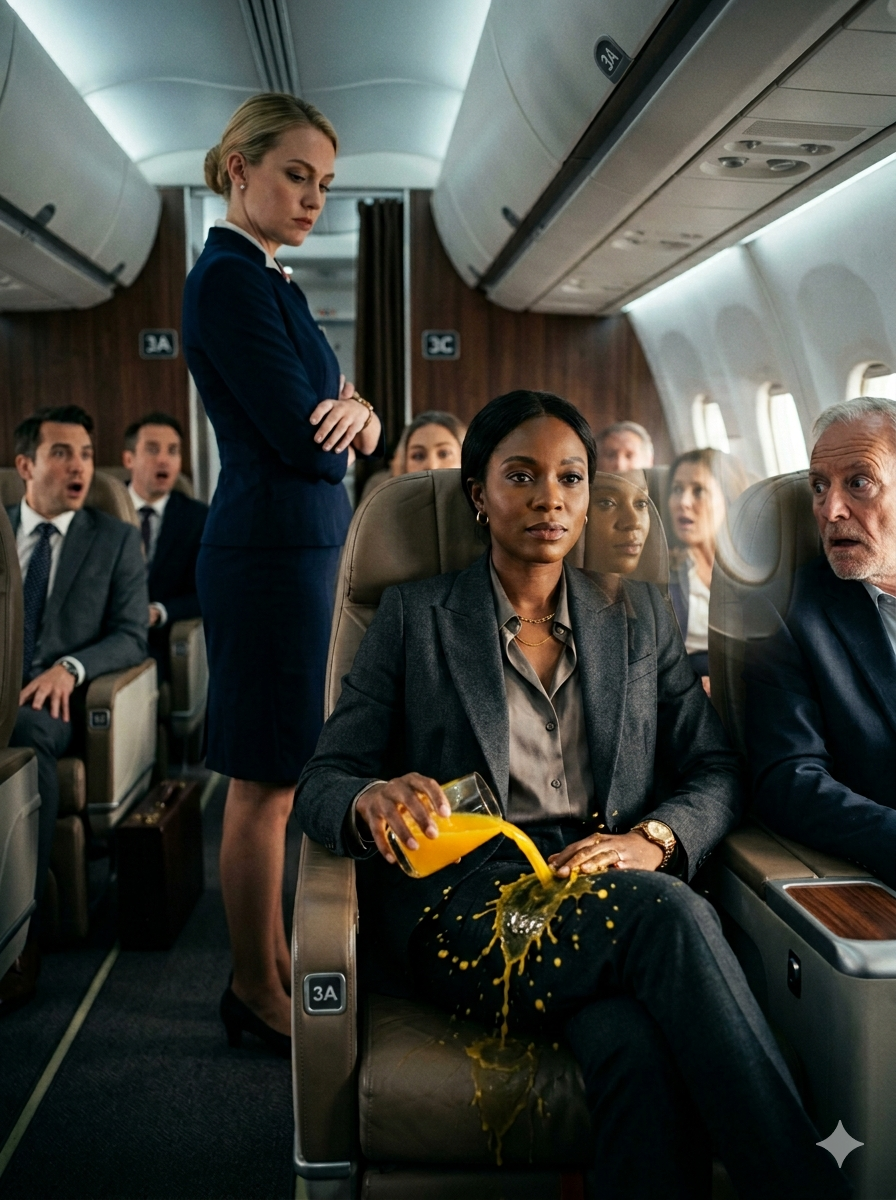
My name is Dr. Renee Carter. That day, I wore a fitted charcoal business suit, seated quietly as I reviewed a thick binder packed with aviation safety reports.
To everyone else in the cabin, I was just another traveler trying to get through a long day.
But to the senior flight attendant, Melissa Grant, I was something else entirely. The way she looked at me—a Black woman sitting quietly in first class—said everything. In that instant, she decided I didn’t belong, that I was beneath her.
No one around me knew who I truly was. They had no idea I was an FAA aviation safety inspector, one of the very few people with the authority to ground an entire aircraft. I had no intention of using that authority. I had only asked for water. Melissa came down my row, her blonde hair perfectly pinned, wearing a smile that felt sharper than polite. It was clear she controlled the first-class cabin like a queen. Passengers weren’t treated as customers, but as subjects expected to follow her rhythm. Yet her attitude toward me felt different. It was personal. It was prejudiced.
Instead of water, she abruptly shoved a plastic cup of orange juice into my hand.
“Full service will begin after takeoff,” Melissa said coldly.
“I asked for water,” I replied calmly.
Nearby passengers shifted in their seats, picking up on the sudden, heavy tension.
Then, with deliberate precision, Melissa tipped the cup.
Sticky orange juice poured across my lap.
It soaked into my suit, ruined my binder of federal documents, and splattered over the leather case beside me.
Gasps moved through the cabin. People couldn’t believe what they had just seen.
“Oh… so sorry,” Melissa said with fake sweetness.
She dropped a few flimsy napkins onto the mess, then turned and walked down the aisle as if nothing had happened.
She assumed I was just a helpless passenger she could humiliate without consequences because of the color of my skin.
She was dead wrong.
Part 2: The Federal Badge
The cold from the orange juice seeped instantly through the costly wool blend of my tailored charcoal suit.
It was a sharp, biting chill that clashed harshly with the warm, recycled air circulating through the first-class cabin.
The liquid settled into the folds of my skirt, a sticky, sickly sweet mess clinging to my skin like a physical expression of the disrespect just forced upon me.
I didn’t flinch. I didn’t spring from my seat.
I remained in seat 3A, perfectly still, as the artificial citrus scent filled my nose.
For several painfully long seconds, the only sound I registered was the steady, low hum of the massive jet engines beyond my window.
But inside the cabin, everything had changed.
The air grew dense, heavy with the undeniable truth of what had just happened.
This was no accident.
I knew it. The passengers around me knew it. And Melissa Grant, the senior flight attendant now walking away with a smug sway in her perfectly pinned blonde hair, absolutely knew it.
She had looked at me—a Black woman sitting quietly in a space she subconsciously believed I didn’t belong in—and decided I was a target.
She interpreted my simple request for water not as a passenger’s need, but as a challenge to her authority.
In her mind, I was someone who needed to be put in place.
I lowered my gaze to my lap.
The sticky orange liquid was spreading quickly, soaking into the thick, heavy pages of my official aviation safety reports.
These were not ordinary papers.
They were classified Federal Aviation Administration documents.
They contained sensitive audit records, maintenance logs, and safety procedures that governed the lives of thousands of passengers every day.
The ink was already beginning to run, the black text dissolving into blurry, unreadable smears under the acidic wash of the juice.
Beside me, my premium leather briefcase—a gift from my mentor when I earned my doctorate—was splattered with the same sticky residue.
A few flimsy, nearly transparent cocktail napkins lay pathetically over the mess.
Melissa had tossed them at me with a fake, venomous sweetness, a final insult before turning her back.
She expected a reaction.
She wanted a reaction.
I could almost hear the script running through her mind. She was waiting for the stereotype she had already assigned to me.
She wanted the “angry Black woman” to leap up, raise her voice, and create a scene.
If I did, she would win.
If I raised my voice, she would instantly play the victim. She would claim she felt threatened. She would call security, and I would be the one escorted off the plane in disgrace, labeled an unruly passenger.
It was a trap. A deeply prejudiced, carefully constructed trap.
But Renee didn’t respond the way Melissa expected.
I had spent my entire life navigating spaces not built for me.
I had walked the halls of elite aviation academies where I was the only woman of color in the room.
I had sat through endless briefings surrounded by white, male executives who constantly questioned my credentials, my data, and my authority.
Through years of painful, exhausting experience, I had learned that my greatest weapon was not anger.
It was absolute, unshakable composure.
I drew in a slow, deep breath, letting it fill my lungs, grounding myself in the present moment.
I closed my eyes briefly, visualizing the immense, invisible weight of the federal authority I carried.
I didn’t need to shout. I didn’t need to curse.
I opened my eyes. The cabin around me remained frozen in suspended animation.
The businessman in seat 3B stared at me, his mouth slightly open, shock and pity written across his face.
I didn’t want his pity.
Slowly, deliberately, I raised my right hand.
I did not rush. I did not fumble.
I reached toward the panel above my head.
With calm precision, I extended my index finger.
She calmly pressed the call button.
Ding. The sharp electronic chime sliced through the tense silence of the cabin.
It was a polite sound, a standard request for service, but in that moment, it felt like a warning.
I lowered my hand and rested it gently on the clean armrest of my seat.
And then, I waited.
I looked down the aisle. Melissa was serving a glass of sparkling champagne to a middle-aged white man in row 1.
She smiled brightly, her posture attentive and accommodating.
She heard the chime. I knew she did.
Her shoulders stiffened slightly—a subtle tell that she knew I had called her.
But she didn’t turn.
She continued pouring the champagne, taking her time, putting on a display of flawless service for the passengers she deemed worthy.
She was making me wait. She was asserting control, reminding me that she dictated this environment.
I simply watched.
Seconds passed. Ten. Twenty. A full minute.
The sticky juice remained uncomfortable, cooling against my skin, ruining a twelve-hundred-dollar suit.
But the physical discomfort meant nothing compared to the fire of resolve building in my chest.
I thought about every time people who looked like me had swallowed their pride in moments like this.
I thought about how often we’re told to “be the bigger person,” to “let it go,” to avoid making a scene for the sake of peace.
But peace built on silent humiliation is not peace. It is subjugation.
And today, on this aircraft, that subjugation ended with me.
At last, after making me wait for what she likely believed was a sufficiently degrading amount of time, Melissa turned.
She placed that sharp, insincere smile back on her face.
She walked down the aisle, her heels clicking softly against the carpet.
When Melissa returned moments later, Renee spoke in the same steady tone.
Melissa stopped at my row, looking down at me with an expression of feigned innocence layered over deep arrogance.
“Yes?” she asked, her voice clipped, lacking the warmth she had just shown the man in row 1. “Is there a problem with the napkins?”
She was mocking me.
She looked at the ruined documents, the stained leather, my soaked clothes—and reduced it to a minor inconvenience.
I didn’t break eye contact.
I didn’t look at the spill. I looked straight into her eyes.
“I need to speak with your captain”.
My voice was quiet, but it carried a weight that made the air between us feel heavier.
It wasn’t a request. It was an order.
Melissa’s smile faltered for a split second.
Her eyes narrowed, the prejudice and disdain rising to the surface.
She didn’t see an inspector. She saw a Black woman stepping outside the role she had assigned.
Melissa crossed her arms.
It was a defensive, defiant stance—a barrier to protect her fragile ego and inflated sense of superiority.
She shifted her weight, looking down at me.
“You can file a complaint when we land”.
Her words were dismissive, dripping with the confidence of someone who had bullied others for years without consequence.
She believed I was powerless.
She believed my only option was to fill out a customer service form that would be ignored and forgotten.
She thought she held all the power.
That was her mistake.
A massive, career-ending mistake.
I held her gaze for three long seconds.
I wanted her to remember this moment—the exact feeling of arrogance before everything collapsed beneath her.
Then I looked away.
I reached toward the side of my seat, where my soaked leather briefcase rested.
My movements were slow. Deliberate.
Every eye in first class was on me. Businessmen, wealthy travelers, even other flight attendants peering through the galley curtain.
They all watched the quiet Black woman in the ruined suit.
I unclasped the brass latch of my briefcase.
I reached inside, past the ruined reports, past my personal items, until my fingers found the familiar texture of my wallet.
Renee slowly opened her leather wallet.
The dark leather bore a faint embossed seal, barely visible from afar.
I lifted it to my lap, holding it above the sticky orange stain.
Melissa sighed impatiently, clearly irritated by the delay.
“Ma’am, as I said, you can go online and file a—”
She never finished.
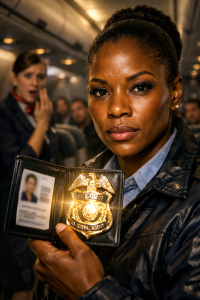
With a simple flick of my wrist, I opened the wallet.
Inside was a Federal Aviation Administration badge.
The heavy silver shield caught the cabin light, flashing with unmistakable authority.
Beside it sat my official federal identification.
My photo. My name. My title.
The gold lettering read: DEPARTMENT OF TRANSPORTATION – FEDERAL AVIATION ADMINISTRATION.
Melissa’s eyes snapped from my face to the badge.
Her demeanor changed instantly, as if the color had been drained from her body.
Her face went pale. Her crossed arms dropped limply to her sides.
The confident queen of the cabin vanished, replaced by a terrified employee who had just realized she had stepped on a landmine.
Gasps erupted again.
This time, not from the spill—but from the realization of who I was.
Passengers leaned forward, eyes wide, staring at the silver badge that carried more authority than any platinum frequent flyer card.
I didn’t smile. I didn’t gloat.
I held the same cold, professional composure I had maintained since boarding.
“I am Dr. Carter,” she said evenly.
I made sure my voice carried clearly to the first three rows. I wanted witnesses. I wanted her behavior exposed under the harsh light of federal authority.
“Federal aviation safety inspector”.
The words hit her like blows.
Melissa stepped back slightly. Her mouth opened, but no sound emerged. Panic choked her voice.
I gestured toward my lap, toward the binder now ruined by her deliberate act.
“And you haven’t just spilled juice”.
I leaned forward slightly, closing the space between us so she felt the full weight of what came next.
“You’ve interfered with federal property and obstructed official duties”.
The cabin went silent.
A deep, absolute silence.
The kind that comes when the natural order has been violently reversed.
No one coughed. No one shifted. Even the engine hum seemed distant.
The power dynamic hadn’t shifted—it had collapsed.
The woman who tried to reduce me to a stereotype now stood before me, visibly trembling.
Passengers exchanged stunned glances.
They were witnessing a reckoning.
They were watching someone who had likely abused power for years finally hit a wall she couldn’t push through.
“I… I…” Melissa stammered, her voice thin and shaking. “I didn’t know… I thought you were just…”
She stopped.
Just what?
Just a Black woman? Just someone she could disrespect? Just a target?
She didn’t finish, knowing the truth would condemn her further.
“You thought wrong,” I said quietly.
I looked past her toward the front of the cabin.
“I will not ask you again. Bring me the captain.”
This time, she didn’t argue.
She didn’t cross her arms. She didn’t mention complaints.
She turned and hurried toward the front galley, her hands trembling as she reached for the cockpit door.
I leaned back in my seat.
The juice was still cold. My suit was still ruined.
But the humiliation was gone. In its place was clarity.
This wasn’t only about me.
It was about everyone who had ever been mistreated by someone like her.
It was about ensuring that the skies—our shared system of travel—weren’t controlled by bigots and bullies misusing small power to harm others.
The wait for the captain was brief, but the tension stretched each second.
I watched the reinforced cockpit door.
Moments later, the captain emerged, irritation on his face, caution in his tone.
He was a tall, older white man with graying hair and four gold stripes on his epaulets.
He stepped into the cabin with the heavy stride of someone interrupted mid pre-flight check.
He didn’t yet know the full story.
Melissa hovered behind him, whispering urgently into his ear.
I could see the bias in his posture immediately.
He looked at Melissa—his colleague, a distressed white woman—and his protective instinct surfaced.
Then he looked at me.
A Black woman covered in juice.
For a brief, telling moment, his irritation deepened. He likely assumed exactly what she had—that I was a difficult passenger making a scene over a spilled drink.
“Ma’am,” the captain said, his voice firm, trying to take control. “My flight attendant tells me there’s been an accident, and you’re causing a disruption. We are preparing for takeoff.”
He had already taken her side. He hadn’t asked me a single question.
I didn’t let his tone shake me. I had dealt with countless captains like him.
I raised my hand, stopping him mid-sentence.
With my other hand, I lifted my wallet, holding the silver badge directly in his line of sight.
He looked at it.
The captain froze.
The irritation vanished, replaced by sharp professional focus.
He leaned closer, squinting to read the gold lettering.
When he saw “FEDERAL AVIATION ADMINISTRATION,” his posture snapped upright.
He was no longer addressing a passenger. He was addressing his regulator.
“Inspector Carter,” he said, his tone completely changed—respectful, cautious, edged with concern.
He looked down.
At the soaked documents.
He saw the binder. The official seals bleeding across the pages. He knew exactly what they were.
Every pilot fears a safety audit. Seeing those documents ruined was a nightmare.
Then he looked at the passengers.
He scanned the first-class cabin.
He was perceptive enough to read the room.
He didn’t see irritation toward a disruptive passenger.
He saw disgust directed at Melissa—and vindicated awe directed at me.
In that moment, he understood: his senior attendant had made a serious mistake.
“Captain,” I said, cutting through the heavy air, “your senior attendant deliberately poured a beverage over me and over classified federal safety documents after I requested water.”
“That’s a lie!” Melissa suddenly shouted.
Her panic erupted. She stepped forward, hands flailing.
Melissa quickly tried to twist the narrative.
“It was turbulence!” she insisted, her voice cracking. “The plane jerked! It slipped from my hand! She’s making it up because she’s angry! She’s aggressive!”
She fell back on the oldest, most insidious stereotype.
Trying to paint me as aggressive, hoping the captain would instinctively side with her.
“The plane hasn’t moved an inch from the gate, Melissa,” the captain said slowly, turning toward her.
His voice was dangerously calm. He knew she was lying.
“I tripped!” she pivoted, desperation rising, tears forming. “My heel caught! It was an accident! I tried to clean it, but she started screaming at me!”
With every word, she buried herself deeper.
I didn’t defend myself.
I didn’t need to.
I simply sat there, covered in the sticky mess she created, holding my badge, letting her lies hang in the silent, condemning air.
I waited.
I was waiting for the final piece to fall into place.
And as Melissa continued unraveling, I looked past her toward the galley.
A young, junior flight attendant stood there.
She looked terrified—caught between her senior’s authority and the presence of a federal inspector.
I held my breath, wondering if she would find the courage to step forward.
Part 3: Grounding the Aircraft
The lie lingered in the cabin’s recycled air, thick with desperation.
Melissa’s frantic voice bounced off the curved ceiling panels, her words a weak attempt to rewrite events in real time.
She was reaching for the oldest, most toxic playbook she knew.
A white woman in distress appealing to a white male captain, trying to cast me—a Black woman sitting quietly in a ruined suit—as the aggressor.
It was a pattern that had repeated countless times throughout history.
But not today. Not on my watch. Not in my airspace.
I did not raise my voice to defend myself.
I did not rush to counter her panicked version of events.
I remained seated, a symbol of complete composure amid the sticky, citrus-scented chaos she had created.
My silence wasn’t surrender; it was a reflection of her guilt.
The captain, a seasoned veteran with graying temples and sharp blue eyes, stood rigid in the aisle.
He had already examined the badge.
He had seen the unmistakable silver shield of the Federal Aviation Administration catching the overhead light.
Then he looked at the soaked documents.
He recognized the official seals bleeding through the paper—the classified safety audits that governed the very license he needed to fly.
Then he looked at the passengers.
He saw the businessmen, the frequent flyers, the people who paid thousands for these seats, all staring at Melissa with undisguised disgust.
He was trained to read instruments and predict turbulence.
Reading this room didn’t take long.
He knew she was lying.
But knowing and acting are not the same—especially when it means turning against his own crew.
Melissa pressed on, her voice rising, edging toward hysteria.
“She bumped my arm, Captain!” Melissa pleaded, tears finally spilling through her carefully applied mascara. “I was just trying to serve her, and she lashed out! It was an accident! I swear, it was just an accident!”
The audacity of the lie was staggering.
She doubled down on bias, hoping her tears would erase what everyone had just witnessed.
She believed proximity to authority would protect her.
She believed the system would favor her over the federal power sitting right in front of her.
I watched the captain’s jaw tighten.
He was cornered.
If he supported her, he risked obstructing a federal inspector.
If he opposed her, he admitted that his senior crew member had committed a blatant, prejudiced act under his command.
The silence stretched, tightening until it felt like the aircraft itself might crack.
I held his gaze.
Unblinking. Unwavering.
I let him feel the weight of the badge in my hand.
I was giving him a chance to choose integrity.
But before he could respond, movement caught my eye.
From the galley, beyond the curtain separating first class, a young woman stepped forward.
The junior flight attendant, fresh from training, her uniform still crisp.
Her name tag read Sarah.
Her hands shook as she gripped the galley counter, knuckles white.
She stared at Melissa, her eyes filled with fear and conflict.
She knew the culture.
Senior attendants like Melissa ruled through intimidation, capable of damaging a junior’s career with a single complaint.
Speaking up meant risking everything.
Especially now.
But Sarah also knew what she had seen.
She had watched Melissa deliberately target me.
She had seen the calculated tilt of the cup, the false apology.
I watched the struggle play out across her face.
She looked at Melissa’s tears. The captain’s hesitation.
Then she looked at me.
She saw the ruined documents, the stained suit, the quiet dignity in my posture.
In that brief moment, something passed between us.
A silent understanding. A shared recognition.
A call for truth.
Sarah took a shaky breath.
She released the counter.
She stepped into the aisle.
The captain turned, surprised.
Melissa spun around, her tear-streaked face hardening into a warning glare.
But the junior flight attendant standing nearby spoke quietly.
Her voice was soft, trembling—but steady.
“She poured it on purpose”.
Five words.
Simple. Devastating.
They hit like an explosion.
Melissa’s fragile story shattered instantly.
The captain recoiled, staring at Sarah, searching for doubt.
He found none.
Only truth.
“Sarah, shut your mouth!” Melissa screamed, dropping all pretense, her voice raw with anger. “You don’t know what you’re talking about! You were in the back! You didn’t see anything!”
She stepped toward the younger woman, hands curling, her hostility fully exposed.
“That’s enough!” the captain roared.
His voice filled the cabin, commanding silence.
He stepped between them, forming a barrier.
He didn’t need more evidence.
He turned back to me.
His expression had changed completely.
No irritation. No hesitation.
Only the grim realization of the situation.
He looked at the ruined documents. The badge.
“Inspector Carter,” he said, voice low, strained. “I… I apologize for my crew member’s actions. This is completely unacceptable.”
He was trying to recover what couldn’t be recovered.
Hoping an apology would resolve everything.
Hoping the flight could proceed.
Hoping I would accept it and remain silent.
He didn’t understand.
I placed my wallet gently on the clean armrest.
I set both hands on the armrests.
Then, with calm, deliberate movement, Renee stood.
Every eye in first class followed.
As I rose, orange juice dripped from my skirt onto the floor.
Plop. Plop. Plop.
The sound of consequences.
I didn’t wipe it away. I wore it.
I glanced at Melissa.
She had backed into the galley wall, pale, trembling.
The queen of the cabin reduced to a frightened figure.
I didn’t address her.
She no longer mattered.
I turned to the captain.
He stood rigid, bracing.
I took a breath, feeling the cabin’s anticipation.
Her voice cut through the silence with precision.
“By the authority granted to me under FAA Order 8900.1… this aircraft is grounded”.
The words landed like a shockwave.
For a moment, silence.
Then reality hit.
A collective groan spread through the cabin.
Frustration rippled—missed connections, disrupted plans.
“You’ve got to be kidding me,” someone muttered.
A woman gasped across the aisle.
I understood.
But their inconvenience could not outweigh safety and integrity.
An airline that allows staff to humiliate a passenger based on race—and then lie about it—is facing a critical failure of safety culture.
If she felt empowered to act this way, what else had she ignored?
What protocols had she bypassed?
What voices had she silenced?
This was no longer about a stained suit.
It was about a deeper failure—and I had the authority to address it.
“Inspector,” the captain said, voice breaking. “Please. We have three hundred souls onboard. I’ll remove her immediately. Just… please don’t ground the aircraft.”
He was pleading.
I met his gaze without sympathy.
“Captain Miller,” I said, reading his name. “Your senior attendant intentionally assaulted a federal inspector, destroyed classified safety documents, and acted with clear prejudice.”
I pointed to the binder.
“That is not a service issue. That is a federal offense. This aircraft is now part of an active investigation.”
I lowered my hand.
“You will contact the tower, inform them the flight is grounded by FAA order, and request a tug back to the gate. Do you understand?”
He searched my face.
Found no hesitation.
He exhaled slowly.
“Yes, ma’am,” he said quietly. “I understand.”
He turned away, passing Melissa without looking at her.
The cockpit door closed behind him with finality.
I remained standing.
The crew scrambled.
The engines began to wind down, their pitch lowering like a restrained beast.
All because of one act—and a refusal to accept it.
I looked out the window.
The taxiway stretched ahead, a path we would not take.
Instead, the aircraft jolted slightly as the tug reattached.
We began moving backward.
The plane returned to the gate.
A public retreat.
Inside, the mood was tense—anger mixed with awe.
Some glared. Some watched silently.
Many looked at me with respect.
The businessman in seat 3B nodded.
I returned it.
As we rolled back, I pulled out my encrypted government phone.
I dialed the FAA command center.
“Command center, Director Reynolds,” came the response.
“Director, this is Inspector Carter. I’ve grounded Flight 114.”
“Go ahead, Renee. What’s the situation?”
“I was subjected to a deliberate, prejudiced act by the senior attendant. Federal documents were destroyed. She attempted to mislead the captain.”
A pause.
“Are you injured?”
“No. But the crew’s integrity is compromised. I need agents, executives, and airport police at the gate.”
“They’re on the way. Hold position.”
“Copy.”
I ended the call.
I looked toward Sarah.
She stood near the exit, visibly shaken.
I met her eyes.
I didn’t smile—but I softened my expression.
A silent message: You did the right thing.
She exhaled, relief flickering across her face.
The aircraft stopped.
Engines fell silent.
Seatbelt signs turned off—but no one moved.
They knew it wasn’t over.
Outside, flashing lights reflected off the terminal.
The jet bridge connected with a heavy thud.
I stood in the aisle, suit soaked, badge visible.
I took a breath.
I had asked for water.
They gave me prejudice.
Now, they would face the consequences.
Part 4: The Aftermath and Resolution
The heavy thud of the jet bridge locking into place echoed through the silent cabin like a judge’s gavel.
A sound of finality.
The end of Melissa Grant’s authority—and the start of accountability.
For twenty minutes, the aircraft had sat motionless.
But this was no ordinary delay.
When the doors opened, officials were already waiting.
Through the window, flashing security lights reflected across the terminal.
I stood in the aisle, posture straight, suit still stained.
I didn’t clean it.
I needed every person boarding to see exactly what had happened.
The door opened.
Authority entered.
Police officers. FAA supervisors. Airline executives.
Melissa’s face drained of color.
She sat trembling, the confidence gone.
The FAA supervisor stepped forward.
“Inspector Carter. Report.”
I calmly explained everything.
The hostility. The deliberate act. The lies.
The destroyed federal documents.
The attempt to mischaracterize me.
Executives looked shaken.
One stepped forward.
“Dr. Carter, please… we can resolve this internally…”
He tried to contain it.
“This is not a customer service complaint,” I said. “This is a federal matter.”
I gestured outward.
“Clear the cabin. We begin interviews now.”
Passengers came forward willingly.
They described everything.
They confirmed my composure—and Melissa’s actions.
Then Sarah spoke.
Her voice trembled—but held.
She told the truth.
Every detail.
And the case solidified.
Melissa was brought out.
Disheveled. Broken.
Abandoned by those who once supported her.
Supervisor Vance spoke clearly.
“Melissa Grant, you are suspended pending federal investigation.”
An executive followed.
“Your employment is terminated, effective immediately.”
Her badge was removed.
Her authority stripped.
She was escorted away.
The cabin watched in silence.
Justice, not spectacle.
I turned to the executives.
“You have a cultural failure,” I said. “This is only the beginning.”
They nodded.
The investigation expanded.
The airline underwent sweeping reform.
Policies changed.
Leadership replaced.
Accountability enforced.
Sarah rose.
She became a leader.
A symbol of integrity.
Melissa fell.
Her career ended.
Her power gone.
But for me, it was never about revenge.
It was about protection.
About ensuring dignity.
About drawing a line.
Months later, I flew again.
Same airline.
Same seat.
This time, a flight attendant approached.
“Water, ma’am?”
A simple gesture.
Respectful. Genuine.
I accepted.
“Thank you,” I said.
The glass rested safely on the tray.
No tension. No hostility.
Just decency.
A small moment—representing something much larger.
Proof that change had taken hold.
The plane took off.
And the lesson remained:
Power without respect means nothing.
THE END.
