

Have you ever been judged purely by how you look before anyone knew who you really were?
My name is David. Some time ago, I entered the breathtaking marble lobby of a luxury hotel. I was dressed in an expensive wool jacket, yet to the employees working that day, I was simply a Black man who didn’t seem to belong. What none of them realized was that I had acquired this very property 18 months earlier. I have a habit of visiting my properties quietly, watching how my staff treats ordinary guests.
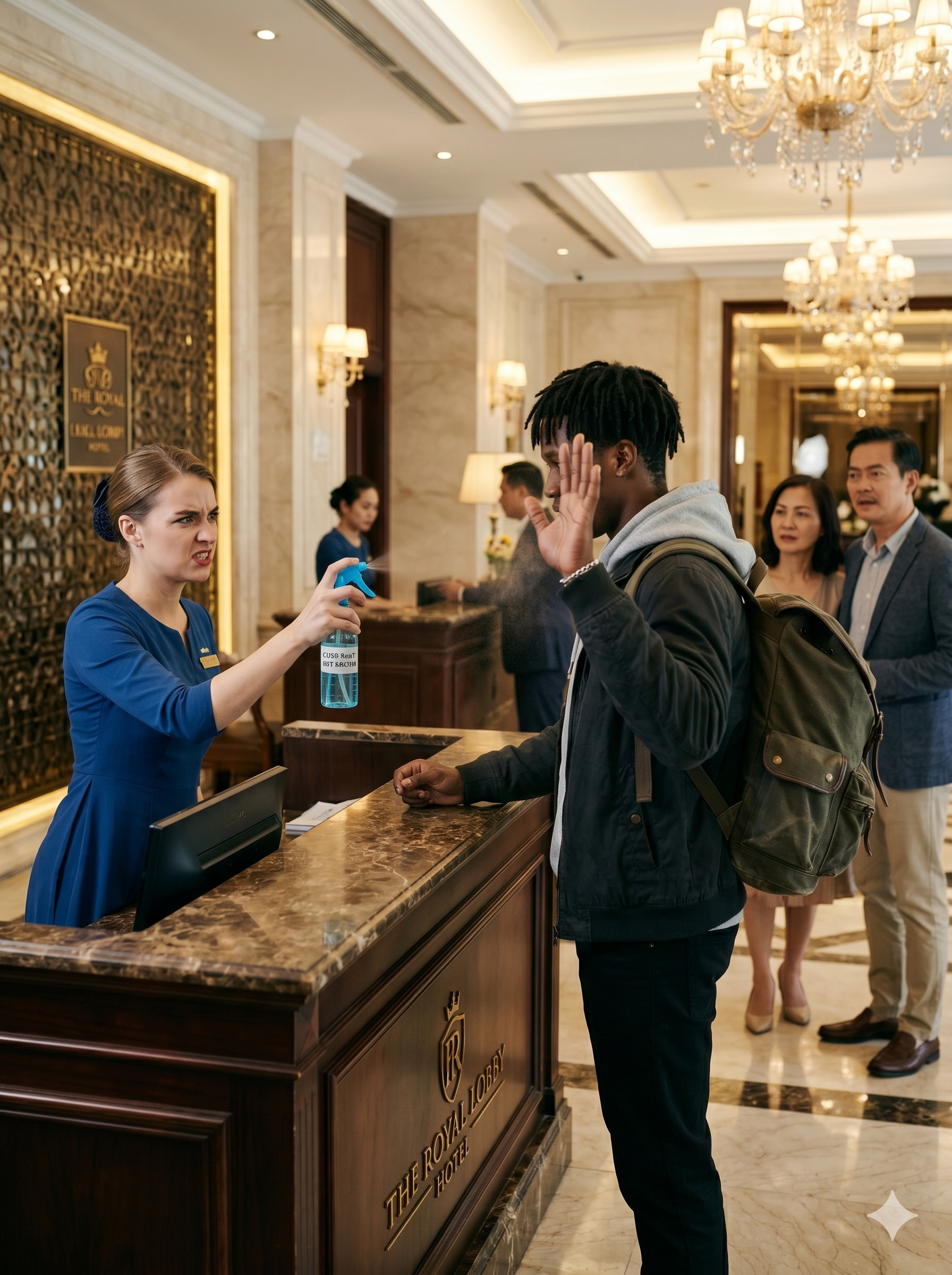
I approached the front desk to check in. I hadn’t even said a word yet. The front desk manager, a woman named Rebecca Miller, looked at me once and grabbed a bottle of hand sanitizer from her counter. Without any warning, she sprayed the strong disinfectant directly into my face.
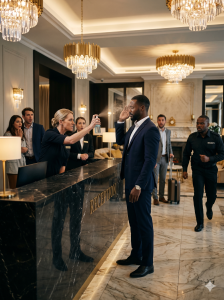
I recoiled sharply, instinctively wiping my burning eyes as the harsh alcohol scent lingered in the air like proof of what just happened.
“You’re contaminating our lobby,” Rebecca’s voice carried pure disgust. She pointed toward the exit with her manicured finger, treating me as if I were garbage. She called for security to remove the “v*grant” right away.
The entire lobby fell into stunned silence. A businessman nearby froze mid-sip, his coffee shaking in his hand. I kept my tone steady despite the sting in my eyes. I simply said, “I have a reservation.”
Rebecca burst into a harsh, exaggerated laugh. “Sure you do, sweetie,” she mocked. Circling me like I didn’t belong there, she told the gathering crowd I was just another sc*mmer trying to trick my way into their penthouse suites.
I calmly took a handkerchief from my jacket and dabbed my face with quiet control. For a brief moment, my American Express black card slipped into view, but she missed it. I told her the reservation was under the name Thompson. She rolled her eyes so dramatically they nearly disappeared, telling everyone that “people like me” always rely on common American names.
Then Janet Davis, the assistant manager, appeared with a cold smile. She scanned me from head to toe and insisted I was mistaken, suggesting there was a budget motel three miles away that suited me better.
My phone vibrated in my pocket with a reminder for a 3:00 p.m. board meeting. I muted it calmly and reached to show my confirmation email. The moment I moved, Rebecca gasped loudly and claimed I was reaching for something. The security chief, Steve Wilson, rushed forward with his hand on his radio, ordering me to keep my hands visible.
They were treating me like a dangerous th*reat for simply standing in their lobby.
From the corner of my irritated eyes, I noticed a young woman pulling out her phone. She began live-streaming everything on Instagram. The viewer count climbed quickly—12, 25, 53. She whispered to her audience, zooming in on the Delta first-class boarding pass peeking from my pocket and the subtle $50,000 Patek Philippe watch on my wrist.
“This doesn’t add up,” she whispered to her camera.
But Rebecca and her team were too focused on asserting control to notice the details right in front of them. They were determined to put me in my place, unknowingly broadcasting discrimination in real time.
And the internet was watching every second of it.
Part 2: The Standoff Goes Viral
The sharp chemical scent of antiseptic still lingered thick in the air between us. My eyes burned, watering from the unexpected chemical as*ault, yet I held steady eye contact with Rebecca Miller. She had begun circling me now, the crisp click-clack of her designer heels echoing across the imported Italian marble floor of the lobby.
She looked at me not as a guest, not even as a person, but as something contaminating her pristine space—an infection that needed removal.
“Look at this,” she announced to the expanding crowd of onlookers, her voice full of theatrical confidence. “Another sc*mmer trying to con his way into our penthouse suites. This is what we deal with every single day, folks. They dress up, put on expensive accessories—probably fake—and try to intimidate honest, working people.”
I remained perfectly still. In 25 years of building a billion-dollar hospitality empire from the ground up, I had learned that the most powerful response to manufactured chaos is complete emotional silence.
If I raised my voice, I would become the “aggrssive Black man.” If I moved too quickly, I would be labeled a th*eat. So I stayed calm, an unmoving center in the storm she was creating around me.
I reached into my tailored wool jacket with slow, controlled precision. The entire lobby tensed instantly. A mother nearby instinctively pulled her child behind her legs, sensing d*nger she could not even explain. Janet Davis, the assistant manager, placed a hand dramatically over her chest. “He’s reaching for something!” she gasped, her tone laced with false alarm.
I pulled out a simple white linen handkerchief and gently dabbed my burning eyes. For a brief instant, the edge of my American Express Black Card caught the light before I slipped it back out of view.
“I am not trying to con anyone,” I said evenly, my voice calm but clearly carrying through the silent lobby. “I have a confirmed reservation.”
“We don’t negotiate with sc*mmers,” Rebecca snapped, her face flushed with authority and anger.
Behind me, I felt the heavy presence of Steve Wilson, the Chief of Security. He positioned himself deliberately, boxing me in. His hand rested on his radio, posture rigid. “Sir, I am giving you one final opportunity to leave voluntarily,” Steve said, lowering his voice. “After that, we involve the police. If you resist removal, it becomes cr*minal trespass.”
I turned slightly toward him. “I’m not resisting anything,” I said calmly. “I am simply standing here.”
The absurdity of it all was staggering. I was the CEO and majority shareholder of Grand View Luxury Hotels and Resorts. This property alone generated $276 million annually. Nearly a quarter of our corporate revenue flowed through the marble beneath my feet. I owned the chandelier above us, the desk Rebecca stood behind, and even the radio Steve was using to th*eaten me.
Yet to them, I was nothing more than an unnamed v*grant.
From the corner of my eye, I noticed the young woman near the concierge desk. Her smartphone was raised, the red indicator showing she was live-streaming.
“This is absolutely wild,” she whispered into her phone. “They’re treating this man like a cr*minal for literally existing in their lobby.”
I subtly adjusted my wrist to check the time. The chandelier’s light caught the face of my Patek Philippe watch. It was understated, but recognizable to those who knew. Another piece of the puzzle they refused to see.
But the internet never misses details.
“Guys, look at his watch,” the young live-streamer said, zooming in. “That’s like a $50,000 watch. Something is seriously wrong with this picture.”
Her viewer count surged rapidly. 500. Then 1,000.
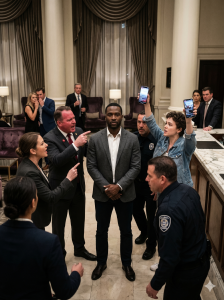
The comment feed exploded faster than anyone could read. “This is pure discrimination,” one wrote. “Why won’t they just check his reservation?” another added. “Record everything. This hotel is about to get sued.”
Rebecca, noticing the camera, doubled down instead of backing away from the mistake. She began performing for the audience.
“This is exactly how they operate, folks,” she said, turning slightly toward the phone. “They create scenes, then cry victim when decent people protect themselves. I’m documenting this for our legal team. This is what har*ssment looks like!”
Janet stepped forward beside her, also raising her phone. “Smart,” she said loudly. “These situations always turn into lawsuits. They’ll claim we discriminated, demand settlements… it’s a whole industry.”
It was a disturbing psychological display unfolding in real time. They had fully inverted reality. I was the one assaulted, the one surrounded, the one being treated as a threat—yet they had convinced themselves I was the aggressor.
A middle-aged businessman finally stepped forward, voice hesitant. “Excuse me, but this seems excessive,” he said, gesturing toward me. “The man just wants to check in.”
Rebecca snapped toward him instantly. “Sir, with respect, you don’t understand the security challenges we face daily,” she said sharply. “People like this target luxury establishments specifically.”
People like this. The phrase echoed heavily. It was familiar, coded, and intentional. It didn’t matter that a Delta first-class boarding pass peeked from my pocket. It didn’t matter how composed I was. In their minds, the stereotype had already been assigned.
Then my phone vibrated again.
Without breaking eye contact with security, I slowly pulled it out, keeping every movement visible.
The screen lit up. A message from Michael Brown, the General Manager of this exact hotel.
“Mr. Thompson, are you still arriving at 4 PM for the walkthrough?”
Immediately beneath it, another message appeared from Lisa Anderson, Corporate Head of HR.
“David, the board meeting materials are prepped. Let me know when you land.”
My thumb hovered over the screen. I held the power to end everything instantly.
But I didn’t open them.
Not yet.
If I revealed myself now, it would become a misunderstanding. Apologies would follow. Excuses would be made. But that wasn’t the point. They weren’t supposed to recognize me—they were supposed to show how they treated people when they didn’t.
If I wanted this rot removed from my company, I needed it fully exposed.
“See how they always have excuses?” Rebecca said sharply, noticing my phone. She pointed at me. “Always have someone to call. Probably calling his lawyer already. It’s all part of the con.”
“Holy sh*t,” the live-streamer said, voice shaking. “You guys, Channel 2 News just joined the stream. Local HTX News is watching. This is going viral right now.”
Her viewer count surged past 1,500. The situation was now spreading beyond the hotel walls.
Steve Wilson stiffened at the word “viral,” glaring at the woman filming. “Ma’am, please stop recording. This is private property.”
“First amendment rights in a public accommodation space,” she replied firmly.
Rebecca’s confidence wavered briefly, then hardened again. Pride pushed her forward.
“Fine!” she said loudly. “Let everyone see what we deal with! Let them see hardworking Americans being har*ssed by people who think they can intimidate their way into anything.”
I closed my eyes briefly. The weight of it all settled in. I had built this empire on the belief that hospitality should be universal. Yet here I stood, inside my own creation, being treated like a suspect in a place I owned.
Steve keyed his radio. Static filled the silence.
“Dispatch, this is Wilson. Requesting HCPD unit to Grand View Grand, main lobby,” he said firmly. “We have a trespassing situation. Individual is uncooperative.”
A crackle responded instantly. “Copy that, Wilson. Unit is en route. ETA is four minutes.”
A wave of tension swept the lobby. Everything had escalated. In four minutes, police would arrive. In four minutes, I would be judged by a system that rarely pauses before acting.
The clock was now undeniable.
I took a slow breath.
“Before the police arrive,” I said quietly, my voice cutting cleanly through the room. “I’d like to make one phone call.”
Part 3: The Phone Call That Stopped Time
“Before the p*lice arrive,” I said quietly, my voice cutting through the heavy, manufactured tension like a scalpel, “I’d like to make one phone call.”
The silence in the grand marble lobby was so deep you could almost hear dust settling beneath the imported chandeliers above us. For a brief moment, the calmness of my request seemed to disrupt their thinking entirely. They had prepared for shouting. They had prepared for panic. They had prepared for resistance, for running, for anger—anything that would confirm the story they had already written in their heads about a Black man cornered by security.
They had not prepared for stillness.
But Rebecca Miller’s arrogance was like a dr*g. She recovered quickly, throwing her manicured hands up in an exaggerated, dismissive gesture.
“Of course!” she mocked, turning to her audience with a cruel smile twisting her face. “The mysterious phone call! Let me guess—your lawyer? A civil rights group? Maybe your social media team?”
Janet Davis, the assistant manager, gave a nervous laugh, adjusting her name tag. “Or maybe his getaway driver,” she said quietly, just loud enough for others to hear.
I didn’t react. Not a blink. Not a frown. Only a quiet, heavy sadness. I had spent 25 years building a hospitality empire meant to represent dignity and service. I had slept on floors, risked everything, fought through rooms where I was the only Black executive—building something meant to welcome everyone.
And now, the very front line of that legacy was destroying it, piece by piece, without realizing the architect was standing in front of them.
I reached into my tailored wool jacket slowly. Every eye in the lobby followed the movement. Steve Wilson tightened his grip on his radio, knuckles white, body coiled like he was waiting for permission to use frce—ready to be the man who stopped the “threat.”
“Actually,” I said, glancing at my phone screen, “I’m calling the owner.”
Rebecca laughed sharply. “The owner of what?” she sneered, pointing at me. “Your little scam? Go ahead. Let’s see who answers.”
I tapped the screen and turned on speaker.
The phone rang once—its tone echoing through the silent lobby.
Twice.
The live-streamer adjusted her phone, zooming in. Her viewer count had passed 2,000. The entire internet felt like it was holding its breath.
On the third ring, the call clicked open. A sharp, professional voice filled the space.
“Michael Brown speaking.”
A ripple of confusion crossed Rebecca’s face. She knew that name. Michael Brown was the General Manager of this hotel. But her mind refused to connect the man on the phone with the man standing in front of her.
“Michael, this is David Thompson,” I said, my tone shifting—no longer a guest’s voice, but one that commanded boardrooms and budgets.
“Mr. Thompson!” Michael’s voice instantly changed from professional calm to alarmed respect. “Sir, I wasn’t expecting your call. I thought you were arriving at 4 PM. Is everything alright?”
The words hung in the air like a dropped b*mb.
Mr. Thompson. Sir.
I watched the exact moment reality began to collapse for Rebecca Miller. Her expression didn’t just change—it broke. The smug confidence drained from her face, replaced by a pale, frozen horror.
“Who did he just call ‘Mr. Thompson’?” someone whispered behind her.
“Everything is not alright, Michael,” I said calmly, locking my eyes on Rebecca. “I am currently standing in the lobby of our flagship Houston property.”
“You’re… you’re in the lobby right now, sir?” Michael’s voice shook through the speaker.
“I am,” I continued evenly. “And your front desk manager just sprayed chemical sanitizer directly into my face and ordered me removed like I was garbage.”
A collective gasp swept through the crowd. A coffee cup slipped from a businessman’s hand and shattered on the marble floor. No one reacted to it.
Every eye stayed on me.
“Your security chief,” I continued, turning slightly toward Steve Wilson, “has boxed me in and is preparing to have me arrested for criminal trespassing. And your assistant manager just suggested I belong in a roadside motel.”
Silence swallowed the room completely.
Steve’s hand slowly left his radio. He looked like he had stepped onto a live wire. Janet clutched the counter so tightly her knuckles went white.
“Sir…” Michael’s voice cracked through the phone, panicked. “Did you say someone sprayed you?”
Instead of answering, I reached into my inner jacket pocket.
Rebecca didn’t move this time. She just stared, frozen, as if her entire career was collapsing in slow motion.
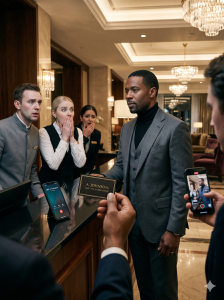
I pulled out a single heavy card—thick, ivory stock with embossed gold lettering that caught the chandelier light.
I turned it toward the livestream camera.
DAVID THOMPSON. CHIEF EXECUTIVE OFFICER & FOUNDER. GRAND VIEW LUXURY HOTELS AND RESORTS.
The phone nearly slipped from the live-streamer’s hands.
“Oh my god,” she whispered. “Oh my actual god.”
She flipped her camera briefly to her face—eyes wide, voice shaking—then back to the card, then to the staff.
“He’s the CEO,” she said urgently. “He owns the hotel.”
The viewer count exploded. 3,000. 4,000. 5,500.
Comments flooded the screen in chaos. Shock. Caps lock. Panic. Memes forming in real time.
Rebecca stared at the card like it was written in another language. Her mouth opened—but nothing came out. The confidence she wore like armor had completely collapsed.
Steve’s radio slipped from his hand and cracked against the marble floor. He didn’t even look down. He just stood there, hollowed out.
“Mr. Thompson…” Michael’s voice trembled. “I am so sorry. I’m coming down right now. Please—”
“Listen carefully, Michael,” I interrupted. Calm. Controlled. Final. “I need you in this lobby in sixty seconds.”
“Yes, sir.”
“Bring Lisa Anderson from HR.”
“Yes, sir.”
“And corporate legal counsel if they’re in the building.”
A hard swallow came through the line. “Yes, sir. Sixty seconds.”
I ended the call.
I placed the business card on the counter in front of Rebecca.
The silence tightened again.
Outside, distant sirens began to echo through Houston streets.
Rebecca finally spoke, voice shaking.
“This… this has to be fake,” she said weakly. “Anyone can print a card. This is a scam.”
But she didn’t believe it. Not anymore.
Her eyes flicked to my watch. My ticket. My card. All real. All undeniable.
I stepped forward slightly.
“Ms. Miller,” I said quietly, “in the eighteen months since I purchased this property, I’ve visited dozens of our locations. I’ve observed how my staff treats people when they think no one important is watching.”
Her breathing quickened.
“I’ve seen excellence,” I continued. “I’ve seen small mistakes. But I have never seen anything like what I’ve witnessed in this lobby today.”
The live stream hit 7,000 viewers.
At the far end of the lobby, the elevator DINGED.
The doors slid open.
And the reckoning walked in.
Part 4: The $12 Million Reckoning
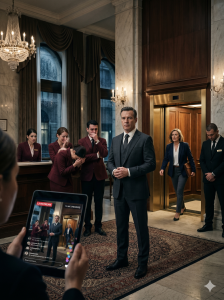
The elevator chimed sharply at the far end of the marble expanse.
Michael Brown appeared at a full run, his usually neat hair disheveled from panic. Behind him, Lisa Anderson from corporate HR struggled to keep pace in her heels, her expression already tight with alarm.
They saw me instantly. Michael’s face went through a rapid collapse of emotion—confusion, recognition, shock, and then pure fear.
“Mr. Thompson,” he said breathlessly as he approached, as if walking into judgment. “Sir, I am so deeply sorry. I had no idea you were in the building.”
“If you had known, your staff would have behaved professionally,” I finished calmly, my voice cutting through his panic. “The real question is why they don’t behave professionally when they think no one important is watching.”
Michael looked like he might be sick. Lisa introduced herself quickly, her voice shaky as she spoke about immediate corrective procedures. I acknowledged her, but before anything else, I turned toward the woman who had started it all.
Every head in the lobby shifted to Rebecca, who now stood behind the reception desk frozen, like her body had forgotten how to move. The live-streamer adjusted her angle, capturing everything for the thousands now watching.
“I… I didn’t,” Rebecca said weakly. “I mean, how was I supposed to know?”
“You weren’t supposed to know who I am, Ms. Miller,” I replied gently. “You were supposed to treat every guest with basic human dignity, regardless of who they are.”
The words hit like physical bl*ws. She tried to respond, to explain, to justify, but nothing came. No argument held anymore.
Behind her, reception phones began ringing nonstop as news outlets and corporate teams reacted in real time. The story had already escaped the building.
I turned slightly toward the room. “This hotel generates $276 million in annual revenue,” I said evenly. “Nearly a quarter of our corporate profits move through this lobby.”
I looked at Michael and Lisa. “Our insurance policies include strict anti-discrimination clauses. Civil rights violations void coverage entirely.” My voice stayed steady. “What happened today, recorded from multiple angles, carries exposure exceeding $50 million under federal civil rights law.”
The room went completely still.
“I’m offering three options,” I continued, “and you have five minutes to decide.”
The live stream surged past 6,000 viewers as people pressed closer.
“Option one: immediate termination of all involved staff, a public apology, and full cooperation with federal investigation. Estimated cost: $2 million.”
Rebecca’s s*bbs broke the silence.
“Option two: full corporate discrimination audit across all 23 properties, mandatory training for 12,000 employees, and new monitoring systems. Estimated cost: $15 million annually.”
“Option three: allow federal investigation to proceed. Civil rights lawsuits follow. Estimated cost: bankruptcy.”
The final word hung in the air like a verdict.
Michael’s voice cracked. “Option one, sir. We choose option one.”
I nodded once. “Ms. Miller, you’re terminated effective immediately. Surrender your badge and key card.”
Her legs weakened. She gripped the counter, pleading about her family, insisting it was a mistake.
“You made choices,” I corrected quietly. “Multiple choices, over multiple minutes, while being recorded.”
Lisa stepped in to handle severance and escort procedures.
I turned to security. “Mr. Wilson, you are suspended pending investigation.” His shoulders dropped as years of service collapsed in seconds. Janet Davis was reassigned to entry-level front desk duties with mandatory training.
The live stream reached 15,000 viewers. The reaction was overwhelming, but I wasn’t finished. Removing individuals wasn’t the solution. The system itself had failed.
I forced Michael to confirm what records already showed—17 formal discrimination complaints and 43 informal reports in 18 months, all minimized or ignored.
“Corporate protocol failed,” I said when Lisa tried to intervene, “because it was built to protect liability, not people.”
I turned to the crowd. “Effective tomorrow, Grand View Hotels will implement full reform across all 23 properties.”
I outlined it clearly: zero-tolerance policy, anonymous reporting systems, mandatory bias training, and real-time monitoring for discrimination incidents.
“These reforms will cost $12 million in year one,” I said. “But discrimination lawsuits cost more. Federal investigations cost more. Reputation collapse costs more. And moral failure costs everything.”
At that moment, two Houston p*lice officers entered through the glass doors.
I approached them calmly, identified myself, and explained there was no criminal matter. I told them the situation had already been addressed internally. They paused, assessed the scene, and left without incident.
I checked my phone. News alerts were flooding in. The stock had already risen slightly.
I looked back at the cameras.
“Excellence has no color,” I said. “Hospitality has no boundaries. And dignity is not optional.”
Six months later, the video had reached 57 million views and triggered policy hearings and legislative reforms in multiple states.
I stood in the same marble lobby, now transformed. Janet—six months into probation—was assisting an elderly couple in fluent, improving Spanish. The culture had shifted visibly.
Zero discrimination complaints had been recorded in 127 days. Employee satisfaction had risen. Guest trust had returned.
Sarah Chen, the live-streamer from that day, now a journalist, returned for an interview.
“Critics say your response was too harsh,” she said on camera. “That Ms. Miller lost everything over one mistake.”
“Ms. Miller made multiple choices over time,” I replied. “Each one deliberate, each one recorded. The consequence wasn’t harsh. The behavior was.”
I looked directly into the lens. “We don’t build better systems by excusing harm. We build them by refusing to normalize it.”
True leadership isn’t about power or punishment. It’s about building systems where respect is the default, not the exception. Justice doesn’t require revenge—only accountability, applied consistently, even when it’s uncomfortable.
And sometimes, the most important change begins the moment someone refuses to ignore what’s right in front of them.
