

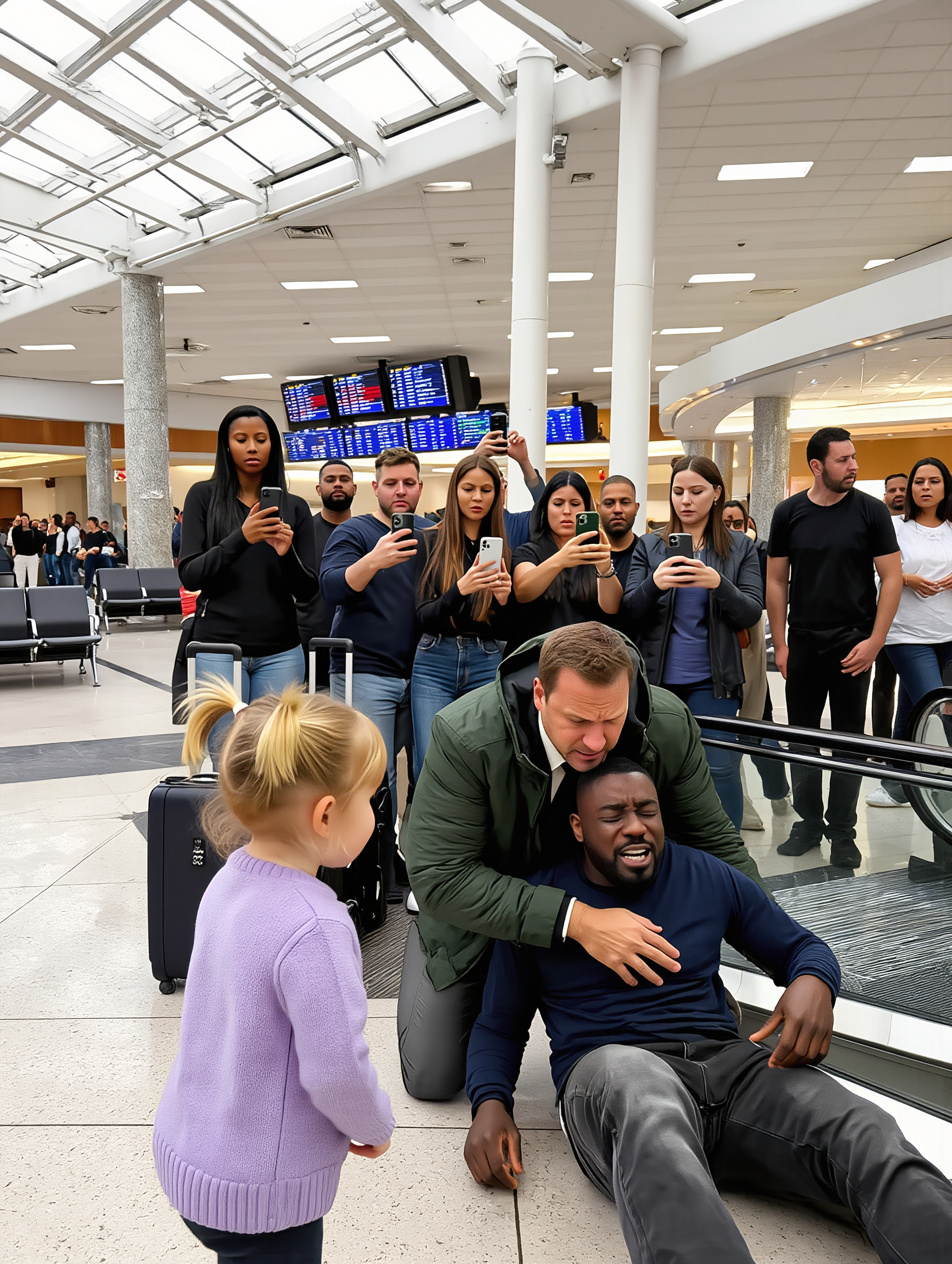
I was unable to move my arms; they were tightly pinned beneath me. Above, a voice turned into a ragged, panicked roar, yelling, “Do not ever touch my daughter!”. It carried the kind of righteous fear of a parent who truly believed he had just rescued his child from a threat. Yet he had not seen beyond my skin, my worn travel hoodie, or the sudden urgency of my movement. He had only registered a Black man grabbing his little girl’s arm near the edge of the concourse.
Let me step back. My name is Arthur. I’m a forty-two-year-old structural engineer. My job is to recognize where systems fail, where collapse is imminent. We were near Gate 12 in an airport that had already felt like purgatory for the past six hours.
I had first noticed the little girl about ten minutes earlier—a small figure in a bright canary-yellow puffy coat. Her father stood a few yards away, locked into an agitated phone call, physically present but completely, dangerously absent from the small life moving around his feet.
Because of my profession, my attention naturally drifted to an out-of-service escalator beside our seating area. I immediately saw that the metal comb plate at the top landing had been fully removed by maintenance. Beneath it, the large interlocking gears and the dark, grease-coated machinery cavity were exposed. The opening was a yawning gap of steel and grime, nearly two feet wide, plunging deep into the floor.
In a brief lapse of attention, the little girl noticed something reflective near the top of the broken escalator. She toddled toward it. She passed the crooked yellow warning sign, and my chest hit with a sudden, heavy thump. I tried to shout, but my voice was lost in the surrounding roar of aircraft noise.
She teetered over the edge, and her stuffed rabbit slipped from her hands, falling silently into the dark machine pit. She gasped softly and reached out after it. In that instant, everything calculated itself in my mind: she was going to fall.
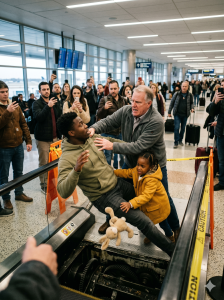
I covered the distance in three long, desperate strides. I threw myself backward, lunging with my right arm extended. My hand caught the thick, slick fabric of her yellow coat just as she tipped forward. I pulled back with all my strength, and we both crashed away from the edge. I twisted mid-fall so she landed on me, my ribs and shoulder taking the full impact. She was safe.
For a fraction of a second, relief surged through me so strongly I could barely breathe. But it shattered before I could even speak.
A shadow dropped over me, followed by an immediate, furious roar. A heavy leather shoe struck my wrist, forcing my grip off the yellow coat. The father tackled me with the force of someone protecting his own child’s life. His knee slammed into my lower back, pinning me down with brutal weight. He seized the back of my jacket, twisting it tight around my neck, partially ch*king me as my face was pressed into the floor.
“Somebody help! Security! He tried to take her!” his voice boomed across the concourse. I tried to gasp out a warning about the open machinery pit, but he was completely consumed by the story forming in his head.
So was everyone else. A tight circle formed around us, phones raised to capture what they believed they were seeing. No one glanced at the exposed escalator just a few feet away. They saw a well-dressed white father restraining a Black man in a worn travel hoodie, and the image filled in all the conclusions for them. I was the attacker; he was the protector.
I already knew the footage would be online within minutes, stripped of any context. What they didn’t know was that I was already running from something far larger—and far more dangerous—than any of them could imagine.
Part 2: The Viral Trap and the Devil’s Bargain
The pressure crushing my spine felt unending, each strained breath scraping against my bruised ribs. I prepared for the cold snap of handcuffs, assuming the father’s knee would soon be replaced by an officer’s grip. Around us, the crowd’s murmurs had swelled into firm, certain condemnation of a crime I had not committed.
Then, suddenly, the soundscape of the terminal changed. The heavy rhythm of running boots echoed across the floor, followed by a radio crackling with sharp static.
“Step back! Everyone step back! Airport police, make a hole!” a commanding, breathless voice shouted.
“Sir, get off him,” a deep voice ordered.
The weight on my back stalled. “He grabbed my daughter!” the father screamed, his voice raw with a distorted, protective panic. “He tried to take her!”.
“I said, get off him, now. We have it under control. Step away,” the officer demanded. Slowly, reluctantly, the pressure lifted as the father removed his knee from my spine. Hands seized my arms and pulled me into a kneeling position while two officers stood over me.
The crowd fell into a stunned silence, phones still raised, waiting for the inevitable moment I would be dragged away. But that moment never arrived.
A third officer in a high-visibility yellow vest moved toward the broken escalator, preparing to reposition the warning barrier. He stepped past where the father stood clutching his shaking daughter, then froze completely. He clicked on a tactical flashlight, the beam cutting into the dark hollow where the escalator’s floor plate was missing.
For illustrative purposes only
The light revealed spinning steel gears, thick grease, and something that made the air turn rigid: the girl’s small stuffed rabbit resting on a metal beam deep inside the machinery. One of its ears was already caught in a rotating sprocket, being pulled steadily into the mechanism.
The officer’s breath caught loudly, sharp enough to silence the entire terminal. He turned, face pale, eyes widened by realization.
“Look down there, sir,” the officer’s voice had a jagged, crystalline edge that cut through the frantic air of Gate 12. He wasn’t looking at me or the dozens of shimmering smartphone screens; he was looking directly at the father, David. “Look at where your daughter was heading.”.
David jerked toward the opening, then dropped backward onto his hands, his breath breaking into something like a sob. He stared into the exposed machinery—the exact space where his daughter would have been destroyed by metal force. I know enough engineering to understand what happens in there; the shear, the torque, the absence of mercy in moving steel.
The crowd’s anger didn’t fade—it collapsed into a hollow silence of realization. The woman who had been shouting about “predators” lowered her phone.
“My God,” David whispered, frozen at the edge of the pit. “Lily.”.
Officer Miller gripped my forearm and helped me rise. David remained on the ground, folded inward, hands over his face. “I’m sorry,” David choked out. “I… I didn’t see. I thought… I’m so sorry.”.
He moved toward me with his hand extended, desperate to repair what had almost been lost. But the damage was already beyond that moment. A woman stepped forward, eyes wide with shaken adrenaline.
“I’ve already uploaded it,” she said, voice trembling. “The whole thing. The save, the… the misunderstanding. It’s already got ten thousand views. People are calling you the ‘Guardian of Gate 12.’ You’re going to be on the news, Arthur!”.
She lifted her phone. On the screen was a grainy vertical video of me on the ground with David’s hands around my thr*at, then the cut to the escalator opening. My face was visible. My name was already in the caption.
My stomach dropped as if the floor had vanished again. The anonymity I had built my life around was gone in seconds of digital hunger. I wasn’t just a traveler—I was in transit under a false identity because, three months earlier, a pedestrian bridge I had approved in Ohio developed a structural fracture in its main support. The legal aftermath had already begun consuming everything. If I became visible now, they would find me.
I looked at David and spoke the only warning I had left. “Tell these people to put their phones away,” I said. “And then, David, I want you to walk away and never look for me again. Because if you find me, you’re going to find out that I’m not the hero you want me to be. I’m just a man who saw a crack and tried to fix it, and I’ve already paid enough for that.”.
I didn’t wait. I handed my boarding pass to the gate agent and walked into the jet bridge, hearing my former life begin to catch up behind me like grinding machinery.
Inside Flight 1422, the air smelled recycled and thin, with a faint metallic edge from overworked systems. We sat delayed on the tarmac for forty-five minutes under a “minor mechanical delay.” My seat was 14C. My pulse would not settle.
Then my phone vibrated—a low, constant thrum that felt wrong in my hand. Marcus was calling.
I pressed it to my ear. “Arthur,” Marcus said, voice stripped of its usual control. “Don’t speak. Just listen. They have the video. The prosecution, the firm, the media—everyone. They’re calling it a ‘flight from justice.’”.
He told me the Riverside Bridge families were already on television, questioning how a man who could save a child at an escalator could allow a bridge to fail. I tried to respond, to explain I had filed warnings, but Marcus cut through it. The server records at my firm were gone.
“If you land in Oregon, you’re walking into a buzzsaw,” Marcus said. “They’ve tracked your tail number. They know where you’re sitting. They know your seat is 14C.”.
Cold sweat spread across my back. The cabin felt smaller, the plane no longer a vehicle but a sealed transport to judgment. Every trace of my life had already been mapped.
Then Marcus delivered the final collapse. “David—the father of the girl you saved. He’s been talking,” he said. David, believing he was helping, had hired a PR firm called Beacon Global to “protect my legacy.” He gave them my identity, my background, my destination. Beacon Global was tied to Miller-Hines—the same insurance network involved in the Riverside Bridge case. My location had been handed directly to the opposing machine.
“They’re offering a deal,” Marcus said quickly. “Beacon Global. They’ll make the Ohio charges disappear. They’ll frame the bridge collapse as an act of God. But you have to sign a non-disclosure. You have to hand over your personal laptop. You have to admit… that you didn’t see the structural fatigue until it was too late.”.
“If I say I didn’t, the design flaw stays in the records,” I said tightly. “Other bridges using that same truss design… they’ll be at risk. People will d*e, Marcus.”.
“And if you don’t?” Marcus snapped. “You go to pr*son for ten years for professional negligence and fleeing. Sign the deal, Arthur. Be the hero the world wants. Delete the files on your drive. Do it before you touch down.”.
The call ended. The plane lifted into a gray, empty sky. My hands shook as I opened my laptop.
The “Warnings” folder sat on my desktop. Six months of emails, photos, and documented fractures at Riverside Bridge. Proof I had tried to stop it—and proof I had also hesitated too long before leaving. Truth and liability sat in the same folder.
I hovered over “Select All.” One path made me a hero built on silence. The other made me honest and condemned. Either way, the structure failed somewhere.
I clicked ‘Select All.’ I hit ‘Delete.’ Then I emptied the trash.
The progress bar moved forward slowly, each percentage like something inside me collapsing. When it finished, I closed the laptop. I felt hollow.
By the time we descended into Portland, I was already standing before the seatbelt light turned off. I needed out before the deal became reality.
But at the end of the jet bridge, I saw them—camera flashes, a crowd of reporters, and a man in a charcoal suit holding a sign with my name. Beside him stood a police officer.
There was no choice left. Only arrival.
The doors opened and sound flooded in—shouting, cameras, names called out like accusations. The man from Beacon Global stepped forward and placed a firm hand on my shoulder, guiding me into view.
“Mr. Vance has no comment at this time,” his voice declared. “He is exhausted from his ordeal. We ask that you respect his privacy as he recovers from his heroic actions.”.
As we moved through the terminal glass, I saw David holding his daughter, Lily, near baggage claim. He looked relieved, almost grateful, waving at me like I had been saved.
But I had not been saved. I had been rewritten.
I stepped into the waiting black SUV as the door closed behind me. The sound sealed off the world. In that silence, I wasn’t a man anymore—only a version of me that others had agreed to believe.
Part 3: A Hollow Hero and the Widow’s Guilt
The Oregon air tasted like ash—not literal ash, but the kind that clings to your throat after you’ve burned away everything that mattered. I had left the airport a manufactured hero, but what I had really stepped into was a gilded cage. Beacon Global PR—or whatever Miller-Hines called their fixers—had complete control over me. They drove me through Portland in a sleek black car, rain smearing the city into gray streaks beyond the tinted glass. They placed me in a luxury apartment overlooking the river, all marble surfaces and curated art, nothing like the small, honest life I once had in Cleveland. But it wasn’t freedom. It was a display case. A performance.
The first week was a blur of media training, staged photos, and scripted interviews. They built the “hero” narrative from the airport footage, polishing every angle until it felt unreal. My supposed quick thinking, my bravery, my selflessness—it all felt like a mask glued over something rotten. I repeated their lines. I smiled on cue. And inside, something hollowed out further each day.
The country embraced it instantly. Headlines called me “Arthur Vance: The Hero Engineer” and “A Second Chance for a True American.” My face appeared on magazines, on screens, on news loops in cafés I walked past. Strangers stopped me in the street with admiration in their eyes, asking for photos, shaking my hand like I had done something pure.
Every bit of it felt like suffocation. I was living inside a lie that everyone insisted was truth. And the silence about the Riverside Bridge—the thing I had failed to stop in Ohio—hung behind everything like a sealed door no one dared open.
And then there was David.
He called me every day, his voice overflowing with gratitude, believing he had saved me from legal disaster. He had no idea he had actually delivered me into the hands of the very people who wanted to control my entire future. One afternoon, while being prepped for a televised appearance, I saw him on a studio monitor, smiling and holding up a newspaper with my face on the front page. A PR handler told me how proud he was. I felt something break inside me. I wanted to confess everything—on air, in front of everyone—but I couldn’t. The machine holding me was too strong.
Months passed. The media storm faded, but the role didn’t. I became a permanent fixture in Portland’s elite circuit—galas, speeches, staged charity appearances. The apartment turned from luxury into confinement. At night, I stood on the balcony above the Willamette River, feeling like a ghost being applauded for a life I hadn’t truly lived.
I started drinking heavily. Expensive scotch, poured just to dull the noise in my head. My handlers pretended not to notice, as long as I showed up, smiled, and stayed on script. They even increased my medication, calling them “stabilizers.” I called them something else.
The nightmares never stopped. The bridge collapsing. The escalator gears. Lily falling. Faces watching me as steel gave way. I’d wake up soaked in sweat, the taste of ash and metal in my mouth.
Then one morning, an email from Marcus shattered what was left of my control. The subject line read: DO NOT DELETE.
My pulse spiked as I opened it. Inside was a news article about another bridge failure in Ohio—same design, same structural warnings. “Experts warn of potential catastrophe,” it said.
My stomach dropped. I had destroyed the evidence that might have prevented this. I had chosen survival over prevention.
And then, a few days later, I found the package.
No return address. Just a photo inside: my old computer screen showing the “Warnings” folder. Metadata visible. Proof someone had access. Someone was watching.
Panic set in fast and total. I tore the photo apart, but the image stayed burned into me. I stopped sleeping. Every shadow in the apartment felt like surveillance. I began seeing Lily in strangers’ faces on the street, in passing reflections, in crowds that didn’t belong to me.
I knew I couldn’t stay inside the role anymore.
That night, I called Marcus.
“I need your help,” I said. My voice barely held together. “I can’t do this anymore.”
He listened without interrupting. When I finished, he told me he had been preparing for this possibility. There was a whistleblower path. Lawyers. Protection programs. A narrow way out—but it would expose everything, including me.
I agreed.
I left Portland quietly and flew under a false name to Chicago.
The city was cold, gray, stripped of illusion. I met Marcus in a worn diner at the edge of town. He handed me a thick file—documents, statements, reports. Enough to bring down Miller-Hines, but also enough to implicate me in everything.
I nodded. I understood what it meant.
That’s when I noticed her.
A woman sitting alone across the diner. Watching me. Familiar in a way I couldn’t place at first. Then I recognized the weight in her eyes before I recognized her face.
Sarah Miller.
She stood and walked toward our booth.
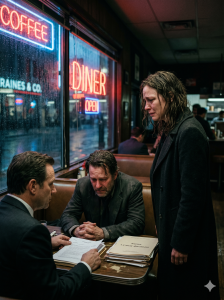
For illustrative purposes only
“Arthur Vance?” she asked softly.
My body went rigid.
“I just wanted to look at you,” she said, voice shaking. “I wanted to see the face of the man who k*lled my husband.”
The words hit harder than anything before it. I tried to speak, but nothing came.
“How could you?” she asked, tears spilling now. “How could you let this happen?”
Other people in the diner turned. Marcus started to stand, but she pushed past him.
“I don’t want excuses,” she said. “I just want you to know my husband was a good man. He loved his family.”
She paused, breathing uneven.
“And you took him away from us.”
Then she turned and left.
The bell on the door rang as she stepped into the cold Chicago air.
I sat there completely still, realizing something I had avoided for too long.
No deal, no media narrative, no manufactured heroism could erase what had already been done—or what I had failed to stop.
Part 4: The Price of the Truth
The encounter with Sarah Miller became the undeniable turning point of my life. Standing frozen in that greasy Chicago diner, watching her disappear into the winter air, I felt the fragile structure of my existence finally collapse. I understood, with painful clarity, that I could no longer outrun what I had done—not through distance, not through silence, not through carefully built protection plans. I abandoned Marcus’s whistleblower strategy entirely. I couldn’t stay hidden. I had to bring everything into the open, even if it destroyed me.
I contacted an investigative reporter I had briefly met during one of my scripted Portland interviews. I told her I had a story she wouldn’t believe—one that involved corruption, negligence, and the Riverside Bridge collapse. She was skeptical at first, but the moment I mentioned Miller-Hines, her focus sharpened immediately.
We worked in secrecy for weeks, meeting in quiet cafés and public libraries. I laid everything out: the structural failures, the suppressed reports, the erased evidence, the PR machinery that turned me into a manufactured hero. She dug even deeper, uncovering layers of corporate negligence I hadn’t even seen.
Eventually, the story was ready.
It ran on the front page of the Oregonian: “HERO ENGINEER EXPOSES BRIDGE COVER-UP.”
The reaction was immediate and violent.
Beacon Global disavowed me within hours, calling me a liar and a fraud across national media. Miller-Hines launched a massive lawsuit before the day ended, accusing me of defamation and breach of contract.
But the truth was no longer contained.
Public outrage erupted. Protests spread through Portland and Cleveland. Federal investigations were opened. Careers collapsed. The system I had once been trapped inside finally began to fracture under its own weight.
I knew I would face prison. I knew my life as I had known it was finished. But for the first time in a long time, I felt something close to peace. Not because I was free—but because I had finally stopped hiding.
The trial was brutal.
The courtroom felt smaller, heavier, stripped of spectacle. Marcus sat beside me, composed but worn down. In the gallery, David was there. He didn’t look at me once. His grief had hardened into something quieter, deeper.
Lily wasn’t there.
The verdict came on a rain-soaked afternoon.
Guilty. Negligence. Obstruction.
The word guilty didn’t feel like a shock. It felt like gravity finally finishing its work. When the gavel fell, I didn’t resist it. The public version of me—the engineered hero, the viral myth—was gone. Only what remained of Arthur Vance was left to stand in the aftermath.
I served my sentence in a low-security facility, stripped of freedom but not surrounded by violence. The days were slow and repetitive. I kept to myself, working in the library, avoiding attention, living inside the quiet consequences of my choices.
When I was released, I didn’t return to Oregon. I couldn’t. Instead, I settled into a modest apartment in a working-class neighborhood and took a job as a construction inspector.
It wasn’t prestigious. It wasn’t visible. But it was real.
Every day, I checked welds, concrete pours, and structural supports. I focused on the small, invisible things that kept buildings standing. There was no applause. No cameras. Only responsibility.
Then, one rainy afternoon, a letter arrived.
It was from David.
He wrote about Lily—her school, her friends, her life moving forward in ways that no tragedy had fully taken from her. He didn’t mention the trial or the past. Just her.
Inside the envelope was a drawing.
A child’s crayon sketch of a large bridge under a bright sun, and a small figure standing near it. I couldn’t be sure who it was meant to be. Maybe me. Maybe no one in particular.
But I kept it anyway. I pinned it above my desk.
Years passed.
The Riverside Bridge remained a scar in the public record, a reminder of failure and consequence. My life, however, settled into something quieter. Smaller. Steady.
Then, one ordinary Saturday, I saw a boy at a mall stumble near an escalator. His shoelace caught. He tipped forward.
Before I thought, I moved.
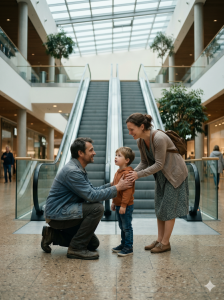
I grabbed him, pulled him back, freed his foot. He didn’t fall.
His mother rushed over, shaken.
“Thank you,” she said.
I nodded once. No crowd gathered. No phones lifted. No story formed around it.
I didn’t stay long enough for one.
“Just be careful,” I said quietly. “Escalators can be tricky.”
And I walked away.
Something inside me had shifted—not healed, not erased, but realigned. I wasn’t chasing redemption. I wasn’t performing survival. I was just acting when action was needed.
The past didn’t disappear. It never would.
But neither did the choice to do better, in whatever small, uncelebrated ways I still could.
And for the first time since everything began, that was enough.
