

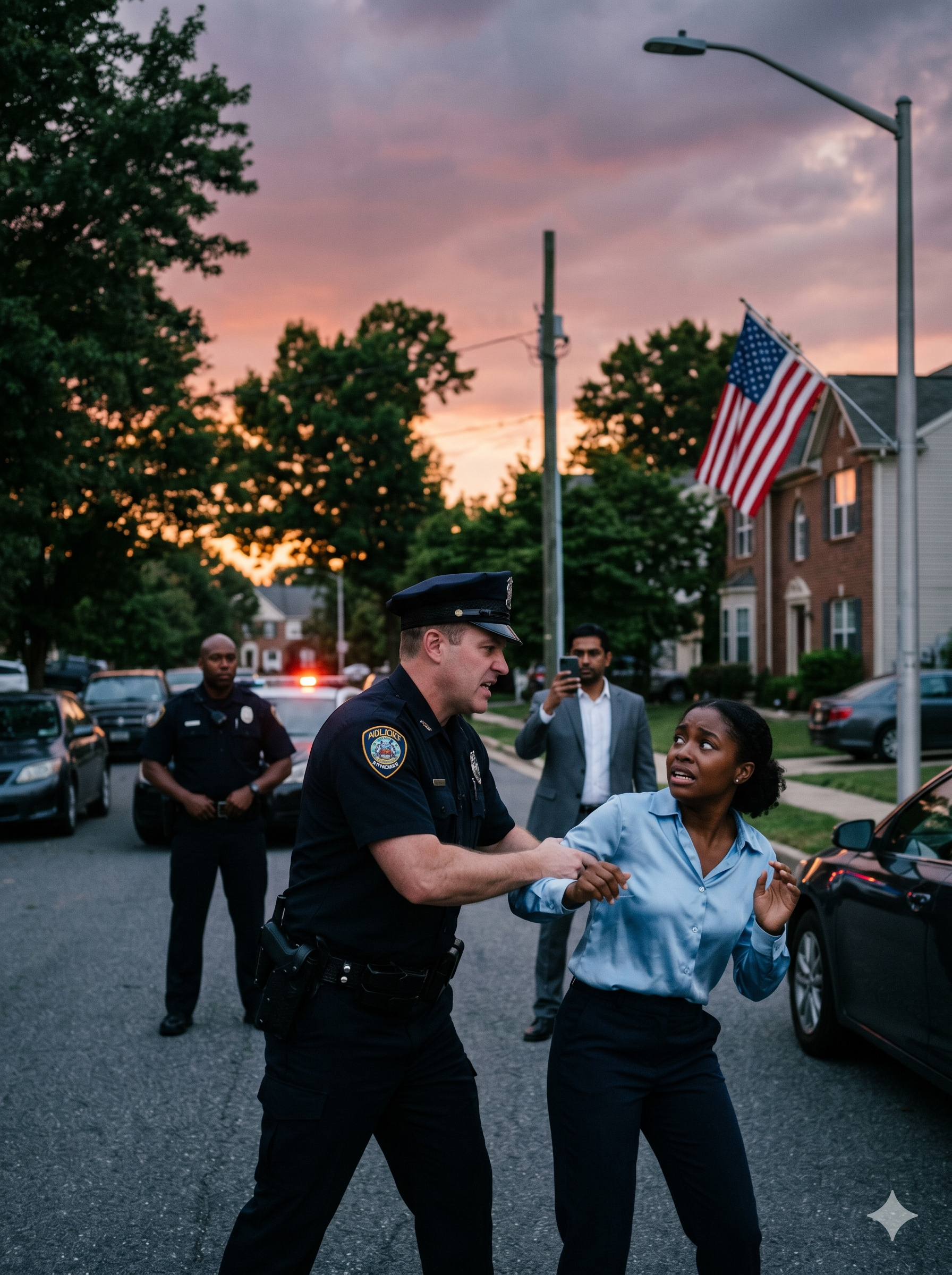
My pulse stayed steady, even as the red and blue lights forced me to pull over. I was only five blocks from my own courthouse. My name is Elaine Washington, and I’ve spent 20 years serving on the federal bench. I know the law thoroughly. Yet in that moment, behind the wheel of my black Mercedes, I was treated like any other suspect.
“Exit the vehicle now!” the voice sliced through the morning air, sharp with baseless accusation.
I watched him in my rearview mirror. Officer Brentwood approached with a rigid intensity, his hand planted on his h*lster as he closed in. He claimed my car had been reported stolen. The cruiser’s dashboard camera blinked red, quietly capturing what would soon become the most serious error of his career.
I moved carefully toward my purse to retrieve my identification. Brentwood instantly stiffened, his commands growing harsher. “I said don’t move!” he shouted, his grip tightening around his w*apon. I stopped, my federal judicial ID only halfway out of my bag.
Another cruiser arrived, its doors swinging open as backup stepped in for a threat that didn’t exist. Officer Reynolds exited, his approach far more hesitant. Traffic slowed as drivers turned their heads, and phones began to rise from car windows, recording everything.
“Officer, I’m simply retrieving my identification as requested,” I said, keeping my voice calm despite the surge of adrenaline. “I’m Judge Elaine Washington of the Federal District Court”.
Reynolds glanced between Brentwood and me, visibly uneasy. “Brentwood, maybe we should—” he began, but Brentwood cut him off, reaching for his radio. He called dispatch, requesting more units for a suspected stolen vehicle. What he didn’t know was that just a day earlier, I had issued a landmark ruling setting new standards for police conduct during traffic stops.
I counted silently to ten, thinking several steps ahead as the violations stacked up by the second. There was no reasonable suspicion, no proper verification—only escalation without justification.
“Ma’am, please exit the vehicle slowly,” Reynolds said, his tone notably calmer than his partner’s.
I complied, stepping onto the pavement in my silk blouse, holding myself upright despite their efforts to diminish me. My court credentials were visible in my hand, the federal seal catching the sunlight. I was expected at the courthouse in 20 minutes for a police misconduct hearing—the irony was impossible to ignore.
“Place your hands on the vehicle,” Brentwood ordered, disregarding the ID I held out. I pressed my palms against the warm surface of my car, maintaining my composure despite the humiliation. I repeated my name and title, articulating each word as he conducted an unnecessarily thorough pat-down. Brentwood scoffed, his breath hot against my neck, mocking me.
The metal glinted in the morning light as he removed his handc*ffs from his belt. The cold rings snapped shut around my wrists, the sound echoing like a gavel striking wood.
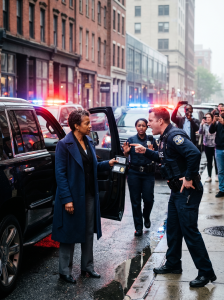
Across the street, I spotted a young Asian man in a tailored suit—Thomas Chen, my former clerk and now an assistant district attorney. He met my gaze, pulled out his phone, and began recording everything. He placed an urgent call, activating my crisis protocol and alerting the Chief Justice, the district attorney, and my judicial clerk.
Meanwhile, Reynolds searched my vehicle, locating my registration and insurance with my name clearly printed. He opened the trunk and suddenly froze. Inside were my judicial robes, neatly hung in a garment bag bearing the federal court seal.
“Anyone can buy a costume,” Brentwood dismissed coldly.
That was when I invoked my right to counsel, speaking clearly and loudly so the dashboard camera would capture every word. I was a federal judge, detained without cause—but the real judgment had yet to begin.
Part 2
The morning sun bore down relentlessly on the harsh asphalt, but the heat rising from the road was nothing compared to the slow, simmering anger building in my chest. There I stood—Judge Elaine Washington of the Federal District Court, a woman who had devoted thirty years to the American legal system—pressed against the side of my own vehicle, my wrists locked in rigid steel handc*ffs.
The weight of the moment felt suffocating. For decades, I had presided from the federal bench, hearing testimony, reviewing civil rights claims, and issuing rulings on the very constitutional protections now being torn apart before me. What had always been theoretical was now painfully real.
Without warning, the sharp crackle of Officer Brentwood’s shoulder radio shattered the silence. A new voice came through—deeper, controlled, and free of the frantic energy Brentwood carried.
“Unit 47, this is Lieutenant Foster. What’s your current situation with the traffic stop at Maple and Fifth?”
Brentwood adjusted his stance, a flash of irritation crossing his flushed face. “Standard stolen vehicle procedure, Lieutenant,” he snapped into the mic, never taking his eyes off me. “Suspect detained. Vehicle being searched.”
“Has identification been verified?”
The question lingered in the thick air, heavy with implication. Before Brentwood could respond with another distortion, the distant wail of sirens grew louder. A third cruiser turned the corner, tires gripping the road as it pulled up sharply behind the scene Brentwood had created.
The door opened, and Lieutenant Diane Foster stepped out. Even at a distance, her movements reflected years of experience—measured, observant, controlled. She didn’t rush. Her gaze swept across the scene—the gathering crowd filming on their phones, the open trunk of my Mercedes revealing my neatly hung judicial robes, and finally, me: a Black woman in professional attire, stripped of her freedom on a public street.
“I requested backup, not supervision,” Brentwood muttered under his breath, his jaw tight as Foster approached.
“And yet, here I am,” Foster replied calmly, her voice steady but firm with authority.
She walked past Brentwood without acknowledgment and approached me, maintaining a respectful, procedural distance. Her eyes met mine, and I caught the subtle widening of recognition. She knew who I was. I remembered her as well—from a community policing seminar I had led the previous year, where she had asked some of the most insightful questions about the Fourth Amendment.
“Ma’am, I’m Lieutenant Foster. May I ask your name?”
I straightened, refusing to let the weight of the cuffs define me. “Judge Elaine Washington, Federal District Court, Eastern Division,” I said, my voice steady and precise. “My identification is in my purse on the passenger seat, which I was attempting to retrieve when Officer Brentwood escalated the situation.”
Foster’s gaze sharpened as she turned. “Officer Reynolds, retrieve the purse.”
Reynolds, who had been lingering near the open trunk, hurried to comply. He brought the bag directly to Foster, carefully avoiding eye contact with Brentwood.
“Judge, do I have your permission to open your purse and verify your identification?” Foster asked, her strict adherence to protocol standing in stark contrast to Brentwood’s recklessness.
“You have my consent,” I replied.
She unzipped the bag, removed my wallet, and examined my federal judicial credentials alongside my driver’s license. The gold seal of the United States judiciary caught the light. She didn’t hesitate.
“Officers, remove these restraints immediately,” Foster ordered. It was not a suggestion.
“Lieutenant, this vehicle matches the description—” Brentwood started, his voice rising.
“Remove the restraints, officer. Now.” Her command cut him off cleanly.
A murmur spread through the crowd as Reynolds stepped forward. His hands trembled slightly as he unlocked the cuffs. “I am so sorry, your honor,” he whispered as the metal released from my wrists. I rubbed the deep marks left behind and met Brentwood’s eyes. He stood rigid, breathing heavily, his expression hardened with defiance.
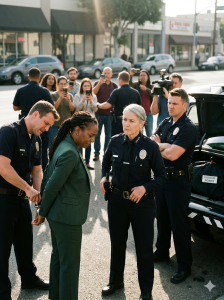
“This department is making a mistake,” he snapped.
“No, Officer Brentwood,” I said, stepping toward him, my voice low and controlled. “You’ve made several mistakes this morning. And now, you’re about to face the consequences.”
Across the street, Thomas Chen lowered his phone and gave me a brief, confident nod. The machinery of justice had just been forcefully set into motion.
Foster gestured toward her cruiser. “Please come this way, Judge Washington. I’d like to speak with you privately.”
She instructed Reynolds to document everything and directed Brentwood to remain on scene, effectively separating him from what would follow. As I settled into the back of her vehicle, the cool air offered momentary relief, but my thoughts were already moving ahead. I informed her I was scheduled to preside over Hernandez v. Metropolitan Police Department—a major civil rights case addressing systemic misconduct during traffic stops. The irony was unmistakable.
“I’m familiar with the case, your honor,” Foster said quietly, meeting my eyes in the mirror. “I believe we have a serious situation developing. I need to take you to the central precinct to fully document this.”
I agreed, but first made one carefully recorded phone call. From the back seat, I contacted my clerk, Marcus, formally notifying the Chief Justice of my detention and requesting that Thomas Chen bring the Hernandez case files to the precinct. I was no longer just the subject of a wrongful stop—I was a federal judge gathering evidence.
When we arrived at the central precinct, the building buzzed with the usual morning chaos. But as Foster escorted me inside, the noise quickly faded. Conversations stopped mid-sentence as officers turned to watch a federal judge being led through their doors.
Instead of processing, she guided me into a glass-walled conference room overlooking the bullpen. After briefly stepping out to retrieve dispatch logs, she left me alone to observe the rising tension outside. I saw Brentwood enter moments later, his confidence strained, heading straight for the Chief’s office.
Foster returned shortly after, her expression serious. She slid a department tablet across the table.
“Judge, I’ve retrieved the full dispatch record,” she said quietly. “There are inconsistencies we need to review.”
I studied the screen. The original report came in at 8:17 AM: a stolen black BMW 5 Series, partial plate JKW.
I drove a Mercedes S-Class, plate ending in RHT. Not even close. But that wasn’t the worst part.
Foster swiped again, revealing timestamped communications. “Officer Brentwood ran your plate at 9:14 AM. Dispatch immediately confirmed your vehicle was clear. Not flagged.”
A chill replaced the earlier heat. “Yet he detained me anyway,” I said, the implications settling into place.
“Yes,” Foster confirmed. “He requested backup for a ‘confirmed stolen vehicle’ after dispatch had already cleared your plate.”
This wasn’t an error. It wasn’t misidentification. It was a deliberate escalation—a targeted act.
Before we could go further, the conference room door opened. Chief of Police Martinez entered, his expression carefully arranged with practiced concern. A man of optics, now facing a public relations disaster.
“Judge Washington, I’ve just been briefed,” he began smoothly. “I want to personally apologize for any inconvenience. We can have you at the courthouse within fifteen minutes.”
I remained seated, letting silence stretch.
“This is far more than an inconvenience, Chief Martinez,” I replied, my voice firm. “This is a documented violation of my Fourth Amendment rights by officers under your command—officers who ignored dispatcher confirmation before placing me in restraints.”
Martinez’s composure faltered as he looked toward Foster. “The dispatcher confirmed the vehicle wasn’t stolen before escalation?”
“Lieutenant Foster has the full record,” I said.
Foster nodded. The realization hit him immediately—this was no minor mistake. Brentwood had broken procedure and misrepresented the facts.
“I’ll have Internal Affairs begin an immediate investigation,” Martinez said, attempting to regain control. “We handle our own.”
“That will not be sufficient, Chief,” I responded, placing my federal judicial emblem on the table between us. “This incident will be documented fully—not only for my case, but because it reflects the exact pattern alleged in Hernandez v. Metropolitan Police Department.”
Martinez swallowed. “I understand, Judge.”
“Do you?” I pressed. “Because Officer Brentwood’s actions may have just provided the evidence needed to place your entire department under federal oversight.”
At that moment, the door opened again. Thomas Chen stepped inside.
He moved with quiet authority, his tailored suit impeccable, a leather briefcase in hand. The room stilled as he entered, bypassing protocol without hesitation.
“Judge Washington,” he said formally, his focus sharp.
“Mr. Chen. Status?”
“The Chief Justice has convened an emergency judicial council meeting,” he announced. “And I’ve brought the documentation you requested.”
He opened his briefcase and removed a freshly issued legal document, handing it directly to Chief Martinez.
“Chief,” Chen said evenly, “this is a federal court order signed by the Chief Justice. It mandates the immediate preservation of all evidence related to this incident—Officer Brentwood’s records, all communications, and all station footage.”
Martinez stared at it, the color draining from his face. Any hope of quietly containing the situation vanished instantly.
“This matter is no longer under your sole jurisdiction, Chief,” I said, rising to my feet. “It is now a federal case.”
Outside the glass, urgency erupted—phones ringing, legal counsel rushing across the bullpen. The precinct had transformed into the center of a legal crisis.
I looked at Thomas, then at Lieutenant Foster, who stood firm—aligned with the Constitution above all else.
“Lieutenant,” I said calmly, “prepare the interview rooms. I want to speak with Officer Reynolds first… and then Officer Brentwood. Separately.”
The real proceedings weren’t going to begin in a courtroom. They were going to start right here.
Part 3
The federal courthouse stood before us like a marble sentinel beneath the midday sky. After the suffocating tension at the precinct, its towering architecture felt like a bastion of reason. But the chaos of the morning had already arrived ahead of us. As Thomas Chen skillfully guided my car toward the secured rear entrance, I saw news vans crowding the plaza. The media had caught wind of the story, reporters positioning themselves for what they clearly sensed would be a historic legal shockwave.
I entered through the private judicial chambers entrance, intentionally avoiding the press gathered at the front steps. The shift from blinding sunlight into the cool, dim corridors mirrored the transformation taking place within me. Chief Justice Rodriguez was waiting in the private hallway. His usual composed expression had been replaced by unmistakable concern.
“Elaine, this is unprecedented,” Rodriguez said quietly, resting a steady hand on my shoulder. “Are you certain you want to proceed today?”.
I slipped off my coat, feeling the lingering ache in my wrists where the steel had pressed into my skin just hours earlier. “Absolutely certain,” I replied without hesitation. “The Hernandez case and this morning’s incident are now inextricably linked”.
Rodriguez nodded solemnly, fully grasping the weight of the overlap between my personal violation and the systemic civil rights case I was already set to oversee. “The courtroom is at capacity,” he added, lowering his voice. “Every law enforcement official in the city seems to be present”.
“Good,” I said firmly. “This needs witnesses”.
I stepped into my private robing room, a space I had relied on for two decades. The silence was absolute. I reached for my judicial robes—the same garments Officer Brentwood had dismissed as nothing more than a costume on the roadside. As I put them on, the weight of the fabric settled across my shoulders with familiar authority. This was no costume; it was the embodiment of the Constitution itself, a shield forged by the rule of law. I adjusted the white collar in the mirror, the contrast stark against the black fabric. Twenty years on the bench had prepared me for moments like this—when the law must stand unshaken against those who abuse power.
“Judge,” Thomas Chen’s voice came from the doorway. “Everyone’s assembled. Chief Martinez is here with department counsel.” He adjusted his glasses. “Officers Brentwood and Reynolds are present with union representatives, and Lieutenant Foster has taken her seat”.
“And our evidence?” I asked steadily.
“Prepared and organized,” Chen confirmed, tapping the secure tablet in his hand. “Sequential and comprehensive”.
I drew in one final breath, centering myself. “Then let’s proceed,” I said, stepping toward the heavy oak courtroom doors.
The bailiff’s voice echoed the moment I entered. “All rise! The United States District Court for the Eastern District is now in session. The Honorable Judge Elaine Washington presiding”.
The packed courtroom rose as one. I scanned the room as I ascended to the bench and took my seat. The balance of power had completely shifted since that morning. Chief Martinez sat stiffly with his legal team. Behind him, Officers Brentwood and Reynolds looked tense and drawn. Across the aisle, Lieutenant Foster sat alone, her posture straight, her focus unwavering.
“Be seated,” I instructed, my voice carrying across the chamber. I placed my hands on the bench, leaning forward slightly. “This court now addresses the consolidated matters of Hernandez versus Metropolitan Police Department and the incident involving this judge earlier today”.
A heavy silence settled over the room. I turned my attention to the defense table. “For those unfamiliar with federal procedure, I will explain my decision to preside over this matter despite personal involvement,” I stated. “Judicial rules permit this when the integrity of the court itself is at issue”.
I allowed the statement to sink in. This was not personal retaliation—it was lawful authority. “Moreover,” I continued, projecting my voice, “my military and judicial background uniquely qualify me to assess the constitutional implications of these events”.
I nodded to Chen. Instantly, the courtroom screens illuminated with my military record.
“Before my appointment, I served eight years in military intelligence with the United States Army, reaching the rank of Major,” I explained, watching Brentwood’s expression begin to falter. “I graduated first in my class from West Point, specialized in counterintelligence, and served as legal counsel within the Judge Advocate General’s Corps”.
The screens shifted to my legal career. “Following my service, I graduated Summa Cum Laude from Harvard Law, clerked for the Supreme Court, and have served on this bench for twenty years,” I continued. “I currently chair the Judicial Conduct Committee for this district”.
I paused, letting the weight of those credentials settle across the room. Brentwood shifted in his seat, the realization of his actions finally catching up to him.
“This morning’s incident offers a rare opportunity to evaluate police conduct through direct evidence,” I said. “Mr. Chen, proceed with Exhibit One”.
The courtroom fell silent as the dashboard footage played. The video showed the entire stop—from Brentwood’s aggressive approach to my removal from the vehicle. His commands echoed through the speakers, contrasted against my calm identification.
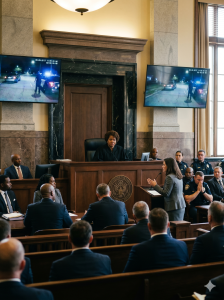
“Note the timestamp,” I directed, pointing toward the screen. “At 9:12 AM, dispatch clearly states my vehicle is not the stolen BMW”. The dispatcher’s voice confirmed it. “Seventeen seconds later, Officer Brentwood requests backup for a ‘confirmed stolen vehicle’”.
At the defense table, attorneys exchanged uneasy looks. The contradiction was undeniable.
“Exhibit Two,” Chen announced.
Bystander videos appeared from multiple angles, capturing the escalation in full detail.
“These recordings were provided by seven witnesses,” I explained. “They corroborate the official footage and provide additional perspectives”.
In the gallery, Brentwood’s representative leaned in, whispering urgently. Brentwood’s earlier confidence had vanished.
“Exhibit Three,” I continued. “Dispatch audio logs”.
The recording played clearly: confirmation of my vehicle, followed immediately by Brentwood’s false report. The inconsistency hung in the air, impossible to defend.
“Exhibit Four,” I said, my tone sharpening. “Officer Brentwood’s personnel file”.
The redacted document appeared, key sections highlighted. “Twelve civilian complaints in three years,” I read aloud. “All alleging improper stops, excessive force, or unlawful searches”.
I looked toward Martinez. “All dismissed for lack of evidence”. I paused briefly. “Yet in nine cases, dispatch had already cleared the individuals before detention occurred”.
The defense team began scrambling to take notes. This was no isolated incident—it was a pattern.
“Exhibit Five,” I continued. “Security footage from this courthouse, two weeks prior”.
The video showed Brentwood, off duty, outside the private entrance—following me and photographing my vehicle.
“He was not assigned here,” I stated. “No official business justified his presence”.
I fixed my gaze on him. “Officer, would you care to explain your off-duty surveillance of a federal judge?”.
He opened his mouth, but his representative stopped him before he could speak.
“Then allow me to clarify further,” I said evenly. “Exhibit Six”.
A spreadsheet of phone records appeared.
“These records show repeated contact between Officer Brentwood and Roger Simmons,” I explained. “The defendant in last month’s police brutality case over which I presided”.
A wave of murmurs spread across the courtroom.
“Mr. Simmons was found liable for 3.2 million dollars in damages,” I continued. “The timing of these calls—before and after that ruling, and again last night—suggests coordinated retaliation beyond a single officer’s actions”.
This was no longer a simple violation—it was an organized attempt to intimidate the judiciary.
I turned toward the witness section. “Lieutenant Foster”.
She stood immediately.
“Based on your experience and the evidence presented, were Officer Brentwood’s actions consistent with department policy?”.
Foster glanced briefly at Brentwood, then Martinez, before answering firmly.
“No, your honor. His actions violated multiple departmental protocols and, in my professional assessment, constitutional protections against unreasonable search and seizure”.
“Thank you,” I said. “Your statement is entered into the record”.
I lifted the thick folder containing Brentwood’s file and let it fall onto the bench with a heavy, echoing thud.
The case had been laid out completely. The evidence was undeniable.
Now, it was time to deliver judgment.
Part 4
The thick manila folder containing Officer Brentwood’s personnel file rested on the polished mahogany bench like a dormant expl*sive. I allowed the silence in the courtroom to stretch, heavy and unbroken, before finally speaking.
“This court now faces a critical question,” I began, my voice cutting cleanly through the tension. “Was this morning’s incident an isolated abuse of authority, or does it reflect a broader systemic failure within the Metropolitan Police Department?”.
My gaze moved across the packed gallery, settling briefly on the central figures: Chief Martinez, whose political future hung in the balance, and Officer Brentwood, whose earlier arrogance had collapsed into visible fear.
“The Hernandez case alleges that minority drivers are disproportionately subjected to stops, searches, and detentions—even when dispatch clears their vehicles, even when proper identification is provided, and even when no reasonable suspicion exists,” I stated, leaning forward slightly. “My experience this morning demonstrated precisely the pattern described in that complaint”.
The defense table remained motionless. The evidence presented had gone beyond persuasive—it was definitive. I straightened, my decision fully formed.
“This court finds sufficient evidence to expand the Hernandez inquiry into a comprehensive, department-wide review under strict federal oversight,” I declared.
Chief Martinez rose instinctively to object, panic flashing across his face, but I lifted a single hand and silenced him immediately. “The Department of Justice will appoint independent monitors to oversee all operations of the Metropolitan Police Department for a period of no less than three years,” I continued. A wave of shock rippled through the gallery. “Additionally, all traffic stop data will be subjected to independent analysis for pattern and practice violations”.
I turned my focus toward the officers seated behind the defense table. “Regarding the constitutional violations committed against this court this morning, I am recusing myself from those determinations,” I said, ensuring the integrity of the process remained beyond challenge. “Those matters will be referred to Judge Williams in the Western District for further proceedings”.
I lifted the final affidavit and read it into the record with measured clarity. “This court retains jurisdiction over the implementation of these reforms and requires mandatory quarterly progress reports. The first report is due in ninety days”.
Reaching for the gavel, I tightened my grip. “Officer Brentwood is suspended immediately pending termination proceedings,” I ordered, noting his representative’s visible defeat. “Officer Reynolds is placed on administrative leave pending further review”.
The gavel struck with decisive finality.
“This court is adjourned until tomorrow at 9:00 AM, when we will begin structuring the oversight framework”.
As I rose, the courtroom remained standing in stunned silence. Beyond the doors, cameras were already capturing the moment justice reasserted itself—not through chaos or vengeance, but through the disciplined force of constitutional law.
Six months later, the memory of that morning had given way to the structured rhythm of reform. Inside the police academy auditorium, new recruits filled the seats, their voices low with anticipation. On their laps rested training manuals titled “Constitutional Policing: Rights, Responsibilities, and Reform.”
I stood at the podium, no longer in judicial robes but in a tailored charcoal suit. Behind me, the projector displayed not theory, but reality—the timestamped footage of my own unlawful stop, now required viewing for every cadet.
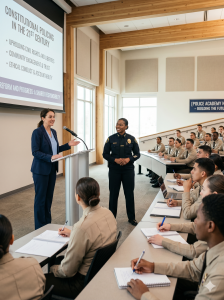
“Your badge grants you immense authority,” I told them, my voice steady. “But authority without accountability becomes tyranny”.
The rear doors opened, and Lieutenant Foster—now Captain Foster—entered with composed confidence. Her new rank reflected more than promotion; it marked trust earned through principle. She took her place beside the stage, representing the department’s newly formed Accountability Division.
“Six months ago, a routine stop exposed serious systemic failures,” I continued. “Today, we examine the changes that followed”.
I advanced the slide. Data filled the screen. “Civilian complaints have decreased by forty-seven percent. Unlawful detentions have dropped by sixty-two percent”. Trust, once eroded, was steadily rebuilding.
“Change is difficult,” I acknowledged. “But necessary reform produces justice—not only for citizens, but for officers committed to doing their duty with integrity”.
In the front row, Chief Martinez sat quietly. His earlier defensiveness had been replaced by humility. What he once saw as punishment had become an opportunity for transformation.
“The incident that triggered these reforms was not isolated,” I explained. “It reflected a deeper pattern that undermined constitutional protections and public trust”.
The next slide appeared—Officer Brentwood’s termination notice alongside his federal indictment. His actions had led him into the very system he once disregarded.
“However, Officer Reynolds chose a different path,” I said, shifting the display. “By acknowledging his failure and committing to reform, he demonstrated the system’s capacity for accountability and growth”.
Reynolds now worked with Captain Foster, helping train others on intervention and ethical responsibility. His testimony had been critical in securing the federal case.
“The strength of our justice system lies not in perfection, but in its ability to correct itself,” I told the cadets. “When we confront failure, we create the opportunity for progress”.
I stepped aside, gesturing for Foster to speak.
“Six months ago, I faced a choice,” she told them, her voice firm. “Protect a colleague—or uphold the Constitution. I chose the Constitution. And you will face similar choices every day”.
The cadets listened closely, many taking notes. This was not theory—it was lived reality.
“The same camera that recorded misconduct also protects those who act with integrity,” I added. “Transparency is not a threat. It is a safeguard”.
I shifted to national data showing similar reforms across other departments. Those embracing accountability improved safety and trust. Those resisting faced lawsuits and declining support.
“Constitutional policing is not only required—it is effective,” I emphasized. “Communities that trust law enforcement cooperate. That cooperation saves lives”.
As the session concluded, questions followed—thoughtful, engaged, sincere. The future of the profession sat before me, listening carefully.
“When I was detained six months ago, I had a choice,” I told them in closing. “Seek personal vindication—or pursue systemic reform. I chose reform because real justice transforms institutions, not just individuals”.
I looked across the room one final time. “You will soon hold power over the rights of others. Use it with restraint, judgment, and unwavering respect for the Constitution”.
The auditorium filled with applause. Outside, reporters waited to document the department’s progress—a model now being studied nationwide.
Later that day, I returned to the federal bench. A new case file awaited me. The courtroom looked unchanged, yet everything beneath the surface had shifted.
Security officers stood with renewed professionalism. Sunlight streamed through the tall windows, illuminating the scales of justice mounted behind the bench. Balance had been restored—not through retaliation, but through accountability.
I thought briefly of Brentwood, now facing trial within the system he had violated. His case was not vengeance—it was affirmation that no one stands above the law.
I opened the file before me. Another case. Another challenge. The work of justice never ends.
The bailiff called the court to order.
I adjusted my robes, lifted the gavel, and brought it down with a clear, resonant strike.
“This court is now in session,” I declared, my voice steady and resolute, carrying the enduring promise of equal justice under the law.
