

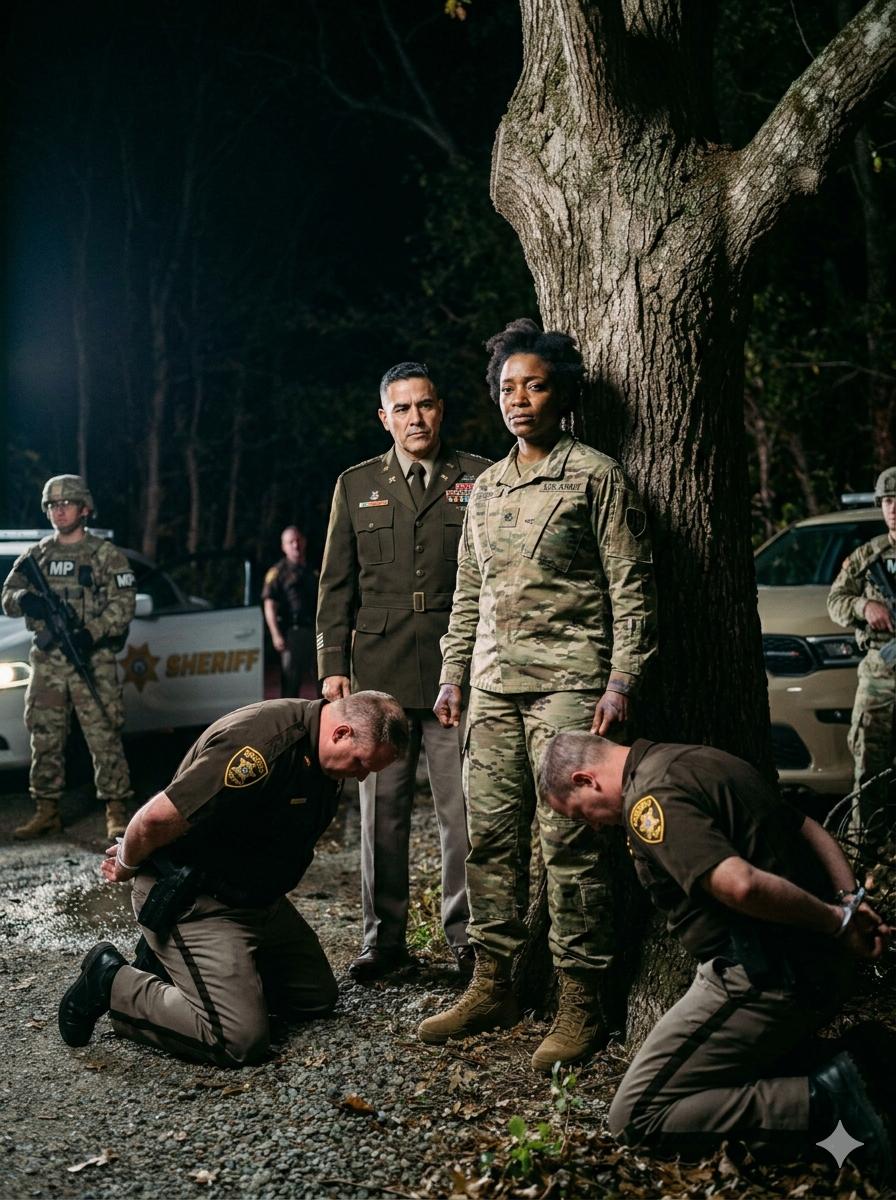
I have spent twenty-six years serving in the United States Army, and over that time, I’ve learned one lesson more deeply than any battlefield strategy: danger seldom reveals itself truthfully. At times, it arrives as artillery fire—but other times, it shows up as flashing blue lights on a deserted road outside the town of Briar Glen.
I was driving alone back to Fort Ashby after a late-night security briefing. My assigned driver had been reassigned earlier that day, and instead of waiting for a replacement convoy, I decided to make the trip myself. It should have been straightforward—ninety minutes of darkness, pine-lined roads, and silence.
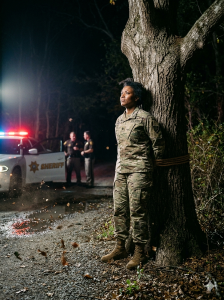
Then the patrol lights appeared in my rearview mirror.
I immediately checked my speed. Five under the limit. Still, I pulled over to the shoulder, steady and alert. Two deputies approached, one on each side of the vehicle. The first was tall, broad-shouldered, and pale-haired.
I lowered my window. When his flashlight hit my face, I saw his jaw tense. He wasn’t just seeing a driver; he was seeing a Black woman alone at night on his road.
“License and registration,” he demanded.
I handed them over, along with my military ID. “Is there a reason I was stopped, Deputy?”
He glanced at the ID, then back at me, looking me up and down with a cold, familiar contempt I’ve faced my entire life. His expression twisted into a mocking grin.
“You a general?” he laughed, shaking his head. “They just handing out stars to people like you these days?”
“Yes,” I replied, my voice even.
The older deputy, Pike, leaned toward the open passenger window. He held my military ID between two fingers as if it were something filthy. “Step out of the vehicle.”
“I would like to know the reason for this stop.”
“Step out,” he snapped, his voice thick with venom. “You people think you can just put on a uniform and do whatever you want. Not out here.”
So I stepped out into the freezing air. I stood upright, shoulders squared. The taller deputy circled behind me while Pike stared as though my very presence—and my rank—offended him.
“If this stop is legitimate, call your supervisor. Now,” I said.
That was when everything shifted. Without warning, the tall deputy moved behind me. Pike grabbed my wrist. I turned instinctively to keep my balance, but that motion was all the excuse they needed. They slammed me against the SUV. A zip tie tightened around one wrist, then the other. Gravel tore through my slacks as they forced me down into the dirt.
I didn’t scream. I didn’t beg. I focused on breathing. They dragged me twenty feet off the road to a wide oak tree near the ditch. This wasn’t just an arrest—it was a deliberate, deeply historical humiliation. They tied a Black woman to a tree in the middle of the night, leaving me in the cold, believing my rank meant nothing against their local authority.
But they had no idea who they were dealing with. And they didn’t know my command center was already tracking my vehicle…
Part 2: The Arrival
The coarse bark of the Georgia oak tree dug into my spine, its jagged ridges pressing through the thin fabric of my civilian travel coat. The freezing night air showed no mercy as it swept across the dark, deserted stretch of County Road 9, carrying with it the damp, bitter scent of pine and soaked earth.
My wrists were bound behind the thick trunk, cinched tight with heavy-duty zip ties that bit deeper into my skin with every shallow breath. I could still feel the sting of gravel scraping my cheek—a final mark left behind when Deputy Mercer and Sergeant Pike had forced me into the dirt.
I didn’t scream. I didn’t beg.
In my twenty-six years serving in the United States Army, I have been deployed to combat zones that would make men like them crumble. I have sat in command tents while artillery fire rattled the ground beneath me, and I have faced hostile forces in places where the rule of law did not exist.
I was trained to endure. I was trained to lead.
Yet standing there in the freezing darkness, tied to a tree in my own country like a fugitive, the danger felt disturbingly different. This wasn’t war. This was something older. Something deliberate.
This was humiliation.
It was a message.
They looked at my government-issued SUV, my military ID, and the four stars I had earned through decades of sacrifice and flawless service. And what did they see? A Black woman alone in the dark. Someone they believed they could break.
About twenty feet away, near the roadside, the two deputies leaned casually against the hood of my idling SUV. The red and blue lights from their cruiser washed over everything in slow, pulsing waves, stretching long, warped shadows across the thick line of trees.
They were proud of what they had done.
“Did you see her face?” Sergeant Nolan Pike chuckled, his voice cutting cleanly through the cold air. He struck a match, the brief flame lighting up his broad, self-satisfied expression as he brought a cigarette to life. “Thought she could just flash that little plastic ID and tell me what to do. Out here on my road.”
Deputy Cole Mercer, younger and taller, let out an uneasy laugh. He paced back and forth, his boots crunching against the loose gravel. “I don’t know, Sarge. She’s a full bird… no, a general. An actual general. You sure the Sheriff’s going to cover this? We just laid hands on a high-ranking military officer.”
“Relax, Mercer,” Pike muttered, taking a long drag before exhaling a thick stream of smoke into the frigid air. “She ain’t a general out here. Look at her. Just another one of them thinking they can step out of line because the government handed ’em a title. The Sheriff knows exactly what he’s doing.”
I closed my eyes and focused on my breathing. In through the nose, out through the mouth. Four seconds in, four seconds held, four seconds out. The steady rhythm kept my heart under control, preventing adrenaline from clouding my mind.
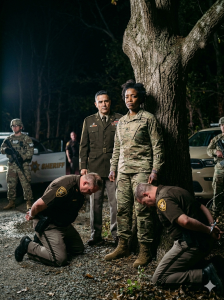
I was taking in everything.
I memorized the tone of Pike’s smug, drawn-out voice. I noted the restless, uneven pacing in Mercer’s steps. I listened to the specific radio frequencies crackling from their cruiser. I registered the smell of burning tobacco, the faint warmth radiating from my SUV’s engine.
“We were told to keep her off the main route,” Pike went on, leaning against my vehicle, arms folded across his chest. “Told to make it messy if she started asking questions. Well, she asked. So we made it messy. By the time we cut her loose, she’ll be too shaken—and too embarrassed—to remember what the hell she was even looking for.”
“Yeah,” Mercer replied quietly, though doubt lingered in his voice. He kept glancing down the empty, pitch-black road. “Just hold her until the route clears. That’s what Hollis said.”
“Exactly,” Pike sneered, turning his gaze toward the darkness where I stood restrained. He raised his voice so every word carried clearly. “You hear that, General? You military folks think you run the world. Think you can just walk through our county and look down on us. But out here, I’m the law. Not Washington. Not the Army. Me.”
He was drunk on his own sense of authority—a brittle, pitiful kind of power rooted in the kind of bigotry that needs a badge and a gun to feel courageous. He needed me diminished so he could feel elevated. He needed me to be a helpless Black woman bound to a tree, not a commanding officer who could end his entire career with a single call.
Cars passed from time to time along the highway. I watched their headlights sweep across the pavement. One civilian vehicle even slowed, the driver leaning out, trying to make sense of what was happening near the ditch.
Pike didn’t react. He simply stepped forward and waved his flashlight with casual authority. “Routine stop, folks! Move it along! Keep moving!” he shouted.
The car accelerated and vanished into the darkness. No help was coming. To anyone passing by, this looked like routine police work.
But I knew better. The clock was already running.
I shifted slightly against the tree, testing the zip ties at my wrists. They held tight, and the small movement sent a sharp surge of pins and needles through my forearms as circulation struggled. I ignored it. Pain was data. Information. And right now, that information told me to remain still and wait.
They had no idea about the vehicle.
My government-issued SUV wasn’t just a standard fleet unit. It was a mobile command platform, equipped with encrypted, military-grade communications and automated distress protocols. The moment I deviated from my approved route, it logged the change. The moment I was forcibly removed and failed to respond to encrypted check-ins, it did more than alert—it triggered a Priority One escalation directly to the operations center at Fort Ashby.
My deputy commander, Colonel Mason Cole, was not a man who believed in coincidence. I knew exactly what was happening back at base. The instant my signal dropped, Mason would have locked down the operations floor. I could almost hear him: “Get me her location. Now. We are not waiting.”
Back on the dark roadside, a burst of static crackled from the radio on Mercer’s shoulder.
“Unit Four, this is Dispatch. Sheriff Hollis is requesting a status update on that… traffic delay.”
Mercer grabbed his mic, his fingers slightly unsteady. “Unit Four to Dispatch. The, uh, the message was delivered. We’re securing the area. Standing by.”
He released the button and looked toward Pike. “He wants to know if we’re clear.”
“Tell him we’re fine,” Pike said with a dismissive glance. “Tell him she’s cooperating.”
He laughed again, a harsh, grating sound echoing through the trees. Then he stepped closer, aiming his heavy flashlight directly into my eyes, blinding me for a moment.
“You comfortable over there, General?” he taunted, every word laced with contempt. “Maybe next time you’ll stay on the highway where you belong. We don’t like people poking around where they’re not wanted.”
I kept my eyes open, staring straight into the glare. I didn’t flinch. I didn’t look away. My silence carried more weight than anything he could say.
“Not so talkative now, are we?” Pike sneered, taking another step. “Yeah, that’s what I thought. You people always have plenty to say until reality shuts you up.”
Then it happened.
It began not as a sound, but as a vibration.
A low, steady tremor beneath my boots. Subtle at first, nearly lost beneath the wind in the trees—but I recognized it. I had felt it in desert deployments. I had felt it on training grounds back home.
It was the unmistakable rumble of heavy military diesel engines moving at speed.
Mercer stopped pacing. He tilted his head, frowning. “Sarge… you hear that?”
Pike paused, lowering his flashlight. The forest fell into an eerie quiet, broken only by the growing vibration. It wasn’t sirens. It wasn’t local backup. It sounded like distant thunder rolling closer, heavy and unavoidable.
Then the silence shattered—the sharp ringtone of Mercer’s personal phone cutting through the night.
He flinched, startled, and quickly pulled it from his vest. He glanced at the caller ID, and even in the flickering patrol lights, I saw the color drain from his face. He looked like he’d seen a ghost.
“It… it’s the Sheriff,” Mercer stammered, his voice cracking.
“Well, answer it,” Pike snapped, though his posture had stiffened.
Mercer swiped the screen and lifted the phone. “Sheriff? Yeah, we have her. We’re on County 9, near the old—”
He stopped. Completely still. Not speaking. Not breathing.
I watched his eyes widen with pure, unfiltered fear. He swallowed hard. “What do you mean they know? How could they—”
He listened for a few seconds more. His hand began to tremble uncontrollably.
“Okay. Okay, we’re—” The call dropped.
Mercer slowly lowered the phone. He didn’t look at Pike. Instead, he turned toward the darkness, staring straight in my direction.
Pike frowned, his hand drifting toward his weapon. “What? What did he say?”
Mercer opened his mouth, but no sound came at first. He licked his lips and tried again.
“They… they found her signal,” he whispered, his voice barely holding together.
Pike’s expression cracked. He took a step back, his confidence faltering. “Who? Who found her signal?”
Mercer lifted a shaking hand and pointed toward the dark horizon, where the distant rumble was rapidly building into a deafening roar.
“The Army,” he choked.
For the first time all night, I moved. I straightened, pressing my shoulders back against the rough bark. The cold no longer mattered. The pain in my wrists faded into nothing. I met their eyes, steady and unyielding, and let the full weight of my rank, my history, and my authority fill my voice—sharp enough to cut through the frozen air and strike them where they stood.
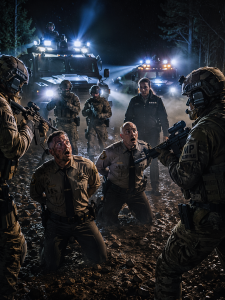
“You had one chance to keep this a traffic stop,” I said, my voice carrying through the sudden, fear-filled silence between them. “Now… it’s something else.”
Before Pike could even register what I meant, the tree line erupted in light.
Through the thick pines, a blinding flood of blue-and-white tactical beams tore through the darkness like blades. The low vibration in the ground surged into something overwhelming—something you could feel in your bones.
The first vehicle didn’t simply arrive—it took over the scene.
A massive, matte-green Army tactical truck burst into view, a machine of armor and raw power, moving fast enough to send clouds of dust, gravel, and pine needles spiraling into the air as it veered off the county road onto the soft shoulder. Its sheer scale dwarfed the deputies’ cruiser.
Right behind it, in flawless formation, came two sleek black armored SUVs. A second tactical transport followed, and close behind, three fully marked Military Police vehicles cut through the night, their roof lights flashing in sharp, blinding white.
The quiet roadside was transformed in seconds.
In less than twenty seconds, the area filled with roaring engines, the screech of brakes, the heavy impact of boots hitting pavement, and the sharp, commanding voices of soldiers taking control.
This was not a local response. There was no confusion, no shouting over one another, no hesitation. It was precise, controlled, overwhelming force.
Military Police officers, fully equipped and armed, poured from the lead vehicles. They didn’t rush blindly—they moved with practiced precision, spreading out instantly to form a tight perimeter that boxed in the deputies and their patrol car completely.
The contrast was immediate—and brutal.
Deputy Cole Mercer, who had mocked my rank minutes earlier, stumbled backward so quickly he nearly fell into the ditch. His hands shot into the air, his face drained of all color.
Sergeant Nolan Pike, however, was still clinging to his pride.
His hand twitched toward his duty belt.
He never made it.
“Hands where I can see them!” an MP captain barked, his voice cutting cleanly through the chaos.
Mercer obeyed instantly, dropping to his knees, fingers locked behind his head.
Pike froze, his hand hovering mid-motion. He tried to speak, grasping for authority that no longer existed. “Now you wait just a damn minute, you have no right to—”
He never finished.
Three armed MPs closed in with rapid precision. A second later, Pike was face-down in the freezing gravel—the same gravel he had forced me into not long before. A heavy knee pinned him in place as his wrists were secured behind his back.
“I said hands where I can see them!” the captain repeated, stepping past him without pause.
The door of the second armored SUV opened before the vehicle had fully stopped.
Colonel Mason Cole stepped out into the flood of tactical light.
Mason was a man of discipline and control—precise, loyal, and unwaveringly protective of his command. He wore only his standard duty uniform, but his presence alone carried more authority than the armed soldiers around him.
He didn’t look at the deputies.
He didn’t acknowledge the patrol lights.
His eyes scanned the scene once—sharp, deliberate.
Then he saw me.
A four-star general, bound to a roadside tree with plastic restraints like a criminal.
I saw his jaw tighten. The anger he carried didn’t flare—it froze, turning into something colder, sharper, more absolute.
He walked past the struggling Sergeant Pike without a glance. He ignored Mercer entirely. His focus never left me.
Stopping a few feet from the two deputies on the ground, he spoke—calm, controlled, and final.
“Secure both deputies.”
“You can’t do this!” Pike shouted, thrashing uselessly against the MPs, his face grinding into the dirt. “You can’t just roll into county jurisdiction and do whatever you want! We are local law enforcement!”
No one responded.
No one needed to.
His badge meant nothing here.
Mercer, seeing Pike subdued in seconds, stopped resisting entirely. His head hung low, his body trembling in the cold.
Mason stepped across the ditch, boots crunching over dry leaves and pine needles, and came to a stop directly in front of me.
For a brief instant, the entire massive, chaotic operation—the rumble of diesel engines, the flashing blue-and-white lights, the shouts of MPs, the sobbing deputies—collapsed into a single, focused moment.
Me, standing upright against a tree, breathing steadily in the freezing Georgia night. And my deputy commander in front of me, absorbing the weight of the historical and professional insult inflicted on his commanding officer.
His gaze moved to my wrists, bound tightly behind the trunk. Then to the dirt on my clothes. Then to the bloodied scrape on my cheek.
“Ma’am,” Mason said quietly, his voice strained with contained anger.
I met his eyes without hesitation. My voice did not waver. The cold didn’t show. I spoke with the composure of someone who had endured a deliberate psychological attack—and come through it intact.
“Colonel,” I replied, steady despite the throbbing numbness in my hands. A thin, dry smile touched my lips. “You took too long.”
Behind him, a few of the armed MPs nearly smiled. The tension eased just enough to let the air move again.
Mason didn’t.
“Yes, ma’am,” he answered, just as quietly.
He reached into his pocket and pulled out a heavy tactical blade. Stepping behind the tree, he slid the steel beneath the thick plastic restraints. Two quick, decisive cuts—and the ties snapped.
My arms dropped heavily to my sides.
I rolled my shoulders back, a sharp grimace flickering across my face as blood surged painfully into my hands and fingertips. The pins and needles were intense—but welcome. It meant I was free.
A combat medic hurried forward, extending a hand to steady me as I stepped away from the tree.
I waved it off—calm, firm.
I didn’t need help to stand.
I stepped forward under the harsh white lights on my own, back straight. I allowed the medic to examine the deep grooves on my wrists and clean the scrape on my cheek, but I refused to sit.
My attention shifted back to the road.
Pike was on his feet now, hands cuffed, being hauled up by two MPs. The smirk was gone. The hatred and arrogance that had driven him minutes earlier had vanished, replaced by the unmistakable reality of federal custody. Mercer remained on his knees, quietly breaking down.
They thought they could isolate me. They thought they could weaken me by turning my race and gender against me in the dark.
Instead, they had called in an army.
I turned back to Colonel Mason Cole. A medic offered me a canteen. I ignored it.
“Ma’am, do you require medical transport?” Mason asked, his eyes still assessing my condition.
“No,” I said. I extended my hand, fingers still tingling and bruised. “Before anything else, Colonel, I need a field notebook and a pen.”
He looked at me and understood immediately. The intent was clear. I wasn’t just recovering—I was already moving forward.
Mason reached into his breast pocket, pulled out a green military notebook and a pen, and handed them over.
“What did you hear?” he asked, his voice lowered.
I opened the notebook, gripping the pen tightly despite the soreness in my fingers. My eyes flicked past him to the deputies being forced into the back of an MP transport under heavy guard.
“Sheriff Hollis was expecting something tonight,” I said, my tone quick and precise. “Pike said ‘the message got through.’ Mercer questioned whether they were too early. They knew who I was before I handed over my ID. They knew my rank—and they targeted me anyway. This wasn’t random.”
Mason’s expression hardened. “Agreed.”
“They were delaying me,” I continued, writing rapidly. “Trying to keep me off this route. And if they were willing to risk federal prison to tie a general to a tree…”
I paused, looking out into the dark line of pines. The wind moved through them again, but now it felt different—like a warning.
“…then whatever Sheriff Hollis is hiding out here,” I finished, “is big enough to bring down this entire county.”
Mason gave a slow nod. The perimeter was secure. The deputies were in custody. But standing there in the freezing night, surrounded by the full force of the United States Army, I knew one thing with absolute clarity.
This wasn’t over.
It was only beginning.
Part 3: The Discovery
The surge of adrenaline that had kept my heart steady and controlled during my captivity was beginning to fade, leaving behind the sharp, biting reality of the freezing Georgia night. The wind cutting through the dense pine trees felt harsher now, slicing through the torn fabric of my civilian slacks and chilling the sweat at the back of my neck.
I sat in the open rear hatch of one of the armored command SUVs, the heavy matte-black door offering slight protection from the wind. A young Army medic hovered over me, her movements precise and careful. She dabbed antiseptic onto the deep scrape along my right cheek where Deputy Mercer had slammed my face into the gravel.
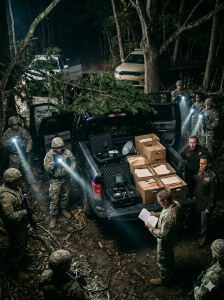
“Ma’am, I strongly recommend we transport you back to the base medical facility immediately,” the medic said, her tone respectful but firm. She lifted my arm gently, inspecting the swollen, reddened grooves carved into my wrists by the zip ties. The skin was bruised, darkened in shades of purple and blue, and my fingers still felt sluggish as circulation returned.
“Not yet, Specialist,” I answered calmly, pulling the thick, fleece-lined field jacket tighter around me. It belonged to Colonel Mason Cole, who had placed it over my shoulders the moment I stepped away from the tree. The scent of canvas and engine oil clung to it—grounding, familiar.
“With respect, General, the swelling in your wrists needs ice, and that cut on your face should be properly treated in a sterile setting,” the medic insisted, holding out a clean bandage.
I gently pushed her hand aside. “I understand, and I appreciate your concern. But if I leave this road now—if I return to Fort Ashby and lie down in a hospital bed before every detail is formally recorded—the story will begin to shift.”
I looked out at the transformed scene before me. The once-quiet county road had become a secured military checkpoint. Military Police in full gear held a tight perimeter, their weapons secured across their chests. The flashing lights from the local patrol car were completely overpowered by the stark white beams of the military vehicles.
Near the ditch where I had been tied moments earlier, two MPs were documenting the scene—photographing the disturbed ground, the broken restraints, and the marks left on the tree.
“If I leave,” I continued, speaking quietly to the medic while meeting Mason’s gaze, “the local narrative will take control before sunrise. They’ll say I resisted. They’ll claim it was a routine stop that escalated. They’ll bury the truth under layers of paperwork. I need to record my statement now—while everything is still clear, while the cold is still in my bones.”
Mason stepped closer, his expression firm and unreadable. He had spent the past twenty minutes coordinating with the Provost Marshal’s office and Army CID. The airspace above us was already restricted, and the jurisdictional fallout from a local sheriff’s department unlawfully detaining a four-star general was sending shockwaves far beyond this road.
“The General is right,” Mason said to the medic, his voice carrying the kind of authority that made it clear he would escalate this as far as necessary. “Treat her here as best you can. We hold this position until the initial reports are secured.”
“Yes, sir,” the medic replied, quickly wrapping a firm, sterile bandage around my wrists to support the strained tendons.
I picked up the green field notebook I had requested. My fingers were stiff, aching with every movement, but I forced them to work. I wrote everything down. The exact moment the patrol lights appeared in my rearview mirror. My speed—five miles under the limit.
I recorded the names. The tall, pale-haired deputy: Cole Mercer. The older sergeant: Nolan Pike.
I didn’t just note what they did—I documented exactly what they said. The condescension in Mercer’s voice when he asked, “You a general?” The hostility in Pike’s tone when he snapped, “You people think you can do whatever you want.” I detailed the moment they grabbed me, the force used when they slammed me against my vehicle, and the deliberate march from the roadside into the darkness.
This wasn’t a victim statement.
It was an intelligence report.
“They were delaying me, Mason,” I said, still writing, the pen moving steadily across the page. “This wasn’t about a ticket. It wasn’t even just about intimidation, though they leaned into that. This was planned.”
Mason leaned against the SUV, arms folded. “You’re sure?”
“Without a doubt,” I replied, turning to a new page. “Mercer got a call from dispatch. He said, ‘the message got through.’ He questioned whether they were ‘too early.’ And Pike…” I paused, recalling his expression. “Pike said they were ordered to keep me off this route. He said they were told to escalate if I pushed back. They wanted me delayed—disoriented—and humiliated.”
“But why?” Mason asked, scanning the empty road. “There’s nothing out here but trees and dirt. What matters about this stretch of road at this hour?”
Before I could respond, the sharp roar of an engine approaching at high speed cut through the night.
Headlights tore through the darkness, closing in fast—too fast for a cautious civilian approach.
“Heads up on the perimeter!” the MP captain called out. Soldiers shifted immediately, raising their hands in a clear signal to stop.
The vehicle—a black, unmarked county SUV with concealed grille lights—braked hard, tires skidding across loose gravel just short of the military line. Dust still hung in the air when the driver’s door swung open.
Sheriff Travis Hollis had arrived.
He stepped out and immediately adjusted the lapels of his dark navy uniform jacket—a calculated gesture, projecting control. He was tall, silver-haired, wearing the kind of practiced smile that played well in public but never reached his eyes.
He had come expecting something else.
He had expected to find two deputies managing a frightened civilian—ready for him to step in and resolve things on his terms.
Instead, he stepped into a wall of military force.
I watched the moment it hit him.
Hollis stopped cold. His eyes moved across the scene—the armored trucks blocking the road, the disciplined line of Military Police, the patrol cruiser trapped within the perimeter.
Then he saw them.
Mercer and Pike, seated in the back of an MP transport, cuffed, heads lowered.
For a split second, his composure cracked. Not surprise—disappointment.
I caught it immediately. Subtle, but unmistakable. He wasn’t shocked by what his deputies had done. He was frustrated they had been caught—and that the military had arrived faster than he expected.
Then it was gone.
The mask returned. Calm. Controlled. Concerned.
Sheriff Hollis walked forward toward the perimeter, wearing the expression of a man ready to take charge of a situation that was no longer his to control.
“Who is the commanding officer here?” Hollis demanded, projecting his voice as he tried to seize back control of the situation. “I am Sheriff Travis Hollis, and this is my county. I demand to know why my deputies have been unlawfully restrained by federal personnel!”
Mason stepped away from the SUV without urgency. He didn’t raise his voice or quicken his pace. He moved toward the perimeter with slow, deliberate intent.
“I am Colonel Mason Cole, United States Army,” he said, his tone cold and unwavering. “Your deputies are currently in federal custody for the unlawful detention, assault, and attempted kidnapping of a four-star general officer.”
Hollis stopped, his expression shifting into practiced surprise. He looked past Mason and finally noticed me in the rear of the command vehicle, wrapped in the oversized field jacket, my bruised wrists resting on the green notebook.
His strategy changed instantly.
“General Reed!” Hollis called, spreading his hands as though approaching cautiously. He stepped past the MPs, ignoring Mason completely. “Ma’am, I am deeply sorry for this misunderstanding. Please, allow me to assure you—this is all just a terrible mistake.”
I didn’t move. I didn’t blink. I held his gaze, letting the silence stretch until it forced discomfort.
“My deputies,” Hollis continued, his smile tightening, “they’re good men. Maybe a little rough, but dedicated. They must have believed there was a legitimate concern involving your vehicle. It’s dark out here—situations can escalate quickly. You understand how law enforcement works. Let me take them back, and we’ll handle this internally. I assure you, they will be disciplined.”
It was a calculated attempt to reframe everything—to reduce what had happened into something manageable, something dismissible.
I rose slowly from the SUV. The medic reached toward me, but I shook my head. I stepped forward, boots crunching against the gravel, until I stood beside Colonel Cole, facing the Sheriff directly.
“No,” I said, my voice quiet but firm with authority. “This is not a misunderstanding, Sheriff. And your deputies are not ‘good men’ who made a mistake in the dark.”
Hollis swallowed, his composure slipping. “General, let’s be reasonable. There’s no need to turn this into a federal situation—”
“They removed me from a marked government vehicle,” I cut in, my tone sharp and controlled. “They restrained me. They dragged me into the woods and tied me to a tree. They mocked my rank, mocked my uniform, and made it clear they were acting under orders to keep me off this route. This does not get handled ‘downtown.’ Your authority ended the moment your deputies laid hands on a United States General.”
Mason stepped forward, closing the distance until he was fully inside Hollis’s personal space. The difference in height was minimal, but the weight of Mason’s presence made the Sheriff seem diminished.
“You are out of your depth, Sheriff,” Mason said, his voice low and controlled. “Nothing here moves without federal oversight. The FBI and Army CID are already on their way. I suggest you contact your attorney.”
That was the moment Hollis slipped.
The composure cracked. His eyes flicked—quick, uncontrolled.
Not toward his deputies. Not toward the lights.
Over my shoulder.
Into the trees.
It lasted less than a second—but it was enough.
In the military, you learn to read the field. You watch where the other side looks—because instinct reveals what they’re trying to protect.
I didn’t turn right away. I held his gaze, watching the tension build, the faint sheen of sweat forming despite the cold.
“You didn’t come here to help them,” I said quietly, the realization settling into place. “You came to make sure they finished it. You came to check if the road was clear.”
Hollis said nothing. He stepped back slightly, his hand drifting toward his belt. “I don’t know what you’re implying.”
Only then did I shift my focus.
The woods beyond the ditch were dense—layers of pine and oak fading into darkness. Our lights illuminated only the nearest rows. Beyond that was solid shadow.
But something was off.
Not movement.
Stillness.
About fifty yards in, between two large trees, there was a shape—a block of darkness that didn’t belong. Not a reflection, but an absence. Clean edges. Unnatural. Hidden from the road.
“Colonel,” I said, my voice flat, my eyes fixed on it.
“Ma’am?” Mason answered immediately.
“Three o’clock. Fifty yards into the tree line. Just past the ditch.”
Mason didn’t question it. He raised his hand and snapped his fingers once.
Four MPs broke from the perimeter at once. They moved without noise, spreading into a tight wedge formation, flashlights and rifles aligned as they crossed the ditch and disappeared into the trees.
Hollis reacted instantly. “Hey! You can’t do that! That’s private county property—this is an illegal search!” he shouted, stepping forward.
Mason shifted, placing a firm hand against the Sheriff’s chest and stopping him cold.
“Stand down,” Mason said evenly. “Or you’ll be restrained and placed in transport with your deputies.”
Then we waited.
The wind cut through the clearing. The lights hummed. Somewhere in the distance, branches snapped under controlled movement.
Seconds stretched.
Then—
The woods erupted.
A sudden, blinding beam cut through the darkness, exposing the hidden shape. At the same instant, the deep roar of a pickup engine igniting shattered the night.
“Halt! Federal Military Police! Kill the engine and step out with your hands up!” an MP shouted, the sharp sound of weapons being readied echoing through the trees.
The driver panicked.
He slammed the truck into reverse. Tires spun violently, ripping into the soft ground and spraying mud as he tried to back out of concealment.
Too late.
Before the vehicle could clear even a few feet, one of our armored SUVs surged off the shoulder, tearing through the ditch and crashing into the underbrush. The driver cut it sharply, angling the vehicle across the truck’s escape path and pinning it against a dense wall of pines.
The engine revved once more—then died.
“Subject contained! Move, move!”
Two MPs rushed the driver’s door, weapons trained. The door was yanked open, and the man inside was dragged out, hitting the mud hard.
“Clear the vehicle!” the MP captain called, pushing forward into the tree line to take control.
Behind us, Sheriff Hollis went pale. The color drained completely from his face as he stared toward the woods, chest rising and falling rapidly. In that moment, it was clear—whatever he had built here was collapsing faster than he could contain it.
Minutes later, the MPs emerged.
Two of them dragged the driver between them—a civilian dressed in dark tactical clothing, reeking of stale coffee and fear. No badge. No official markings.
But he wasn’t the most important part.
Another pair of MPs carried equipment from the truck. One placed a sophisticated police-band radio scanner on the hood of my SUV. It was tuned directly to the sheriff department’s encrypted dispatch frequency. Beside it, he set down a professional DSLR camera fitted with a long telephoto lens—powerful enough to capture detailed images from hundreds of yards away in near-total darkness.
Then the captain stepped forward, holding a thick, unmarked manila folder.
“Ma’am. Colonel,” he said, his expression hard. “This was open on the passenger seat.”
He handed it to Mason.
Mason opened it and angled his penlight over the contents. I stepped closer, looking over his shoulder.
The folder was explosive.
Inside were dozens of high-resolution, time-stamped photographs. Not of me—but of a remote, overgrown service road less than three miles from our position.
I recognized it immediately.
From the briefing earlier that day.
According to official records, that road led to a decommissioned federal site—an old Cold War-era military storage facility. It had been listed as inactive for over twenty years.
It was supposed to be empty.
But the photographs told a different story.
They showed heavy transport trucks moving in and out under cover of darkness. Late-night convoys. Unmarked county maintenance vehicles escorting them. And in one clear, undeniable image—a flatbed truck marked with restricted plates belonging to a private military logistics contractor.
This wasn’t random.
This wasn’t local corruption.
This was something organized.
Beneath the photographs lay a handwritten ledger. It listed precise delivery times, cleared routes, and inventory codes.
I fixed my eyes on the codes. A chill ran through me.
I recognized those alphanumeric sequences immediately. I had just spent four hours in a classified briefing going over them. They matched the exact tracking codes for restricted, highly sensitive military components and communications equipment that had been reported as “missing in transit” from three separate bases in the region.
This wasn’t a simple local theft ring. This was a large-scale, multi-million-dollar scheme involving fraud, contract corruption, and unauthorized access to federal logistics systems.
And they were using the abandoned bunker site in Briar Glen to store the stolen government equipment before funneling it into the black market.
“My God,” Mason whispered, turning the pages, his eyes widening with realization. “This is a massive diversion operation. They’ve been siphoning restricted tech right under the government’s nose.”
I lifted my gaze from the folder and slowly looked back at Sheriff Hollis.
He was shaking. The arrogant, dominant local politician who believed he could rule his county through fear and racial intimidation was gone. In his place stood a man who looked cornered, realizing he had walked straight into his own downfall.
“You weren’t trying to protect your deputies from me,” I said, as the full picture locked into place. My voice remained calm, but it carried undeniable force. “You weren’t trying to teach a Black woman in a uniform a lesson about local authority.”
I stepped closer, raising the folder into the stark tactical light.
“You were trying to keep me from seeing something,” I continued, the truth cutting through the cold air. “Someone inside your little corrupt network realized that my route home tonight from the security briefing might bring me too close to that warehouse road. You didn’t need to kill me. You just needed to discredit me. You needed to delay me, intimidate me, and humiliate me long enough to keep me off this highway so your trucks could clear the site before I noticed the heavy traffic.”
No one along the roadside denied it. The Sheriff’s silence spoke louder than any confession.
From the back of the MP transport vehicle, muffled sobbing broke through the stillness. Deputy Mercer, watching everything collapse, finally cracked.
“We were just told to stall you!” Mercer shouted through the metal mesh of the transport window, his voice trembling with fear. “That’s all! He said just hold you until the route cleared! The Sheriff said you’d been at the briefing, that you might take County 9 back to base! He said if you asked questions, we were supposed to make it messy so you’d be too scared to report it!”
“Shut up, you idiot!” Pike snapped from beside him, struggling against his restraints.
But Mercer didn’t stop. The fear of federal charges had overtaken any loyalty he had left. “He said you were just a woman! He said you wouldn’t fight back if we pushed you hard enough!”
I didn’t react. I didn’t let the insults—buried in their assumptions—touch my composure. I kept my eyes on Sheriff Hollis, watching everything he had built collapse in real time.
“Messy enough to tie me to a tree in the freezing cold?” I asked, my voice steady and controlled.
Hollis opened his mouth—ready to deny it, to spin it, to plead—but nothing came.
Mason closed the folder with a firm snap. He looked at me, his expression set with unwavering loyalty and focus.
“Ma’am,” he said, his voice lower now, carrying the weight of what was coming. “Whatever is in that bunker, it’s not minor. This goes beyond a civil rights violation. This is a coordinated breach of federal logistics.”
I nodded, glancing down at my bruised wrists. The pain was still there—a reminder of what had been done.
They had tried to strip me down. To make me small.
Instead, they gave me exactly what I needed.
“Get me the encrypted sat-phone, Colonel,” I ordered, my voice carrying across the secured scene. “Wake up the Director of the FBI. Wake up the Federal Prosecutors. I want a joint task force assembled and warrants prepared for that bunker site by 0400 hours.”
I turned away from the Sheriff and his deputies, pulling the heavy jacket tighter as I looked toward the dark horizon.
“They thought they could hide in the dark,” I said, the wind cutting through the trees.
“Let’s bring the sunrise to them.”
Part 4: The Aftermath
By 5:30 a.m., the heavy darkness that had covered County Road 9 finally began to lift, giving way to the cold, gray light of a Georgia morning.
The freezing wind that had cut through the pine trees all night softened into a damp, biting chill. The county line outside the small town of Briar Glen no longer resembled a quiet rural road. It didn’t even resemble a local crime scene. It looked like what it had become—a staging ground for a full-scale federal operation.
I sat in the open rear hatch of the armored command SUV, watching the rising light fall across the same tree where I had been restrained just hours earlier. The thick bark of the oak was scarred where the plastic ties had dug in. My wrists, wrapped in clean white bandages, pulsed with a steady ache that kept me grounded.
I should have gone straight to the base medical unit. Colonel Mason Cole knew it. The medics knew it. But I also understood—with the certainty that comes from decades inside systems of power—that if I left before giving my official account while the memory was still sharp, the truth would begin to shift before daylight fully settled.
So I stayed.
Wrapped in Mason’s oversized field jacket over my torn and dirt-streaked clothes, I dictated everything. Names. Exact wording. The tone of their racial hostility. The direction of Sheriff Travis Hollis’s glance into the trees. The timing of the radio call. The concealed truck. The camera. The folder.
Reinforcements arrived in waves.
First came unmarked sedans with darkened windows, tires crunching across the gravel. Then two armored investigative vehicles. Then a mobile evidence unit that looked built to withstand anything.
FBI agents stepped out carrying hard cases, their movements precise, controlled. No raised voices. No wasted motion. Just quiet, methodical authority. Army CID officers integrated seamlessly under a joint command structure, while Military Police maintained a strict, unbreakable perimeter.
No one from Hollis’s department was allowed near communications without oversight. Their patrol cars had been shut down, their flashing lights gone—replaced by the stark white beams of federal vehicles cutting through the morning haze.
What began as a targeted act of roadside abuse—a racially driven attempt to intimidate and degrade—was now formally tied to obstruction, unlawful detention of a general officer, and interference in a restricted federal matter.
Sheriff Travis Hollis—the man who had arrived hours earlier with polished confidence and a politician’s smile—was unraveling.
Whatever control he thought he had was gone the moment a senior FBI agent stepped out of the lead sedan.
Agent Dana Mercer.
And she made one thing immediately clear—cold, direct, and without hesitation—she had no connection whatsoever to Deputy Cole Mercer, who now sat in handcuffs in the back of our transport vehicle.
Agent Mercer didn’t extend a hand. She offered no greeting. She walked straight up to Hollis, her badge catching the early light, and immediately requested his phone, his county vehicle keys, and his duty weapon.
Hollis faltered, his face flushing a deep, uneasy red. “Now see here, you can’t just disarm an elected official on his own—”
“You are not under arrest at this moment, Sheriff,” Agent Mercer cut in, her voice precise and unyielding. “But you are not free to leave this scene.”
The words at this moment hung in the cold morning air like a blade poised to fall. Slowly, Hollis unfastened his duty belt, his hands trembling as he surrendered his weapon and encrypted phone. A man who had built his authority on quiet intimidation and unspoken alliances now stood exposed, watching federal agents seal his devices into evidence bags.
As the roadside operation continued, the folder recovered from the hidden truck proved to be the evidence that unraveled everything in Briar Glen.
The high-resolution images, marked maps, and handwritten notes formed a clear and undeniable trail leading directly to the old bunker road just a few miles away.
By midmorning, as sunlight finally pushed through the lingering fog, federal tactical teams and Army CID units executed a no-knock warrant at a large, fenced warehouse concealed behind a rusted county maintenance sign.
Official county records listed the property as abandoned for years. In reality, when agents forced entry through the steel doors, they uncovered a fully active, tightly run black-market logistics center. Inside were stacked pallets of diverted contractor equipment, unregistered communications systems, and heavy crates filled with restricted military components.
For months, the operation had been hidden behind falsified storage records and manipulated routing approvals. It wasn’t dramatic or theatrical—it was methodical. A quiet, expansive network built on fraud, theft, contract manipulation, and unauthorized access to federal supply systems. The kind of operation that survives because it looks too ordinary to attract attention.
But I had noticed.
Sitting in the cold, reviewing the timeline with Mason, the reason they had targeted me became unmistakably clear.
This wasn’t random.
They hadn’t stopped me for speed. They hadn’t acted on impulse. Someone inside their network had panicked.
They knew I had attended a high-level security briefing that afternoon at a nearby base—a briefing focused specifically on missing equipment transfers and suspicious routing tied to old federal sites in the region.
And they realized my route back to Fort Ashby might bring me close enough to see what they were trying to hide.
They didn’t need to kill me. That would have immediately brought the full weight of the federal government crashing down on them. All they needed was to discredit me—to slow me down, confuse me, and intimidate me long enough for their transport trucks to clear out and disappear into the night.
And they believed the easiest way to do that was to use my identity against me.
Deputy Cole Mercer and Sergeant Nolan Pike had been ordered to “stall” a general—but they turned that directive into something far more vicious. They saw me—a Black woman alone on a dark road—and let their prejudice dictate their actions. They believed that if they dragged me from my vehicle, mocked my uniform, slammed me into the dirt, and tied me to a tree like a runaway, I would be too shaken, too humiliated, and too afraid to ever speak about it again.
They thought they could weaponize this country’s history to silence me. They thought isolation would make me powerless.
They were wrong.
By that same evening, both Mercer and Pike were formally charged. Federal prosecutors moved immediately and decisively. The evidence we secured at the roadside was undeniable—clean, direct, and damning.
The charges came down like a hammer: unlawful detention, serious civil rights violations, assault under color of law, falsifying official reports, and conspiracy to obstruct an active federal investigation. The men who had mocked my rank in the darkness were now sitting in federal custody without bail, facing decades behind bars.
Sheriff Travis Hollis followed soon after. Just two days later, he was formally arrested. The FBI cracked his encrypted phone, uncovering records that directly tied him to the contractor operative discovered in the woods with the surveillance equipment. He faced sweeping obstruction and conspiracy charges, his political career—and the network he controlled—completely dismantled.
The warehouse raid was only the beginning. It triggered a wide-reaching federal investigation spanning multiple counties and extending into the executive levels of a private logistics company with defense contracts.
In today’s world, secrets don’t stay hidden for long. The media uncovered the story before the indictments were even finalized. News crews flooded Briar Glen, and my name began appearing across every major network.
But the public didn’t first see me as a victim. They didn’t see someone broken.
They saw a photograph.
It had been taken by a military documentation officer just after sunrise. In it, I stood beside an armored vehicle. My bruised wrists were visible beneath the sleeves of Colonel Cole’s oversized jacket. My face still bore the scrape from the gravel. But my posture was firm—chin lifted, shoulders squared—and my eyes were fixed forward with unwavering resolve.
That image spread everywhere. It became the defining symbol of the entire case.
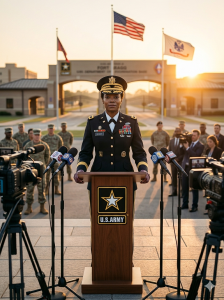
A week later, after briefing the Pentagon and testifying in closed sessions before a joint federal and military review board, I made a decision. I chose not to stay behind public affairs barriers. I stepped to a podium outside Fort Ashby and addressed the press directly.
Dressed in full uniform, four stars on my shoulders, I faced the rows of cameras and microphones. I didn’t exaggerate. I didn’t seek sympathy. I spoke plainly.
“I was humiliated,” I said to the silent crowd, my voice calm and steady. “I was unlawfully restrained, degraded, and treated by local law enforcement as though my uniform, my rank, and my decades of service meant absolutely nothing.”
I paused, allowing the weight of those words to settle—knowing they echoed far beyond that moment.
“But this is much larger than what happened to me on that roadside,” I continued, looking directly into the camera. “The danger is not only that two corrupt deputies abused their power to assault a woman in the dark. The real danger is that systems—local, political, and financial—created an environment where they believed they could. They believed their badges gave them complete immunity to conceal corruption through intimidation and violence.”
That single statement spread rapidly across every major network and social platform.
At the podium, I laid out the facts of the stop—the unlawful detention, the use of force, and the deliberate effort to delay an active federal matter. Most importantly, I publicly commended Colonel Mason Cole and the Fort Ashby Military Police response team by name. I recognized their discipline, and I recognized that they chose not to hesitate when something was clearly wrong.
I did not speak to the press about the fear I felt in those woods. I refused to give Pike and Mercer the satisfaction of knowing they had shaken me. But later that night, alone in my office with Mason, I admitted the hardest truth of it all.
It wasn’t the zip ties cutting into my wrists. It wasn’t the tree, the cold, or even the threat of violence.
“It was how normal they thought it was, Mason,” I said quietly, staring into my coffee. “The ease with which they reduced me to nothing. The way they laughed. That was the most terrifying part.”
Months later, the town of Briar Glen still carried the weight of the scandal.
The sheriff’s department was dismantled and rebuilt under strict state oversight. The contractor firm behind the operation lost all federal eligibility, its contracts terminated, and multiple senior executives were indicted on racketeering charges.
As for Deputy Mercer and Sergeant Pike, the evidence against them was overwhelming. They accepted plea-adjacent agreements to avoid life sentences, but the outcome was still decisive—their careers ended, their pensions stripped, and both were sent to federal prison for lengthy terms.
I understand that systemic reform doesn’t happen overnight. One arrest—or even many—cannot erase decades of entrenched bias and local corruption. No one in the Army, and certainly no one in my community, believed otherwise.
But the secrecy was broken. The shadow they had operated under was exposed by the full light of federal accountability. And that mattered.
At Fort Ashby, I resumed full duty within days. I refused to let them take anything more from me.
The first time I drove that stretch of County Road 9 again, I wasn’t alone. Mason sat beside me in the passenger seat. He didn’t offer reassurances or fill the silence—he simply stayed present, steady and unshaken.
As the headlights passed over the familiar bend, the oak tree came into view near the ditch.
I slowed slightly. I glanced at the trunk, at the rough bark where I had been bound. For a moment, I felt the echo of that night—the cold, the pressure at my wrists.
Then I drew a breath, faced forward, and kept driving.
I had endured. I had prevailed. And I had learned something many who try to wield power through fear fail to understand: humiliation only holds power if it is allowed to be the final word.
In Briar Glen, it wasn’t.
What those two corrupt deputies intended as a display of control became the very evidence that exposed their entire operation. Their attempt to break a Black woman in the dark instead dismantled the system that protected them and revealed the corruption they worked so hard to conceal.
They tied a general to a tree believing isolation, fear, and prejudice would make her small.
Instead, it called in an army.
Share this story. Demand accountability from those entrusted with authority. Defend civil rights relentlessly, support those who serve with integrity, and never accept abuse disguised as power. Darkness only prevails when no one is willing to shine a light into it.
