

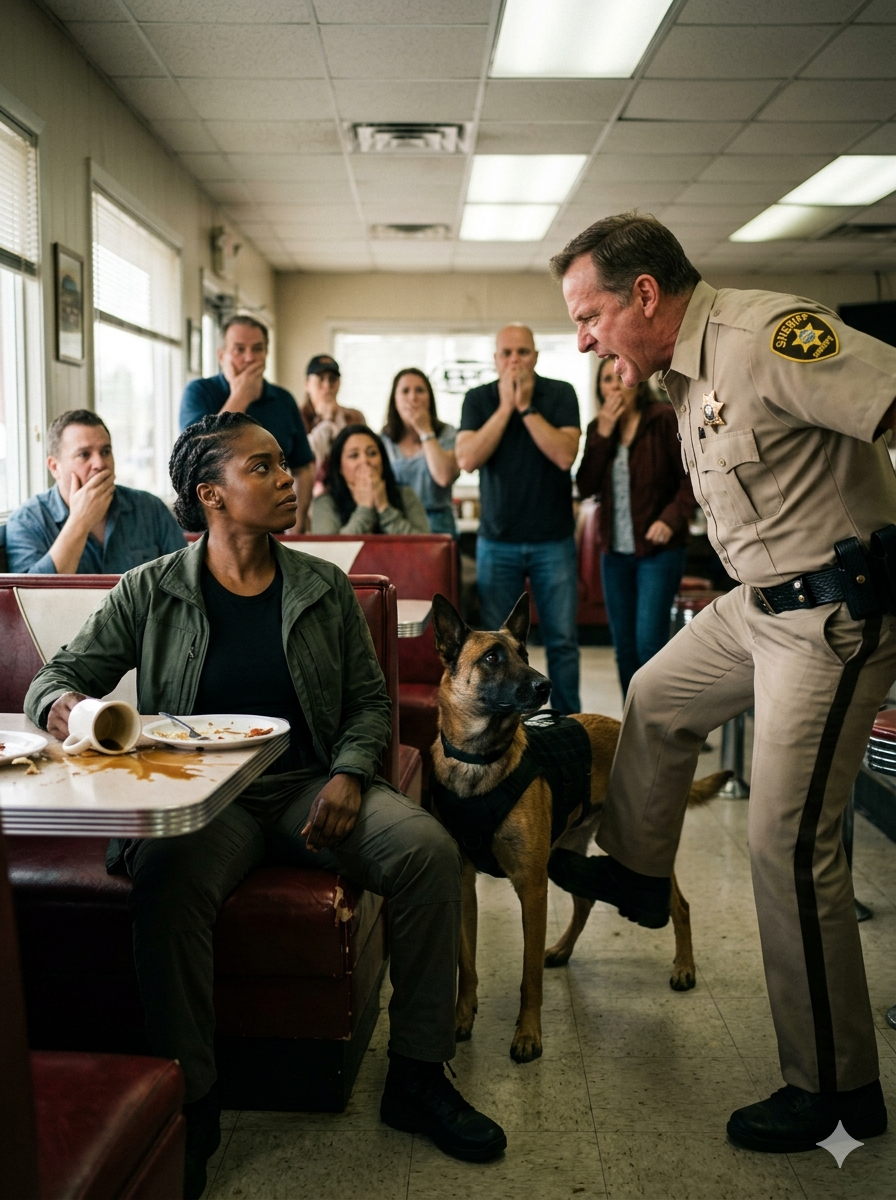
After twelve years in Naval Special Warfare, I was done chasing adrenaline; what I wanted was quiet. I purchased a cabin in Ashford Ridge, Colorado, looking for pine trees and peace. As a Black woman in a small mountain town, I anticipated the stares, but I never tolerated disrespect.
Sheriff Clayton Rusk believed his badge entitled him to walk over others. He stepped into Miller’s Diner, spotted me and Kodiak—my retired K9—and decided to make a scene. He h*t me with vile racial slurs and called Kodiak a “filthy animal.”
Then he k*cked Kodiak. Hard.
Everything fell silent. My SEAL instincts, buried beneath months of civilian life, surged back instantly. When Rusk reached out and grabbed my shoulder to shove me out of the booth, he crossed the line.
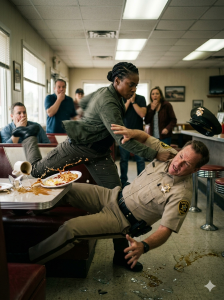
In under two seconds, I moved. I turned his own force against him, driving his face into the table amid spilled coffee and shattered porcelain. I locked his arm in a precise tactical hold that made him scream in front of everyone.
I leaned closer, my voice low and ice-cold: “Take your hands off me. Now. I’ve neutralized targets a lot more dangerous than a small-town b*lly with a shiny toy on his chest.”
Rusk struggled for breath, his face flushing red. “You’re dead… you just ass*ulted a cop! You’ll rot in a hole for this!”
I smiled. Not kindly—more like someone who already knew the outcome. “Then do it legally, Sheriff. Put the cuffs on me. But remember this moment—it’s the last time you’ll ever feel powerful.”
I knew I’d be taken in. I knew I’d end up in his jail. But what Rusk didn’t realize was that Kodiak’s harness had a hidden 4K camera. Every slur, every k*ck, and his unprovoked assault was already uploading to a federal server.
That punch wasn’t the end of it. It was only the beginning.
Part 2: Into the Lion’s Den (Extended Cut)
The steel of the handcuffs dug into my wrists, a sharp, localized p*in I registered and immediately pushed to the back of my mind. The cruiser reeked of cheap pine air freshener, stale chewing tobacco, and the lingering sourness of nervous sweat from whoever had occupied this molded plastic backseat before me. Each time the heavy Ford Explorer hit a pothole along the winding, poorly maintained Colorado backroads, the metal ratchets of the cuffs cinched tighter by another millimeter. It wasn’t accidental. A rookie might forget to double-lock cuffs; a corrupt cop leaves them single-locked on purpose so they tighten with every jolt—cutting circulation, sending a quiet message of control.
I didn’t flinch. I didn’t shift. I sat perfectly still, spine straight, my breathing measured into a steady four-count in, four-count hold, four-count out. Through the reinforced steel mesh dividing the backseat from the front, I could see the back of Deputy Travis Keene’s head. He was whistling an off-key, tuneless melody, tapping his fingers against the steering wheel. He thought he was transporting a broken civilian. He mistook the silence behind him for fear.
He had no idea.
Through the tinted rear window, I tracked the taillights of Sheriff Clayton Rusk’s cruiser leading ahead. Kodiak was in that vehicle. The thought of Rusk’s hands anywhere near my partner sent a brief surge of cold, controlled rage through my chest, but I shut it down immediately. Emotion in a hostile setting is a liability—it makes you careless, predictable. I needed to stay invisible, a ghost in the system.
We pulled into the Ashford Ridge Sheriff’s Department just as the sun dipped behind the jagged peaks of the Rockies, casting long, skeletal shadows across the gravel lot. The building was a relic of 1970s brutalist design—a solid block of gray, unyielding concrete that resembled a bunker more than a police station. It mirrored Rusk perfectly: isolated, hardened, and devoid of warmth.
The cruiser lurched to a stop. Keene shut off the engine and stepped out, gravel crunching beneath his boots. A moment later, my door was yanked open. It wasn’t Keene—it was Rusk. He had removed his aviator sunglasses, revealing pale, bloodshot eyes that pulsed with hostility. The spot on his face where I had driven him into the diner table was already darkening into an angry purple bruise.
“End of the line, SEAL,” Rusk spat, the title dripping with sarcasm and insecurity. He didn’t offer a hand. Instead, he reached in, grabbed the collar of my tactical jacket, and jerked me forward.
I let my weight drag against him for just a split second—enough to make him strain—before stepping out smoothly on my own. I stood a few inches shorter, but when I met his gaze, I made sure he felt small.
“You’ve got a lot of nerve bringing your kind of trouble into my town,” Rusk sneered, leaning close enough that I could smell stale coffee and adrenaline on his breath. “You think you’re untouchable because of what you are? Because you’re some Black female hotshot who served her country? Let me explain how the real world works. Out here, I am the country. I am the law. And you are nothing but a trespasser who just threw her life away.”
I didn’t blink. “You’re bleeding, Clayton,” I said quietly, my voice flat and steady. “You might want to put some ice on that. It’s going to swell—and it’s going to remind you of me every time you look in the mirror.”
His jaw tightened. For a moment, I saw his hand twitch toward his service weapon. He wanted to str*ke me again, right there in the parking lot. But even someone like Rusk knew better than to assault a handcuffed prisoner in broad daylight with a dispatcher possibly watching from inside.
He clamped down on my bicep, fingers digging into the muscle, and shoved me toward the heavy glass doors. “Get her inside. Put her in Room B. I want her isolated.”
The station interior was exactly what I expected: scuffed linoleum floors, flickering fluorescent lights buzzing with a low, irritating hum, and walls painted that lifeless institutional pale green meant to drain the energy from a room. Behind a thick pane of bulletproof glass, a young dispatcher with a headset glanced up as we entered. She looked at me, then at Rusk’s bruised face, and immediately dropped her gaze back to her keyboard. Fear was written all over her.
The whole town was afraid of him.
Keene took over, steering me down a narrow hallway that reeked of industrial bleach and old sweat. “Keep moving,” he muttered, giving me an unnecessary shove between the shoulder blades.
“Where is my dog?” I asked. It was the first time I’d spoken to him since the arrest.
“Oh, the mutt?” Keene let out a crude, wet chuckle. “He’s in the holding kennels out back. Animal Control’s picking him up in the morning. After what happened at the diner, he’s being classified as a highly dangerous weapon. Standard procedure is euthanization. Don’t worry—they make it quick.”
A tight, burning rage flared in my gut. Kodiak wasn’t just a dog. He was a decorated military working dog, a Belgian Malinois who had detected IEDs in the scorched valleys of Afghanistan, who had dragged my wounded radioman to safety under heavy f*re in Fallujah. He had earned his retirement. He had earned peace. Hearing this small-town lackey casually say ‘euthanization’ in reference to him was enough to make me want to break his neck.
But I shut it down. I pictured the anger as a locked box, sealed it, and threw away the key. Stay on mission. The trap is already in place. Let them step into it.
Keene shoved me into Interrogation Room B. It was a tight, suffocating space, no more than eight by ten feet. A single metal table was bolted to the concrete floor. Two heavy steel chairs faced each other. A two-way mirror covered the upper half of one wall, though I doubted anyone was actually behind it. The room was built for pressure—no windows, no clock, no connection to the outside world.
“Sit,” Keene ordered.
I stayed on my feet.
He stepped closer, his hand resting on his baton. “I said, sit.”
“I heard you,” I answered evenly. “I choose to stand.”
He hesitated, unsure how to handle someone who didn’t fold under his borrowed authority. Before he could push it further, the steel door opened and Rusk walked in. He had removed his duty belt and tossed it onto the table with a sharp metallic clatter. Pulling out a chair, he sat, leaning back with his arms crossed.
“Leave us, Travis,” Rusk said without looking at him.
Keene paused. “You sure, Sheriff? She’s… unpredictable.”
“I said leave.”
Keene stepped out, and the door shut behind him. The magnetic lock clicked into place with a heavy thud.
Rusk studied me in silence for a long moment. It was textbook—establish dominance through silence, make the subject uncomfortable, force them to fill the gap.
I had trained to endure interrogations by foreign intelligence agencies using sleep deprivation, cold exposure, and sensory overload. A bruised sheriff sitting across from me in a brightly lit room wasn’t going to shake me. I held his gaze, reading the details—the faint twitch in his left eye, the shallow breathing, the slight shift in posture. He was projecting control, but underneath it, he was scrambling. He knew he had crossed a line in that diner. Now he was trying to bury it.
Finally, he spoke. “You know, Brianna… can I call you Brianna?”
“You can address me as Chief Petty Officer Cole, or you can address me as ‘ma’am’,” I replied, steady.
He gave a humorless chuckle. “You military types always think rank carries over into the real world. Let me explain your situation, ma’am. You’re facing aggravated assault on a peace officer, resisting arrest, disorderly conduct, and harboring a dangerous animal. Around here, that’s a minimum of ten years in a state penitentiary. By the time you get out, you’ll be old. Your pension—gone. Your reputation—gone. And your dog… well, we’ve already covered that.”
He leaned forward, elbows on the table. “But I’m a reasonable man. Sometimes people snap. Veterans come back with PTSD, minds scrambled. They overreact. I could write this up as a misunderstanding. A minor scuffle. You plead guilty to a misdemeanor, pay a fine, and leave my town by sunrise. Don’t come back. If you do that, maybe Animal Control releases the mutt to a shelter in another county.”
Classic pressure play. He was testing for weakness, waiting for me to bargain.
“You’re offering a deal because you’re afraid,” I said flatly.
His eyes narrowed. “Afraid? Of you?”
“Afraid of what happens when your cruiser’s dashcam footage gets requested by my lawyer. Afraid of what witnesses at the diner will say under subpoena. You put your hands on me first. You attacked my service dog. You abused your authority. You’re offering a deal because you don’t have a case—you have a liability.”
“There is no dashcam footage,” Rusk replied, a sharp, satisfied smile spreading across his face. “That’s the thing about small-town budgets—equipment fails. My camera hasn’t worked properly in weeks. And the diner patrons? They’ve lived here their whole lives. They know who protects them. They know which side to stand on. If I tell them you threw the first punch, they’ll swear to it on a stack of Bibles.”
He stood and moved slowly around the table until he was directly behind me. I could feel his presence, close and deliberate.
“You don’t understand how things work here, Brianna,” he said quietly. “I’m the apex predator. You’re just passing through. A tourist who doesn’t know her place.” He leaned closer, his voice dropping into a whisper at my ear. “A Black woman walks into my town thinking she’s tough because of some government training—it disrupts the order of things. You think your military friends care about you right now? You’re alone. Completely alone.”
He was wrong. Completely, decisively wrong.
As he paced, filling the stale air with his rhetoric, my focus shifted away from him. I pictured Kodiak. I pictured the custom tactical harness he was wearing. To someone like Rusk or Keene, it looked like standard heavy-duty nylon with a ‘RETIRED K9’ patch stitched on the side.
But beneath that patch, embedded within the Kevlar lining, was a micro-modular camera and audio transmitter. Not Bluetooth. Not cellular. An encrypted, high-frequency mesh network device linked directly to a concealed SATCOM relay mounted to my truck—still parked back at the diner. That relay was continuously uploading a live, unalterable feed to a secure federal server monitored by the Department of Justice’s Public Integrity Task Force.
Every slur. Every threat. Every admission about the dashcam. Every claim about coercing witnesses. Rusk wasn’t interrogating me.
He was recording his own confession for federal agents watching from hundreds of miles away.
“You’re very quiet, Cole,” Rusk said, returning to his chair. “Are you praying? Or are you just realizing how badly you messed up?”
“I’m not praying,” I replied, letting a faint, cold smile form. “I’m just impressed by your confidence. It takes a special kind of ignorance to dig a hole this deep and still ask for a bigger shovel.”
Rusk’s expression hardened. He slammed both palms onto the metal table. “I’m done playing games. You’re going into isolation. No food, no water, no phone calls. You’ll sit in the dark until you understand exactly who controls your life.”
He called for Keene. The deputy hurried in, his hand resting on his weapon.
“Take her to Cell 4,” Rusk ordered. “And shut off the heat in that block. Let her freeze for a few hours. Let’s see how tough the Navy really made her.”
Keene grabbed me roughly, dragging me out of the interrogation room and down another long corridor. This one led to the holding cells. The temperature dropped noticeably. The concrete walls seemed to hold the cold, radiating it outward.
Cell 4 was at the far end. A windowless box with a stainless steel toilet and a solid concrete bench. No mattress. No blanket. Keene shoved me inside, and I staggered, catching myself just before my knees hit the floor.
“Enjoy your night, hero,” he sneered, sliding the heavy bars shut. The lock snapped into place with a loud clang that echoed down the empty hall.
Darkness closed in, broken only by a weak, flickering bulb outside.
I moved to the bench, sat cross-legged, and closed my eyes. I went back to BUD/S—to surf torture in Coronado, linking arms with my boat crew, sitting in the freezing Pacific at night while waves crashed over us and hypothermia crept in like liquid ice. Instructors paced the shore with megaphones, telling us to quit, telling us we were weak, telling us we didn’t belong.
You survive by detaching. You survive by treating pain as data. The cold in this cell was nothing. The pressure of the cuffs was nothing. I controlled my body, my breath. I slowed my heart rate, conserved heat, kept my mind sharp.
Time blurred. Minutes, maybe hours.
Then a sound broke the stillness—faint, almost lost beneath the hum of ventilation.
Scratch… scratch, scratch… scratch.
I opened my eyes and turned toward the back wall.
Scratch… scratch, scratch… scratch.
Kodiak.
They had placed the kennels directly behind the isolation block. My partner was using his front paws to gently scratch at the base of the wall. No whining. No barking. Just controlled contact—a pattern we had used in the field when separated by debris or thin barriers.
I am here. I am ready.
I shifted, lowering my cuffed wrists to the floor. I couldn’t make noise, but I could tap my boot lightly against the concrete.
Tap. Tap. Pause. Hold.
The scratching stopped instantly. Kodiak understood. He would stay still. He wouldn’t provoke the guards. He wouldn’t give them a reason.
He was a professional.
An hour later, the hallway door creaked open. Heavy footsteps echoed closer. Not Keene—this stride was steady, deliberate.
Rusk.
He stopped at my cell. The dim hallway light cast his face in harsh shadow. He looked disheveled—shirt untucked, a heavy black flashlight in one hand, keys in the other. I could smell cheap whiskey from where I sat.
“Wake up, Cole,” Rusk slurred slightly, tapping the bars with the flashlight. “Change of plans.”
I didn’t move. My breathing stayed even, my focus locked on him.
“I’ve been thinking about your case,” he said, lowering his voice. “All that paperwork. The attention if a ‘war hero’ goes to trial here. It’s a headache. A big one. And I don’t like headaches.”
He slid a key into the lock and turned it. The door swung open with a long, grating squeal. He stepped inside, holding his sidearm—a Glock 19—loose at his side.
“Stand up.”
I rose smoothly, showing no sign of stiffness despite the cold.
“Turn around.”
I did. He grabbed the chain between my cuffs—not to remove them, just to control me—and guided me out into the dim hallway.
“We’re taking a little drive,” Rusk said, his breath warm against my neck. “There’s a logging road about ten miles north. Runs along a deep ravine. Pitch black out there. Dangerous terrain. Sometimes prisoners get combative. They try to run. In the dark, in the mountains… accidents happen. A fall. A tragic end to a disturbed veteran’s life.”
He was outlining my execution. He had decided it would be easier to erase me than face me in court. He had crossed the point of no return.
“You’re making a mistake, Clayton,” I said quietly as he pushed me toward the rear exit. “You think darkness hides things. It doesn’t—it reveals exactly who you are.”
“Save that for God,” Rusk laughed, a harsh, grating sound. “If He’s even listening.”
He shoved me through the heavy metal door into the freezing night. The back lot was empty, washed in the sickly yellow glow of a lone sodium vapor lamp. Wind tore down from the mountains, cutting through my thin clothes. His personal SUV—an unmarked black Chevy Tahoe—sat idling in the center, exhaust curling into the cold air.
“Walk,” he ordered, pressing the muzzle of the Glock into my spine.
Every instinct screamed to act. I knew precisely how to disarm him—a sudden drop in center of gravity, a sharp pivot, a strike to the radial nerve to force the weapon loose, followed by a decisive blow to the throat. Even in cuffs, I could end it in under three seconds.
But I didn’t.
Because I understood what was unfolding beyond Rusk’s narrow, corrupted world.
At a location not far away…
Three hundred miles out, inside a subterranean command center in Denver, the room pulsed with tension, lit by the cold glow of tactical monitors.
Colonel James Miller, a veteran commander of DEVGRU units, stood with arms folded, eyes locked on the main display. A topographical map of Ashford Ridge filled the screen, a pulsing red dot marking the exact GPS signal from Kodiak’s harness. Beside it, a live transcript of the audio feed scrolled continuously.
“He just unholstered his weapon,” an FBI Special Agent reported, headset on, fingers moving rapidly across the keyboard. “Audio confirms intent to transport the suspect to a remote location. He’s describing a staged accident. This is escalating to an imminent threat to life.”
Miller’s jaw tightened. Brianna Cole was one of the best operators he had ever trained—disciplined, precise, unbreakable. Watching a corrupt sheriff press a gun to her spine tested every ounce of restraint he had.
“ETA on tactical teams?” he demanded.
“HRT and Public Integrity Task Force units are already on the ground,” the agent replied. “They moved in on foot to avoid detection. They’re staged around the perimeter of the Ashford Ridge precinct. Visual confirmation on the rear lot.”
“Clear shot if he fires?”
“Snipers are in position. Thermal shows two heat signatures—Rusk and Chief Petty Officer Cole. But sir… she’s moving exactly by protocol. She’s drawing him into the open. She’s giving our snipers the angle.”
A flicker of respect crossed Miller’s face. Even now—cuffed, threatened—she was still controlling the field.
“Tell the strike team to hold on my signal,” he said, voice steady and cold. “I want him caught in the act. Charges that airtight, no one gets him out. We move when he tries to force her into the vehicle.”
Back in the freezing lot, Rusk shoved me closer to the idling Tahoe.
“Open the back door,” he ordered.
“My hands are cuffed behind me, Clayton,” I said evenly. “I can’t.”
He muttered a curse, keeping the gun trained on me as he shifted to the side, reaching for the handle with his left hand.
“You’re very bold with a gun on a restrained woman,” I said, my eyes scanning the dark tree line beyond the lot. I couldn’t see them—but I knew they were there. I could feel it. Professionals. Watching.
“Shut up,” he snapped, yanking the door open. “Get in.”
He stepped in closer, ready to shove me inside.
“Look up, Sheriff,” I whispered.
He paused for a split second. “What?”
“I said—look up.”
The streetlamp above us shattered in a burst of sparks. Darkness swallowed the lot instantly.
Before his eyes could adjust, everything detonated into motion.
Part 3: The Federal Hammer
The instant the sodium vapor lamp burst above us, plunging the empty lot into suffocating darkness, everything changed. Rusk flinched. I felt the muzzle of his w*apon shift against my spine. In that single heartbeat, the so-called apex predator of Ashford Ridge realized he was no longer in control.
“What the hll?” Rusk muttered, his voice cracking. His grip tightened on my shoulder as he tried to drag me back toward the SUV, using me as a shield. “Don’t move, Cole. I swear to God, I’ll shot. I’ll drop you right here!”
He was panicking. Panic makes an armed man unpredictable—but against Tier One operators, it makes him exposed.
“Look down, Clayton,” I said quietly, my voice steady despite the wind.
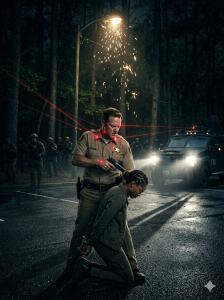
He glanced at his chest—and froze. Even in the darkness, it was unmistakable. A dozen red laser dots danced across his body—center mass, throat, forehead. Precision targeting from rifles hidden in the tree line.
“Sheriff Clayton Rusk!” a voice thundered through the night, amplified and echoing off the concrete walls. A heavily armored BearCat vehicle rolled forward from the shadows, sealing off the lot. “This is the Federal Bureau of Investigation and the Public Integrity Task Force! Drop the w*apon! Drop it now and step away from the hostage!”
Rusk stood frozen, unable to process it. Seconds ago, he was untouchable. Now, he was surrounded.
“I… I am the Sheriff!” he shouted blindly. “This is my jurisdiction! Back off!”
Wrong move.
“Execute,” came a calm command from the darkness.
The night detonated.
Two stun grenades exploded on the asphalt nearby—deafening blasts followed by blinding white light. I had already braced—eyes shut, jaw loose. Rusk hadn’t. He screamed, dropping the Glock as his hands flew to his face.
Before the echo faded, shadows surged forward. Operators in full tactical gear moved with ruthless precision. Three agents hit Rusk at once, slamming him into the ground. His protests vanished under the force as a knee drove into his back. Flex-cuffs snapped tight around his wrists.
“Target secured! W*apon recovered!”
An agent stepped in front of me, lowering his firearm and pulling out bolt cutters.
“Chief Petty Officer Cole, hold still, ma’am.”
“I’m steady,” I replied.
Snap. Snap. The chain between my cuffs gave way. Moments later, the cuffs were off. Blood rushed back into my hands in a burning wave, but the relief cut through it. I rolled my shoulders, free again.
“You injured, ma’am? Need medical?” the agent asked.
“I’m good,” I said. “But my partner is still inside. They locked him in the rear kennels.”
He keyed his radio. “Command, hostage secure. Initiate breach. Friendly K9 inside—do not engage. Repeat, do not engage.”
Almost instantly, the front of the station erupted. A battering ram tore through the main entrance. Agents flooded the building, clearing rooms with practiced speed.
“FBI! Down! Hands where I can see them!”
I followed the agent back inside. The station—once Rusk’s stronghold—was taken in minutes.
At the front desk, Deputy Travis Keene lay face-down, sobbing as agents restrained him. The swagger he’d shown earlier was gone. The dispatcher, shaking, was being guided out by a federal agent, a blanket wrapped around her shoulders.
“It’s okay,” the agent reassured her. “You’re safe now. He can’t hurt anyone again.”
I didn’t stop. I moved down the hallway, past the interrogation room, straight to the isolation block.
An operator stood near the kennels with a breaching shotgun. He saw me and stepped aside.
“He’s in Cell 4, Chief.”
I approached the bars. The dim light flickered across the cold concrete.
Kodiak sat upright inside, perfectly still. Ears forward. Eyes locked on me. No barking. No panic. He had held position through everything.
Exactly as trained.
“Open it,” I said.
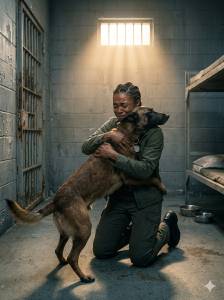
The agent used a master key from the front desk to unlock the heavy door. The moment the iron gate swung open, I dropped to my knees.
“Free,” I whispered the release command.
Kodiak broke his stay instantly. He didn’t walk—he launched himself into me. Seventy pounds of trained muscle slammed into my chest, nearly knocking me backward. He buried his head into my neck, letting out sharp, emotional whines. His tail wagged so hard his entire body shook. I wrapped my arms around him, pressing my face into his fur. For the first time since this started, a tear slipped free, hidden in his coat.
“Good boy,” I said, my voice thick. “You did perfect, buddy. You did perfect.”
After a moment, I stood and clipped his leash back onto his harness. Kodiak shifted immediately into working mode, pressing close to my leg, eyes scanning the hallway. We moved out together.
By the time we reached the main lobby, the station was fully under federal control. Agents were moving fast—boxing up files, pulling hard drives, dismantling everything piece by piece.
At the center of it all sat Sheriff Clayton Rusk, bound to a plastic chair. His face was bruised and dirty from the takedown. Standing over him was a tall man in an FBI windbreaker—Colonel James Miller.
He looked up as I entered with Kodiak. A restrained but proud smile crossed his face. “Chief Cole. Good to see you in one piece.”
“Good to see you, sir,” I replied with a short nod. “Appreciate the timing.”
Miller turned back to Rusk. The sheriff looked up at me, eyes wide with shock, anger, and the slow realization of what had happened.
“You set me up,” Rusk spat, blood at the corner of his mouth. “You federal b*stards—this is entrapment! You have no jurisdiction! A judge will throw this out before breakfast!”
Miller let out a quiet breath and pulled a rugged tablet from his vest. He swiped the screen and held it up.
The footage was crystal clear. The diner. The exact moment Rusk k*cked Kodiak. Every word, every slur, every threat captured perfectly. It rolled forward—traffic stop, arrest, interrogation—right up to his own words about tampering with cameras and making me “disappear.”
“Entrapment means we made you commit a crime,” Miller said evenly. “No one made you do anything. You chose every step.”
Rusk stared at the screen, stunned. “Where… where did that come from? My cameras were off. There were no cameras in the diner.”
I stepped forward, letting Kodiak stand beside me. I tapped the reinforced Kevlar panel on his harness.
“You spent so much time looking down on us, Clayton,” I said. “My skin. My service. My dog. You were so blinded by it, you never noticed the ‘filthy animal’ you k*cked was wearing a live-streaming bodycam.”
His gaze dropped to the harness. The realization hit all at once. The dog he had abused was the one who recorded everything. His shoulders sagged. The fight drained out of him.
“Get him out of here,” Miller ordered.
Agents pulled Rusk to his feet and marched him outside, past the growing crowd. The people of Ashford Ridge stood in silence as he was loaded into a federal transport van.
No one looked away anymore.
Miller turned back to me. “DOJ is taking over. We’ve got enough to put him, his deputies, and half the system behind him away for decades. You okay, Brianna? We can have you in D.C. tonight.”
I looked down at Kodiak, leaning calmly against my leg. Then I looked out at the mountains, the first light of dawn breaking across them.
“No, sir,” I said quietly. “I bought a cabin here. I think I’ll go home.”
By the time Kodiak and I stepped through the shattered doors of the precinct, the sun was rising over the Colorado peaks. The sky shifted from deep purple to bright gold. The cold night air gave way to the clean scent of pine and damp earth.
The lot—where I had nearly been killed—was now filled with federal vehicles and agents working methodically.
A crowd stood behind the tape.
People who had stayed silent. People who had looked away.
They watched as Rusk was brought out again—no badge, no authority, just a man in cuffs between federal agents. The arrogance was gone. He scanned the crowd, searching for loyalty.
He found none.
As Kodiak and I walked toward my truck, the crowd parted. No one spoke. Their faces carried a mix of awe, relief, and quiet guilt.
An older man stepped forward—the same one from the diner. He removed his cap, twisting it in his hands.
“Ma’am,” he said, voice unsteady. “We knew… what he was doing. For years. We tried once, but… nobody listened. We were scared.”
I stopped. I understood that kind of fear. I’d seen it in places far worse than this.
“I understand,” I said. “But next time—say it louder.”
He nodded, eyes wet, and stepped back.
I opened the tailgate. Kodiak jumped in without hesitation, settling onto his bed with a deep, satisfied breath. I climbed into the driver’s seat and started the engine.
Over the next week, Ashford Ridge changed. Federal teams took over. Reports poured in—years of abuse, corruption, silence finally breaking. Rusk and Keene were denied bail, held on a long list of federal charges.
The diner reopened. People talked freely again. Laughed again.
And for the first time in a long time, no one was looking over their shoulder.
And me? I spent that week on the porch of my small cabin, sipping coffee and watching the wind move through the pines.
But something had shifted.
Whenever I drove into town—to the feed store or the hardware shop—people didn’t just give polite waves anymore. They stared. They whispered. They left baked goods on the hood of my truck. The local paper asked for an interview. They wanted the story of the Black female Navy SEAL who had taken down a corrupt police department with a takedown and a K9 camera.
They wanted a hero.
But I didn’t make it through twelve years of combat to become a monument. I didn’t buy that cabin to be anyone’s savior. I came for one thing: silence. And I knew that as long as I stayed in Ashford Ridge, I would always be the woman who fought the sheriff. I would never just be Brianna.
So, exactly seven days after the raid, I packed.
I loaded my duffel bags, Kodiak’s gear, and my few belongings into the truck. The bruise on my shoulder had faded to a dull yellow, but my spirit felt lighter than it had in years.
As I drove out of Ashford Ridge for the last time, a few locals stood by the roadside. They didn’t try to stop me. They simply raised their hands in a quiet, respectful wave—gratitude mixed with the understanding that my part here was over. I didn’t wave back like a hero. I gave a slow nod and kept driving.
Because the lesson here wasn’t that one retired SEAL saved a town.
The lesson is that bullies thrive in the dark. They depend on silence. They depend on you believing that a badge, a title, or a loud voice makes them untouchable. But discipline, courage, and undeniable evidence will defeat a b*lly every time.
Never mistake a warrior’s silence for weakness. Sometimes we’re not retreating—we’re just waiting for you to step into the trap.
