


The sharp, grating cackle struck me right in the chest before I could even lift my hand off the hood of the EV-7.
I had driven nonstop for 45 minutes across the city from my engineering lab to this upscale luxury dealership. I knew I didn’t resemble their typical wealthy customers. Thick grease was packed deep beneath my fingernails, and a heavy smear of dark engine oil ran across my left cheek. I wore a faded flannel shirt riddled with tiny burn holes from late-night soldering sessions, ripped jeans, and heavy work boots so worn the leather had split open at the toes.
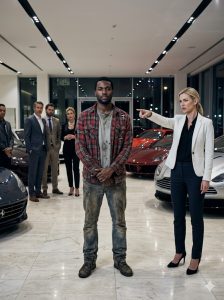
But in that deeply emotional moment, I didn’t care about how I looked. I had spent the last three years of my life painstakingly building this very car. I had worked exhausting 16-hour days, missed Thanksgiving and Christmas with my chosen family, and slept on a thin, uncomfortable cot in my freezing lab when my battery prototypes kept failing at 20 degrees below zero. Standing in that brightly lit showroom, it was the first time I had seen my creation fully assembled and gleaming with a flawless, high-gloss finish. The interior carried a faint scent of new vegan leather, and the intricate infotainment system I had coded from scratch glowed a soft, familiar blue on the dashboard.
For a brief moment, those heavy years slipped away, and I was 14 again. I remembered shivering through winter nights, sleeping at a drafty bus stop directly across from this very dealership. As a young Black kid trapped in a broken foster system, drifting between temporary homes, I used to sneak inside on bitter January days just to stand quietly near the heat vents and stare at the cars. Back then, I was invisible—a forgotten kid dreaming that one day I would build something that didn’t fall apart in the middle of the night. I wanted to create something that would make kids like me feel safe, like they finally belonged somewhere permanent.
Then the saleswoman walked over, wearing a red-lipsticked smirk sharp enough to cut. A polished name tag reading “MANDY” was neatly pinned to her crisp, expensive white blazer. In an instant, my quiet dream burst apart.
“Can I help you find the nearest homeless shelter?” she asked.
She didn’t lower her voice. She said it loudly enough for the entire showroom to hear. Three other sales reps immediately began snickering behind their sleek desks, while a wealthy couple trying out a $200k sports car looked over and laughed into their expensive lattes.
Heat surged across my face in a sudden, intense flush. I had faced this same look my entire life—that degrading sneer that treated me like I was less than nothing because I grew up without parents, without money, without a last name that carried weight. For a split second, I nearly turned to leave. I considered going home, changing into the tailored suit I had recently bought for my upcoming National Innovation Award ceremony, and returning when no one could judge me for the worn clothes I had used to build the very cars they sold. But a quiet wave of defiance rose inside me. I had worked far too hard to stand in this room. I didn’t owe anyone a polished appearance to prove I belonged.
“I’m here to ask about the EV-7,” I said, my voice steady despite my raw hands clenched tightly in my pockets, my fingernails pressing so hard into my palms they nearly drew bl**d.
Mandy threw her head back and laughed so harshly she had to wipe tears from the corners of her heavily made-up eyes. She flicked at the sleeve of my worn flannel as if it were filthy. “Sweetheart, this car costs $120,000. That’s more than you make in six years flipping burgers, right? We don’t let people hang around here to stare at cars they’ll never afford. Go take a look at the rundown used lot down the street. That’s where people like you belong.”
Part 2: The Manager’s Mistake
The sharp, cutting echo of Mandy’s laughter ricocheted off the spotless, floor-to-ceiling glass walls of the showroom, swelling until it seemed to drown out every other sound in the building. “Go check out the beat-up used lot down the road,” she had said, her tone dripping with a cruel kind of satisfaction. “That’s the place for people like you.”
For a long, painful moment, the air inside the luxury dealership went completely still. The soft jazz playing from the hidden ceiling speakers felt strangely out of place against the suffocating tension tightening around my chest. I stood there—a young Black man in a faded, burn-scarred flannel and grease-stained jeans—frozen on the immaculate white marble floor. I could feel every eye in the room shifting toward me. The wealthy couple sitting in the $200,000 sports car nearby had stopped speaking entirely. The man, dressed in a pristine cashmere sweater draped over his shoulders, paused with his overpriced latte halfway to his lips. His wife, glittering with heavy diamonds under the harsh showroom lights, let out a quiet, dismissive scoff that hit harder than any blow.
They weren’t looking at me as a person—not as someone who had spent three years sacrificing sleep, comfort, and sanity to build the very machine they admired—but as a blemish. A smudge on their perfect, insulated world. I could see the familiar, nauseating judgment forming in their eyes. My worn boots and the oil streak across my cheek didn’t tell a story of hard work or ingenuity to them. Combined with the color of my skin in this exclusive space, it told a story of intrusion. I didn’t belong. I was something to be erased.
Mandy didn’t even give me a chance to respond. She had already decided my value, labeled me “worthless transient,” and moved on. With an exaggerated sigh of irritation, she spun on the heel of her designer pumps. The sharp clack of her steps echoed across the marble as she raised her hand, snapping her manicured fingers to summon the broad-shouldered security guard standing near the glass entrance.
“Frank! We need you over here!” Mandy called, her voice calm, almost bored—like she was asking someone to wipe up a spill. She pointed a polished fingernail directly at my chest. “This guy is loitering and refusing to leave. Escort him out, please. Before he gets grease on the merchandise.”
I watched the guard’s head snap up. His posture tightened, his hand instinctively dropping near the heavy belt at his waist as his gaze locked onto me. That universal look—authority preparing to handle a “problem.”
And in that exact, terrifying instant, the bright showroom around me vanished.
The hum of the air conditioning, the faint scent of vegan leather, the glaring lights—it all dissolved into a rushing roar in my ears. My mind went cold. My breath caught as a deep, bone-chilling fear gripped my body.
I wasn’t twenty-five anymore. I wasn’t the lead engineer of National Auto Innovations. I wasn’t the man carrying a twenty-four-million-dollar contract in his pocket.
I was twelve again.
I could taste freezing rain on my lips, metallic and bitter. I could feel it soaking through my thin sneakers, turning my socks into icy weights. I stood on the rotting porch of my third foster home—a peeling, broken house at the end of a forgotten street. The sky above was a bruised purple, pouring down freezing October rain that stung like needles against my skin.
My stomach ached with hunger, but it was nothing compared to the crushing rejection. My dark green duffel bag lay in the mud at the bottom of the steps, unzipped, spilling my few belongings—a couple of worn socks, a too-small T-shirt, and a battered library book about engine mechanics—into the cold dirt.
In the doorway stood my foster mother, Brenda, blocking the warm light inside. Her face twisted with rage, veins bulging as she screamed over the rain.
“You dirty little th*ef!” she shrieked, pointing at me the same way Mandy had just done. “I knew it was a mistake taking you in! I knew it! You people are all exactly the same! You bring nothing but trouble into my house!”
My twelve-year-old self trembled violently, teeth chattering, tears mixing with the rain. “I didn’t st*al anything, Brenda! I swear!” I cried, voice cracking with desperation. “I just fixed it! I just wanted to help!”
Behind her sat the old rusted lawnmower. It had been broken for years. For nights, I had quietly worked on it—cleaning parts, fixing cables—hoping to prove I had value. Hoping she might finally see me differently.
But she hadn’t. She saw only a problem. A threat.
“You’ll never amount to absolutely anything!” she screamed, slamming the door with a violent BANG. The lock clicked shut, sealing me outside in the cold.
I stood there for hours, shivering, staring at the door, realizing the world had already decided who I was. Disposable. Worthless.
The memory hit so hard my chest heaved in the showroom. My hands trembled in my pockets as the cold rain faded, replaced by sterile air.
The guard was halfway toward me now. Mandy stood with arms crossed, smirking.
I drew a slow, steady breath. I wasn’t that boy anymore.
Before the guard could reach me, the glass door of the manager’s office swung open.
Grant Carter stepped out, moving quickly, tension in every stride. He looked exhausted—his suit loose, his tie undone, his eyes hollow with sleepless nights. A man on the edge.
I knew his situation well. His dealership was failing. Two weeks from collapse. Twenty-two employees depending on him. And he had been desperately trying to reach me—the Lead Engineer—for months.
Now he stood here, unaware he was looking at his only chance.
“What’s going on here, Mandy?” Grant asked, voice dry and tired. His eyes scanned me quickly—boots, clothes, grease—and I saw the same judgment form. Another problem.
Mandy rolled her eyes and gestured toward me. “This transient wandered in off the street,” she said. “He thinks he can stand around and gawk at the EV-7. I told him he’s wasting our time, but he refuses to leave. I was just having Frank escort him out before he scares off customers or tries to steal something.”
The words hit like echoes from the past.
Grant sighed heavily. For a split second, there was a flicker of sympathy—but it vanished. He was too tired to fight this battle. He just wanted it over.
“Sir,” Grant began, forcing a polite tone, “I’m going to have to ask you to—”
He was about to make the worst mistake of his career.
But this time, I wasn’t that boy in the rain.
I met his exhausted eyes, my gaze hardening into something unbreakable, and prepared to change everything.
Part 3: The $24 Million Revelation
“Sir,” Grant Carter began, his voice a strained, raspy whisper like dry leaves scraping across concrete. He cleared his throat, trying to summon the authority of a general manager, but only managed a hollow, worn tone. “I’m going to have to ask you to—”
He never finished. I wasn’t going to allow it.

The air inside the luxury showroom felt thick, weighed down by wealth, privilege, and the silent judgment of everyone present. The couple seated in the $200,000 sports car had stopped their quiet conversation entirely. They stared at me with a mix of curiosity and thinly veiled disdain, waiting for the inevitable ending—the moment the dirty, out-of-place Black man in the ruined flannel would be removed so they could return to discussing leather trims and acceleration times.
Mandy stood nearby, arms folded tightly over her immaculate white blazer. Her posture radiated arrogance. Her chin lifted, lips curled into a smug smile. She was enjoying this. To her, I wasn’t a person—I was a nuisance she had already dealt with. Her eyes flicked toward Grant, clearly expecting him to say the words that would send the security guard forward to throw me out.
But I didn’t move. My boots stayed planted on the cold marble floor as a strange, steady calm settled over me—the same clarity I felt in the lab at three in the morning when everything finally made sense.
I looked at Grant Carter and saw not authority, but desperation. Dark circles under his eyes, a faint tremor in his hand, panic written across his face. A man drowning. A man fourteen days from losing everything.
And yet, he was about to throw away the only thing that could save him.
“Before you finish that sentence, Mr. Carter,” I said quietly.
My voice was calm but sharp enough to cut through the room.
Grant blinked, caught off guard. His mouth closed mid-word, his eyes widening slightly. He had expected resistance—anger, pleading, maybe a scene. Not this. Not control.
Mandy scoffed loudly. “Oh, please,” she snapped. “Don’t try to negotiate. You don’t belong here. Frank, just grab him. He’s probably casing the place.”
I didn’t even look at her. My eyes stayed locked on Grant.
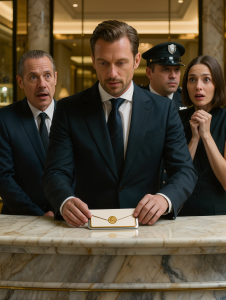
Slowly, I reached into my pocket and pulled out two items. A white envelope sealed with gold—the Department of Transportation crest—and a lanyard holding a corporate ID.
I placed them on the marble counter. The badge struck the surface with a sharp crack that echoed through the silent showroom.
“I don’t need to test drive the EV-7 to know how it runs,” I said evenly.
The room went completely still.
“I don’t need a test drive,” I continued, meeting his eyes, “because I designed it. Every single inch.”
Grant stared, uncomprehending. Then his gaze dropped to the badge.
“I spent thirty-six months building its six-hundred-mile battery system,” I said, my voice rising slightly. “I engineered its safety frame. I wrote the algorithms that cut production costs in half.”
I paused as his hand hovered over the badge.
“The Department of Transportation recognized that work,” I added, gesturing to the envelope. “And they gave me full control over distribution. I hold the exclusive twenty-four-million-dollar contract.”
Grant’s face drained of color. He picked up the badge with trembling hands, comparing the photo to my face.
“I… Mr… Mr. Bennett?”
“That’s my name,” I said. “I came here to finalize that contract.”
The realization hit him hard. He grabbed the counter to steady himself, breath uneven as the weight of what had just happened crashed down on him.
“Mr. Bennett… I… I had no idea…” he stammered.
But his reaction was nothing compared to Mandy’s.
I turned to her.
Moments ago, she had been confident, untouchable. Now she looked hollow. Pale. Frozen. Her expression collapsed as she stared at the badge.
“Y-you…” she stuttered. “You’re the…”
“The transient?” I said quietly. “The one who belongs at the used lot?”
She flinched.
“Oh my god,” she whispered, panic flooding her voice. “I’m so sorry. I didn’t know. It was just a joke—please, you have to believe me!”
She reached toward me, desperate. I stepped back.
Her apology meant nothing.
“You can have the car!” she cried. “Free! Maintenance for life! Anything—just please don’t be mad!”
It was pitiful.
For a moment, I almost felt something—but it vanished. I remembered too much. Every look. Every assumption. Every time I had been reduced to nothing.
This program wasn’t built for people like her. It was built to break systems like hers.
I turned away from her completely and faced Grant.
“I chose this dealership for a reason,” I said, my voice quieter now.
I glanced toward the far corner.
“When I was fourteen, I was homeless. I used to sneak in here to warm up. A salesman named Joe Henderson found me.”
Grant’s expression shifted.
“He didn’t throw me out. He helped me. He made me feel like I mattered.”
I met his eyes.
“I wouldn’t be here without that.”
Grant swallowed hard. “Joe… he still comes in every Friday. He talks about that kid all the time.”
The moment settled heavily between us.
Then his expression hardened.
“Mr. Bennett,” he said quietly, “what do you want me to do about her?”
Silence filled the room.
I looked at Mandy one last time. This wasn’t a mistake. This was who she was.
I turned back to Grant.
“The contract is yours,” I said.
Relief flooded him instantly.
“But—”
He froze.
“I have one condition,” I said, pointing toward Mandy. “She is fired.”
Mandy gasped.
“If you want this deal, she’s gone. Immediately. No exceptions.”
I leaned closer.
“Otherwise, I walk out and take the contract elsewhere.”
There was no hesitation.
“No problem at all, Mr. Bennett,” Grant said firmly, his authority fully returned. He didn’t even look at her. “She is gone. I will have Frank the security guard walk her out of the building right now.”
Part 4: Full Circle
“She is gone. I will have Frank the security guard walk her out of the building right now.”
Grant Carter’s voice carried across the silent showroom, firm and absolute, like a man who had just pulled his life back from the edge. He didn’t even glance at Mandy. His tired eyes, still shadowed with exhaustion, stayed locked on mine. The panic that had gripped him moments earlier was gone, replaced by something cold and resolute. He was a manager again—a father protecting his home, a leader protecting his team—and he wasn’t about to let one toxic employee destroy that.
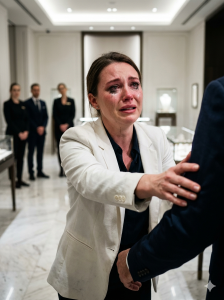
Mandy let out a sharp, piercing scream that tore through the stillness. “You can’t do this!” she cried, her voice cracking under the weight of reality. She stumbled toward Grant, her white blazer wrinkled, mascara streaking down her face, her polished image collapsing into something frantic and unrecognizable. “Grant, you cannot do this to me! I am your top earner! I’ve been here for seven years! I have a mortgage! I have a kid in daycare! You can’t just fire me over a stupid misunderstanding!”
Grant slowly turned to her, his face completely devoid of sympathy. Whatever compassion he might have had was gone, burned away by how close he had come to losing everything.
“It wasn’t a misunderstanding, Mandy,” he said quietly, his voice low but sharp enough to make the nearby staff flinch. “You humiliated a man because you assumed he was poor. You tried to throw out the Lead Engineer of the EV-7 program because you judged his clothes. You nearly cost twenty-two people their jobs, their insurance, and their livelihoods because of your arrogance. You are a liability to this business and everything we stand for. You are terminated, effective immediately. Frank!”
The security guard snapped to attention, stepping forward. “Yes, Mr. Carter.”
“Escort her to her desk. She has five minutes to collect her things, and then you walk her out. If she makes a scene, call the police,” Grant said firmly.
Mandy’s protests turned into frantic sobbing as Frank guided her away. She begged, apologized, and looked at me one last time with desperate eyes—but I turned away. I had spent years being punished for things I couldn’t control. She was now facing the consequences of choices she made fully aware. I felt nothing. As her cries faded, a heavy silence settled over the showroom.
Grant exhaled deeply, running his hands over his face before turning to his stunned staff.
“Everyone, gather around,” he called.
They approached slowly. When they were all there, Grant’s voice trembled.
“I’ve been hiding something from you for two months,” he said. “We were close to bankruptcy. Fourteen days from shutting down. I had termination letters ready for all of you this Friday. I thought we were finished.” He paused, then gestured toward me. “But this man—Mr. Leo Bennett, Lead Engineer of National Auto Innovations—just brought us a twenty-four-million-dollar government contract. We’re not closing. No one is losing their job. Your insurance is safe. And every one of you is getting a ten percent bonus.”
The room erupted—gasps, cheers, tears. Some of the staff broke down, hugging each other. Grant stepped forward and gripped my hand with both of his.
“Thank you,” he whispered. “You saved us.”
An hour later, I sat in his office. The stack of termination letters was gone, replaced by the contract documents. I signed my name, finalizing the deal. Across the room, Grant was on the phone with his wife, crying as he told her their home was safe.
As I prepared to leave, the door creaked open.
An older man stood there in a worn mechanic’s jacket, holding a chipped coffee cup. His silver hair thinned at the crown, his face lined with years of work and kindness. He froze when he saw me.
He squinted, studying my face—the grease, the eyes—trying to place me.
“Joe?” I said softly.
His eyes widened. “Hey… you’re that kid, aren’t you? The one who used to come in and ask all those questions about engines?”
A smile spread across his face, and my chest tightened. I handed him the gold-sealed award invitation. As he read it, his hands trembled.
“I knew it,” he said, voice breaking. “I always knew you’d do something great.”
I showed him a photo of Tom. “He taught me everything. But you… you were the reason I believed I could do it.”
Joe pulled me into a tight embrace. We stood there for a long time, talking about everything that had brought us back to this moment.
A week later, the first shipment of EV-7s arrived—twenty cars, painted sky blue, polished and ready.
I stood in the showroom again, this time in a tailored navy suit, watching as community members arrived.
The first keys went to a seventeen-year-old girl named Lila.
Her story mirrored mine—years in foster care, unstable housing, working multiple jobs to survive. Her old car had failed her when she needed it most.
When I handed her the key fob, she held it like it was priceless. She sat in the driver’s seat, ran her hand over the dashboard, and then broke down crying—relief pouring out all at once.
I leaned in and handed her a note with my number.
“This car is for people like us,” I told her. “If you ever need anything, you call me. And don’t let anyone tell you that you don’t belong.”
She nodded, eyes shining. “I won’t.”
As for Mandy, word spread quickly. No dealership would hire her. Eventually, she ended up working at the same kind of used car lot she had mocked.
Every time one of those blue EV-7s passed by, she was reminded of what she had lost.
But I didn’t think about her anymore.
I was too busy building what came next—designing affordable electric trucks, mentoring kids, proving every day that success isn’t defined by where you start or what you wear.
A week later, I stood on a stage in Washington D.C., accepting the National Innovation Award. Beneath my suit, I carried Tom’s photo close to my heart.
At the microphone, I didn’t talk about technology or profit.
I thanked Joe for a cup of hot cocoa. I thanked Tom for believing in me. And I spoke to every kid out there who felt forgotten.
The world will try to decide who you are.
But they don’t write your story. You do.
THE END.
