


The Wealthy Businessman Came Home Early — and Was Stunned by What He Found
Michael Reynolds had never felt so powerless as he had these past several months. Even as the head of one of San Diego’s biggest construction firms, he’d had to face a hard reality: no fortune could mend his three-year-old daughter’s broken heart.

That afternoon, some unexplainable instinct pulled him away from an investor meeting early and sent him home. When he walked into the kitchen of his mansion, he had to grip the doorframe just to stay upright.
There was his daughter Ava, perched happily on the housemaid’s shoulders. The two of them were washing dishes together, singing a silly children’s tune. Ava was laughing — freely, unguardedly — a sound he hadn’t heard from her in months.
“Scrub right here, princess,” Paige said gently, guiding Ava’s small hands. “You’re doing great.”
“Aunt Paige, can I make bubbles with the soap?” Ava asked, then stopped short. “What’s wrong?”
Her voice rang out clear. Sure of itself. Alive. A voice Michael had worried was lost for good.
Paige spotted him and nearly lost her footing.
“Mr. Reynolds, I didn’t expect you home so soon,” she said, flustered.
“Daddy!” Ava cried — then immediately shrank back, as though she’d broken some rule.
Michael turned and hurried to his office, shutting the door behind him. His hands shook as he poured a glass of whiskey.
What he’d just seen left him deeply shaken. How had this young woman managed, in only a few months, what he himself had failed to do for so long? Why did Ava chatter so freely with the maid, but fall silent around her own father?
The next morning, Michael left for work as usual — but instead of driving to the office, he parked several blocks away and doubled back on foot. He needed answers. He slipped in through the rear entrance, went straight to his study, and set up a handful of small cameras he’d picked up on his way home.
What he saw afterward changed everything he thought he knew.

Paige never treated household chores as mere obligations. She turned laundry into a soft lesson on colors. Folding towels became a quiet matching game by size. Making dinner meant counting carrots and naming the herbs that scented the kitchen air. Bedtime stories drifted naturally into talks about feelings, about people who were missed, about how the world kept turning even when it felt shattered.
One night Ava asked, her voice thin but steady, “Why does the sky turn orange at night?”
Paige smiled, tucking the blanket snugly around the girl’s shoulders. “Because the sun is saying goodnight, the way people do. It doesn’t mean it’s gone for good. It just means the day is resting so tomorrow can start.”
Michael’s chest tightened watching Ava take this in without any fear. Something about that simple answer had reached a place no formal therapy had ever touched.
Not everyone under that roof was pleased.
Agnes Whitford, the family’s longtime house manager, watched Paige with a resentment she barely bothered to hide. Agnes had helped raise Michael himself. She’d been there through his mother’s illness, his wedding, the long quiet months following the accident. To her mind, the household ran on a certain order, and Paige was upending it.
“You’re overstepping,” Agnes told her one afternoon in the laundry room, her tone low and cutting. “You were hired to keep this house running — not to raise the child.”
Paige kept her voice level. “I’m not replacing anyone,” she said. “I’m just listening. Sometimes that’s all a child really needs.”
Tension between the two women kept building. Michael felt torn — loyalty to the woman who’d stood by his family for decades, against the plain fact that his daughter was coming back to life under Paige’s quiet attention.
Then the preschool teacher called.
Her voice was bright with excitement. “She spoke today,” the teacher said. “She played with the other kids. She told them stories about the cooking and cleaning games you do at home. Whatever’s happening there — it’s working. We’ve been waiting so long to hear her voice.”
Michael left work early that day. He arrived home to find Agnes scolding Paige in the backyard while Ava clung to her legs, tears running down her small face.
“I don’t want her to go,” Ava wept, the words spilling out unfiltered.
Michael stepped in. “What’s going on here?”
“She took the child outside without asking,” Agnes said sharply. “There are rules for a reason.”
“Ava wanted to see the flowers,” Paige said quietly. “I thought it would be fine.”
Michael crouched to his daughter’s level. “Are you okay, sweetheart?”
Ava sniffled, wiping her face with her hand. “Paige says flowers grow even when it rains. Like people do.”
That evening Michael called both women into his study. Agnes spoke first, laying out careful, pointed accusations. She claimed Paige was manipulating the situation, worming her way into the child’s life inappropriately. Then she dropped something she’d dug up herself: Paige actually held a degree in early childhood education.
Michael looked at Paige. “Why didn’t you mention that when you were hired?”
Paige held his gaze steadily. “Because people get suspicious when education shows up alongside poverty,” she said quietly. “I needed the job. I didn’t need the judgment.”
A few days later, Agnes came back with another accusation — that Paige had lied about her address. When Michael pressed for an explanation, Paige’s calm finally broke. She admitted that after losing the affordable housing she’d shared with her younger siblings, she’d moved into a temporary shared shelter. She’d been afraid the truth would cost her the job.
“I was scared,” she said, her voice shaking. “I didn’t want to lose this. Ava means so much to me.”
Michael surprised even himself with what he said next. “Then help me understand your life before I decide anything.”
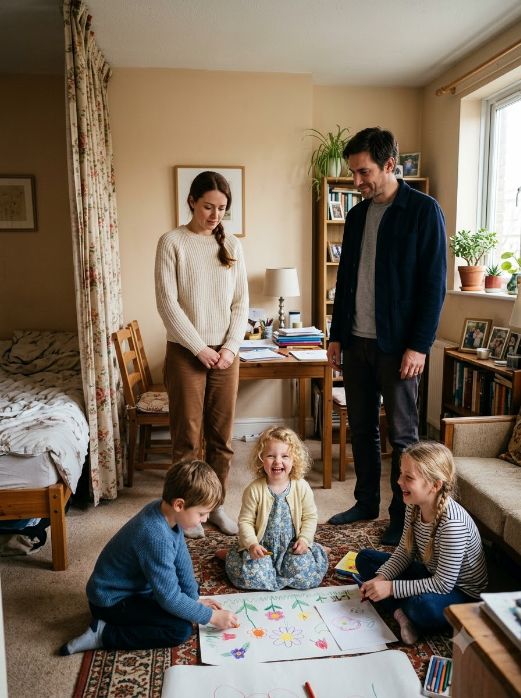
That weekend, he visited the cramped apartment where Paige’s family had found temporary footing. The space was tight — schoolbooks piled on a narrow table, a curtain splitting off the sleeping area — but it was warm all the same. Her younger siblings welcomed him with curious, polite eyes and obvious pride in their sister. Ava, who’d insisted on tagging along, was sitting on the floor within minutes, drawing pictures alongside the kids, her laughter spilling freely through the room.
When they got home, Michael had made up his mind.
Agnes announced her retirement not long after. In a quiet moment, she admitted she’d been wrong — about Paige, about the shift in the household, about the chance that someone new could bring exactly what the family needed. There was no big confrontation, just a long, understanding look and a handshake carrying years of shared history.
Paige stayed on. Clearer boundaries were drawn. Trust, once broken, began mending on steadier ground.
Months went by. Ava thrived. She spoke up confidently at preschool, slept peacefully without the restless dreams that used to haunt her, and laughed so often it no longer startled anyone in the house. Michael changed too. He started leaving the office earlier. He learned to cook simple meals himself instead of leaving everything to the staff. Most of all, he learned to listen instead of rushing to fix whatever seemed broken.
One evening, they planted flowers together in the garden his late wife had once tended. Ava pressed a small marigold into the dirt, patted the soil around it, and looked up at her father.
“Mommy is gone,” she said, “but love stayed.”
Michael felt tears fall freely for the first time in ages. He didn’t wipe them away.
Over the seasons that followed, something grew between Michael and Paige — slowly, carefully, rooted in respect rather than need or gratitude alone. They moved cautiously, aware of the tangled history between them, and of the small child who noticed everything with clear, thoughtful eyes.
One night, as Ava was being tucked in, she asked, almost offhandedly, “Are we a family now?”

Neither one rushed to answer. Both of them smiled.
They married a year later in that same garden, surrounded by the flowers they’d planted together and the quiet presence of those who’d witnessed the long journey back from silence. Ava scattered petals along the path, declaring with proud certainty that families are built from care, not just names.
The house that had once echoed with silence now overflowed with the ordinary, precious sounds of life being lived again — laughter in the kitchen, footsteps on the stairs, the soft hum of bedtime stories. Healing, Michael came to understand, often arrives quietly. It comes not through grand gestures or costly interventions, but through patience, honesty, and the unexpected gift of someone willing to listen when the rest of the world has grown too loud or too far away to hear.
