


During a family gathering, my mother shouted, “Learn from your sister who sends us $4,000 every month, you ungrateful daughter!” I tried to explain, “But that’s actually me…” but my father yelled, “Don’t steal your sister’s accomplishments! Then try stopping the payments!” The next month, I uncovered the truth.
The family gathering opened with the scent of roasted chicken, lemon cleaner, and bitterness that had lingered for years.
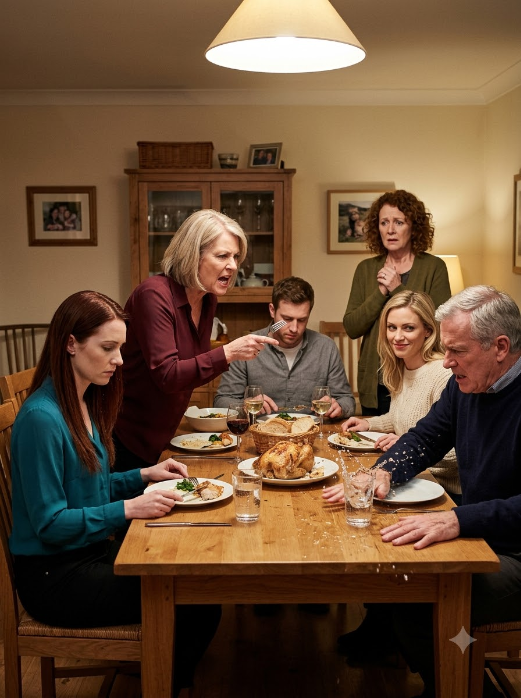
I sat at the far end of my parents’ dining table in Columbus, Ohio, hands folded in my lap, listening to my mother praise my older sister, Vanessa, as if she alone had saved the entire family from ruin.
“Learn from your sister who sends us $4,000 every month!” my mother, Patricia, snapped, aiming her fork at me. “You ungrateful daughter!”
My father, Richard, leaned back in his chair with the same heavy authority he’d always used to silence me. Vanessa sat beside him, scrolling her phone, a small satisfied smile curling her lips.
I stared at her.
Four thousand dollars.
Every month.
For three years.
Money I had quietly wired after my father’s knee surgery, after my mother’s hospital bills, after they warned they might lose the house. I never told them, because they had always assumed Vanessa was the successful one. Vanessa, the favored daughter with designer bags and polished lies. Vanessa, who hadn’t kept a steady job in years.
I opened my mouth carefully.
“But that’s actually me—”
My father slammed his palm on the table hard enough to rattle the water glasses.
“Don’t try to steal your sister’s accomplishments!” he shouted.
The room fell silent.
My younger brother, Eric, dropped his gaze. My aunt Linda froze mid-bite, napkin halfway to her mouth.
Vanessa finally glanced up from her phone. For half a second, fear crossed her face. Then she smiled.
“Dad, don’t get upset,” she said sweetly. “Megan’s always been jealous.”
My name sounded ugly coming from her.
My mother shook her head in disgust. “You show up here in your cheap blouse with your bitter face, and instead of being grateful your sister supports this family, you try to claim her sacrifice?”
Something in me went very still.
For years I had worked double shifts as a financial analyst, skipped vacations, lived in a cramped apartment, and sent money from an account labeled “family support.” I never expected thanks. I only wanted my parents safe.
But watching Vanessa soak up praise for my exhaustion changed everything.
I looked at my father. “Are you sure you want me to stop talking?”
He sneered. “Yes. And if you’re so desperate to prove something, then try stopping the payments.”
Vanessa’s smile vanished.
My mother laughed coldly. “She can’t stop what she never started.”
I stood, grabbed my purse, and pushed in my chair.
“Fine,” I said. “Next month, you’ll know.”
I walked out while my father shouted after me, calling me dramatic, jealous, and selfish.
The following month, I learned the truth was worse than stolen credit.
Part 2
I didn’t cancel the payments right away.
That was the detail people misunderstood later. They assumed I’d acted out of anger, cutting my parents off in one emotional outburst just to watch them suffer.
The reality was far quieter.
That night, I drove home to my apartment in Cincinnati, hands gripping the wheel so tightly my fingers ached. My father’s words kept looping in my head. Don’t try to steal your sister’s accomplishments. Then try stopping the payments.
By the time I got home, the roasted chicken I’d barely touched sat like a stone in my stomach. I opened my laptop and logged into my bank account.
There it was.
Automatic transfer.
$4,000 monthly.
Recipient: Patricia and Richard Lawson.
Memo: Family support.
I stared at it for a long moment.
Then I noticed something I should have caught sooner. A second linked account had been added to the payment chain six months earlier. My money still left my account, but now it routed through a joint checking account before reaching my parents.
Joint account holders: Vanessa Lawson and Patricia Lawson.
I sat back slowly.
My mother knew.
Or at least had access.
I scrolled through the transaction history, downloading statement after statement. My breath grew shallow as the pattern emerged. For the first two and a half years, the full $4,000 had gone straight to my parents. Then the routing shifted. After that, only $2,500 reached their mortgage and medical bills.
The remaining $1,500 vanished into cash withdrawals, luxury boutiques, hotel charges, and payments to a leasing company for a white BMW Vanessa had been driving while claiming her “consulting business” covered it.
My sister hadn’t just taken credit for my support.
She’d been skimming from it.
And my mother had either looked the other way or helped hide it.
I printed everything the next morning at my office before anyone arrived. Bank statements. Transfer confirmations. Dates. Partial account numbers. Every memo line. Every withdrawal.
I also called the mortgage company.
After twenty-two minutes on hold, I confirmed something that made the room tilt.
My parents were still three months behind.
“But I’ve sent enough to cover the mortgage and the medical payment plan,” I said.
The representative’s tone turned careful. “Ma’am, we can only confirm what’s been received.”
I thanked her and hung up.
Then I called the hospital billing office.
Same answer.
Partial payments. Late fees. Warnings.
By noon, my anger had cooled into something sharper.
I canceled the automatic transfer.
Not because my father had dared me.
Because every dollar I sent was fueling a lie.
That evening, Vanessa called eight times. I didn’t answer. Then my mother called. Then my father. Then Eric.
Finally, a text came from Vanessa.
What did you do?
I stared at the screen until it dimmed.
For the first time in my life, I didn’t rush to explain myself.
A week later, my parents got a notice that the mortgage payment had failed.
Two weeks later, Vanessa’s BMW payment bounced.
Three weeks later, my mother left a voicemail with no shouting in it.
Only panic.
“Megan,” she said, voice shaking. “Call me. We need to talk.”
I deleted nothing.
I kept everything.
Because by then I understood this was no longer about being loved.
It was about proof.
PART 3
By the time I agreed to see them again, I had already met with a lawyer.
His name was Thomas Reed, a calm man in his fifties who wore gray suits and listened without cutting in. His office overlooked a busy Cincinnati street, but inside everything felt hushed: leather chairs, thick carpet, framed diplomas, a glass bowl of peppermints nobody touched.
I set the folder on his desk. “I need to know if I’m imagining this.”
He read in silence for nearly twenty minutes.
Every so often his expression shifted—not dramatically, just enough to tell me the facts were sinking in.
When he finished, he folded his hands.
“You’re not imagining it,” he said. “You’ve been sending money for family support. Your sister appears to have diverted part of it for personal use. Your mother’s name on the joint account raises questions. Your parents publicly crediting the payments to your sister isn’t necessarily illegal on its own, but the diversion of funds may be actionable depending on the representations made and how the account was set up.”
I swallowed. “What should I do?”
“First, don’t restart the payments. Second, don’t argue over the phone. Third, put things in writing whenever you can. Fourth, if they ask for money, request the bills directly and pay vendors yourself, only if you choose to help.”
Only if you choose to help.
That phrase stayed with me long after I left his office.
For thirty-two years, helping had never felt optional in my family. It felt like rent I owed just for existing.
Vanessa was the brilliant one. The beautiful one. The one whose mistakes got called “stress,” whose lies got called “misunderstandings,” whose selfishness got called “ambition.”
I was the practical one. The quiet one. The one expected to fix things, then vanish before anyone had to say thank you.
At sixteen, I worked weekends at a grocery store to buy my own school clothes. At twenty-two, Vanessa wrecked my mother’s car, and my parents blamed the rain. When I graduated from Ohio State with honors, my father said, “Accounting is stable. Don’t get arrogant.” When Vanessa quit her master’s program after one semester, my mother called her “too creative for rigid systems.”
The old memories surfaced again, no longer as wounds, but as evidence.
A pattern laid bare.
I agreed to meet my family at my parents’ house that Saturday. This time I didn’t go alone. Eric came with me. He’d called the night before and admitted he suspected something was off.
“I didn’t realize it was your money at first,” he said. “Vanessa told Mom she was managing transfers from an investment account. But after that dinner, I started putting it together. Dad got angry too fast.”
“Why didn’t you say something?” I asked.
A long pause followed.
“Because in this family, telling the truth gets you punished,” he said.
I understood that far too well.
When we arrived, my mother opened the door right away. She looked smaller than she had at dinner. Her hair was pinned up unevenly, dark circles under her eyes.
“Megan,” she said.
No insult. No accusation.

Just my name.
My father sat in the living room in his recliner, arms folded. Vanessa stood by the fireplace in a cream sweater, her face arranged into careful wounded innocence.
Aunt Linda was there too. I hadn’t invited her, but I was glad she’d come. She’d witnessed the first humiliation. Now she could witness the reckoning.
I sat on the sofa and set the folder on the coffee table.
My father spoke first. “This has gone far enough.”
I met his eyes. “I agree.”
His mouth tightened. He’d expected me to back down.
My mother clasped her hands together. “We just need the payment fixed. The mortgage company called again.”
“The payment isn’t getting fixed,” I said.
Vanessa scoffed. “So you admit you stopped helping out of spite.”
I opened the folder.
“No. I stopped because the money was being stolen.”
The word landed like a dropped plate.
My mother flinched. Vanessa’s eyes sharpened. My father leaned forward.
“Watch your mouth,” he said.
I pulled out the first stack of papers and laid them on the table.
“These are transfers from my account. Four thousand dollars a month for three years. Not Vanessa’s account. Mine.”
Aunt Linda leaned in and picked up the top page, scanning it.
“Oh my God,” she whispered.
My father’s face reddened. “Anyone can print papers.”
I’d expected that.
I pulled out my phone, opened my banking app, and turned the screen toward him. “Then look here. Same transfers. Same dates. Same recipient details.”
My mother stared at the screen.
Her lips parted.
For the first time, I saw not confusion, but recognition.
“You knew,” I said quietly.
She looked away.
That was answer enough.
Eric let out a hard breath beside me. “Mom.”
My father turned on her. “Patricia?”
My mother’s eyes filled. “I didn’t know at first.”
Vanessa snapped, “Mom, don’t.”
But my mother had already begun to unravel.
“I didn’t know at first,” she repeated. “Vanessa said Megan wanted to help anonymously because she was embarrassed she couldn’t visit more. Then Vanessa said it would be simpler if the money passed through her account since she was handling the bills.”
I nearly laughed. Not because it was funny, but because the lie had gone down so easily. They’d believed I was too cold to show up, yet still useful enough to pay.
“And when only part of the money made it to the bills?” I asked.
My mother wiped her cheek. “Vanessa said there were fees. Taxes. Other debts.”
“Fees?” Eric said. “Fifteen hundred dollars a month in fees?”
Vanessa lifted her chin. “I handled everything while Megan played the martyr from another city.”
I turned to her. “You bought a BMW.”
Her expression hardened.
I set down the next stack of papers.
“Luxury stores. Hotels. Car payments. Cash withdrawals. All from the account my money passed through.”
My father stared at the pages. His anger was still there, but it no longer had anywhere to go.
Vanessa crossed her arms. “You gave money to the family. I’m family.”
Silence again.
There it was.
Not denial.
Entitlement.
I looked at my parents. “That’s what you defended.”
My father rose slowly. “Vanessa, is this true?”
She rolled her eyes. “Don’t act shocked. You liked telling everyone I was supporting you. Mom liked it too. It sounded better than admitting Megan was the one keeping the house afloat.”
My mother covered her mouth.
My father’s voice dropped. “You let me call your sister a liar.”
Vanessa laughed once, bitterly. “You didn’t need my help for that.”
The words hit their mark.
My father looked at me, and for a moment something like regret tried to surface on his face. But pride fought it off. Pride had always outweighed love in him.
“Megan,” he said stiffly, “there was confusion.”
“No,” I said. “There was favoritism. There was lying. There was theft. And there was humiliation.”
He looked as though I’d struck him.
I kept going before anyone could cut in.
“I’m not paying another dollar into any account tied to Vanessa or Mom. I’ve spoken with an attorney. I have documentation. I’ll cover the mortgage company directly for one month to stop foreclosure while you sort out your finances. After that, you sell the house, refinance, or figure it out yourselves.”
My mother cried harder. “One month?”
“Yes.”
“But we’re your parents.”
“I know.”
That was all I said.
Those three words carried more weight than I expected. I know. They carried childhood birthdays Vanessa ruined while my parents made excuses. They carried report cards ignored while Vanessa had a dance recital. They carried hospital bills I paid without a single thank-you. They carried a dinner table where my father shouted me down before I could tell the truth.
My father sank back into his recliner.
Vanessa pointed at me. “You’re enjoying this.”
“No,” I said. “I’m ending it.”
She looked around for someone to rescue her. My mother wouldn’t meet her eyes. My father looked drained. Aunt Linda stared at Vanessa as though seeing her clearly for the first time.
Then Eric spoke. “You need to pay Megan back.”
Vanessa barked a laugh. “With what?”
“The car,” he said. “Sell it.”
Her face twisted. “That car is mine.”
“No,” I said. “It was bought with stolen money.”
Vanessa snatched her purse. “You’re all pathetic. You needed me when you wanted something to brag about. Now you need someone to blame.”
She headed for the door.
My father called after her. “Vanessa.”
For once, she stopped.
His voice shook. “Give your mother the account card.”
Vanessa turned slowly. “Excuse me?”
“The account card,” he repeated.
She looked at my mother. “You’re letting him talk to me like this?”
My mother’s face crumpled. “Vanessa, please.”
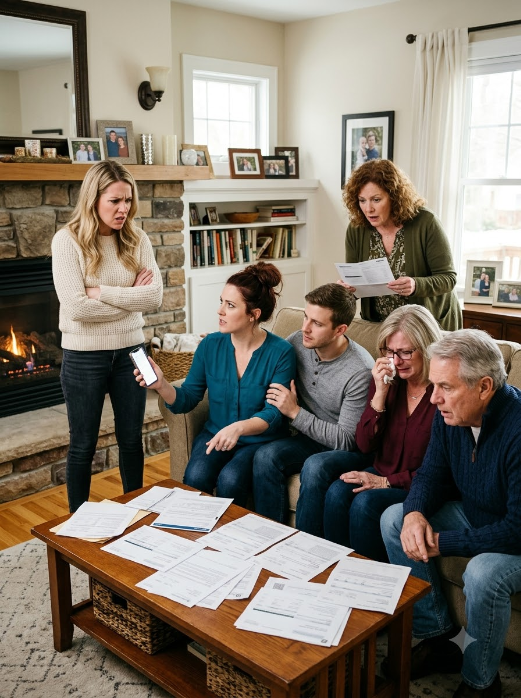
With a sharp motion, Vanessa yanked a debit card from her wallet and threw it onto the carpet.
“There. Choke on your precious bills.”
Then she left, slamming the door hard enough to rattle the wall.
No one spoke for a while.
Outside, her BMW engine roared and faded down the street.
My mother bent to pick up the card, but I stopped her.
“Leave it there.”
She froze.
“That account needs to be closed. You need to request statements. You need to strip Vanessa’s access from anything financial. And you need to stop calling this confusion.”
My mother nodded weakly.
My father stared at the floor. “I was wrong.”
I waited.
He rubbed his face. “I was wrong about the money.”
It wasn’t enough. Not close.
But it was the first honest sentence he’d given me in years.
“I’m not asking you to choose me over Vanessa,” I said. “I’m telling you I’m done paying for being treated like less.”
Aunt Linda stood and sat beside me, resting her hand over mine.
“I’m sorry,” she said. “I should have spoken up that night.”
My throat tightened without warning. “Thank you.”
After that meeting, things moved quickly.
Vanessa’s car was repossessed two months later. She tried telling relatives I’d wrecked the family out of jealousy, but Aunt Linda had copies of the statements, and Eric had no patience left for silence. Her version of events never gained traction.
My parents sold the house the following spring and moved into a smaller condo they could actually afford. I made one direct mortgage payment, exactly as promised, and nothing more.
For months, my mother sent long apology messages. Some felt sincere. Some felt frightened. Some sounded as though she missed the money more than she missed me. I only replied to the ones that took responsibility without excuses.
My father called less often. When he did, his voice was stiff and awkward. Once he said, “I didn’t realize how much you’d done.”
I answered, “You didn’t want to.”
He didn’t argue.
That counted as progress.
As for Vanessa, she moved to Florida with a man who sold roofing contracts after hurricanes. Six months later, she texted from a new number.
You ruined my life.
I looked at the words, then typed back:
No. I stopped funding it.
Then I blocked her.
A year after that first family dinner, Eric invited me over for a meal at his apartment. Aunt Linda came. My parents came too. It wasn’t a flawless evening. My mother chose her words carefully. My father looked uneasy when Eric openly thanked me for helping him work through a student loan problem.
But no one called Vanessa the family hero that night.
No one called me ungrateful.
Near the end of dinner, my mother touched my arm.
“Megan,” she said softly, “thank you for what you did for us. I should have said that years ago.”
I looked down at her hand on my sleeve.
Part of me wanted to pull away. Part of me wanted to cry. Part of me was still that girl at the dinner table, waiting for someone to notice how hard she was trying.
“I know,” I said.
Then, after a pause, I added, “But thank you for saying it now.”
Forgiveness didn’t arrive like sunlight. It came like a door left unlocked. I didn’t need to swing it wide open. I only needed to know I held the handle.
That night, I drove home through quiet Ohio streets with no automatic transfer scheduled, no secret sacrifice draining my account, and nothing left to prove.
The truth hadn’t made my family perfect.
It had only made the lies too costly to keep.
And for me, that was enough.
