

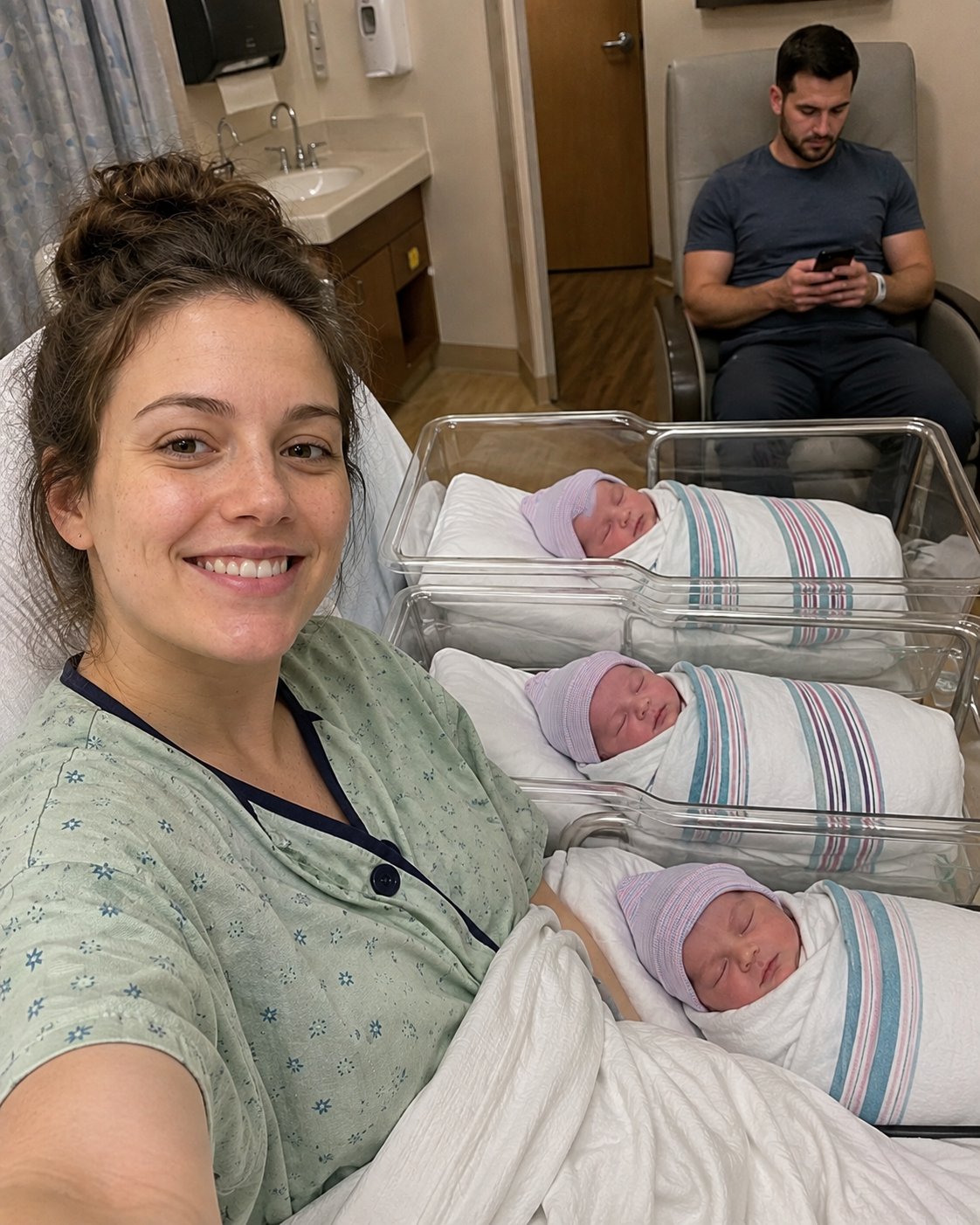
I thought I knew the man I’d married, especially when he swore he’d be the kind of father our daughters could always lean on. But the days following the birth of our triplets proved just how mistaken I was.
Three in the morning, the baby monitor cast a blue glow across my face as I sat cross-legged on the nursery floor, a half-warm bottle in hand. Two of my daughters were fussy. The third had finally, thankfully, drifted off.
I hadn’t managed more than an hour of sleep at a time in six days.
My phone buzzed against the carpet. A message from my sister, Naomi.
“Are you still awake? Send me the shift schedule.”
I hadn’t slept more than an hour.
I tapped out a reply with one thumb. “Ava and Mia are up. Zoe’s asleep. Send coffee.”
“On my way at seven. Hold on, Layla.”
I set the phone down and stared up at the ceiling. Four years married. Three babies. One husband somewhere over the Pacific with a suitcase full of swim trunks.
I kept trying to reconcile it with the man I remembered from the ultrasound.
One husband somewhere over the Pacific.
My husband, Eric, had cried that day. Actually cried in front of the technician, squeezing my hand as though he feared I might drift off the table.
“Triplets,” he’d said. “Three of them. I’m going to be the world’s best dad! You hear me? The best there ever was!”
The technician had smiled, clearly no stranger to that kind of declaration.
Still, I believed him. That was the thing. I believed every word.
My husband, Eric, had cried that day.
Here’s what you should know: Eric had wanted a big family since our first month together. His parents had raised just one child, him, and he always said the house had felt too quiet growing up. He wanted noise, insisting, “A home should sound like one.”
My husband even picked out matching onesies in three sizes before I reached my second trimester. Three tiny purple ones reading “Sister 1, Sister 2, Sister 3.”
Yet he never cracked open a single parenting book. I bought four.
They gathered dust on his nightstand beneath a pile of golf magazines.
My husband even bought matching onesies.
When it came time to put the cribs together, Eric announced in his group chat that he was “in the trenches, building nurseries,” while he was actually out at the driving range with Luke. I assembled all three cribs on my own.
Naomi noticed. Naomi always noticed.
“He gets excited about the idea of things, Lay,” she once told me, drying a wine glass at my sink. “That’s not the same as actually showing up for the work.”
He ended up at the driving range.
“He’ll come through,” I’d said.
“I hope so.”
“He will.”
She let it go. She was good like that. My sister said her piece once, then supported you no matter what you chose.
At the baby shower, Eric stood in the middle of the living room, announcing to everyone that he was about to become a girl dad, three times over, the luckiest man in the tri-state area.
“He’ll show up.”
His mother, Deborah, watched him from the doorway with an expression I couldn’t quite place.
Later, she drew me aside near the coat rack.
“Layla, honey. Call me anytime. Day or night, doesn’t matter.”
“Deborah, that’s so kind, but…”
“Especially,” she said, pausing. “Especially if Eric withdraws into himself. You call me.”
She pulled me aside.
I gave a small laugh, because what else could I do?
“He’s not going to disappear,” I said. “He’s thrilled.”
My mother-in-law squeezed my elbow and said nothing more.
I hadn’t thought of that moment in months.
It resurfaced now, on the nursery floor, with the monitor’s hum in the background.
“He’s not gonna disappear.”
I lifted Ava from her crib and held her to my chest. Mia was building toward a real cry, so I rocked them both gently.
“Your dad loves you,” I whispered. “He does. He’ll come home and love you.”
I said it out loud, the way you recite a prayer you’re no longer certain you believe.
Somewhere over the ocean, my husband slept.
I had no idea yet what he’d been posting the whole time he was gone.
“Your dad loves you.”
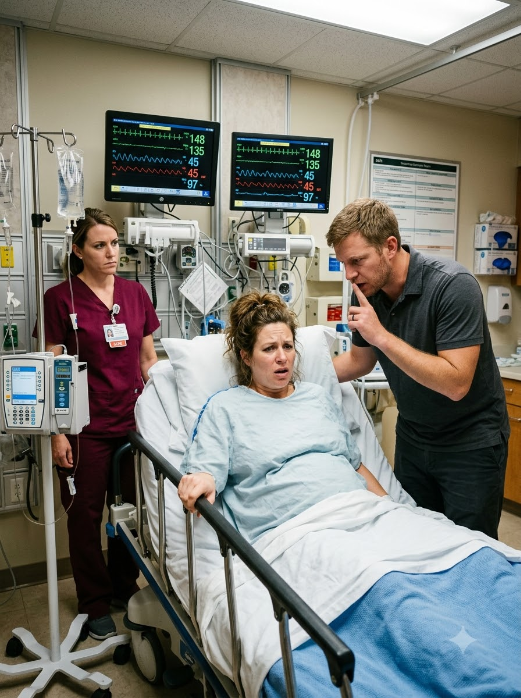
The delivery room smelled of antiseptic and something sharper I couldn’t place. It was chaotic and loud. Monitors beeped steadily, and nurses moved in and out. Three tiny heartbeats traced across a screen, and somewhere behind me, my husband exhaled heavily.
“Is it always this hot in here?” Eric muttered, pulling at his collar. “I feel like I might pass out.”
A nurse glanced his way without comment. I clutched the side rail and tried to breathe through the tightening across my belly.
It was chaotic and loud.
“Eric, can you grab me some ice chips?”
“One second. My phone’s dying.”
Another contraction rolled through me, sharper than before. I couldn’t stop it. A sound tore from my throat, low and raw, the kind your body makes when it’s doing something you never agreed to.
Eric leaned in close. His breath carried the coffee he’d bought downstairs.
I couldn’t help it.
“Layla, babe,” my husband murmured. “Could you keep it down a little? You’re causing a scene, and it’s really stressing me out.”
I went still. Not from the pain. From the sentence itself.
The nurse adjusting my IV paused, hand still on the tape. She looked at Eric, then at me, her mouth tightening into a thin line. Another nurse near the monitor caught her eye from across the room.
“Can you try to be a little quieter?”
I had no room to react. Another wave was already climbing up my back, and the doctor was entering with the delivery team trailing behind. My babies were arriving whether Eric was at ease or not.
It seemed that as the reality of three babies drew closer, my husband’s early excitement had begun to fade.
A few days later, we carried our triplets home.
I was running on empty, just trying to piece together some kind of routine.
I had no room to react.
Five days in, my entire world had shrunk to two-hour intervals.
Feed. Burp. Change. Rock. Set down. Pick up the next one.
My body ached. My hair hadn’t seen shampoo since the hospital. Somewhere around the 90-minute mark of sleep, I lost track of which baby I was holding without checking the bracelet on her ankle.
Eric had been “helping” by passing me clean burp cloths before heading back to bed.
My hair hadn’t been washed since the hospital.
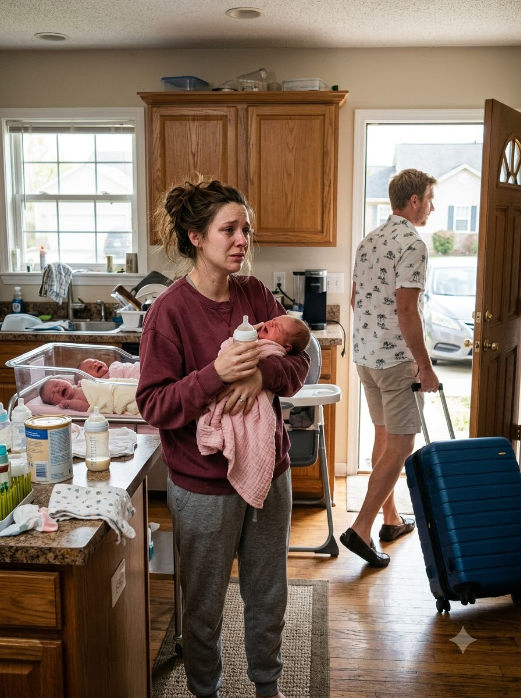
I was heating a bottle when I heard the wheels of a large suitcase rolling across the hardwood.
My husband wheeled it into the kitchen as casually as if he were leaving to catch a work flight.
“What’s going on?” I asked.
He avoided my eyes. “So. I need to talk to you about something.”
“Okay.”
“I’ve been doing a lot of thinking these past few days.”
He rubbed the back of his neck.
I heard the wheels of a large suitcase.
“See, the crying, the schedule, waking up every two hours. Honestly, it’s wrecking me, Layla. My mental health is in a really dark place right now.”
I stared at him. One of the babies began to fuss.
“Eric, I haven’t slept in five days.”
“I know. I know.” He raised his hands as though soothing a stranger.
I stared at him.
“That’s why I think it’s best if I step back for a bit. Just to reset. The guys and I already booked a place in Cabo. Two weeks. I’ll come back a much better dad, I swear. I just can’t be any use to anyone right now.”
“Cabo?”
“It’s already paid for.” He winced, apologetic, as though the money were the real tragedy. “Luke’s picking me up in five.”
“You booked a trip?”
“I need this, baby. For us. For the girls, really.”
“It’s already paid for.”
The fussing escalated into a full cry. Then a second baby joined in.
“Eric, you cannot be serious.”
“I’ve never been more serious.” He crossed the kitchen and kissed the top of my head as though I were a niece he was fond of. “You’re so strong. You’ve got this. Naomi’s around, right?”
“She works. She has her own life.”
“Eric, you can’t be serious.”
“Buuut…she loves the babies.”
“Eric, please.”
My husband was already rolling the suitcase toward the front door. A car horn sounded outside, brief and upbeat.
“Two weeks,” he said. “I’ll bring you back something nice!”
“Don’t do this.”
He pulled the door open. Sunlight spilled across the entryway. He didn’t look back.
“You’ll thank me later!”
The door clicked shut.
“Don’t do this.”
I stood in the doorway, a warm bottle in one hand and Ava, our loudest, wailing against my collarbone. Down the hall, her sisters joined in one after another, until the whole house rang with a jagged chorus of crying.
I stared at the closed door.
Fourteen days. I had no idea how I’d make it through 14 days.
I looked at the closed door.
I thought it was hard before Eric left, but those two weeks turned out to be the hardest I’d ever lived through.
Night three nearly broke me.
All three babies cried at once, a wall of sound I couldn’t get past. I sat on the kitchen tile with a warm bottle in hand and cried harder than any of them.
I called Naomi at 2 a.m., barely able to string words together.
Night three broke me.
“I’m coming,” my sister said. “I’m packing a bag right now.”
Naomi arrived before sunrise with an overnight bag and a stack of legal pads.
“Okay,” she said, kneeling beside me on the floor. “We’re going to get through this, but we’re doing it with a system.”
By the end of that first day, we had color-coded bottles and a shared spreadsheet on my phone. It sounds minor, but it saved me.
“I’m coming.”
My sister pitched in whenever she could, but the bulk of the feedings, crying, and sleepless nights fell to me.
I hadn’t heard a word from Eric.
On day six, my phone buzzed while I was burping Mia. A text from a number I recognized as Luke’s.
“Yo, want me to cover your share of last night’s bar tab on the kid-free Finsta, or you still keeping that one locked down from the wife?”
I read it over several times.
I hadn’t heard from Eric once.
Then I read it out loud to Naomi when she got home from work.
“Kid-free Finsta,” my sister repeated slowly. “That’s a private Instagram, Layla. He’s had a second account this whole time!”
My hands began to shake.
“Help me find it.”
It took her about 20 minutes.
“That means a private Instagram.”
Luke’s public profile linked to a tagged photo, which led to a private handle, which Naomi requested to follow from a burner account.
By evening, we were in.
The page held over a year’s worth of posts! Poolside selfies captioned “kid-free zone forever.” Videos of Eric doing shots with Luke, joking about how “the wife handles the chaos.”
A photo from Cabo, taken three days after he left me, captioned “escape complete.”
We were in.
Not a single word about mental health. Not one photo of our daughters.
“He’s been planning this,” Naomi said quietly. “For a long time.”
I sat there holding my phone, still foolishly searching those pictures for the man from the ultrasound.
“You have to confront him,” she said.
“I can’t. If I blow this up, I blow up everything, including their entire childhood.”
“He’s been planning this.”
Then I remembered Deborah at the baby shower, her hand on my wrist, her voice low.
I hadn’t understood it back then. I did now.
I called her from the nursery, bracing for her to defend her son.
“Deborah, it’s Layla. I need to show you something, and it scares me to.”
The line went silent for a long moment.
I hadn’t understood it then.
“My son left, didn’t he?” my mother-in-law asked.
I couldn’t get words out.
“Layla, listen to me. I’ve known who my son was for a long time. I watched him do this to two women before you. He runs. He always runs.”
“He went to Cabo. He left me alone with our newborns.”
“I’ll be there within the hour,” she said.
I couldn’t speak.
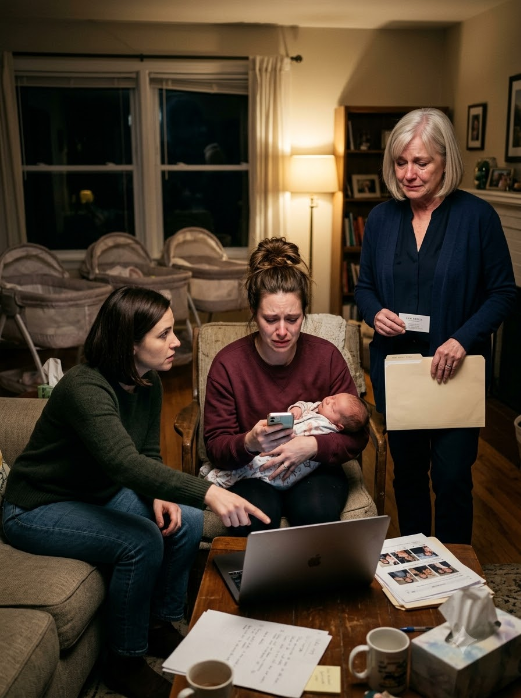
Deborah arrived that evening carrying a folder, mascara smudged beneath her eyes. She held me longer than my own mother ever had.
Then she sat at my kitchen table, opened her folder, and slid a business card across the wood.
“This is a family lawyer. She’s expecting your call.”
“Deborah, I don’t know if I can do this.”
She hugged me.
“You already are,” she said. “You’ve been doing it alone for a week.”
Naomi brewed coffee. Deborah made the call. I sat with Zoe against my chest and listened to my mother-in-law explain to a stranger, in a steady voice, that her son had abandoned his newborn daughters and needed to face what came next.
We spent the following days quietly getting ready.
Deborah made the call.
Naomi captured screenshots of every Finsta post and sorted them by date. Deborah packed Eric’s clothes into boxes and lined them by the front door. I met with the lawyer twice and signed the draft separation agreement at my living room table while the babies napped in their swings.
I didn’t change the locks. I wanted my husband’s key to still work when he returned.
I wanted him to walk in expecting nothing had shifted.
Naomi took screenshots.
Deborah, who had only stepped out to grab clothes before coming back, rested her hand on my shoulder as I capped the pen.
“He’s home tomorrow,” she said. “Are you ready?”
I glanced toward the nursery, where three tiny chests rose and fell in the dim light.
“Yes,” I said. “I’m ready.”
The key turned in the lock yesterday evening as though nothing had changed.
“Are you ready?”
Eric strolled in fully relaxed, sun-kissed and grinning, until his eyes scanned the living room.
He froze mid-step, his suitcase hitting the floor.
“This can’t be happening!”
Boxes bearing his name lined the wall by the door. Naomi sat on the couch, calmly feeding one of the babies. Deborah stood by the window, arms folded.
His suitcase hit the floor.
“Mom? What are you doing here?”
“Sit down, Eric.”
“Layla, what is this?! I just walked through the door!”
I handed him the envelope. He opened it slowly, color draining from his face as he flipped through the screenshots.
“These…these are just jokes! Layla, come on! The guys and I mess around.”
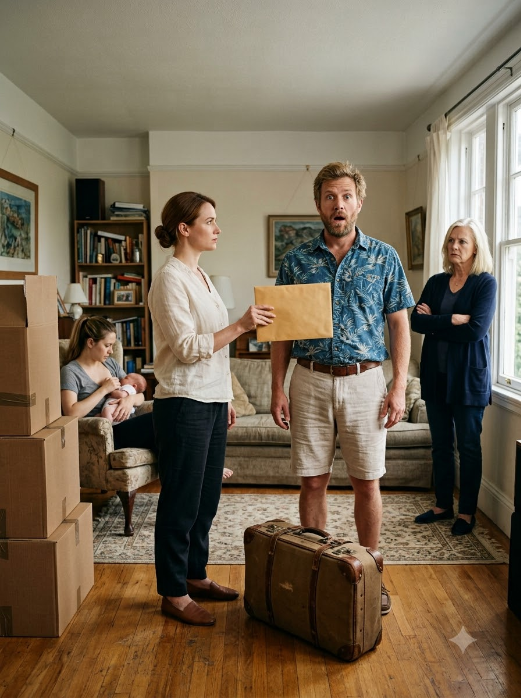
“Kid-free Finsta,” I said. “A year of posts. Not one mention of your mental health.”
“Sit down, Eric.”
“Mom, tell her! Tell her I’ve been struggling!”
Deborah didn’t step in to save him. “I’ve been telling myself that story about you for 30 years, honey. I’m done.”
“You have no idea what it’s like! The crying, the noise, I couldn’t breathe in here!”
“When I was in labor with your children,” I said, “you told me to be quiet because I was stressing you out.”
“That’s not fair!”
“I’m done.”
“A father doesn’t go on vacation from his newborns, Eric. A husband doesn’t hush his wife in labor. And a man in a mental health crisis doesn’t caption it ‘kid-free.'”
My so-called husband turned to his mother, desperate.
“I love you,” Deborah said softly. “That’s exactly why I’m not shielding you from this.”
He picked up a box. Then another. He said nothing more.
The door clicked shut behind him.
“I’m not protecting you from this.”
Months later, I sat in the nursery at dawn. All three girls were finally asleep.
Naomi was curled up on the couch, and Deborah’s coat still hung by the door.
I looked at my daughters and understood something I’d missed for years.
I didn’t lose my family. I found out who was really in it.
