

**The Shoeshine Boy and the Billionaire: A Story of Lost Years, Hidden Truths, and Second Chances**
The polished stone sidewalk in front of Manhattan’s Harrington Grand Hotel gleamed under the crisp autumn sunlight. Ten-year-old Ryan Carter knelt among scattered brushes, cloths, and dented tins of shoe polish, his small hands trembling as he tried to gather them. Moments earlier, the hotel manager had kicked his shoeshine box across the pavement with a shout that echoed off the marble columns: “Get away from the entrance!”

Ryan’s wooden box—old, worn, with his name painted in faded blue letters by his mother—was more than a tool for earning coins. It was the fragile barrier between his family and despair. His mother, Emily, lay feverish in their cramped Queens apartment, needing antibiotics that cost exactly $48.70. Ryan had saved $26. Today, he was determined to close the gap.
No one helped. Executives in tailored suits stepped around him. Women in designer coats looked away. The wind alone seemed to pity him, scattering a few bills that had fallen from his pocket. Then everything changed.
A convoy of black luxury vehicles pulled up. The central Rolls-Royce Phantom stopped at the red carpet. Out stepped Richard Harrington, seventy-two years old, owner of a global hotel empire worth billions. Silver-haired, impeccably dressed, he radiated the quiet power that made boardrooms fall silent. The manager, Martin Wells, instantly transformed into obsequious politeness.
But Richard’s gaze fell on the boy.
“Who is this?” he asked.
Martin sneered. “Just a street kid, sir. I was removing him.”
Richard stepped off the red carpet. The crowd watched in stunned silence as the billionaire knelt beside Ryan. “Why are you working here, son?”
Ryan looked up, eyes wide but steady. “My mom is sick. I need money for her medicine.” He pulled out the crumpled pharmacy receipt, his voice small yet resolute.
Something in the boy’s determination struck Richard. Then Ryan reached for a brush, and his sleeve slipped back, revealing a pale crescent-shaped birthmark on his wrist. Richard froze. The mark was unmistakable—identical to the one his late wife Catherine and their daughter Emily had shared. A family legacy passed through generations.
The world narrowed. Memories flooded Richard: Emily laughing in Central Park, their bitter argument eleven years ago, her walking out after he dismissed her love for a man he deemed unworthy. “If you walk out that door, don’t expect me to clean up your mistakes.” She never came back. Private investigators found nothing. Pride had cost him everything.
Now, kneeling on cold stone, Richard whispered, “That mark…”
Ryan tugged his sleeve down, self-conscious. Richard’s voice broke. “What is your mother’s name?”
“Emily Carter.”
The name hit like lightning. Richard’s face drained of color. “Take me to her.”
Chaos followed. Martin protested about meetings and investors. Richard’s response was ice-cold: “Cancel everything.” He fired the manager on the spot for choosing marble over mercy. Then he draped his own cashmere coat around Ryan’s shoulders and guided the boy into the SUV.
Inside the luxury vehicle, Ryan clutched his shoeshine box like a shield. “Are you rich?” he asked.
“Yes.”
“Then why didn’t you help her?”
The innocent question pierced Richard’s heart. “Because I was proud. And wrong.”
They drove to Queens, the glittering skyscrapers giving way to worn brick buildings. Dr. Helen Brooks, Richard’s longtime physician, accompanied them, already coordinating hospital care. At the sixth-floor walk-up, Emily lay on the couch, burning with fever. When she saw Richard in the doorway, shock drained what little color remained in her face.
“No,” she breathed.
Ryan rushed to her side. “Mom, he says he can help. He knows you.”
What unfolded next was a reckoning eleven years in the making. Helen examined Emily and confirmed she needed immediate hospital care. Emily resisted, pride flaring despite her weakness. “I don’t need his doctors.”
But for Ryan’s sake, she relented. As paramedics arrived, Richard rode behind the ambulance, his mind reeling. In the hospital’s private room—arranged without consultation—father and daughter began the painful process of unpacking lies that had shattered their family.
Emily had fled New York after a devastating argument. Pregnant and terrified, she believed Richard had threatened her boyfriend, Daniel, forcing him to disappear. She changed her name, moved frequently, and raised Ryan alone—cleaning hotel rooms she could never afford to stay in, working odd jobs, and shielding her son from the grandfather she thought was a monster.
Richard, meanwhile, had paid Daniel to leave after the young man demanded money and admitted he never wanted the child. Richard believed he was protecting Emily. By morning, he regretted it and searched desperately, but Emily had vanished. Guilt and shame kept him from public admission. He threw himself into his empire, building towers while his family crumbled.
Dr. Brooks provided the final pieces. Before Catherine’s death, she had suspected Daniel’s deceit. Catherine left records proving Daniel was already married under another name. He had manipulated both sides: taking Richard’s money to abandon Emily, then telling Emily that Richard had forced him out. Daniel vanished with the cash, leaving destruction behind.
Emily read Daniel’s handwritten note—greedy and cold—and her world shattered anew. The man she had mourned as a victim was a con artist. The father she had hated was flawed, arrogant, and deeply mistaken, but not the architect of every cruelty she imagined.
Tears flowed. Accusations flew. Richard sat in the wreckage of his choices. “I never stopped looking,” he said. Emily countered, “I thought you were coming to take Ryan.”
Ryan, exhausted but listening intently, asked the hardest question: “So Dad lied?”
The boy who had shined shoes to buy medicine now faced adult betrayals that predated his birth. Richard crouched before him. “None of this is your fault.”
That night, Richard slept in a chair by the door—not imposing himself, but present. Ryan curled under the oversized coat. When Emily woke, she saw them both and felt the weight of lost years.
Over the following days, conversations continued. Richard confessed everything: the argument, the payment, the regret, the silent searches. Emily shared the shelters, the fear, the lonely birth, and the nights Ryan heard her whisper “Dad” in her sleep. No easy forgiveness came, but understanding began to grow. Richard accepted blame without defense—an evolution the old Richard would never have allowed.
Ryan watched warily. “Are you going to leave again?”
Richard’s answer was measured: “You shouldn’t believe me yet. Watch what I do next.”
And he did. Richard canceled international trips. He visited daily, bringing small comforts—Ryan’s favorite foods, books, a new shoeshine box that honored the old one. He arranged the best care for Emily without fanfare. Most importantly, he listened.
Weeks turned to months. Emily recovered. Ryan returned to school, no longer needing to work before dawn. The family began tentative steps toward something new. Richard sold a stake in one of his hotels and created a foundation for single parents in medical need—quietly, without press releases. He told Emily, “Home was always yours. I just forgot that for a while.”
The crescent birthmark on Ryan’s wrist became a symbol not of painful coincidence, but of reconnection. On weekends, they walked Central Park where Emily once played as a child. Richard taught Ryan chess and listened to his dreams. Emily watched, guarded but softening.
Life did not erase the eleven lost years. Scars remained. Emily still had moments of anger. Richard carried guilt like an invisible overcoat. Ryan occasionally woke from nightmares about losing his mother. Yet in those cracks, light entered.
The boy who once knelt on Fifth Avenue now stood taller. The billionaire who commanded empires learned humility on a sidewalk. The daughter who ran found her way home—not through wealth, but through truth.
In the end, the most luxurious thing at the Harrington Grand was not marble or crystal, but the fragile, hard-won bridge between a grandfather, his daughter, and the grandson who brought them back together—one scattered brush, one revealed birthmark, and one honest confession at a time.
**The Shoeshine Boy and the Billionaire: A Story of Lost Years, Hidden Truths, and Second Chances**
The crisp autumn air outside Manhattan’s Harrington Grand Hotel carried the scent of roasted coffee and distant regret. Ten-year-old Ryan Carter knelt on the polished stone, gathering scattered brushes and tins after the hotel manager had kicked his shoeshine box across the sidewalk. “Get away from the entrance!” Martin Wells had shouted. Ryan’s old wooden box, painted with his name in faded blue by his mother, was all that stood between his family and despair. His mother Emily needed antibiotics costing exactly $48.70. He had $26.
Then Richard Harrington, the seventy-two-year-old billionaire owner of the global hotel empire, stepped out of his Rolls-Royce. One glance at the boy—and the crescent birthmark on Ryan’s wrist—changed everything. The mark matched his late wife’s and daughter Emily’s. Minutes later, Richard was kneeling beside Ryan, canceling meetings, firing Martin, and driving to Queens with the boy.
In the tiny sixth-floor apartment, Emily lay feverish. Seeing Richard, she whispered, “No.” But Ryan’s need pulled them together. Paramedics took her to the hospital, where Richard arranged a private room.
At the hospital, everything moved quickly. IV fluids dripped. Monitors beeped. Ryan sat beside his mother’s bed, swallowed by Richard’s oversized cashmere coat, clutching his shoeshine box like an anchor.
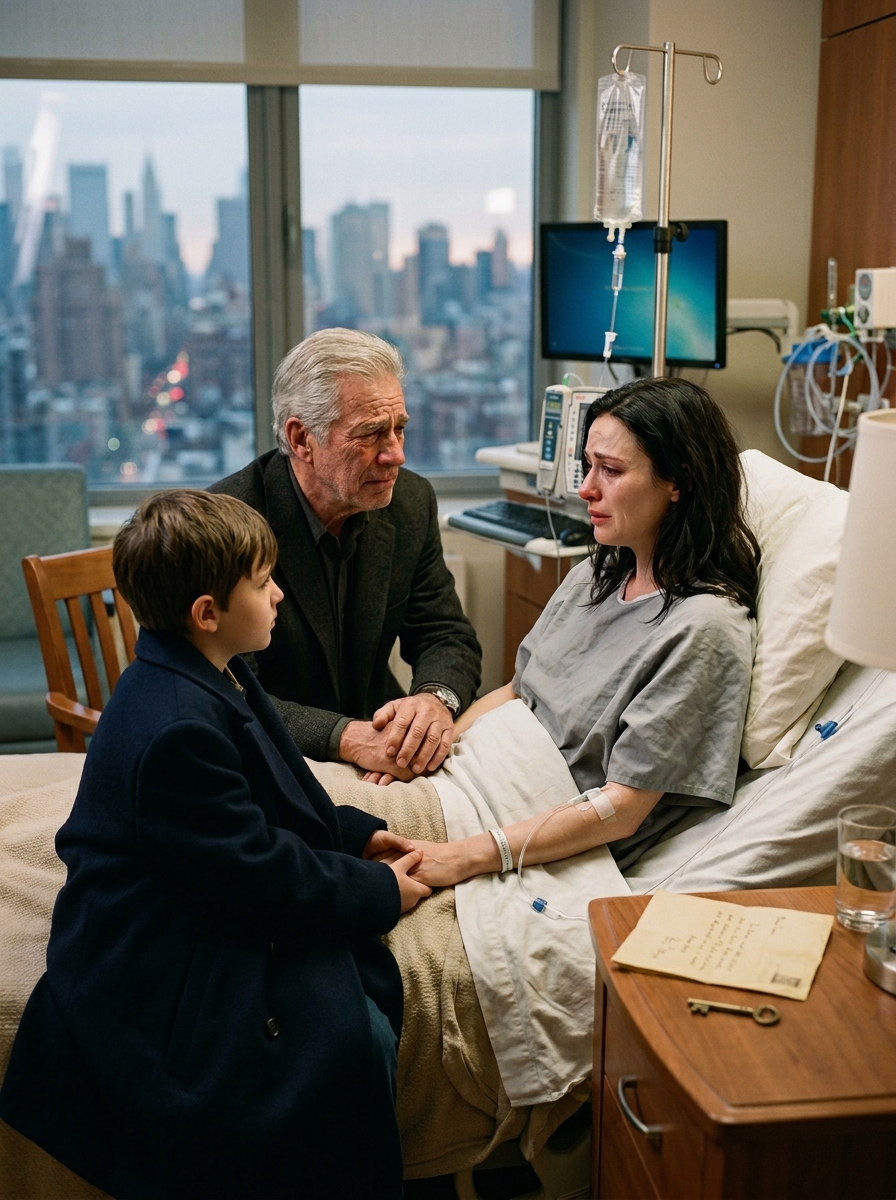
Emily’s eyes opened. “You’re still here.”
Richard turned from the window. “I’m not going anywhere, Emily.”
She gave a weak, bitter laugh that became a cough. “I’ve rested for eleven years. Now I want answers. Why now?”
“I found you through him,” Richard said, nodding at Ryan. “The birthmark. Your name. Everything broke inside me.”
Ryan refused to leave. “I want to hear this too.”
Richard sat, leaving space. “Ask me anything. I won’t lie again.”
“Did you really pay Daniel to leave me?” Emily asked.
“Yes,” Richard admitted. “He came after you walked out. Said you were pregnant and he’d disappear for two million. I thought I was protecting you from a gold-digger. By morning I regretted it, but you were gone.”
Tears slid down Emily’s cheeks. “He told me you threatened to ruin him. That you’d take the baby and raise it without me.”
“I never said those things,” Richard swore. “I searched for years. Investigators. Rewards. Nothing.”
Ryan spoke quietly. “Mom cries at night. She says ‘Dad’ in her sleep. I thought she meant my father.”
The room fell silent except for the oxygen hiss.
Emily continued, voice hoarse. “I changed our name. Moved constantly. Cleaned rooms in hotels like yours while pushing Ryan’s stroller past the Grand, wondering if you were inside.”
Richard’s shoulders shook. “I was ashamed. Pride kept me silent. I built an empire while my family crumbled. Your mother knew I would regret it.”
Dr. Helen Brooks entered and handed over documents proving Daniel’s deceit—he had been married, manipulated both sides for money, then vanished.
Emily read Daniel’s greedy note aloud, her voice trembling. The truth landed like a blow. The man she mourned had been a con artist. The father she hated had been proud and wrong, but not solely evil.
“I’m sorry,” Richard said, covering her hand. She didn’t pull away. “I can’t return the years, but I’m here. Whatever you need—even if it’s for me to leave.”
Emily studied him. “I want Ryan to have a grandfather. But I need time. Prove it with actions, not money.”
Richard nodded, tears in his eyes. “Watch what I do next. I’ll sleep in this chair every night if you let me.”
Ryan asked, “You really slept here last night?”
“I did,” Richard smiled tiredly. “My back hates me, but it’s the least I deserve.”
A faint smile touched Emily’s lips. “You always were stubborn.”
“Runs in the family,” Richard replied.
Days passed. Martin Wells entered one afternoon in a wrinkled suit, holding a cheap bouquet. Ryan stiffened. Richard rose.
“I came to apologize,” Martin said.
“To whom?” Richard asked coldly.
Martin looked at Ryan. “I behaved poorly.”
“You behaved honestly,” Emily said from the bed, sharpness returning. “That was the problem. You practiced that speech in the hallway, didn’t you?”
Martin placed a tin of black shoe polish on the table—one of Ryan’s. “My father shined shoes in Newark for thirty years. I hated it. Hated people looking through him. So I became the man who looks through others first.”
The room quieted. Martin’s cruelty came from fear of poverty, not ignorance.
Ryan’s voice trembled. “You made me feel like trash.”
“I know,” Martin whispered. “I don’t expect forgiveness.”
“I don’t forgive you,” Ryan said.
Martin turned to Richard. “I don’t expect my job back.”
“You won’t get it,” Richard replied. “But you will report to the Harrington Foundation. One year helping children like Ryan. Meals, medicine, dignity. Learn, or leave with nothing.”
Martin agreed.
After he left, Ryan asked, “Why didn’t you destroy him?”
“Because I destroyed enough people by being proud,” Richard said.
Emily looked at him with something less closed than before.
A week later, Helen brought Catherine’s sealed letter and a brass key. Emily read it aloud only after insisting Richard stay.
My dearest Emily,
If you are reading this, pain has brought you and your father together again. Your father is not innocent. Neither are you. Neither was I.
Daniel came to me first. I saw what he was but feared pushing you away. I tried to expose him quietly and failed.
The key opens a deposit box in Ryan’s name. I knew about the baby. The money keeps you safe, but the real gift is proof—you were never erased. Love was still trying.
If Richard is near you, make him listen. Richard, do not buy your way back. Earn it. Start by letting them choose how close you get.
Love, Mom
Tears flowed. Richard covered his face. “I didn’t know.”
“Catherine didn’t trust you with it then,” Helen said.
Emily held the key. “She was right.”
Ryan touched it. “Grandma knew me?”
“She knew about you,” Emily whispered, pulling him close.
The letter became their fragile bridge.
Emily recovered. She refused the penthouse, choosing a modest Queens apartment with working elevators. Richard visited Sundays—first one hour, then lunch, then longer. He brought books, learned Ryan hated peas and loved sketching buildings, and once bought an absurdly expensive coat that Emily made him return. Ryan laughed for ten minutes.
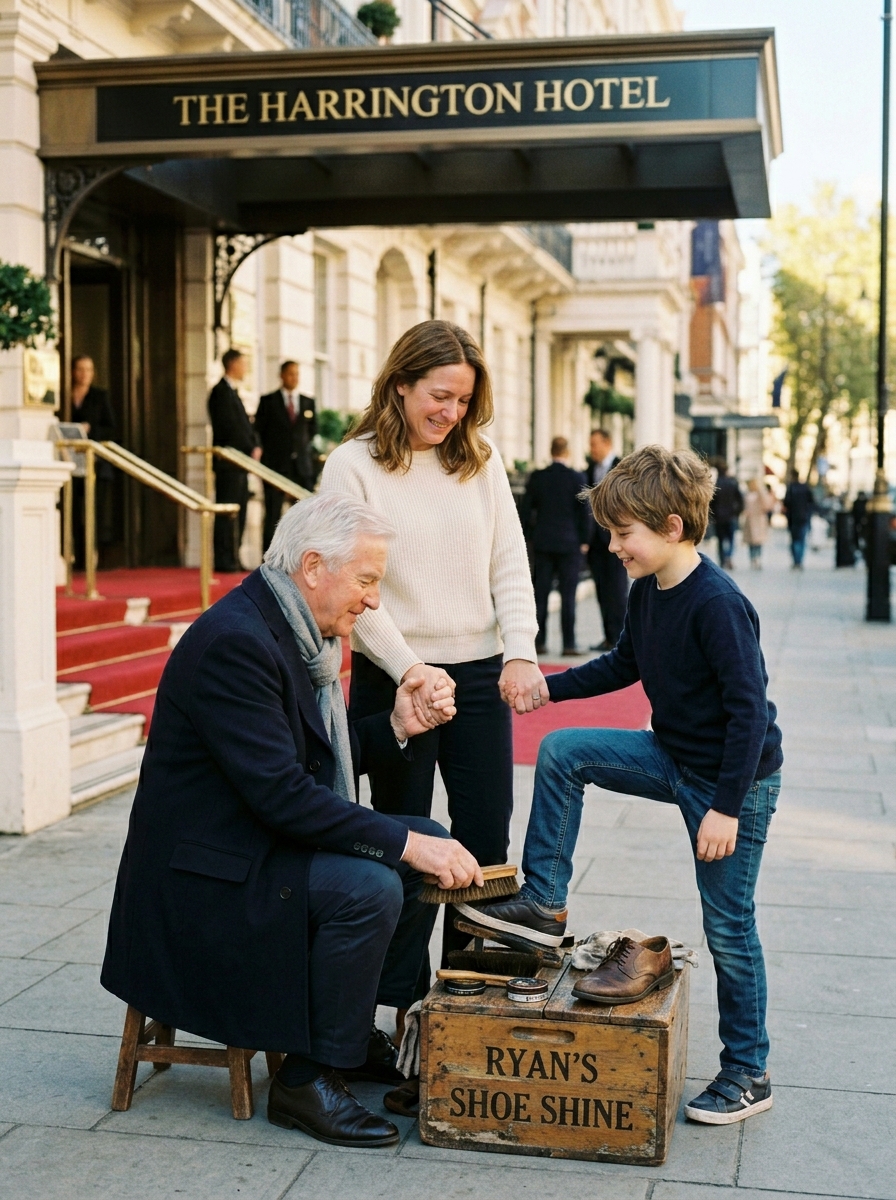
Richard attended school conferences in tiny plastic chairs and rode the subway, gripping the pole white-knuckled. Ryan called it the funniest day ever.
The Harrington Grand changed. A simple shoeshine stand appeared beside the entrance with a plaque: *For every child trying to carry more than childhood should ask.*
Months later, on a bright morning, Ryan stood outside the hotel—not kneeling, but beside his repaired shoeshine box. Richard stood with him.
“You sure you want to keep it?” Richard asked.
“I want to remember,” Ryan said.
He handed Richard a brush. “Grandpa rule. You start at the bottom.”
Richard knelt awkwardly. A bellhop nearly dropped his tray. Emily watched, laughing softly as Ryan corrected his grandfather’s technique.
“Not bad for a beginner,” Ryan declared.
Richard laughed—real, rusty, human.
Emily closed the box gently. Ryan slipped one hand into hers, the other into Richard’s. They stood together as the city moved around them.
Eleven years could not be erased. Daniel’s lies lingered. Catherine was gone. Yet pride had bent. Truth had surfaced. A boy once kicked from the entrance now held his family together beneath the pale Manhattan sun.
Richard no longer felt like he was entering a hotel. For the first time in years, he felt like he was coming home.
