


She Picked the Wrong Man to Slap. The Entire Town Paid the Price.
Part I
The slap rang through the diner like a gunshot.
One moment, the lunch crowd at Harlow’s Diner was wrapped in the familiar rhythm of clinking silverware, steaming coffee pots, and country music drifting softly from the speakers. The next, Michael Delator’s head jerked to the side, his glasses flew from his face, and his body collapsed out of the booth as though his bones had suddenly forgotten how to hold him upright.
The entire room froze.
Not merely quiet. Frozen.
The kind of silence that falls when everyone understands, with sickening certainty, that they have just watched a boundary crossed that can never be undone.
Michael slammed against the tile shoulder first. Coffee splashed beside him, dark and steaming, spreading over the floor like spilled ink. His glasses skidded beneath a stool, one lens split clean through the center. At sixty-eight, he was slender rather than weak, wearing a neatly pressed brown jacket over a pale blue shirt, gray hair trimmed short, his features shaped by years of discipline. Even lying on the floor, there was still something composed about him, something unshaken.
Sheriff Erica Mullen towered above him in full uniform, one hand still partially raised, anger swelling through her chest. She was a heavy-set woman in her forties, blonde hair twisted into a tight knot, jaw clenched hard enough to crack stone. The badge pinned to her chest caught the diner lights.
“You think you can ignore me?” she snapped. “You think the law doesn’t apply to you?”
A waitress near the register gasped and covered her mouth. A trucker in the corner booth started to stand, then slowly sat back down when Erica’s deputy near the entrance rested a hand close to his holster. No one spoke.
Michael blinked once. Then again.
Then he reached—not toward Erica, not toward the booth to lift himself up—but toward the glasses resting just outside his fingertips.
That composure only seemed to fuel Erica’s anger further.
“Don’t move,” she barked.
Michael stopped. Slowly, he raised his eyes to meet hers. His cheek had already begun to redden. A thin cut shimmered near his lip.
“Sheriff,” he said evenly, “all I did was ask you not to speak to the waitress that way.”
And it was true.
Everyone inside the diner knew it. Ten minutes earlier, Erica had burst through the door demanding to know why her takeout order still wasn’t ready. Tina, the waitress, had apologized and explained that the diner had been overwhelmed after church service ended. Erica called her incompetent. Then useless. Then something uglier, muttered low enough to blur yet sharp enough to wound. Michael, who visited Harlow’s every Sunday after late service, had simply looked up from his coffee and said, “Ma’am, there’s no call for humiliating a young woman who’s working harder than anyone else in this room.”
That should have ended it.
But Erica Mullen never tolerated being corrected, especially in public, and certainly not by a Black man old enough to be her father.
Now she stepped closer, boots striking against the tile.
“You don’t tell me what there’s a call for.” Her voice lowered into something dangerous. “I keep order in this town.”
Michael’s fingers tightened against the floor. “No,” he answered. “You wear it.”
For the first time, uncertainty flickered across Tina’s face—not because Michael sounded scared, but because he didn’t.
Erica bent closer until her face hovered inches from his. “What did you say?”
Michael met her gaze without blinking. His hands trembled slightly, but not from fear. From restraint.
“I said,” he replied, “there’s a difference.”
A murmur spread through the diner. Erica’s expression sharpened into something cruel.
Then she smiled.
That smile was worse than shouting. There was no warmth in it, only the satisfaction of someone who had decided another person no longer deserved dignity.
“You old fool,” she said quietly. “You have no idea who you’re talking to.”
Michael’s eyes drifted past her—not toward the deputy, not toward the stunned customers, but toward the payphone mounted in the narrow hallway near the restrooms. Harlow’s still kept it there for truckers and people with dead batteries. A leftover from another era.
When he spoke again, his tone was nearly gentle.
“No,” he said, “I know exactly who I’m talking to.”
That was when Tina, trembling, stepped forward. “Mr. Delator, let me help you up—”
Erica turned sharply toward her. “Stay back.”
“Sheriff, please,” Tina whispered. “He didn’t do anything.”
Erica’s eyes flashed coldly. “Do you want to join him on the floor?”
The diner recoiled as one. Chairs scraped backward. Someone muttered a curse beneath his breath. Harlow himself, broad-armed and flushed behind the counter, wiped his hands nervously on a dish towel as though weighing whether bravery was worth financial ruin.
Michael drew in a slow breath before pushing himself onto his knees. He moved like a man carefully accounting for every ache while refusing to surrender to any of them. By the time he stood, blood stained the corner of his mouth, his shirt was marked, and his expression carried such rigid control that Tina’s eyes filled with tears.
Erica straightened her posture. “You’re lucky I don’t charge you with disorderly conduct.”
Michael pressed a folded napkin someone had abandoned on the table against the blood. “For what? Embarrassing you?”
Her face went pale with fury.
He bent down, retrieved his broken glasses, and carefully placed them on the table. Then he slipped a hand inside his jacket and removed a small black flip phone—outdated, worn, and strangely modest in his steady grip.
Erica let out a short laugh. “Who exactly are you going to call?”
Michael flipped the phone open.
The entire diner watched him the way people watch a fuse burn toward dynamite.
He dialed from memory.
When the call connected, something in his expression shifted—not softer, exactly, but older than anger.
“Daniel,” he said. “It’s time.”
He listened for only three seconds, never taking his eyes off Erica.
Then he closed the phone and slipped it back into his pocket.
Erica crossed her arms. “That supposed to scare me?”
Michael’s voice stayed so quiet that half the diner leaned closer to hear.
“No,” he said. “It’s supposed to warn you.”
For a brief moment, nobody moved.
Then Erica laughed again, louder this time, because some people laugh when fear begins creeping in before they fully recognize it.
“You think one phone call changes anything?” she scoffed. “In this county, I am the law.”
Michael glanced at the cracked lens of his glasses. “That,” he said, “is exactly why this county is about to change.”
She stepped toward him again, but before another word could leave her mouth, the bell above the diner door jingled.
A man in a charcoal suit entered alongside a woman carrying a leather case and another man holding a camera rig. None of them were locals. Their shoes were too polished, their posture too sharp. Behind them came two state troopers and an older woman with a silver badge clipped to her blazer.
The entire room seemed to inhale together.
The silver-badged woman scanned the diner, spotted Michael’s split lip, and immediately went pale.
“Mr. Delator?” she asked.
Michael nodded once.
She turned toward Erica. “Sheriff Mullen,” she said, “I am Investigator Helen Ward with the State Judicial Conduct Commission.”
Erica frowned. “The what?”
The man holding the camera lifted it into position.
Helen’s voice hardened. “Put your hands where I can see them and remove your sidearm.”
Whispers exploded across the diner.
Erica stared at her as though she’d heard wrong. “You can’t walk in here and order me around.”
Helen stepped closer. “Thirty-six minutes ago, a sealed federal complaint was unsealed naming you in twelve counts of civil rights abuse, intimidation of witnesses, falsification of arrest records, and destruction of evidence.”
The color drained from Erica’s face.
“That’s impossible.”
“No,” Michael said. “It’s overdue.”
The room turned toward him.
For the first time, genuine unease slipped into Erica’s voice. “Who are you?”
Michael held her stare. There was no victory in his expression. Only sadness.
“I’m the man,” he said, “you should have left standing.”
Then the diner door opened once more.
Judge Daniel Delator stepped inside.
Tall, broad-shouldered, and dressed in rolled-up shirtsleeves as though he had rushed straight from chambers, he stopped the instant he saw Michael’s bruised cheek and split lip. Something dark crossed his face—not shock, because shock is powerless, but the controlled fury of a man who knew exactly where blame belonged.
He crossed the diner in six long strides.
“Dad,” he said.
The word struck harder than the slap ever had.
Every person inside Harlow’s looked from Daniel to Michael to Erica.
Erica herself actually stepped backward.
Michael looked at his son and, for the first time since the slap, his voice trembled slightly. “I’m all right.”
Daniel’s jaw tightened. “No,” he answered softly. “You’re not.”
And there in the center of Harlow’s Diner, with the entire town watching, Sheriff Erica Mullen realized she had just struck Judge Daniel Delator’s father.
But that was only the beginning.
Part II
If fear had a sound, it was the scrape of Erica Mullen’s badge sliding across the counter.
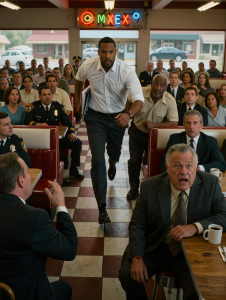
Helen Ward placed an evidence bag beside it and studied the sheriff the way a surgeon might study a tumor she had planned to remove long ago.
Daniel never laid a hand on Erica. He never raised his voice. He didn’t have to. The entire room leaned toward him anyway, pulled by the force of a man struggling to keep himself controlled.
“You will cooperate,” he said, “or these troopers will assist you.”
Erica pieced her voice together in fragments. “Daniel—Judge Delator—this is all a misunderstanding.”
Helen cut in sharply. “Don’t.”
But Erica wasn’t looking at Helen. Her eyes stayed fixed on Daniel as though familiarity might somehow save her. “I know your office. I know everyone at the courthouse. I’ve served this county for fourteen years.”
Daniel’s face remained cold. “Then you had fourteen years to learn that a badge is not permission.”
Behind the register, Tina openly cried. Harlow rested a hand on her shoulder. The trucker in the corner muttered, “Lord help us,” and no one told him to stop.
Michael now sat in a booth while the older woman from the state team inspected his bruised cheek and cleaned the cut on his lip. He accepted the attention politely, almost apologetically, as if he were inconveniencing her. Even injured, he carried the same infuriating dignity that had enraged Erica from the beginning.
Helen opened the leather case and pulled out folders thick with tabs and colored markers. “Sheriff Mullen,” she said, “we’ve been assembling this case for nine months. Civilian complaints. Missing body camera footage. Deputies pressured into silence. Arrests that conveniently targeted residents who challenged you at public meetings.”
Erica swallowed hard. “You can’t prove any of that.”
A younger deputy near the entrance suddenly spoke, his voice thin and strained. “Actually, ma’am… they can.”
Every head turned instantly.
Deputy Ryan Pike was twenty-six, baby-faced beneath his uniform, the kind of hometown boy people still remembered as one of the Miller twins from the high school baseball team. He had stood stiffly near the door the entire time, but now his hands trembled.
Helen gave him a slow nod. “Deputy Pike submitted the first corroborated statement.”
Erica looked at him as though she might kill him where he stood.
“You?” she whispered.
Ryan’s eyes filled with tears, but he didn’t look away. “You made me alter reports. You told me if I refused, you’d bury my mother’s medical insurance issue with the county. You said nobody would care because the people you targeted didn’t matter.”
A woman seated in the back released a shattered gasp. Her husband wrapped an arm around her shoulders.
Helen began spreading photographs across the counter: bruised wrists, ripped shirts, porch camera stills, screenshots of text messages, copies of reports with altered timestamps. Every image deepened the silence in the diner.
Daniel studied one photo, then another, and a muscle tightened in his jaw. “How many?”
Helen answered plainly. “More than we know yet.”
Still seated, Michael closed his eyes.
Daniel noticed immediately. He crossed the diner and crouched beside the booth. Everyone could hear him because his voice, when directed at his father, lost every trace of courtroom polish and became something rawer.
“Why didn’t you tell me?” he asked.
Michael stared at his folded hands. “Because I am your father before I am your burden.”
“That isn’t what I asked.”
A long pause passed. Then Michael lifted his gaze. His eyes were old, wise, and tired in a way Daniel had never fully understood until now.
“I didn’t tell you,” Michael said, “because I wanted to believe this town could save itself without asking my son to carry it.”
Daniel looked devastated.
Michael continued quietly, “And because every time a Black man speaks his humiliation aloud, someone asks for proof as though pain alone is never enough.”
Those words swept through the room like a storm front. Tina cried harder. Harlow lowered his eyes. Even one of the troopers swallowed hard and turned away.
Erica’s expression twisted with desperation. “This is political. Every bit of it. I kept this town safe. People here know that.”
“No,” a voice came from the doorway. “You kept it scared.”
Heads turned once more.
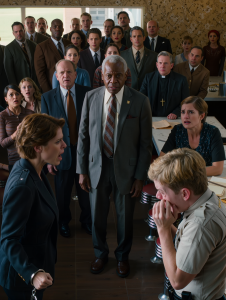
Mayor Ruth Hanley stood there in a navy coat, flanked by two council members and, astonishingly, Reverend Paul Mercer from New Hope Baptist. Behind them crowded more townspeople, drawn by rumors spreading faster than wildfire. Someone had called someone, and now the town itself had arrived to witness its conscience.
Ruth stepped forward. “You threatened business owners. You targeted families. You stopped boys for driving while Black and called it suspicion.” Her voice shook, though not from doubt. “You made fear feel normal.”
Erica looked from face to face, suddenly realizing the thing power always realizes too late: it survives on silence, and silence had finally ended.
Daniel stood. “This matter will not be heard in my courtroom due to conflict, but I will personally ensure every lawful avenue is pursued.”
“You sanctimonious coward,” Erica spat. “You think this is about justice? This town loved me.”
Michael answered before Daniel could.
“No,” he said. “This town obeyed you. There is a difference.”
The same words. The same wound. And this time it struck where everyone could feel it.
Helen stepped forward to cuff Erica.
Erica jerked backward. “Don’t touch me!”
The camera operator captured everything: the sweat along Erica’s temple, the rage burning in her eyes, the bitter irony of her outrage now that she was the one being restrained. She searched the diner for support and found none. Not from the waitress. Not from the mayor. Not from the deputy she had bullied into silence. Not even from the old men at the pie counter who once praised her toughness.
Then she noticed Michael watching her.
Not smirking. Not gloating.
Simply watching.
That seemed to shatter something inside her more completely than the charges themselves.
“You planned this,” she accused.
Michael released a tired breath. “No. You planned this every time you confused cruelty with power. We simply stopped stepping aside.”
Helen secured one cuff around Erica’s wrist.
The sheriff twisted wildly. “I can still fix this. I know things about this county. About this courthouse. About—”
“Enough,” Daniel said.
But Erica wasn’t done. Her voice rose, shrill and venomous.
“You want truth?” she shouted. “Fine. Ask your father why he really came back to this town after thirty years. Ask him what happened the night Judge Henry Vale died.”
The diner froze again.
Daniel slowly turned toward Michael.
Helen’s hand paused before fastening the second cuff.
Even Michael looked shaken—not guilty exactly, but struck by a door he believed had been buried forever.
“Erica,” Helen warned sharply, “be very careful.”
But Erica had smelled weakness and lunged for it. “Everyone thinks old Henry Vale died of a heart attack on his porch. Ask Michael Delator where he was that night. Ask him why he left town the next morning and never returned until after your mother died.”
The color drained from Daniel’s face. “Dad?”
Michael rose slowly.
The older woman tending his injuries tried to stop him, but he gently moved her hand aside. He stood to full height, blood still at the corner of his mouth, bruises blooming across his cheek, and looked first at Daniel, then at Erica.
When he finally spoke, his voice sounded more fractured than before.
“Because,” he said, “I was the one who found Judge Vale dying.”
Shock rippled through the diner.
Daniel stared at him. “You never told me that.”
“No.”
“Why?”
Michael’s eyes glistened. “Because the truth ruined enough lives already.”
Erica laughed through clenched teeth. “There it is.”
But Michael continued, his eyes fixed on his son.
“Henry Vale was your grandfather.”
The room practically staggered beneath the revelation.
Daniel stepped backward. “What?”
Michael closed his eyes briefly, then reopened them with visible effort. “Your mother never told you because Henry never acknowledged her publicly. He was a white judge with a Black housekeeper he pretended not to know. He sent money. Nothing more. The night he died, he called me to his house. He said he wanted to confess. To acknowledge her. To put your name into the family record. I arrived too late.”
Daniel looked as though the floor had vanished beneath him. “Grandfather?”
Michael nodded once. “By blood. Not by decency.”
The entire diner seemed to tilt into a deeper history none of them realized they had been standing inside.
Erica saw it happen and smiled triumphantly despite the cuff hanging from one wrist. “So the honorable judge comes from the same rot as the rest of us.”
“No,” Michael replied, and now his voice carried a force strong enough to still even the troopers. “He comes from what survived it.”
Daniel’s breathing had changed. Ruth Hanley had turned pale. Reverend Mercer lowered his head.
Helen recovered first. “Finish the arrest.”
But before the second cuff clicked shut, the diner television above the pie cooler flickered from weather coverage to breaking news. Someone must have changed the channel. On the screen appeared aerial footage of the county courthouse surrounded by reporters.
Then the anchor spoke the words that made everyone stare.
“—following the death this morning of federal appellate nominee Judge Daniel Delator in a reported highway collision—”
Tina screamed.
Daniel was standing right there.
Every head snapped from the television to the living man in the diner and back again.
The anchor continued, “Sources say identification was made from personal effects recovered at the scene—”
Daniel’s face emptied completely.
Michael gripped the edge of the booth.
Helen whispered, “What in God’s name…”
And for one impossible moment, it felt as though the town itself had stepped outside reality.
Part III
The first person to react was Daniel.
He grabbed the remote off the counter and turned the volume up. The newsroom repeated the headline with chilling certainty: fatal collision, burned vehicle, identity awaiting official confirmation but believed to be Judge Daniel Delator based on registration papers and identification recovered from the wreck.
Recovered from the wreck.
Daniel reached for his jacket pocket. Then his expression shifted.
“My wallet,” he said.
Michael stared at him. “What?”
“My wallet was stolen this morning.”
Helen turned immediately. “From where?”
Daniel was already piecing it together aloud, his words sharp and rapid. “Courthouse parking garage. I thought I left it in chambers. My phone too—I assumed I misplaced it when I rushed over here.”
The camera operator slowly lowered his rig. Even he looked rattled.
Erica, still wearing one cuff, let out a faint laugh.
It was a dreadful sound.
Everyone looked at her.
“You,” Helen said.
Erica tilted her head slightly. “I was wondering how long it would take.”
Daniel’s eyes narrowed. “What did you do?”
For the first time since the arrest started, Erica looked composed. Not triumphant, not secure, but grimly prepared. It was the face of someone who had saved one final move and waited for everyone else to catch up.
“You thought this was the entire story,” she said. “It isn’t.”
Helen forced the second cuff onto Erica’s wrist at last. “Talk.”
This time Erica didn’t resist. “A month ago, I got a call from a man claiming he knew what your father had buried. About Henry Vale. About the old records. He wanted money. Said there were letters, hospital records, signed statements. Enough to shatter this town’s favorite fairy tale.” Her eyes shifted toward Daniel. “Enough to destroy your nomination.”
Daniel went completely still. The federal appellate seat. Only weeks away. Every newspaper in the state had already celebrated it. The town’s greatest point of pride.
“I refused,” Erica continued. “Then he mailed me a copy of one letter. Henry Vale admitting your mother was his daughter and revealing another secret too.”
All color vanished from Michael’s face. “No.”
Helen stepped forward. “Who contacted you?”
Erica smiled faintly. “Your investigator already knows him.”
Helen’s expression changed instantly.
“Say the name,” she demanded.
Erica looked directly at Michael.
“Judge Henry Vale’s other grandson,” she said. “Deputy Ryan Pike.”
The diner erupted into chaos.
Ryan stumbled backward toward the door, pale as paper. “That’s not true!”
But Michael’s gaze had already fixed on him with terrible recognition. Not because he truly knew Ryan, but because he recognized a face. The curve of the mouth. The brow. Blood leaves echoes behind across generations.
Reverend Mercer gasped aloud. Ruth Hanley dropped heavily into a booth.
Helen moved toward Ryan. “Stay where you are.”
Ryan’s eyes flooded with panic. “She’s lying!”
Erica laughed again. “Am I? Tell them about your grandmother, Edith Pike. Tell them who worked in Henry Vale’s house before Michael’s wife ever did. Tell them what your mother discovered in that trunk after Edith died.”
Ryan looked from Daniel to Michael, and whatever denial he had prepared collapsed completely.
“I never wanted to hurt anyone,” he whispered.
“Start talking,” Helen ordered.
Ryan sagged against the wall. The fresh-faced deputy disappeared, replaced by a young man drowning beneath generations of buried poison.
“My grandmother worked for Henry Vale when she was sixteen,” he said. “She got pregnant. He paid her father to stay quiet and married her off to a man shipping out for Korea. Everybody pretended the dates lined up.” His mouth trembled violently. “My mom found letters after Grandma died. Henry knew. He always knew.”
The diner had become something like a church of grief.
Daniel stared at him. “So you’re saying—”
Ryan nodded, tears spilling freely now. “I’m your cousin.”
Michael closed his eyes slowly.
Ryan rushed onward, shame tangling his words. “I didn’t tell anybody. Then Erica found out I was digging through old records. She cornered me. Said if I wanted help exposing courthouse hypocrisy, she could use it. She said you and Judge Delator were part of the same machine, same bloodline, same lie.”
Erica snapped, “I said the truth should burn.”
Ryan flinched but kept speaking. “I copied Daniel’s schedule. I stole his wallet and phone from the garage. But I swear I never meant for anyone to die. I left them in the car because the plan was to make it seem like he ran. Just vanished before the confirmation hearing. Erica said scandal would destroy him.”
Daniel’s voice dropped into something dangerously soft. “And the collision?”
Ryan shook his head wildly. “I don’t know! I left the car on quarry road. It was empty.”
Helen turned toward one of the troopers. “Dispatch. Now. Get state police at the scene and confirm whether there’s actually a body.”
The trooper was already reaching for the radio.
The entire diner listened to bursts of static and clipped police codes while the television repeated Daniel’s false death, the town devoured its own buried secrets in public, and Michael Delator stood motionless in the center of all of it.
When the trooper finally lowered the radio, he looked stunned.
“No body,” he said. “Vehicle burned, but the driver’s seat had been rigged with animal remains from a veterinary disposal site. They’re saying the fire was staged.”
Daniel released a sharp breath.
Tina burst into tears again, this time from pure emotional whiplash.
Helen spun toward Erica. “You attempted to fabricate the death of a federal nominee.”
Erica’s face twisted bitterly. “I tried to stop a dynasty.”
Michael stepped forward.
Every voice in the diner died instantly.
The bruise across his face had darkened, his lip was swollen, but his eyes had become painfully clear. He looked first at Ryan, then at Daniel, then finally at Erica.
“You thought blood was the story,” he said.
Nobody moved.
He turned fully toward Ryan. “Listen to me, son. Henry Vale’s blood is not your curse unless you choose to carry his sins like inheritance.” His voice deepened. “What that man did to our mothers, our families, this town—that was violence. But what you did today was a choice.”
Ryan broke completely. He slid down the wall onto the floor, covering his face with both hands.
Michael shifted his attention to Erica. “And you—you wrapped your cruelty in the language of exposure. You convinced yourself you were cleansing corruption, but what you truly wanted was domination. Same poison. Different uniform.”
For once, Erica had nothing to say.
Daniel looked at his father with a mixture of heartbreak and awe. “Dad…”
Michael raised one hand gently without turning toward him. Not to silence him, but to ask for one final moment.
Then he did the last thing anyone in that diner expected.
He reached inside his jacket and pulled out a sealed manila envelope, worn with age but carefully preserved.
Helen frowned. “What is that?”
Michael looked directly at Daniel. “The reason I came back.”
He handed the envelope to his son.
Daniel opened it with trembling hands. Inside rested yellowed letters, a birth certificate, a notarized statement, and one newer document printed on crisp paper.
“What is this?” Daniel whispered.
Michael gave a weary smile that carried decades of sorrow inside it.
“Henry Vale’s confession,” he said. “And my answer.”
Daniel scanned the final page. His eyes widened. “Dad…”
Ruth Hanley rose slowly. “What is it?”
Daniel looked up in disbelief. “It’s the deed.”
“To what?”
Michael slowly turned, taking in the diner, the mayor, the waitress, the trucker, the deputies, and the people of a town that had finally stopped looking away from violence.
“To the old Vale estate,” he said. “Henry signed it over to me the night he died. I never recorded it.”
The room fell silent once again.
“That house,” Michael continued, “and the land beneath it legally belong to me now. I came back to file the deed tomorrow morning.”
Daniel stared at him. “Why now?”
Michael’s answer was simple.
“Because I’m done letting the dead own more of this town than the living.”
Then he looked toward Ruth.
“I want the estate demolished. Every board. Every brick. And in its place, I’m funding a public legal clinic, a scholarship house, and a civil rights archive in my wife’s name and Edith Pike’s name—because the truth should not only expose what was done to women like them. It should serve the people who survived.”
Ruth covered her mouth with one hand.
Reverend Mercer openly cried.
Ryan looked up from the floor, shattered. “Why would you include my grandmother?”
For the first time, Michael’s face softened completely.
“Because no child should inherit silence.”
The television still shouted nonsense about Daniel’s death, but nobody was listening anymore. The real resurrection was unfolding inside that diner.
Helen slowly straightened. “Mr. Delator… this changes everything.”
Michael nodded once. “That’s the point.”
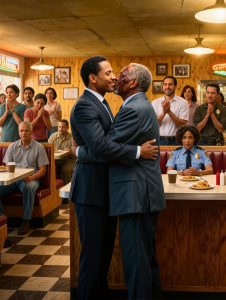
Daniel looked from the deed to his father, and whatever words he wanted refused to come. Instead, he stepped forward and embraced him there in front of the entire town, careful of the bruises, one hand trembling against Michael’s back.
And Michael, after enduring a slap, a lie, a buried bloodline, and a lifetime of swallowing pain so his son could stand taller, finally allowed himself to lean back.
Erica watched the embrace in handcuffs.
She had wanted scandal. Ruin. Ashes.
Instead, she had detonated a rebirth.
By nightfall, the state suspended her commission, federal charges multiplied, reporters flooded the courthouse, and every old complaint she had buried beneath paperwork came roaring back into daylight. By morning, footage from the diner was everywhere. People replayed the slap endlessly, but what stayed with them was not only the violence.
It was what followed.
The old man standing again.
The phone call.
The warning.
And then the truth pouring out—not as revenge, but as reckoning.
Weeks later, after the false death scheme, the staged crash, the evidence tampering, and decades of hidden family abuse had all been dragged into court, reporters repeatedly asked Daniel Delator how it felt to discover within a single afternoon that he had nearly been declared dead, uncovered a secret bloodline, and owed his public future to a father who had carried history in silence.
Daniel always answered the same way.
“My father taught me that justice isn’t what power says in a courtroom,” he said. “It’s what dignity does after being struck.”
But the town remembered a different final image.
Not Erica in handcuffs.
Not the investigators.
Not even the judge.
What they remembered was Michael Delator standing inside Harlow’s Diner with a split lip and a shaking hand, choosing not to destroy, but to build.
And that was the ending nobody expected.
Because the most shocking thing to happen in that town was not that a racist sheriff slapped the judge’s father.
It was that the man she tried to humiliate had been carrying the future of the entire town in his pocket all along.
