

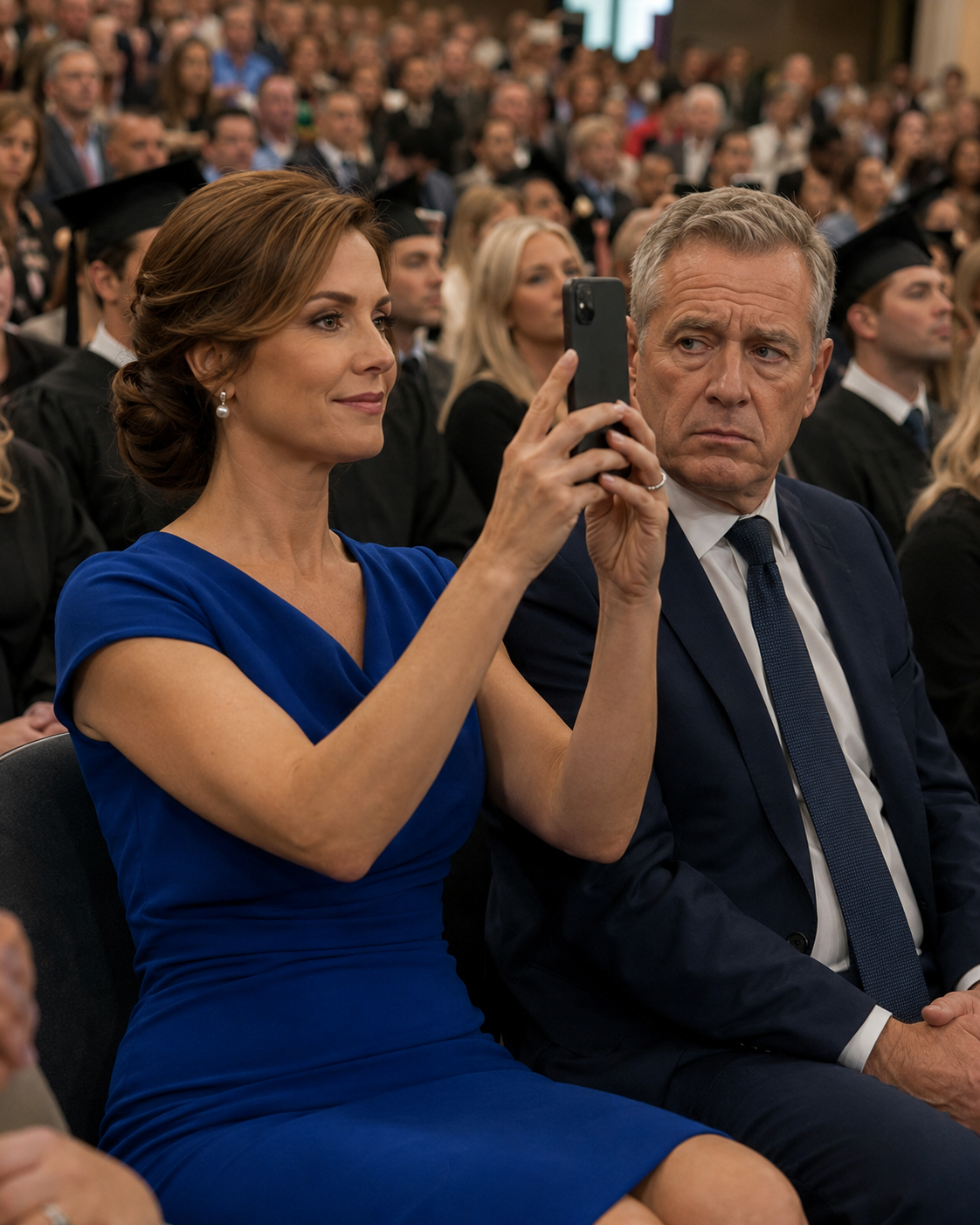
The usher looked like he’d barely finished high school himself. His name tag said Brandon, and he couldn’t quite bring himself to look at me.
“Ma’am, I’m sorry, but those seats in the front are no longer available. You’ll have to stand back here.”
My grip tightened on the graduation program. From the back of the auditorium, Row B was clearly visible. Two chairs. Two reserved name cards. I’d watched my son set them there himself that very morning, right after hugging me in the parking lot.
“Front row, second seat from the aisle,” he’d told me with a smile. “I saved the best spot for you.”
Now the cards were missing. Not entirely — one lay crumpled beneath the row in front, ripped cleanly in two. My name, Sarah Evans, written in Michael’s careful blue marker, torn straight down the center.
“Those were my seats,” I said, keeping my voice low. “My son reserved them.”
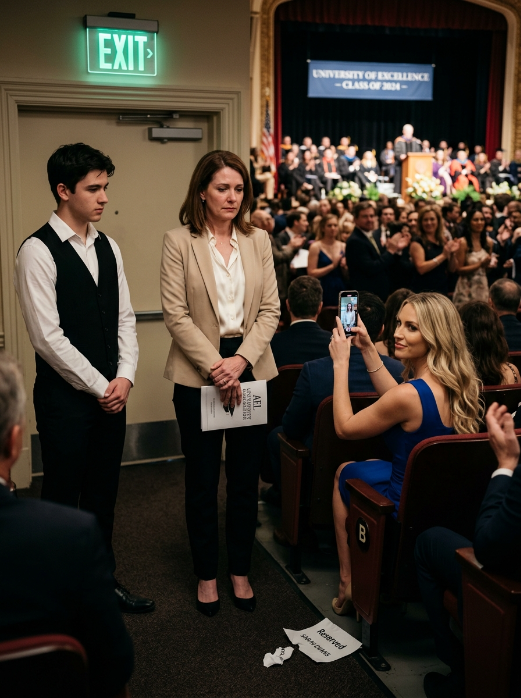
Brandon shifted his weight, uneasy.
“The woman in the blue dress said there’d been a seating mix-up.”
I followed where he was looking. There sat Chloe — my ex-husband David’s third wife, twenty-eight years old, decked out in an expensive cobalt-blue dress, planted in the middle of Row B like she’d always belonged there.
She turned, caught sight of me at the back, and smiled. It wasn’t warm. It was the kind of smile that says, I know exactly what I did.
Then she raised her phone and pointed it my way. Recording. Before getting to what happened next, you should know about the eighteen years leading up to it. Otherwise you might mistake my not marching down that aisle and reclaiming my seat for weakness. It wasn’t weakness. It was caution. And from the outside, caution can look a lot like giving up.
David walked out when Michael was six.
He came home one Tuesday and announced he had “outgrown” me. That was his word — outgrown. As if I were a worn-out sweater he no longer wanted. He’d found someone new at work. He wanted the house. He promised he’d be generous with support payments. That night, Michael stood in the hallway in his Spider-Man pajamas, watching me break down on the kitchen floor. I scooped him up and told him we were starting a new adventure. He wrapped his arms around my neck and wouldn’t let go.
He always held on tight. We spent two months with my sister Claire. After that, I found a cramped apartment above a Vietnamese restaurant. The heating barely functioned. The bathroom door never shut all the way. Michael took the bedroom; I slept on the pullout couch. Money was tight, always.
David rarely paid what the court ordered. There was always some excuse — a business problem, a financial setback, a delayed payment. Eventually I stopped counting on him at all. I cleaned medical offices in the mornings and took in sewing alterations at night for extra cash. Some nights I worked past two. Some nights past three.
I went without vacations. Without new clothes. Without everything except what actually mattered.
Michael. He never owned the priciest shoes or a designer jacket. But he always had books. Always had school supplies. And always had a mother who was there.
Every game. Every conference. Every milestone. Michael was gifted — by elementary school he was reading well beyond his grade level. Teachers noticed. Doctors noticed. Everyone noticed. I drove him forty minutes each direction to a magnet school. I brought him to robotics competitions, science camps, math tournaments. David showed up to exactly two important events in twelve years — one science fair, one graduation — and stayed only long enough for the photos.
That was his gift. Photographs. He missed the fevers. The late-night meltdowns over homework. The bullying. The struggles. But he never missed a picture. That’s why, years later, when Chloe took my seat at Michael’s graduation, I didn’t move. Because eighteen years of quiet endurance meant more than one moment of public outrage. I wasn’t going to hand someone their next social media moment. So I stood beneath the exit sign. And I waited. What Chloe pulled that day wasn’t anything new — just the latest move in a much longer game.
Since marrying David, she’d spent years working her way into every corner of Michael’s life. Social media posts. Snide little comments. Small moves calculated to make me feel like I didn’t exist. None big enough on its own to cause a scene. But stacked together, they formed a pattern. My attorney even gave it a name. The Chloe File. By graduation day, it ran past eighty pages. That morning, Michael had hugged me in the parking lot.
“I love you, Mom,” he’d said.
Then he stopped.
“No. I mean it. I know everything you’ve done for me.”
I remember just staring at him. He wasn’t usually one for sentiment.
“Don’t cry today,” he said.
“Why would I cry?”
“Because today’s going to be a good day.”
I didn’t grasp what he meant. Not then. An hour later, I was standing at the back of the auditorium while Chloe occupied my seat. Claire was livid.
“She took your place,” she hissed.
“Not today,” I told her. “We’re not letting this ruin Michael’s day.”
So I kept quiet. Then the principal stepped up to the podium.
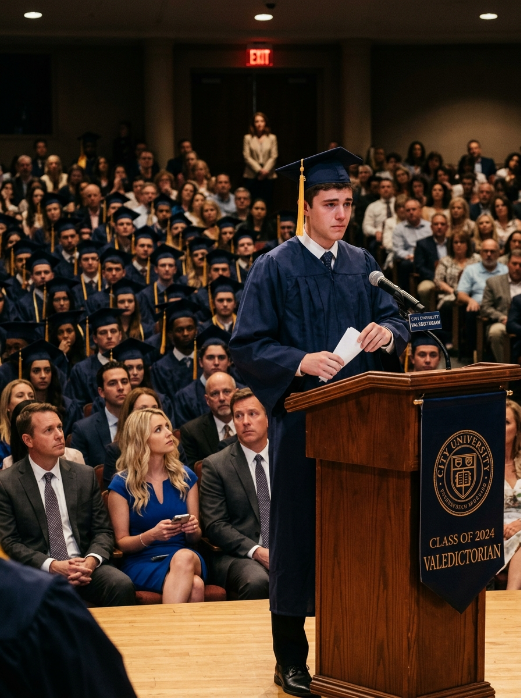
“And now,” he said, “it’s my honor to introduce this year’s valedictorian… Michael Evans.”
The room erupted. People jumped to their feet. Teachers cheered. Students shouted. David sprang up too, clapping like he’d earned some of the credit himself. Chloe raised her phone to film. Michael walked out onto the stage. But his eyes didn’t go to David. They didn’t go to Chloe. He looked straight to the back of the auditorium. At me. Then he pulled out his prepared speech, glanced at it, folded it back up, and tucked it into his pocket.
“I had a speech ready,” he said into the microphone. “But I’m not giving it.”
Six hundred people went still.
“I was going to thank everyone who got me here.”
His eyes flicked toward Chloe.
“But this morning, someone in this room did something I can’t let slide.”
Chloe’s phone dropped slightly. Michael pointed straight at her. The whole room turned to look.
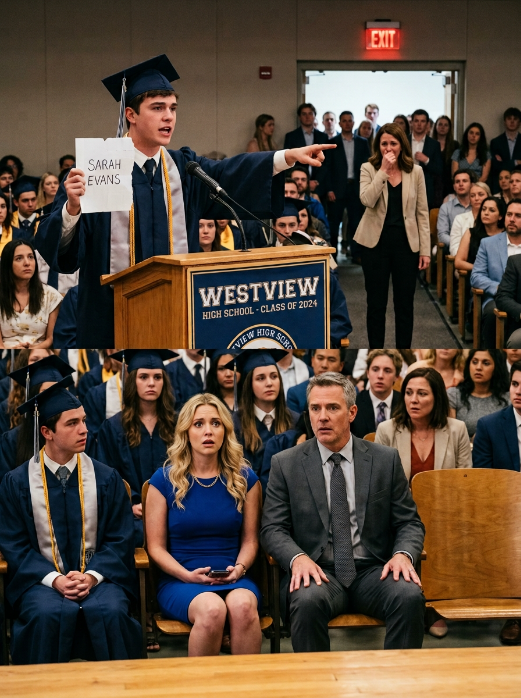
“You thought no one saw what you did. You thought your money made you untouchable.”
Then he held up the torn name card. My name. Split in two.
“I have the security footage,” he said.
Whispers rippled through the crowd.
“My mother worked two jobs for eighteen years to get me here.”
His voice broke, then steadied again.
“She cleaned offices before sunrise. She worked into the night. She never missed a single parent meeting. Not one.”
He pointed to the back of the auditorium. To me.
“I’m standing here because of her.”
Every head in the audience turned. For the first time, six hundred people were looking at me. Not Chloe. Not David. Me. Standing there under the exit sign, it hit me. Every sacrifice had counted for something. Every early morning. Every sleepless night. Every hardship. We’d made it. And my son had made certain the entire room knew exactly who belonged in the front row.
