

He mocked a grieving soldier… then the black SUVs showed up.
My name is Marcus Reed, and the day a county deputy kicked my Army cap beneath his cruiser and labeled me a fraud, I realized how fast a uniform can shift from a symbol of honor into a mark that makes you a target for the wrong man with the right badge.

I was driving back to base across western Tennessee after laying my father to rest.
Even now, that line carries more weight than the highway itself did. My father, Earl Reed, was a Vietnam veteran who spent the rest of his life teaching me that honor doesn’t announce itself. It stays steady. It shows up. It carries grief without letting it harden into cruelty. That morning I had stood at his graveside in full dress uniform because that’s what he would have expected. By the time I reached Jericho County, the flowers were gone, the sound of taps still lingered in my head, and all I wanted was water and a few minutes to breathe before continuing the drive.
I stopped at a gas station just after dusk.
I remember the harsh fluorescent lights over the pumps, the scent of fuel, the weight in my shoulders, and that strange exhaustion that comes after funeral tears fade but don’t fully leave you. I was still in uniform: pressed jacket, service ribbons, polished shoes, cover tucked under one arm while I reached for my wallet. I had barely stepped toward the cooler inside when tires screeched across the lot.
A deputy’s cruiser slid in fast.
The driver’s door swung open and Deputy Nolan Pierce was already shouting as he moved toward me.
He didn’t ask anything first. No greeting. No checks. Just accusations. He claimed the vehicle I was in matched a theft alert and demanded to know where I had “gotten the costume.” For a brief moment, I thought it was a mistake that would clear itself once I spoke.
I said calmly, “Deputy, I’m Sergeant Marcus Reed, United States Army. My military identification is in my wallet.”
He laughed.
Not unsure. Not hesitant. Cruel.
He said men like me always had stories, and before I could properly pull my CAC card, he slammed me onto the hood, twisted my arm behind my back, and cuffed me so tightly my wrist went numb. I kept telling him to check the registration, run the plate, look at my ID. He ignored every word. He accused me of stolen valor, impersonating military personnel, and driving a stolen vehicle I had legally rented through a defense travel account.
Then he did something I will never forget.
He took my cover, looked at it, smirked, and kicked it under his cruiser like it was trash.
That was the moment humiliation turned into rage.
Not just because of pride. Because my father had been gone less than twenty-four hours, and the same uniform I wore to honor him was being treated like a joke by a man too careless—or too corrupt—to verify what stood in front of him.
At the station, he kept me in cuffs and began writing a report built entirely on falsehoods.
What he didn’t know was that someone inside that building still had a conscience.
And one phone call was about to send a convoy into Jericho County that Deputy Nolan Pierce would never forget.
Because once that call reached the Pentagon, the man mocking my uniform was no longer handling a grieving soldier—he was standing in the center of his own collapse.
Part 2
If you’ve never sat cuffed in a county holding room while someone lies about your life through a glass window, it feels exactly like this:
Slow.
That’s the worst part. Violence is instant. False paperwork takes its time. Deputy Nolan Pierce moved with the confidence of a man who believed no one important was coming. He kept stepping out of the report room just long enough to toss insults through the bars. He called my ribbons “mail-order.” Said I should’ve chosen a cheaper car to steal. Said I had the look of someone who mistook discipline for importance.
Grief had already worn me down that day. Under different circumstances, I might’ve reacted with anger. But the Army teaches something more useful: control buys time. So I stayed still, focused on breathing, and watched everything unfold.
That’s when I noticed Deputy Claire Bennett.
She was younger than Pierce, early thirties maybe, with a careful expression that suggested she knew when to stay quiet. She passed by once with paperwork she didn’t need to deliver, looked at my cuffs, then at my folded jacket on the bench, then at the name tape on my chest. Something shifted in her eyes. Not pity. Recognition.
Later, when Pierce went to the back office bragging on the phone, she came close enough to speak quietly.
“Do you know anyone who can verify you fast?”
I gave her one name.
General Nathan Holloway.
Not because we were close, but because I had served under his command structure on a special assignment, and his office had signed the travel authorization that put me on that road. Claire hesitated for a second, then slid a desk phone through the slot and walked away as if nothing had happened.
The call lasted under a minute.
I identified myself. Confirmed my location. Provided my unit and travel reference, then added one sentence that changed the tone instantly:
“I am in custody, sir, and the arresting officer is alleging stolen valor while refusing to verify my military credentials.”
Then silence.
Anyone who’s served knows there are two kinds of silence: doubt, and movement. This was movement.
Within twenty minutes, Jericho County stopped feeling isolated. Phones began ringing everywhere. Claire avoided eye contact entirely. Pierce returned from the office irritated, then defensive, then uneasy. Dispatch mentioned federal vehicles crossing the county line. He told them to relax. Then he tried to disable his cruiser’s dash-cam archive.
He was too late.
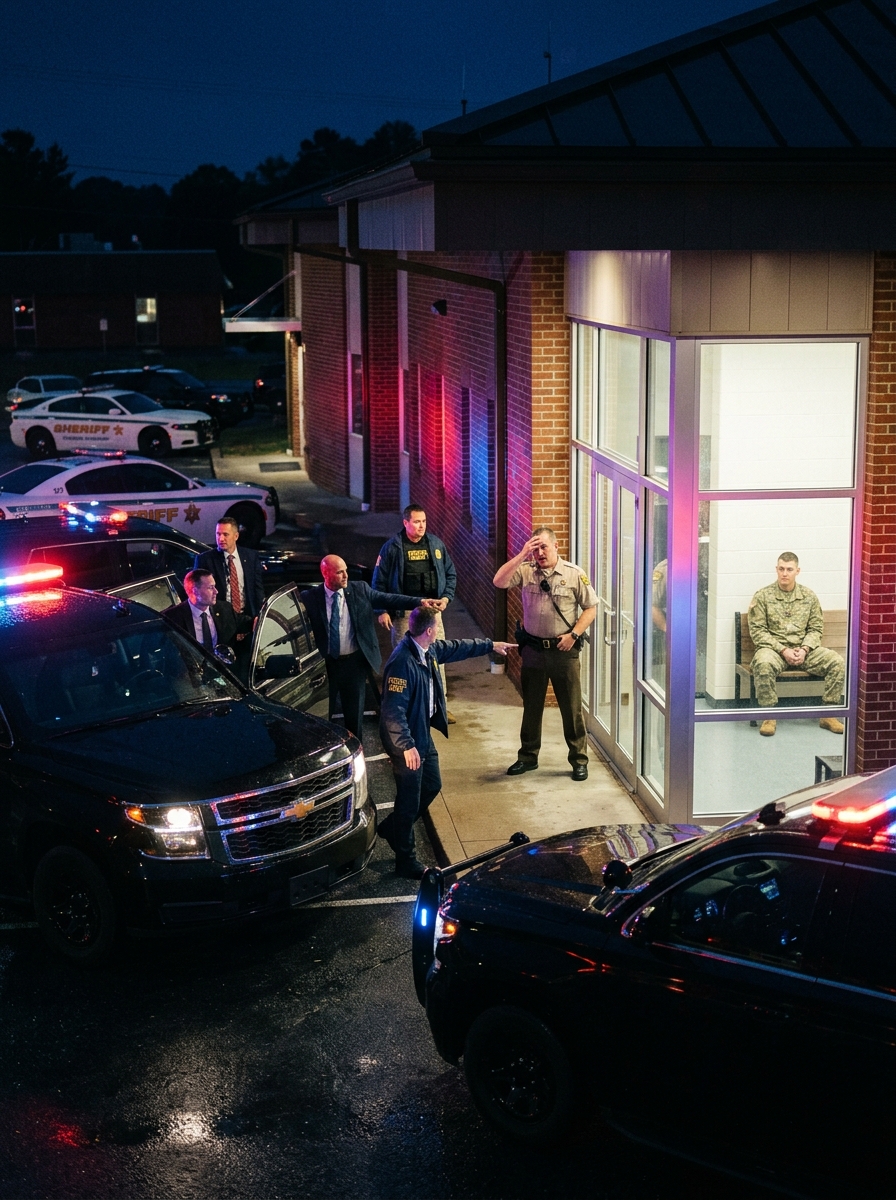
The first black SUV arrived before he even reached the lot.
Then another.
Then marked federal units.
Then men in suits and tactical gear stepped out with quiet authority that didn’t need explanation. Military investigators. FBI agents. Fort Campbell liaison officers. Through the window, I saw Pierce realize they weren’t there to “clarify” anything—they were there to take over.
My cuffs came off.
His duty belt followed.
That should’ve been enough. But when they searched his cruiser, they found something that had nothing to do with me—and everything to do with how quickly he had acted.
A metal cash box.
Multiple IDs.
Property bags from prior stops.
And a ledger that made an FBI agent quietly say, “This is bigger.”
Pierce hadn’t just arrested the wrong man.
He had been operating a scheme that finally caught the wrong moment, the wrong victim, and the wrong call.
And when the dash-cam audio was recovered, it didn’t just confirm misconduct—it revealed what he intended to do after booking, and why I might not have left Jericho County at all.
Part 3
The dash-cam footage ended Deputy Nolan Pierce’s career far more decisively than any courtroom argument.
The video alone was damning: the aggressive stop, my repeated offers of military identification, refusal to verify rental records, slurs, the kick to my cover, excessive force. But the audio after my arrest—what Pierce thought he could erase before federal arrival—was worse. He spoke like a man discussing profit, not people. He joked about out-of-state drivers carrying cash. He said uniforms and credentials only made targets more valuable because fear kept them compliant. Then he crossed a line that turned misconduct into a federal case.
He discussed seizing my property before anyone could “untangle the paperwork.”
That wasn’t policing.
That was theft with authority.
The search of his cruiser exposed everything. Once the case reached local news, then state, then national coverage, more victims came forward. Drivers who had stayed silent for years suddenly had documents, receipts, and matching accounts. Immigrants. Contractors. Military families. All with the same pattern: they believed no one would side with them against a local deputy with deep connections.
For a long time, they were right.
Sheriff Walter Pierce, his uncle, helped maintain that system. Complaints vanished. Dash-cams “failed.” Logs shifted in convenient ways. But once federal investigators entered, the structure collapsed. The sheriff was suspended, then charged. Claire Bennett testified. So did dispatch staff, victims, and a former deputy who admitted he was pressured into silence.
I became the public face of the case, whether I wanted it or not.
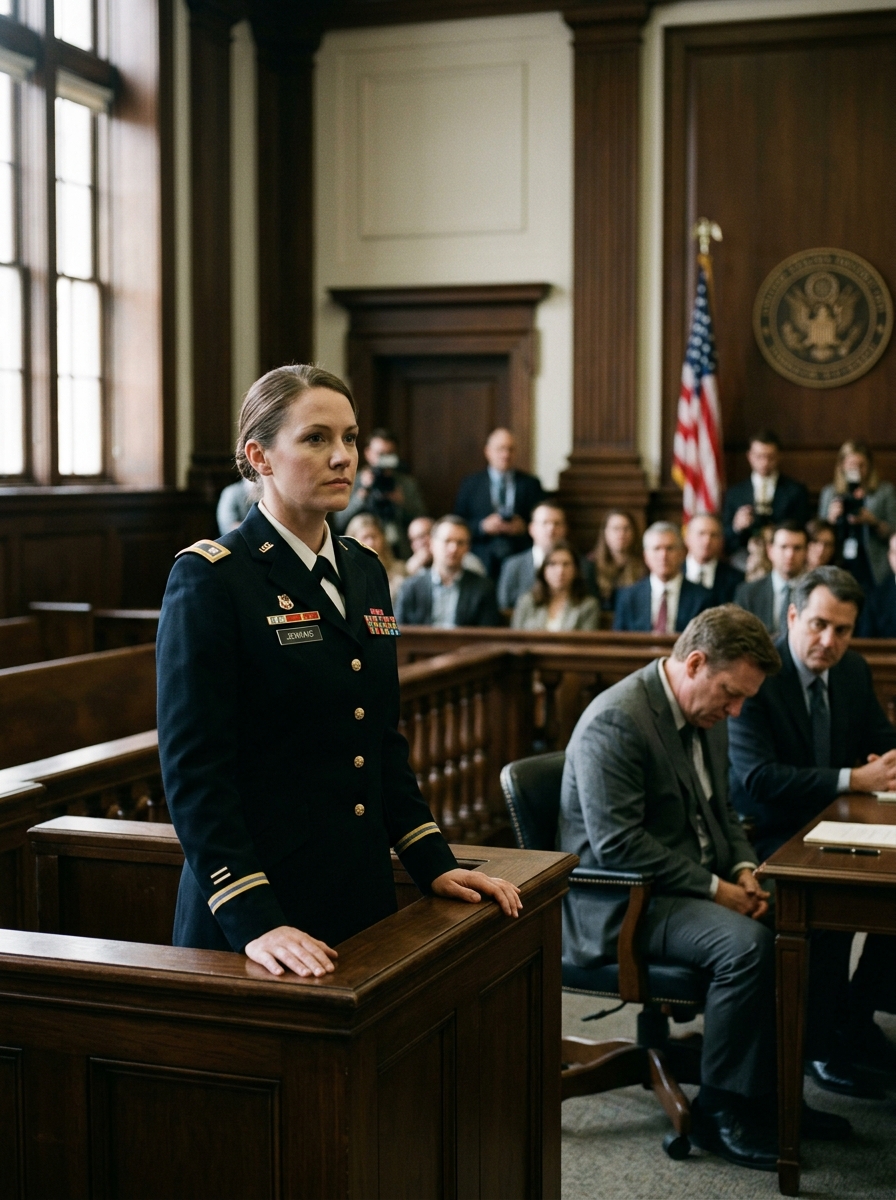
I testified in federal court wearing the same uniform Pierce had mocked, though I wore a replacement cover. I had retrieved the original from evidence myself after clearance. It was scuffed, slightly bent, marked with tire dust. I kept it anyway. Some things stop being objects and become memory.
Pierce was convicted on civil rights violations, extortion-related charges, falsification of records, and obstruction. His sentence—sixty-two years without meaningful release—didn’t feel like celebration. Justice rarely does when you’ve lived through the harm. It felt final. Cold. Correct. Sheriff Walter Pierce followed.
The civil settlement changed my life, but not in the way people assume. Most of it went into the Reed Defense Fund, created to support service members and veterans trapped in abusive local systems they can’t afford to fight. That mattered more than revenge. My father used to say suffering only means something if it helps someone else avoid it. I held onto that.
Five years later, I visited Nolan Pierce in federal prison.
People still ask why. The answer is simple even if it doesn’t sound simple. I didn’t go to give him peace. I went to take mine back. He looked smaller, worn down by time and concrete. I told him I forgave him—not to excuse what he did, but to stop carrying him with me.
Then I left.
He stayed.
That’s the difference between forgiveness and freedom.
Every year since, I visit my father’s grave in uniform without wondering if anyone can strip meaning from it.
They can’t.
If this story moved you, share it, protect the vulnerable, and remember: power survives in silence, but truth grows louder when it’s forced into the light.
