

Part I
By the time the first hand touched her arm, Ava Monroe already understood the day would not follow the usual pattern.

The courthouse steps were still wet from a light morning rain, pale stone glowing under a dull, washed sky. Reporters clustered behind barricades. Lawyers hurried past with coffee in one hand and files in the other. Uniformed officers stood at the entrance beneath tall columns, their expressions carrying the familiar, weary suspicion of long hours and unchecked authority. The city was waking into another unpleasant headline, though no one had realized it yet.
Ava walked up the steps in a fitted black suit, a brown leather briefcase at her side, her heels tapping the stone in a steady, composed rhythm. She moved with quiet assurance that made people glance twice without knowing why. Her hair was tied into a sleek low bun. Pearl earrings caught the morning light. She looked composed, refined, exact.
And somehow, to Officer Ryan Daniels, that composure felt like a challenge.
He stepped into her path so suddenly she almost ran into him. “Hold it.”
Ava stopped. No reaction. “Excuse me?”
Daniels was broad-shouldered, flushed, and already irritated in the way some men became when they felt they could not easily control the person in front of them. “This entrance is restricted.”They shoved her on the courthouse steps… not knowing they were humiliating the woman who would decide their fate an hour later.
Ava glanced at the brass plaque near the doors, then back at him. “No, it isn’t.”
His eyes scanned her briefcase, her suit, her heels, her stillness. Something sharp and dismissive formed in his expression. “I said it is now.”
Two nearby officers turned slightly. People on the steps slowed. Cameras shifted. From behind the barricade, someone whispered, “What’s happening?”
Ava took a slow, controlled breath. “Officer, I have every right to enter this building. Please move.”
Daniels let out a short laugh. “Lady, you don’t belong here.”
The words hung in the air like a strike.
Heads turned. A young clerk froze mid-step. A reporter raised her phone higher. Ava felt the familiar heat rise in her chest—that controlled, contained anger she had learned to bury beneath discipline and silence. But beneath it lay something steadier: certainty.
“Take your hand off me,” she said.
Only then did he seem to notice his grip on her arm. His fingers tightened.
“Or what?” he asked.
Ava turned fully toward him, and for the first time he registered her eyes—calm, steady, unshaken in a way that unsettled him. “You just made the biggest mistake of your career.”
Daniels scoffed. “Yeah? You and what title?”
A few uneasy laughs surfaced. Someone muttered, “Oh no.”
Ava could have answered. She could have ended it instantly. But she didn’t. Something held her back—maybe the cameras, maybe experience, maybe the knowledge that men like him rarely listened in private.
So she stayed silent.
That silence angered him more than words would have.
He shoved her.
Not enough to knock her down, but enough to make the crowd react. Her heel slipped slightly on the wet stone, her briefcase striking her leg. Daniels stepped closer, looming now, breathing harder, enjoying it. “I said move.”
Phones appeared everywhere.
A younger officer, Elliot Perez, shifted uneasily. “Daniels, maybe—”
“Stay out of it,” Daniels snapped.
Ava straightened slowly. Her jaw tightened, but her voice stayed even. “Tell me your badge number.”
Daniels smiled. “You planning to file a complaint?”
“No,” she said. “I’m planning to remember it.”
That should have stopped him.
Instead, he grabbed her briefcase.
The movement was quick, rough, instinctive—like he had decided she had no right to carry it. He yanked it from her hand and dropped it onto the stone. The clasp broke open. Papers shifted inside.
The crowd erupted.
“Hey!”
“What the hell?”
“Get that on video!”
Ava stared at it for a moment too long. The briefcase had been her father’s gift when she graduated from Yale Law. Old, heavy, carefully maintained every week. He had pressed it into her hands and told her, Walk into every room like you were sent for. He had died before seeing where she had ended up.
Daniels didn’t know what he had touched.
The humiliation spread fully now—public, complete. People watched with pity, anger, uncertainty. The kind of silence that admits something is wrong but does nothing to stop it.
Ava bent, picked up the briefcase, checked the clasp, and said quietly, “Open those doors.”
Daniels laughed. “Or what?”
The courthouse doors suddenly burst open.
A gray-haired clerk rushed out, breathless and pale. “Where is she? Where is Judge Monroe?”
The entire staircase went still.
Daniels frowned. “Judge who?”
The clerk looked between him and Ava, then at his hand still raised. Color drained from his face. “Oh my God.”
Ava stepped forward.
Then again.
No one stopped her.
The crowd parted instinctively.
Daniels moved aside too late, nearly stumbling. “Wait—Judge?”
But she didn’t look at him. She walked through the open doors into the marble interior. Her briefcase at her side. Her posture unchanged. Behind her, the realization spread.
“She’s the judge.”
“Newly appointed.”
“That was her?”
“He shoved a judge?”
Ryan Daniels stopped breathing properly. The color drained from his face in waves.
Inside, Ava entered the private corridor and paused by a tall window overlooking the city. Her hands shook now that she was alone. She hated that they did. She pressed them to a table until they steadied.
Judge Monroe.
The title still felt unfamiliar.
This was meant to be a clean beginning. Her swearing-in had been quiet a week earlier. Today was her first major case: a police misconduct hearing involving a teenager’s death, altered footage, and conflicting departments.
Her assistant, Margaret Hale, hurried up. “Ava, are you all right? We saw part of it on the security feed. Security is pulling the footage now.”
Ava lifted the briefcase. “Who’s in my courtroom?”
Margaret hesitated. “Press. Attorneys. Community leaders. Internal Affairs. And…” She swallowed. “Officer Daniels is listed as a witness in the misconduct hearing.”
Ava turned slowly.
Everything sharpened.
“Good,” she said.
Margaret blinked. “Good?”
Ava’s voice lowered. “Then he is already exactly where I need him to be.”
She walked toward the courtroom doors.
Outside, Ryan Daniels finally realized the worst part of his day hadn’t happened yet.
It was waiting inside.
Part II
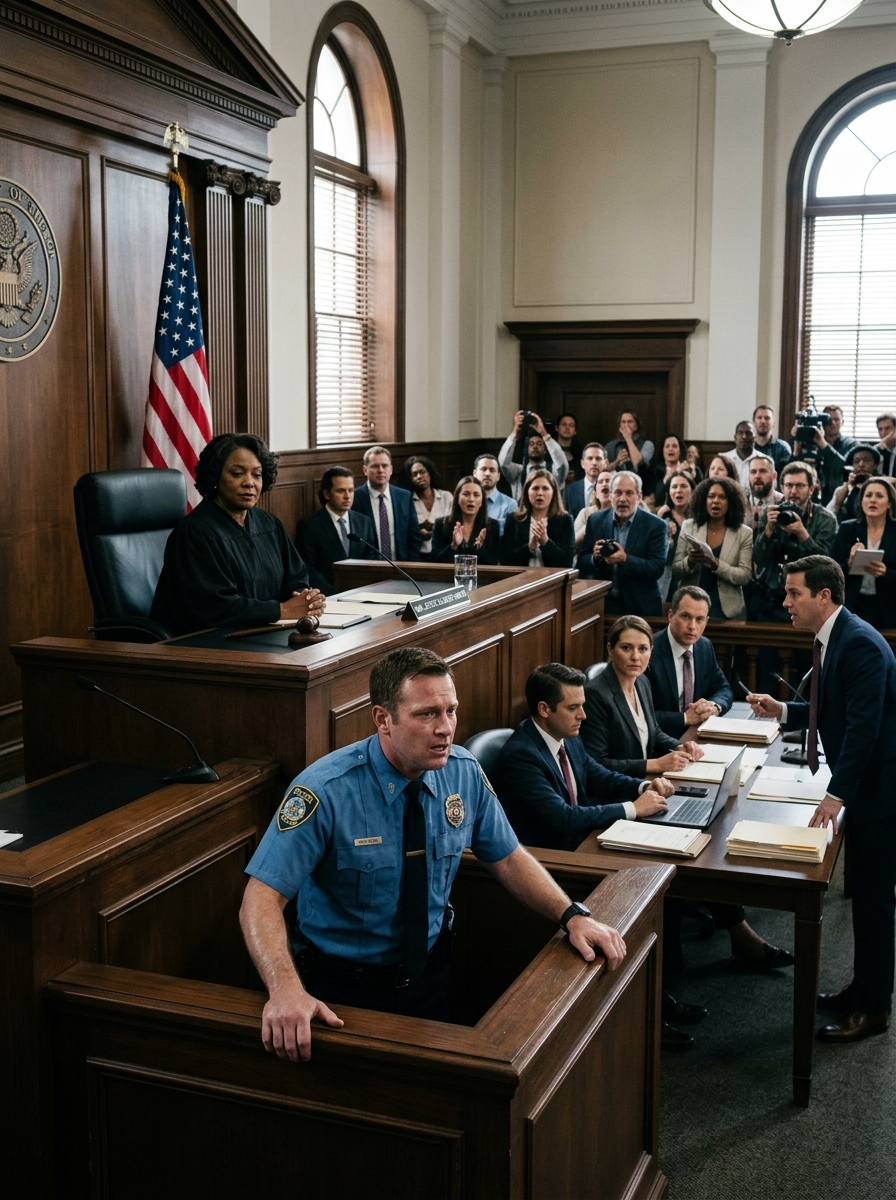
Courtroom 4B was already full when Ava entered.
The gallery was packed: journalists, grieving families, activists, officers, attorneys, clerks moving quickly through tight aisles. The bench gleamed under overhead lights. The flag stood still behind it. The court seal watched over everything.
Ryan Daniels stood near the witness rail, tense and unsteady.
“All rise.”
Everyone stood.
Ava entered from the side door and walked to the bench without urgency. She didn’t look at Daniels until the last moment—and even then, only briefly.
She placed her briefcase down.
Then sat.
“Be seated.”
Everyone obeyed.
Daniels sat late, rigid, sweating.
Ava opened the docket. “We are here today in the matter of the City of Halcyon versus Lieutenant Marcus Bell et al., regarding allegations of evidence tampering, falsification of reports, and the use of unlawful force in the arrest and subsequent death of Jamal Carver.”
At the name, a woman in the front row lowered her head and cried silently.
Ava looked up. “Before we begin, this court will address an incident that occurred on the courthouse steps at approximately 8:42 this morning.”
Murmurs spread.
Daniels’ attorney stood. “Your Honor, with respect, any matter involving my client outside the scope of today’s hearing should be addressed separately—”
“Sit down, Mr. Klein.”
He sat.
“The scope of this hearing concerns police credibility, abuse of authority, conduct under stress, and public trust. The incident this morning may be more relevant than anything currently in the record.”
Silence filled the room.
“Officer Daniels,” she said, “step forward.”
He did, visibly shaken.
“Do you recognize me?”
“Yes, Your Honor.”
“Did you recognize me when you stopped me outside?”
“No, Your Honor.”
“Did you prevent me from entering the courthouse?”
“Yes, Your Honor.”
“Did you tell me I did not belong here?”
A pause.
“Yes, Your Honor.”
“Did you put your hands on me?”
“Yes.”
“Did you throw my briefcase to the ground?”
Klein stood again. “Your Honor, I advise my client not to answer further pending counsel—”
Ava struck the gavel once. The sound cut through everything.
“Sit. Down.”
Klein dropped into his chair so quickly it scraped loudly across the floor.
Daniels looked as if he wanted the ground to swallow him. “Yes, Your Honor.”
Ava allowed the silence to stretch. She understood that silence was often where truth began to fracture.
Then she asked, “Why?”
Daniels blinked. “Your Honor?”
“Why did you do it?”
He stared downward. “I—I thought—”
“No,” Ava said. “Don’t tell me what you thought. Tell me what you saw.”
The courtroom leaned forward.
Daniels tried again. “I saw a woman trying to enter a restricted entrance—”
“That was a lie. Try again.”
He wet his lips. “I saw—someone I didn’t think was supposed to be there.”
“Based on what?”
No response.
“Based on what, Officer?”
His eyes flicked helplessly toward Klein, then toward the seated officers, then toward the cameras, and finally back to Ava. The entire room felt like it was pressing against him.
“Based on…” He stopped.
Ava waited.
“Based on how she looked,” he whispered.
Gasps spread across the room.
Ava’s expression did not change, but something cold and familiar settled inside her. There it was—stripped of policy, stripped of language, stripped of justification. The simplest form of damage.
“Say it clearly,” Ava said.
Daniels’ face tightened. “I judged you by your appearance.”
“More clearly.”
His eyes closed.
“Because you were a Black woman,” he said.
The courtroom erupted.
Voices rose. A pen hit the floor. Jamal Carver’s mother covered her mouth. One officer near the wall stared at Daniels in disgust. In the back, someone whispered, “He actually said it.”
Ava struck the gavel. “Order.”
Silence returned, trembling.
She turned slightly. “Call your next witness.”
What followed over the next ninety minutes was not a hearing but a collapse.
Security footage was introduced: Daniels stopping Ava on the courthouse steps, grabbing her, shoving her, seizing her briefcase, humiliating her in front of the crowd. Then came body-cam evidence from the Jamal Carver case: missing timestamps, altered metadata, audio gaps where none should exist. A forensic analyst testified that segments had been manually overwritten. Internal Affairs admitted their review had been “incomplete.”
Each revelation landed heavier than the last.
Then Ava heard a name she had not expected.
“Who signed off on the evidence chain?” she asked.
The city attorney flipped pages. “Captain Thomas Weller, Your Honor.”
Ava went still.
Thomas Weller.
The name struck like something half-buried rising again. Ten years earlier, as a young federal prosecutor, she had built her first major corruption case around a trafficking network tied to city officials. The case collapsed when a witness disappeared, evidence vanished, and internal leaks compromised the strategy. Her career survived—but barely.
Thomas Weller had been there then too.
She hid the reaction immediately. “Where is Captain Weller now?”
The city attorney hesitated. “On administrative leave.”
“Why?”
No immediate answer.
Ava’s voice sharpened. “Counselor.”
Finally: “There are concerns, Your Honor, that the altered footage may have originated above Lieutenant Bell’s level.”
A ripple moved through the room.
“Meaning Captain Weller?” Ava asked.
“Yes.”
Her fingers rested on the bench, steady despite the pressure in her chest. The case was widening into something older than today.
“Bring him in,” she said.
The side door opened. Captain Thomas Weller entered with a court officer.
He looked older, heavier, but his eyes were unchanged—controlled, measured, unreadable. When he saw Ava, he paused for just a fraction too long.
Recognition.
Not of a judge.
Of her.
He recovered quickly. “Your Honor.”
Ava studied him as if he were evidence being unsealed. “Captain Weller, you are under oath. Did you alter or authorize the alteration of body-camera evidence related to Jamal Carver?”
“No, Your Honor.”
“Did you pressure subordinates to revise reports?”
“No.”
“Did you have contact with Officer Daniels prior to this morning?”
His eyes flicked once toward Daniels. “Routine departmental contact only.”
Ava lifted a document. “Phone records submitted five minutes ago show seven calls between your office and Officer Daniels between 6:00 a.m. and 8:30 a.m. today. Were those routine?”
A bead of sweat moved down Weller’s face.
The room was so silent even paper sounded intrusive.
“I instructed him to maintain order due to press activity,” Weller said.
“Did you identify me by name?”
“No, Your Honor.”
Ava tilted her head slightly. “That is interesting.”
No reply.
“Security logs show that at 7:58 a.m., you accessed a restricted personnel memo detailing my arrival, appointment status, and entrance point.” A pause. “So I will ask again. Did you identify me by name?”
Weller’s expression shifted.
Daniels lifted his head sharply.
Every attorney in the room froze.
Ava knew the moment the air changed—this was no longer a hearing. It was exposure.
Weller opened his mouth, closed it. “I may have referenced a new judge arriving.”
“Did you tell Officer Daniels to stop me?”
“No.”
“Did you tell him to embarrass me?”
“No.”
“Did you hope I would be discredited before presiding over a police corruption case involving your department?”
“Absolutely not.”
Ava remained composed. “Then why did you send him my photograph?”
The courtroom erupted again.
Klein stood. The prosecution rose. Reporters surged forward. Daniels turned toward Weller, horror breaking through his face.
“I did not—” Weller began.
Ava lifted a printed image. A grainy, timestamped screenshot from Daniels’ phone. Her official headshot, forwarded from a departmental number at 8:11 a.m., beneath a message that read:
“Sit. Down.”
Klein dropped into his chair so quickly the legs scraped across the floor.
Daniels looked as if the ground might open beneath him. “Yes, Your Honor.”
Ava let the silence expand. She knew silence was often where truth began to unravel.
Then she asked, “Why?”
Daniels blinked. “Your Honor?”
“Why did you do it?”
He stared downward. “I—I thought—”
“No,” Ava said. “Don’t tell me what you thought. Tell me what you saw.”
The courtroom leaned in.
Daniels tried again. “I saw a woman trying to enter a restricted entrance—”
“That was a lie. Try again.”
He licked his lips. “I saw—someone I didn’t think was supposed to be there.”
“Based on what?”
No answer.
“Based on what, Officer?”
His eyes searched helplessly for Klein, then the officers, then the cameras, and finally Ava. The whole room felt like it was closing in.
“Based on…” He stopped.
Ava waited.
“Based on how she looked,” he whispered.
Gasps spread through the courtroom.
Ava didn’t react outwardly, but something cold and final settled inside her. Not policy. Not procedure. Just the raw truth finally spoken aloud.
“Say it clearly,” Ava said.
Daniels’ face tightened. “I judged you by your appearance.”
“More clearly.”
His eyes shut.
“Because you were a Black woman,” he said.
The courtroom erupted.
Voices rose. A pen fell. Jamal Carver’s mother covered her mouth. An officer stared at Daniels with disgust. Someone in the back whispered, “He actually said it.”
Ava struck the gavel. “Order.”
Silence returned, shaken.
She turned slightly. “Call your next witness.”
What followed over the next ninety minutes was not a hearing but a collapse.
Security footage was played: Daniels stopping Ava on the courthouse steps, grabbing her, shoving her, taking her briefcase, humiliating her in front of everyone. Then came body-cam evidence from the Jamal Carver case: missing timestamps, altered metadata, audio gaps where none should exist. A forensic analyst confirmed manual tampering. Internal Affairs admitted their review had been “incomplete.”
Each revelation hit harder than the last.
Then Ava heard a name she didn’t expect.
“Who signed off on the evidence chain?” she asked.
The city attorney flipped pages. “Captain Thomas Weller, Your Honor.”
Ava went still.
Thomas Weller.
Ten years ago, as a young federal prosecutor, she had built her first major corruption case around a trafficking network tied to city officials. It collapsed when a witness disappeared, evidence vanished, and internal leaks destroyed the chain. Her career survived—but barely.
Weller had been there then too.
She hid the reaction instantly. “Where is Captain Weller now?”
“On administrative leave.”
“Why?”
No immediate answer.
Ava’s voice sharpened. “Counselor.”
Finally: “There are concerns, Your Honor, that the altered footage may have originated above Lieutenant Bell’s level.”
A ripple moved through the room.
“Meaning Captain Weller?” Ava asked.
“Yes.”
Her fingers stayed steady on the bench, though her pulse did not. The case was no longer contained.
“Bring him in,” she said.
The side door opened. Captain Thomas Weller entered with a court officer.
Older. Heavier. But the same eyes—controlled, unreadable. When he saw Ava, he froze just a fraction too long.
Recognition.
Not of a judge.
Of her.
He recovered quickly. “Your Honor.”
Ava looked at him like evidence being uncovered. “Captain Weller, you are under oath. Did you alter or authorize the alteration of body-camera evidence related to Jamal Carver?”
“No, Your Honor.”
“Did you pressure subordinates to revise reports?”
“No.”
“Did you have contact with Officer Daniels prior to this morning?”
His eyes flicked briefly toward Daniels. “Routine departmental contact only.”
Ava lifted a document. “Phone records show seven calls between your office and Officer Daniels between 6:00 a.m. and 8:30 a.m. today. Were those routine?”
A bead of sweat slid down Weller’s face.
Silence pressed in.
“I instructed him to maintain order due to press activity,” Weller said.
“Did you identify me by name?”
“No, Your Honor.”
Ava tilted her head slightly. “That is interesting.”
No reply.
“Security logs show you accessed a restricted memo at 7:58 a.m. detailing my arrival and entrance.” She paused. “So I will ask again. Did you identify me by name?”
Weller’s expression shifted.
Daniels looked up sharply.
The courtroom froze.
“I may have referenced a new judge arriving,” Weller said.
“Did you tell Officer Daniels to stop me?”
“No.”
“Did you tell him to embarrass me?”
“No.”
“Did you hope I would be discredited before a corruption hearing involving your department?”
“Absolutely not.”
Ava stayed calm. “Then why did you send him my photograph?”
The courtroom exploded.
Klein stood. Prosecutors rose. Reporters surged forward. Daniels turned toward Weller in horror.
“I did not—” Weller started.
Ava held up a printed image: a screenshot of Daniels’ phone. Her official headshot, forwarded from a departmental number at 8:11 a.m., beneath a message that read:
Make sure she doesn’t walk in smiling.
Jamal Carver’s mother sobbed aloud.
Officer Daniels whispered, “No…”
And Ava, reading the message, felt everything lock into place with a cold certainty.
This wasn’t humiliation.
It was coordination.
Not because Daniels had recognized her.
Because Thomas Weller had known exactly who she was.
And he had been afraid of her for ten years.
Part III
By then, no one pretended this was still a normal hearing.
Weller stood at the rail as the structure of his control collapsed piece by piece. Daniels sat pale and shaken, realizing he had been a tool, not an author. Attorneys looked cornered. The press smelled collapse. And Ava, behind the bench, felt the past pressing violently into the present.
She hadn’t expected him.
Not here. Not like this.
She understood now why the message had felt personal. Make sure she doesn’t walk in smiling. That wasn’t strategy. That was history.
Ava placed one hand on her father’s briefcase.
“Captain Weller,” she said, “ten years ago, were you assigned as liaison to Operation Lantern?”
Weller went still.
The city attorney started, “Your Honor, I don’t see the relevance—”
“You don’t see much,” Ava said. “Sit down.”
Weller tried to recover. “I don’t recall every assignment.”
“That’s unfortunate,” Ava said. “I do.”
She gestured. “Exhibit 42.”
Documents circulated. Weller’s signature appeared on an old memorandum. His breathing changed immediately.
“I led that case,” Ava said. “A witness vanished. Evidence disappeared. A sealed memo was leaked. Three traffickers walked free.” She leaned forward. “I’ve spent ten years wondering who inside the system betrayed it.”
All eyes turned to Weller.
He tried to laugh. It failed. “This is absurd.”
“Is it?” Ava asked.
She raised new files: transfers, communications, metadata, recovered logs. Once investigators pulled on the Jamal Carver chain, deeper archives surfaced—hidden folders, renamed files, erased records restored by forensic digging.
And in them, a pattern emerged.
Payments. Contacts. Complaints buried. Evidence redirected. Careers built on manipulation.
Weller wasn’t an anomaly.
He was a system.
Then Ava saw something that stopped her cold.
“Captain Weller,” she said, “did you know my father, Nathaniel Monroe?”
A flicker.
Still he said, “No, Your Honor.”
Ava opened a file. “Six calls. Two reports. Your name appears alongside his after he reported officers unloading restrained teenagers behind a city warehouse.”
The room went still.
Her father had never told her that part.
Only once had he said: There are things in this city that survive because good people get tired.
A month later, he was dead.
Ava’s voice lowered. “Did you have my father killed?”
Chaos erupted.
Shouting. Panic. Bailiffs moving. Klein calling for mistrial. Daniels collapsing inward. Ava struck the gavel until the room broke into silence.
Weller’s voice was thin. “I want counsel.”
“Answer the question.”
“I didn’t kill him,” Weller said.
A pause.
“But you know who did,” Ava said.
Silence.
“Who?”
Weller looked at Daniels.
Daniels shot up. “No—no—no.”
Ava turned slowly. “Officer Daniels. What do you know about Nathaniel Monroe?”
“I was a rookie,” Daniels whispered.
The room froze.
“I was there,” he said. “We were told he was a problem witness. Weller said he’d interfere with an operation. We were told to follow him, scare him, keep him quiet.”
Ava’s hands went still.
“I was driving backup,” Daniels said, breaking. “We were supposed to box him in. But Weller hit him first. Forced him into the barrier.” His voice cracked. “Then he told me to hit the rear. Make it look like an accident.”
A sound broke from Ava—something raw and fractured.
Daniels fell to his knees.
“I didn’t know he was your father,” he sobbed. “I didn’t know until today. Weller sent me your photo. Told me to stop you, humiliate you, derail you. I just did what I was told.”
Those words filled the room like poison.
I was told.
Ava sat motionless, grief and rage colliding beneath control. She saw her father. The driveway. The funeral. The years of unanswered questions.
And now the answer kneeling in front of her.
She closed her eyes.
When she opened them, her voice was steady.
“Clerk, notify the state attorney general, the Department of Justice, and homicide. This courtroom is a crime scene.”
The room shifted.
“Bailiff. Take Weller and Daniels into custody.”
Weller screamed. Daniels didn’t resist.
As they were removed, Jamal Carver’s mother said, “Tell the truth for once before you die.”
No one forgot it.
The courtroom dissolved into chaos. Sirens gathered outside. News alerts spread instantly. But Ava stayed behind the bench, gripping it until her hands steadied.
Margaret approached. “Ava…”
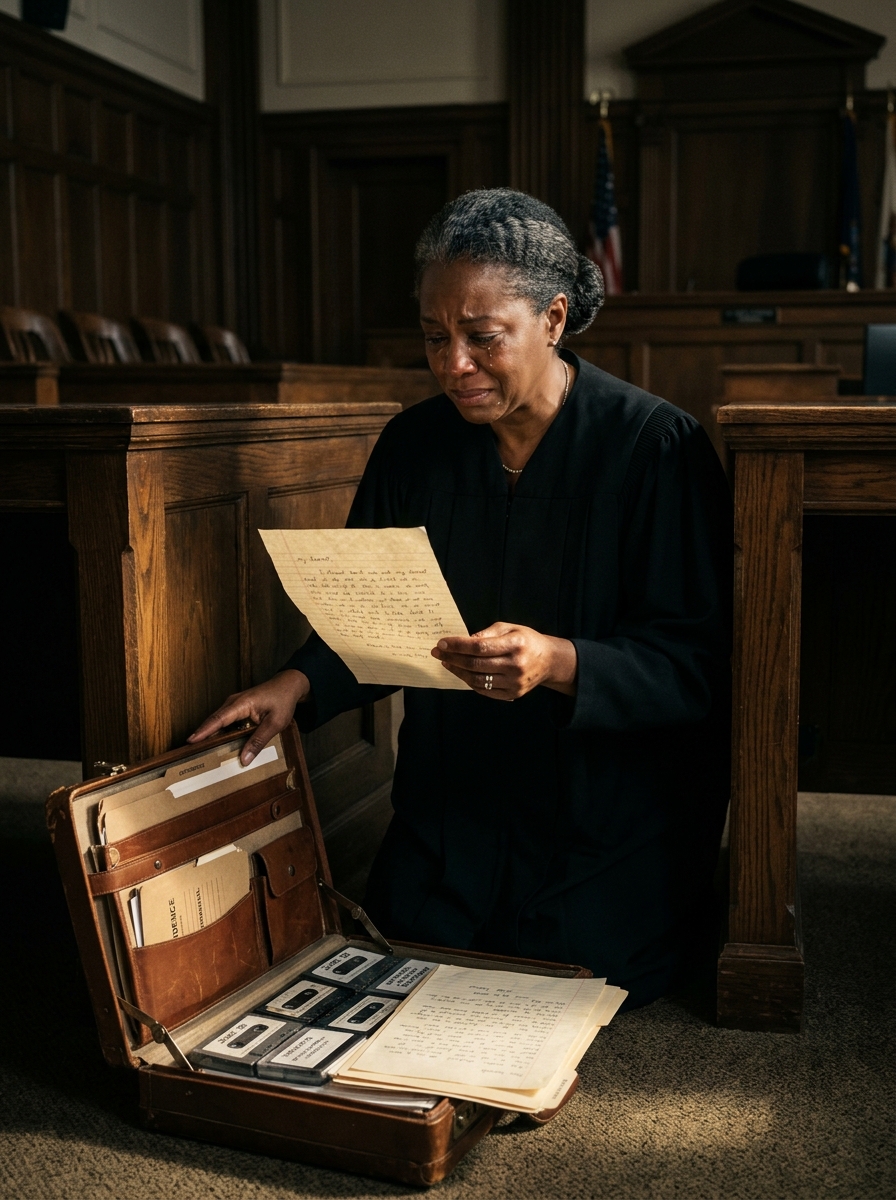
Ava opened her father’s briefcase.
Inside the lining, she found a folded note.
Her father’s handwriting.
If you are reading this, Peanut, then they were more afraid than I hoped.
Ava couldn’t breathe.
I kept copies. Names. Dates. Places. Hidden where only a lawyer would look. If the system fails you, don’t get small. Make noise.
Her knees weakened.
Inside the case, she found a hidden compartment: micro-cassettes, a key, and handwritten names.
The city would later call this the beginning.
Weller’s arrest was historic.
Daniels’ confession was catastrophic.
But what Ava held was something larger.
It exposed judges, officers, officials, a deputy mayor, and more. It cleared Jamal Carver’s name. It reopened decades of cases. It revealed her father as the first man who tried to document the system from inside.
And the final truth was this:
Ava Monroe hadn’t walked into her first day as a judge.
She had walked into the case her father died trying to place in her hands.
The briefcase they threw to the ground had been carrying it all along.
And as sirens rose outside, Ava stood in the center of it all—grief-struck, unshaken, and certain of one thing her father had taught her long before the world tried to silence him:
When truth is buried in daylight, you don’t whisper.
You make it impossible to ignore.
