

Act I
The tray went flying before anyone fully realized what had happened.
A silver lunch tray spun across the grand dining hall of St. Bartholomew’s Preparatory Academy, sending fruit, popcorn, and a paper cup skidding over the polished marble floor. The sharp clang beneath the mahogany tables sliced through the room like a slap.

Then the little girl hit the ground.
She landed hard on her side, her cream-colored dress suddenly seeming painfully out of place among rows of navy blazers, gold crests, silk ribbons, and polished loafers. Her braids fell across her face. One knee folded beneath her as she tried to stand without making a sound.
She was seven years old.
Old enough to recognize humiliation.
Far too young to deserve it.
Standing above her was Victoria Ashford, blonde, poised, and covered in diamonds bright enough to reflect every chandelier hanging in the hall. Her white designer suit remained untouched by the mess she had created. A silver clutch dangled from one wrist like a weapon disguised as elegance.
“Get away from this table, trash,” Victoria said.
The entire dining hall went still.
At the closest table, a boy slowly lowered his fork. Two girls in navy uniforms lifted their hands to their mouths. A teacher near the far wall stepped forward once, then stopped the second she realized who had spoken.
Victoria Ashford was not someone people corrected lightly.
Her family’s name was engraved on the science wing, printed across gala invitations, murmured by administrators, and protected by generations of wealth that knew exactly how to punish embarrassment.
The little girl looked up at her.
“My seat is here,” she said softly.
Victoria laughed, though there was nothing warm in it.
“Girls from families like yours don’t belong here.”
Several students looked away.
That was the cruelest part.
Not the tray.
Not the fall.
The way the room lowered its eyes before deciding which side it would stand on.
The little girl pressed her palms against the marble, trying to get back up. Her chin trembled once, but she forced the tears down with a kind of courage no child should ever need.
“My name is Sofia Reyes,” she said. “I was told to sit at this table.”
Victoria bent closer.
“Your name does not matter here.”
At that same moment, outside the tall arched windows, a black luxury SUV pulled up in front of the glass entrance.
At first, nobody noticed.
They were too focused on watching a wealthy woman humiliate a child.
Then the doors opened.
A silver-haired man in a charcoal suit stepped into the hall with two security guards behind him. His red tie sat slightly loose, as if he had rushed there. His expression remained calm, but his eyes scanned the room with the cold precision of a man who had built institutions and knew exactly when one was failing.
The headmaster went pale.
“Mr. Alden,” someone whispered.
Victoria turned.
The man did not look at her first.
He walked directly toward the little girl on the floor and knelt beside her.
“Sofia,” he said, his voice breaking slightly around her name. “Miss Reyes, forgive our delay.”
Relief filled the little girl’s eyes.
“Grandpa?”
The entire dining hall forgot how to breathe.
The man rested a gentle hand on her shoulder before lifting his gaze toward Victoria Ashford with an expression that drained the color from her face.
“No one here,” he said, “outranks the founder’s granddaughter.”
Victoria’s lips slowly parted.
“Wait…” she whispered. “What?”
And inside that stunned silence, everyone in the room realized the little girl sitting on the floor was never the outsider.
She was the reason the school still existed.
Act II
St. Bartholomew’s was the kind of school that trained children to inherit the world long before they were old enough to question whether they deserved it.
Its campus stood on a hill in New England, surrounded by red maple trees, stone walkways, and buildings old enough to appear honorable. Parents spent more on kindergarten tuition than many families spent on college. Students wore navy blazers with gold crests, studied Latin before long division, and learned to shake hands as though every introduction might someday become a business opportunity.
The dining hall was its centerpiece.
Towering ceilings. Arched windows. Oil paintings of benefactors staring down from paneled walls.
And at the center of those portraits hung one man.
Edward Alden.
Founder.
Philanthropist.
The architect behind the school’s reputation.
His name had become almost legendary across campus. Students knew he had created St. Bartholomew’s after losing his wife, Eleanor, a teacher who believed intelligence should never be limited by a family’s bank account. They knew he funded scholarships, built libraries, and quietly donated to children no cameras ever photographed.
What most students did not know was that Edward Alden had once come close to leaving the school behind entirely.
Years earlier, his only daughter, Margaret, had married a man named Daniel Reyes.
Daniel did not come from old money. He was a public school art teacher from Queens, the son of Puerto Rican and Dominican parents, warmhearted, stubborn, and deeply unimpressed by wealth. Margaret loved him with the kind of certainty that made powerful families nervous.
Edward resisted at first.
Not because Daniel lacked money.
Because Edward had been arrogant enough to believe nobody outside his world could care for his daughter better than he could.
He was wrong.
Margaret married Daniel anyway. For several painful years, father and daughter barely spoke. Then Sofia was born, and Edward’s entire world shifted the moment a tiny hand wrapped around his finger.
But reconciliation came too late.
Far too late.
A car accident took Margaret and Daniel on a rainy October night when Sofia was only five. Edward arrived at the hospital wearing the same charcoal suit he used for board meetings and left hours later carrying a child who did not understand why everyone around her kept whispering.
From that moment on, Sofia Reyes became his heart.
But Edward made one decision that shocked his lawyers.
He did not register her at St. Bartholomew’s under the Alden name.
He kept her surname.
Reyes.
He wanted her to carry part of her father with her too.
He also refused to reveal her identity to the school community. Sofia would arrive quietly in the lower academy, without a special ceremony, donor reception, or photograph beside his portrait. He wanted to know whether the institution he built could still recognize worth without first being told where to look.
It was a noble idea.
It was also a dangerous one.
Because while Edward Alden was grieving and distracted, others had slowly begun shaping St. Bartholomew’s into something else.
One of them was Victoria Ashford.
At twenty-nine, Victoria already spoke the language of power fluently. She smiled at trustees, chaired charity luncheons, corrected staff behind closed doors, and treated every building carrying her family name as though it personally belonged to her.
Her father, Graham Ashford, sat on the board and ranked among the school’s largest donors. Over the years, he had steadily pushed the academy away from Edward’s scholarship vision and toward something colder: exclusivity disguised as excellence.
Victoria believed that future belonged to her.
She had once been a student at St. Bartholomew’s herself. She had worn the blazer, sat at the best tables, and learned early that cruelty, when delivered with perfect posture, could easily be mistaken for leadership.
Now she had returned as a parent advisor, social chair, and unofficial gatekeeper.
She noticed Sofia on the very first day.
Not because Sofia misbehaved.
Because she looked different from the rest of the room.
No designer cardigan. No monogrammed hair bow. No driver waiting outside pickup in a tinted car. Just neat braids, a cream dress, careful manners, and the quiet alertness of a child accustomed to entering spaces where adults formed judgments before introductions.
Victoria asked the admissions secretary about her.
The answer annoyed her immediately.
“Sofia Reyes,” the secretary replied. “New student.”
“Scholarship?”
“I’m not sure.”
Victoria’s smile tightened.
Soon enough, she convinced herself she knew.
By the end of the week, she had already told two mothers that standards were slipping. By the end of the month, she suggested the school needed to protect its “cultural fit.” By winter, she had turned Sofia into a symbol of everything she wanted removed.
And Sofia felt every bit of it.
Children always do.
She noticed how certain mothers stopped talking when she walked near them. How classmates asked whether her dress came from a “regular store.” How one boy admitted his mother told him not to trade snacks with her because “you never know.”
She never told Edward all of it.
She knew he was getting older.
She knew his heart already carried pain.
She knew adults became sad when children told difficult truths.
So she kept most of it buried inside herself.
Until the Founder’s Day luncheon.
The day Victoria Ashford decided to make her warning public.
And the day Edward Alden arrived five minutes too late to stop it.
Act III
Edward helped Sofia back to her feet, but he did not rush her.
That mattered.
He did not pull her up like something fragile. He did not shield her face from the crowd. He simply offered his hand, waited until she stood steadily again, then gently brushed a piece of fruit from the sleeve of her cream-colored dress with such care that several teachers quietly looked away in shame.
“Are you hurt?” he asked.
Sofia shook her head.
But her bottom lip trembled.
Edward noticed.
His expression turned colder.
The headmaster, Dr. Lowell, hurried forward with panic hidden beneath practiced professionalism.
“Mr. Alden, this is a terrible misunderstanding.”
Edward kept his eyes on Sofia.
“Was my granddaughter sitting on the floor when I walked in?”
Dr. Lowell hesitated.
“Yes, but—”
“Then I understand enough to begin.”
Victoria recovered faster than anyone else. People like her were skilled at rebuilding their masks quickly.
“Mr. Alden,” she said, forcing a delicate laugh that sounded rehearsed, “I am absolutely mortified. I had no idea who she was.”
That sentence caused more damage than any confession could have.
Edward slowly turned toward her.
“No idea who she was?”
Victoria’s smile stiffened.
“I mean, of course, I would never have—”
“Never have what?” Edward interrupted. “Thrown her tray? Called her trash? Told her she did not belong?”
The hall stayed silent.
Students stared down at their plates. Teachers focused on the walls. Parents looked at Victoria as though distance alone might protect them from association.
Victoria swallowed hard.
“She was sitting at the Founders’ Table.”
Sofia answered before Edward could speak.
“My teacher told me to sit there.”
Her voice was small, but everyone heard it clearly.
Victoria snapped immediately. “Children should not interrupt adults.”
Edward stepped directly between them.
“Adults should not assault children.”
The word landed across the hall with quiet force.
Victoria’s cheeks flushed red.
“I barely touched her.”
A girl seated nearby slowly raised her hand.
Every head turned toward her.
She looked about twelve, wearing the navy blazer and gold crest like armor. Her voice shook, but she spoke anyway.
“She pushed the tray first,” the girl said. “Then Miss Reyes fell.”
A boy beside her nodded quickly.
“I saw it too.”
Then another student spoke up.
“And she called her trash.”
A murmur swept through the dining hall.
Not gossip anymore.
Witnesses.
Victoria looked around in horror as the children she expected to intimidate suddenly found courage.
Edward looked toward them.
“Thank you,” he said.
Only two words.
But to those students, it sounded like permission.
Dr. Lowell cleared his throat nervously.
“We should continue this conversation somewhere private.”
Edward lifted his gaze toward the oil portraits lining the walls.
“My wife believed education begins when truth enters the room,” he said. “So no, Dr. Lowell. We will not hide truth inside an office.”
Victoria’s clutch clicked open and closed in her hand.
Her diamonds still sparkled beneath the chandeliers, but now they looked less like elegance and more like armor.
“Mr. Alden, with respect, my family has donated millions to this institution.”
Edward nodded once.
“Yes. Your family has donated money.”
Then he looked down at Sofia.
“My granddaughter gave this school the opportunity to prove it still had a soul.”
Victoria’s expression shifted.
Because in that moment, she finally understood.
This was never only about one insult. One tray. One child. Edward Alden had been watching. Waiting. Testing whether the academy still belonged to his late wife’s dream or to people like the Ashfords.
He turned toward Dr. Lowell.
“I requested three months of reports concerning scholarship integration and student treatment. Instead, I received polished summaries.”
Dr. Lowell went motionless.
Edward reached inside his coat and removed a folded packet.
“Fortunately, children are often more honest than administrators.”
Several teachers exchanged uneasy looks.
At that exact moment, Victoria’s father, Graham Ashford, entered through a side door after hearing the commotion. One look at Edward’s face told him immediately that something had gone terribly wrong.
“Edward,” he said carefully, “let’s not make this theatrical.”
Edward did not smile.
“Too late, Graham. Your daughter started the performance. I’m simply bringing the ending.”
And for the first time that year, Victoria Ashford no longer looked like the queen of the academy.
She looked like a woman standing above a trapdoor.
Act IV
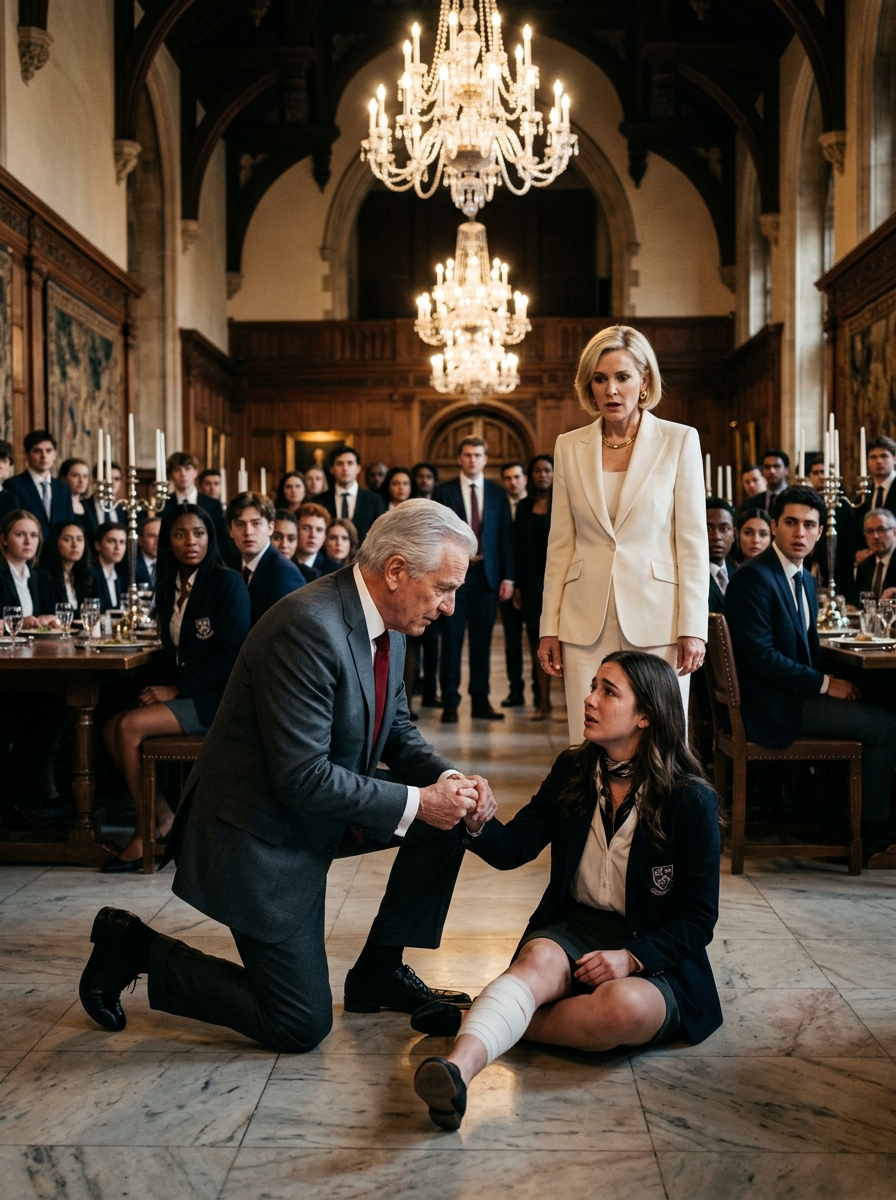
Graham Ashford moved quickly toward his daughter, his expression carefully polished into concern.
He was older than Victoria, heavier around the eyes, but clearly made from the same expensive mold. Dark suit. Perfect cufflinks. A voice lowered just enough to sound reasonable. Men like Graham rarely raised their voices. They understood that power sounded more respectable when it whispered.
“Edward,” he said, “everyone here is emotional. Let’s not turn a child’s lunchroom mishap into a board issue.”
Edward’s eyes narrowed.
“A child’s lunchroom mishap?”
Graham glanced briefly toward Sofia before looking away.
That single glance told Edward everything.
Not guilt.
Irritation.
As though Sofia herself had become an inconvenience simply by falling onto the floor.
Edward handed the packet to Dr. Lowell.
“Read the first page.”
The headmaster looked trapped.
“Mr. Alden, perhaps—”
“Read it.”
Dr. Lowell opened the packet. The color slowly drained from his face.
The first page was not a student complaint.
It was an email.
From Victoria Ashford to members of the parent advisory council.
Dr. Lowell barely managed the first few lines before his voice began failing him.
Edward took the page back and read aloud himself.
“The school must decide whether it wishes to remain a premier institution or become a sentimental charity project. The presence of certain children creates discomfort for families who have invested generationally in St. Bartholomew’s.”
A sharp whisper spread through the hall.
Victoria lifted her chin.
“I was talking about standards.”
Edward turned to the next page.
“Here is another. ‘We should identify scholarship families early and discourage overplacement in high-visibility traditions until they understand the culture.’”
He slowly looked around the room.
“High-visibility traditions. Like eating lunch.”
Victoria opened her mouth, but nothing came out.
Edward continued reading.
“There are messages discussing seating charts. Recommendations to isolate certain students. Notes questioning whether some families could afford proper uniforms. A proposal suggesting financial-aid students use the east reception during gala events to avoid congestion with donors.”
A teacher covered her mouth.
One parent suddenly stood and left the room, face burning with shame.
Graham’s jaw tightened.
“These are internal conversations taken completely out of context.”
Edward faced him directly.
“Then explain the context in which humiliating children becomes honorable.”
Graham stayed silent.
Sofia stood beside her grandfather with one small hand wrapped around his. She did not fully understand the emails, but she understood the tone. She had heard it before through softer words, colder smiles, and pauses that made rooms feel smaller.
Edward looked down at her.
“I am sorry,” he said quietly. “I believed silence would protect you from being treated differently.”
Sofia shook her head.
“They treated me different anyway.”
The sentence broke something inside him.
For years, Edward believed he could improve the world through systems. Endowments. Policies. Scholarships. Carefully written mission statements framed in hallways.
But a mission statement had not helped Sofia stand up from the floor.
A seven-year-old child had needed people.
And too many people had failed her.
Edward turned toward the students.
“I founded this school with my wife because she believed talent could appear in any child, from any neighborhood, from any family. She used to say arrogance was the enemy of learning because it convinced people they were already complete.”
His voice grew firmer.
“Somewhere along the way, this academy began teaching arrogance in a blazer.”
Dr. Lowell lowered his eyes.
Graham stepped forward.
“You should be careful. The Ashford endowment funds nearly a quarter of the school’s expansion plan.”
Edward’s expression remained unchanged.
“Then the expansion can wait.”
Victoria stared at him.
“You would risk the school over her?”
The room recoiled slightly.
Her.
Not Sofia.
Not Miss Reyes.
Not even a child.
Her.
Edward’s voice remained calm.
“No, Ms. Ashford. I am saving the school from people who believe a child needs a famous last name before she deserves kindness.”
Then he turned toward Dr. Lowell.
“Victoria Ashford is removed from every advisory position effective immediately. Her access to students ends today.”
Victoria gasped.
“You can’t do that.”
“I just did.”
Graham’s expression darkened.
“The board will have something to say about this.”
Edward looked once more toward the portraits.
“I am the founder, Graham. I built the board.”
The words landed like a gavel striking wood.
Then Edward faced Dr. Lowell again.
“And you will submit your resignation by morning.”
The headmaster’s shoulders collapsed.
Throughout the dining hall, students sat frozen, watching the world they believed permanent rearrange itself in front of them.
Sofia gently tugged Edward’s hand.
He bent down beside her.
“Can I still eat lunch?” she whispered.
A strange, aching silence filled the room.
Edward looked at the scattered food across the marble floor, the overturned tray, the ruined moment, and the little girl asking for the smallest dignity the room had denied her.
Then he stood upright.
“Yes,” he said. “But not alone.”
He pulled out a chair at the Founders’ Table.
And what happened next became the moment Victoria Ashford would never forget.
One by one, students began standing.
First the twelve-year-old girl who spoke up earlier.
Then the boy beside her.
Then another student.
Then an entire table.
They picked up their trays and walked toward Sofia.
Not loudly.
Not dramatically.
But together.
Victoria watched as the seat she tried so hard to deny became the most important table in the entire room.
And her diamonds could not buy her way back into it.
Act V
Sofia ate only half a sandwich, a few apple slices, and left the popcorn untouched.
Edward noticed.
“You usually like popcorn,” he said softly.
She stared at the floor where the first tray had shattered.
“I don’t want it today.”
He gave a small nod.
“Then not today.”
That was what real protection looked like. It didn’t rush pain away just so adults could feel at peace again. It made space for bruises no one else could see.
After lunch, Edward led Sofia through the west garden, passing the stone fountain Eleanor Alden had designed years ago. From a distance, the campus looked calm again. Red leaves drifted over the grass. Students moved between buildings. Bells rang on schedule, pretending nothing had changed.
But everything had.
By evening, parents received an official statement from the founder’s office.
By morning, Dr. Lowell was no longer there.
By the end of the week, the Ashford name had been removed from three major events—not erased from history, but stripped of influence over the children they had tried to sort by value.
Graham Ashford threatened legal action.
Edward welcomed discovery.
The threats faded.
Victoria vanished from school events almost overnight. For years, she had believed the world was a room where the right dress, the right diamonds, and the right surname meant no one could ask you to leave.
She learned otherwise.
But Edward did not see her removal as enough.
Punishment was simple.
Repair was not.
He launched an independent review of every scholarship complaint from the past decade. He met families who had been ignored. He created a student dignity council with real authority, not decorative language for brochures. He required every administrator to reapply under a new standard that valued courage as much as credentials.
Most importantly, he changed the Founders’ Table.
For decades, it had been reserved for donors’ children during ceremonies—a quiet signal everyone understood even when no one admitted it.
Edward had the brass plaque removed.
In its place, he installed another.
Eleanor Alden’s words were engraved there:
No child earns belonging. They arrive with it.
On the first Friday after everything, Sofia paused outside the dining hall.
She wore her cream dress again.
Edward had offered to buy her any uniform she wanted, but she chose the dress herself. Not because she rejected the blazer forever, but because she didn’t want the room to think it had forced her to stop being herself.
Blue ribbon tied her braids.
She held her lunch tray tightly.
Edward stood beside her.
“You don’t have to go in yet,” he said.
Sofia looked through the open doors.
Inside, the hall was filled with ordinary noise. Forks tapping plates. Chairs scraping. Children laughing too loudly. Teachers pretending not to listen.
Then the twelve-year-old girl from before saw her.
She stood up and waved.
“Sofia! Over here!”
A few students turned.
Then more.
No whispers.
No silence.
Only space opening at the table.
Sofia’s grip on the tray loosened.
Edward watched as she took one step forward.
Then another.
She stopped and looked back.
“Grandpa?”
“Yes?”
“Can you sit with me?”
Edward smiled faintly.
“I was hoping you would ask.”
They walked in together.
Not as a founder and his hidden granddaughter.
Not as a powerful man correcting a wrong.
But as family.
At the table, the students introduced themselves properly this time. Sofia listened carefully to every name. When one boy apologized for not speaking up earlier, she looked at him for a long moment.
Then she said, “Say something sooner next time.”
The boy nodded.
“I will.”
Edward lowered his gaze, hiding his emotion.
That was Eleanor in her.
Gentle, but not fragile.
By winter, Sofia wore the navy blazer.
The gold crest rested over her heart, but she never treated it as proof she belonged. She had learned something many adults still struggled to understand.
Belonging was not stitched into fabric.
It was not granted by donations, inherited names, or women in diamonds standing over children on marble floors.
It was older than that.
Deeper.
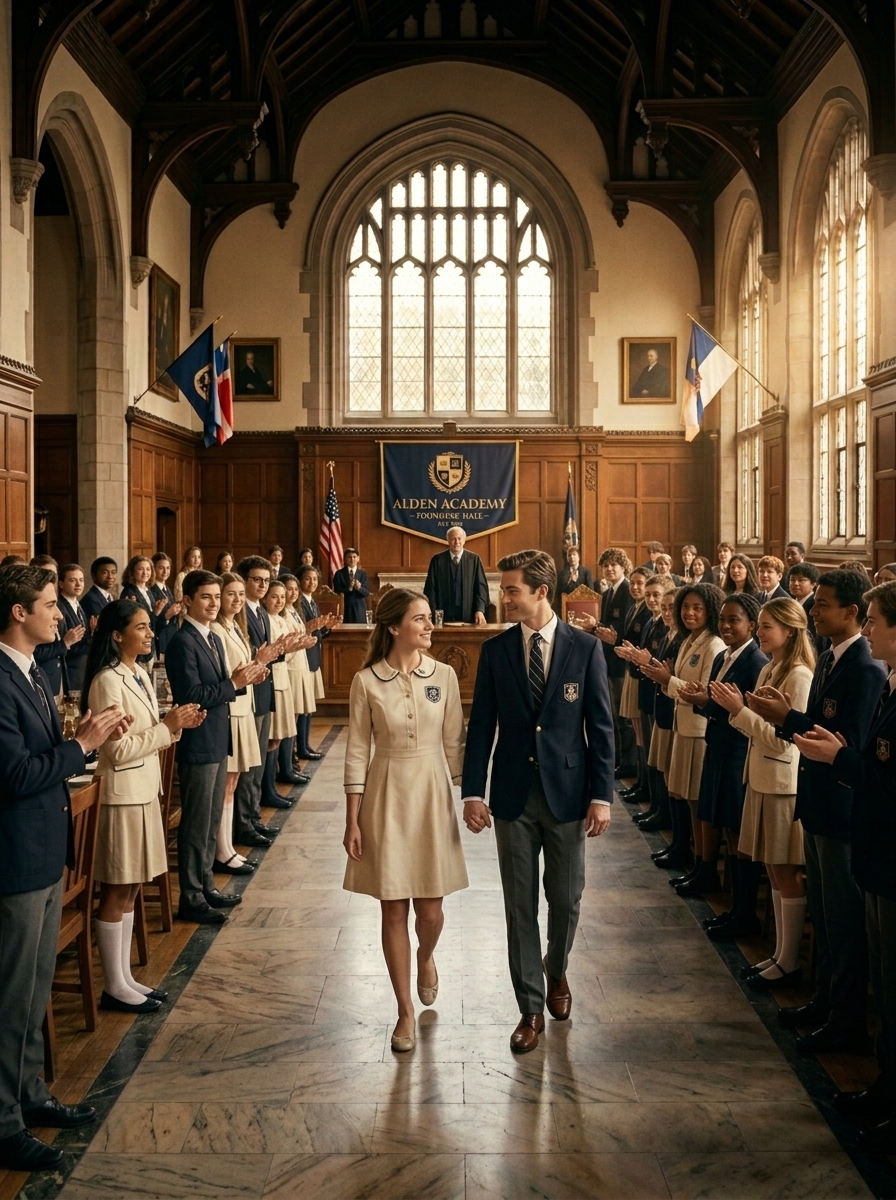
Not negotiable.
Months later, when spring light filled the dining hall and white-green life returned beyond the arched windows, a new family arrived for a tour. Their son was quiet, his shoes worn, his parents nervous in that way people are when they feel overwhelmed by wealth.
A woman near the entrance glanced at them, then quickly looked away.
Sofia noticed.
She left her table, crossed the marble floor, and stopped in front of the boy.
“Hi,” she said. “I’m Sofia Reyes.”
The boy looked around the grand hall behind her.
“I don’t know where to sit.”
Sofia smiled and held out her hand.
“You can sit with me.”
From the far end of the hall, Edward Alden watched as his granddaughter guided the new child toward the Founders’ Table.
This time, no one stopped her.
No one questioned her.
No one tried to decide who belonged.
Because the girl they once called trash had become the living reminder of what the school had forgotten.
And the table once used to measure status had become the place where dignity finally sat.
