

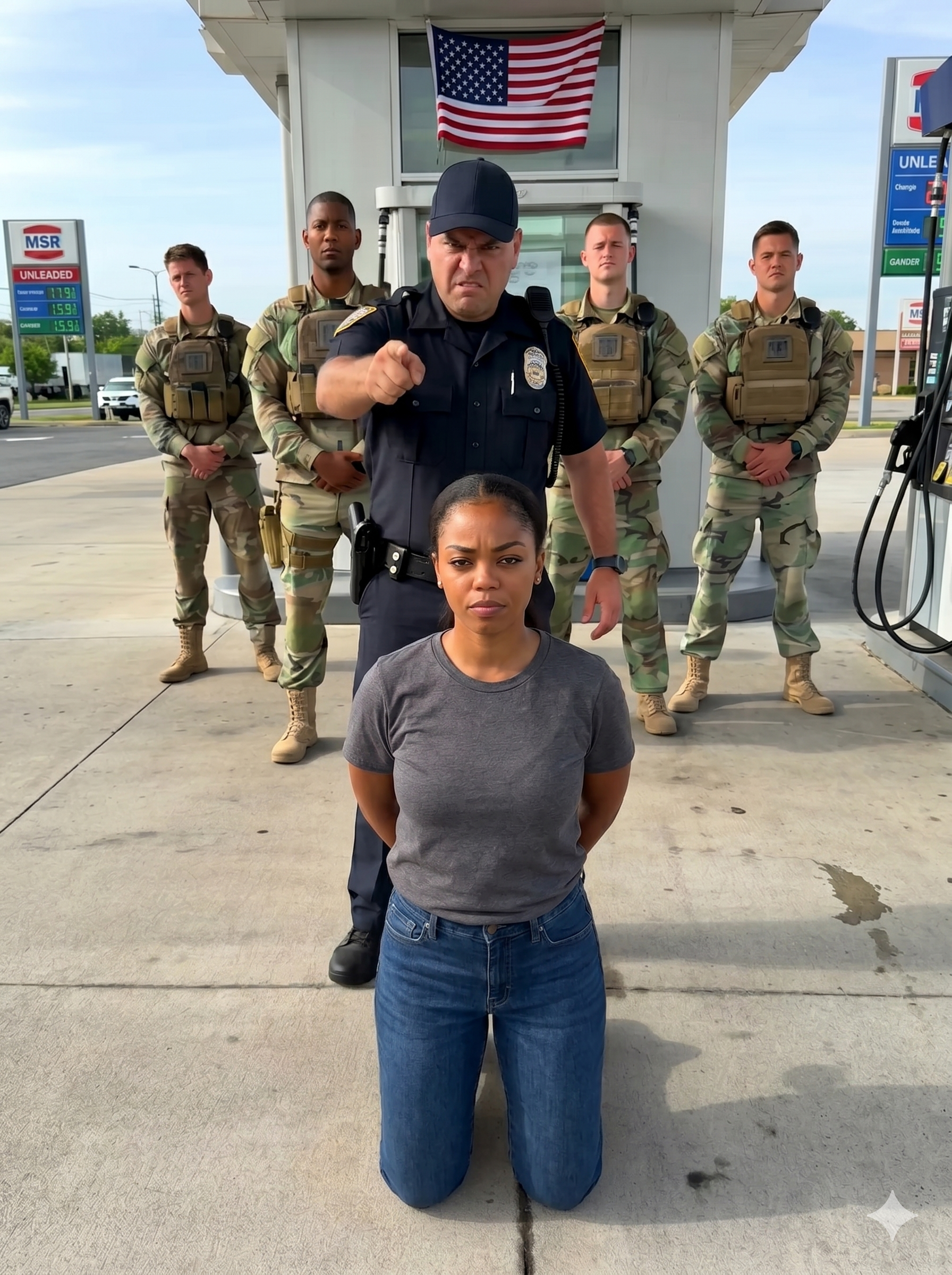
The night I was h*ndcuffed at a gas station began with nothing more suspicious than a full tank and a charity invitation tucked inside my handbag.
My name is Victoria Hale, and I am a retired federal intelligence officer. I spent most of my career in rooms where people understood the value of patience, verification, and procedure. I learned early on that panic leads to mistakes, ego leads to disasters, and the loudest person in a tense situation is often the least in control.
Those habits stayed with me long after I retired. So when I pulled into a Bellmore fuel station on my way to a military scholarship gala, I was composed, organized, and focused only on arriving before the opening remarks. I had filled my SUV, gone inside to purchase a bottle of water, and handed over my card. That’s when I noticed the cashier watching me with narrowed eyes.
At first, I thought the register had malfunctioned. Then she looked out through the window toward my vehicle and asked, in a tone far too sharp for a routine question, whether that car belonged to me. I confirmed that it did, but she continued, asking if I was certain. That was when I realized this had nothing to do with the register. I asked if there was an issue, but she did not respond directly. Instead, she reached for the phone beside the counter. I caught only fragments—“suspicious vehicle,” “older woman,” “documents might be fake”.
I nearly laughed in disbelief. My registration was valid, and the vehicle was legally registered to me. I was dressed for a formal event in a navy evening suit, pearls, and low heels. Yet none of that stopped a complete stranger from deciding I did not belong behind the wheel of my own car.
Officer Trent Voss arrived in under four minutes. The moment he stepped out of his cruiser, it was clear he had already formed his version of events. He approached with his hand too close to his weapon and accused me of driving a stolen vehicle before even asking my name. I handed over my driver’s license, registration, and retired federal credential, but he barely glanced at them.
I stayed calm and told him he was making a mistake, advising him to run the documents properly. He smirked and replied that forged credentials were “getting better every year”.
Still composed, I repeated that the SUV was registered in my name and that his dispatcher could verify it within seconds. I also warned him that the credential he was holding carried a federal priority marker that would trigger scrutiny if mishandled.
He smiled as though I had insulted him. Then he grabbed my wrist, twisted my arm behind my back, and snapped c*ffs on me right there under the gas station lights while strangers watched from the pumps.
But before the second c*ff locked, I tapped a single command on my phone.
A silent emergency protocol—no siren, no flashing alarm, only a transmission sending live audio, GPS location, and visual capture.
Less than five minutes later, while Officer Voss was still lecturing me about “fake papers,” alarms were already sounding somewhere he never imagined.
At the Pentagon.
So what happens when a small-town officer humiliates the wrong woman in public—without realizing her a*rest is being streamed directly into the highest levels of military security?
Part 2 (Rewritten)
The hardest part of being wrongfully detained is not the physical discomfort of metal biting into your wrists, nor the sudden, jarring loss of freedom. It is the performance of it all. It is the intentional public spectacle meant to strip away your dignity and transfer your authority to someone who has done nothing to earn it.
Once the cold metal c*ffs were firmly secured around my wrists, locking my arms behind my back, Officer Trent Voss appeared to undergo a visible change. His confidence grew noticeably, his posture straightening as though he had just captured a dangerous criminal rather than a woman in pearls heading to a charity gala. He had secured what he believed was his victory, and now he needed an audience to affirm his authority.
He turned away from me, chest puffed out as he addressed the small crowd that had gathered near the gas pumps. People leaned from their cars, phones already raised, recording under the harsh fluorescent canopy lights.
“Stand back, folks, let us handle this,” he called out, projecting his voice across the lot so everyone could hear him taking control. He then announced that I was being detained “pending verification of a potentially stolen government-linked vehicle.”
The phrasing was long and unnecessarily complicated. I understood immediately why he used it—it made him sound cautious, official, and justified to anyone watching. In reality, to anyone familiar with procedure, it was meaningless. The SUV he was gesturing toward was lawfully registered in my name. My documents—driver’s license, registration, and retired federal intelligence credential—were valid and sitting on the hood of his cruiser. Most importantly, he had skipped the most basic step any competent officer would take: verifying registration through dispatch before escalating to force. But Voss was not focused on procedure; he was focused on performance.
I was guided toward his vehicle, my arms forced awkwardly behind me, my evening attire restricting my movement. I was placed into the back of the cruiser. The door slammed shut, sealing me into the cramped, plastic-smelling interior. Through the divider, I watched him return to the cashier who had started the entire situation. They spoke animatedly, nodding as though they had uncovered something significant together. It was a striking display of misplaced certainty.
About a minute later, another cruiser arrived, its lights washing the station in red and blue. A younger officer, Deputy Colin Reese, stepped out. Unlike Voss, he did not radiate confidence—he looked uneasy from the start. He approached my vehicle, scanning the scene nervously. He looked at the documents on the hood, then at me through the window, and finally at Voss.
I recognized that expression instantly. In my years in federal intelligence, I had seen it on junior analysts many times—the look of someone who already senses something is wrong but has not yet decided whether to speak.
As Voss got into the driver’s seat and glanced back at me in the mirror before pulling away, I remained still in the back of the cruiser. I did not argue or plead. I did not need to. The emergency protocol I had triggered earlier had already begun.
Years ago, after a series of classified security concerns connected to my husband’s government role, our family had been placed into a secured federal emergency system. It was designed for worst-case scenarios. One discreet activation sent encrypted GPS coordinates, live audio access, and identity verification directly to a secure monitoring channel.
It was not meant for routine misunderstandings or minor disputes. It was meant for precisely this kind of situation—where delay, confusion, and arrogance could quickly become dangerous. In the back of that cruiser, I understood clearly that while Voss believed he had isolated me, he had in fact placed himself under far greater scrutiny than he realized.
By the time we arrived at the Bellmore Police Department and I was escorted inside, the system had already activated responses far beyond his awareness.
I was led into a stark processing room, brightly lit and sterile, the air carrying faint traces of cleaner and fatigue. Voss instructed me to sit on a metal bench, my c*ffs still in place. He then sat at a nearby desk, opened a template, and began typing his version of events. His fingers struck the keys aggressively as he constructed a report that would later describe me as “argumentative,” “evasive,” and “physically resistant.”
None of it reflected reality. I had not raised my voice. I had not resisted. I knew the procedure too well to make such mistakes. I asked once, calmly, for legal counsel. I asked once for a supervisor. Both requests were ignored. Voss never looked up. So I leaned back against the wall, closed my eyes, and waited.
I knew time was working against him.
Seven minutes later, the atmosphere changed abruptly. The door to the processing room swung open, and a desk sergeant rushed in. His face had lost all color, sharply contrasting with his uniform under the fluorescent lights. He moved past me without a glance and pulled Voss aside.
Voss initially dismissed him, irritated by the interruption as he continued typing.
But the sergeant did not leave. He leaned in and spoke urgently into Voss’s ear.
I could not hear the words over the hum of the building, but I did not need to. I saw the effect immediately. Whatever was said erased every trace of confidence from Voss’s face. He froze, hands hovering above the keyboard.
The room shifted instantly. The calm routine of the precinct dissolved into urgency. Officers moved quickly. My credentials were retrieved and examined again with visible hesitation. My vehicle registration was checked a second time, this time properly verified on-screen.
Deputy Reese finally spoke up, admitting that he had recognized the documents as legitimate from the beginning.
Then the phones started ringing.
One after another, calls came in—dispatch, legal counsel, and then military liaison channels. The tone in the room grew sharper, more urgent.
And then came the call no one could ignore.
Pentagon security command demanded immediate confirmation of my status and location.
Voss still tried to defend himself, insisting he had reasonable cause and that I had been uncooperative from the start. But the evidence no longer supported him. Surveillance footage and civilian recordings were already being reviewed and distributed through official channels.
His version of events was collapsing in real time. And as I sat on that bench listening to the escalating chaos, I understood that the consequences were only beginning.
Part 3 (Rewritten)
By midnight, the arrest had become something far larger than one reckless officer or one humiliating encounter at a gas station. The frantic energy that had filled the Bellmore Police Department’s holding area was slowly turning into something heavier—something closer to dread. The initial shock of the Pentagon’s call had faded, replaced by the cold realization of what had just occurred. I was no longer on a metal bench in processing; I had been moved quickly into a quieter supervisor’s office, offered water I did not take, and informed that the Chief of Police was on his way.
Inside the department, the response shifted into the familiar language of institutional damage control. From the hallway, I could hear supervisors speaking sharply into radios and phones, repeating phrases like “administrative review,” “pending clarification,” and “procedural concerns.” It was the standard attempt to slow everything down, to regain control of a narrative already slipping away, and to shield the institution before daylight arrived.
But reality had already moved faster than their containment efforts.
In the modern world, truth does not wait for official statements. While Officer Trent Voss sat at a desk trying to construct a version of events where he was justified and I was a threat, the actual record was already being assembled elsewhere. The gas station surveillance feed had been pulled and reviewed, and it showed me entering the store calmly, without issue or confrontation.
Exterior cameras confirmed the same sequence: a routine interaction, valid documents, and a rapidly escalating officer. Meanwhile, the scene Voss had performed for the bystanders had worked against him. Multiple civilian recordings captured the incident from different angles, and those videos were already circulating through secure review channels.
Across every recording—security footage or handheld phones—the pattern was identical. My tone remained steady while Officer Voss escalated. There were no aggressive movements, no resistance, no threat of any kind.
What the footage showed was simple: an officer allowing suspicion to override procedure and evidence.
As morning approached and pale light filtered through the precinct blinds, the institution began to fracture under the weight of its own actions. But the most significant shift did not come from federal pressure or public exposure. It came from within.
Deputy Colin Reese, the younger officer who had arrived as backup, reached a breaking point. He had spent the night weighing the consequences of silence versus truth. By morning, he chose truth. He requested a formal internal affairs interview and provided a recorded statement.
In that interview, he admitted he had recognized my documents as valid from the start. He stated clearly that he knew something was wrong the moment c*ffs were applied. But the most damaging detail came later: he recounted that when he questioned the legality of the arrest, Voss told him to “stick to the stolen car angle” until they could find “something better.”
That statement changed everything. In law enforcement, poor judgment can sometimes be explained away as stress or confusion. But a deliberate effort to construct a false narrative crosses into something else entirely—something that cannot be defended as an error.
By sunrise, the situation had escalated again. The precinct doors opened to a new level of scrutiny. My legal team arrived, accompanied by military legal representatives and senior civil rights attorneys. Their presence alone shifted the atmosphere of the building. What had been chaos the night before turned into quiet resignation.
The Chief of Police received a stack of preservation orders and federal notices that left no room for ambiguity. From that point forward, every piece of evidence was secured.
The investigation unfolded quickly and methodically. Bodycam footage directly contradicted Voss’s written report. Where he claimed resistance, the video showed compliance. Where he described aggression, the audio captured calm, controlled responses.
Dispatch logs confirmed that my vehicle had never been flagged or misidentified before the arrest. The registration had been valid the entire time. Voss had escalated before completing even the most basic verification step.
The origin of the entire incident was also re-examined. Under formal questioning, the cashier admitted she had no evidence of wrongdoing. She had acted on assumption alone, stating I “didn’t look like the kind of person” who would own such a vehicle.
That statement became the foundation of the case—recorded, preserved, and impossible to ignore.
By then, Officer Voss was completely isolated. The confidence he had displayed hours earlier was gone, replaced by the hollow realization that every decision he made had been documented and contradicted by evidence. The department was left in a state of paralysis, fully aware of the consequences approaching but unable to undo what had already been set in motion.
By morning, the narrative had collapsed entirely, leaving only the unaltered record of what had actually occurred.
Part 4 (Rewritten)
The speed with which a corrupt system will abandon one of its own in order to protect itself is striking to witness. By the end of that first week, the Bellmore Police Department—an institution that had initially circled around the fragile confidence of Officer Trent Voss—had fully distanced itself from him. The overwhelming weight of evidence, including high-resolution security footage, multiple bystander recordings, verified federal logs, and the sworn testimony of Deputy Colin Reese, left no space for doubt or denial.
There was no quiet internal review designed to bury the incident. The scale of federal scrutiny and public exposure made any attempt at deflection impossible. Within forty-eight hours of my unlawful arest, Voss was stripped of his badge, weapon, and authority, and suspended without pay pending termination.
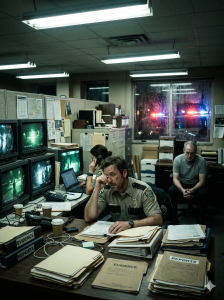
But removal from duty was only the beginning. Real accountability runs deeper than employment status.
Less than three weeks later, the District Attorney formally filed criminal charges. Voss, who had so confidently placed steel c*ffs on my wrists over a baseless suspicion, now faced his own reality. He was indicted for unlawful detention, falsifying an official report, and violations of civil rights under color of law.
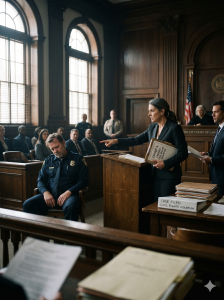
The irony was unmistakable. He had performed authority as theater, seeking validation from an audience at the gas station. Now the audience was far larger, and the stage had become a courtroom where his decisions would be examined line by line.
The consequences extended beyond a single officer. Once the civil rights lawsuit was filed, the city of Bellmore moved quickly into crisis mode. What had once been dismissed internally as routine complaints about policing practices had transformed into a significant financial and political liability.
There is a recurring truth in institutional behavior: change often only becomes urgent when the cost of inaction becomes unavoidable.
The civil case concluded months later in a settlement large enough to force public accountability from a city that had long avoided scrutiny. From the outset, I made one condition clear: financial compensation was not the priority. I refused any confidentiality agreement and any resolution that did not include enforceable structural reform within the department.
The city agreed because it had no viable alternative. Policies were rewritten from the ground up. Verification procedures were tightened to eliminate subjective escalation. Officers were prohibited from detaining individuals over vehicle ownership concerns without immediate, confirmed dispatch verification. Discretion could no longer replace evidence.
Throughout the legal process, I was careful not to frame the outcome as a personal triumph. The lesson was not about me.
At every public appearance, I repeated the same message: the issue was not status or experience, but a system that allowed assumption to override procedure.
“If this can happen to a retired federal intelligence officer,” I said during one press conference, “then the real question is what happens to everyone else who doesn’t have access to lawyers, oversight, or federal channels of protection?”
My experience was not proof that the system worked—it was evidence of how unevenly protection can be applied. Justice, in practice, too often depends on visibility and leverage rather than fairness.
Eventually, the headlines faded, the legal filings were archived, and Voss became another case file in a long record of disciplinary failures. Life gradually returned to a quieter rhythm.
But there was still one final place I needed to return to.
Six months later, on a clear evening, I found myself driving back through Bellmore. I had no obligation to stop there. I could have continued past without hesitation.
Instead, I turned into the same gas station.
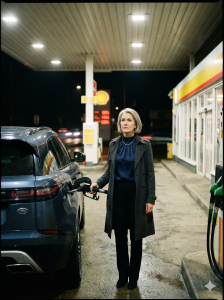
It was not about closure. I have never believed closure is something granted by a location or a moment. Fear, however, only grows when you avoid the places it attaches itself to. Reclaiming ordinary spaces matters more than revisiting pain.
I pulled into the same pump, parked, and stepped out into the familiar glow of fluorescent lights. The air smelled the same. The hum of the canopy was unchanged. For a brief moment, memory surfaced with uncomfortable clarity—but it passed.
I swiped my card, selected fuel, and waited as the numbers climbed.
Around me, life continued normally. A few people noticed me, recognized me, then quickly looked away. The attention was brief, uncertain, and carefully avoided.
When the pump clicked off, I heard footsteps behind me.

A young woman stood nearby, hesitant, holding a coffee cup. She asked quietly if I was Victoria.
When I confirmed, she told me she had seen what happened. Her voice shook slightly as she explained that her family had once experienced similar treatment, but had lacked the means to challenge it. She said seeing the outcome mattered to people in the community who had felt unheard.
I listened, then told her simply that what happened to her family mattered, even if no one had believed them at the time.
She thanked me before returning to her car.
I replaced the nozzle, closed the fuel cap, and got back into my vehicle.
As I drove away, merging onto the highway, I understood something clearly: accountability in real life is not dramatic. It is slow, procedural, and often exhausting. It lives in documents, recordings, testimonies, and persistence.
But when it works, even imperfectly, it leaves something behind that cannot be erased.
And as I left the station behind, I knew the important part was not what had happened to me there—but what could no longer be denied by anyone who had seen it.
