

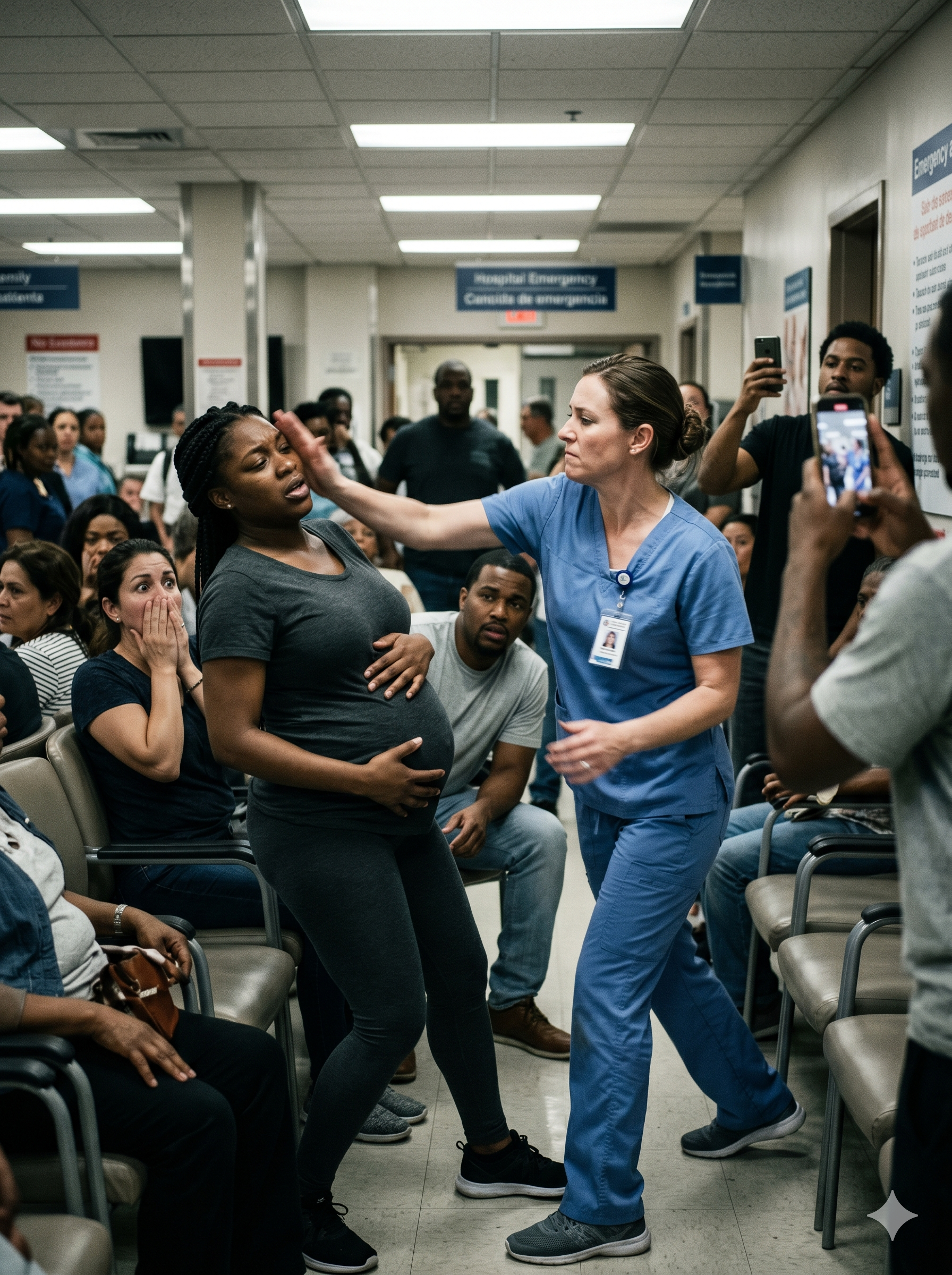
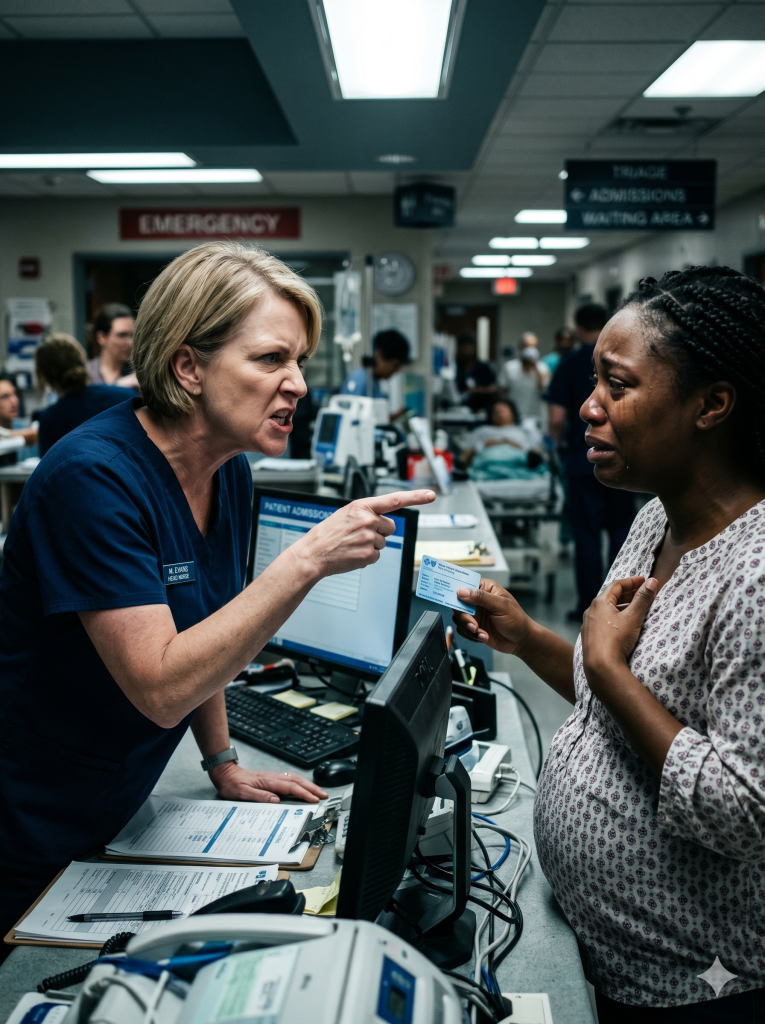
Her dark skin glistens with sweat beneath the harsh fluorescent lights. “Please, I have insurance.” Sarah’s voice cracks. “Don’t lie to me.” Patricia finally looks up, her cold blue eyes scanning Sarah from head to toe with open contempt. Sarah tries to step closer, clutching her belly. “My baby—” “Keep your distance.” Patricia abruptly rises from her chair.
“Don’t you dare raise your voice in my ER.” Patricia’s palm strikes Sarah’s cheek with brutal force. Sarah’s head snaps sideways, her body staggering backward. She grips the desk edge to keep from falling, the other hand shielding her unborn child. The waiting room goes silent. Security cameras record every second.
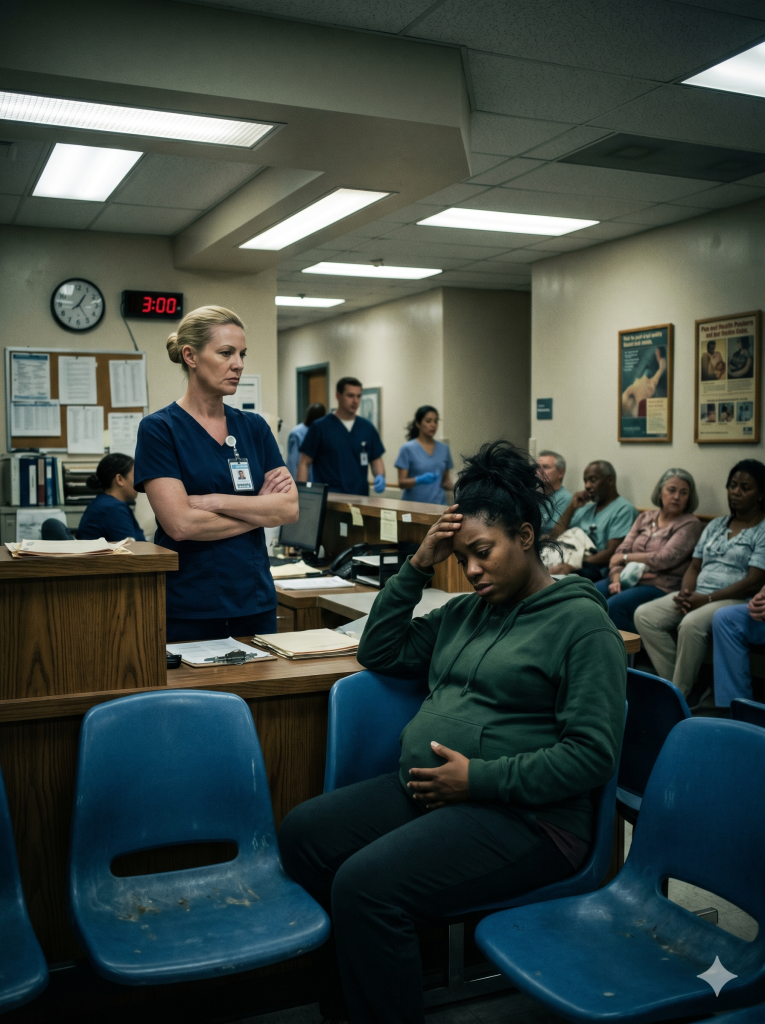
What Patricia doesn’t realize yet is that she has just made the worst mistake of her life. The antiseptic smell of Metropolitan General Hospital mixes with the faint scent of fear and desperation that clings to every emergency room at 3:00 a.m. Fluorescent lights buzz overhead, casting harsh shadows across cracked linoleum floors that have witnessed too many tragedies.
Sarah Williams sits hunched in a plastic chair, her hand still pressed to her stinging cheek. The red imprint from Patricia’s slap burns like a mark of humiliation. Around her, the waiting room reflects countless stories of suffering. An elderly man coughs into a bloodstained handkerchief. A young mother rocks a feverish infant. A construction worker cradles his injured arm. Yet Sarah feels completely alone.
She pulls her worn cardigan tighter, trying to disappear. Her wedding ring glints under the light—a simple gold band symbolizing three years with James. They saved for months to buy a modest home in Riverside Heights, a quiet neighborhood where children ride bikes and neighbors still greet each other.
Sarah teaches second grade at Lincoln Elementary, where her students call her Mrs. W and give her crayon drawings of stick figures holding hands. She volunteers at the food bank and sings in the church choir every Sunday. Her life is simple, steady, ordinary. Nothing about her suggests anything beyond what she appears to be.
Behind the reception desk, Patricia Hendrickx rules her sterile domain like a queen. At 45, she has spent 20 years at Metropolitan General, rising from floor nurse to head of emergency services through persistence and politics. Her blonde hair is always perfect.
Her uniform is crisp, her shoes polished. Patricia lives in a small apartment in Milfield, a 30-minute commute from the hospital. She drives an aging Honda with rust and no air conditioning. Her refrigerator is covered with bills—rent, utilities, car payments—constant reminders of financial strain.
She watches younger doctors drive luxury cars to suburban homes while she takes the bus when her car fails. She sees administrators in glass offices making decisions about care while she handles blood and chaos on the floor.
Patricia has learned to claim power in small ways: a sharp tone, a delayed response, the authority to make people wait. Tonight, like every night, she is the gatekeeper between suffering and relief, deciding who is worthy of attention.
Metropolitan General reflects the city’s divide. It serves tech executives with elite insurance and homeless patients paying with Medicaid alike. The wealthy receive private rooms and attentive care. The poor get folding chairs and suspicion.
Dr. Jennifer Carter moves through the ER with controlled urgency. At 32, she is a resident in emergency medicine, enduring long shifts under crushing debt. She notices everything—the tone Patricia uses with certain patients, the uneven wait times, the quiet bias embedded in routine decisions.
But residents do not challenge head nurses. Not if they want strong evaluations and future recommendations.
Carlos Mendes pushes his mop across the floor in steady, practiced strokes, invisible to most. Eight years on the night shift have taught him everything about the hospital’s rhythms. He knows who shows kindness and who shows cruelty.
His wife Maria works in city planning downtown. She often mentions a young mayor pushing reforms for housing and fairness. Carlos has never met him, but he respects anyone who stands up for working families.
Security guard Mike Foster patrols the hallways with tired vigilance. After 23 years in law enforcement, he recognizes tension before it erupts. Tonight, his attention keeps drifting between Sarah and Patricia, sensing something building.
The night shift runs under looser supervision—fewer witnesses, less oversight, more room for abuse. And tonight, every thread is about to intersect.
Sarah checks her phone: 3:47 a.m. James is likely still at city hall working through budget negotiations. She doesn’t want to burden him yet. She just needs reassurance that her baby is safe.
What she doesn’t realize is that everything is about to shift.
At 4:15 a.m., the cramps worsen. Sharp pain shoots through her back, followed by a warm wetness that triggers panic. She has lost pregnancies before—she knows what this could mean.
Shaking, she rises and approaches the desk again. “Excuse me.” Her voice is barely audible. “I think I’m bleeding.”
“Someone please—” Patricia keeps typing, slow and deliberate. “I told you to wait your turn.”
“But it’s been over three hours, and I’m scared.”
“Three hours?” Patricia lets out a cold laugh. “Honey, some people wait all night. Maybe better insurance would fix that.”
Sarah pulls out her card with trembling hands. “I have Blue Cross. It’s good coverage. My husband’s job—”
“Save it.” Patricia finally looks up, eyes icy. “Every welfare case has a story.”
“He works for the city.” Sarah’s voice shakes. “We pay taxes.”
“City worker.” Patricia sneers. “Let me guess—sanitation, road crew. One of those union jobs.”
Sarah clutches her stomach as another wave of pain hits. “Please, I need help.”
“You think pregnancy makes you special.” Patricia steps closer. “You think it puts you ahead of everyone else.”
The words “you people” hang in the air.
“I’m just scared,” Sarah whispers.
“Scared?” Patricia circles her like a predator. “Try dealing with people who think the world owes them something.”
Dr. Jennifer Carter approaches, drawn by the rising tension. She takes in the scene—Sarah doubled over, Patricia looming, the charged silence.
“Is everything okay?”
“It’s fine,” Patricia snaps. “She just doesn’t understand waiting.”
“I’ve been here three hours,” Sarah pleads. “I’m eight months pregnant.”
“Bleeding at this stage is concerning,” Dr. Carter says carefully.
“She’s exaggerating,” Patricia cuts in. “Not an emergency.”
“We should assess—”
“I decide triage.” Patricia’s voice hardens. “Not you.”
Dr. Carter hesitates, then backs down. “Understood.”
She leaves with a worried glance toward Sarah.
Carlos pauses his mopping, watching quietly, jaw tight.
Patricia turns back. “Now sit down. Stop wasting time.”
“I’m bleeding,” Sarah insists, voice rising.
“Lower your voice.” Patricia hisses.
Sarah tries, but fear overtakes restraint.
“Please, I’m begging you. Just let someone examine me. 5 minutes. That’s all I need.” Patricia’s face twists with fury. “Begging? Now we’re getting to the truth. You think if you grovel enough, I’ll feel sorry for you. You think tears and pleading will get you special treatment?”
“I think basic human decency should get me medical care when I need it,” Sarah replies, her teacher’s instincts finally overpowering her fear.
The words hit Patricia like a slap. Her face flushes red and her hands clench at her sides. “Human decency. You want to lecture me about decency?”
“I want someone to help me save my baby.”
“Your baby.” Patricia steps closer, invading Sarah’s space. “Let me tell you something about your baby. Maybe if people like you thought before you started breeding, we wouldn’t have overcrowded schools, overloaded welfare systems, and emergency rooms full of people who can’t afford the consequences of their choices.”
Gasps ripple through the waiting room. Several patients openly pull out their phones to record Patricia’s rant. Carlos stops pretending to mop and moves where he can see everything clearly.
Sarah’s eyes fill with tears, but her voice steadies. “You don’t know anything about me or my family. You don’t know what we’ve been through or what we’ve lost.”
“I know enough,” Patricia snarls. “I know your type. Coming in here acting helpless, expecting everyone else to fix your problems. Your problems aren’t my priority.”
“My baby’s life should be everyone’s priority.”
The words hang in the air like a challenge. Patricia’s face darkens with rage. She has lost control of the moment—and she knows it.
Instead of backing down, she escalates. “Stand up,” Patricia orders.
“What?”
“I said stand up. I want everyone in this waiting room to see exactly what entitlement looks like.”
Sarah stays seated, fear and confusion battling on her face. “I don’t understand.”
“You will.” Patricia grabs Sarah’s arm and yanks her up with brutal force.
Sarah cries out as pain shoots through her abdomen.
“This,” Patricia declares loudly to the room, “is what happens when people think pregnancy gives them the right to make demands.”
Her hand rises. For a split second, everything freezes. Carlos reaches for his phone. Dr. Carter reappears at the doorway. Security guard Mike Foster steps forward.
And Sarah Williams stands completely exposed as the moment collapses around her.
Patricia’s palm crashes into Sarah’s cheek with vicious force. Sarah stumbles backward, clutching her face as tears spill over. The sting radiates through her jaw, but the humiliation cuts deeper.
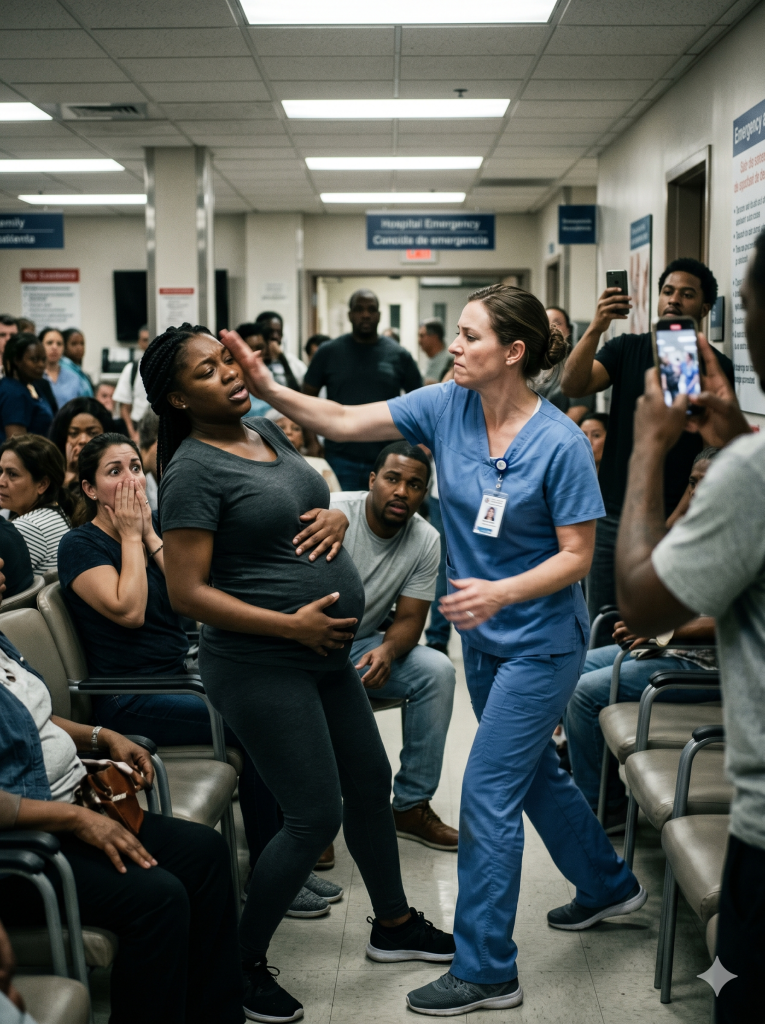
The waiting room erupts. “Did she just hit a pregnant woman?” someone whispers. “Oh my god—call security!”
Mike Foster hesitates, hand hovering near his radio, caught between duty and fear of Patricia’s influence.
Sarah steadies herself against a chair, one hand instinctively covering her belly. The red mark blooms across her cheek.
“You—You hit me,” she whispers in shock.
“Damn right I did.” Patricia looms over her. “And I’ll do it again if you keep pushing me. This is my ER. You show respect or you get out.”
Dr. Jennifer Carter rushes in. “Patricia, what are you doing? You can’t assault a patient.”
“Assault?” Patricia snaps. “She was aggressive. I defended myself.”
“She’s eight months pregnant and bleeding.” Dr. Carter checks Sarah’s pulse. “This is not acceptable.”
“You’re out of line, Dr. Carter.” Patricia lowers her voice dangerously. “I suggest you go back to your duties before I speak to your attending.”
Dr. Carter hesitates, then helps Sarah sit. “I’m documenting this.”
“Of course you are.” Patricia smiles coldly. “Administration will be very interested.”
Carlos finally speaks up. “I saw what happened. That woman didn’t threaten anyone.”
Patricia turns on him. “Did I ask you, janitor?”
“No, ma’am.”
“Then stay quiet unless you want to lose your job.”
Carlos clenches his fists but says nothing, swallowing his anger.
Sarah tries to stand again. “I’ll go somewhere else. I just want to leave.”
“You’re not going anywhere,” Patricia blocks her.
“You can’t keep me here.”
“Watch me.” Patricia grabs her phone. “Mike, I need security. Now.”
Mike approaches slowly. “Patricia, maybe we should—”
“Are you questioning me too?” she screams. “Does anyone remember who’s in charge?”
Sarah feels warmth spreading between her legs. Panic sets in. “Something’s wrong…”
“I think my water just broke.”
“More attention-seeking nonsense,” Patricia mutters.
But Dr. Carter’s face changes instantly. “Patricia, she needs immediate care. This is an emergency.”
“The only emergency is her attitude.”
Sarah doubles over as another contraction hits. “Please… something’s happening to my baby…”
“Your baby will be fine when you learn to behave.”
The cruelty lands like another blow.
A nearby woman begins recording. “This is insane.”
Patricia storms over. “Delete that.”
“No. This is assault.”
Mike finally speaks up. “Patricia… this is getting out of control.”
“I’m the only one keeping order in this place!” she shrieks, spinning back toward Sarah.
“This is all your fault.”
“You came in here acting entitled, disrupting my ER, turning my staff against me.” Sarah looks up through tears of pain and humiliation. “I just wanted help for my baby.”
“Your baby?” Patricia’s laugh is sharp and bitter. “Let me tell you something about your baby. Maybe this is nature’s way of telling you that some people shouldn’t reproduce.”
The words explode through the waiting room like a shockwave. Even those who had stayed silent look stunned. “Oh my god,” someone gasps. Another voice murmurs, “She didn’t just say that.”
Dr. Carter steps forward. “That’s enough, Patricia. I’m taking this patient to trauma bay 3 now.”
“You will do no such thing. I am the charge nurse—”
“And I am a doctor with a patient in active labor.” Dr. Carter’s voice sharpens. “Move.”
“Get out of my way or I’ll have you removed.”
Patricia’s expression twists with venom. “You know what, doctor? Maybe you need a lesson in authority too.” She grabs the phone and dials administration. “This is Patricia Hendricks in the ER. I need security to remove two disruptive individuals. A patient threatening staff and a resident refusing orders.”
Carlos can’t stay silent anymore. He pulls out his phone and starts recording. “Hospital policy be damned. Lady, you’re out of control. This woman needs help.”
“Put that phone away right now or I’ll have you arrested.”
“For what? Telling the truth?”
He keeps filming as Patricia’s control continues to unravel. More patients lift their phones. The waiting room shifts into open defiance.
“This is disgusting,” someone says. “She hit a pregnant woman,” another adds.
Patricia snaps, voice rising. “All of you shut up. I have twenty years of experience. I know what’s best for patients. You know nothing.”
Sarah cries out as another contraction tears through her body, stronger than before.
Dr. Carter checks the monitor. “They’re three minutes apart now.” She looks at Patricia. “I’m taking her to delivery whether you approve or not.”
“Over my dead body.”
They lock eyes like adversaries in a standoff. Then Patricia’s phone vibrates. She glances down—and her expression shifts from rage to confusion, then to dread.
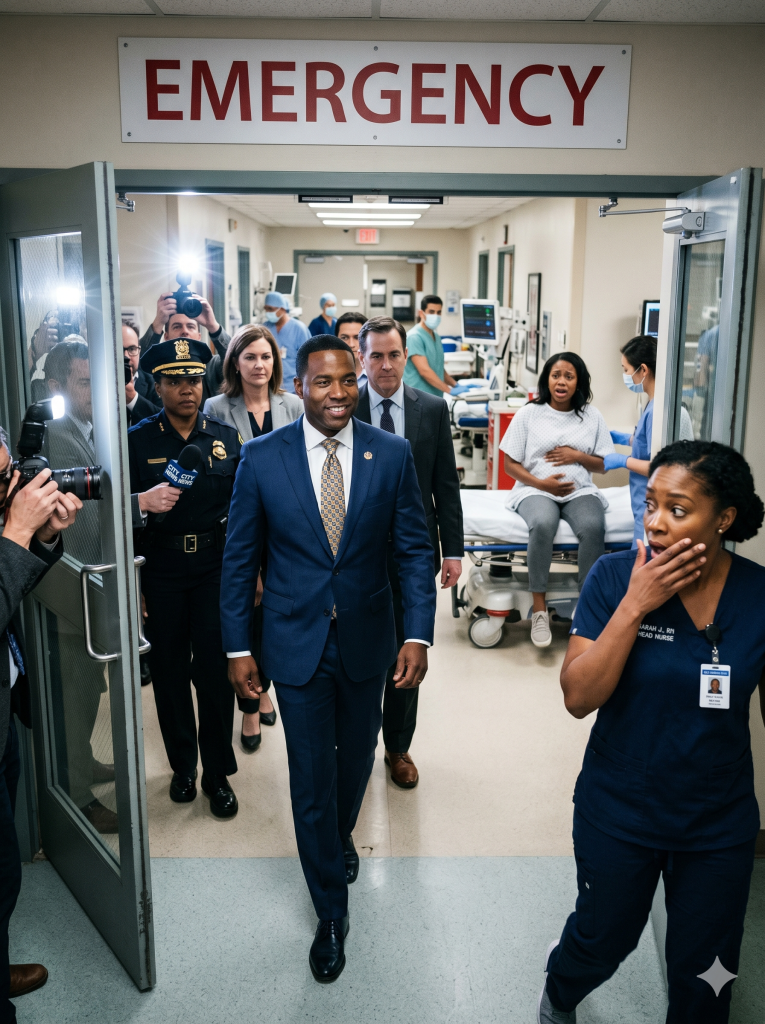
Emergency message: ER incident escalating. Mayor Williams en route with security detail. Immediate protocol review pending.
The color drains from Patricia’s face. “Mayor Williams…”
She turns slowly toward Sarah, seeing her differently for the first time—the calm education in her voice, the wedding ring, the restrained composure under pain.
“What did you say your last name was?” Patricia asks, suddenly quieter.
“Williams.” Sarah gasps through another contraction. “Sarah Williams.”
The phone slips from Patricia’s hand and shatters on the floor.
Mayor James Williams has been dominating headlines—the reformer targeting corruption and discrimination in city services. And his wife is an elementary school teacher.
Outside the glass doors, black SUVs arrive in a sudden convoy, lights cutting through the early morning darkness.
Patricia realizes she has been recorded assaulting and denying care to the mayor’s wife. Her breath turns shallow.
Sarah fumbles for her phone. Each movement sends pain through her body. She hesitated all night—but now she has no choice.
The call connects.
“Sarah, what’s wrong?”
“James…” her voice breaks. “I’m at Metropolitan General. Something’s wrong with the baby. They won’t help me.”
Silence. Then his voice hardens. “Stay where you are. Don’t move. Don’t sign anything. Don’t let anyone touch you. I’m coming.”
Patricia watches, unease creeping in as Sarah’s tone shifts—not weaker, but steadier.
Fifteen minutes later, the doors burst open. Cold air rushes in.
James Williams enters first, focused and controlled, followed by a wave of officials that freezes the room: Chief of Police Robert Martinez, Board Chairman Thomas Bradley, City Attorney Linda Thompson, and two news crews.
Patricia steps forward, forcing authority back into her voice. “Visiting hours are over. You can’t just storm in here.”
Chief Martinez raises his badge. “We’re here on official business.”
“I don’t care what business you think you have. I am charge nurse—”
“I’m Chairman of the hospital board,” Thomas Bradley says calmly.
Recognition flickers in Patricia’s eyes, but she pushes forward. “Mr. Bradley, we had a disruptive patient—”
“And where is my wife?”
James’s voice cuts through everything.
He walks past them, eyes locking onto Sarah curled in her chair, crying.
Patricia scoffs. “So you brought people to intimidate me—”
“I’m James Williams,” he says quietly.
“Good for you. That doesn’t change hospital protocol.”
“I’m the mayor of this city.”
The words fall like a stone into water.
Silence spreads across the ER.
Even the fluorescent lights seem to soften in their hum. Patricia’s expression shifts in stages—confusion, disbelief, then a slow, creeping horror as realization takes hold. The pregnant woman she has been humiliating, dismissing, and denying care is not just another welfare case. She is the wife of the city’s most powerful elected official.
“That’s That’s impossible,” Patricia whispers. “She’s just she doesn’t look like—”
“Like what?” James’s voice is quiet and lethal. “Like someone who deserves basic human dignity? Like someone whose life matters?”
Chief Martinez steps forward, hand resting on his radio. “We’ve received multiple reports of assault and medical negligence. I’ll need to review all security footage from tonight.”
“There’s been a misunderstanding,” Patricia stammers, her earlier confidence dissolving. “Mrs. Williams was the situation was I didn’t know who she was.”
City Attorney Thompson opens her briefcase and sets out a legal pad. “And that changes what, exactly? Are you saying patient care here depends on marital status?”
Patricia freezes, realizing every word traps her deeper. “No, that’s not what I meant. I treat everyone equally.”
“Really?” Dr. Carter steps out from the treatment area, voice tight with anger. “Because I watched you physically assault this woman and deny her emergency care for hours.”
Carlos Mendes steps forward, still gripping his mop like a staff. “I recorded everything on my phone. All of it.”
The young mother lifts her device. “Me too. It’s already online.”
Patricia watches her career collapse in real time. Security cameras have recorded everything. Witnesses stand with video proof. News crews are already filming. There is no denial left. No escape.
James kneels beside Sarah, his public composure breaking into raw fear. “I’m sorry I wasn’t here sooner, sweetheart. Let’s get you and our baby the care you need.”
Patricia tries again. “Mr. Mayor, there’s been a terrible misunderstanding. If you would just let me explain—”
James rises slowly. When he looks at her, there is no anger—only something far worse: certainty.
“Miss Hendrix,” he says quietly, “the only misunderstanding is yours. You thought power gave you permission to hurt people. You’re about to learn what power actually does.”
The shift is immediate. Patricia Hendrix, who commanded this ER moments ago, now stands trembling under the weight of his gaze.
“Mr. Mayor, please,” she stammers. “I didn’t know who your wife was. If I had known—”
“Stop.” His voice cuts cleanly through her panic. “That’s exactly the problem, Miss Hendrix. You didn’t think it mattered who she was.”
Hospital administrator Dr. Margaret Hayes rushes in, jacket half-on, face drained of color. She takes in the scene—the mayor, the police chief, the cameras, Patricia standing frozen at the center.
“Mr. Mayor, I came as soon as I heard. This is completely unacceptable.” She turns sharply. “Patricia Hendrix is suspended immediately.”
Board Chairman Bradley steps forward. “Security will escort her out. Her system access is terminated effective now.”
Patricia turns pale. “You can’t do this. I have union protection. I have seniority. You need proper documentation—”
City Attorney Thompson looks up calmly. “We already have it. Security footage, witness statements, and video recordings of the assault. The union won’t protect you from criminal charges.”
Dr. Carter moves in with urgency. “Mrs. Williams needs immediate delivery. Her contractions are two minutes apart.”
James helps Sarah to her feet as Patricia makes one last attempt. “Mrs. Williams, I sincerely apologize. I was under pressure and made poor decisions. If you could just—”
Sarah turns, exhaustion and pain in her voice. “You didn’t apologize when you thought I was powerless, Miss Hendrix. You apologized when you found out who I was married to.”
The words land like a strike. Around them, patients nod, phones still recording.
Carlos lowers his mop and resumes filming.
Dr. Hayes turns to security. “I want her removed immediately. Clear her locker, take her badge and keys. She is banned from this hospital pending investigation.”
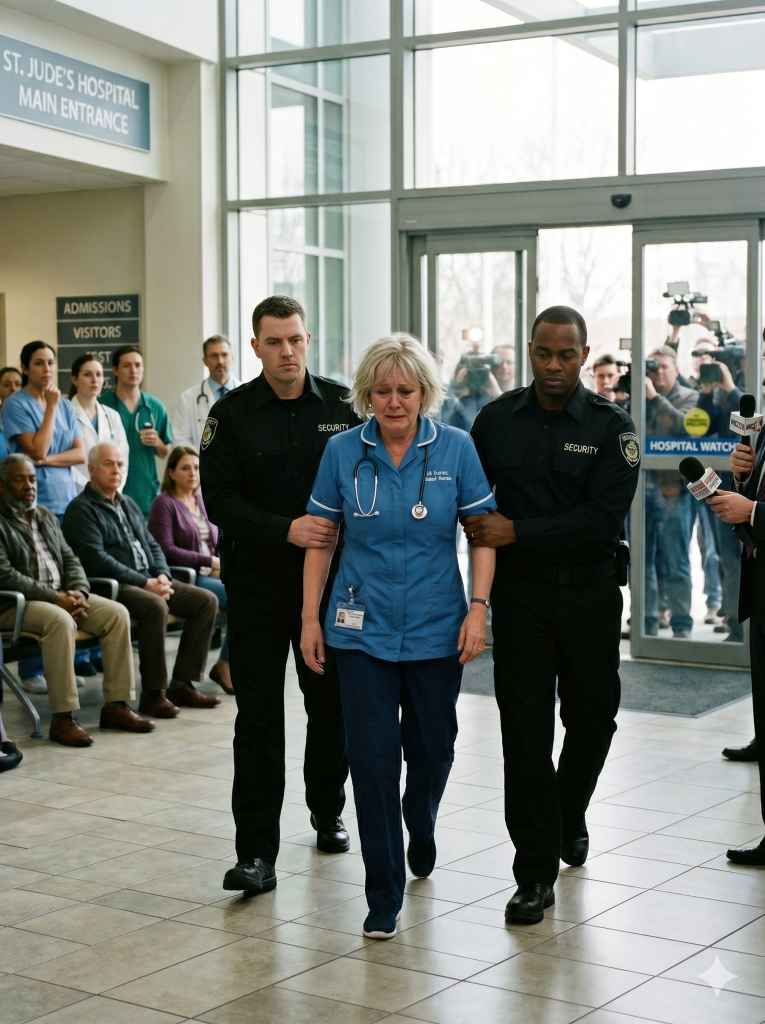
Two security guards approach Patricia, their expressions stern but controlled. “Ma’am, we need you to come with us.”
“This isn’t fair,” Patricia protests as they take hold of her arms. “I’ve worked here for 20 years. I know this hospital better than anyone. One mistake shouldn’t one mistake.”
Chief Martinez steps into her path.
“Ma’am, preliminary investigation indicates this is not your first report of discriminatory behavior. We will be reviewing your entire employment record.”
As the guards escort Patricia toward the exit, she passes Carlos Mendes. The janitor meets her eyes directly, his weathered face showing no sympathy.
“20 years,” he says quietly. “20 years you’ve treated people like they don’t matter, thinking nobody important was watching. Guess you were wrong.”
Patricia’s legs weaken as the full reality crashes over her. She is not only losing her job—she is facing criminal charges: assault on a pregnant woman and civil rights violations. The videos are already spreading across social media.
Her name is becoming synonymous with hospital racism.
Dr. Carter rolls a gurney into the waiting room as Sarah’s condition worsens. “We need to move now. This baby is coming whether we’re ready or not.”
As James helps his wife onto the gurney, Chief Martinez signals his officers. “I want this entire incident documented—every witness statement, every video file, every security recording—and I want charges filed within 24 hours.”
The automatic doors close behind Patricia with a final whoosh, severing her from the world she ruled for two decades. Through the glass, she sees news crews setting up, preparing to broadcast her downfall to the city.
Inside the ER, order slowly returns. Dr. Carter takes control of Sarah’s care with the competence and compassion that should have been present hours earlier. Staff whisper among themselves, sharing long-silenced stories of Patricia’s past behavior.
Carlos picks up his mop again, but his step is lighter now. Justice—real justice—has finally reached Metropolitan General’s emergency room.
And for the first time in 20 years, the night shift works without fear.
James holds Sarah’s hand as they move toward the delivery room. “Everything’s going to be okay now,” he whispers. “You’re safe. Our baby’s going to be safe.”
Outside in the parking lot, Patricia sits in her car, staring at her revoked badge, trying to understand how everything collapsed in 15 minutes.
The truth is simple. It had been collapsing for 20 years. Tonight, someone finally saw it.
Three weeks later, the investigation into Patricia Hendrix has become a city-wide reckoning. What began as one ER incident has exposed decades of institutional discrimination.
District Attorney Sarah Carter sits in her office surrounded by evidence boxes. Her desk is filled with complaints, statements, and recordings repeating the same pattern.
“47 formal complaints,” she says, flipping through a thick file. “47 times patients reported discriminatory treatment—and every single one was dismissed or buried.”
The evidence is overwhelming: security footage showing delayed care for minority patients, recordings of racist remarks, and testimonies from former staff who stayed silent for years.
Dr. Marcus Johnson, a former physician at Metropolitan General, finally speaks. “Patricia made my life hell,” he says. “She delayed my patients’ results, withheld notifications, spread rumors. I knew it was racial—but I couldn’t prove it.”
Hospital records confirm the pattern: minority patients waited significantly longer for care, received less pain medication, and faced higher complaint dismissal rates.
Board Chairman Thomas Bradley calls an emergency meeting. “How did we miss this for 20 years?”
The answer is uncomfortable: they didn’t miss it—they ignored it.
Former administrator Dr. Richard Hayes admits under oath he received warnings but prioritized efficiency over discrimination claims.
The Department of Justice launches a federal investigation.
“This was systemic failure,” explains FBI Agent Maria Santos. “Multiple levels of leadership enabled it.”
The criminal trial begins two months after Sarah gives birth. Maya Williams is born healthy despite the trauma.
Prosecutor Sarah Carter presents overwhelming evidence: videos, testimony, and documented abuse. The courtroom gasps when footage shows Patricia’s assault on Sarah.
Defense attorney Robert Sterling argues overwork and misinterpretation. Every claim collapses under evidence.
Dr. Jennifer Carter testifies: “She denied care based on race and threatened my career when I intervened.”
Carlos Mendes speaks with shaking hands. “I saw it for 20 years. Nobody would listen to a janitor.”
The trial sparks national debate on healthcare equity.
Judge Maria Rodriguez delivers sentencing with clear condemnation.
18 months federal prison, loss of license, fines, and mandatory service. The Williams family is awarded damages, but broader change follows.
Metropolitan General faces federal oversight, reform mandates, and equity audits. The Sarah Williams Healthcare Equity Act becomes law, requiring bias tracking and reporting nationwide.
States across the country adopt similar reforms. Medical boards enforce stricter standards.
Dr. Carter becomes Chief of Emergency Medicine, implementing patient advocacy reforms.
Carlos Mendes becomes a patient advocate and trainer.
Patricia serves her sentence in federal prison, participating in bias education programs.
Her case becomes a teaching example in medical ethics.
The Williams family creates a scholarship fund for minority medical students.
Sarah returns to teaching and becomes a public advocate for healthcare equity.
“Discrimination in healthcare isn’t rare,” she says. “It’s just rarely recorded.”
James adds, “Change happens when people refuse to stay silent.”
Statistics show dramatic improvements in equity and patient care outcomes nationwide.
Patricia’s video remains a permanent reminder that discrimination carries consequences.
If this story moves you, share it. Speak up. Report injustice.
Sometimes the most powerful response is refusing to stay silent when dignity is denied.
