

Chapter 1: The Dead Drop
This is the account of my own coup d’état—a tale of ultimate betrayal inside what was supposed to be the sanctuary of home, the unsettling shift of a maternal figure into something predatory, and the unwavering determination of a soldier who realized his most terrifying battle was not fought overseas, but within his own kitchen.
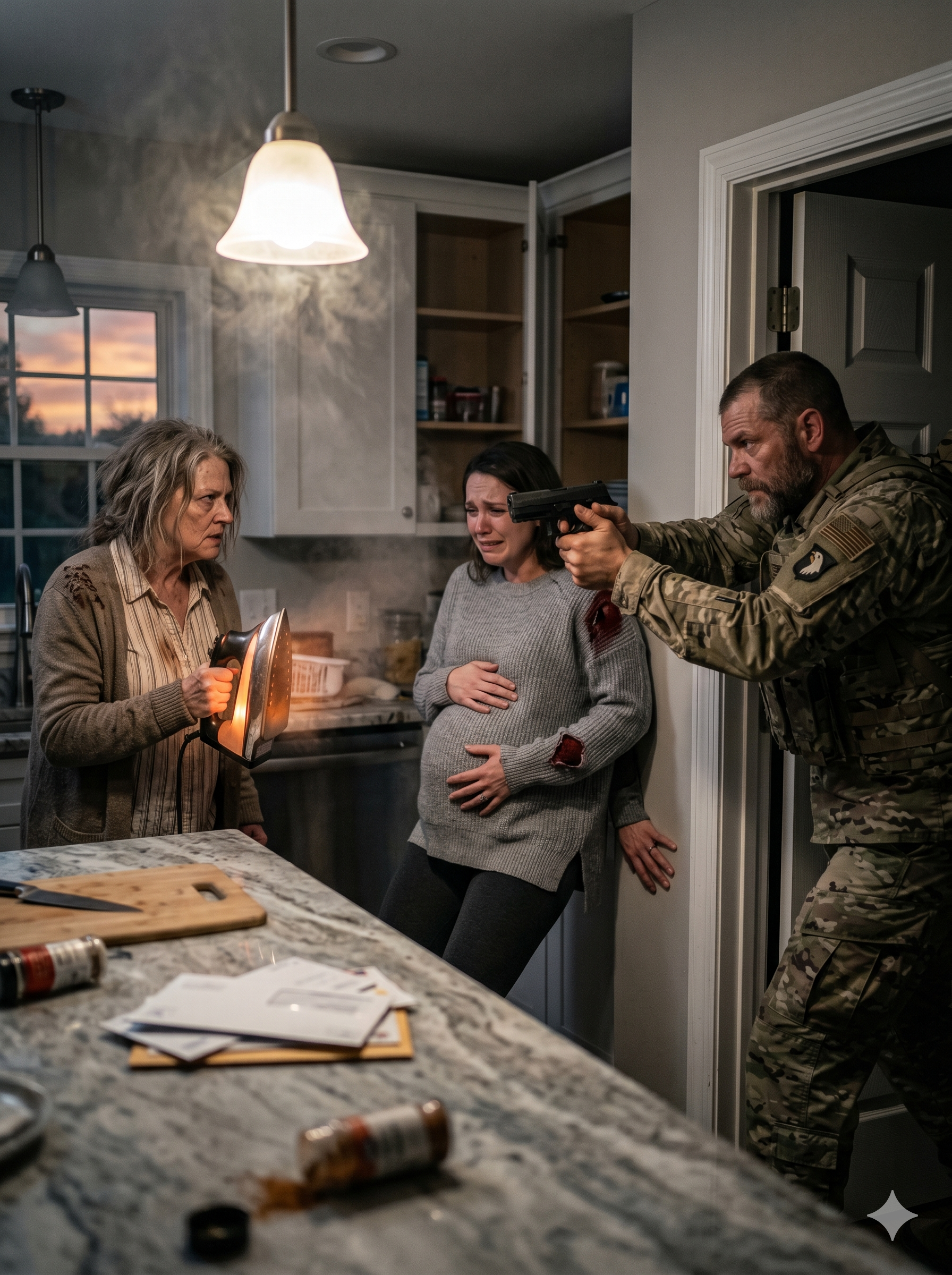
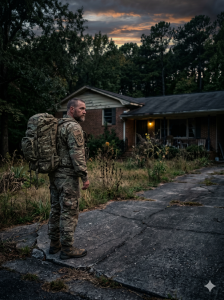
I stood at the edge of my fractured concrete driveway, the heavy, humid air of a late Georgia evening pressing down on my shoulders. The weight of my rucksack—eighty pounds of canvas and Kevlar—felt like a familiar burden. Yet the complete silence of the house ahead of me felt wrong, almost suffocating.
I am Staff Sergeant Elias Vance. For the past three hundred and sixty-five days, the steady roar of Blackhawk rotors, the scent of cordite, and the sharp, unpredictable snap of distant sniper fire had defined my world. I endured that high-intensity combat zone sustained by a single, consuming hope: returning to my wife, Sarah. She was my grounding point. Through every dust storm and night patrol, I replayed the sound of her laughter in my mind like a lifeline. She was gentle where I was hardened, endlessly strong in her own way, and now eight months pregnant with our first child—a daughter we had already named Grace.
I touched the tungsten wedding band hidden beneath my tactical glove—a quiet promise carried across an ocean of sand. I hadn’t called ahead. I wanted to witness the raw, unfiltered shock of joy on Sarah’s face when I stepped through the door a week earlier than my scheduled return.
But as I looked up the driveway, a faint, icy unease began to crawl up my spine.
The flower beds along the porch were entirely dead. Brown, brittle stems were strangled by overgrown thorny weeds. Sarah loved those hydrangeas. She used to spend hours caring for them, saying the soil kept her grounded. Seeing them decay felt like staring at an abandoned outpost.
I remembered my mother’s last letter—the only piece of mail that had reached my forward operating base a month earlier. My mother, Eleanor, was a woman of rigid standards and suffocating expectations. I was her only “achievement,” a trophy she liked to present to her church congregation. In her eyes, Sarah was nothing more than the middle-class intruder who had taken her prize.
“Don’t worry about Sarah, Elias,” the neat cursive writing said. “I moved in to take care of everything. She’s… been difficult lately, and quite fragile. But mother knows best. Just focus on your duty.”
I swallowed the dry knot in my throat and loosened the chest strap of my pack. I didn’t use the front door, instead stepping quietly across the grass toward the back patio. The neighborhood lay still, wrapped in the heavy twilight of suburban America—the very place I had spent a year fighting to protect. It was supposed to be the safest place on Earth.
My hand moved forward, my fingers closing around the cool brass of the back door handle. I paused, expecting the soft murmur of a television, the sound of dishes in the sink, the familiar hum of a home waiting to welcome me.
Instead, what broke through the wood was a sharp, jagged scream. It wasn’t a startled shout or a harmless cry of surprise. It was a raw, guttural shriek—unfiltered, panicked terror.
Chapter 2: Enemy Combatant
The back door burst inward, crashing into the drywall with the force of a flashbang.
I didn’t shout or announce myself. My civilian mindset shut off completely, and the deeply ingrained reflexes of a breach-and-clear specialist took over. I entered the kitchen in a smooth, silent blur of olive drab and black steel.
The air inside was heavy and suffocating, carrying the sharp scent of scorched fabric and raw ozone.
My eyes swept the room, identifying threats in a fraction of a second. In the center of the kitchen, slammed back against the marble edge of the island counter, stood Sarah. She looked skeletal, her face marked by exhaustion, her eight-month pregnant belly exposed and shaking beneath a torn maternity shirt.
Over her loomed my mother.
Eleanor wasn’t cooking. She wasn’t “taking care” of anything. In her right hand, she held a heavy industrial clothing iron. The metal plate glowed a dull, hostile orange, radiating heat just inches from the stretched skin of Sarah’s stomach. Eleanor’s eyes were wide and unfocused, stripped of any grandmotherly warmth she showed the outside world. They were the eyes of a fanatic.
“Sign them!” Eleanor’s voice came out as a venomous, rhythmic hiss. She struck her free hand against a stack of legal documents on the counter. “Sign the divorce papers and walk away with your life. My son doesn’t need a pathetic, middle-class anchor dragging him down. If you don’t leave him, I will make sure this bastard child carries the mark of your greed forever.”
She thrust forward, the burning metal closing in on Sarah’s skin.
Sarah let out a broken, anguished sob, her hands desperately shielding her stomach. “Please… Eleanor, please, she’s your grandchild!”
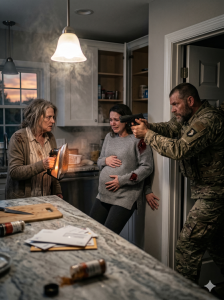
The sharp metallic click of my 9mm sidearm chambering echoed as the loudest sound in the room.
I didn’t see the woman who once packed my lunches. I didn’t see the woman who had cheered at my graduation. My training overrides sentiment in the presence of a lethal threat to a civilian. I saw a predator. I saw an active target endangering a non-combatant.
“Drop it,” I said. My voice stayed low, controlled, and cold enough to rattle the glass.
Eleanor froze. Her head snapped toward me. The fury drained from her face, replaced by a deathly pallor as she stared down the black barrel of her own son’s service weapon.
“Elias?” Her voice cracked as she tried to regain control. “Elias, honey! You’re home early! It’s… it’s just a joke! A test! I was just making sure she was tough enough for our family!”
I stepped closer, keeping the sights aligned with her chest. My blood had turned to ice.
“The joke is over,” I said, my gaze locked on hers with absolute, frozen calm. “Drop the iron, mother, or I will treat you exactly like an enemy combatant. You’re going to jail, and I’m testifying.”
Eleanor stared at me, realizing the finality in my tone. Her fingers loosened. The iron struck the linoleum floor with a heavy clang, instantly burning a black mark into the tile.
But as the plastic cracked, Eleanor didn’t surrender. She threw her hands to her face and let out a shrill, piercing, perfectly calculated wail, screaming at the top of her lungs for the neighbors to call the police, crying that her “war-crazed, PTSD-addled son” had broken into the house and was trying to murder her in cold blood.
Chapter 3: The Long Siege
I didn’t react to her screaming. My weapon stayed lowered but ready, forming a controlled barrier between the threat and the victim, waiting for the sound of sirens to arrive.
When the local police finally forced the front door open with weapons drawn, Eleanor immediately collapsed into performance. She lunged toward the lead officer, sobbing with precisely shaped tears, describing my supposed sudden violent breakdown in vivid detail. I didn’t interrupt her. I carefully placed my sidearm on the dining table, stepped back with my hands visible, and asked for the shift lieutenant by name—a man I had once served alongside in the National Guard years ago.
While two confused officers led a handcuffed, still-wailing Eleanor out toward the cruiser, I knelt on the scorched kitchen floor beside Sarah.
I pulled her into my arms. She felt weightless—too fragile, like she might break under pressure. She was far thinner than any woman eight months into pregnancy should have been. Her fingers clung to my uniform shirt, her tears soaking into the fabric.
“She told me you were dead, Elias,” Sarah whispered, her voice barely audible, her body still shaking from shock. “Two months ago… she showed me a telegram. Official seal. She said if I didn’t leave quietly, she’d take Grace the moment she was born and tell the courts I was a drug addict.”
A cold weight settled in my chest. This wasn’t a moment of instability. It was organized, prolonged control.
Once the paramedics arrived to stabilize Sarah, I left her side for only three minutes. I went down the hallway to the guest room Eleanor had taken over. The air inside carried her heavy floral perfume. I ignored the closet and went straight to the bed, flipping the mattress off the frame.
That was when I found it.
A hidden cache.
Hundreds of my letters—every one I had written from deployment—sealed, unopened, bound in stacks. Next to them lay Sarah’s outgoing mail, also untouched. Eleanor had severed every line of communication, isolating her completely inside the house.
But beneath it all was a folder that tightened something in my jaw until it hurt. Inside were forged Department of Defense casualty documents and a pre-signed, notarized petition for emergency custody of my unborn child, citing Sarah’s alleged “severe mental instability.”
Eleanor hadn’t acted on impulse. She had built a system. A narrative. A year-long siege designed to erase my wife and replace her.
I walked back into the kitchen, the documents in my hand. The lieutenant stood near the doorway, his expression changing as he understood what he was looking at.
My phone vibrated. A message from my father—the quiet man who had left Eleanor decades ago and rarely contacted me.
It read: “She’s doing it again, isn’t she? The police scanner just called your address. Don’t trust anything she says. Check the basement freezer, Elias. Check the back.”
Chapter 4: Basement Camera 04
The legal proceedings began less than forty-eight hours later. Eleanor, backed by a substantial inherited fortune, retained one of Atlanta’s most aggressive high-profile defense attorneys. His approach became clear immediately: put my military service on trial.
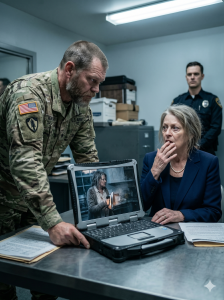
We sat in a sterile, fluorescent-lit conference room in the county courthouse during pre-trial mediation. Eleanor was seated across the polished mahogany table, dressed in a conservative beige cashmere sweater. She presented herself as the wounded, misunderstood matriarch. Her attorney, wearing a suit worth more than my first vehicle, leaned forward and steepled his fingers.
“We understand that Sergeant Vance experienced significant trauma overseas,” the attorney said, his tone carefully laced with manufactured empathy. “Combat-induced aggression is a tragic reality. My client is willing to overlook the terrifying assault with a deadly weapon. We are prepared to offer a plea: a mutual restraining order, community service for Eleanor, and family counseling. Let’s keep this quiet.”
Eleanor smiled—a tight, controlled curve of the lips. She extended a manicured hand across the table’s glossy surface. “We’re family, Elias,” she said softly, her voice dripping with forced warmth. “You don’t want to be the son who sent his own mother to a state penitentiary. Think of the scandal. Think of your career. Just let me be a part of my granddaughter’s life, and we can all heal.”
I stared at her hand without blinking, without reaction.
I reached into my assault pack and pulled out my ruggedized military laptop, opening it and rotating the screen toward them.
“My father texted me the night of the arrest,” I said, my voice flat and emotionless. “He told me to check the basement freezer. I thought he meant a body. He meant the false panel in the back.”
Eleanor’s expression shifted—her smug confidence cracking for the first time.
“You see, counselor,” I continued, tapping the trackpad, “my mother is a perfectionist. She wanted undeniable, admissible proof of Sarah’s ‘instability’ for custody proceedings. So she installed hidden, motion-activated micro-cameras in the vents of my home.”
I clicked into a folder labeled Basement Camera 04.
The video appeared on screen in high definition with audio. It showed the kitchen, timestamped two weeks earlier. Sarah was asleep on the couch in the adjoining room. Eleanor was visible moving calmly through the frame, humming a hymn, unscrewing a bottle of bleach, and carefully pouring a measured amount into a carton of milk before returning it to the refrigerator.
The attorney stopped breathing. His face went pale almost instantly.
Eleanor’s hand jerked back to her lap. The silence in the room became absolute, broken only by the soft hum of the laptop fan.
“I’m not just the son who is sending you to prison, Eleanor,” I said, leaning forward. “I am the Sergeant who documented your war crimes. You didn’t just abuse my wife; you attempted to poison and kill my daughter before she was even born. There is no ‘family’ here. Only a predator and her victim.”
The attorney slowly closed his briefcase with a deliberate click, stood up, and without acknowledging his client, walked out of the room—effectively ending his representation on the spot.
Eleanor was left alone.
But something in her gaze shifted again—the fanaticism returning, sharper and more unhinged now that she was cornered. She leaned forward across the table, her expression twisting into open hatred, and hissed:
“You think you’ve won, boy? You think a video changes the paperwork? I still hold the deed to that house. You and that whore will be sleeping on the street by morning. I will break you both.”
Chapter 5: Tainted Ground
Eleanor’s threat proved to be nothing more than empty venom. The video evidence of the bleach incident, combined with the forged military documents and the seized cache of intercepted letters, left her new court-appointed public defender with no meaningful defense.
The sentencing came quickly and with severe finality. Eleanor was convicted of attempted manslaughter, aggravated psychological abuse, and federal mail tampering. Given the sustained and calculated nature of her actions, the judge departed from standard sentencing guidelines and ordered her into a high-security psychiatric correctional facility. The trial drew intense public attention, and the carefully maintained image she had built over decades in our hometown was erased in less than a week.
I wasn’t in the courtroom when the gavel fell. I was in a hospital room three miles away.
In the middle of depositions and legal fallout, Sarah’s body finally reached its breaking point. She went into early labor. The delivery was complicated by malnutrition and extreme prolonged stress, but she endured it with a resilience that outlasted everything she had been forced to survive.
The hospital room was quiet, filled only with the steady rhythm of a heart monitor—a stark contrast to the violence of the previous month. I sat in a plastic chair, looking down at the small bundle in my arms.
My daughter, Grace, was here.
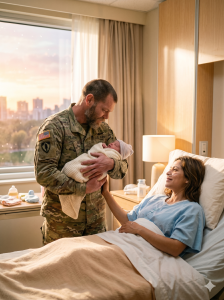
She was tiny, but perfect. No scars, no signs of harm—only ten small fingers and a thick patch of dark hair.
Sarah lay back in the bed, watching us. The drained, fearful look that had defined her for so long was gone, replaced by exhaustion and something closer to peace.
“We’re really safe?” she asked, her voice steady for the first time in a year.
“She’s never coming back, Sarah,” I said, gently kissing the top of Grace’s head. “The house is already sold. My father stepped in. He had old financial records proving she illegally transferred the deed during the divorce. He tied it up in civil court until the buyers cleared everything. We’re taking the equity. We’re moving to the coast.”
Three hundred miles away, the consequences of her actions were finally closing in.
In a state penitentiary cell lit by a single caged bulb, Eleanor tried to reach out. She used her allotted phone time to call former acquaintances from her church circle, the women who once sat on her porch drinking tea and listening to her stories. Every number was disconnected or had blocked her entirely.
She wrote letters, demanding forgiveness, demanding attention, demanding control.
Every envelope was returned to her cell, stamped in heavy red ink: RECIPIENT DECEASED TO SENDER.
Stripped of her audience, her influence, and her narrative, she was left entirely alone.
Two weeks later, as I packed the final belongings from the house, I lifted a loose floorboard in the guest room to ensure nothing of hers remained. My flashlight caught the edge of something hidden beneath it—a leather-bound journal.
I pulled it free.
Inside was Eleanor’s handwriting. The final entry, written the day I came home, was a structured list titled: “Plans for The Next Generation – Raising Grace correctly.”
Chapter 6: The Watch
Three years later, the humid, suffocating air of Georgia was gone, replaced by the clean salt wind and steady rhythm of the Atlantic crashing against the shore.
I sat on the weathered wooden steps of our small coastal cottage in North Carolina. The late afternoon sun stretched across the horizon in bands of violet and gold. A short distance away, where sea grass met sand, Grace ran freely, her small feet kicking up sprays of water, her laughter carried off by the breeze.
Sarah followed close behind, a woven blanket resting over her shoulders. She was strong again. The hollow exhaustion in her face had softened, her eyes were clear, and she moved with a quiet, steady confidence that no one could take from her. She was no longer the woman trapped in fear—she had rebuilt herself into someone grounded and whole.
I rested a worn paperback in my lap when my phone buzzed against the wood beside me. I picked it up. A formal notification from the Georgia State Department of Corrections appeared on the screen.
Inmate: Vance, Eleanor. Status Update: Deceased. Time of Death: 03:14 AM. Cause: Cardiac Arrest.
I stared at the message. I waited for something—grief, anger, even relief. But nothing came. Only a clean, quiet sense of closure. The past had finally stopped reaching forward.
I deleted the notification.
My gaze dropped to my hands. They were weathered, marked by old scars—hands that had once held a rifle in distant conflict and once drawn a weapon in the place I called home. But now, they built instead of destroyed. They fixed fences, carried firewood, and lifted my daughter when she fell asleep too far from the house.
“Daddy, look!” Grace called out, running back toward the porch, holding up a spiraled conch shell.
“It’s beautiful, Grace,” I said, stepping down to meet her. “Just like you.”
I understood then that survival wasn’t the same as peace—but peace had finally become something real. The war, in every sense that mattered, was over.
I picked her up and settled her on my hip, slipping my arm around Sarah’s waist as she joined us. Together, we stood watching the tide roll in.
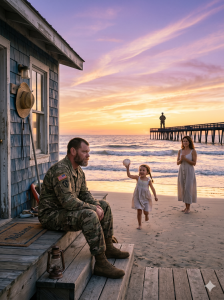
Far down the beach, near the public pier, a lone figure stood against the wind—a young soldier in a slightly rumpled uniform, duffel bag at his feet, staring out at the water like he no longer knew where to go next.
Something in me shifted. Old instincts, quiet but persistent, recognized him.
I adjusted my stance, gently setting Grace back down beside Sarah, and began walking along the shoreline.
Not toward another battle.
But toward someone who might still be trying to find the way home.
