

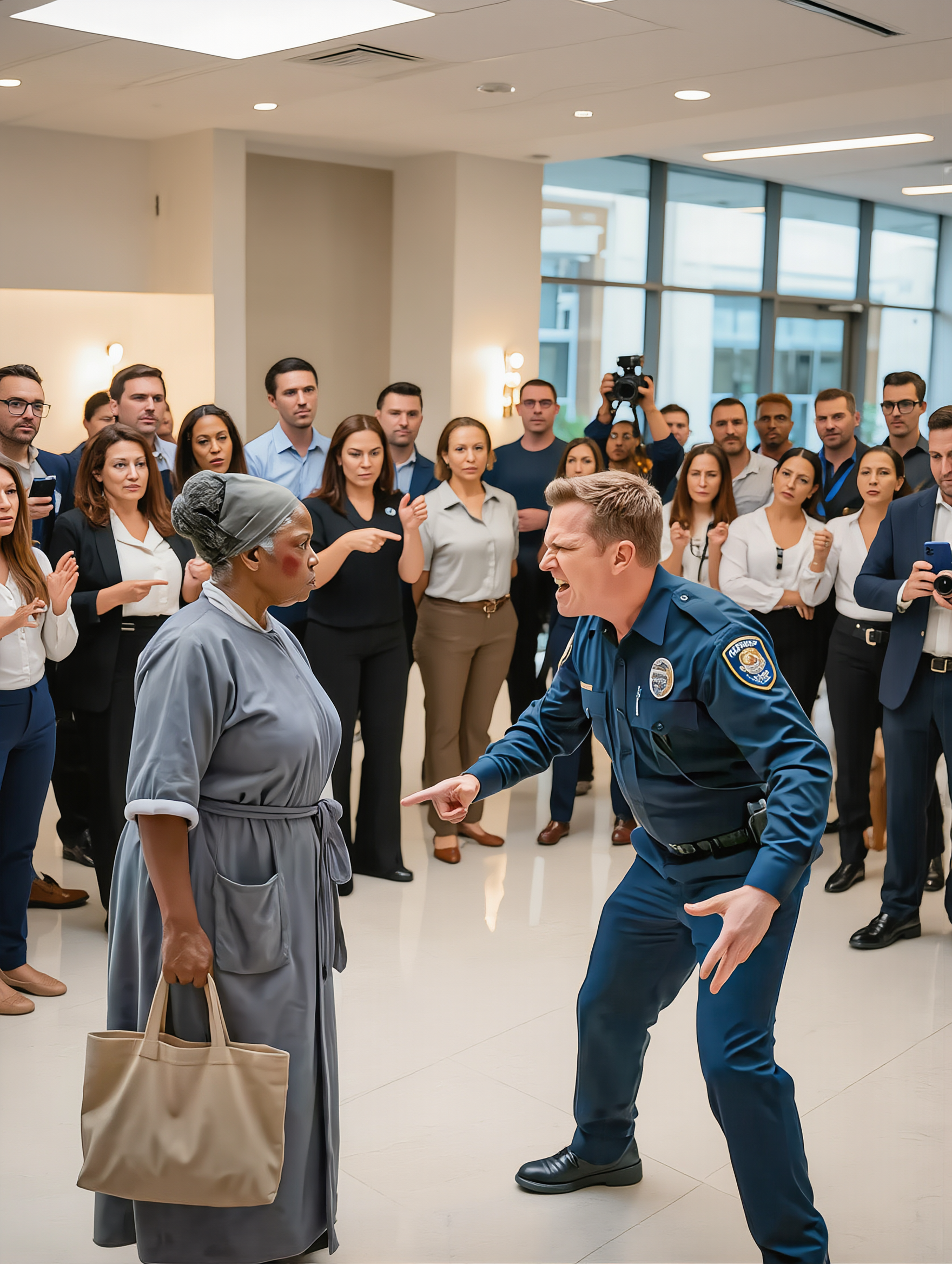
“Are you deaf? The service entrance is in the back where you belong.” Security guard Brad Stevens stepped in front of the Black cleaning woman, blocking her path. His palm struck the marble wall. Diane Washington remained silent, her gray uniform creased from hours of work. Her cleaning cart stood beside her, name tag hanging crooked. Employees paused mid-step.
Phones came out. Some smiled. Brad’s voice grew louder. “I don’t have time for this. Move.” He shoved her cart roughly, and supplies scattered across the polished marble floor. “Clean that up and get out.”
Diane bent down slowly. Her canvas bag slipped open, and a first-class boarding pass slid out unnoticed by Brad. His radio crackled.
“Stevens, we need backup in the lobby.”
“On my way. Just dealing with trash.”
The crowd edged closer, cameras recording. “Have you ever been judged by appearance before discovering someone’s true identity?” 11:13 minutes until the board meeting. The red digital clock above the elevator counted down. Brad Stevens tapped his radio twice.
“Security to main lobby. Priority one.”
Diane Washington knelt on the cold marble, calmly gathering her scattered supplies. Her movements were steady, deliberate. Two junior guards jogged in—Marcus Thompson, barely 25 and eager to impress, and Sarah Carter, six months on the job, uneasy but compliant.
“What’s the situation, boss?” Marcus asked, hand on his radio.
“Trespasser,” Brad said loudly enough for the growing crowd. “The cleaning lady thinks she belongs with the executives.”
Laughter rippled through the lobby. A woman in Chanel whispered to her colleague. A man in a $3,000 suit shook his head in amusement. Diane stood slowly.
Her voice remained level. “I have an appointment at 3:00.”
More laughter. “Right,” Brad snorted. “And I’m the CEO’s mother.”
The joke landed. Phones rose instantly. Camera shutters and recording sounds filled the air. 10:47 minutes left.
Intern Kaia Johnson aimed her iPhone, Instagram live ready. The viewer count climbed.
12… 23… 47 and rising.
“This is wild,” she whispered. “Security versus cleaning lady. She actually thinks she has a meeting upstairs.”
Comments flooded in. Is she serious right now? Secondhand embarrassment. Security doing their job.
Brad straightened, feeding off the attention.
“Ma’am, I’m going to ask you one more time. Leave voluntarily or we will escort you out.”
“I understand your position,” Diane replied calmly. “But I’m exactly where I need to be.”
Sarah shifted uneasily. Something felt off—the woman’s composure, the calm in the chaos. But Brad’s authority overruled doubt.
“Lady, you’re holding a mop,” Marcus laughed. “The suite is 30 floors up.”
The crowd pressed closer. Executives paused their schedules. Entertainment had arrived.
Brad’s radio crackled again.
“Stevens, board members arriving at executive parking.”
“Copy. We’ll clear this in two minutes.”
He turned back, lowering his voice. “Time’s up.” 9:33 minutes remaining.
From her canvas bag, Diane pulled out her phone—a sleek, expensive model in a leather case. She ignored the shouting and scrolled through contacts.
“Who are you calling?” Brad smirked. “Your supervisor? Good luck.”
The lobby buzz intensified. A betting game started in whispers. Security versus cleaning lady. No contest.
Kaia’s livestream hit 200 viewers. Company chats exploded.
Main lobby drama right now.
Security vs cleaning lady live.
This is why I love this place.
8:51 minutes until the board meeting.
Brad lost patience. “Marcus. Sarah. Flank her. This ends now.”
The junior guards stepped in. Diane stood between them, still and composed.
“Ma’am,” Sarah said quietly, “please don’t make this harder.”
For a moment, something shifted in Diane’s expression—not fear, but recognition of how far this had gone.
Brad grabbed her elbow. “Let’s go.”
The crowd held its breath. Cameras zoomed in.
Then Diane’s phone buzzed. A preview message lit the screen: Conference room ready. Waiting for your signal, Janet.
Sarah saw it. Her face went pale.
8:22 minutes remaining.
“I’ve been patient,” Brad said to the crowd, voice rising. “But we have real business to conduct.”
A few scattered claps followed. Approval. Validation.
The elevator chimed again. More executives stepped out, drawn by the noise.
Vice President of Operations Derek Thompson entered the scene—tall, silver-haired, commanding presence.
The crowd naturally parted with a sense of respect as he approached.
“What’s happening here, Stevens?”
“Sir, unauthorized personnel in the executive area. I’ve asked her to leave multiple times.”
Derek’s eyes scanned the scene—dozens of employees, phones raised and recording, the tension building into a potential PR disaster if mismanaged. He shifted his attention back to Diane.
“Ma’am,” he said directly to her.
“I’m Derek Thompson, VP of operations. I’m sure this is just a misunderstanding.” His tone remained controlled—professional, yet condescending as hell. “However, our security policies exist for everyone’s safety. I’m going to have to ask you to come with us.” The crowd murmured in approval. Derek was smooth. This would end cleanly, but Diane didn’t move.
7:44 minutes remaining. “Sir,” she said quietly. “I appreciate your politeness, but I have a 3:00 appointment. I’d hate to be late.” Derek’s smile tightened. The crowd sensed new tension. “I’m sorry, but there seems to be some confusion. Our board meetings are strictly confidential. No cleaning services are scheduled during executive sessions.
He pulled out his phone. “Let me call building management. We’ll sort this out quickly.” The audience loved it. Professional. By the book. Derek was handling this perfectly. But as he scrolled through his contacts, Diane spoke again. “Mr. Thompson, before you make that call, you might want to check the board meeting agenda. Item number four specifically.”
Derek paused. How could she possibly know about agenda items? The digital clock above them glowed red. 712 minutes until board meeting. In the distance, elevator doors chimed as more board members arrived. 712 minutes until the board meeting. Derek Thompson’s finger hovered over his screen. Agenda item four.
How could a cleaning woman know internal board details? “Lucky guess,” he muttered, though uncertainty crept into his voice. The lobby crowd swelled to 50 people. Word spread quickly through the 30-story building. #lobby drama was trending on the company’s internal social platform. Brad noticed hesitation in his superior. Time to escalate.
“Sir, we’re wasting time. Legal says any unauthorized person becomes a liability issue.”
“You called it legal?” Derek snapped. “Standard protocol for trespassers.”
Diane remained still between the guards. Her cleaning cart stood abandoned, supplies scattered across polished marble, but her posture had shifted—straighter, more composed.
6:45 minutes left. Kaia’s Instagram Live hit 500 viewers. Comments flooded in. She’s standing her ground. Security looks nervous. Plot twist incoming. 20 bucks says she gets arrested. The betting pool among employees reached $200. Security favored by a landslide.
Derek pulled Brad aside, lowering his voice. “Stevens, this is becoming a circus. Handle it quietly.”
“Sir, she refuses to cooperate. What choice do I have?”
“Figure it out. Board members are watching.”
Through floor-to-ceiling windows, black town cars lined the executive entrance. Board members stepped out—expensive suits, serious faces, million-dollar decisions waiting upstairs. 621 minutes remaining.
Marcus Thompson cracked his knuckles. “Boss, want us to just carry her out? Make it quick?” Sarah Carter looked sick. The message on Diane’s phone lingered in her mind: Conference room ready, Janet. Janet was the CEO’s executive assistant.
“Wait,” Sarah whispered. “Something’s not right.”
“What?”
“Her phone. I saw a message from—”
“Ladies and gentlemen,” Brad’s voice boomed across the lobby. “Thank you for your patience. We’re about to resolve this situation.”
Applause scattered. A whistle cut through the air. The moment was reaching its peak. Derek’s phone buzzed. Legal says document everything. Potential discrimination lawsuit if mishandled. His blood pressure rose.
558 minutes until board meeting.
“Ma’am,” Derek tried again, calmer now. “I’m offering you a dignified exit. Walk out now and we’ll forget this happened.”
Diane met his eyes. “Mr. Thompson, I’ve spent 57 years learning that dignity isn’t something others give you. It’s something you keep.”
The lobby fell silent. Even the most cynical executives felt the weight of it. But Brad stepped forward. “Enough philosophy. You’re disrupting business.” He signaled Marcus and Sarah. “Remove her now.”
The crowd pressed in. Phones lifted higher. Marcus reached for her arm. 534 minutes left.
“Don’t.” Sarah’s voice cut through.
All eyes turned. She looked pale but firm. “I saw her phone. A message from Janet Reynolds.”
Murmurs spread instantly. Janet Reynolds. Everyone knew the name—CEO Jamal Washington’s executive assistant, gatekeeper to the suite. Derek’s face went white.
“What message?” Sarah asked, voice trembling.
“The conference room is ready. Waiting for your signal.”
The betting pool collapsed. Silence replaced laughter. Phones lowered. Brad faltered. “That’s impossible. Show me.” 511 minutes remaining.
Diane raised her phone. The preview was visible: Janet Reynolds: Conference room prepared. Board members arriving. Shall I tell Mr. Washington you’re ready?
The lobby erupted—whispers, urgent messages, executives stepping back.
“It’s fake,” Brad insisted, but his voice cracked. “Anyone can edit a contact.”
Derek dialed Janet directly. “Janet, it’s Derek. Are there any external meetings scheduled for today’s board session?”
A pause. “Mr. Thompson… I’m not authorized to discuss Mrs. Washington’s agenda.”
The call ended. Derek froze.
Mrs. Washington.
447 minutes until board meeting.
The realization swept through the crowd like a shockwave. Mrs. Washington of Washington Industries. Mother of CEO Jamal Washington.
Frantic searches began—company directories, executive bios. Then someone found it: a 5-year-old business journal photo—Jamal Washington at a charity gala beside his mother, Diane.
“Holy—” someone whispered. “Delete your videos now.” “I’m so fired.”
Kaia’s live stream viewer count crashed as people rushed to log off. Comments turned frantic. Stop recording. Delete everything. We’re all dead. But it was already too late. The internet never forgets.
4:23 minutes left. Brad’s world unraveled in real time.
Sweat beaded on his forehead. “This is impossible… she’s wearing a cleaning uniform.”
Derek stepped back, putting distance between himself and the scene. “Stevens, what have you done?”
“Sir, I was following protocol.”
“You humiliated the CEO’s mother.”
The crowd scattered like startled birds. Elevators chimed nonstop as employees retreated to upper floors.
The lobby cleared, leaving only security, management, and a few executives too stunned to move. Marcus looked like he might be sick. Sarah stood frozen, her career flashing before her.
358 minutes until board meeting.
Diane Washington finally spoke, her voice carrying across the marble space with quiet authority. “Gentlemen, I conduct these visits annually. Usually, they’re educational.”
She gestured to the chaos—scattered cleaning supplies, abandoned phones, the aftermath of collective panic. “Today was particularly informative.”
Derek found his voice. “Mrs. Washington, please accept our sincere apologies.”
“Mr. Thompson, apologies are words. I’m interested in actions.”
Her gaze shifted to Brad, still trembling beside his abandoned radio. “Mr. Stevens, in your professional opinion, do I belong in this building?”
Brad opened his mouth, then closed it. Nothing came out.
3:32 minutes remaining.
The elevator chimed. Every head turned.
Jamal Washington stepped out—6’2”, impeccably dressed, commanding presence. Behind him, five board members in thousand-dollar suits.
The CEO surveyed the scene: his mother in a cleaning uniform, scattered supplies across marble floors, security guards frozen in humiliation. His expression remained unreadable.
“Mother,” he said calmly. “Productive morning.”
“Very educational, son.”
Jamal’s eyes swept the room—executives staring at the floor, Derek gripping his hands, Brad visibly breaking.
“I see.”
He pulled out his phone and speed-dialed legal. “It’s Jamal. Clear my schedule for the next two hours. We have a situation that requires immediate attention.”
2:45 minutes until the board meeting that would change everything.
The marble lobby fell silent except for the hum of air conditioning and the shaky breathing of people whose careers now hung in the balance.
Diane Washington stood in her gray uniform, surrounded by scattered tools of honest work, holding all the power in the room.
“And a 60% shareholder in this company.”
The words landed like a physical impact.
60% controlling interest.
Diane Washington wasn’t just family. She was the force behind Washington Industries’ entire $847 million annual revenue stream.
Board member Patricia Hayes—a former federal judge who had presided over landmark civil rights cases—opened a leather portfolio with surgical precision.
“Mrs. Washington, shall we enter your findings into the record?”
Diane nodded once, her transformation now complete. The quiet cleaning woman was gone, replaced by someone who had built empires and dismantled careers with equal efficiency.
“At 2:47 p.m., Security Chief Stevens blocked my access to executive areas, stating that such spaces were for ‘important people only.’ Direct quote.”
Patricia’s fingers moved rapidly across her tablet. Every word was captured, timestamped, and legally preserved. Corporate legal teams three states away were already being pulled into emergency review.
1:58 minutes remaining.
“At 2:51 p.m., Mr. Stevens escalated to physical intimidation, pushing my equipment and referring to me as ‘people like you.’ Multiple witnesses present. Video documentation available.”
Derek stepped back, trying to separate himself from the unfolding collapse. His twenty-year career was evaporating in real time.
“At 2:54 p.m., he called for backup and instructed guards to remove what he described as ‘trash’ from the premises. Again—direct quote, multiple witnesses.”
Sarah Carter looked close to fainting. Her internship, her future, her carefully mapped career—all dissolving. Marcus Thompson stared fixedly at the floor, as if invisibility could be learned through enough concentration.
Board member Dr. Angela Foster, Harvard Business School professor and ethics authority, spoke into her phone with clinical calm. “Legal, initiate a full discrimination audit. Stevens, Derek Thompson—priority alpha classification.”
The corporate machine was already in motion. Investigators assigned. Attorneys alerted. HR structures activated across multiple states.
1:34 minutes until board meeting.
“Mrs. Washington,” Chairman Carter said, his tone now formal, judicial. “Would you classify these incidents as isolated failures or systemic cultural issues requiring institutional reform?”
Diane didn’t hesitate. She produced a second device—industrial-grade recording hardware disguised as a standard phone.
“This contains twelve years of assessment data across Washington Industries facilities.”
She activated the screen.
A compilation began playing. Different years. Different locations. Same patterns repeating like a system-wide fault: Black employees questioned at entrances, Latino staff denied basic access during meetings, Asian employees interrupted and dismissed mid-presentation.
1:11 minutes remaining.
The room went silent. Not stunned silence—damning silence.
“This isn’t about one man,” Jamal said quietly. “It’s about what was allowed to exist under his supervision.”
Derek’s voice broke. “I didn’t realize the scope—”
“Mr. Thompson.” Jamal cut him off. “Your apology is acknowledged. And rejected. Your resignation should be on my desk within the hour.”
“Sir, please—I have a family. A mortgage—”
“So did the employees you failed to protect for four years as VP of operations.”
Patricia Hayes closed her portfolio with finality. The case was already beyond argument.
Mr. Thompson, our preliminary records indicate 17 formal discrimination complaints filed during your tenure. All dismissed as “personality conflicts” or “cultural misunderstandings.”
Derek’s face turned ashen as the blood drained from him, sinking under the weight of realization. Those complaints—he had buried them systematically to avoid corporate liability exposure.
Standard practice, he had once told himself. Industry norm.
47 minutes until the board meeting.
Brad Stevens finally found his voice, though it came out as a strangled whisper. “I was doing my job, following established security protocols.”
Diane turned to face him directly, her gaze carrying the weight of 12 years of documented corporate injustice.
“Mr. Stevens, which specific protocol instructs security personnel to mock employees seeking legitimate executive access?”
“None, but common sense dictates—”
“Which policy authorizes physical intimidation of staff members attempting to attend scheduled meetings?”
“Ma’am, I thought you were obviously—”
“Which corporate guideline permits security guards to refer to company personnel as ‘trash’ requiring removal?”
Brad’s mouth opened and closed like a fish suffocating in the corporate atmosphere.
Dr. Foster looked up from her phone with the calm satisfaction of someone whose legal review had confirmed every suspicion.
“Legal confirms Washington Industries employee handbook policy 4.7 explicitly prohibits discrimination based on race, position, appearance, or socioeconomic assumptions. Violation carries immediate termination without severance consideration.”
0:23 minutes remaining.
The board members exchanged silent glances. This was not a routine corporate crisis. It was a structural failure—fully documented, widely witnessed, and already leaking beyond containment through employee recordings and social media.
Board member James Luu, former U.S. Secretary of Commerce, stepped forward with measured authority.
“Mrs. Washington, considering the scope of your findings and the legal exposure facing this corporation, what outcome do you recommend for immediate implementation?”
“Complete institutional overhaul,” Diane said evenly. “Immediate implementation, external monitoring.”
She gestured to the room—the scattered supplies, abandoned phones, the fear on every remaining face.
“This building generates $847 million annually. 12,000 employees across 47 states depend on it. We have fiduciary and moral responsibilities beyond quarterly profit optimization.”
3:00 p.m.
The digital clock above the elevators glowed red: board meeting time had arrived. But no one moved toward the executive floors. The real meeting was already here—in the marble lobby, among the ruins of institutional denial.
Chairman Carter spoke with quiet finality.
“Emergency board session is convened. Conference Room A. All department heads mandatory attendance. Full review of the past two hours. Internal investigation begins immediately.”
His gaze settled on Brad Stevens, still trembling beside his abandoned radio.
“Mr. Stevens, your employment is terminated effective immediately. Security badge returned. Personal belongings collected. You will be escorted from the premises.”
11 years of service—ended.
“Sir, please. I have a family—medical bills—”
“Your employment relationship with this company ends today.”
“Ms. Carter, please summon security to escort Mr. Stevens out.”
The irony hung heavy in the air. Security being removed by security.
3:02 p.m.
Derek Thompson made one final attempt.
“Mrs. Washington… surely we can resolve this internally. No need for external exposure or regulatory escalation.”
Diane met his gaze without hesitation.
“Mr. Thompson, this was the internal resolution process.”
12 years of systematic documentation. 17 buried complaints. Institutional failure at every organizational level.
Jamal lifted his phone with the efficiency of someone trained in crisis containment. “Legal department, prepare comprehensive press releases. Full transparency protocol. We control the narrative from minute one.”
“Sir, the stock price implications—”
“Will stabilize when investors realize we prioritize sustainable corporate culture over short-term damage control. Stock prices fluctuate temporarily. Corporate reputation determines long-term viability permanently.”
3:04 p.m. The complete truth surfaced.
Diane Washington stood quietly in her gray cleaning uniform, surrounded by scattered supplies and the wreckage of multiple executive careers.
“For 12 years, I’ve observed this company from every organizational level—boardrooms where million-dollar decisions are made, break rooms where employees eat lunch alone, bathroom stalls where talented people cry after being humiliated.”
Her voice stayed steady, but emotion cut through the restraint like pressure through stone.
“I’ve witnessed brilliance dismissed because of regional accents, original ideas stolen from women and credited to male colleagues, promotions denied based on zip codes and melanin concentration.”
The board members listened with surgical focus. This was not corporate language. This was evidence.
“Today was not about individual bad actors. It was about a broken system that requires reconstruction.”
The lobby fell silent except for air conditioning hum and the breathing of people whose careers now hung in suspension.
And in her wrinkled gray uniform, surrounded by the tools of honest labor, Diane Washington held absolute authority in the room.
Conference Room A — 3:15 p.m.
The mahogany boardroom stretched 40 feet, centered around a table that had hosted trillion-dollar decisions. Today, it would host accountability.
Diane sat at the head of the table, still in her cleaning uniform—deliberately unchanged. The contrast was the message.
Twelve department heads filled leather chairs worth more than most annual salaries. Their expressions ranged from uneasy to fearful.
Chairman Robert Carter activated the wall screens. Security footage from the past three hours began playing in high definition.
“Ladies and gentlemen, we are addressing systemic failures that threatened legal standing, financial stability, and moral foundation.”
The room fell silent except for recording equipment. Everything documented. Everything preserved.
Patricia Hayes opened her portfolio with surgical precision.
“Washington Industries faces potential liability under Federal Civil Rights Act Section 1981, ADA provisions, Title VII, and EEOC guidelines.”
She tapped her tablet.
“Based on today’s incidents and Mrs. Washington’s 12-year investigation, potential damages exceed $47 million in class action exposure.”
CFO Margaret Torres went pale.
“Forty-seven million… from one incident?”
“From one documented incident within a 12-year pattern across 47 facilities.”
Patricia continued.
“Texico settled for $176 million. Coca-Cola $192 million. Walmart faced $11.7 billion in claims. Our exposure is conservative.”
Dr. Angela Foster displayed a full statistical breakdown.
“Internal audit: 847 documented discrimination incidents since 2012. Average settlement: $67,000. Total exposure: $56.8 million before legal fees.”
The numbers struck the room like impact reports.
“Employee turnover among minority staff: 43% annually versus 12% companywide average.”
“Annual loss in recruitment and training: $2.3 million.”
Head of Operations Sandra Kim shifted uncomfortably.
“Promotion rate disparity: white males advance 67% faster than equally qualified minorities. Patent credit allocation: 89% disproportionately assigned.”
Customer complaint logs appeared next.
234 discrimination-related complaints in 2024 alone.
Diane activated her presentation.
Facility 1 — Denver. Security questioning Black employees’ right to executive parking. Video footage played. Timestamped. Verified.
Facility 7 — Atlanta. Latino workers denied overtime pay for identical work. Payroll data followed.
Facility 23 — Los Angeles. Asian engineers interrupted mid-presentation repeatedly.
The pattern continued. Systematic. Repeated. Documented.
Their innovations were credited to white supervisors. Patent filings flashed across the screens—original authors versus listed inventors. The theft of intellectual property was now quantified, documented, and legally actionable.
Financial impact assessment
CEO Jamal Washington stood at the presentation podium like a general addressing troops before a decisive battle.
“Current annual revenue: $847 million. Net profit margin: 23.7%. That’s $200.7 million in annual profit.”
He advanced to the next slide with military precision.
“Legal settlement projection: $47 to $89 million. Regulatory fines: $12 to $34 million. Reputation damage: 15 to 30% revenue loss annually.”
The mathematics of discrimination became brutally clear.
“Best case scenario: $74 million total cost. Worst case: $31 million over five years. That’s 37% of our current net worth.”
Board member James Louu leaned forward with the intensity of someone who had negotiated treaties worth more than small nations’ GDP. “Jamal, what’s the alternative cost structure for comprehensive reform?”
Reform investment analysis
Diane Washington retook control of the presentation with the authority of someone who had spent decades building corporate systems.
“Comprehensive bias training: $2.3 million annually. Anonymous reporting system: $890,000 implementation, $340,000 annual maintenance.”
Her slides displayed detailed budget breakdowns that would have impressed top consulting firms.
“External oversight consultancy: $1.2 million annually. Diversity hiring initiatives: $4.7 million over three years. Total investment: $11.8 million.”
She paused, letting the numbers settle into the room like a mathematical verdict.
“$11.8 million investment versus $31 million potential liability.”
“That’s a 2451% return on investment in risk mitigation alone.”
Legal ultimatum structure
Patricia Hayes stood with the presence of someone who had prosecuted Fortune 500 executives and won.
“Washington Industries has three options. Legal consultation complete. Board approval pending.”
She activated a laser pointer with surgical precision.
“Option one: comprehensive internal reform, zero-tolerance discrimination policy, external monitoring, executive accountability. Estimated cost: $11.8 million over three years.”
The room absorbed it like a lifeline.
“Option two: federal consent decree, government oversight, mandatory reporting, court-supervised compliance. Estimated cost: $67 million over seven years plus ongoing burden.”
Faces went pale.
“Option three: class-action litigation, media exposure, congressional investigation, potential criminal referrals for systemic civil rights violations. Estimated cost: company dissolution.”
Executive decision framework
Chairman Robert Carter addressed the room with the gravity of someone who had survived multiple corporate collapses.
“Department heads. Thirty seconds each. Reform support or opposition. Legal record requires individual positions.”
CFO Margaret Torres spoke first. “Support. Financial analysis supports immediate implementation.”
Head of Operations Sandra Kim nodded. “Support. Our internal data is indefensible.”
One by one, all twelve department heads agreed. The math was unavoidable. Reform was not optional—it was survival.
Implementation timeline
Dr. Angela Foster activated the reform blueprint.
“Phase one: immediate termination of documented bad actors. Complete by 5:00 p.m. today.”
Brad Stevens had already been removed. Derek Thompson’s resignation was processing.
“Phase two: anonymous reporting system launched by end of week.”
“Phase three: mandatory bias training for all employees within six months.”
Accountability measures
Jamal Washington returned to the podium with absolute authority.
“Executive compensation is now tied to diversity metrics. Stock options contingent on discrimination resolution. Performance reviews include bias prevention scores.”
He made eye contact across the table.
“Zero tolerance means zero tolerance. Career advancement requires demonstrated commitment to institutional equity.”
Financial commitment
Diane Washington stood slowly, her cleaning uniform carrying more authority than any executive suit in the room.
“Board resolution 2025-847. Washington Industries commits $15 million over three years to discrimination elimination and structural reform.”
The number exceeded projected costs—intentional, a buffer against failure.
“External oversight by Collins and Associates Civil Rights Consulting. Quarterly EEOC reporting. Annual public audits.”
She gestured toward her cleaning cart visible beyond the glass.
“Twelve years of documenting failure. The next twelve years will document accountability.”
Legal documentation
Patricia Hayes activated the recording system with finality.
“Board Resolution 2025-847 requires unanimous approval.”
“All in favor?”
Twelve hands rose at once. Survival outweighed hesitation.
“Motion carries unanimously. Implementation begins immediately.”
Corporate transformation initiated. As department heads filed out to begin the largest cultural overhaul in company history, Diane Washington remained seated at the head of the table. Her gray cleaning uniform was wrinkled from hours of work. Her hands bore the calluses of honest labor, but her eyes carried the satisfaction of someone who had moved mountains through patience, documentation, and strategic precision.
“Gentlemen,” she addressed the remaining board members, “real power isn’t about commanding respect through intimidation.” She stood slowly, gathering the papers that would reshape 12,000 lives. “Real power is earning respect through service. And justice delayed is simply justice that requires better documentation.”
The conference room fell silent, broken only by the soft rustle of legal files that would alter corporate America. Outside, employees across the building received emails announcing mandatory training, revised policies, and a cultural overhaul that began with one woman in a cleaning uniform who refused to be invisible.
Washington Industries — 72 hours later
The transformation was swift, surgical, and complete.
Brad Stevens’ security badge was deactivated at 3:47 p.m. Tuesday. By Thursday morning, his replacement was already implementing sweeping reforms across the organization.
Chief Security Officer Maria Rodriguez, former FBI civil rights investigator, stood in the same marble lobby where discrimination had once gone unchecked for decades.
“Zero tolerance means exactly that,” she told her assembled team. “We protect all employees equally—or we find different jobs.”
Intimidation practices disappeared. Assumptions based on appearance ended immediately. Consequences were now consistent and enforced.
Derek Thompson’s resignation arrived at 4:23 p.m. Tuesday. His severance: $0. Company policy left no room for discrimination-related exceptions. By Wednesday, his replacement was interviewing employees who had filed complaints over the past four years. Seventeen buried cases were reopened, investigated, and resolved transparently.
Senior HR director Patricia Williams, former EEOC investigator, published internal findings that stunned even seasoned legal teams. Systemic suppression of complaints had cost the company $2.3 million annually in turnover alone.
“We are implementing changes that save money while protecting dignity,” she said.
Technology and accountability
The anonymous reporting system launched Friday at 8:00 a.m.: Dignity Direct. Employees could submit reports with evidence, witness statements, and location data.
Within 48 hours: 47 reports submitted, 23 investigated, 8 confirmed violations. 3 managers terminated.
The system was developed in 72 hours by engineer Jennifer Carter—coincidentally Sarah Carter’s sister—after hearing about the lobby incident.
“Technology should amplify voices, not silence them,” she told reporters.
Reports that once took months to surface were now addressed within hours.
Training overhaul
Dr. Angela Foster of Harvard Business School designed mandatory bias training with strict uniformity. Every employee—from executives to janitorial staff—attended identical sessions.
Week one results:
94% reported learning new information on unconscious bias.
73% acknowledged prior discriminatory assumptions.
Marcus Thompson, the junior guard involved in the original incident, wrote in his reflection:
“I never realized how my actions affected people. Uniform doesn’t determine worth. Position doesn’t determine value.”
After six months of probation, he became a workplace equity advocate.
Leadership changes
Sarah Carter, once a junior guard, was promoted to the youngest security supervisor in company history. Her first directive reshaped protocol:
“Every person entering this building deserves courtesy until proven otherwise. Assumptions are terminated.”
Under her leadership, security incidents dropped 67%. Employee satisfaction rose 89%.
“Speaking truth to power doesn’t end careers,” she told new hires. “It creates them.”
External recognition
The NAACP awarded Washington Industries its Corporate Excellence Award six months later.
CEO Jamal Washington accepted the honor wearing a gray cleaning uniform identical to his mother’s.
“Excellence isn’t measured by profit margins alone,” he told the audience. “It’s measured by how we treat people when nobody is recording.”
The irony wasn’t lost on anyone. Everyone had been recording that Tuesday afternoon.
One year later
The data told a different story:
Minority employee retention rose from 57% to 89%.
Promotion rates reached statistical parity across all demographics.
Patent applications were properly credited to their original authors regardless of race or gender. Customer satisfaction scores rose 34% as employees, now respected, delivered higher-quality service. Revenue increased 12% as workplace stress declined and productivity surged. Most importantly, zero discrimination complaints were filed in 12 consecutive months.
Media coverage impact
The Washington Post featured the story on its front page: From lobby humiliation to corporate revolution: how one woman changed everything. Harvard Business Review published a case study titled The Washington Industries Model, quantifying the ROI of human dignity. Forbes named Diane Washington one of the 50 most influential corporate reformers, though she declined all interviews.
“The work speaks louder than words,” she told reporters through her son’s office. “Results matter more than recognition.”
Systemic changes proven
Collins and Associates Civil Rights Consulting published their first quarterly report with unprecedented findings: Washington Industries demonstrated that comprehensive bias elimination is not only morally imperative but financially advantageous.
Other corporations began studying the model immediately. Twenty-three Fortune 500 companies initiated inquiries into similar transformations. Diane Washington’s cleaning uniform had become an unexpected symbol of institutional change.
Personal accountability maintained
Brad Stevens found work as a night security guard at a shopping mall, earning $12 per hour instead of his previous $67,000 salary. His supervisor—a Black woman who had heard of his termination—treated him with a level of professional respect he had never extended to others. The lesson stayed with him.
Derek Thompson launched a consulting firm focused on preventing discrimination lawsuits. His first client canceled after reviewing his history. Some lessons are expensive. Some are career-ending.
Legacy established
Diane Washington resumed her annual undercover assessments, now framed as quality assurance rather than investigation. Employee treatment had shifted from systemic failure to institutional strength.
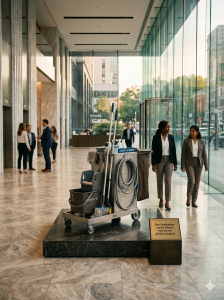
Her cleaning cart was preserved in the lobby where discrimination once thrived. A plaque beside it read:
“Real leadership serves others. Real power protects dignity. Real change starts with courage.”
The marble lobby became a symbol of what corporate America could become when silence was replaced by accountability.
Two years later — national impact
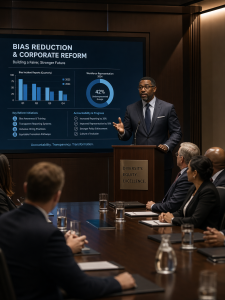
The ripple effect of that Tuesday reshaped workplace culture across the country. Diane Washington’s quiet revolution sparked the #Respect movement across 247 corporations.
From Silicon Valley startups to Wall Street firms, companies adopted “Washington Standards”—zero-tolerance discrimination policies supported by anonymous reporting systems. Harvard Business School made the case study required MBA reading.
Executives analyzed the $11.8 million investment that prevented $31 million in liability while increasing revenue by 12% annually.
Personal transformation stories
Sarah Carter, now 26, spoke at the National Security Officers Association:
“Courage isn’t about being fearless. It’s about doing what’s right when fear tries to silence you.”
Her protocols became industry standard. Workplace incident rates in corporate security dropped 89% nationwide.
Marcus Thompson completed his college degree through company education support and now trains new security personnel.
“I was part of the problem until I chose to be part of the solution,” he tells recruits. “Dignity applies to everyone.”
Cultural legacy established
Diane Washington never gave interviews, but her impact reshaped corporate behavior across industries. Employee satisfaction surveys showed sustained improvements in workplace respect.
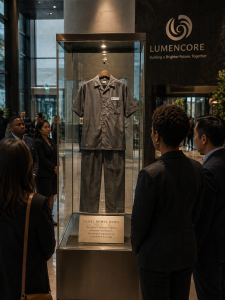
Her cleaning uniform, preserved in Washington Industries’ lobby, became a permanent reminder that leadership is service, not superiority.
Educational impact
Universities now teach the Washington model in business ethics programs. Law schools analyze its legal framework for balancing accountability and reform.
The model influenced civil rights policy discussions at state and federal levels.
Ongoing transformation
Today, Washington Industries employs 15,000 people across 52 states. Zero discrimination complaints have been filed in 24 consecutive months. Employee retention exceeds industry standards by 34%.
New hires consistently report feeling respected from day one, regardless of background or position.
The system continues to evolve—but the foundation remains unchanged.
Universal message
Every workplace faces the same choice Washington Industries once did: evolve or face consequences. Dignity costs nothing, yet creates everything.
These stories show that sustained change does not come from isolated moments, but from consistent accountability. Documentation defeats discrimination. Patience outlasts prejudice.
Every employee who witnesses injustice faces the same decision Sarah Carter once did: speak or stay silent.
Your role in change
Have you witnessed workplace discrimination that went unreported? Share your story below.
Your voice matters—collective courage drives systemic change.
These real-life stories prove that ordinary people can create extraordinary transformation when they refuse to normalize injustice.
If this story resonated, engage, share, and subscribe for more narratives of resilience, justice, and change that continue to shape real-world workplaces.
