

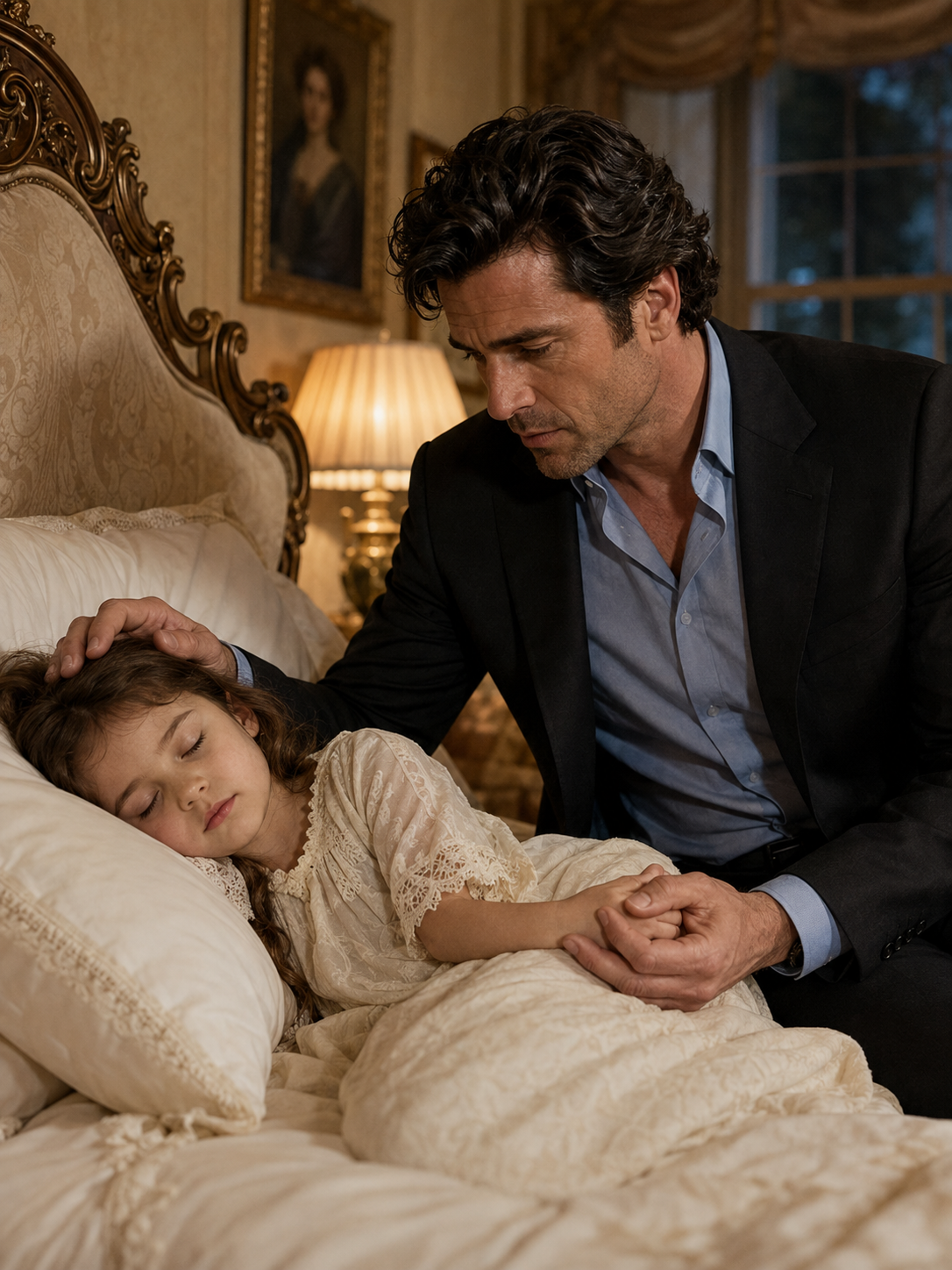
At three in the morning, the most dangerous man in the city stood in his own hallway holding a child who was not his own. He had not held a child since the day his daughter was buried. He had not slept properly in three years. The girl was light as air. She smelled of soap, cold night air, and a stuffed rabbit whose ear had gone limp from being clutched too often. When she let out a soft breath against his collarbone, Alessandro Corvino momentarily lost the ability to breathe.
The villa sat at the far end of a private drive so long that most visitors turned back before reaching the gate. Stone walls, three meters high, surrounded the property, topped with iron spikes that gleamed under the moon like the teeth of a snare. Behind those walls stood two straight rows of cypress trees, planted the year Serena had walked through the front doors as a new bride, and never once removed since. Alessandro had preserved them. He had preserved everything.
Three years earlier, in the same week both coffins were lowered into the earth, the housekeeper had added a new household rule: no children in the master wing, none in the private hallway after dark, ever. That rule had been broken exactly once. Tonight.
The evening had unfolded the way every evening did — with a gathering in the study. Four capos occupied the tall leather chairs surrounding the walnut table. At the head sat Alessandro, black gloves resting on the wood before him, silent since the door had shut. The topic was the eastern port. Carlo Falcone had been pushing against the boundary the two families had honored for eleven years. A Corvino ship had been detained at customs for six hours, two containers searched, nothing discovered — a message all the same.
The youngest capo, Adrian Bellini, lowered his glass and cleared his throat. He proposed handing over the north dock as a peace offering. It would cost less than open conflict.
Alessandro raised his eyes. Nothing more. He said nothing, his voice never rose, yet Adrian’s next words dissolved before he could speak them. The blood left the young man’s face. He stared down at his own hands as though they had turned against him.
Dante Rizzo moved. A bottle left the sideboard, and the crash of it against the far wall seemed to linger in the air far longer than any sound should. Red spread across the plaster and crept downward. When it ended, Adrian stood with his right hand sliced open in three shallow lines, pressed to his chest, head bowed. Forgive me, Don Corvino. I spoke out of turn.
Alessandro gave no reply. The meeting resumed as though nothing had occurred.
Two floors above, Hannah Cole knelt scrubbing the baseboards of the upper landing when the sharp noise carried up through the old air vent. Her cloth went still. She held her breath. Down the hall, on the long leather bench, her daughter slept, one hand pressed to the ear of a gray rabbit worn soft in a dozen places.
Hannah was twenty-five. She looked closer to forty. Her hands were cracked and swollen at every joint, the skin stripped raw by bleach, ammonia, and cold water in the months since her mother’s death. Her hair was tied back tightly at the base of her neck. Beside her lay the tools of her work: brushes, rags, a bottle of citrus cleaner.
The meeting broke up close to midnight. Mrs. Riva found her on the landing and said, not meeting her eyes, “You will stay alone tonight. The second study needs to be cleaned before dawn.”
In this house, silence was simply part of the job.
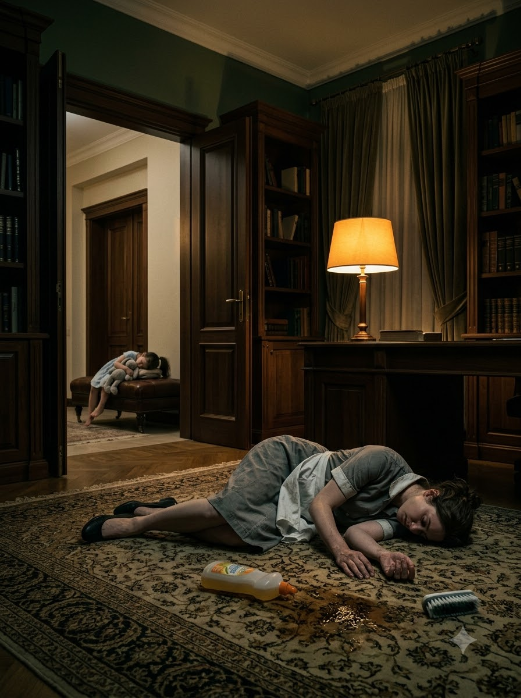
Hannah did not raise her head. She was already kneeling on the Persian rug, a small stiff brush in her right hand, her left palm pressed flat to the wood for balance. The stain in the grain was dark and spread wide. She had scrubbed for close to two hours and had barely lightened its edge. The sharp copper scent of blood rose through the citrus cleaner, the two smells twisting together until her throat tightened with every breath. She kept breathing regardless. She kept scrubbing regardless.
She thought of her mother, of the rented hospital bed, of envelopes as thin and pale as her mother’s wrists had become. She thought of the loan man who had rung three times the day before, his messages shrinking each time. She thought of Mia, asleep on the bench, who had gone without dinner, and the toast she had promised for morning. She could not let herself forget the toast.
Her knees had gone numb. Her shoulders ached. Her sight blurred at the edges, the room softening as though a damp cloth had been dragged across it. She blinked, blinked once more, told herself she would close her eyes for just a moment. Only a moment. The bottle slid from her grip and rolled across the rug, coming to rest against the leg of the walnut table. She never heard it stop. Her body sank forward with the quiet surrender of something that had exhausted every reason to keep going. Her forehead came to rest against the floorboards as softly as a leaf settling on water. The brush lay where it had dropped.
At three in the morning, the estate lay in its deepest quiet. Even the guards along the outer wall had lowered their voices. In the east wing, Alessandro left his office and entered the long corridor, a man who had given up trying to sleep. He was halfway down it when he stopped — not the way a man halts before danger, but the way one stops when the floor beneath him no longer feels familiar.
On the long leather bench beneath the second window lay a small child curled on her side. Her knees were pulled nearly to her chest. Both arms circled a gray rabbit. A single lock of dark hair lay across her cheek, rising and falling with her breath.
He had spent his life being the one who moved first. Now he could not lift his foot.
Ava had done this once, many times before. At three years old, she had refused sleep on nights he came home late, and Serena would discover her curled on this same bench outside the study, waiting for a father who never returned before sleep finally won.
He lifted a hand into the space between them, as though testing an invisible barrier. Then he knelt. He never recalled bending his knees. He only remembered slipping one gloved hand beneath the curve of her knees, the other behind her back. The child sighed, her arms lifting without waking to circle his neck. Her cheek settled against the black wool of his coat as though it had always rested there. Her small warmth pressed into his collarbone, and something shifted in his chest that he had believed was long gone.
He would carry her to Mrs. Riva. The housekeeper would locate her mother, and the world would seal itself back over the small gap that had opened in it.
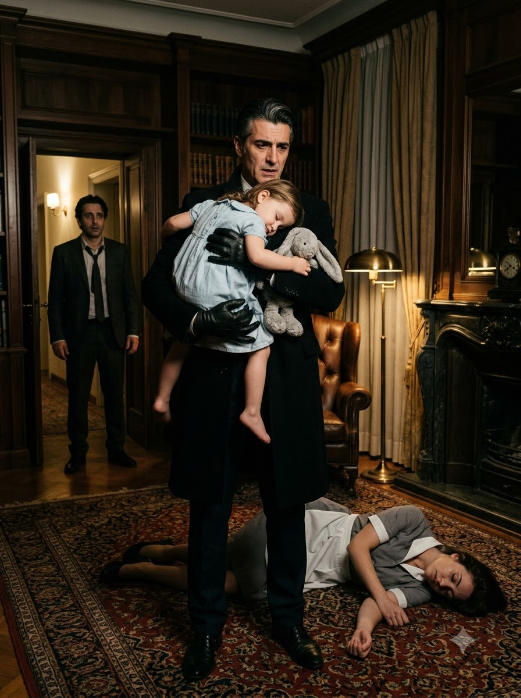
He had nearly reached the staircase when a sound stopped him — small, round, hollow, something rolling across wood, coming from behind the double doors of the second study. He turned back and pushed the door open with his shoulder, his arms too full to use his hands. The lamp burned low. The wine stain still marked the far wall. And there, on the Persian rug, lying on her side as if she had lain down to listen for something in the floor, was a woman in a gray uniform, all color drained from her face. The bottle of citrus cleaner rested against the table leg. She had folded, not fallen. She had kept going until the engine simply stopped turning.
He crossed the rug in three strides and set the child down in the velvet armchair by the fireplace. She did not wake. He arranged one small hand against her cheek, tucked the rabbit beneath her chin, and took out his phone. “Estate. Ten minutes.” The call ended before the doctor could respond. She would come. She always did. The next call was even shorter. “Seal this wing. No one in. No talking.”
Dante arrived within three minutes, without shoes, tie loosened, jacket slung over one arm. He stopped a single pace inside the door. He looked at the child in the velvet chair. He looked at the woman on the rug. He looked at his boss. He asked nothing. Fifteen years had taught him better.
Alessandro lifted the child once more and walked out without a word.
By morning, when thin, hesitant light crept through the heavy curtains of the third-floor guest suite, he still sat in the blue velvet armchair. He had not moved in four hours. Gloves still on. Coat still fastened. The soft rise and fall of the child’s breath beneath the quilt had become the only clock he needed. At seven minutes past seven, she stirred. Her small fingers curled once against the rabbit’s head. Her lashes lifted. Her eyes opened — brown, wide, remarkably steady. She did not cry. She did not flinch. She took in the room, then turned her head and found him.
“Are you the one who carried me?” Her voice was thin and warm, and it passed through him the way thread slips through a needle’s eye.
His throat closed. No sound would come. He nodded once instead.
She smiled — the small, drowsy, half-formed smile of a child still emerging from the last edges of sleep — and stretched one hand across the space between them to rest her fingers on the back of his glove. Her hand was warm and impossibly small.
“Your hand is so big.”
He had used that hand to sign papers that ended men’s lives. He had used it to cradle the small foot of a daughter he could no longer reach. He did not dare move.
Her smile dimmed. Her eyes drifted past him toward the door. “Where did my mommy go?”
“Sleeping,” he said, the word emerging rougher than he intended, pulled up from a place that rarely gave voice to anything. “She is safe.”
She nodded. She trusted him. She had no cause to, and trusted him regardless. She turned her face into the pillow, pulled the rabbit closer beneath her chin, closed her eyes, and drifted back to sleep as effortlessly as she had woken.
Alessandro felt the corner of his mouth rise. He could not recall his mouth remembering how.
The ceiling above her was low and cream-colored, and belonged to no room she remembered entering. A soft weight of cotton lay across her chest, a cool strip of plastic ran along the back of her left hand, a bag of clear fluid hung from a stand beside the bed. Memory returned in fragments: the Persian rug, the metallic smell, the small brush in her right hand. Then a long stretch of darkness. And then — Mia. The name hit her like a slap, and she was upright before her mind had finished forming the thought.
She swung her legs off the mattress. The IV line pulled taut. Tape peeled from her cracked skin, the needle slid free, and a thin red line rose across her knuckles toward her wrist. She did not look at it. “Mia,” she said, her voice thin and unsteady.
Mrs. Riva appeared in the doorway before she could stand. The head housekeeper made no move to stop her. She only raised a hand, palm open, the way one might calm a frightened animal, and spoke in the gentlest tone Hannah had ever heard from her. “She is safe, Hannah. The child is safe. Don Corvino took her upstairs.”
Hannah’s mouth opened. Nothing came out. Upstairs meant the third floor. The master wing. The corridor bound by the rule repeated to her on her first day of work, and every month since. Not a child. Not ever.
Her hands began to tremble. “Come,” Mrs. Riva said. “He is expecting you.”
Hannah followed, gripping the banister with both hands because her knees seemed to have forgotten what stairs were. The bandage the doctor had left hung loosely around her fingers. She climbed one step, then another, then another. The upper corridor was warmer than the floors below. She had never been allowed this far before. She had never wanted to be.
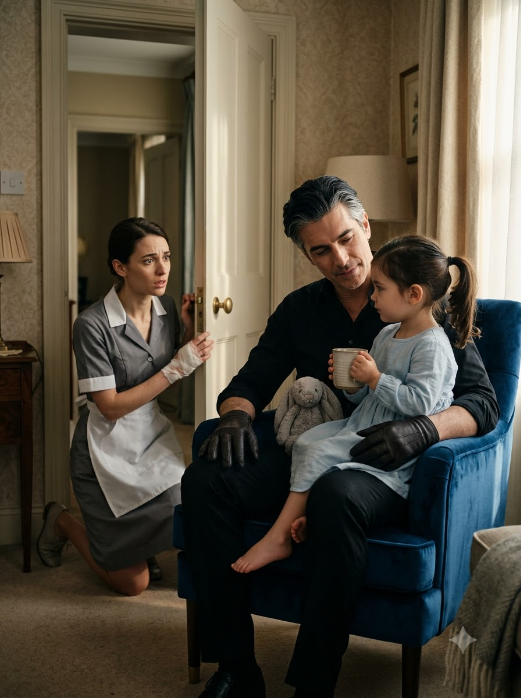
Mrs. Riva stopped before a door at the far end of the hall and stepped to the side. It stood slightly open. Through the narrow gap, Hannah saw the room — and saw her daughter.
Mia sat on Alessandro Corvino’s lap, holding a small ceramic mug of warm milk with both hands. She was informing him, with tremendous seriousness, that her stuffed rabbit had learned to fly the previous winter, but only when no adults were watching. And the man beneath her — the man the entire city feared, whose blood Hannah had scrubbed from the floor only hours earlier — was listening. Genuinely listening.
Hannah’s legs gave out beneath her. She sank to her knees in the doorway. The words spilled out in a rush, tangled and ashamed. She was sorry. So sorry. She would never let it happen again. Please, please, not the job. She could not afford to lose it. Please.
Alessandro did not turn his head. His voice did not rise. He said only, in the same flat, precise tone he used to close meetings, “You will rest a week, full pay. There will be no argument.”
That evening, in the main study, Dante Rizzo set a thin manila folder on the walnut desk and remained standing until Alessandro motioned for him to sit. “Hannah Cole. Twenty-five, clean record, no arrests, no ties to anyone. She has never come within ten blocks of anything connected to us. She is exactly what she seems.”
Alessandro opened the folder. The first page held a photograph — Hannah at nineteen, in a graduation gown, beside an older woman with matching dark hair and a face not yet hollowed by illness. “The mother,” Dante said. “Ruth Cole. Died eight months ago. Liver cancer, stage four by the time it was caught. No insurance. Three months at a private clinic on the east side after the county hospital sent her home once the money ran out. Hannah signed the intake forms as the one responsible.”
The second page was a scanned hospital record. “Mia Cole. Three years old. No father listed on the birth certificate. Hannah has never named him — not to the state, not to anyone at the diner where she works nights, not even to Mrs. Riva when she was hired. Whoever he was, he isn’t part of this.”
Alessandro turned another page. He did not look up. “The debt,” Dante went on. “A hundred thousand on paper. She signed with a man named Leo Marsh on the east side eight months ago to cover what remained of the clinic bill and the funeral. Marsh is small-time, works out of a laundromat on Delancey. Interest runs six percent a month. She pays him four thousand every month, and none of it touches the principal — it only covers the interest. She’s been on that treadmill for eight months.”
Alessandro closed the folder, his gloved hand resting on it a moment longer. “Three jobs,” Dante added, more quietly now. “The estate by day. A diner on Fourth Street from midnight to five. A grocery on weekends, stocking shelves. She sleeps during twenty-minute breaks. Marsh called three times yesterday. His messages keep getting shorter.”
He watched his boss’s expression. Fifteen years at his side had taught him to read the smallest shifts in Alessandro Corvino’s face. What he saw now was something he had not seen in three years, and he was not sure he had ever seen it take quite this shape before. He kept his own expression unreadable.
Alessandro said nothing for a long while. When he finally spoke, his voice was quiet and each word deliberate. “All of it. Full principal. Wire it through the shell in Malta. Warn Marsh in person. If he crosses the river again, if he says her name to another living soul, I will break both his hands myself.”
Dante hesitated, just once. “Sir, this isn’t business. She can’t repay a hundred thousand.”
“I don’t need her to repay it,” Alessandro said. “I need her safe.”
Three days later, Mrs. Riva found Hannah polishing brass fittings in a downstairs hallway and told her, without emotion, that the boss wished to see her in the main study at four o’clock. Hannah washed her face twice in the small staff bathroom before going. She smoothed her uniform over her hips. She rebraided her hair. She looked at her hands and understood no amount of soap would ever make them the hands of a woman who belonged in that room. And she stopped trying to make them so.
The study door stood open a hand’s width when she arrived. She knocked once against the frame regardless. A voice from within said only, “Come.”
She stepped inside. Alessandro sat behind the walnut desk and did not rise. The green banker’s lamp lit the papers before him from the side, casting half his face into shadow. Dante stood at the far window, hands clasped behind his back, not looking at her. She understood he was there to witness, not to take part.
Two documents lay on the desk. The first was a single cream-colored page bearing a notary seal in the lower corner. She could make out the words even upside down: a deed of assignment. The debt she had carried for eight months, its balance printed in black at the bottom — zero. Leo Marsh’s signature sat there, sharp and hurried, as though the pen had been pushed toward him before he’d had time to think.
Beside it lay a second document, an employment contract. The heading, in bold serif letters: Personal Housekeeper of the Master Wing. The salary listed was three times what she currently made. Her hand began shaking before she finished reading the figure.
She remained standing. He had not asked her to sit. She looked up. Her voice, when it came, was unsteady but present: “What do you want from me, sir?”
Alessandro did not blink. “I don’t want anyone in this house owned by a loan shark,” he said, his tone as flat as a ledger entry. “It’s a security risk. Nothing more.”
Her throat tightened, then loosened. “And Mia?”
He was silent long enough that she wondered if he would answer at all. “The child is welcome,” he said at last. “Everywhere. The grounds. The corridors. The garden. She does not enter the master wing unless I am present.”
Hannah looked down at the two papers. She looked at her own cracked, worn hands resting on the desk’s edge. She looked at the man across from her — the storm-gray eyes, the black gloves, the mouth that had not softened once through the entire exchange. She understood exactly what she was doing. She was exchanging one danger for another. She had known enough danger to tell the difference between kinds. This one did not reek of cheap cologne and did not call her at midnight. This one had covered her daughter with a quilt. This one would not touch Mia. That had to be enough. It would have to be.
She picked up the pen. She signed her name on the line. Her signature slanted because her fingers would not steady, and she made no effort to hide it.
Alessandro capped the pen. He slid a small brass key across the desk toward her. “Room seven, second floor. You and the child move in tonight.”
The second-floor corridor smelled of beeswax polish and old cedar. Room seven sat at the end of the east passage, quiet behind a pale door marked with a small brass numeral at eye level. Hannah turned the key in the lock. The mechanism gave the smooth, practiced click of hardware kept in careful repair for a long time. She pushed the door open.
The room was modest in size but held a warmth unlike any room she had rented since her mother’s death. A double bed stood against the far wall, draped in a thick cream quilt. Two shallow armchairs sat beneath the window. A small oak wardrobe, a writing desk. A second door led to a private bathroom. A private bathroom.
Hannah stood in the doorway, the paper carton pressed to her chest, unable for a moment to decide whether this was her room or one she had stumbled into by mistake. Mia felt no such doubt. The child broke free of her mother’s grip and ran. “Mama, mama, look!” She launched herself onto the bed. The quilt caught her. She rolled once, sat up laughing at how soft the fabric felt. Then she stood on the mattress, bouncing, ponytail flying loose, cheeks flushed. She threw the gray rabbit into the air and caught it against her chest. Threw it again. Caught it again. Gasping with the particular delight only children give away freely.
Hannah remained in the doorway a while longer. Then she set the carton on the writing desk. It held everything the two of them owned: three books, two folded photographs, a change of clothes each, a tin of dried lavender that had belonged to her mother. She lowered herself slowly to the floor and sat with her back against the wall.
A soft knock came at the door. Mrs. Riva entered without waiting for an answer, a lacquered tray balanced in her hands: two bowls of pale soup still steaming, toasted bread with butter melting into it, a small cup of warm milk. She set the tray beside the carton and looked at Hannah once, briefly, without pity. “Welcome to the house, Hannah. No one will disturb you tonight.” Then she was gone, the door closed behind her, and Mia was climbing into her lap, chattering about how soft the pillow was.
Later, after the soup, the bath, and the story, once Mia had fallen asleep with the rabbit clutched beneath her chin, Hannah lay on her side of the wide bed staring at the ceiling. She was waiting. Waiting for a knock that would ask something of her. Waiting for footsteps in the hall. None came — only the wind stirring through the arched window at the end of the corridor.
She turned her face into the pillow. The tears came slowly, without sound, tracking warm across her temple before vanishing into the fabric. She was not crying from sadness. She was crying because she could not remember the last time she had fallen asleep without fear.
Within three weeks, Mia Cole had become a small, quiet fixture within the walls of the Corvino estate. She wandered the corridors with the gray rabbit tucked beneath one arm and the gravity of an unpaid inspector. She showed no fear of Dante Rizzo, a man who had once reduced a grown capo to tears with three sentences, and who now stepped aside for her in doorways as though she were royalty. She showed no fear of the garden guards, who had taken to leaving small polished stones along the low wall for her to discover. She showed no fear of old Vito Sarno in his leather chair by the north window, who had lowered his newspaper the first time she toddled past him, and lowered it every time since.
She showed no fear of Alessandro.
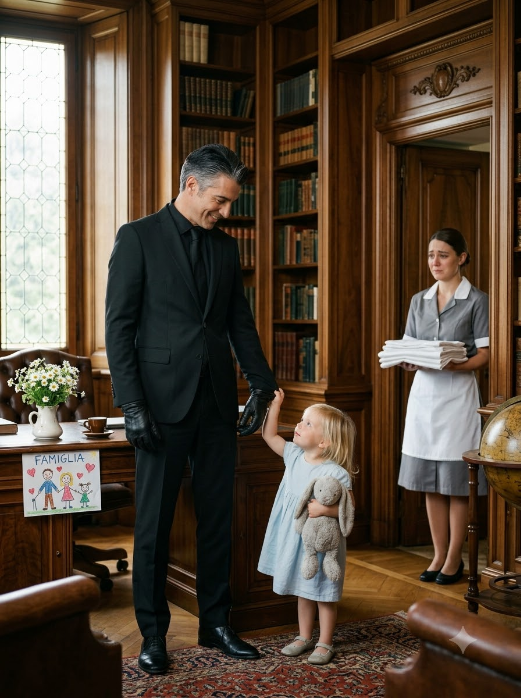
On the first day, she appeared at the study door holding a piece of paper folded twice in her small hand, presenting it like a formal notice. On it were three crayon figures standing along a green line, and a fourth small shape below them she explained, with great solemnity, was the rabbit. She had labeled them in the rounded print of a child just learning her letters: Mama, me, uncle, and rabbit. Alessandro took the paper. He held it for a long moment. Then he crossed the room, opened the desk drawer, retrieved a strip of clear tape, and fixed the drawing to the wall beside the window.
On the fourth day, she arrived with a small plate of cookies she had baked with the head cook, Rosa. One corner of each cookie had burned from sitting too long on the tray. Mia looked troubled by the burnt corners. Alessandro picked up the first cookie and ate it, then the second, then the third. He finished every cookie on the plate. Mia watched with solemn, satisfied eyes.
On the tenth day, she came in from the garden with a handful of small white daisies. She marched past Dante without a word, walked straight to Alessandro’s desk, and arranged the daisies in his half-finished espresso with the focus of a florist. The espresso went untouched that morning. So did the meeting notes he had been reviewing when she walked in.
On the fourteenth day, a call from one of the capos left Alessandro standing at the window, jaw set hard. He had been staring at the cypress trees for some time when a small hand tugged at his black sleeve. He looked down. Mia had been drawing on the rug behind him and had paused to study him, her head tilted to one side.
“You smile prettier,” she said.
He lowered his gaze slowly to meet hers. Then, without meaning to, he smiled. A real smile. The second time in three years.
Hannah stood in the hallway outside the open door, a folded stack of linens in her arms. She did not go in. She did not interrupt. For a long moment, she could hardly believe what she was seeing. Dante passed the doorway carrying a report. He glanced in, glanced away, said nothing. That evening, in the black sedan on the drive down the private road, he spoke one sentence to the driver without turning from the window: “The boss has come back to himself.”
A month passed. Dante noticed the small changes first, because Dante noticed everything and was paid to say little about it. The boss now sat down to dinner at seven instead of standing over the sink at midnight with a glass of scotch in one hand and a folder in the other. The bottle of Islay whiskey on the sideboard, once refilled every ten days, had lasted the entire month. The shadows beneath Alessandro’s eyes had begun, almost imperceptibly, to fade. And on the night of the twenty-eighth day, for the first time in three years, Alessandro Corvino slept five hours straight. He woke at five in the morning, disoriented, not immediately understanding what had happened to him. Then he understood, and lay still on his back in the dark, listening to his own steady breathing as though it belonged to someone else.
That noon, Vito Sarno came for lunch. The old counselor ate slowly, said little, and never once looked directly at Alessandro across the table. He never had. He observed the world from the corners of his eyes and had done so since the year Alessandro’s father first brought him into the family. After coffee, Vito rose and walked out onto the south terrace, where Dante stood smoking a thin cigarette against the balustrade. He did not sit. He simply stood beside Dante, looking out over the winter garden.
“He has come back,” Vito said.
Dante waited.
“Be careful,” Vito said. “The enemies of this house will notice it too. Men like Falcone can tell the difference between a mourner and a man.” He went back inside without turning his head.
Dante remained at the balustrade a minute longer after his cigarette had burned out. Something cold moved along the back of his neck and did not fade for the rest of the afternoon.
Later that day, alone in the main study, Alessandro unlocked the left drawer of his desk for the first time since the funerals. Inside, resting on dark velvet, sat a small walnut music box, its lid inlaid with a single mother-of-pearl bird in flight. Serena had chosen it for Ava’s second birthday. Ava had opened it every night before bed to hear the same eight bars of an old Italian lullaby. He did not open it now. He lifted it out with both hands and set it on the desk before him. He looked at it for a very long time.
That night, returning to the study for a folder he had left behind, Alessandro stopped in the doorway. Mia had fallen asleep on the long velvet sofa. She had come up to wait for her mother’s shift to end and lost the battle against her own eyelids. The gray rabbit was tucked beneath her arm. One small hand rested against her cheek.
For the first time, he did not see Ava in her. He saw only Mia. The dark ponytail, the small warm freckle at the corner of her mouth, the particular way her feet crossed at the ankle. A different child. A living child. The realization moved through him like a slow wave, and for a moment he could not breathe. When breath returned, it came back lighter than he remembered breath being allowed to feel.
Across the city, at the southern edge of the harbor, stood a seafood restaurant that had belonged to the same family for four generations. Its lower dining room was crowded and loud, open to any tourist who could cover the bill. Its upper floor appeared on no menu. A single private table sat behind heavy red velvet curtains at the top of a narrow staircase, and no one climbed those stairs uninvited.
That night, the curtains were drawn. Two men sat at the table. Carlo Falcone was forty-seven, dressed in a charcoal suit tailored to the millimeter, a silver tie fixed with a small pearl pin his mother had given him the year he took over the family. His hair had gone entirely silver by thirty-eight, and he had never dyed it. His eyes were pale, cold blue, the color of harbor water in January. He ate slowly, drank slowly, and spoke as though every sentence had been reviewed in his mind once before being released.
Across from him sat his younger brother, Nico, thirty-nine, a scar along the left side of his jaw given to him at twenty-two by a man who had lived exactly eleven minutes afterward. Where Carlo weighed his words, Nico cut straight through. He did not eat slowly. He did not drink slowly.
The waiter had been sent away. The plates had been cleared. Carlo set down his fork and looked at his brother across the table.
“The mourner has stopped mourning,” he said.
Nico’s scarred jaw tightened. “So the reports are true. The child. The housekeeper.”
“I have three men who’ve watched the gate for a month,” Carlo said. “He carries her in his arms now. He smiles at her. He hasn’t smiled in three years.” He paused, and the pause was the most dangerous thing in the room. “A man who mourns is predictable. A man who has something to live for is not. We’ve pressed the line at the port for eleven years and he’s given us nothing. That’s about to change.”
Nico leaned forward, the scar going white at its edges. “Then we press harder. Now. Before he trusts his luck.”
Carlo studied the dark harbor beyond the window. “We press,” he said, “but not the man himself. We press the thing he has begun to love.”
