

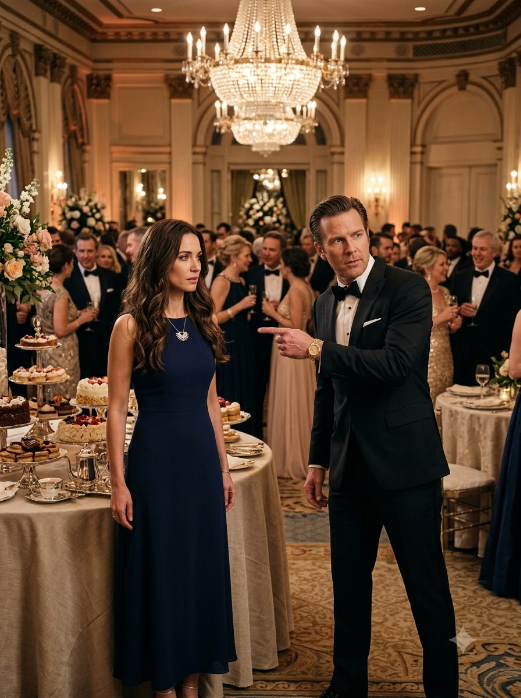
The night Julian Whitmore told his wife to keep out of sight in the dimmest corner of the ballroom, Elena Vance had on a plain navy-blue dress.
It carried no designer tag, no costly fabric, and a small mended seam near the hem that Elena had stitched herself that very afternoon at the kitchen table. The whole outfit likely cost less than the shoes worn by some of the women at the gala.
Still, it was clean, neatly pressed, and it meant something to her.
It brought back memories of the woman who had raised her.
Mrs. Rosa Bennett.
A warmhearted widow from South Dallas who sold tamales, sweet bread, and homemade hot chocolate from a small food cart—and who had taken in an abandoned little girl nobody else wanted, thirty years before.
Outside the historic Arlington Manor Hotel in downtown Dallas, Julian handed his keys to the valet along with his imported black Aston Martin and gave Elena a once-over laced with annoyance.
That familiar look was back—the one he always wore whenever she reminded him of her modest upbringing.
“Please, Elena,” he muttered, fidgeting with his gold Rolex. “Tonight matters enormously for my future. The board’s here. Investors too. Senators, CEOs… and above all, my boss.”
“I know,” she said gently. “That’s why I came. To be there for you.”
Julian let out a humorless laugh.
“You don’t get it. That dress…” He dropped his voice. “You look like part of the catering crew.”
The words wounded her more than she cared to admit.
It wasn’t the first time he’d made her feel insignificant.
When they’d first met, Elena had been filing paperwork at a nonprofit health clinic in Oak Cliff. Julian had come by for a public fundraising event there.
Back then, he’d been warm and attentive. He’d told her he was worn out by shallow, wealthy women and admired how real and unpretentious she was.
She’d taken him at his word.
Once they married, though, his remarks began to shift.
“Say less at dinner parties.”
“Don’t bring up growing up without much.”
“That accent puts people off.”
And on that particular night, beneath the ballroom’s chandeliers, Julian pushed it further still.
“Stay by the kitchen or the restrooms,” he whispered. “Don’t tell anyone you’re my wife tonight. If someone asks, say you’re working the event.”
Elena stared back at him.
Without thinking, her fingers wrapped around the old silver necklace resting at her throat.
It was shaped like half a sun, crafted by hand decades earlier.
Rosa had given it to her not long before she passed.
“You were pulled from a terrible fire thirty years ago,” Rosa had told her, weak from her hospital bed. “There was a burn scar on your collarbone… and this necklace was clutched in your tiny fist.”
Those had always been the only clues Elena had to her origins.
Once inside the ballroom, Julian turned into an entirely different man.
He beamed.
He shook hands.
He laughed alongside powerful executives and wealthy investors.
Elena did as she’d been told and lingered near the dessert table, pretending not to notice that her husband avoided even glancing her way.
Then, all at once, the room fell quiet.
The owner of Whitmore Corporation had arrived.
Richard Kensington.
The seventy-two-year-old billionaire telecommunications magnate whose nod of approval could make a career—or end one.
Richard walked in beside his older sister, Eleanor Kensington, with security trailing a few steps behind.
Julian practically sprinted across the room.
“Mr. Kensington,” he said, out of breath. “This is such an incredible honor.”
Richard shook his hand without any real warmth.
“I heard you brought your wife tonight.”
Julian tensed.
“Yes, sir. She’s… somewhere around here. She’s shy. Not really used to this crowd.”
Reluctantly, he waved Elena over.
She walked forward with her shoulders squared, despite the humiliation churning inside her.
“Elena, this is Mr. Kensington,” Julian said hurriedly. “Elena’s… helping out with the event.”
Elena offered her hand politely.
Richard didn’t take it.
His gaze had fixed on the necklace at her throat.
The blood drained from his face.
Beside him, Eleanor gasped, hand flying to her mouth.
Julian gave a nervous chuckle.
“Oh, don’t mind that old thing,” he said, tugging at Elena’s arm. “I keep telling her not to wear flea-market junk to formal events. Go back to the corner, Elena. You’re embarrassing me.”
Richard’s voice suddenly boomed through the ballroom.
“Take your hands off her. Now.”
The room went silent instantly.
Julian let go of Elena.
“Sir, I—”
Richard paid him no attention.
He moved slowly toward Elena, his eyes welling with tears.
“That necklace…” he whispered. “Where did you get it?”
Elena swallowed hard.
“It belonged to the woman who raised me. She found me after a car fire thirty years ago near Fort Worth. I had a fever, a burn scar, and this necklace.”
Eleanor let out a broken sound.
With trembling hands, she drew out a gold chain hidden beneath her blouse.
Hanging from it was the other half of the same silver sun.
The two halves fit together perfectly.
Gasps rippled through the ballroom.
Julian forced out another nervous laugh.
“Sir, with all due respect, you could find a necklace like that anywhere—”
“Shut up,” Eleanor snapped.
She carefully flipped Elena’s necklace over.
“There’s an inscription on the back.”
Richard studied it, his hands shaking.
The engraving had worn with age, but the words could still be made out.
E.K. — My light always returns.
Richard shut his eyes.
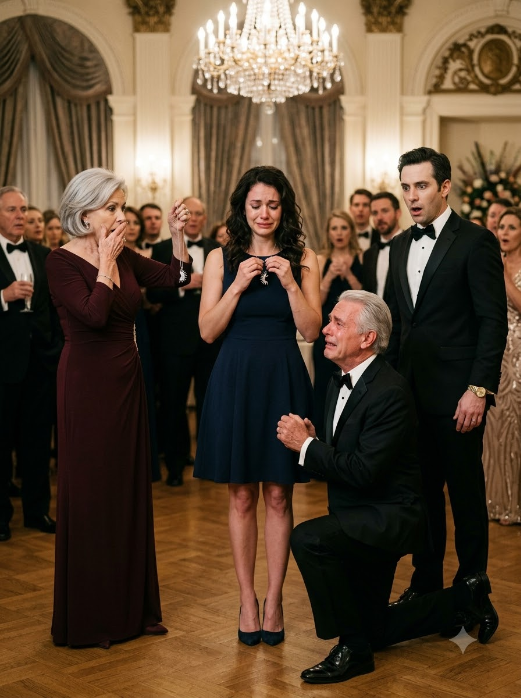
Then, in front of the entire room, the most powerful man there sank to his knees before the very woman Julian had told to hide.
“Elizabeth,” he choked out. “My daughter… my little Elizabeth.”
Shocked whispers swept through the room.
Elena felt as if the floor had given way beneath her.
For thirty years she had carried an unexplained emptiness inside her that no one could account for.
Now the answer knelt in front of her.
Eleanor was weeping openly.
“The accident…” she said. “We were told no one survived. We buried an empty coffin and grieved for you for thirty years.”
Richard looked at Elena as though afraid she might vanish all over again.
“I spent ten years looking for you,” he whispered. “Private investigators. Police. Hospitals. I never gave up hope.”
Julian’s expression shifted almost instantly.
The embarrassment vanished.
Something far uglier took its place.
Greed.
“Baby!” he exclaimed, reaching toward Elena. “I always sensed there was something special about you! Mr. Kensington, I swear I’ve treated her like royalty this whole time.”
Elena stepped back.
“Don’t touch me.”
Julian blinked.
“Elena, sweetheart, everyone’s emotional right now—”
“No,” she said. “For the first time in five years, I’m finally seeing things clearly.”
Every eye in the room was on her.
“An hour ago you told me to hide near the restrooms because you were ashamed of me,” she went on. “For years you mocked the woman who fed me when I had nothing. You treated my past like something shameful.”
Julian’s face turned pale.
“But now that I’m your boss’s daughter, suddenly I matter?”
Nearby investors traded uneasy glances.
“Elena, please, not in front of everyone—”
“You love status,” she said. “Not me.”
Richard rose slowly to his feet.
When he faced Julian, his expression had turned to stone.
“You’re fired, effective immediately,” he said quietly. “And if you have any sense, you’ll get out of my sight before I decide to ruin the rest of your life as well.”
Julian looked ready to crumble.
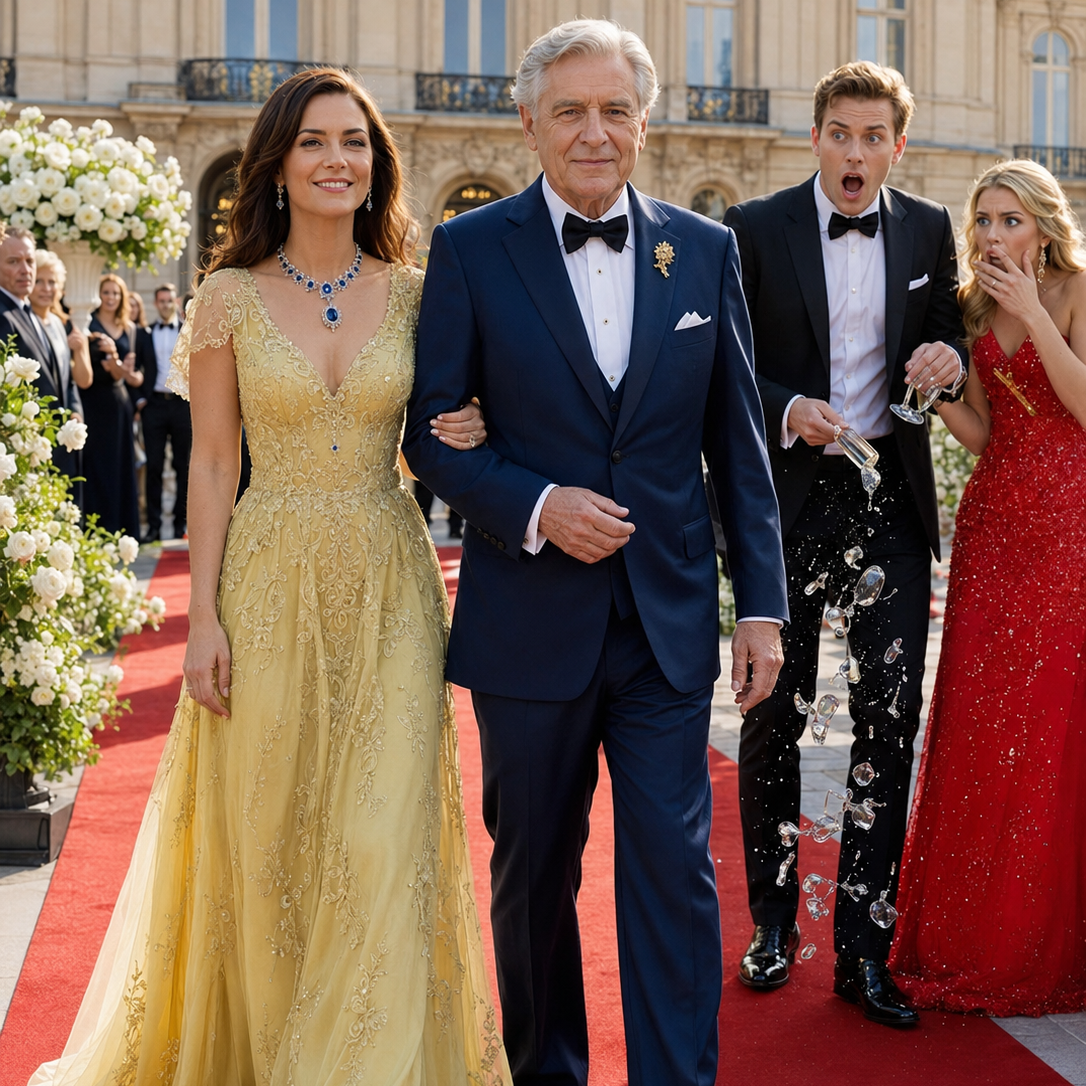
That night, Elena walked out of the hotel through the front entrance, beside her biological father.
Not through the kitchen.
Not tucked away in a corner.
Not ashamed.
And no longer alone.
Months later, DNA testing confirmed what the necklace had already hinted at.
Investigators also uncovered something far darker.
The crash thirty years earlier hadn’t been an accident.
A business rival had tampered with the vehicle, and in the chaos that followed, Elena had entered the public hospital system without anyone linking her to the Kensington family.
Rosa Bennett had saved her life.
Elena’s divorce from Julian moved quickly.
She didn’t seek revenge.
She didn’t need to.
Julian ruined his own reputation all on his own.
Few major companies in Texas wanted anything to do with the executive who had publicly humiliated the long-lost daughter of the Kensington family simply because he’d assumed she looked poor.
Six months later, Elena stood beside Richard at Rosa Bennett’s grave in South Dallas.
Richard laid white roses gently against the headstone.
“Thank you,” he murmured. “For loving my daughter when I couldn’t.”
Elena wore the same simple navy-blue dress she’d had on the night of the gala.
Around her neck, though, the silver sun was whole at last.
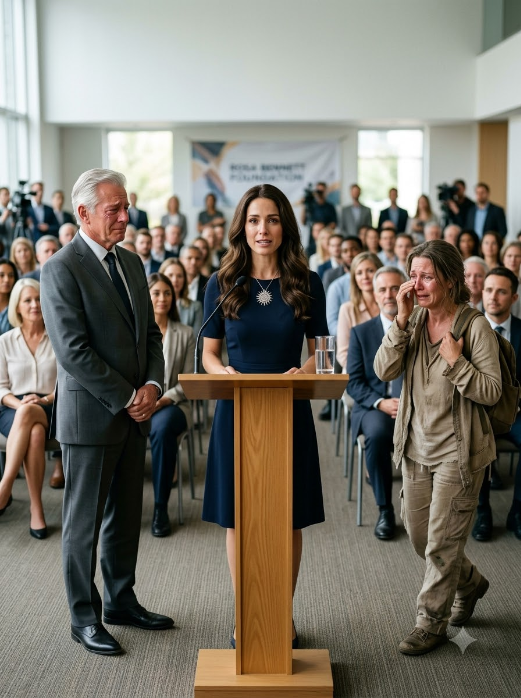
A few weeks after that, Elena founded the Rosa Bennett Foundation, an organization devoted to helping women dealing with financial and emotional abuse.
At the opening ceremony, hundreds of guests and reporters gathered to hear her speak.
Elena wore no jewels.
Only the restored silver necklace.
When she stepped up to the microphone, the room went quiet.
“For years,” she said, “someone tried to convince me that my worth was tied to money, status, and where I came from.”
Her voice held steady.
“He told me to hide because my clothes and my roots embarrassed him. But I came to understand something important: dignity isn’t passed down through a family name. It can’t be purchased with wealth. And it can’t be erased by humiliation.”
Throughout the audience, people wiped away tears.
Elena smiled.
“Sometimes life lets people tear you down in public… only so the world can witness just how powerfully you rise back up.”
As she left the stage, a woman in worn clothing approached her, crying.
“Because of your story,” the woman whispered, “I finally found the courage to leave my husband.”
Elena pulled her into an embrace.
Because her real story had never truly begun in the shadows of that ballroom.
It began the moment she stopped believing she needed anyone’s permission to stand in the light.
