


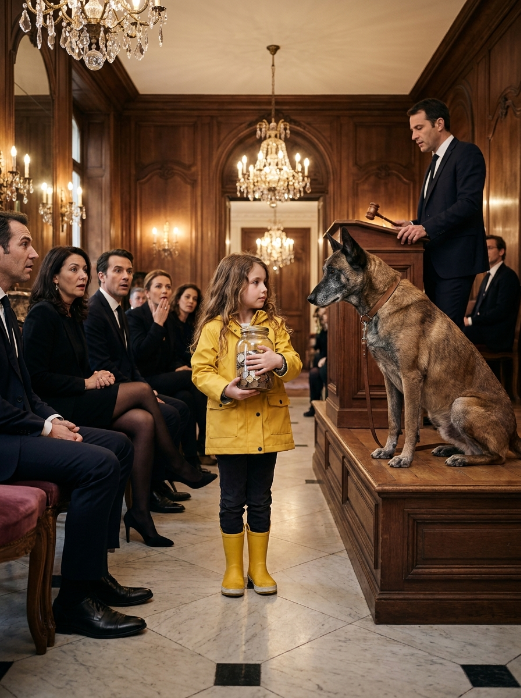
Léa Laurent was never the kind of child to wander into forbidden places by chance. At eight years old — small, quiet, but unshakably determined — she pushed open the heavy oak doors of the Hôtel des Ventes des Domaines in Lyon. Her yellow boots, drenched by the icy October rain, squeaked faintly against the marble floor, though she barely noticed. Held tight against her chest was a large glass jar packed with coins. Every step carried the weight of purpose, a mission more important than anything else, her tiny heart pounding beneath her coat. She hadn’t come out of curiosity — she had come to save Tango, the Belgian Malinois, once an elite dog of the Anti-Crime Brigade and the devoted partner of her mother, Captain Élise Laurent, who had died tragically seven months before.
The auction room hummed with hushed conversation, thick with the scent of expensive cologne. Men in dark suits moved between velvet chairs, numbered paddles in hand, their eyes fixed coldly on the platform where retired dogs were paraded like objects for sale. Bids were weighed by pedigree, obedience scores, bite force. To these private security contractors, the animals were simply assets. To Léa, Tango was the last living thread tying her to her family.
She slipped past the security gate, ignoring the startled looks thrown her way, clutching her jar even tighter. Seven months of sacrifice were poured into it: coins gathered from supermarket carts, pennies pulled from her pockets, birthday money set aside, even her cherished comic book collection sold off in secret. All of it, saved piece by piece, for this single moment.
The auctioneer’s voice cracked over the loudspeakers: “Lot number 12, Tango. Nine years old. Belgian Malinois. Retired assault dog. An exceptional service record alongside the late Captain Élise Laurent.”
A ripple passed through the room at the sound of her mother’s name. Élise Laurent had been a local legend — fearless, principled, respected — until a bloody shootout took her life. What the papers never printed was that Tango had lived through it too, and so had Léa. Up on the platform, Tango sat with quiet dignity, gray creeping into his muzzle. Suddenly his ears lifted. His eyes found Léa’s across the room. His tail thumped softly against the floor. He knew her.
Léa steadied herself with a breath, walked down the aisle, the coins clinking with each step. Reaching the stage, she spoke, her voice shaking but clear: “I want to buy Tango. I have 82 euros and 47 cents. It’s all I have left.”
Silence swallowed the room. The auctioneer cleared his throat, clearly uneasy. “The starting price is 500 euros, my dear…”
Then the doors flew open. Aunt Béatrice, Léa’s legal guardian, cold and controlling, stormed inside. Fury twisted her face as she seized Léa’s arm. “You insolent little brat!” she hissed. “That dog is a coward! He let my sister die to save his own skin!” Spinning toward a businessman seated in the front row, she barked, “Mr. Dubois, buy him. Lock him up in your warehouses — I never want to lay eyes on that monster again!” Dubois smirked and raised his paddle: “600 euros.”
What happened next was almost impossible to believe…
PART 2
Léa cried out and thrashed against her aunt’s grip, but it held firm as iron. The glass jar slipped from her fingers and shattered against the marble with a sharp, final crash. Her coins — 82 euros and 47 cents, collected with love and tears — spilled across the floor beneath the polished shoes of the businessmen. Léa’s eyes filled with despair as Tango barked wildly from the platform, straining against his leash to reach her.
“600 euros, going once…” the auctioneer murmured, eyes downcast in shame.
“Hold on just a moment!” A deep voice thundered from the back of the room. A man in his sixties rose slowly, his posture rigid, a scar cutting across his left cheek. Commander Lefèvre, once Élise Laurent’s superior and a widely respected figure, walked the aisle without pause, unbothered by the murmurs around him. He stopped before Dubois and pinned him with a cold, contemptuous stare. “Dubois, if you buy this dog, every one of your security firms will be audited weekly for the rest of your life. Lower the paddle.” Dubois went pale and slowly obeyed.
Lefèvre turned to Béatrice. “As for you, Madam — your hatred has blinded you. Élise was a hero, and so was that dog.” He pulled several bills from his wallet and set them on the auctioneer’s desk, then crouched to retrieve a stray 50-cent coin from the floor, placing it on top. “In the name of police brotherhood, we’re exercising the family’s right of pre-emption. Sold to Léa Laurent. For 82 euros and 47 cents.”
The gavel came down. Applause broke out across the room. Béatrice stood seething, humiliated, left with no choice but to bring Léa and Tango back to her large, cold apartment in Lyon’s 6th arrondissement. But their troubles were far from finished. The moment the door shut behind them, Béatrice, bitter and nearly bankrupt, jabbed a finger toward the concrete courtyard outside.
“That mutt stays out there!” she snapped. “He doesn’t set foot inside. One slip-up, one bark, and I’m calling animal control to have him put down. Understood?”
For three long weeks, life turned into quiet suffering. Tango grew thinner in the cold courtyard, his old glory dimming, his ribs visible through a dull, patchy coat. He stopped barking, stopped playing — he only waited by the glass door each night, hoping Léa would come sit beside him on the cold concrete, sharing their sorrow in silence. Béatrice never let go of her belief that Tango had abandoned Élise during the shooting, that he’d run instead of taking the bullet meant for her.
Then Friday night arrived, and everything fell apart. Béatrice was hosting a crucial dinner with investors from Paris — her final shot at saving her company. To set the mood, she lit an expensive, handcrafted candle near the glass door to the courtyard, letting the scent of vanilla and orange blossom spread through the room.
The moment that scent drifted through the vents and reached the courtyard, Tango went rigid. His ears shot up. A low, guttural growl tore from his throat — not fury, not aggression, but a sound of pure anguish. It was Élise’s perfume, the one she wore every single day. Memories crashed over him like fire. Driven by instinct and grief alone, Tango threw his full weight — thirty-five kilos of coiled muscle — against the glass door. The tempered glass shattered with a thunderous crack.
Guests screamed, chairs toppled, champagne glasses shattered as everyone scrambled for the exit. White with rage and panic, Béatrice snatched up her phone. “Hello, animal control? Get here now! My dog’s lost his mind! He’s tearing the place apart! He’s dangerous!”
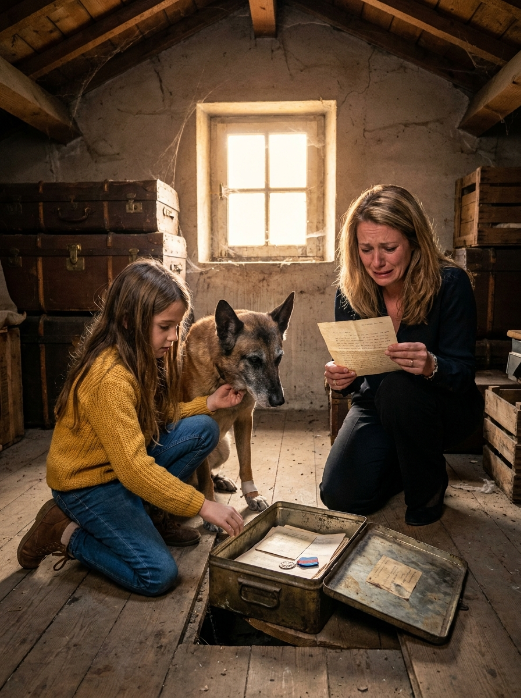
But Tango paid no attention to any of it. He ignored the blood streaming from his paws, sliced open by the broken glass. Led only by memory and the lingering trace of Élise’s scent, he tore across the living room, up the wooden staircase, and straight toward the attic. Léa, frightened but instinctively trusting the dog, chased after him.
In the attic, Tango was clawing frantically at a floorboard hidden beneath an old, dust-covered trunk. His nails tore at the wood with a desperate urgency, as though he somehow understood what lay hidden beneath it. Léa dropped to her knees beside him, using her small hands to help pry up the loose plank. Underneath sat a locked metal box. A strip of tape on the lid bore her mother’s unmistakable handwriting: “For Béatrice and Léa. The truth.”
Béatrice burst into the attic, phone still pressed to her ear. “Yes, hurry! He’s up in the attic—” Her voice cut off mid-sentence. Her eyes landed on the box. All color drained from her face. Without thinking, she let the phone fall to the floor and moved toward the box, hands shaking. Grabbing an old screwdriver from a nearby shelf, she pried the rusted lock open.
Inside were no ordinary mementos. There lay her sister’s Police Medal of Honor, sealed medical records, and a long letter written by hand. Béatrice crumpled to her knees on the dusty floorboards, unfolding the letter, her voice cracking as she read it aloud through rising sobs.
“My darling Béatrice, my sweet little Léa,
If you are reading this, it means my plan worked and I am no longer with you. I lied to both of you. Eight months ago, doctors diagnosed me with terminal pancreatic cancer. I had only weeks left, in excruciating pain. Béatrice, I knew your business was failing. I knew the banks would seize everything, that you’d never raise Léa properly, that you’d end up on the streets.”
Béatrice’s hand shot to her mouth, her eyes wide with horror. She kept reading, her voice thick with tears:
“So I made the only decision I could to save you. During the raid at the warehouse, I deliberately took the most exposed position. The suspects were heavily armed—but above all… Tango didn’t run. He’s not a coward. When the shooting began, he wanted to shield himself, as trained. But I gave him the ultimate command: do not intervene. Move away and protect the bystanders. I needed to die in the line of duty, not in a hospital bed. My death in action would trigger a life insurance payout of €500,000 and a full state pension for Léa. That money is for you. I sacrificed my life to secure your future.”
The letter fell from Béatrice’s fingers. A heavy silence settled over the attic, broken only by Tango’s panting.
“Béatrice, I beg you,” read the final line, Léa’s small voice carrying the words aloud, “do not blame this magnificent dog. He carried out the hardest command of his life: to let his master die to fulfill her last wish. Love him as I have loved you. He is all that remains of my courage.”
The truth hit Béatrice like a bolt of lightning. The proud, hardened businesswoman crumpled to the floor, overtaken by sobs of guilt, grief, and love all at once. She had starved, isolated, and tormented the one creature who carried the secret of Élise’s final act of sacrifice.
Tango, despite his glass-cut paws and weeks of neglect, moved toward her slowly. No anger, no resentment — only trust and devotion. He pressed his warm head against her cheek, letting out a long, low sound of relief. Béatrice threw her arms around him, burying her face in his fur, whispering endless apologies, as Léa wrapped her small arms around them both.
By the next morning, everything had changed. The courtyard sat empty and quiet. Tango now slept on a thick rug at the foot of Léa’s bed, his paws carefully bandaged. Béatrice’s business survived, thanks to Élise’s insurance, but her priorities had shifted completely. The following year, she sold her shares and devoted herself fully to raising her niece.
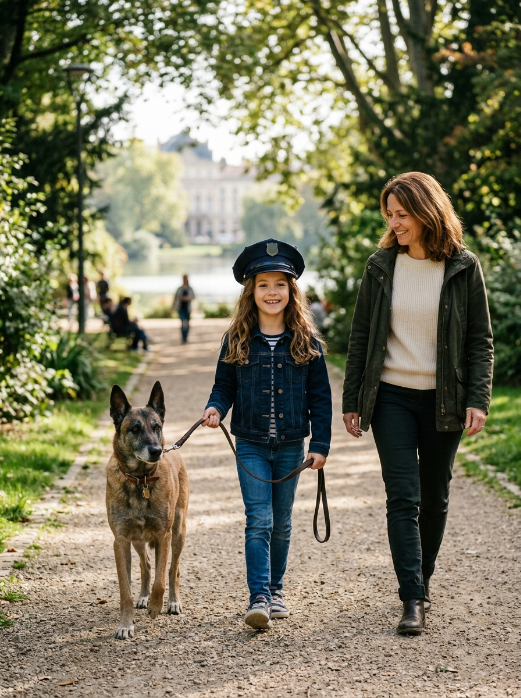
Now, in the parks of Lyon, you might catch sight of a smiling little girl in a slightly oversized police cap, walking beside a stately Belgian Malinois with a graying coat and warm, loyal eyes. Every Wednesday, Léa and Tango visit local schools, teaching children about courage, loyalty, and the quiet weight of sacrifice. And whenever a child asks whether her dog is a hero, Tango’s ears perk up — and Léa answers with a bright smile, the very same one Captain Élise Laurent used to wear.
Loyalty, she has come to understand, isn’t measured by deeds others witness — but by the unbearable weight of a secret carried out of love.
