

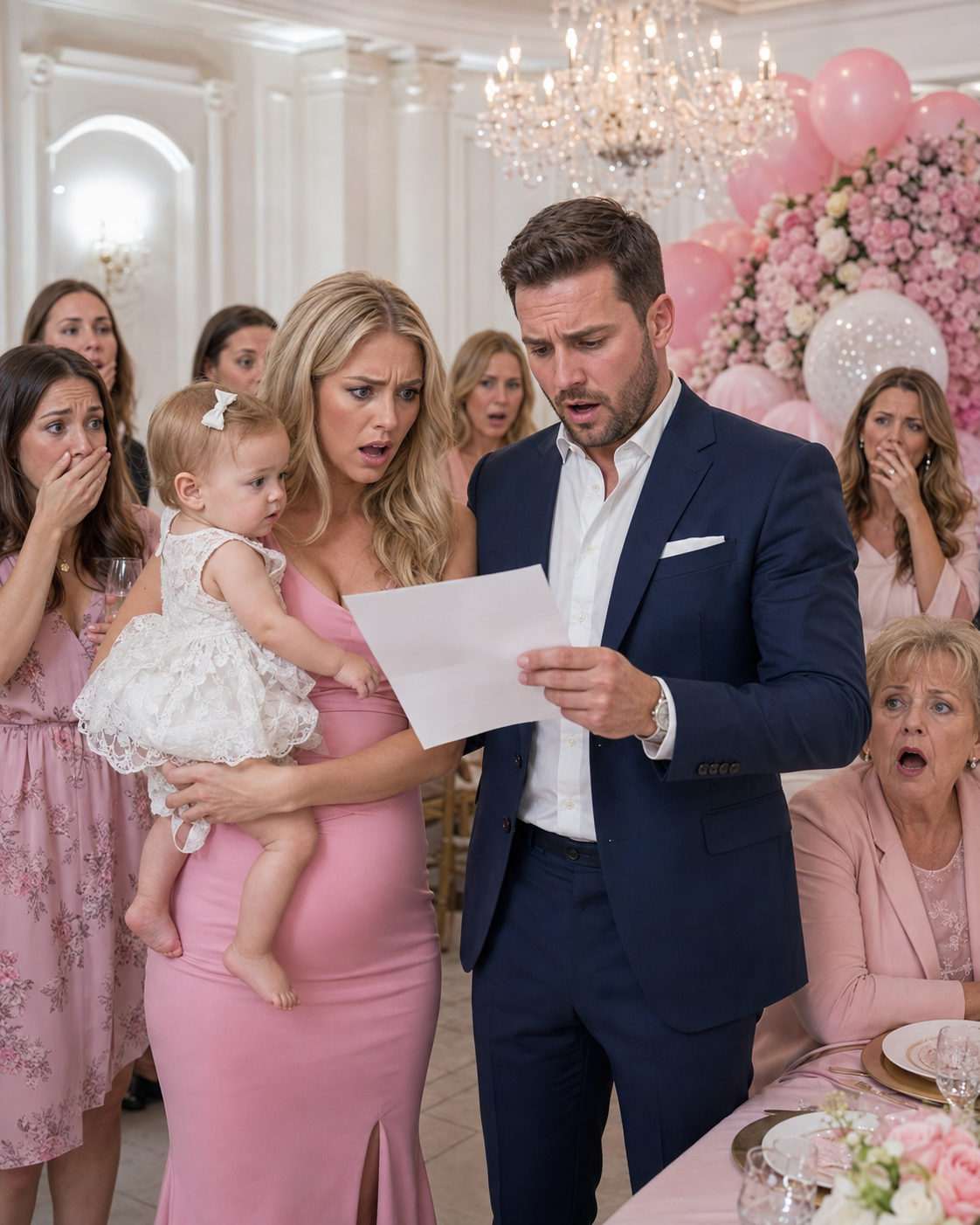
On my daughter’s first birthday, my mother-in-law lifted her glass in front of the entire family and demanded to know who Lucía’s real father was, since the baby had blue eyes. Everyone assumed I would break down.
Instead, I pulled two envelopes out of my bag.
My daughter, Lucía, had just learned how to clap. Perched on my hip in a white ruffled dress, she patted my blouse with her tiny hands while her blue eyes traced the lights above as if they were stars. Cookie crumbs covered her mouth, since she’d already figured out that parties made grown-ups careless and babies opportunistic.
The room was filled with white roses, ivory tablecloths, gold-rimmed glasses, and relatives murmuring as though even their voices needed to sound costly.
It was a gorgeous party.
Too gorgeous.
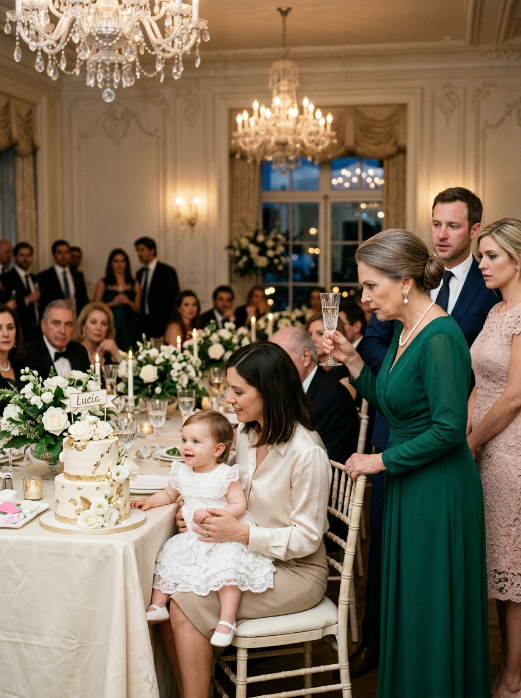
My mother-in-law, Teresa Aranda, had insisted on holding it at a private club in San Ángel. I’d wanted something simple—lunch at my parents’ place, vanilla cake, balloons, Lucía smeared in frosting. But my husband Rodrigo had said:
“My mom is excited. Let her do it. It’s her first granddaughter.”
Her first granddaughter.
As if Lucía belonged to her as well.
At 7:40, Teresa clinked her glass.
Silence fell over the room.
She rose in an emerald dress with pearls circling her throat, wearing the smile of a woman accustomed to being obeyed.
“I’d like to toast Lucía,” she announced. “This precious little girl turning one today.”
Lucía clapped again, delighted by the attention.
Then Teresa’s gaze landed on her.
Not the way a grandmother looks at a child.
The way a judge looks at evidence.
“Although I do need to say something,” she went on, her voice sugary. “The Aranda family has had five generations of brown eyes. My husband, my sons, my parents, my grandparents—every one of them. And now this child shows up with such striking blue eyes.”
The mood in the room shifted.
Lucía stopped clapping and buried her face in my neck. Babies may not grasp words like betrayal or bloodline, but they sense the moment a room stops feeling safe.
Rodrigo stood beside his mother, one hand resting on the back of Paulina Mier’s chair.
Paulina.
The woman Teresa had always wished for him instead.
Teresa turned to me with rehearsed concern.
“Daniela, no one is upset. We’re family. We just think it would be best to know who Lucía’s real father is.”
Someone gave a nervous laugh.
My daughter started crying.
Teresa expected me to fall apart. She expected me to plead with Rodrigo to stand up for me. She expected a scene she could later point to as proof I was unstable.
But I kissed the top of Lucía’s head.
Took a breath.
And smiled.
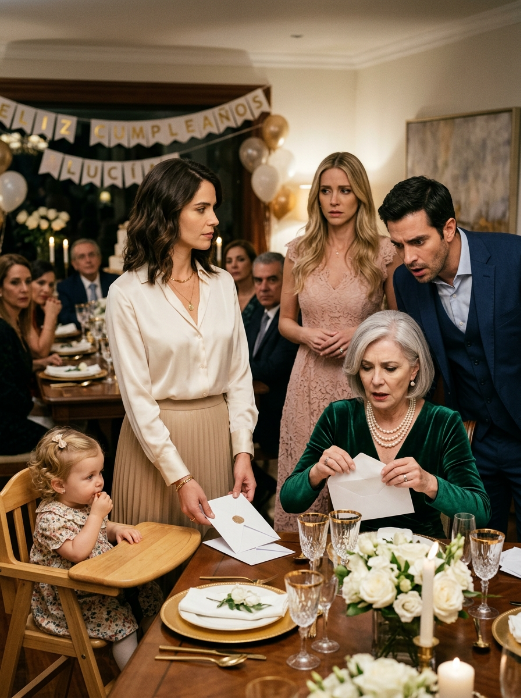
Because tucked in my bag, underneath wipes, cookies, and a pacifier, was an envelope bearing a lab’s official seal.
And beneath that sat a second envelope.
Teresa had no idea it existed.
That was her mistake.
My name is Daniela Salgado. I was raised in a cramped apartment in Narvarte, by parents who worked hard and lived with integrity. We had no club memberships, no family portraits, no impressive last name. What we had was stability, bakery birthday cakes, cousins crowding the hallway, and chairs borrowed from the neighbors.
I never felt ashamed of any of it.
The Arandas tried to teach me shame later on.
The first time I met Teresa, she looked at my shoes before she looked at my face. Over dinner, she asked about my parents’ jobs before asking anything about me. When I told her, she offered a careful, pitying smile.
“Hard workers.”
In her vocabulary, that meant poor, but tolerable.
Rodrigo always tried to smooth over her jabs.
“She doesn’t mean anything by it.”
Years later I realized that’s what men say when they’ve grown up too close to cruelty to recognize it anymore.
The woman Teresa had always pictured for Rodrigo was Paulina. She managed to bring her up at nearly every meal.
“Paulina just wrapped up a project in Mérida.”
“Paulina comes from such a solid family.”
“Paulina has such admirable discipline.”
When I was eight months pregnant and swollen, Teresa remarked:
“Paulina does Pilates every single day. Such impressive body awareness.”
Rodrigo told me afterward:
“Don’t take it personally. My mom just has high standards.”
Those weren’t standards.
They were contempt wearing perfume.
When Lucía arrived, I thought things might finally shift. Rodrigo cried the moment the nurse set her in his arms.
“She’s perfect,” he murmured.
For one hour, I believed him.
Then Teresa reached the hospital. She kissed Rodrigo first, then bent over the crib.
“She has blue eyes,” she said.
“All newborns have lighter eyes at first,” Rodrigo answered.
“Yes,” Teresa said. “But these are very blue.”
That’s when the chill set in.
Comments turned into silences. Rodrigo started coming home late. Tuesdays. Thursdays. Then whichever day he pleased. He began looking at me the way a person looks at a risk they’re weighing.
The first proof came when his phone lit up while he was upstairs.
Teresa had texted:
“Think hard about this, Rodrigo. Five generations of brown eyes. You can’t just look past it.”
I opened the thread.
For weeks, she’d been planting doubt in him.
“Where did those eyes come from?”
“Don’t let love blind you.”
“Paulina would never put you in a position like this.”
“A test could be done quietly, no one has to know.”
Rodrigo never told her to stop.
He’d written back:
“I’ve been thinking about it.”
“Don’t push yet.”
“Let me see.”
Let me see.
My husband had questioned our daughter’s parentage because his mother decided a recessive gene outweighed five years of love.
Three weeks after that, I discovered an email thread on Rodrigo’s laptop labeled “Birthday structure.”
Between Teresa and Paulina.
The scheme was laid out plainly.
Step one: plant doubt about paternity. Step two: position Paulina next to Rodrigo where everyone could see. Step three: turn Lucía’s birthday into the stage for the accusation. Step four: once I’d been publicly humiliated, Rodrigo would file for divorce.
Teresa had already hired a lawyer.
I sat on the kitchen floor for eleven minutes.
Then I stood up.
Made coffee.
Fed Lucía.
And started building my exit.
The first call I made wasn’t to my mother.
It was to a lawyer.
Patricia Robles listened, then told me:
“Daniela, you’re going to need proof, not just feelings. What you’re feeling is valid, but paperwork is what actually holds up in court.”
So I gathered proof.
Messages. Emails. Photos. Schedules. Bank transfers.
I also arranged a certified paternity test.
Result: 99.998%.
Rodrigo was, without question, Lucía’s biological father.
Patricia dug up more. Teresa had opened an account using Rodrigo’s personal information, and used it to pay her divorce attorney and send Paulina monthly payments disguised as “consulting” and “event support.”
For three months, I kept smiling.
I showed up to dinners. Replied to messages. Let Teresa handle the party planning.
To anyone watching, I looked like an exhausted mother.
Underneath, I was building my way out.
Now, at my daughter’s birthday party, Teresa had just delivered her carefully rehearsed line.
“It would be best to know who Lucía’s real father is.”
I reached into my bag and set the first envelope down in front of her.
“If we’re airing out secrets,” I said, “start with this one.”
Teresa paused, but every eye in the room was on her. She broke the seal.
Her face changed.
Rodrigo leaned in over her shoulder.
Before anyone could twist the moment, I spoke up.
“Genetic confirmation of paternity. Lucía Aranda Salgado is Rodrigo Aranda’s biological daughter, with 99.998 percent certainty.”
The room erupted in murmurs.
“Blue eyes are recessive,” I added. “They came from Rodrigo’s great-grandmother—the woman in the hallway portrait, Teresa. The one you always described as having eyes like a winter sky.”
Teresa balled up the paper in her fist.
I pulled out the second envelope.
“This one’s for Rodrigo.”
Rodrigo opened it to find Patricia’s card, bank statements, the payments made to Paulina, the divorce lawyer’s contract, and a report detailing how the account had been opened using his own identity.
He turned to his mother.
“What is this?”
Teresa raised her chin.
“Family protection.”
“You opened an account using my name?”
Silence.
“You hired a divorce lawyer on my behalf?”
Silence.
“You were paying Paulina?”
Paulina’s face drained of color.
“They told me it was for event support,” she whispered. “I had no idea.”
Teresa made one last attempt.
“This girl staged all of this.”
“No,” I said. “You staged this. I simply gathered the evidence.”
Then I pulled out the screenshots.
Phase one: the blue eyes.
Phase two: Paulina.
Phase three: the public birthday.
Phase four: the divorce.
The room fell completely silent.
I turned to Rodrigo.
“You knew your mother planned to say something. You knew everyone would hear it. You knew Lucía would be right here. And you still stood next to Paulina while your mother put our daughter on trial.”
He stepped toward me.
“I didn’t know the full extent of it.”
“But you knew enough.”
Teresa interrupted:
“This girl has no right to wreck her daughter’s party.”
“You wrecked it,” I said, “the moment you turned a baby into a weapon.”
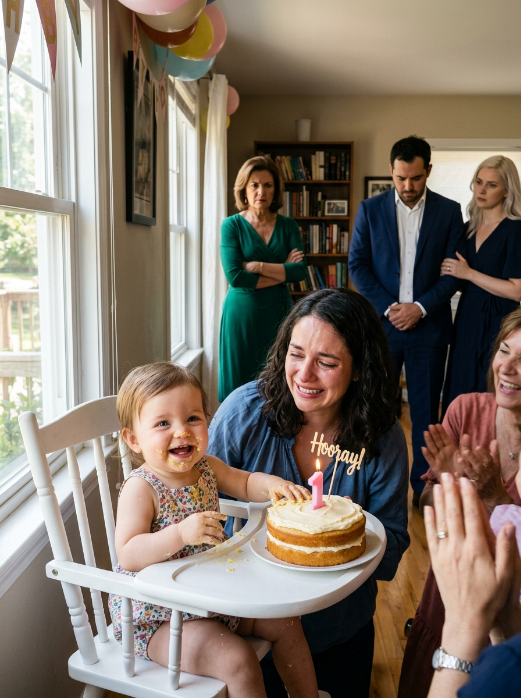
Then I brought out the small vanilla cake I’d made myself. Yellow frosting, a single candle. Nothing like Teresa’s towering three-tiered display. Just a real birthday cake for a real child.
I set Lucía in her high chair by the window and lit the candle.
At first, I sang by myself.
Then my mother joined in.
Then Julián, Rodrigo’s brother.
Then an aunt.
Then a couple of cousins.
Within minutes, half the room was singing while Teresa’s scheme quietly fell apart behind us.
Lucía dug her hand into the frosting and giggled.
That’s the photo I kept: my daughter with yellow frosting coating her fingers, blue eyes wide open, one candle glowing in front of her.
Twenty minutes later, I left.
In the hallway, Rodrigo caught up with me.
“Daniela, I didn’t know about the account.”
“I know.”
Relief washed over his face. I cut it short.
“I also know you hesitated. You let your mother talk. You never once asked me for the truth before letting our daughter be humiliated.”
His eyes welled up.
“I’m sorry.”
“You’re not ready to apologize yet. You’re scared because you just found out your mother used you too.”
I pressed Patricia’s card into his hand.
“My lawyer will be in touch with yours. Find one who doesn’t answer to your mother.”
Then I walked out with Lucía asleep on my shoulder.
The divorce took seven months. The paternity test put an end to the lie. The emails exposed Teresa. The fraudulent account became her legal problem. Rodrigo chose not to press charges against his mother, but their bond never fully recovered.
Paulina stepped away from that circle entirely. Later, she sent a short apology, explaining that Rodrigo had convinced her our marriage was already over and that I was unstable. I didn’t hold it against her. She’d played a part in the damage, but she wasn’t the source of it.
When it came to custody, I made one difficult call: Lucía would never be used as a weapon.
Rodrigo had failed as a husband. If he wanted to be a father, he’d have to prove it through showing up, staying consistent, and being responsible.
Over time, he tried.
Not perfectly.
But steadily.
Teresa asked to see Lucía. I agreed, but only under conditions: public settings only, Rodrigo present, no solo visits, no comments about her eyes, her worth, or her place in the family.
Teresa called it punishment.
I called it boundaries.
A year later, we marked Lucía’s second birthday at a small neighborhood bakery. No club. No lavish flowers. No relatives sitting in judgment. Just my parents, a handful of close friends, Rodrigo, and two kids from daycare hiding beneath the table.
Lucía wore a yellow dress, demanded blueberries like someone twice her age, and blew out her candle with more enthusiasm than skill.
Rodrigo and I stood together while everyone sang.
It wasn’t reconciliation.
It was survival.
Someday, once Lucía is old enough, I’ll explain the truth to her gently. I’ll tell her that adults sometimes fail out of fear, pride, or cowardice. I’ll tell her that money can dress up a room but can’t make it safe. I’ll tell her that her existence was never proof against anyone.
A daughter should never have to grow up feeling like a question mark inside someone else’s family.
A daughter is an answer.
And that night, when Teresa believed she’d already written my ending, I laid two envelopes on the table and took my life back.
