


I didn’t scream when the brown sludge burst open, soaking my face, my coat, and my pregnant belly. I simply stood there frozen, dripping mud, completely silent.
The beige coat—my favorite one, purchased with my own money—was completely saturated with grit and icy water. On my lips, I could taste the metallic mix of exhaust and dirt.
About forty feet away, Derek brought his black Escalade to a stop and rolled down his window. He was smiling. “Oops,” he sneered, loud enough for the nearly empty parking lot to hear. “Didn’t see you there, Penn.”. Next to him, his 26-year-old blonde girlfriend, Brittany, let out a giggle—high, sharp, and cutting. “Maybe she should watch where she’s standing,” she laughed, waving in my direction. “Bye-bye, welfare queen.”.
He wanted tears. He wanted me begging. He wanted the old Penny—the woman who spent six years apologizing for taking up space, who couldn’t even buy groceries without his approval.
But I am 32 years old, seven months pregnant, and I am done making myself small. I didn’t wipe my face. I just stared at him with an expression he had never seen—no fear, no rage, only a calm, icy calculation. I was memorizing his license plate. I was counting witnesses, including the security guard by his Honda Civic with a dash cam still recording.
“Drive away, Derek, while you still can,” I said, my voice unnervingly steady.
He laughed, though uncertainty slipped into it now, and sped out of the lot.
Derek Harrison thinks he just humiliated his poor Black ex-wife in front of his new girlfriend. He believes he’s untouchable because he owns three car dealerships and can buy off local sheriffs.
He has no idea who I married.
My hands weren’t shaking from fear when I pulled out my phone; they were shaking from the magnitude of what I was about to set in motion. I dialed the man who had left our Inman Park home before sunrise that morning.
“William,” I said to my husband. “I need you to come home.”.
Derek thought he was putting me in my place. HE HAD NO IDEA HE HAD BEEN STANDING IN MY HUSBAND’S TERRITORY THE ENTIRE TIME.
Part 2: The Sheriff’s Price Tag
The drive home takes 45 minutes, but most of it is gone from my memory. What remains is the physical weight of humiliation. I remember the mud drying on my skin, stiffening and cracking with each breath I took. I remember the choking smell of dirt, exhaust, and that sharp metallic taste clinging to my throat. I remember staring at my hands as they trembled violently on the steering wheel of my four-year-old Honda.
I did not cry. I had stopped crying over Derek Harrison three years ago. But beneath the cold, wet grit soaked into my favorite beige coat, something else began to grow inside me. Something quiet, cold, and patient. It felt like calculation. By the time I pulled into the driveway of our Craftsman house in Inman Park, the decision had fully formed. I had spent four years apologizing for existing, shrinking myself to fit inside the small, suffocating box Derek built around me. Not anymore. Not this time. This time, I would not be silenced. This time, Derek Harrison had chosen the wrong woman.
The Ashford Police Department smells exactly like a dying town’s justice system: burnt coffee and old, stained carpet. I sat in a rigid plastic chair, my damp coat clinging to me, holding a manila folder in numb hands. Across the scratched counter, Officer Jennings typed with two fingers, eyes locked lifelessly on his screen. He never looked at me.
“So, you’re saying,” Jennings read slowly from his digital notes, boredom dripping from every word, “that your ex-husband drove through a puddle and splashed you. Deliberately.”.
“He made eye contact,” I said, my voice unnervingly calm. “Then he accelerated directly into the water.”.
Jennings let out a sigh, heavy and performative. “Ma’am. Splashing someone with puddle water isn’t exactly assault.”.
“There’s a history,” I insisted, nails pressing into the manila folder. “We were married for six years. I’ve filed complaints before.”.
Jennings finally clicked his mouse. He scanned his screen, typed a few more keys, then frowned—not in concern, but inconvenience. “I’m not seeing any prior complaints under your name.”.
The air in my chest turned to ice. “I filed one in 2019,” I said, heart pounding hard against my ribs. “When he followed me to my apartment.”.
More slow, grinding typing. “Nothing here.”.
“Are you sure you filed it in Asheford?” he asked, looking at me like I was an emotional, confused woman.
I was sure. I could still recall the hours I spent in a chair exactly like this. I remembered the officer’s name, the case number, and the hollow promise that someone would follow up—a promise that never came. But as I watched Jennings’ screen, the truth settled in. The record was gone. Erased. As if my fear, my report, my existence in that moment had never happened at all. He had deleted my past.
Jennings scribbled something quickly on a slip of paper and slid it toward me. “Case number 2024 to 1992,” he muttered. “Status pending review. We’ll look into it. Someone will be in touch.”.
I took the paper. It felt like holding my own rights’ death certificate. No one would be in touch. Not today. Not tomorrow.
The psychological warfare started exactly three days later. On October 18th, my phone buzzed on the kitchen counter. A text from Derek’s familiar number lit up the screen: You think you can move on? Think again. I made you. I can unmake you..
I didn’t respond. I simply screenshotted it, saved it to a hidden folder, and forwarded it to a secure email address.
But the digital threats were only the beginning. On October 22nd, the nightmare crossed into the one place I thought was safe.
It was nap time at Sunshine Academy. The classroom was quiet, filled with the soft breathing of sleeping toddlers. I was organizing lesson plans when a shadow passed over the window. I looked up.
Derek.
He was standing at the chain-link fence, hands casually in his designer slacks, just watching. Watching my classroom. My heart slammed against my chest so hard I thought the children might feel it too. Panic, sharp and suffocating, rose in my throat. I grabbed my phone and called the front office. The principal immediately contacted the police.
I stayed hidden behind the blinds, one hand protectively over my seven-month pregnant belly, praying for sirens. Twenty unbearable minutes later, a single patrol car arrived. Two officers stepped out and walked toward Derek at the fence.
I watched, holding my breath, waiting for them to cuff him. Waiting for shouting. Instead, they talked. Then, to my absolute horror, Derek tipped his head back and laughed. One of the officers even smiled and extended a hand, firmly shaking my abuser’s hand. Derek turned with ease, walked back to his black Escalade, and drove away like nothing had happened.
A few minutes later, one of the officers walked into the school office. I recognized his badge. It was Russell Davis, the chief of detectives.
“False alarm, ma’am,” Davis said, his tone smooth and completely stripped of empathy. “Mr. Harrison was just in the neighborhood. Wanted to see how his ex-wife was doing. No law against that.”.
“He was watching my classroom,” I said, my voice shaking with restrained fury.
Davis only shrugged, adjusting his heavy utility belt. “He was on a public sidewalk. Can’t arrest someone for standing.”.
They were his. The police belonged to him. That realization hit me like a physical blow to the stomach. That evening, desperate and running out of paths, I went to the courthouse and filed for a restraining order. The clerk behind thick safety glass took my tear-stained, frantic paperwork without even looking up from her phone. “Judge Morrison handles these,” she said flatly. “He’ll review it next week. Maybe the week after.”.
Maybe the week after. By then, Derek could already have killed me.
The next day, October 23rd, my phone rang. Unknown number. The moment I answered, the mocking, casual voice on the other end drained the color from my face.
“Hey, Pen,” Derek said.
“Don’t call me again,” I whispered, scanning the empty classroom.
“Heard you’ve been busy talking to cops, filing papers,” he went on, ignoring me completely. Then his tone shifted—cheerful gone, replaced by something sharp and poisonous. “Here’s the thing. I know everyone in this town. The sheriff? We golf together. The judge handling your restraining order? He bought his Lexus from me.”.
I stood frozen, the phone pressed tight to my ear. I said nothing.
“You want to fight me in Asheford?” Derek sneered, certainty of power dripping from every word. “Go ahead. See how far you get.”.
The line went dead.
That night, the house in Inman Park felt enormous and exposed. When my husband, William, finally came home late from meetings, he found me at the heavy oak kitchen table. Spread across it were police reports, printed threats, and a brutal timeline of everything I had tried to survive.
William stopped in the doorway, taking it all in. He didn’t ask if I was okay. He just walked over, his presence grounding the room, and said quietly, “Tell me.”.
So I did. I told him everything. The mud exploding across my coat. The texts. The classroom window. The erased 2019 report. The officers shaking Derek’s hand.
William listened without interruption, his face calm in a way that revealed nothing. When I finally broke, he asked only one question.
“Harrison Motors, the flagship location on Asheford Boulevard?”.
I looked up, confused. “Yes. Why?”.
William turned and walked down the hall to his office. A minute later, he returned with a thick, crisp folder. He placed it over my scattered reports and opened it. Inside was a lease agreement.
Tenant: Harrison Motors, Inc. Landlord: Ellis Development Group, LLC.
“What is this?” I whispered, struggling to understand.
“Derek Harrison has been paying rent to my company for six years,” William said evenly, though the air shifted around him. “Two point one million dollars total.”.
I stared at the page. Monthly rent: $28,500..
Derek Harrison, who believed he controlled everything, had no idea who owned the ground beneath his business.
“Did you know?” I asked, searching his face. “When we met?”.
“No,” William said simply. “I have 45 tenants in that plaza. I don’t memorize names.”. He paused, then sat across from me. “I found out six months after we married. I didn’t tell you because I didn’t want you thinking about him. Ever.”.
Silence filled the kitchen. The refrigerator hum felt loud. I looked at the man I married—the man who kissed my pregnant belly every morning and brought home my favorite organic peanut butter—and realized how little I truly knew of his world.
“William,” I said carefully. “What are you going to do?”.
He didn’t answer immediately. Instead, he picked up his phone and dialed from memory.
“Raymond, it’s William Ellis,” he said, voice shifting into something precise and controlled. “I need you in Atlanta tomorrow. Bring your team.”.
The call lasted three minutes. His words were clipped, deliberate. I caught fragments that made my skin tighten: Full background… financial records… every complaint..
When he hung up, he looked at me.
“Raymond Cross,” William said. “Private investigator. Former FBI, 22 years. He finds what people try to hide.”.
“And then what?” I whispered.
William leaned forward slightly, forearms on the table, eyes darker than I’d ever seen. “Then we see who’s been protecting Derek Harrison. And we make them stop.”.
I looked at the lease sitting over my police reports. I looked at my husband—this quiet force I had built a life with. I thought about everything I had survived just to reach this fragile peace.
“I don’t want revenge,” I said softly, tears slipping free. “I just want him to leave me alone.”.
“I know,” William said, covering my hands with his. “But men like Derek don’t stop when asked. They stop when they have no choice.”.
I closed my eyes. I saw the mud again. The officers. The courtroom silence. The missing record.
When I opened them, I looked at William. “Okay,” I said. “Do it.”.
William nodded once. “There’s something else you should know.”.
He unlocked his phone and slid it toward me. A Forbes page loaded. A photo of him in a charcoal suit. Under it, a number that made my breath catch.
Net worth: $1.5 billion..
I stared at the screen. Then at him, sitting there like it was just another evening.
“Derek Harrison thinks he’s powerful because he owns three car dealerships and bought a local sheriff,” William said quietly, voice steady as steel. “He’s about to learn the difference between local money, and real money.”.
For the first time since that Escalade splashed through the mud, something in my chest loosened.
I didn’t feel anger anymore.
I felt hope.
Part 3: The 1.5 Billion Dollar Trap
November 15th began as a suffocating extension of the nightmare, but by midnight, it had turned into the battlefield for my unborn daughter’s life.
The emergency room at Piedmont Atlanta Hospital was a lesson in sterile fear. I lay rigid on a narrow, painfully uncomfortable hospital bed, surrounded by a relentless symphony of mechanical sounds. Monitors beeped urgently, tracking the erratic rhythm of my heart, while a blood pressure cuff tightened around my arm with such force it left deep, angry marks on my skin. The fluorescent lights washed everything in a pale, sickly glow. The air smelled of sharp antiseptic and the unmistakable metallic edge of my own fear.
My body was failing me—or rather, Derek Harrison’s psychological warfare was finally breaking me physically. I was having severe Braxton Hicks contractions. False labor, the doctors said, not yet dangerous, but my blood pressure had spiked to pre-eclampsia levels. The attending physician, a weary-eyed woman, hovered over my chart, using words like “extreme stress” and “mandatory bed rest”.
My husband, William, sat in the stiff plastic chair beside me, his hand wrapped tightly around my cold fingers. He had abandoned his multi-billion-dollar world to be here, staring at the fetal monitor. He hadn’t spoken in twenty minutes. His silence wasn’t emptiness—it was calculation.
“Is this worth it?” I finally asked, my voice cracking, barely audible in the sterile air.
I turned my head slowly toward the ceiling, counting the acoustic tiles to keep from falling apart. Twelve across. Eight down.
“Four years,” I said, tears sliding into my hair. “I spent four years getting away from him. Four years building a new life, finding you, learning how to breathe without apologizing. And now I’m in a hospital bed, hooked to machines, terrified I’m going to lose my baby because of him again.”
The fetal monitor beeped steadily beside me—cold, mechanical, indifferent.
“I just want to be left alone,” I sobbed, gripping William’s hand until my knuckles whitened. “I just want to raise my baby in peace.”
William didn’t answer right away. His jaw was tight, a muscle twitching beneath his skin. He was thinking about everything already in motion—the investigation, the news exposure, the corrupt officials being pulled into the light.
“You deserve peace,” William finally said, voice thick with love and contained fury. “You deserve to be left alone.” He paused, brushing a tear from my cheek. “But Penny… if we stop now… what happens to the next woman?”
I closed my eyes as another wave of pain hit me that had nothing to do with contractions. There were three others. Three names buried in Ashford’s records.
Amanda Cole. Jennifer Walsh. Rachel Adams.
They had reported him. They had begged for help. And the system had erased them because Derek Harrison could afford to.
The monitor beeped again.
“If we stop now,” William continued softly, “he learns his money works. He learns intimidation works. He learns people eventually give up.”
I lay there, the cold air brushing my skin, thinking of Amanda Cole—not a name, but a real woman who had stood where I was now. She had been ignored. Erased.
“I’m not asking you to fight,” William said quietly, his voice breaking. “Whatever you choose, I’m here.”
“I know,” I whispered, looking at him through tears. “You’ll be here.”
This is the moment where most people break. Exhaustion. Trauma. Fear that settles into bone. But as my daughter kicked faintly inside me, I realized something: I wasn’t most people anymore.
“Let me think,” I whispered, something sharp and focused returning.
William nodded, squeezing my hand. Outside, Atlanta’s skyline glittered—beautiful, indifferent. Somewhere out there, Derek Harrison was likely sleeping, certain he had won. I watched the lights blur through tears, feeling the crushing weight of a decision I wasn’t ready to make.
The hospital discharged me the next morning, but it didn’t feel like freedom. It felt like carrying the storm home.
They gave me pamphlets and instructions: reduce stress, hydrate, rest.
I tried. I truly tried. But my mind wouldn’t stop. Every time I closed my eyes, it replayed everything—Derek’s smug face in the Escalade, Brittany’s sharp laugh, the freezing mud soaking through my coat.
William turned our home into a guarded silence. He canceled meetings, stayed close, made tea, fluffed pillows, read softly from baby name books like normality could be rebuilt through routine.
But nothing was normal. We were at war.
On the second night, I woke at 3:00 a.m., drenched in sweat, gasping from a nightmare I couldn’t recall. My heart raced. My daughter kicked hard.
William was already awake.
“I keep thinking about them,” I whispered into the dark. “Amanda, Jennifer, Rachel. They were alone.”
“You’re not alone,” he said.
“I know,” I replied, touching his face. “That’s why I can’t stop. I have what they didn’t. If I quit now… what was any of it for?”
He was silent for a long moment. “Are you sure?”
“No,” I said softly, managing a small, broken smile. “But I’m going to do it anyway.”
Forty-eight hours later, my phone rang. Unknown number: Lisa Grant.
My hands shook as I answered. “Hello?”
“Mrs. Ellis,” a woman’s voice trembled. “My name is Lisa. I used to work at Harrison Motors. I saw what he did to those women.”
I sat upright instantly.
“I have things you need to hear,” she whispered.
The next morning, everything changed. We met in a small coffee shop in Decatur, far from Asheford’s reach.
Lisa Grant was 31, exhausted, with dark circles under her eyes and shaking hands wrapped around a latte she hadn’t touched. She looked like someone who had been running from fear for years. She had worked at Harrison Motors for four years before quitting in 2022.
“I saw everything,” Lisa said, voice trembling. “How he treated women who came in alone. The comments. The hands that lingered too long.”
I stayed silent as the past took shape.
“Amanda Cole worked in accounting,” she continued. “He cornered her in the breakroom. She filed a complaint. Two days later, she was fired.”
“What happened to the complaint?” I asked, though I already knew.
“It disappeared,” Lisa said bitterly. “Sheriff’s office said there was no evidence. She left town terrified.”
Lisa slid a thick manila folder across the table. I opened it. Names. Dates. Incidents. Pages of it.
“Jennifer Walsh was his girlfriend before Brittany,” Lisa said quietly. “When she tried to leave, he stalked her. She filed a restraining order.”
“Denied?” I asked.
“Denied.”
“How?”
“The judge who handled it bought his Lexus from Derek. At cost.”
I stared at the folder, then at Lisa. “Why now?”
Lisa met my eyes. “Because you didn’t give up.” She swallowed hard. “I heard he’s scared now. For the first time in years. I can’t stay quiet anymore.”
Her voice steadied as she pushed the folder toward me.
That was the moment the silence around Derek Harrison began to break.
Sandra Moore, the tenacious investigative journalist from the Atlanta Tribune, used the files provided by William’s private investigator to begin tracking down the victims. She located Amanda Cole in Savannah. After six years of fear, Amanda finally agreed to go on the record. Jennifer Walsh, now residing in Charlotte, sent a notarized, legally binding statement documenting her abuse in detail. Rachel Adams, long dismissed by local law enforcement, submitted a comprehensive account directly to the FBI’s federal tip line.
As Asheford—once Derek’s private playground—began to fracture, the town itself turned against him with rising intensity. Pastor David Coleman of Asheford First Baptist Church stood at his pulpit on Sunday and delivered a stunning public rebuke: “If William Ellis says there is corruption in our county, we believe him.”. The local NAACP chapter held an emergency press conference demanding an immediate federal investigation into the police department. Even longtime business allies of Derek began pulling their advertisements from his dealerships, scrambling to escape the spreading contamination.
From the safety of my living room couch, I watched the shift unfold on silent television.
“How does it feel?” William asked, entering the room with a cup of decaf tea.
I wrapped my hands around the warmth of the mug and thought for a moment. “Like I’m not alone,” I said quietly, a wave of relief breaking through me. “For the first time in years. Like someone finally believes me.”
William sat beside me and pulled me close. “They believe you because you told the truth. Everything else follows from that.”
The dismantling of Derek’s empire accelerated rapidly. The FBI investigation formally expanded on November 20th, moving faster than even William expected.
Within days of Lisa Grant’s testimony, two more former employees of Harrison Motors contacted Sandra Moore at the Tribune. A former customer who had witnessed Derek’s behavior in the showroom also came forward. Then another woman, who had briefly dated him in 2015, added her account.
Each story carried different details, but the pattern was identical.
“He’s been doing this for years,” Sandra Moore said sharply to her editor over the phone. “The only reason he’s never faced consequences is because he’s been buying everyone who’s supposed to stop him.”
On November 19th, the Atlanta Tribune released a second explosive article. This time, the headline named Derek Harrison directly. The exposé included verified quotes from Lisa Grant and Amanda Cole, exposed political donations, buried police complaints, and a sustained pattern of institutional protection.
Derek’s attorneys immediately threatened legal action. The Tribune’s legal team calmly invited them to proceed.
But the media storm was only one front. While Derek’s public image collapsed, Raymond Cross, the former FBI investigator, continued building the case brick by brick.
He found Calvin Brown.
Calvin, a 28-year-old security guard at Eastgate Shopping Center, had seen firsthand how complaints disappeared in Asheford. He knew exactly what happened when power met truth in that town—and truth lost.
On October 15th, he had been sitting in his Honda Civic when he witnessed a wealthy white man in a black Escalade deliberately accelerate into a puddle, drenching a pregnant Black woman in freezing mud. He saw her stand frozen as the man and his blonde girlfriend laughed.
His dashcam had recorded everything.
He never submitted it to local police. He already knew better.
But on November 20th, Raymond Cross approached him in the parking lot.
“Mr. Brown,” Cross said evenly, showing his credentials. “I understand you were working on October 15th.”
Calvin stiffened. “Who’s asking?”
“Someone trying to help the pregnant woman who was splashed. I’m not with Asheford police.”
Calvin studied him carefully, then exhaled. “I kept the footage,” he admitted. “I knew no one would believe a Black woman over a rich white guy in this town.”
Cross nodded. “Would you be willing to provide it to the FBI?”
Calvin let out a short laugh. “FBI? Seriously?”
“Seriously.”
After a long pause, Calvin nodded slowly. “Ellis,” he said. “The billionaire behind the community center. This is his doing, isn’t it?”
Cross gave no confirmation.
Calvin held his gaze, then nodded again. “Yeah,” he said. “I trust him.”
The dashcam footage was undeniable. The timestamp read 10/15/2024 14:07:33. It showed the Escalade rolling forward, the deliberate acceleration, the eruption of muddy water, and—clearly—the license plate. There was no ambiguity, no interpretation, no escape.
On November 21st, Cross delivered the footage to FBI Agent Daniel Reeves.
But Derek’s collapse wasn’t limited to harassment alone. William’s broader strategy had already widened the net.
While attention focused on abuse allegations, Cross’s forensic accounting team uncovered something far more destructive. Harrison Motors was deeply entangled in federal financial crimes—systematic title washing, falsified vehicle histories, and resale of salvage cars as clean. They found odometer tampering, large-scale cash fraud, and unreported transactions spanning years.
These were not local violations. These were federal offenses.
And still, I held one final piece of evidence.
On October 22nd, as everything escalated, I began recording everything Derek said to me. Georgia law allowed one-party consent, and I made use of it.
On November 23rd, I played one of the recordings for William.
“You think moving on means I let you go?” Derek’s voice hissed through the speaker. “I will destroy you, Penny. I will take everything. Your job, your husband… that baby.”
William went completely still. He listened once. Then again. And again.
“The bureau has this?” he asked, voice tight with fury.
“Raymond delivered it this morning,” I said. “Along with Calvin’s footage and the financial evidence.”
The trap was fully set. All that remained was execution.
On November 24th, Agent Daniel Reeves called William.
“We’re convening the grand jury,” Reeves said. “Derek Harrison, Sheriff Bradley, Chief of Detectives Russell Davis—everyone tied to this. We’re taking them all down.”
William ended the call and turned to me.
“It’s time,” he said quietly.
The billionaire’s trap had finally closed. And the man who believed he controlled everything was about to learn he had become the target.
PART 4: Building Over The Ruins
The night before the grand jury convenes, I cannot sleep. The silence inside the Inman Park house feels heavy, saturated with the weight of everything that has been set in motion. I slip quietly out of bed, careful not to wake William. The hardwood floor is cold beneath my feet as I move toward the floor-to-ceiling windows of our bedroom.
I stand at the window, staring out at the vast, glittering Atlanta skyline. Millions of lights blink back at me, indifferent to the war about to erupt in the federal courthouse downtown. I press my palm against the cold glass, grounding myself in something real. Beneath my other hand, deep in my womb, my daughter kicks hard against my skin. It is a firm, undeniable reminder of what I am protecting. A life Derek Harrison once tried to erase before it even began.
“Nervous?” William asks softly from the darkness of the bed. I hadn’t realized he was awake, though I should have. He hasn’t truly slept since the day I came home covered in freezing brown mud.
“Terrified,” I admit, the word catching in my throat.
The mattress shifts, followed by the quiet sound of his footsteps. He joins me at the window, his broad frame casting a protective shadow over me. He doesn’t touch me at first—just stands there, steady and present, absorbing my fear.
“You don’t have to testify,” he says quietly, his voice low and rough with restraint. It is an out, an escape. “We already have enough without—”
“I want to,” I cut in, turning from the glass to face him. My voice is barely a whisper, but it is unshakable. “I need to. For Amanda. For Jennifer. For Rachel. For every woman who never got to speak.”
I think of Lisa Grant trembling in that Decatur coffee shop, unable to hold her cup. I think of Amanda Cole, destroyed by a system that protected a predator instead of a victim. If I don’t stand in that room and speak the truth—me, with all my protection, all my resources—then nothing truly breaks. I have to be the one who lights the match.
William studies me in silence, his eyes dark and searching. Then he nods once.
“Then I’ll be there, right outside the door,” he says firmly.
“You can’t come in,” I remind him gently. “Grand jury rules.”
“I know,” he replies, jaw tightening. “But I’ll be there anyway.”
I step into him, burying my face against his chest. His arms wrap around me immediately, solid and grounding. He smells like cedar and safety. For the first time in days, the knot in my chest loosens.
“What happens after?” I ask quietly. “After the indictment… the trial… all of it?”
William is silent for a moment, as if assembling something structural in his mind.
“We build,” he says at last. “That’s what we do.”
He tilts my face up until I meet his eyes. “We build something better than what came before.”
My thoughts drift to the Harrison Motors flagship property on Asheford Boulevard. Empty. Cleared out. Reclaimed. In its place, a community health center—something meant to heal instead of harm.
“I like that,” I whisper.
We stand there for a long time, watching the city glow like a distant constellation. I rest my hand on my stomach again. My daughter settles.
Tomorrow, everything changes.
November 25th arrives beneath a heavy, bruised sky. The Federal Courthouse in downtown Atlanta rises like a fortress—cold concrete, sharp glass, unyielding authority. Rain threatens but doesn’t fall.
I wait in a secure witness room, but the tension seeps through every wall. According to Raymond Cross, Derek’s arrival is exactly what you’d expect: controlled arrogance.
He enters with three expensive defense attorneys, moving like a man still convinced the world bends for him. His suit is tailored, his smile practiced. But it doesn’t reach his eyes. He believes, even now, that influence will save him.
It doesn’t.
The moment his attorneys receive the preliminary evidence list, the performance collapses.
Fifty-two counts. Not a misunderstanding. Not a mistake. A system-wide indictment: stalking, harassment, wire fraud, tax evasion, conspiracy to obstruct justice.
The sentencing guidelines are brutal. Fifteen to twenty-five years. Federal time. No favors. No local influence. No escape routes.
Inside the grand jury room, everything is sealed—but not silent in meaning. The case leaks through corridors, through whispers, through shaken clerks.
Derek sits before twenty-three jurors and realizes, too late, that he has no leverage left.
He invokes the Fifth Amendment.
“Did you deliberately splash Penelope Ellis with mud?”
“Fifth Amendment.”
“Did you threaten your ex-wife and her unborn child?”
“Fifth Amendment.”
“Did you conspire with county officials to suppress complaints?”
“Fifth Amendment.”
Again and again.
But silence doesn’t save him.
The dashcam footage plays. The audio recordings play. The texts are read aloud. Financial documents are projected. Witness statements follow—Lisa Grant, Amanda Cole, Jennifer Walsh—each voice dismantling the illusion piece by piece.
Eight years. Five victims. One system built to protect him.
Outside the grand jury room, Asheford collapses in real time. Sheriff Bradley resigns under pressure. Russell Davis begins negotiating with federal prosecutors. Commissioner Hris is already gone. The structure that once protected Derek is dissolving.
And inside, he is alone.
His attorney emerges onto the courthouse steps, lashing out at the cameras.
“This is a politically motivated witch hunt orchestrated by a billionaire with unlimited resources,” he says. “My client maintains his innocence.”
It sounds hollow even as it’s spoken.
Six hours later, the foreperson returns.
A unanimous indictment on all fifty-two counts.
Bail is set at $750,000. GPS monitoring is ordered. A federal protective order is issued—no contact with me or any witness.
Downstairs, Derek writes the check with shaking hands.
When it is over, I am guided outside. The air feels sharp, almost unreal. Cameras erupt into flashes, turning the courthouse steps into a storm of light.
A black sedan pulls up.
The door opens.
William steps out.
He doesn’t speak to the press. He doesn’t acknowledge the noise. He simply looks at me.
And comes to take me home.
I step out under the gray sky, escorted by federal marshals. I am exhausted—stripped down by adrenaline, memory, and relief. But for the first time in a very long time, the weight I’ve been carrying doesn’t feel like it’s crushing me anymore.
It feels like it’s finally lifting.
Across the wide plaza, surrounded by aggressive reporters shouting questions he refuses to answer, Derek is being escorted toward the bail bondsman’s office. He suddenly stops.
He looks up.
He sees William. And then he sees me.
For six years, Derek Harrison looked at me and saw nothing more than a weak, pliable object he could break whenever he pleased. Today, he looks at me and sees the architect of his total collapse.
William meets Derek’s panicked, furious stare from across the distance. My husband does not smile. He does not sneer. He gives no emotion at all for Derek to cling to. He simply nods once—cold, final, absolute—a silent acknowledgment of a sentence already carried out.
Then he turns away from the ruined man, opens the car door for me, and we leave the chaos behind.
The drive back to Inman Park is almost eerily quiet. The luxury interior of the sedan feels worlds away from the sterile tension of the courthouse. Only the soft hum of the engine and the steady sweep of the windshield wipers fill the space as they push through a light drizzle.
I rest my head against the cold glass, watching the city slide past in blurred gray and neon. The courthouse recedes behind us in the rearview mirror while the skyline stretches ahead. It feels symbolic—like I am physically leaving my past behind.
“How do you feel?” William asks quietly, breaking the silence. He doesn’t take his eyes off the road, but his hand reaches across the console for mine.
I close my eyes, searching for the truth.
“Empty,” I admit at last.
William glances at me, concern tightening his expression.
“I thought I’d feel… I don’t know,” I continue, struggling to name it. “Triumphant. Vindicated. Like I’d won.”
“And you don’t?” he asks gently, thumb brushing my hand.
“I feel tired,” I say honestly. “Like I’ve been carrying something enormous—something crushing—for years.”
My hand moves instinctively to my belly. “And I just… put it down.”
Tears gather quietly as the realization settles.
“That’s not nothing, Penny,” William says firmly.
“No,” I whisper, a small, real smile breaking through. “It’s not.”
We ride in silence for a while, rain tracing soft lines across the glass. My thoughts drift back to the plaza—to Derek’s face when he realized, for the first time, that he had no control left.
“He looked scared,” I say quietly.
“When the federal charges hit him—when he finally understood his money couldn’t save him—he should be,” William replies.
“I know,” I murmur. Then, after a pause, I admit the truth I didn’t expect to find. “A part of me wanted him to be scared.”
“I wanted him to feel what I felt,” I continue. “But now that I’ve seen it…”
“It doesn’t feel the way you thought it would,” William finishes.
I shake my head. “No. It doesn’t feel like victory. It just feels… necessary.”
William squeezes my hand. “That’s because you’re not like him,” he says quietly. “You never wanted to hurt anyone. You just wanted to be safe.”
I let his words settle deep inside me.
“I want to go home,” I say finally. “I want to sleep without checking the locks.”
Then something lighter rises in my chest.
“And tomorrow… I want to think about the future.”
“The nursery still needs painting,” I add suddenly.
A laugh escapes me—unexpected, bright, real. It surprises even me.
“Yellow,” I say, smiling through tears. “With tiny ducks.”
William’s face softens completely. “With ducks,” he agrees.
We drive toward home. Toward quiet. Toward whatever comes next.
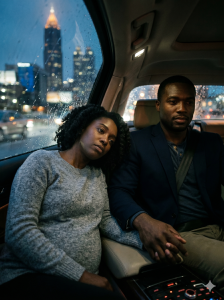
For illustrative purposes only
Three months later, Asheford looks like a place trying to remember what it once was.
The Harrison Motors flagship site stands empty, stripped down to its bones. But it is no longer a symbol of power—it is a foundation for something new. A clean sign now reads: Future Home of Asheford Community Health Center. An Ellis Development Project.

For illustrative purposes only
Derek Harrison is no longer untouchable. His assets have been frozen, his dealerships seized, his influence gone. He lives in a rented apartment under strict federal monitoring, a GPS ankle bracelet blinking steadily as he waits for trial.
The system that protected him for years has collapsed under federal scrutiny. Sheriff Bradley accepts a plea deal and receives prison time. Russell Davis cooperates with prosecutors. County officials fall one by one as the investigation spreads.
The silence that once shielded Derek is gone.
Sandra Moore receives a major journalism award for her investigation, her reporting spanning six exhaustive parts that expose the depth of the corruption.
Calvin Brown is promoted by Ellis Development after his dashcam footage becomes key evidence in the federal case.
But the most important change doesn’t happen in courtrooms or headlines.
It happens in a hospital room.
On a clear January morning, after a long but safe delivery, I give birth to my daughter.

Eleanor Grace Ellis.
7 pounds, 4 ounces. Healthy. Perfect. Safe.
William holds her with shaking hands, the same man who once moved billion-dollar systems now crying quietly into her blanket.
Two weeks later, I return to work.
It is a rainy Tuesday when I drive down Asheford Boulevard again. The road looks the same. The sky looks the same. The puddles gather at the curb just like before.
I see them approaching.
I do not hesitate.
I drive straight through.
The water splashes harmlessly and falls away.
No fear follows it.
No memory controls me.
Only movement forward.
Derek Harrison once believed power meant control through fear.
He was wrong.
True power builds. It protects. It restores.
And the truth is simpler than all of it:
I was never his to break.
