


I didn’t flinch when they ripped the chair out from under me.
The Meridian Crown Gala was designed as pure spectacle, with crystal lighting suspended low enough that guests were constantly reminded of their own reflections. Every seat carried a name, a ranking, and an unspoken rule about who actually belonged. I was seated quietly at Table One, focused on my phone, when Whitney and Douglas Harrow crossed the room with that loud, inherited confidence that never bothers to confirm first.
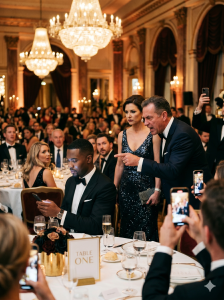
Whitney stopped, stared at me, and laughed. “You’re in our seat,” she snapped, tossing her clutch onto the table. I didn’t say a word; I simply returned my gaze to my screen. My silence offended them more than any response could have. The platinum place card resting face down in front of me was enough to ignite their anger.
Douglas gripped the back of my chair. “Get up. Now,” he ordered, as nearby guests began lifting their phones, sensing entertainment. When I didn’t move, Whitney smiled toward the cameras and called security, claiming I was an “uninvited guest”. Four guards rushed in—no questions asked, only momentum driven entirely by assumption.
“VIP isn’t a skin tone lottery,” Whitney whispered loudly as Douglas pulled the chair back. I rose slowly, refusing to give them the struggle they were clearly hoping to capture. Whitney mistook my restraint for weakness and shoved me hard in the chest.
Laughter broke out across the room. The guards seized my arms and started dragging me toward the service corridor as a room full of elites filmed a Black man being removed from the most exclusive table in the building. I didn’t resist, and I didn’t plead. I let the humiliation complete its performance.
Because within just twenty feet, the same crowd cheering my removal was about to understand something devastating.
WHAT DO YOU THINK HAPPENED WHEN THEY FOUND OUT WHO OWNED THE BUILDING?
PART 2: The Corridor of Echoes
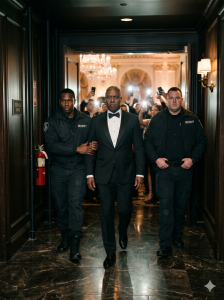
The physical act of being removed from a room is not only the pressure of hands on your body; it is the abrupt, violent stripping away of autonomy. Security seized my arms and pulled me toward the service corridor. I felt the immediate, punishing grip of four large men whose entire role depended on fast, unquestioning obedience. Their hands locked onto the tailored fabric of my tuxedo, the wool tightening across my shoulders. One of them dug his grip deep into my bicep, a sharp, biting pressure that revealed his adrenaline. He was breathing hard, a faint wheeze cutting through the ambient gala noise, driven by the belief he was neutralizing a threat.
I didn’t resist. I didn’t plead. I allowed it to unfold. I let my body go completely slack, turning myself into dead weight. It is as much psychological as physical. When you resist, you give them a story—you become the aggressor, the thing that needed control. By not struggling, I forced them to carry the full burden of what they were doing, both physically and symbolically. My shoes, polished to a reflective shine, scraped across the imported marble floor of the Meridian Crown Gala. The friction produced a faint, grating sound that blended uncomfortably with the delicate clink of crystal champagne glasses and the soft string quartet playing in the background.
We were twenty feet from the service exit, yet time felt fractured. The distance stretched like a dark corridor with no end. Each step forward became an exhausting stretch of sensation. The air hit me in waves—a suffocating mix of expensive Tom Ford cologne, heavy floral perfume, the metallic note of chilled caviar, and beneath it all, the sharp, electric scent of collective judgment.
Cameras followed eagerly. This was live humiliation. Bright smartphone flashes erupted from every direction, creating a disorienting strobe. In those broken bursts of light, I saw their faces. The city’s elite—people whose portfolios I had once studied, whose companies I had quietly disrupted or acquired over years—none of them recognized the architect behind their systems. They only saw a Black man being dragged from a table they believed he had no right to occupy. Their expressions shifted between amusement, performative shock, and open contempt. I saw a woman in an emerald dress covering her mouth, eyes bright with a thrill she couldn’t hide. I saw men in tailored suits leaning in, whispering, reassured in their assumptions.
I kept my eyes forward, fixed on the heavy brass-studded doors of the service corridor. My heartbeat stayed slow and steady. Stay calm, I told myself. Let them finish what they started. Then, abruptly, everything stopped. The guards halted so suddenly my shoulder twisted painfully.
“Hold on. Wait,” a voice commanded.
It was Douglas Harrow. He stepped into my path, blocking the exit. The cameras shifted instantly, eager to capture him confronting what they believed was an intruder. Douglas stood wide, his posture filled with that hollow confidence of inherited wealth. He adjusted his cuffs, letting his gold Patek Philippe catch the light.
He looked down at me with a thin, practiced smile. This was staged mercy—the kind meant to elevate the person offering it.
“You know, buddy,” Douglas said, his voice carrying clearly over the room’s silence. He spoke slowly, as if addressing a child or something beneath him. “I’m a reasonable man. My wife is a reasonable woman. We don’t want to ruin your night completely.”
He paused, letting the moment stretch so every camera could capture his generosity. The guards eased their grip slightly, sensing a shift in control.
“Just admit it,” Douglas continued, leaning closer. I could smell gin on his breath, sharp and bitter. “Admit you snuck in. Apologize to my wife for sitting in our seat, and apologize to this room for causing a scene. You do that, and I’ll tell the boys here to just walk you out to the street. No police. No charges. I’ll even give you a twenty for a cab ride back to whatever part of town you came from.”
A murmur of approval spread through the crowd. How generous. How forgiving.
My throat was dry, a metallic taste rising. The arrogance of it was staggering. He wasn’t offering compromise; he was demanding submission. He wanted my words to confirm his superiority. He wanted me to bow.
I looked at him. Not with anger. Not with emotion. With the detached stillness of someone evaluating data.
I let the silence hold for three seconds. Let the cameras capture his expectation. Let the tension tighten like wire.
“I have nothing to apologize for,” I said softly, my voice steady. “And you are standing in my building.”
Douglas’s smile collapsed instantly. The performance of mercy vanished, replaced by raw, exposed rage. My calmness without effort infuriated him more than defiance ever could.
“Throw this piece of * out,” Douglas spat, his voice breaking with anger. “Throw him in the alley!”
The guards reacted immediately. Their grip tightened, bruising muscle. They surged forward again, practically lifting me as they dragged me toward the doors. Laughter erupted once more, louder now, fueled by Douglas’s fury.
My thoughts flicked back to the table I had been removed from. The platinum place card. The one Whitney had mocked. It lay face down, small and insignificant, yet tied to something far larger. I imagined the silence that would fall when someone finally turned it over. The realization that would spread through them like cold water.
Fifteen feet. The kitchen doors came into view. I could hear clanging pans, the distant calls of staff unaware of the storm unfolding beyond their world.
Ten feet. Camera flashes burned into my vision. The moment was supposed to break me here. This is where people are expected to fracture, to fight, to plead. But my dignity wasn’t dependent on their perception. My power wasn’t inherited or borrowed. I stood on ground they didn’t understand.
Five feet. The lead guard pressed his weight into the brass push bar of the heavy doors. The hinges groaned. A cold, sterile draft spilled out, carrying bleach and raw onions—a harsh contrast to the luxury behind me.
This was the end of their performance. I was meant to be discarded.
And then, twenty feet from the exit, every security radio in the room cracked open at once.
It wasn’t just the four holding me. It was every earpiece, every walkie-talkie across the room, the perimeter, and the stage. The burst of static was so sudden and artificial it cut through the music and noise like a blade.
The guards holding me froze. The one at the door stopped completely, hand hovering inches from the brass bar.
Through the heavy static, a single voice cut across every channel. It was sharp. It was panicked. And it carried across the room through every radio at once, amplified by the scale of the system.
“Release Mr. Monroe immediately,” the voice commanded, breathless and shaken. “That is the majority owner.”
PART 3: The Weight of the Crown
A single voice broke through every channel.
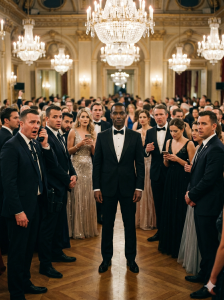
“Release Mr. Monroe immediately. That is the majority owner.”
The words didn’t simply transmit; they hit like a detonation. The earpiece static seemed to linger in the air, a harsh synthetic hum that froze everything in place. The guards went rigid. The change in the four men holding me was immediate and alarming. The adrenaline that had driven them moments earlier drained out of them, replaced by a sudden, cold realization.
Hands fell away. The crushing grip on my arms disappeared so abruptly I nearly lost balance. The lead guard—the one whose hand had been on the brass push-bar—slowly turned his head toward me. All color had drained from his face. He was no longer looking at someone to remove; he was looking at the structure that sustained his livelihood.
In the ballroom, the music cut off midphrase. A cellist’s bow dragged across a string with a harsh screech, a sound that shattered the illusion of the evening. The room itself seemed to stop breathing. The layers of crystal clinking, laughter, and conversation collapsed into a heavy silence.
I didn’t smile. I didn’t react. I simply inhaled, steadying myself in the sudden reversal that filled the corridor. I straightened my posture and smoothed the wrinkles left in my jacket by their grip. Then I turned back toward the room as if nothing had occurred.
From the stage, a man rushed forward, microphone shaking in his hand. It was the gala’s lead organizer, someone I had approved for the role months earlier. He moved quickly, shoes slipping slightly on marble, face pale and damp with panic.
“Everyone, lower your phones,” he said, voice cracking over the PA system. It wasn’t a request. It was desperation.
A few devices dropped. Most remained raised, locked by disbelief.
“Ladies and gentlemen,” he continued, gripping the stand tightly, “the man you just saw being assaulted is Caleb Monroe, majority shareholder and incoming chief executive.”
The silence that followed was crushing.
It pressed into everything. I walked slowly back into the ballroom. The same five hundred guests who had moments earlier laughed and filmed now parted from my path without hesitation, as if distance alone could protect them.
I looked at the Harrows. Whitney’s expression collapsed entirely. Her earlier smugness dissolved into confusion, then raw panic. Douglas’s hand fell away from the chair as though it had been burned. His confidence drained instantly, leaving him hollow, exposed, and visibly shaken by realization.
The people around them stepped back, severing connection in real time.
Every phone now turned in their direction. The focus had shifted completely. The narrative inverted in seconds. They were no longer observers of humiliation—they were its subject.
I didn’t acknowledge them. I passed without stopping and returned to Table One, sitting exactly as before. The platinum place card still lay face down against the cloth.
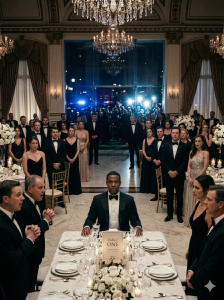
The man on stage swallowed hard, the sound echoing through the silence. “Effective immediately,” he said, voice trembling but firming with necessity, “Whitney and Douglas Harrow are terminated from all corporate affiliations. Security, escort them out through the front.”
Not the service corridor. The front doors.
Whitney let out a scream—sharp, unrestrained, stripped of composure. “You can’t do this!” she shouted, scanning the room for support that no longer existed.
Douglas tried to speak. “Wait, Caleb, Mr. Monroe, please, it was a misunderstanding—”
No one responded. The guards who had removed me earlier now moved toward them instead. Slowly. Deliberately. Purpose now replaced hesitation.
This time, there was no restraint.
They took Douglas by the arms, firm and unyielding, creasing his tailored jacket. Whitney was pulled into position beside him, her protests ignored as they formed a corridor of inevitability around her.
The walk stretched on.
They were led the full length of the ballroom, past tables filled with people who now watched in silence. Cameras continued recording. The flashes returned, capturing ruined makeup, pale expressions, and the collapse of everything they had built socially.
By the time they reached the front doors, the atmosphere had completely inverted.
I stood as they arrived. The guards paused, waiting.
Whitney’s voice broke again, reduced to a whisper. “You can’t do this.”
I looked at her without anger, without satisfaction—only certainty.
“I just did.”
The doors opened. They were pushed through into the night. The glass closed behind them with a heavy finality, cutting off the sound of her sobs.
PART 4: The Deafening Silence
The doors sealed shut behind the Harrows. The sound of the latch echoed through the ballroom like a gavel striking wood.
I didn’t move immediately. I stood there, allowing the reality to settle across the room. Behind me, five hundred of the most powerful people in the country stood in strained silence. Moments earlier, they had been entertained. Now they were suspended in uncertainty, trapped in the aftermath of their own assumptions.
I turned and walked back through the aisle. It felt wider now. People instinctively shifted away as I passed, avoiding even accidental alignment.
I bypassed Table One and stepped toward the stage.
I climbed alone. The room remained silent, the weight of what had just occurred pressing down on every person present. The organizer stepped aside quickly, retreating into the curtain’s edge.
I placed my hands on the podium and looked out across the audience—designer clothing, rigid posture, and faces that had lost all certainty.
I didn’t raise my voice. I didn’t need to.
“You watched a man get removed from his own company,” I said evenly through the microphone. My tone stayed calm, which made the silence heavier.
I scanned the room. A man who had filmed earlier now looked down immediately, unable to meet my eyes.
“Some of you laughed. Some of you filmed. None of you asked questions.”
I paused. The silence answered for them. It pressed into the room, unavoidable and complete.
“I won’t explain why that matters,” I continued. “Your behavior already did.”
I stepped away from the podium. No applause followed. No one moved.
The atmosphere shifted again—this time from spectacle to consequence. Conversations died before they could start. The structure of power inside the room quietly reorganized itself.
I returned to Table One. The platinum place card remained exactly where it had been left.
I reached out and turned it over.
Engraved on its surface, precise and unmistakable, was my name.
CALEB MONROE.
Inside, I sat alone at Table One. The orchestra never resumed, and no one asked it to. The silence itself became the only sound the room deserved.
Some lessons don’t require music.
Through the vast glass windows at the front of the venue, the aftermath unfolded onto the street. Outside, Whitney’s voice cracked as cameras captured her breakdown, mascara streaking down her face in dark, uneven lines while paparazzi—originally there for celebration—now documented her collapse. Douglas stood beside her, head in his hands, his phone vibrating endlessly with messages that would no longer change anything: board members cutting ties, country clubs rescinding access, friendships dissolving in real time.
Inside, I remained at Table One. Nothing restarted. Nothing needed to. The silence carried everything that mattered.
If this story made you pause, don’t scroll past it. Like the video to support stories where power answers for itself. Share it with someone who understands quiet strength.
In the comments, write the moment you realized the outcome was already decided. Subscribe and turn on notifications for more stories where humiliation is recorded, patience is strategic, and consequences arrive without warning.
END.
