


Part I — The Smallest Kindness
By the time the yelling began, most of the people on West Fifty-Seventh had already chosen to look away.
That was how New York functioned on cold mornings. People saw everything and acknowledged nothing. A man could snap at a stranger outside a café, a delivery truck could growl in the bike lane, a woman could stand on a corner crying into her gloves, and the city would continue forward as if movement itself were a kind of mercy.
But at seven-thirty that morning, in the narrow stretch of sidewalk outside Marrow & Reed Café, one elderly woman sat alone at a small round metal table with a paper cup in her hands, and one man hovered over her as though he had spent his life waiting for someone weaker than himself.

“People like her scare customers.”
His voice sliced through the clink of cups and the hum of traffic. Not loud enough to make a scene. Just enough so everyone could hear and pretend they hadn’t.
The woman at the table said nothing.
She wore a coat that had once been taupe but had worn down into the shade of damp cardboard. Gray strands slipped from beneath a knit cap in weary curls. A worn shoulder bag leaned against her chair. Her hands, thin and pale, wrapped around the cup, fingers reddened by the cold. At a glance, she was easy to label. Old. Poor. Unwanted. The kind of person a polished city tried to blend into its pavement.
The man standing over her seemed newly assembled by contrast. Crisp beige polo. Dark trousers. An expensive watch. The sort of face that considered itself reasonable even while being unkind. His jaw was squared, his hair neatly parted, his lips tight with the satisfaction of correction.
Inside the café entrance, a young employee stood frozen with a tray in her hands.
Her name was Talia, and she had been working at Marrow & Reed for nine months—long enough to memorize the regulars’ orders and the manager’s moods, long enough to understand that a place like this sold more than coffee. It sold atmosphere. It sold the illusion that life could be managed with the right espresso machine, enough reclaimed wood, and small pots of rosemary lining the windowsill.
It did not sell disruption.
The old woman had entered ten minutes earlier, moving slowly, shoulders hunched against the wind. She had asked, in a voice so quiet Talia had to lean in to catch it, whether there might be anything left from breakfast that would otherwise be thrown away.
Talia had glanced around before replying. The morning rush had not yet reached its peak. Two trays of pastries would never make it to noon, and a stack of sourdough breakfast sandwiches sat wrapped for speed. The rules were clear. Waste had to be recorded. Free food required approval. Compassion, as always, was absent from the employee handbook.
“I can pay for tea,” the woman had said, almost apologetically. “Just not for much else.”
Talia had rung up the smallest hot tea on the menu and quietly added a sandwich to the tray when no one was watching.
The woman had thanked her with a dignity that unsettled Talia. Not because it asked for sympathy, but because it didn’t. She had taken her food outside, to Table Seven by the railing, where the faint morning sun touched the metal chairs first.
Three minutes later, the man in the beige polo stepped outside with his latte and decided her presence was a problem.
“Sir,” Talia said now, finally managing to speak. “She bought something.”
The man shot her a glance, irritated that the furniture had spoken.
“That’s not the point.”
It was, of course, exactly the point. But men like him preferred their prejudice to sound like principle.
Part II — What Hunger Hides
If anyone had asked Talia later when her day truly started, she wouldn’t have said seven-thirty.
She would have said it began an hour earlier, in the dim walk-up apartment in Queens where she sat on the edge of her bed, trying to decide whether she could send money to her mother that week or keep everything for rent. She would have said it began with the voicemail from her younger brother in Phoenix asking for “just a little help this month,” his tone too casual—which meant things were worse than he was letting on. She would have said it began with the familiar anxiety she carried into every morning—that one mistake, one missed shift, one complaint from a manager, and the delicate balance of her life would fall apart.
People liked to think of choices as simple. Brave or cowardly. Kind or cruel. But most decisions arrived wrapped in fear.
Talia’s father had spent his life driving city buses in El Paso, measuring morality in practical ways. Offer water before advice. Sit before judging. Feed first, ask questions later. After he passed, her mother held onto the sayings but lost the house anyway. By twenty-four, Talia understood that kindness often came at a cost and was rarely rewarded.
That morning, when the woman in the knit cap asked for tea, Talia’s first reaction hadn’t been generosity. It had been calculation. Was the manager watching? Was the sandwich too noticeable? Would anyone complain?
Then she noticed the woman’s hands.
Hands revealed truths that faces sometimes concealed. These were not hands pretending helplessness. They were worn hands, the kind shaped by years of doing, now left with too little to hold. Talia recognized something in them—not exactly her mother, not exactly herself, but that fragile line between stability and collapse.
So she had slipped the sandwich onto the tray.
Now, after the SUV door had shut, she stood in the doorway, cold seeping through her sneakers, wondering if she had imagined it all.
“You all right?” Deven, the shift manager, asked as he appeared beside her.
He wore the distracted look of someone who treated every issue as a staffing concern. He glanced past her toward the sidewalk. “What happened?”
Talia hesitated. If she told the truth, he would question why she had given away food. If she lied, she would carry the moment alone all day.
“Just a customer being a jerk,” she said.
Deven exhaled with the weary indifference of the underpaid. “As long as it’s done.”
It wasn’t done.
The man in the beige polo returned inside and stood at the pickup counter as though nothing had occurred. He didn’t look at Talia. That somehow felt worse. Cruelty in front of others at least acknowledged itself. Cruelty followed by routine made humiliation seem like just another task to finish before eight a.m.
When she handed him his drink, their fingers didn’t meet.
He took a sip, frowned at the foam, and walked out without leaving a tip.

The morning rush consumed the next twenty minutes. Office workers. Dog walkers. A woman in running clothes who always ordered six pumps of vanilla and acted offended when asked to pay for them. The line swelled, shrank, then swelled again. Talia steamed milk, wiped counters, called out orders, smiling automatically.
But every time the café door opened, she glanced up.
At seven fifty-eight, the black SUV pulled up to the curb directly in front of Marrow & Reed.
Everything inside Talia stilled.
It wasn’t the sort of car people ignored. Not because it was flashy—it wasn’t—but because it carried a quiet, unmistakable sense of purpose that came with money. The rear door opened again, and this time the woman who stepped out no longer looked like someone pushed to the margins of the city.
She looked like the kind of person the city adjusted itself around.
The gray hair was the same, now brushed back from her face. Her eyes were unchanged too—steady, observant, carrying a deeper weariness. But the worn coat was gone. In its place was a cream overcoat layered over a tailored black outfit that fit her with certainty. The shoulder bag had become a structured handbag. Nothing about her was dramatic. That was what made it striking. She hadn’t become someone else. She had simply allowed the world to see the part of her it had failed to imagine.
Conversations in the café faltered.
Even Deven lifted his gaze from the register.
The woman stepped into the café without rushing. Her eyes swept the room once, taking everything in—the polished counters, the pastry display, the line of customers, Talia at the espresso machine, Deven at the register. And the man in the beige polo, still inexplicably lingering, half-turning with his cup in hand as though his body sensed trouble before his pride could catch up.
When the woman spoke, her voice was soft enough that everyone leaned in to hear it.
“Who showed her kindness?”
No one replied.
The question settled oddly over the room, because everyone understood at once that she wasn’t asking about someone else. She was asking whether anyone, in that brief and unpleasant moment outside, had managed to stay human.
Deven straightened. “Ma’am, if there’s been some misunderstanding—”
She looked at him, and he fell silent.
Heat rushed to Talia’s face. Not pride—panic. She had never wanted to be the focus of anything. She didn’t step forward, but something in her stance must have given her away, because the woman’s gaze found her and remained there.
The man in the beige polo tried to laugh. It sounded thin.
“I think everyone’s getting a little dramatic.”
The woman turned toward him, her expression edged with something like maternal disappointment.
“No,” she said. “I think everyone became very clear.”
That was all.
She didn’t raise her voice. She didn’t demand apologies. She didn’t declare herself with the kind of practiced authority Talia associated with wealthy people who believed power had to be loud to matter.
Instead, she reached into her handbag and pulled out a slim card case. Talia couldn’t see what was inside from where she stood, but Deven saw enough to turn pale.
“Ms. Vale,” he said, barely audible.
So that was her name. Lenora Vale.
Even Talia recognized it then. Not because she followed business headlines, but because the name had come up once or twice during staff training, tied to the parent company that owned Marrow & Reed and a dozen other boutique cafés across Manhattan and Brooklyn. Founder. Executive chair. Rarely seen. Known for visiting locations without warning. Known, according to rumor, for noticing everything.
The man in the beige polo drained of color.
Lenora closed the card case and looked at Talia.
“What is your name?”
“Talia.”
“Did you offer me food this morning, Talia?”
There was no use lying. “Yes.”
“Why?”
The room seemed to lean closer.
Talia opened her mouth, closed it, then finally answered in the only honest way she could.
“You looked hungry.”
Something close to a smile passed across Lenora’s face—not quite amusement. More like relief.
“Yes,” she said. “I was.”
Part III — The Weight of Seeing
What followed was quieter than anyone might have imagined.
There were no dramatic firings in the middle of the café. No speeches crafted for social media. No public humiliation with applause rising on cue.
Lenora Vale asked Deven to close the register for five minutes and have new customers wait outside. She told the man in the beige polo to set his cup on the counter and leave. He tried once to regain his footing—mumbling about misunderstanding policy, concern for the business, maintaining standards. Lenora listened without interrupting, which somehow made his words feel smaller.
Then she said, “You mistook cruelty for standards.”
He walked out without finishing his drink.
The door closed behind him. Silence took his place.
Lenora turned back to Talia, and for the first time the younger woman noticed how tired she truly looked. Not just physically—though that was there—but in the way powerful people sometimes appeared when disappointment had become routine.
“Walk with me,” Lenora said.
They stepped outside to the narrow stretch of sidewalk by the railing. Table Seven still held the half-finished tea and the sandwich wrapper folded in on itself. The city kept moving, unaware that something had shifted.
Lenora rested one hand on the cold back of the empty chair.
“My husband used to sit here,” she said.
The admission came so suddenly that Talia said nothing.

“Before there were twelve cafés, before investors, before consultants told me which neighborhoods were profitable and which were aspirational.” She gave a faint smile. “Back when this was just one impossible little shop and a very good baker with more hope than money.”
Talia looked at the table differently then—not as café furniture, but as something personal.
“He died six years ago,” Lenora continued. “After that, I began visiting locations without notice. Sometimes dressed like myself. Sometimes not.” Her gaze drifted toward the street. “You learn more when people think you have nothing to offer them.”
Talia swallowed.
Lenora touched the paper cup lightly, as if confirming the warmth had long faded. “You would be surprised,” she said, “how often respectable people fail simple tests.”
There was no bitterness in her voice. That was what made it hurt.
“Why today?” Talia asked before she could stop herself.
Lenora looked at her. “Because this store has received three complaints in two months about staff coldness. Because numbers can mislead in flattering ways. Because managers grow nervous when owners arrive polished.” She paused. “And because hunger is clarifying.”
The words lingered between them.
Talia thought of her own skipped breakfast, saving money. Of her mother delaying medication until payday. Of how thin the line could be between one version of life and another.
“I’m sorry,” she said, though she wasn’t entirely sure what she meant.
Lenora shook her head. “No. Don’t apologize for seeing someone.”
Then she reached into her handbag again and took out a small metal pin attached to a backing card. The card faced away; whatever was written on it stayed hidden in the glare of the morning light. But the pin itself caught a glint of brightness.
Talia looked at it, then back at Lenora.
“I can’t—”
“You can,” Lenora said. “Whether you will is a different question.”
She explained it plainly. Deven would be transferred to a larger location where structure mattered more than judgment. An interim district lead would step in for a week. If Talia wanted the role, she would begin assistant manager training right away and take over the store within the month.
Talia almost laughed from the shock.
“I’ve never managed anything.”
“That isn’t true,” Lenora said. “You managed fear, public pressure, and the risk of doing the decent thing while someone else performed certainty. I can teach inventory. I can teach scheduling. I can teach loss prevention.” Her voice softened. “I cannot teach instinctive dignity nearly as easily.”
Talia lowered her gaze to the pin in Lenora’s palm.
Her hands trembled as she took it.
The old reflex rose immediately: doubt. Surely there was a catch. Surely this was one of those stories wealthy people told themselves about merit—the kind that overlooked luck, timing, and the cost of courage in the wrong room. But Lenora still watched her with those steady eyes, and there was nothing self-congratulatory in her expression. Only weariness. Perhaps hope. And the fierce seriousness of someone trying, in one small corner of a bruised city, to build a place that didn’t automatically reward the worst in people.
“I almost didn’t help you,” Talia admitted.
Lenora nodded, as though it mattered. “Of course you almost didn’t.”
“I was scared.”
“That matters too.”
They stood quietly for a moment as a bus exhaled at the light.
Then Lenora said, “Kindness that costs nothing tells us very little. The kind that risks something is the only kind worth trusting.”
Talia closed her fingers around the pin.
Inside the café, Deven watched through the glass, trying not to look like he was watching. His expression held confusion, resentment, and, somewhere beneath both, the slow realization that all his neat systems had failed to measure the one thing that mattered most.
“What happens now?” Talia asked.
Lenora’s smile this time was small, but genuine.
“Now,” she said, “you decide what kind of place this is when I’m not here.”
Part IV — What Stays Warm
The strangest thing was how quickly the city tried to swallow the moment and carry on.
By eight-thirty, the line had returned. Orders resumed. Milk hissed beneath steam. Receipts printed. Two finance interns debated oat milk. Someone asked if the blueberry muffins were fresh, as if the morning hadn’t quietly split in two just half an hour earlier.
But for Talia, nothing remained where it had been.
She tucked the small metal pin inside her apron pocket because she couldn’t yet bring herself to wear it. Every few minutes, her fingers brushed against it through the fabric, making sure it was still there.
Deven stayed cautious and pale. Lenora remained for forty minutes, not hovering, not performing authority. She observed the floor, asked three straightforward questions about staffing, one about waste, and another about how often employees were expected to skip breaks during busy hours. She greeted customers with the same calm composure she had carried at Table Seven. Most didn’t recognize who she was. Talia found that strangely reassuring.
Before leaving, Lenora ordered another tea.
This time she paid the full amount, waited for the receipt she didn’t read, and carried the cup to the door herself. At the threshold, she turned back.
“Talia.”
“Yes?”
“You were right this morning.”
Talia blinked. “About what?”
Lenora raised the cup slightly. “I was hungry.”
Then she walked out.
In the weeks that followed, the story spread in fragments. A customer retold it poorly to a friend. A barista at another location heard that some rude man had been banned by corporate. Someone on the block insisted a billionaire had disguised herself as homeless to test employees, turning it into something like a game show and missing the point entirely. By the time it reached Brooklyn, it had gained a chauffeur, a hidden camera, and a public apology that never happened.
The truth was simpler.
An elderly woman had sat at a table with tea and a sandwich.
A man had decided her poverty—or what he assumed was poverty—made her disposable.
A young woman with too many bills and too little authority had made space for one small act of mercy.
And because of that, something unseen but essential had come into view.
Talia did accept the promotion.
At first, she made mistakes. She overordered pastries one week and nearly ran out of espresso filters the next. She learned that kindness wasn’t the same as being lenient, that protecting a staff required boundaries as much as warmth, and that some customers mistook friendliness for surrender. But the café changed, gradually and noticeably. Staff took their breaks on time. Unsold food went through proper donation channels instead of the trash. Complaints about coldness faded. The rosemary by the window stopped dying because someone finally remembered plants needed more than aesthetic intention.
Every so often, especially on sharp winter mornings, Talia would bring her own tea outside before opening and stand beside Table Seven while the street came to life around her.
She thought often about how close she had come to doing nothing.
That was what stayed with her most. Not the SUV. Not the reveal. Not even the promotion. It was the quiet ordinariness of the moment before the choice. How easy it would have been to look away, cite policy, protect herself, and become just another person surviving by pretending survival justified everything.
Maybe that was why the memory never turned sentimental. It remained practical.
A month after her promotion, a teenager came in soaked from the rain, trying to warm his hands around a few coins. Two months later, an exhausted nurse in wrinkled scrubs broke down when her card was declined, and Talia quietly guided her to a table with coffee anyway. In December, when the heating failed in the apartment building across the avenue, Marrow & Reed stayed open an extra hour after closing and let half the tenants sit inside with paper cups and red noses until the super fixed it.
None of it made headlines. None of it needed to.
The café didn’t become something sacred. It remained what it had always been: a small business on a noisy street in an impatient city. People still snapped over wait times. Deliveries still arrived incorrectly. Tips still rose and fell with the weather and mood. But something in the air shifted. As if the room itself had learned that elegance without decency was just another costly disguise.
Lenora returned twice that winter.
Not in disguise. Not announced, either.
The first time, she sat at Table Seven in a charcoal coat, reading something on paper Talia never tried to identify. The second time, near Christmas, she came in with tired eyes and snow dusting her shoulders. Talia prepared her tea before she even reached the register.
Lenora smiled at the cup.
“You remembered.”
“You looked hungry,” Talia said.
For a moment, the older woman’s expression softened into something gentler than amusement. Something closer to gratitude. Something like recognition.
Outside, snow drifted down through the yellow glow, softening the sharp edges of the street. Inside, the windows fogged, cups tapped lightly together, and the café held onto its small pocket of warmth against the cold.
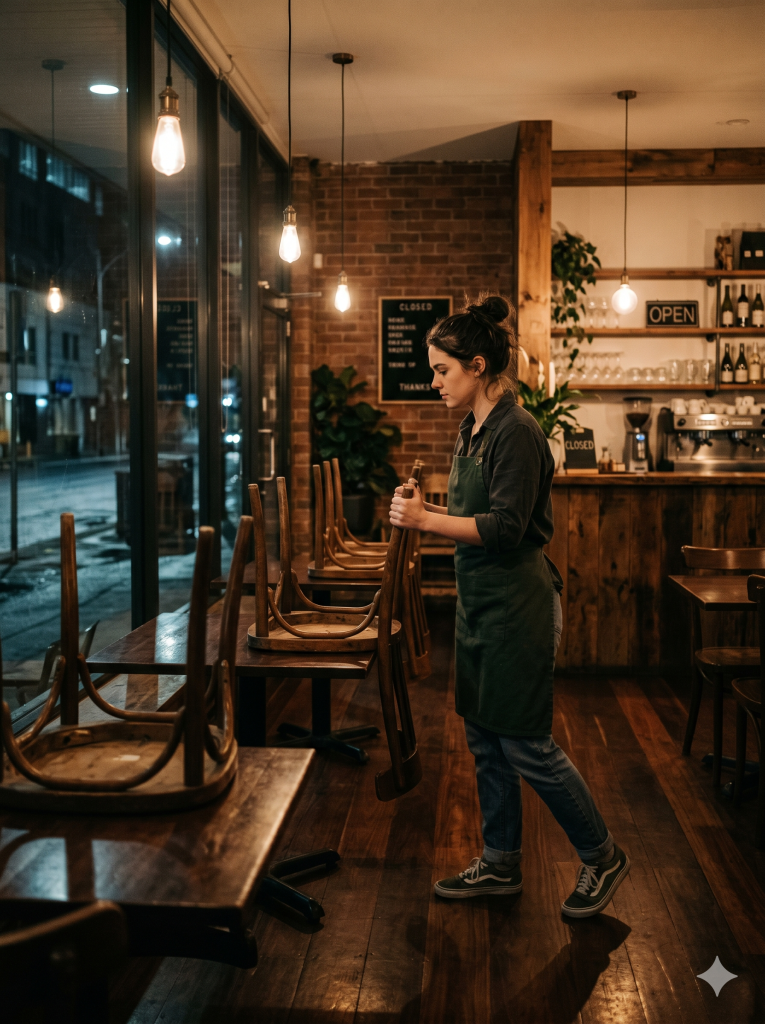
That night, after closing, Talia flipped the chairs upside down onto the tables one by one until only Table Seven remained.
She left it as it was for a little while longer.
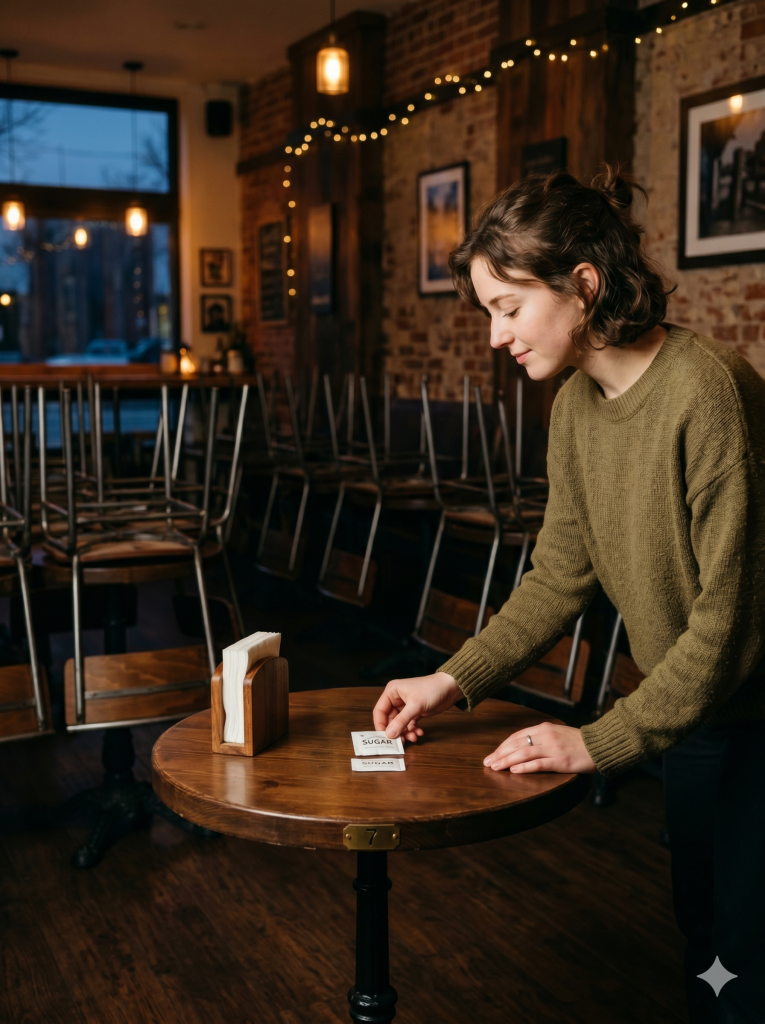
Then she set two fresh sugar packets beside the napkin holder, adjusted the chair, and stepped back.
From the sidewalk, it looked like any other table waiting for the morning.
But Talia understood differently now.
Sometimes the full measure of a person—sometimes the entire course of a life—could hinge on whether you allowed someone to sit in peace.
