

The low, steady hum of the Boeing 777 had always been a source of comfort to me. But tonight, cruising at thirty-five thousand feet somewhere above the vast darkness of the American heartland, that familiar vibration felt different.
Weighted.
Thick with tension that no one had voiced.
I am Dr. Marcus Stone. I finished at the top of my class at Johns Hopkins, devoted ten years to mastering thoracic surgery, and authored enough research to fill a small library. Still, as I sat in seat 1A—a privilege I had earned through relentless effort—I was acutely aware that a polished brass buckle did nothing to change the color of my skin.
This wasn’t paranoia; it was instinct sharpened over fifty years in a country that often sees only Black before anything else.
It began even before boarding, back at the jet bridge at JFK. I was in the premier lounge, surrounded by a crowd of luxury watches and tailored suits. When Sarah, the lead stewardess, conducted her manifest check, she didn’t just glance my way; she assessed me. A swift, calculated look to determine whether my appearance matched the class of my ticket.
That unmistakable “are you sure you belong here” stare.
She didn’t notice the fatigue from a grueling three-day surgery I had just completed in Chicago. She didn’t know I had painstakingly repaired a child’s ruptured aorta while other surgeons watched in amazement. To her, I was simply a potential issue. A statistic.
After boarding, I eased into the wide leather seat of 1A, craving nothing more than rest. Sleep had been a stranger to me since Tuesday; that Chicago case had demanded ninety-six uninterrupted hours of focus.
Then came dinner service. Sarah passed my row, offering the investment banker in 2B a lobster tail with a warm smile. But when she reached 1A, the smile disappeared. She stood over me, her posture stiff, almost confrontational.
“Meal,” she said. Not an offer. A command.
Though exhausted, I kept my voice composed. “Excuse me, miss. I don’t believe I was asked for my order.”
“We serve what’s listed on the manifest,” she replied sharply. “And this is what you’re getting.”
I held onto the calm tone that had steadied operating rooms in moments of crisis. “Perhaps there’s been a mix-up. I believe I requested the vegetarian option, though I’d also be fine with the filet mignon.”
She didn’t hear politeness; she heard resistance. To her, it was ‘riff-raff’ stepping out of line. Her face flushed as she leaned in, her voice cutting just loud enough to carry.
“You really are full of yourself, aren’t you? Don’t you dare speak to me that way. You should just be grateful you’re even sitting here.”
Fifty years of this.
“Miss,” I started, “I am only asking for the service I paid for—”
“I won’t serve a c*iminal,” she snapped.
The entire cabin fell silent. Before I could even register the absurdity, she acted. With a sharp, forceful motion, she swept the plated salmon dish off the tray and onto the floor. The crash of porcelain against the carpet rang out. Sauce and food splashed across my tailored trousers.
She stood there, breathing hard, looming over the mess.
“Now,” she demanded, “let me see your handcuffs.”
She truly believed I was in custody. In her mind, there was no scenario where I was a successful physician; the only explanation that fit was that federal agents were somewhere behind me.
I felt every eye in the cabin turn toward me. They were waiting—for the stereotype, for the reaction. But I am Dr. Marcus Stone. I work on hearts. I don’t perform for crowds.
I met her icy blue stare with a calm, unshakable authority—the same presence I carry when a life rests between my fingers.
“You have just made a serious mistake,” I said. “And the outcome is no longer yours to control.”
She stammered something about calling security.
“Yes,” I replied quietly. “Because what’s about to unfold will make everything very clear.”
At that moment, we both heard it—the solid click of the lock releasing. The reinforced cockpit door slowly began to open…
Part 2: The Captain’s Verdict
The solid click of the deadbolt echoing through the First Class cabin wasn’t loud, yet in that moment it landed like a gunshot. The reinforced cockpit door—once sealed and distant—slowly swung open.
For the last ten minutes, the air had felt suffocated by the weight of Sarah’s hostility. She had stood over me, insisting on seeing my handcuffs, utterly convinced my presence in seat 1A was some kind of offense. In her mind, she had constructed an entire reality where a Black man in a tailored suit could not be a surgeon, could not be successful—only a suspect.
Now, that reality was about to collapse.
Captain James Miller stepped out of the cockpit. Tall, with gray at his temples, he carried the quiet authority of someone who had spent thirty years commanding the skies. He didn’t emerge casually—he moved with intent, his expression tight as he responded to the raised voices that had pierced even the insulated cockpit.
Flight 1092 was no longer just a plane cutting through the stratosphere at thirty-five thousand feet.
It had become a courtroom.
Miller’s gaze immediately dropped to the chaos on the carpet: shattered porcelain, smeared sauce, a ruined salmon dish at my feet, and oil staining the hem of my charcoal trousers. Then he looked at Sarah, still standing rigid, her chest rising and falling with adrenaline and misplaced conviction.
Finally, he looked at me.
I didn’t move. I stayed composed, breathing the same controlled rhythm that steadies my hands in surgery. Slowly, I rose into the aisle, the gold medal in my hand feeling far heavier than it should. Just hours earlier, it had been awarded for pioneering a pediatric cardiac procedure. Now, it felt meaningless. I didn’t want recognition—I just wanted to sit in the seat I had paid for without being treated like a threat.
“Sarah,” Captain Miller said, his voice low and dangerous, “what exactly is happening here?”
She turned toward him, her ice-blue eyes wide, completely misjudging the situation. She thought help had arrived. She believed the highest authority on the plane would validate her actions.
“Captain,” she said, her voice trembling with manufactured fear, “this… this individual is being disruptive. He’s refusing to comply with manifest protocol. I believe he poses a serious security risk. I was requesting to see his restraints. We should contact the Marshals.”
The silence that followed was deafening.
It was the sound of everything unraveling.
Captain Miller stared at her as though she had spoken nonsense. The color drained from his face, leaving him pale with shock. He looked back at me—at the stains, at my stillness, at the effort it took to remain dignified—and something in his expression broke.
He didn’t raise his voice. He didn’t argue.
He simply walked past her.
Closing the distance, he came to my side and placed a hand briefly on my shoulder. It was a small gesture, but it carried weight—solidarity, acknowledgment. His hand trembled noticeably against my jacket.
This wasn’t just about a crew member behaving badly.
This was something far worse.
The man she had humiliated, the man now standing quietly in front of him, was the same one who had saved his daughter’s life less than two days ago.
“Dr. Stone,” he said softly, his voice meant only for me, “I am so deeply sorry. There are no words.”
In seat 2B, the investment banker who had watched it all unfold stiffened, choking slightly. The word “Doctor” hung in the air.
And then Sarah understood.
Her posture faltered. The defiance drained from her face, replaced by a sickly, ashen shock.
“My crew is trained to be the best,” the Captain continued, his voice heavy with shame. “Sarah has been with us for six years. I never saw this side of her. But I suppose… that’s the problem. You don’t see it unless you choose to.”
I met his gaze calmly, though the exhaustion ran deep. “You don’t see it because it isn’t aimed at you, Captain,” I said quietly. “It only appears for certain people.”
He nodded, the weight of that truth settling visibly over him. He understood. If I had looked different, none of this would have happened.
When he turned back to Sarah, his tone was no longer emotional. It was precise. Final.
“Sarah. Go to the rear galley. You will not speak to another passenger for the remainder of this flight. You will not handle service equipment. You are relieved of duty, effective immediately. Walk.”
“Captain, I—” she stammered, glancing around for support that no longer existed.
“Walk,” he repeated.
She did.
And as she made her way down the aisle, passing every passenger who had witnessed her display of authority, the cabin remained heavy with the aftermath.
“Come with me,” Miller said, turning back to me. “You’re not staying here.”
He gestured toward the mess at my feet—the discarded meal already beginning to sour the air. The man in 2B stared fixedly at his screen, his face flushed, saying nothing.
Silence, I thought, could be just as damaging.
As I followed the Captain toward the front galley, I noticed the other attendants—Mia and David—standing frozen, pale and shaken.
“Mia,” Miller said sharply, “clean up seat 1A. Now.”
She moved immediately.
“And afterward,” he added, “I want a full written report from both of you. Everything you saw, everything you heard—and why neither of you intervened.”
“Captain, we didn’t want to cause a scene,” Mia said weakly.
“A scene?” His restraint cracked. “She threw a meal at a passenger. She accused a surgeon of being a criminal. The scene was already happening. Your silence made you part of it.”
He didn’t wait for a reply.
Instead, he led me into the crew rest area—a small, private compartment just behind the cockpit. Inside was a narrow bunk, a fold-out desk, and a rare sense of quiet.
“Stay here, Marcus,” he said, his tone softening again. “I’ll have a proper meal brought to you. And security will be waiting at the gate—for her.”
I stepped inside and sat heavily on the bunk, the adrenaline finally beginning to drain.
“Captain,” I said before he could leave.
He paused. “Yes, Doctor?”
I looked up. “How is Lily?”
Everything in his expression changed.
“She’s awake,” he said, his voice breaking slightly. “She asked for her teddy bear this morning. The doctors say her vitals are stronger than they’ve ever been.” He wiped at his eye. “You didn’t just save her. You gave her a future.”
For a moment, I was back in the operating room—the bright lights, the fragile rhythm of a failing heart, the long hours that stretched into days.
I allowed myself a small smile. “That’s what matters, James. The rest of this… it’s just noise.”
“It shouldn’t be,” he said firmly. “I’ll check on you soon.”
He closed the door gently behind him.
Alone in the dim quiet, I leaned back, exhaustion settling deep into my bones. But sleep didn’t come.
My mind replayed everything—especially the certainty in Sarah’s eyes. The conviction that she was right. That she had authority not just over service, but over worth.
That was the real damage.
An hour later, there was a soft knock. David entered carefully, carrying a tray with a perfectly prepared steak, a glass of red wine, and warm bread.
“Sir,” he said quietly, placing it down, “the Captain asked me to bring this. And… I’m sorry.”
“Thank you, David,” I replied. Then, after a pause, “What about Sarah?”
He hesitated. “She’s in the back. Last row of Coach. Someone recorded everything… it’s already online. It’s going viral. People are calling her ‘The Sky Karen.’”
A cold weight settled in my chest.
That was the last thing I wanted.
“Is she still insisting I’m a criminal?” I asked.
He shook his head. “No, sir. She’s crying. Asking if you’re going to sue.”
I looked down at the wine, its dark surface reflecting the dim cabin light.
“I don’t need her money,” I said quietly. “But she does need to understand—people aren’t disposable just because they don’t fit your version of importance.”
He nodded and left.
I ate in silence, though I barely tasted anything. Every bite reminded me of the meal on the floor.
As the plane began its descent into Los Angeles, I found myself thinking about the contradiction of it all.
I spent my life repairing hearts—seeing firsthand how identical we all are beneath the surface.
And yet, here we were, still dividing worth based on appearance.
It was a failure far deeper than any medical condition.
Then the Captain’s voice came over the intercom.
“Ladies and gentlemen, we are beginning our final approach into LAX. Thank you for flying with us. And remember—on this aircraft, and in this world, respect is not optional. It is the minimum requirement.”
It was a powerful message.
But I knew it wouldn’t reach the people who needed it most.
When the wheels hit the runway, the impact felt like a full stop to something ugly and unresolved.
For most passengers, it was just the end of a flight.
For me, it was the beginning of something much larger.
As the plane taxied, I could hear it—the rapid tapping of phones beyond the door.
They were watching the video.
Watching her throw everything I had built onto the floor of seat 1A.
Captain Miller’s voice came through the internal crew channel, bypassing the cabin speakers.
“Marcus, stay in the rest area until I come get you,” he said. “Port Authority and our corporate security chief are already at the jet bridge. I don’t want you dealing with the press or the ‘lookers’ until we’ve secured a clear path.”
I understood his strategy. It was the mindset of someone used to handling pressure with precision. But sitting there in the dim light, staring at the gold medal resting quietly on the desk, a harder truth settled in. “Clear paths” weren’t something men like me were often granted.
The aircraft finally jolted to a stop. Moments later came the heavy thud of the jet bridge locking into place.
Normally, this would be when First Class passengers jumped to their feet, grabbed their polished carry-ons, and rushed off with a sense of urgency that rarely made sense.
Not this time.
Through the thin wall of the rest area, I heard the cabin door open. Instead of the usual shuffle, there were firm, deliberate footsteps—boots, not loafers.
“Captain Miller?” a deep voice called.
“Here,” Miller answered. “She’s in row 44. Escort her off first. No passengers move until she’s gone. I don’t want a spectacle.”
“Understood.”
I leaned toward the small window in the door. Two Port Authority officers, along with a sharply dressed man in a dark suit, moved down the aisle with purpose.
Minutes later, they returned.
Sarah was between them.
She looked nothing like the woman from earlier. Her once-perfect bun had come undone, strands of hair falling loose. Her face was pale, blotched, and exhausted. The confidence she had worn so easily before was gone. She carried her blazer over her arm, as if trying to hide her hands—the same hands that had thrown my meal.
She wasn’t in handcuffs, but the way the officers flanked her told a different story. The irony wasn’t lost on me.
As she passed the galley, she looked up.
Our eyes met through the small window.
Everything had changed.
There was no anger left in her expression. No certainty. Just the hollow realization of what she had done—and what it had cost her. She had wagered her career on a belief she assumed was shared.
She had lost.
She was escorted off in silence. No applause. No reactions. Just a heavy, suffocating quiet.
“Marcus. It’s time,” Miller said, opening the door.
He looked drained now. The adrenaline had faded, leaving behind the strain of everything that had happened—and the weight of being a father waiting for his child to recover.
“Passengers are being held for a few more minutes,” he said. “I want you out before the crowd moves.”
I picked up my briefcase and stepped into the galley. Mia and David stood off to the side, visibly shaken. They avoided my eyes.
I didn’t acknowledge them.
Some things didn’t require words.
We moved quickly down the jet bridge. The warm Los Angeles air hit my face as we exited the aircraft.
The man in the suit stepped forward.
“Dr. Stone? Robert Vance, Head of Global Security,” he said, extending his hand. “I want to personally apologize. What happened tonight is unacceptable.”
“It goes beyond your company,” I replied evenly, not taking his hand.
He nodded, lowering it. “We’ve terminated Sarah Jenkins effective immediately. No severance. We’re preparing a public statement. We’d appreciate your input.”
I stopped. “You want me to help manage your image?”
A flicker of discomfort crossed his face. “We want to get it right.”
“The message was already delivered,” I said. “It sounded like a plate hitting the floor. If you want honesty, tell the truth—you have a deeper issue than one employee.”
He didn’t argue.
We stepped into the terminal.
And that’s when I saw them.
The crowd.
People gathered near the gate, phones raised, screens glowing. Some were media. Others were just curious onlookers drawn by the viral video.
“There he is!”
“Dr. Stone!”
Flashes lit up the space. Voices overlapped.
In that moment, I wasn’t a surgeon. I wasn’t a man who had spent decades saving lives.
I was a headline.
A clip.
A symbol.
Security moved quickly, forming a barrier as we pushed forward. A reporter shoved a microphone toward me.
“Doctor, will you be suing the airline?”
I stopped.
Turned.
And spoke.
“I am a heart surgeon,” I said, my voice steady but carrying. “I dedicate my life to keeping people alive. Tonight, I was treated as if I didn’t deserve even basic respect because of how I look.”
The crowd fell quiet.
“My concern isn’t a lawsuit,” I continued. “It’s the reality that millions of people experience this every day—without witnesses, without intervention, without protection.”
I looked directly into a nearby camera.
“What you saw isn’t just about me. It’s a reflection. And the real question is—if no one in authority had stepped in, would any of you have?”
Silence.
Real silence this time.
I turned and walked away.
Vance guided me to a private lounge where my bags were waiting.
“Your car is ready,” he said quietly. “Is there anything else we can do?”
I looked down at the gold medal still in my hand.
Then I walked over to a nearby trash bin and placed it gently on top. Not discarded—just… left behind.
It didn’t fix anything that mattered tonight.
“Tell the Captain I’ll call to check on Lily,” I said. “And tell your board they owe me a proper steak.”
I left the building and stepped into the cool night air. A black Escalade waited at the curb.
Inside, the silence was immediate.
But not for long.
My phone buzzed.
An email.
High priority.
From the hospital board in Chicago.
I stared at it, a familiar weight returning.
The situation wasn’t over.
It was evolving.
Because sometimes, being the victim isn’t seen as injustice.
It’s seen as risk.
And whatever came next… was going to test everything I had built.
Part 3: The Corporate Hit Job
The inside of the Cadillac Escalade felt like a sealed chamber of silence—a sharp, almost suffocating contrast to the chaotic, flashing noise of the terminal I had just left behind. The thick, soundproof glass cut me off entirely from the cameras and shouting voices, leaving me alone in the dim, leather-scented cabin. The driver, a broad-shouldered man in his middle years who had likely chauffeured countless celebrities, politicians, and executives, kept his eyes firmly fixed on the glowing taillights ahead on the 405 South. He didn’t ask about the stain on my suit or the media frenzy outside. He didn’t offer empty reassurances. For that quiet restraint, I was deeply thankful.
I leaned back against the soft headrest, closing my eyes and trying to match my breathing to the steady rhythm of the engine. But the calm didn’t last. My gaze dropped to the phone resting on my thigh. The notification from the Chicago Memorial Hospital board still pulsed on the lock screen, insistent and impossible to ignore.
I unlocked it, the cold blue light illuminating my tired face. The email was flagged in red.
Marcus, please call me on my private line immediately upon landing. The video of the incident on Flight 1092 has reached the board. We need to discuss the implications for the hospital’s upcoming capital campaign and your role as the face of the New Heart Center. We need to manage the optics of this “confrontation” before it affects donor relations.
I read it three times. The word “confrontation” lingered like a bitter aftertaste. It was chosen carefully, deliberately. I hadn’t confronted anyone. I had been sitting quietly in a seat I paid for, recovering from saving a child’s life, while someone used prejudice as a weapon to publicly humiliate me.
But to Arthur Sterling—a man whose world revolved around donors and appearances—this was just a “situation.”
Truth came second to perception.
In the elite, high-stakes world of medicine, there is an unspoken rule for people who look like me: excellence gets you in the door, but invisibility keeps you there. You are allowed to succeed, to innovate, to bring in millions—so long as you never disrupt the illusion. Never remind the establishment that outside the operating room, the world still sees you differently.
By becoming visible—by becoming viral—I had broken that rule.
I had become inconvenient.
My thumb hovered before I finally dialed. Arthur answered immediately.
“Marcus,” he said smoothly, his voice polished and measured. “I’m glad you’re safe. That video… it looked… intense.”
“It was an assault on my dignity, Arthur. I wouldn’t call it ‘intense.’ I’d call it what it was: ‘discriminatory.’”
There was a pause. Calculated.
“Of course. Absolutely unacceptable,” he replied. “But Marcus, the video is everywhere. Millions of views. And you know how this works—people are already searching for alternative narratives. Some outlets are suggesting you were ‘curt’ with staff before filming began.”
My jaw tightened. “I had just spent ninety-six hours saving a child’s life. If I was ‘curt,’ it’s because I’m human—not a customer service script.”
“I understand,” he said, though his tone suggested calculation more than empathy. “But our donors… they’re conservative. Old money. They expect our lead physicians to remain above situations like this. This whole ‘Sky Karen’ narrative—it introduces a level of chaos that doesn’t align with the hospital’s image. We were thinking it might be best if you took a short ‘personal leave.’ Let things settle.”
A cold weight settled in my chest.
“Personal leave?” I repeated. “You want me to step back because I was profiled and humiliated on a plane?”
“Not step back—protect,” he corrected. “We’re protecting you. And the brand.”
“I am the brand, Arthur,” I said quietly. “My work is the reason your pediatric transplant success rate ranks among the best globally. If the board sees my identity—or how I’m treated because of it—as a liability, then maybe the board needs to reconsider what this institution actually represents.”
“Let’s not be emotional,” he replied, his voice now stripped of warmth. “Just avoid further public statements. Let our PR team handle the ‘victim’ narrative.”
I said nothing more.
I ended the call and dropped the phone beside me.
The reality was becoming painfully clear. In the eyes of corporate power, being the victim didn’t make things simpler—it made them complicated. Messy. Risky.
I picked up the phone again and opened social media. The main video was flooded with comments—raw, unfiltered, and revealing.
@RealAmerican2024: “Notice how we don’t see what happened BEFORE the video started recording? He probably provoked her on purpose. These elite, entitled types think they own the plane and the people working on it.”
@FlightGal99: “Sarah was a great, loyal worker. I know people who flew with her. This guy probably used his ‘status’ to bully her. I stand with Sarah.”
@TruthSeeker: “Look at his suit. Probably a criminal or scammer. No real doctor gets treated like that for no reason.”
There it was.
The same label she had used—criminal—now spreading across thousands of screens. To them, my presence in First Class wasn’t evidence of years of discipline and achievement. It was suspicion.
Their worldview couldn’t process anything else.
My phone buzzed again. A message from an unknown number.
Dr. Stone, this is Captain Miller. I’m off-duty now. Are you okay? I just heard from my union rep. Sarah’s representative is claiming wrongful termination. They’re saying I intimidated her and that you were ‘threatening’ her before I arrived. They’re trying to flip the narrative. I’m standing firm—but you should know what’s coming.
I stared at the screen.
They weren’t just reacting anymore.
They were rewriting the story.
I stared at the glowing screen for a long moment, the text softening at the edges as exhaustion pressed in. The “logic” of America’s class and racial hierarchy revealed itself with brutal clarity: when the truth becomes inconvenient to those in power, a louder, more convenient version is created to replace it.
Sarah Jenkins was no longer just a prejudiced flight attendant who lost control. In the fast-moving, divisive machinery of the internet, she was being recast as a martyr—one symbolizing a specific kind of resentment, the belief that the “wrong people” are succeeding.
I shifted my gaze to the tinted window, watching the neon-lit stretch of the city blur as we drove into Beverly Hills. My thoughts drifted to Lily, the Captain’s daughter, her fragile heart now beating steadily in a hospital miles away. Then to the gold medal I had deliberately left behind at LAX.
That’s when the realization settled in.
I couldn’t walk away.
If I stayed quiet—if I accepted the “personal leave” Arthur Sterling so conveniently suggested—I would be allowing the lie to stand. I would be agreeing that my dignity was negotiable, that my humanity could be reduced to a “brand risk.”
I opened my briefcase and pulled out my laptop right there in the backseat. I didn’t call a lawyer. I didn’t reach out to a PR firm.
Instead, I contacted a colleague in London—the editor-in-chief of one of the most respected medical journals in the world. I activated secure voice dictation.
“Thomas,” I said, my voice steady in the quiet cabin. “I’m sending you an op-ed. It’s not about surgery—it’s about the anatomy of prejudice. I want it featured on the front page of your digital edition by morning. Replace whatever’s scheduled.”
If they wanted a “confrontation,” I would give them one—but not through noise or spectacle. I would answer with precision, with clarity, with truth.
As the Escalade turned into the sweeping driveway of my hotel, I saw reporters already gathered outside, their lenses reflecting the ambient glow of the building.
The story wasn’t fading.
It was evolving.
And as I stepped out, adjusting my suit jacket over the stain Sarah had left behind, I knew the next twenty-four hours would define everything. Whether I remained a respected surgeon—or was forced into something far more confrontational.
The next morning, the sun over Beverly Hills was harsh, artificial—almost offensive in its brightness. I stood on the private balcony of my suite, overlooking the pristine landscape of palm trees and luxury storefronts. The calm outside stood in stark contrast to the storm unfolding elsewhere.
My op-ed, The Anatomy of a Prejudice, had been live for six hours.
It was clinical. Precise. Detached.
I hadn’t appealed to emotion. I hadn’t framed myself as a victim. I had dissected the incident the way I would a failing organ—identifying systemic breakdowns in the structures meant to maintain fairness and civility.
The academic world responded immediately. Medical professionals across the globe amplified it, sharing it through their networks.
But outside that sphere, the reaction was different.
The broader public wasn’t reading op-eds.
They were watching television.
I stepped back inside and turned on the large screen mounted on the wall.
And there she was.
Sarah Jenkins.
Live.
Gone was the crisp uniform. In its place, a soft cardigan, neutral tones—carefully chosen to project vulnerability. She sat beside Bryce Bentley, a well-known attorney skilled in reframing narratives around power and class.
“I was absolutely terrified,” she said softly, her voice fragile, her eyes glistening. “The passenger… Dr. Stone… he had a very intimidating presence. From the beginning, he dismissed me. He spoke as if I didn’t matter. When the meal incident happened, it was an accident. My hands were shaking because of how he had been speaking to me. Then the Captain came out—and they both turned on me. I felt cornered. I felt unsafe.”
I watched in silence.
It was a complete rewrite.
Bentley leaned forward, placing a reassuring hand on her arm.
“This is a clear case of corporate overreach,” he declared. “A powerful individual uses personal connections to destroy the career of a working-class employee over a minor incident. This is about imbalance of power.”
I turned the TV off.
The strategy was obvious—and effective.
They weren’t denying what happened.
They were redefining it.
I was no longer a victim. I was being recast as the aggressor—an elite figure abusing power.
And judging by the reaction online, the narrative was taking hold.
My phone buzzed on the nightstand.
Dr. Stone, due to ongoing legal developments and public allegations regarding your conduct, the Board has placed you on Administrative Suspension with pay, effective immediately. Access to hospital systems and surgical duties is temporarily restricted pending review.
I felt it physically.
Like the air had been knocked out of me.
I sat down on the edge of the bed, the vast suite suddenly feeling confining.
They had acted quickly.
Too quickly.
In less than a day, the institution I helped build had distanced itself from me—not because of facts, but because of perception.
My mind shifted immediately—not to my reputation, but to my patients. The children, the families, the surgeries scheduled. Lives depending on continuity, on precision.
All of it—paused.
Not for medical reasons.
But for optics.
Before I could fully process it, my secure phone rang.
Captain Miller.
“Marcus,” he said, his voice strained. “They’re coming after me too.”
I straightened. “What happened?”
“The union’s backing Sarah. They’re saying I violated protocol—left the cockpit to intimidate her. I’ve been grounded pending investigation.”
I exhaled slowly. “I’m sorry, James.”
“Don’t be,” he said firmly. “I did my job. And my daughter is alive because of you.”
He paused, then lowered his voice.
“But listen—Bentley isn’t just handling her case. He’s been meeting with people connected to your board. This isn’t random. It’s coordinated.”
I went still.
“They’re using this,” he continued. “To push you out. Cleanly. Legally.”
The pieces clicked into place.
This wasn’t just fallout.
It was leverage.
“They think I’m just a surgeon,” I said quietly.
“What are you going to do?” he asked.
“In surgery,” I replied, “when there’s uncontrolled bleeding, you don’t treat every wound at once. You find the source. The main artery. And you stop it.”
“And here?”
“Arthur Sterling,” I said. “And the system protecting him.”
I ended the call and opened my laptop again.
Not to respond publicly.
Not to argue online.
Instead, I accessed my private archives.
Over the years, I had treated some of the most powerful individuals in the country. Not just their conditions—but I had seen who they were when everything else was stripped away.
I began drafting messages.
Not to the media.
Not to the board.
But to the hospital’s largest donors—people whose lives I had personally saved.
I laid out the facts. The internal contradictions. The long-term risk of an institution that prioritizes perception over integrity.
No emotion.
Just truth.
Then I made one more call—to a private investigator.
“I need everything on Bryce Bentley,” I said. “Financial connections. Links to Sterling. Follow the money.”
“And Sarah Jenkins,” I added. “Her full internal history.”
“I’ll have it by tonight,” he replied.
By evening, I sat alone in the dark, the city glowing below.
My phone vibrated.
A message.
The report.
It confirmed everything—and more.
Patterns. Records. Financial ties.
This wasn’t spontaneous.
It was systemic.
I leaned back, the weight of it settling into something sharper. Focused.
Tomorrow, I would return to Chicago.
Not to defend myself.
But to confront the system directly.
Not as a victim.
But as someone who understood exactly where to apply pressure.
Part 4: The Boardroom Massacre
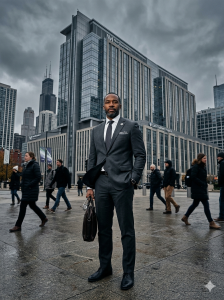
The Chicago morning hit like a wall—cold, sharp, and unforgiving. As I stepped out of the car onto the curb in front of Chicago Memorial Hospital, the wind cut straight through my coat, carrying the harsh mix of lake air and diesel. It was the exact opposite of Los Angeles’ artificial warmth, and I welcomed it. The cold felt honest. It cleared my head and sharpened my focus after a sleepless flight.
I paused, looking up at the towering glass structure that had been my world for the past decade. My name wasn’t on it, but my work was embedded in every floor. I had built the cardiothoracic program into something unmatched. I had spent years inside those walls, saving lives, pushing limits, sacrificing everything else.
And now, standing there under suspension, I felt like an outsider.
I didn’t look like one.
My suit was flawless. My posture steady. In my hand, my briefcase—ordinary to anyone else, but to me, it held everything I needed.
I stepped inside.
The lobby was quieter than usual, but the tension was immediate. Security avoided eye contact. Residents went silent. Conversations stopped mid-sentence.
Word had spread.
I wasn’t part of the system anymore.
I didn’t turn toward my office. I headed straight for the executive elevators. I scanned my badge—there was a brief pause—and then a green light.
Still active.
The doors closed, and I rode up in silence. Floor by floor, I let everything from the past 24 hours fall away. By the time the elevator opened on the 22nd floor, there was no hesitation left.
Only intent.
The hallway was quiet, insulated from the rest of the hospital. At the end stood the boardroom doors. Voices murmured behind them.
I didn’t knock.
I pushed the doors open hard enough that they slammed against the walls.
The room went silent instantly.
Fourteen people turned to look at me.
Arthur Sterling stood at the head of the table, composed but visibly tense. Bryce Bentley sat nearby, relaxed, confident.
“Marcus,” Sterling said, forcing control into his voice. “This is a closed executive session. You are on administrative leave. You need to leave immediately.”
I walked forward anyway, letting the doors close behind me.
“I have every right to be here,” I said calmly. “You’re making decisions about my career without facts. That ends now.”
I placed my briefcase on the table.
Bentley leaned back, unimpressed.
“Dr. Stone,” he said, “I suggest you think carefully. We’re finalizing a settlement that allows you to step away quietly. If you disrupt that, we go to trial. And we will make serious allegations about your conduct.”
I looked at him.
Calm. Direct.
“In my field,” I said, “we don’t jump to conclusions. We examine all the evidence before deciding what’s actually wrong.”
I opened the briefcase.
“You’ve built your case around one moment,” I continued. “But you ignored the full history.”
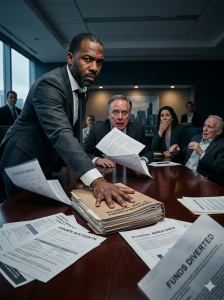
I took out a thick stack of documents and set them on the table, sliding them forward.
“These are internal records,” I said. “Multiple incidents. Patterns of behavior. Complaints that were documented long before this flight.”
The room shifted.
Board members reached for the files, flipping pages, scanning details.
The confidence in the room started to crack.
What had been presented as a simple narrative—one incident, one accusation—was no longer holding.
I stood there, steady, watching as the story began to change.
“Your so-called innocent victim, Sarah Jenkins, didn’t simply ‘drop a plate’ on my flight because she felt intimidated,” I said, projecting my voice so that every person in the room could hear the unvarnished truth. “In 2019, while employed by Delta, she was formally disciplined and suspended without pay after aggressively refusing to serve a Latino family in Premium Economy, falsely accusing them of ‘smuggling’ alcohol onboard. In 2021, during her time with United, she was placed on a strict ‘behavioral watch list’ after attempting to have an elderly Sikh passenger forcibly removed by federal marshals for what she labeled ‘suspicious, threatening prayer’ before takeoff. And just eight months ago, she was written up for aggressively following a young Black college student into the lavatory area, accusing him of trying to smoke.”
I leaned forward, pressing my knuckles into the table, locking my gaze onto Bentley’s suddenly shaken expression.
“Every single time, Mr. Bentley, she relied on the exact same rehearsed, weaponized narrative. She claimed she felt ‘threatened.’ She claimed she felt ‘unsafe.’ She labeled minority passengers as ‘belligerent.’ She is not a casualty of class conflict or elite intimidation. She is a thoroughly documented, repeat offender—a bigot who hides behind her uniform and her tears to police the presence of minorities in spaces she believes they don’t belong.”
Around the table, the board members erupted into hushed but urgent conversation, rapidly flipping through the incriminating pages of the investigator’s meticulously assembled dossier. The carefully constructed narrative they had been too afraid to challenge only minutes earlier was now unraveling under the weight of undeniable proof.
Arthur Sterling’s face twisted into something unrecognizable. The confident flush drained instantly, replaced by a blotchy, sickly purple as panic set in. He looked like a man on the verge of collapse.
“This… this is completely irrelevant to the crisis this hospital is facing!” Bentley snapped, slamming his palm against the table, though his earlier confidence was visibly fading. “These records are sealed! You obtained them unlawfully! They’re inadmissible in court, and they don’t change the fact that the footage of you and my client is damaging this hospital’s reputation!”
“It establishes the foundation of the disease, Mr. Bentley,” I replied, my voice cutting cleanly through his rising panic and forcing silence back into the room. “It identifies the root cause. But you are correct about one thing—Sarah Jenkins’ actions are only a surface symptom. Let’s address the primary artery. Let’s talk about the hemorrhage that’s truly threatening this institution.”
I turned slowly, fixing my eyes on Arthur Sterling. He visibly recoiled, shrinking into his chair.
“Arthur,” I said, my voice lowering into a cold, dangerous whisper, “let’s discuss why you were so eager—so desperate—to settle this case immediately with someone whose history of racial bias is so thoroughly documented. Let’s talk about why you were willing to sacrifice your Chief of Surgery without even the most basic internal review.”
Reaching back into my briefcase, I withdrew a second, slimmer folder—far more lethal than the first. Instead of sliding it across the table, I held it up for everyone to see.
“These documents detail offshore accounts, shell corporations, and private financial holdings,” I announced, the silence in the room turning heavy and suffocating. “It appears, Arthur, that your connection with Mr. Bryce Bentley extends well beyond professional opposition.”
Sterling attempted to rise, his mouth opening and closing soundlessly, but no words came.
“According to these records,” I continued, reading aloud, “Arthur Sterling and Bryce Bentley are equal partners—fifty-fifty stakeholders—in a private medical litigation firm registered in the Cayman Islands. A firm positioned to collect a thirty-percent commission on the settlement Chicago Memorial is preparing to pay to Sarah Jenkins.”
A collective gasp rippled through the room. Several board members physically pushed back from the table, as though distance might shield them from the fallout.
“You weren’t protecting the hospital’s reputation, Arthur,” I said, my voice heavy with disgust. “You weren’t shielding donors from controversy. You saw my public humiliation—an act of blatant discrimination against one of your own—and recognized it as a financial opportunity. You engineered panic within this board, forced my suspension, and rushed toward a quiet settlement so you and Mr. Bentley could funnel millions into your own accounts. You turned my character assassination into a revenue stream.”
The silence that followed was absolute. Every member of the board stared at Arthur Sterling, the truth too clear, too documented, too complete to deny.
“This is—this is fabricated! Completely false!” Sterling finally choked out, his voice breaking under pressure. Sweat streamed down his face, destroying his composed appearance. “He’s lying to save himself! These documents are forged! I’ll sue you for defamation, Marcus—I’ll ruin you!”
“No, Arthur,” I said calmly, my voice returning to a precise, clinical tone. “It’s a biopsy. And the results are back. The tumor is malignant. And it’s about to be removed.”
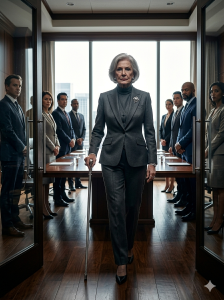
At that exact moment, the heavy mahogany doors swung open once more.
Three figures entered the room with quiet authority.
They weren’t doctors. They weren’t attorneys. They were the primary legacy donors—the individuals whose wealth sustained the very foundation of the institution.
At the front was Eleanor Vance.
She moved with measured precision, her silver-tipped cane striking softly against the floor, her posture unwavering, her gaze sharp and uncompromising.
As she approached the table, every board member rose instinctively, driven by respect—and fear.
She didn’t acknowledge Sterling. She didn’t spare Bentley a glance.
Instead, she walked straight toward me and stopped a few feet away, lifting her gaze to meet mine.
“Dr. Stone,” she said, her voice a commanding blend of gravel and grace.
“Mrs. Vance,” I replied quietly, inclining my head.
“I stayed up most of the night,” she said, addressing the room while still looking at me. “I watched that disgraceful video. I read your op-ed in the London journal. And I reviewed the materials you sent to my office at three in the morning.”
Only then did she turn.
Her body pivoted slowly, her cane grounding her as she fixed her gaze on Arthur Sterling with unmistakable contempt.
“And I now understand—completely—what this board has attempted to do to the man who gave me five more years with my grandchildren,” she declared, her voice echoing across the room.
She stepped closer, her eyes locking onto him.
“Arthur,” she said firmly, leaving no room for argument, “you have ten minutes to gather your belongings and leave this building. If you are still here in eleven, I will withdraw the entire Vance Family Endowment—all four hundred million dollars. I will personally ensure federal charges are brought against you, and I will dismantle what remains of your career.”
She paused briefly, glancing at the two donors behind her, who nodded in silent agreement.
“And they will do the same,” she added. “This ends today.”
Arthur Sterling’s collapse was immediate.
There was no resistance. No argument. No attempt at defense. He understood, with chilling clarity, that he had been completely and permanently removed from power.
He stood shakily, his face drained of all color, and without meeting anyone’s eyes, he turned and hurried out through the side door.
Bryce Bentley wasted no time. He grabbed his briefcase, hastily stuffing in his papers, and rushed out behind him—his confidence gone, his opportunity vanished.
The tension in the room finally broke, leaving behind a shaken group of executives who looked as though they had just survived a disaster.
The Vice Chair slowly rose, clearing his throat, his composure fragile.
“Dr. Stone… Marcus,” he began, his voice unsteady, “we made a grave mistake. A catastrophic failure in judgment. We allowed fear—and Arthur’s influence—to dictate our actions.”
He swallowed, meeting my gaze.
“Your suspension is lifted immediately. We will issue a full public apology and a formal statement affirming our complete support for you and your leadership as Chief of Surgery.”
I looked around the table at the men and women who had nearly sacrificed me.
They were not strong.
But they were no longer dangerous.
“Keep the public apology,” I said coolly, reaching down to secure the latches on my leather briefcase. “The internet’s opinion does not define my excellence. But I have two non-negotiable conditions before I leave this room and return to my patients.”
“Anything, Doctor. Absolutely anything,” the Vice Chair responded immediately, his tone urgent, eager to satisfy the donors standing behind me.
“First,” I said, my voice firm and precise. “I require the creation of a substantial, well-funded public trust in this hospital’s name, seeded with no less than ten million dollars in corporate funds. This trust will be dedicated entirely to providing legal defense and support for medical professionals of color who face systemic discrimination and corporate retaliation.”
“Agreed,” the Vice Chair replied without hesitation, nodding quickly. “We’ll have legal begin drafting the charter today.”
“Second,” I continued, narrowing my gaze. “I want a formal, detailed letter drafted and delivered by courier to the Federal Aviation Administration, the Airline Pilots Association, and the airline’s CEO. Every member of this board—and Mrs. Vance—will co-sign it. The letter will fully exonerate Captain James Miller, affirm that he acted heroically in protecting a passenger from an unprovoked assault, and formally recommend his immediate reinstatement with full back pay and public recognition.”
The Vice Chair didn’t pause. “Consider it done, Marcus. I’ll draft it personally before lunch.”
I turned my eyes toward Eleanor Vance. She gave a single, decisive nod.
That was enough. My work here was complete. The malignant tumor had been removed from the institution’s leadership. The primary artery of corruption had been identified, clamped, and cut. The bleeding had stopped.
I turned and walked out through the heavy mahogany doors, leaving the boardroom—and its chaos—behind.
As I made my way down the long, quiet hallway toward the elevators, the air itself felt lighter. For the first time in two days, I could breathe deeply. The flawed logic of the outside world hadn’t changed—there would always be people like Sarah, driven by prejudice, and men like Arthur, eager to profit from it. The hierarchy of race and class was far too deeply rooted to vanish overnight.
But today, in this building, truth had carried more weight. Today, the system had been forced to yield to excellence.
When I reached the elevators and pressed the button, my phone vibrated sharply in my pocket. I pulled it out. A FaceTime call.
Caller ID: James Miller.
I inhaled, steadying myself, then accepted the call.
Captain James Miller’s face filled the screen. He wasn’t in civilian clothes—he stood in a bright, sunlit kitchen, dressed in his crisp captain’s uniform, four gold stripes gleaming. He looked years younger.
Behind him, perched at the kitchen island, was Lily—eyes bright, hair messy, wearing a hospital recovery gown over her clothes. She grinned and waved a stuffed teddy bear enthusiastically at the camera.
“Marcus!” Miller’s voice burst through the speaker, full of joy. “I don’t know what kind of miracle you pulled in Chicago, but my union rep just called me five minutes ago!”
“Did you get the news, James?” I asked, a genuine smile finally breaking through.
“I’m back on the schedule! Fully reinstated! Investigations dropped!” he said, laughing, brushing a tear from his cheek. “And it gets better—Sarah Jenkins. The airline’s legal team is filing a federal countersuit against her and Bryce Bentley for fraud, extortion, and breach of contract. They’re going after them hard.”
A tight knot formed in my throat as I looked at Lily, her small, repaired heart beating strong.
“I’m glad, James,” I said quietly. “You earned those wings. Give Lily a hug for me.”
“I will. I promise,” he replied, his expression softening. “And Marcus… thank you. For everything. But especially… for not letting them throw the plate.”
“Safe flight, Captain,” I said, and ended the call.
I stepped into the elevator and rode down to the surgical level. When the doors opened, I was greeted by the familiar, sterile scent of antiseptic and clean linen.
I walked past the nurses’ station. The same staff who had avoided my gaze earlier now looked at me with wide, relieved smiles. Word had clearly spread.
I nodded and kept moving.
Straight to the surgical prep room.
A 1:00 PM transplant was waiting. Somewhere above, a helicopter was carrying a viable human heart—time-sensitive, fragile, essential.
The human heart didn’t care about first-class disputes. It didn’t care about viral outrage or public perception. It didn’t care about medals—or the color of the hands that would hold it.
It only wanted to beat.
To live.
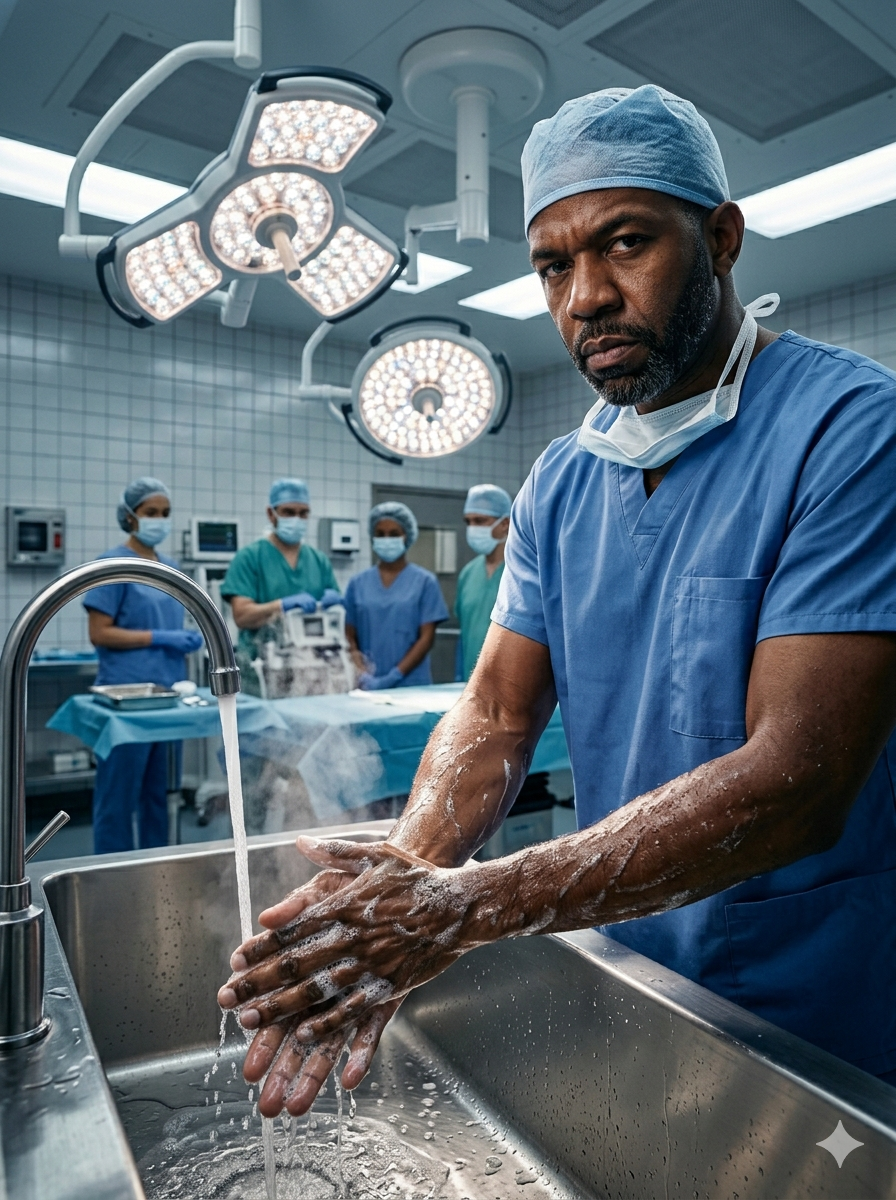
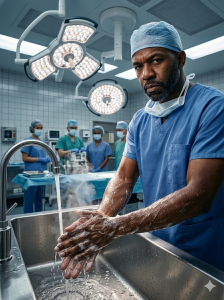
I removed my charcoal suit jacket, draping it carefully over a chair, and rolled up my sleeves. At the scrub sink, I pressed the pedals. Hot water surged out.
I pumped iodine soap into my hands and began the familiar ritual—methodical, precise, grounding.
As I scrubbed to my elbows, feeling the heat and the sting of antiseptic, a deep calm settled over me.
Looking at my hands, I understood something clearly.
Dignity isn’t something others can take.
They can humiliate you. Misrepresent you. Try to bury your name beneath lies and profit from your pain.
But they cannot touch what you’ve built through years of discipline, sacrifice, and mastery.
Excellence is armor.
And it holds.
I rinsed, keeping my hands elevated, sterile. I nudged the OR door open with my hip.
Inside, Operating Room 1 waited—cool, bright, precise. The overhead lights blazed. The heart monitor pulsed steadily.
My team stood ready—silent, focused, waiting.
They looked at me with absolute trust.
I stepped forward, approaching the table, looking down at the patient beneath the drapes.
I inhaled deeply.
The noise of the world disappeared.
I extended my hand, steady and sure.
“Scalpel,” I said.
And just like that, everything made sense again.
The world outside could remain chaotic, unfair, and flawed.
But in this room—
I restored order.
It was time to heal.
I shifted my gaze deliberately, fixing it on Arthur Sterling. He flinched, retreating into his chair.
“Arthur,” I said, my voice lowering into a cold, cutting whisper. “Let’s discuss, openly and honestly, why you were so eager—so desperate—to settle out of court with someone who has a well-documented record of racial bias. Let’s examine why you were so quick to sacrifice your Chief of Surgery without even conducting a basic internal review.”
I reached back into my leather briefcase and withdrew a second, smaller set of documents bound in a black folder—far more dangerous than the first. Instead of sliding them across the table, I held them up for everyone to see.
“These are deeply buried offshore banking records, shell company filings, and private asset registrations,” I announced, as a suffocating silence filled the room. “It turns out, Arthur, your relationship with Mr. Bryce Bentley extends far beyond simple legal opposition.”
Sterling attempted to rise, his mouth opening and closing uselessly, like a fish gasping for air, but no words came.
“According to these documents,” I continued, reading from the top page, “Arthur Sterling and Bryce Bentley are equal co-investors—fifty-fifty partners—in a concealed medical litigation holding firm based in the Cayman Islands. A firm positioned to collect a thirty-percent commission on the multi-million dollar settlement Chicago Memorial is preparing to pay Sarah Jenkins.”
A collective gasp rippled across the table. Several board members physically recoiled, pushing their chairs back as if proximity to Sterling itself was dangerous.
“You weren’t trying to ‘protect the hospital brand,’ Arthur,” I said, my voice laced with unfiltered contempt. “You weren’t shielding donors from controversy. You saw my public humiliation—an act of blatant racism against your own physician—and recognized it as a financial opportunity. You pressured this board into panic, forced my suspension, and rushed toward a quiet settlement so you and Mr. Bentley could funnel millions of hospital dollars into your private accounts. You orchestrated and profited from my professional destruction.”
The silence that followed was absolute.
Every board member turned in unison toward Arthur Sterling. The logic of the betrayal was too precise, too well-supported, too undeniable for spin or deflection.
“This… this is fabricated! A complete lie!” Sterling finally choked out, his voice cracking under pressure. Sweat streamed down his face, disrupting his carefully maintained composure. “He’s inventing this to save himself! These documents are forged! I will sue you for slander, Marcus! I will destroy you!”
“No, Arthur. It’s a biopsy,” I replied calmly. “And the results are in. The tumor is malignant. And it’s about to be removed.”
Right then, as if on cue, the massive mahogany doors at the rear of the room swung open.
Three figures entered slowly and with purpose.
They weren’t doctors. They weren’t lawyers. They were the three principal legacy donors I had contacted overnight from Los Angeles—the individuals whose immense fortunes quite literally sustained this institution.
At their head was Eleanor Vance.
Eighty years old, she carried herself with unwavering strength—steel wrapped in elegance. Her late husband’s name was engraved in gold on the very wing we stood in. She walked with a silver-tipped cane, posture straight, gaze sharp.
As she approached the table, every board member rose instinctively—out of respect, and fear.
Eleanor didn’t glance at Sterling. She ignored Bentley entirely.
She walked straight toward me and stopped a few feet away, looking up into my eyes.
“Dr. Stone,” she said, her voice a striking blend of gravel and silk, commanding the room without effort.
“Mrs. Vance,” I replied with a slight nod.
“I stayed up very late last night,” she said, addressing the room while keeping her eyes on me. “I watched that appalling video. I read your clinical op-ed in the London journal. I reviewed the emails and financial records you sent at 3:00 AM.”
Then she turned—slowly—toward Arthur Sterling.
The contempt on her face was absolute.
“And I now understand, with complete clarity, what this board has attempted to do to the man who gave me five more years with my grandchildren,” she said, her voice echoing like thunder.
She stepped closer, locking onto Sterling.
“Arthur,” she said, leaving no room for negotiation, “you have ten minutes to gather your belongings and leave this building. If you are still here in eleven minutes, I will withdraw the entire Vance Family Endowment—all four hundred million dollars. I will personally ensure you are federally indicted for embezzlement, and I will dismantle whatever remains of your life.”
She paused, glancing at the two donors behind her. They nodded once.
“And I assure you,” she continued, addressing the board, “my colleagues are prepared to do the same. This ends today.”
Sterling’s collapse was immediate—and pitiful.
He didn’t argue. He didn’t resist. He didn’t even attempt a defense.
He knew.
In the brutal ecosystem of elite power, he had just been erased.
He rose unsteadily, his face drained of all color, and fled through a side door without looking at anyone.
Bryce Bentley followed instantly, scrambling to gather his belongings, retreating like a rat abandoning a sinking ship. His lucrative deal had vanished.
The suffocating tension in the room finally broke.
The Vice Chair, a normally quiet man, stood slowly, wiping sweat from his forehead.
“Dr. Stone… Marcus,” he said, voice trembling, “we made a catastrophic error. We allowed fear to override judgment. Your suspension is lifted immediately. We will issue a full public apology and formally reaffirm our support for your leadership.”
I looked at them—fearful, shaken, but no longer dangerous.
“Keep the apology,” I said, closing my briefcase with a firm click. “Public opinion does not define my excellence. But I have two conditions before I return to my patients.”
“Anything,” the Vice Chair said quickly.
“First, establish a fully funded public trust—no less than ten million dollars—to provide legal support for medical professionals of color facing discrimination and retaliation.”
“Done.”
“Second, draft and deliver a formal letter to the FAA, the Airline Pilots Association, and the airline’s CEO. It must fully clear Captain James Miller, recognize his actions as protective and honorable, and recommend immediate reinstatement with full back pay and recognition.”
“Consider it done.”
I glanced at Eleanor Vance. She nodded once.
The work was complete.
The tumor had been removed.
I turned and walked out.
…
As I moved down the hallway, the air felt lighter. The system hadn’t changed—but today, truth had forced it to bend.
My phone rang. James Miller.
I answered.
He stood in uniform, smiling, Lily behind him waving.
“I’m reinstated!” he said. “And the airline is countersuing Sarah Jenkins and Bryce Bentley.”
I smiled. “You deserve it.”
After the call, I returned to the OR.
Because none of that noise mattered here.
Only one thing did.
I held out my hand.
“Scalpel.”
And just like that, the world made sense again.
THE END.
