Chapter 1
The insult hit the packed lecture hall like a gunshot cracking through silence.
Forty pairs of eyes snapped toward the back row, and the room locked into such stillness that even the old vents above seemed to forget how to breathe.
“Who let this black kid into my classroom?”
Professor Leonard Hartwell’s voice echoed off the high walls with the assurance of a man who had never once been made to answer for himself.
He stood at the front beneath the projector light, silver hair combed with military precision, navy blazer sharply pressed, gold watch flashing at his wrist.
For twenty-three years, he had ruled Hensley University’s mathematics department without challenge.
His work was cited everywhere.
His name opened doors, shut down inquiries, and made uneasy administrators conveniently forget what they had heard.
He pointed toward the back row.
“You. Stand up. The black one.”
A low wave of murmurs passed through the hall, then collapsed into silence.
Isaiah Parker rose without a word.
Nineteen years old.
Slim, motionless, dark hoodie half-zipped over a plain white shirt, hands relaxed at his sides, eyes calm and unreadable.
Hartwell let the silence stretch until it became uncomfortable.
Then he smiled.
“Well, look at this,” he said, turning slightly so the entire room could share the moment.
“A black face in advanced number theory. I suppose miracles do happen.”
A few uneasy laughs broke through the tension.
Most students lowered their gaze to their notebooks, suddenly captivated by empty pages.
Hartwell stepped closer to the front row, his voice dropping into something sharper and more deliberate.
“Tell me, Isaiah, did your welfare case worker fill out your application, or did some diversity committee drag you in here to meet a quota?”
Someone whispered, “Oh my God.”
Another student quietly reached for a phone beneath the desk.
Isaiah did not react.
Did not move.
Did not interrupt the professor’s performance.
Hartwell mistook the silence for weakness.
Men like him always did.
He picked up a piece of chalk and turned toward the blackboard with practiced theatricality.
“I’m going to write a problem so difficult that PhDs have failed it, postdocs have dodged it, and geniuses have spent months pretending it was beneath them.”
The chalk screeched across the board.
Symbols filled the space in dense layers, like barbed wire drawn in mathematical form.
A few students leaned forward.
Even those who disliked Hartwell could not deny his skill.
When he finished, he tapped the final expression and faced Isaiah again.
“And you, Mr. Parker, are going to explain to this room why black kids don’t belong in real mathematics.”
The air inside the hall felt poisoned.
No one moved. No one breathed.
Isaiah looked at the equation.
Then at Hartwell.
And for the first time, something unfamiliar flickered behind the professor’s smug expression.
Not remorse.
Not conscience.
Recognition.
It disappeared so fast that almost no one would have noticed.
But Isaiah did.
Hartwell noticed that he noticed.
And something beneath the arrogance shifted into fear.
Chapter 2
Isaiah walked slowly down the aisle, each step steady and controlled.
The room watched him as though observing a moment they could not interrupt.
Hartwell crossed his arms.
“Take your time. I know this must be overwhelming.”
Isaiah stopped in front of the board.
The problem was constructed with deliberate cruelty, a distorted piece of analytic number theory Hartwell had once boasted about at conferences after too much wine.
Except Isaiah had already seen it.
Not in a classroom.
Not in any textbook.
In a locked cedar box in his mother’s closet.
Wrapped in aging paper marked with a name stamped across the top.
LEONARD HARTWELL.
When Isaiah was twelve, curiosity had taken him where grief should have kept him away.
It had been two weeks after his mother died.
He had found letters, photographs, and old notebooks filled with proofs written in two distinct hands.
One belonged to his mother, Dr. Lena Parker, brilliant and nearly forgotten.
The other belonged to Professor Hartwell.
Younger then. Hungrier.
On the back of one photograph, in his mother’s careful handwriting, were seven words Isaiah had never forgotten.
He promised he would make things right.
He never did.
Isaiah reached for the chalk.
Behind him, Hartwell gave a quiet laugh.
“Don’t embarrass yourself,” the professor said.
“Although I suppose that would imply you were capable of shame.”
The first line Isaiah wrote was precise and clean.
A reframing so elegant it made three graduate students in the front row sit upright.
The second came faster.
The third drew an audible reaction from the room.
Hartwell’s smirk tightened.
“That route doesn’t work,” he said quickly.
Isaiah continued writing.
It worked perfectly.
He removed a false dependency Hartwell had intentionally inserted to disguise the proof’s structure.
Then he split the expression along a symmetry so clear that students began looking at the professor instead of the board.
“What is he doing?” a girl whispered.
A boy beside her replied, “He’s fixing it.”
Hartwell stepped forward, his voice tightening.
“This isn’t a seminar, Mr. Parker.
You do not improvise on my board.”
Isaiah wrote again.
Then again.
The lecture hall seemed to shift around him.
Humiliation had entered wearing Isaiah’s face, but now it was moving back toward the man who had called it forth.
By the time Isaiah reshaped the core expression into something solvable, even the students recording on their phones had stopped holding them steady.
Hartwell’s breathing grew uneven.
He recognized the proof.
Not as brilliance.
But as structure.
Because every step Isaiah made carried the unmistakable imprint of Lena Parker.
Isaiah set the chalk down and turned.
Hartwell forced a laugh that cracked at the edges.
“So,” Hartwell said, “you memorized a derivation. That proves nothing.”
Isaiah spoke at last, his voice low enough that the entire room leaned in.
“No,” he said.
“What proves something is that you changed her notation but forgot her instinct.”
The words cut through the room.
Hartwell went pale.
“Excuse me?” he asked.
But it wasn’t anger in his voice.
It was fear.
Isaiah looked at him with a calm so complete it felt merciless.
“You heard me, Professor.”
And in the third row, a student who had been recording since the first insult lowered her phone and whispered, “Who is her?”
Chapter 3
For a full second, Hartwell and Isaiah locked eyes while the entire room seemed to stop breathing.
Then Hartwell laughed again, louder this time, as if volume alone could smother the rising panic.
“This is absurd,” he snapped.
“An undergraduate shows up, scribbles on a board, and now he thinks he can invent drama.”
Isaiah turned to face the class instead of him.
“My mother never invented drama,” he said.
“She invented mathematics.”
The statement struck the room harder than the earlier insult.
Quietly, names began to pass between students like sparks catching in dry brush.
Isaiah spoke on before Hartwell could cut in.
“Lena Parker. Doctorate from Yale. Published twice before she turned twenty-eight. Recruited here as a junior researcher twenty years ago.”
In the front row, a student was already typing rapidly.
No results appeared.
Another student whispered, “I’ve never heard of her.”
Isaiah responded without looking at him.
“That’s because her work disappeared.”
Then he turned back to Hartwell.
“My mother used to say the worst theft isn’t stealing someone’s answer.”
“It’s stealing their future.”
Hartwell slammed his briefcase down onto the desk.
“That is enough.”
But it wasn’t enough.
Not anymore.
Isaiah reached into his hoodie pocket and pulled out a folded photograph, its edges worn soft with time.
He raised it for the room to see.
Inside it, a younger Hartwell stood beside a woman with sharp eyes, a tired smile, and a stack of handwritten notes held to her chest.
On the back, faint but still visible from the front rows, was the same date as the earliest proof in the cedar box.
“Where did you get that?” Hartwell asked.
His voice had shifted, becoming almost childlike.
“From my mother’s things,” Isaiah said.
“The same place I found the letters.”
“The same place I found the drafts with her original proof and your notes in the margins.”
The students no longer pretended not to watch.
Several phones were now openly raised.
One of Hartwell’s teaching assistants half-stood from his seat, pale and trembling.
He understood exactly what this could lead to.
Hartwell forced a sneer back into place.
“Even if such papers exist, you have no idea what collaboration looks like.”
“You’re a boy playing in grown people’s history.”
Isaiah’s expression hardened for the first time.
“She died three months after filing a complaint to the department.”
“She said someone stole her proof, erased her name, and threatened to blacklist her.”
A stunned silence spread through the hall.
The fluorescent lights buzzed overhead like trapped insects.
“She was told there wasn’t enough evidence,” Isaiah said.
“She lost funding. Lost her position. Lost everything she had built.”
“And one year later, you published the theorem that made your career.”
Hartwell lunged toward the photograph.
Isaiah stepped back before he could touch it.
Three students gasped.
A chair scraped loudly across the floor.
“Careful, Professor,” Isaiah said.
“You’re on camera now.”
Hartwell looked around.
At the raised phones.
At the shocked faces.
For the first time in his adult life, it seemed he understood that power was not a wall.
It was only a costume.
And the room had just watched it tear apart.
Then the door at the back of the lecture hall opened.
Every head turned.
An older woman in a dark suit entered with a campus security officer at her side.
Silver curls framed a face sharpened by anger.
Professor Evelyn Shaw.
Chair of the university ethics committee.
Former dean.
Hartwell opened his mouth.
No words came.
Shaw’s gaze moved from the board to Isaiah, then to the cluster of recording phones.
Finally, she looked at Hartwell.
“Leonard,” she said evenly, “what exactly is happening in my university?”
Chapter 4
Hartwell’s brilliance had always come with a single advantage: when trapped, he lied quickly.
“This student disrupted my class,” he said immediately.
“He is making dangerous accusations based on stolen materials and fabricated family mythology.”
Shaw didn’t react at all.
“Is that why half your students are crying?”
Hartwell turned, and only then did he seem to register the damage he had caused.
A young woman in the second row had tears streaming down her face.
A graduate assistant looked like he might be sick.
Even Hartwell’s supporters were now watching him with open disgust that couldn’t be reversed.
Isaiah stepped forward.
“I didn’t come here to make a speech,” he said.
“I came because this was my mother’s room.”
All eyes shifted upward.
The plaque beside the door suddenly carried weight.
Hartwell Seminar Hall.
Donated by alumni, named after its most celebrated scholar.
Isaiah’s jaw tightened.
“She taught in this room before he had it renamed.”
“She told me once, when I was little, that equations remember who loved them first.”
Shaw’s expression shifted subtly.
Something in her hardened composure cracked.
“You’re Lena’s son,” she said softly.
Isaiah nodded.
A shadow of memory crossed her face.
“I thought you were in Chicago.”
“I was,” Isaiah said.
“Until a package arrived last month.”
He reached into his backpack and pulled out a thick envelope.
Not documents.
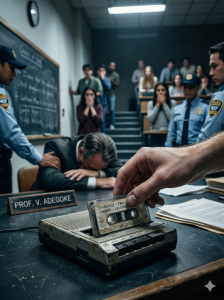
A cassette tape.
Hartwell took an unsteady step back.
No one missed it.
“My mother mailed copies of everything to someone she trusted before she died,” Isaiah said.
“That person passed away six weeks ago.”
“The envelope came to me with a note that said: If you’re ready, finish it.”
Shaw stared at the tape.
“What’s on it?”
Isaiah kept his eyes fixed on Hartwell.
“A recorded meeting between my mother and Professor Hartwell.”
“The day she confronted him.”
The room fell into absolute silence, broken only by the faint click of the security officer’s radio.
Hartwell raised a shaking hand.
“That tape means nothing,” he said too quickly.
“It could be edited. Manufactured. This is blackmail.”
Isaiah gave a faint, humorless smile.
“She says the date out loud.”
“So do you.”
Hartwell’s eyes flicked toward the exit as if measuring escape.
Security immediately tracked the movement.
Shaw stepped into the aisle.
“No one is leaving.”
Hartwell’s expression darkened.
“You don’t have authority to stage a trial in front of students.”
“No,” Shaw replied.
“But I do have authority to suspend you before lunch.”
A wave of shock moved through the room.
Hartwell pointed at Isaiah, his hand trembling.
“You planned this,” he hissed.
“From the moment you enrolled.”
Isaiah looked at him for a long moment.
Then he said something no one expected.
“I didn’t enroll.”
Confusion spread instantly.
Hartwell blinked.
“What?”
Isaiah didn’t look away.
“I’m not a student at Hensley University, Professor.”
“I never was.”
Whispers erupted across the lecture hall.
Shaw’s attention snapped fully onto him.
Isaiah reached into his pocket and placed a second ID card on the desk beside the cassette.
Dark blue.
Federal seal.
Hartwell stared at it.
So did everyone else.
Isaiah finally said it plainly.
“My name is Special Investigator Isaiah Parker.”
“I’m here with the Department of Education’s Office of Civil Rights.”
Hartwell’s knees nearly gave way.
But Isaiah still wasn’t finished.
“Your lecture this morning wasn’t the investigation,” he said.
“That was just the confession.”
Chapter 5
The silence that followed felt almost unreal, as if the room itself had detached from reality.
Then everything broke at once.
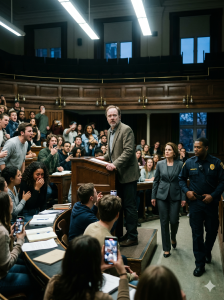
Students shouted over one another.
Phones shot higher into the air.
Somewhere near the back, a stunned laugh escaped in disbelief.
Hartwell gripped the desk so tightly his knuckles turned white.
“No,” he whispered.
“No, that’s impossible.”
Isaiah slid the identification card forward.
“It’s very possible.”
“Especially after three former faculty members, two graduate researchers, and one retired archivist gave sworn statements naming you.”
Shaw stared at Hartwell as if she were looking at someone already gone.
“How long?” she asked.
Isaiah answered without hesitation.
“Longer than anyone wanted to admit.”
“Intellectual theft, racial discrimination, retaliation, falsified authorship records, destroyed complaints.”
Hartwell’s lips shook.
“That tape—”
“Has already been authenticated,” Isaiah said.
“The copies of Lena Parker’s drafts have too.”
“So has the metadata on your publication revisions.”
Hartwell scanned the room, searching desperately for even a single ally.
There was none.
Not among the students he had intimidated.
Not among the assistants who once admired him.
Not even Professor Shaw, who now looked at him with a disgust sharpened by betrayal.
“You knew,” Isaiah said quietly.
“You knew exactly what she was worth.”
“That’s why you stole from her.”
Hartwell’s voice broke.
“She was brilliant, yes, but she was unstable, angry—”
Shaw’s hand struck the desk. The sound made half the room flinch.
“Do not,” she said, each word like ice, “speak of her that way again.”
Hartwell froze.
And in that stillness, something inside him seemed to collapse.
Isaiah looked at the blackboard.
At the proof still faintly glowing under the lights.
“She solved it before you did,” he said.
“She solved it before you even understood what she was reaching for.”
“You didn’t build your legacy.”
“You buried hers and stood on top of the grave.”
Hartwell’s face twisted.
For a brief moment, something like shame broke through.
Then, unexpectedly, he laughed.
Soft at first.
Then louder.
The students recoiled.
Even Shaw looked unsettled.
Hartwell straightened, eyes bright with a fragile, unhinged relief.
“You still don’t understand,” he said.
“She gave it to me.”
Isaiah went still.
So did Shaw.
Hartwell laughed again, tears forming in his eyes.
“She gave me the proof because she loved me.”
“She knew what publication would do to a young woman with a child and no support.”
“She said I was better positioned to protect the work.”
Isaiah’s expression shifted.
Not to belief.
But to rage.
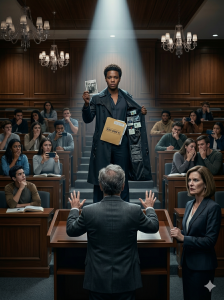
“You built that story in your head for twenty years,” he said.
“My mother filed a complaint.”
Hartwell held his gaze, smiling through collapse.
“No,” he whispered.
“She withdrew it.”
Isaiah’s grip tightened on the desk.
Shaw turned sharply.
“What?”
Hartwell swallowed.
“Check the archive.”
“She withdrew the complaint herself.”
“Because she found out the truth.”
Isaiah stared at him, something cracking for the first time.
“What truth?”
Hartwell’s eyes locked onto his.
“That you were my son.”
The room erupted into chaos.
A student screamed.
A phone dropped loudly to the floor.
Isaiah didn’t move.
Couldn’t.
Shaw looked sick.
The security officer took a stunned step back.
Hartwell was crying now, but still smiling faintly, as if relief and ruin had become the same thing.
“She told me she’d never let you know.”
“She said if I had any decency left, I would stay away.”
Isaiah’s heartbeat roared in his ears.
The room blurred at the edges.
Every letter in the cedar box.
Every photograph.
Every silence.
Rearranged into something unbearable.
Hartwell leaned forward, voice breaking.
“That proof on the board,” he whispered, “wasn’t just hers.”
“It was blood.”
Isaiah’s hand drifted toward the cassette tape like someone reaching for air underwater.
If Hartwell was lying, the tape would end him.
If he wasn’t, it would end Isaiah too.
Shaw stepped closer.
“Give me the tape.”
But Isaiah reached it first.
His fingers closed around the cassette.
The plastic trembled in his hand.
Inside it waited a truth that could destroy Hartwell completely—or reshape everything into something worse.
Isaiah looked at the man who had broken what remained of his past.
Then at the students, the phones, the board, the proof, the room his mother once stood in.
And with every eye on him, he lifted the tape toward the recorder on Hartwell’s desk.
Then he pressed play.