

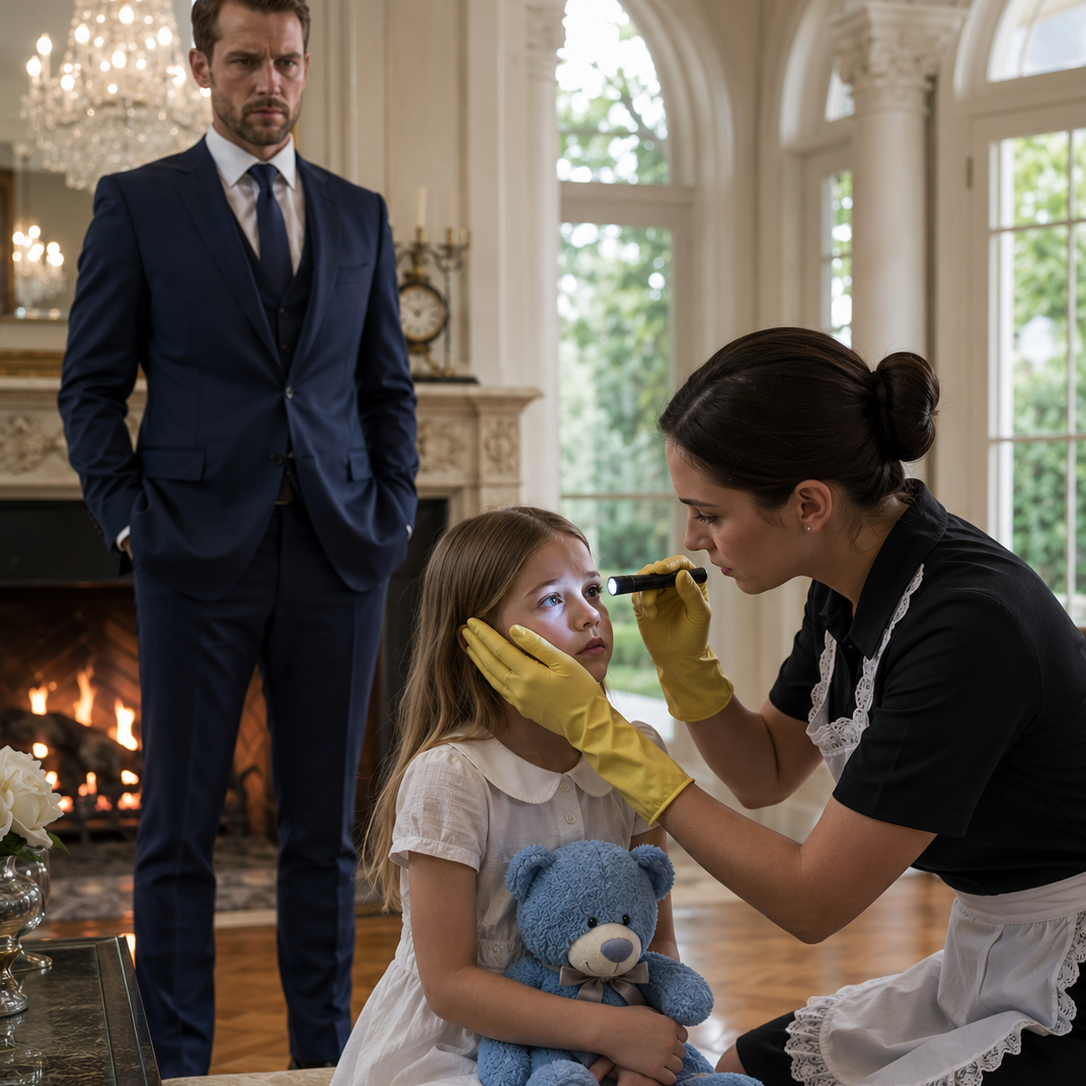
The Whitmore estate sat on the wooded edge of Greenwich, Connecticut, and its walls weren’t made of stone alone. They were made of silence—the kind so thick it seemed to press against your ribs.
For seven years, Jonathan Whitmore had lived inside that silence.
Ever since his wife, Caroline, had died in a car crash just weeks after their daughter was born, Jonathan had turned into a man ruled by routine and iron control. He led one of New York’s largest private equity firms with unforgiving precision. Markets were wary of him. Rivals gave him grudging respect.
But behind his own front door, he was simply a father in mourning.
His daughter, Amelia Whitmore, was seven.
And she was blind.
“Congenital blindness,” the top specialists in Manhattan had told him when she was still a baby. “Severe. Permanent.”
Jonathan had repeated those words so many times they’d hardened into fact.
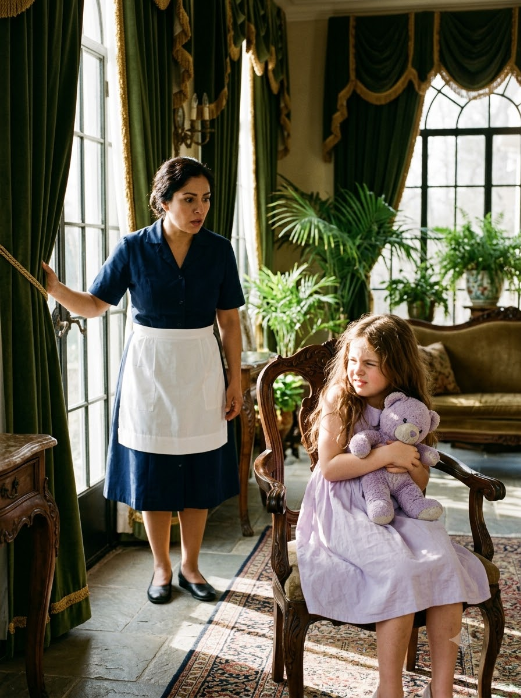
Amelia was soft-spoken and fragile, forever curled into the same corner of the sunroom, clutching a worn lavender teddy bear. Her wide hazel eyes never seemed to land on anything. She almost never smiled. Almost never spoke. Her gaze drifted somewhere past the world in front of her.
Each morning, Jonathan dressed her himself. He combed her fine brown hair and carried her out to the garden.
“This one’s yellow,” he’d murmur, guiding her small fingers toward a rose. “Bright, like the sun.”
She’d touch the petals softly—but her face stayed far away. Resigned.
Jonathan had buried his hope alongside his wife. All that was left was one purpose: shield Amelia from a world she’d never see. Keep her safe. Keep her closed off.
Until the day the silence cracked.
Her name was Elena Morales.
Elena hadn’t just been hunting for a job when she applied to be the live-in housekeeper—she’d been searching for something to anchor herself to. Six months before, she had lost her own son to leukemia. Grief had scooped her hollow. Taking care of someone else was the only thing keeping her upright.
When Jonathan interviewed her, he saw something familiar in her eyes: a person surviving loss.
He hired her on the spot.
From day one, Elena felt pulled toward Amelia. While she dusted shelves or polished silver, she’d watch the little girl—not with pity, but with a kind of instinct.
And she started noticing things.
One afternoon, as she yanked back the heavy velvet curtains, a hard beam of sunlight poured in and struck Amelia’s face.
The girl flinched.
Barely.
A slight tightening around her eyes. A small turn of her head, away from the light.
Elena went still.
Blind children don’t respond to sunlight that way.
Over the next week, she watched more closely.
She dropped a shiny spoon near Amelia. The girl’s pupils moved.
She flicked the hallway light on and off. A blink. A faint squint.
These weren’t the reactions of someone in total darkness.
They looked like the reactions of someone who could catch light—maybe even shapes.
Elena’s pulse quickened, hope and fear tangled together.
If she was right, everything Jonathan believed was false.
One stormy night, thunder shook the tall windows of the estate. Jonathan had gone up early with a migraine, leaving Elena to put Amelia to bed.
The house felt charged, almost humming.
Elena crouched down in front of the girl.
“Amelia, sweetheart,” she said gently. “I want to try something. I just need you to be brave for me.”
Amelia held onto her teddy bear but didn’t pull back.
Elena took out her phone.
Her hands trembled.
If Jonathan caught her, he might fire her on the spot for “experimenting” on his daughter. But she couldn’t unsee what she’d seen.
She switched on the flashlight.
A sharp white beam sliced through the dim room and landed straight in Amelia’s eyes.
For one long second—
nothing.
Then—
Amelia’s pupils contracted.
She blinked fast. Once. Twice. A third time.
Her face scrunched with discomfort.
And then, in a small, shaking voice, she said:
“It’s bright… it hurts.”
Elena gasped, tears already streaming down her face.
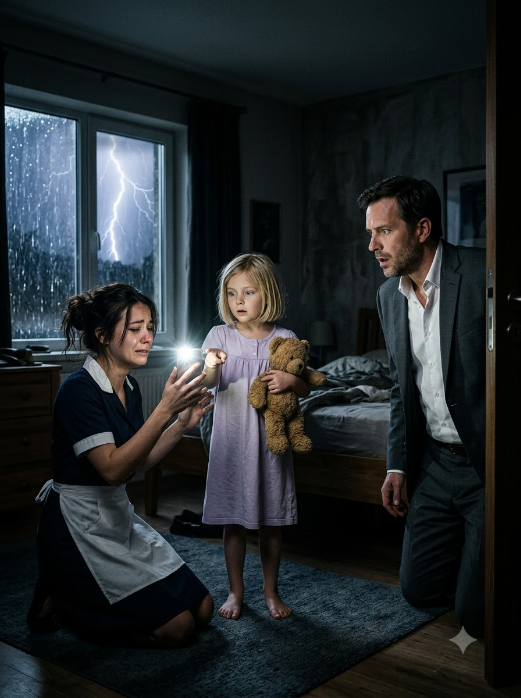
“She can see,” she breathed. “Oh my God… she can see.”
The bedroom door flew open.
Jonathan stood there, furious.
“What are you doing?!” he shouted, crossing the room. “I told you not to disturb her! Are you shining lights in her eyes?!”
He seized Elena’s arm, his rage stoked by years of fear and grief.
“You’re fired. Get out of my house.”
But before he could pull her out, Amelia did something she had never done before.
She got to her feet.
With unsteady but deliberate steps, she moved toward the sound of Elena’s voice.
“Daddy, stop!” she cried.
Jonathan froze.
Amelia never raised her voice. Never moved on her own.
She turned her face toward him—not sharply focused, but aimed right.
“Daddy… I saw the light. Miss Elena showed me the light.”
Jonathan sank to his knees.
“What did you say?” he whispered.
“Light,” Amelia said again, softer, pointing toward the phone. “I saw it.”
The floor seemed to tilt beneath him.
That night, no one slept.
Jonathan went straight to the bathroom cabinet where Amelia’s prescribed eye drops were stored. For seven years, a well-regarded ophthalmologist—Dr. Howard Klein, a trusted family advisor—had insisted they were essential for “managing internal eye pressure.”
Elena looked up the ingredients online.
Atropine. Cyclopentolate.
Given in high, sustained doses, they dilate the pupils and freeze focus—producing extreme light sensitivity and blurred sight.
Jonathan felt his stomach drop.
It hadn’t been fate.
It hadn’t been blindness.
It had been chemical suppression.
A slow, deliberate theft of sight.
Within a day, he’d brought in independent specialists to examine Amelia.
The truth landed like a blow: she’d had limited but real vision at birth. The ongoing medication had badly stunted her development.
Why?
Later digging uncovered malpractice, financial manipulation, and a disturbing pattern of control. Dr. Klein had kept Jonathan dependent on him—fragile, grieving, and unwilling to question, ever since Caroline’s death.
But in that moment, Jonathan wasn’t thinking about revenge.
He was thinking about his daughter.
He emptied every bottle of eye drops into the trash.
“We’re done living in the dark,” he said, pulling Amelia into his arms—and, without pausing, pulling Elena in too.
The weeks that followed felt like watching a miracle unfold in slow motion.
First, Amelia began making out blurred shapes.
Then colors.
One morning, Jonathan walked into the sunroom and found her standing at the window.
She pointed out at the yard.
“Green,” she said quietly.
Then at a rose.
“Red.”
Jonathan broke down—sobbing in a way he hadn’t even managed at Caroline’s funeral.
But these weren’t tears of loss.
They were tears of something handed back to him.
The heavy curtains came down. Sunlight poured through the mansion. Silence gave way to music, laughter, and small, wondrous discoveries.
Jonathan pursued legal action against Dr. Klein—and justice caught up with him.

But the real victory wasn’t in a courtroom.
It was watching Amelia race through the garden, chasing butterflies.
Elena never left.
She had walked into that house carrying her own grief—and ended up restoring sight not only to a child, but to a father.
Months later, Amelia handed Jonathan a drawing.
Three stick figures under a big yellow sun.
“Who’s that?” Jonathan asked.
“You, me… and Mama Elena,” she said simply.
Jonathan looked up at Elena—and in that quiet moment, something unspoken settled between them.
The real blindness had never been in Amelia’s eyes.
It had been in a father’s surrendered heart.
And sometimes, all it takes to change a life—to break through years of fear and silence—is one brave person willing to reach for the switch.
So tell me—
Are you someone who accepts the darkness?
Or someone who dares to look for the switch?
