

My phone vibrated on the conference table at 1:17 p.m.
I remember the exact time because the budget slide on the screen had frozen, and the little digital clock in the corner of my laptop looked crisper than anything else in that room.
The room smelled of burnt coffee, dry-erase markers, and that stale carpet odor every office develops when the air conditioning runs too long.

My manager was going over quarterly cuts.
Someone from accounting kept tapping a pen against a folder.
I saw my son’s name light up the screen and let it ring once, because that’s what responsible employees do in meetings where everyone pretends their outside lives don’t exist behind the glass walls.
Then the phone buzzed again three seconds later.
Noah was four.
He knew better than to call me at work unless something was wrong.
That wasn’t because I was strict with him.
It was because Noah was the kind of kid who treated small rules like promises.
He remembered to line his shoes up by the door.
He remembered to thank the crossing guard.
He remembered that if he missed me during the day, he was supposed to ask his mom to send a picture instead of calling.
So when his name flashed twice in a row, something cold spread through my chest before I even touched the screen.
I stood up with the phone already against my ear.
“Hey, buddy,” I said, keeping my tone soft since half the room was watching me. “You okay?”
At first there was only breathing.
Not steady breathing.
Wet, broken little gasps catching in his throat.
“Daddy,” he whispered.
I stepped away from the table.
“Noah? What’s wrong?”
“Please come home.”
The room behind me faded away.
The projector, the coffee cups, the spreadsheet, the people in button-downs watching me over their laptops.
All of it turned to noise.
“Where’s Mom?” I asked.
“She’s not here.”
His voice trembled on every word.
“Who’s with you right now?”
He tried to answer and broke down instead.
“Noah,” I said, slowing myself down. “Tell Daddy what happened.”
There was a short pause, like he’d glanced over his shoulder.
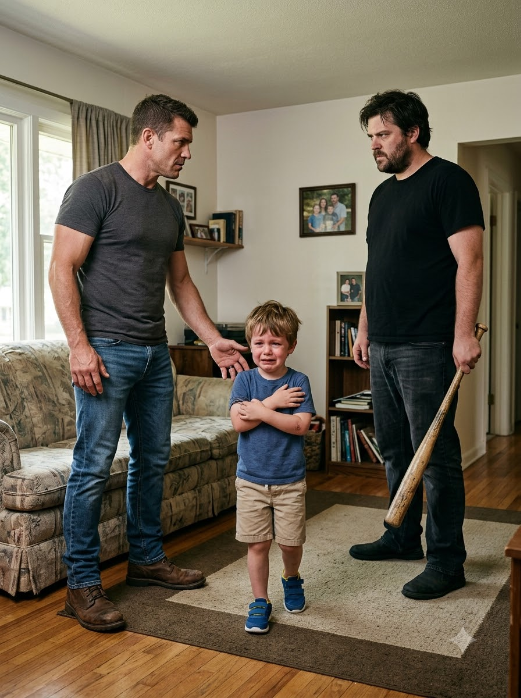
Then he whispered, “Mommy’s boyfriend… Travis… hit me with the baseball bat. My arm hurts really bad. He said if I cry he’ll hit me again.”
For a moment the sentence didn’t register.
I understood each word on its own.
Baseball bat.
Hit me.
Arm hurts.
Again.
But my mind refused to attach those words to my own child.
Then a man’s voice bellowed in the background.
“Who are you talking to? Give me that phone!”
Noah made a sound that still jolts me awake sometimes.
The line went dead.
The conference room fell completely silent.
A pen stopped tapping.
A chair creaked somewhere.
My manager said my name, but I was already halfway to the door.
My keys were in my right pocket.
My laptop stayed open on the table.
I don’t remember grabbing my jacket, though someone later told me I’d dropped it in the hallway and never looked back.
At the elevator, my hands shook so hard I hit the down button three times.
On an ordinary day, Lena’s house was twenty minutes from downtown.
During a weekday lunch rush, with delivery trucks, red lights, and construction, twenty could easily turn into thirty.
Noah was four years old.
He was alone with a grown man who had just hurt him.
Rage built in me so quickly it nearly became useless.
Rage wanted me to scream.
Rage wanted me to hurl the phone.
Rage wanted me to drive recklessly and become one more obstacle between my son and the help he needed.
But panic only serves the people who have no one counting on them.
I needed to act.
So I called my brother.
Derek picked up on the first ring.
“What’s going on?”
“Noah just called me,” I said.
The elevator opened and I bolted into the parking garage.
My shoes hit the concrete hard enough to echo.
“He said Travis hit him with a baseball bat. Lena’s not home. I’m twenty minutes out. Where are you?”
A beat of silence.
Then his voice shifted.
Derek had always stayed calm in emergencies.
When we were kids and I fell out of an oak tree, he ran for our mother without shedding a tear.
When my tire blew on the interstate years later, he arrived with a jack, a flashlight, and a thermos of coffee before I’d even finished apologizing.
He’d competed in regional MMA fights in his twenties, but that wasn’t what made him dangerous.
What made Derek dangerous was that he never needed to perform anger.
He went quiet instead.
“I’m about fifteen minutes from Lena’s,” he said.
“Go now.”
“Have you called 911?”
“Doing it right now.”
“On my way.”
He hung up before I could say another word.
By 1:20 p.m. I was in my car, one phone connected to emergency dispatch, the other line open, waiting for Derek to call back.
I gave the dispatcher everything.
Noah’s full name.
His age.
Lena’s address.
That Travis was an adult male.
That a baseball bat was involved.
That my son said he’d been threatened not to cry.
The dispatcher’s voice stayed even.
“Is the child breathing?”
“He was talking less than a minute ago,” I said. “Then the man took the phone.”
“Are you at the location now?”
“No. I’m driving there. My brother’s closer.”
“Sir, don’t enter the residence if the suspect is armed. Officers are on their way.”
I heard her.
I even understood why she had to say it.
But all I could picture was Noah’s bedroom with the blue dinosaur blanket, the bin of toy cars under the window, and the baseball glove I’d bought him that he still wore on the wrong hand.
Lena and I had been divorced for eleven months.
We weren’t enemies, but we weren’t friends either.
We’d learned to be civil in the driveway.
We’d learned to hand off a backpack without dredging up whatever had broken us.
We’d learned to sign the same school forms and stand near each other at preschool events without turning every small friction into proof the marriage had failed for a reason.
That was the part of divorce no one warns you about.
You can stop trusting someone with your heart and still have to trust them with your child.
Lena loved Noah — I never doubted that.
But love isn’t the same as judgment.
Travis had been in the picture about three months.
He was the type who smiled a beat too fast and stared a beat too long.
At pickups he’d stand behind Lena on the porch with his arms crossed, as if I were the inconvenience instead of Noah’s father.
I’d asked Lena once if she was sure about him.
She told me I was being controlling.
After that I kept quiet, not wanting every worry to turn into a custody battle.
That silence rode beside me in the car now like a second passenger.
At the first red light, I nearly ran it.
A school bus rolled through the intersection from the left, yellow and enormous and slow.
I pounded the steering wheel with the heel of my hand and forced myself to wait.
The dispatcher asked me to repeat Travis’s name.
I did.
She asked if there were weapons in the house.
“I don’t know,” I said. “Noah said baseball bat. That’s all I’ve got.”
The light changed.
I drove.
At 1:27 p.m., Derek called back.
I put him on speaker while the dispatcher stayed on the line.
“Two blocks out,” he said.
I could hear his engine.
I could hear his blinker.
I could hear the slow, deliberate breathing he used when he was fighting to keep adrenaline from making his choices for him.
“Police are en route,” I said. “Don’t go in swinging.”
“I’m not going in swinging.”
“Derek.”
“I’m getting eyes on Noah.”
The dispatcher said, “Sir, tell your brother not to go inside.”
I almost repeated it.
Then I pictured Noah on the floor, holding back tears because a grown man had warned him crying would get him hurt again.
“Derek,” I said, “what do you see?”
A few seconds passed.
Gravel crunched under his tires.
“Pulling up now,” he said.
His voice dropped.
“Your porch flag’s knocked sideways. Front door’s cracked open. I see Noah’s little blue sneaker on the steps.”
My vision narrowed.
“A sneaker?”
“The blue one.”
I’d tied that shoe myself two mornings earlier.
Noah had insisted he could do it himself, then knotted it so tight I’d had to pry it loose with a fork.
A small, silly memory.
The kind that becomes unbearable when you’re afraid there won’t be another one.
“Derek, wait for the officers,” I said, though I already knew he wouldn’t.
“I hear yelling in there.”
The dispatcher asked what he was hearing.
I relayed it as best I could.
Then, through Derek’s phone, a voice came from inside the house.
Travis.
Muffled, furious.
“I told you to shut up!”
Then Noah screamed.
It didn’t last long.
It cut off as if he’d clamped his own hand over his mouth.
Derek said one word.
“Move.”
He didn’t yell it.
He didn’t curse.
He said it like a door swinging shut.
“Who the hell are you?” Travis snapped.
Something scraped across the floor.
I heard Derek step inside.
“Noah,” he said, “look at me. Come toward my voice.”
My son sobbed, “Uncle Derek?”
I had to pull over for a second because my hands could no longer be trusted on the wheel.
Cars honked behind me.
I didn’t care.
“That’s right, buddy,” Derek said. “Come here. Slow.”
Then his tone sharpened.
“Hands where I can see them, Travis.”
That told me everything about the room.
Derek could see Travis’s hands.
He could see the bat.
He could see Noah close enough to danger that he was picking every word like a step on thin ice.
The dispatcher asked, “Is your brother inside now?”
“Yes,” I said.
“Officers are close. Tell him to create distance if he can.”
I passed it along, but Derek wasn’t listening to me anymore.
He was listening to the room.
Then another voice came through the phone from outside.
“What is going on?”
Lena.
She’d come home.
I heard keys hit the porch.
I heard her say Noah’s name in a way that no longer sounded like language.
“Stay back,” Derek told her.
“Where is my son?” she screamed.
“Lena, stay back. He’s still holding it.”
There are moments a person collapses without physically falling.
I heard it happen to my ex-wife on that porch.
Her breathing changed.
Her voice cracked apart.
Every argument we’d ever had, every tense pickup, every sharp text about bedtime or insurance or forgotten socks, all of it disappeared beneath the sound of a mother realizing she’d misjudged the man she’d let into her house.
“Travis?” she said.
For the first time, he sounded unsure.
“He was being a brat,” Travis said. “He wouldn’t listen.”
I’ve hated people before.
I’ve never hated anyone as purely as I hated him in that moment.
Derek answered quietly.
“Put the bat down.”
“Get out of my house.”
“Not yours,” Lena said, crying so hard the words shook. “Get away from him.”
That was the first time she chose the right side out loud.
Sirens rose in the distance.
Faint at first, then closer, echoing off the houses on that quiet street.
The neighbor’s dog started barking.
Someone outside said, “Oh my God.”
Derek said, “Noah, keep coming. Don’t look at him. Look at me.”
My son cried, “My arm hurts.”
“I know,” Derek said. “You’re doing good.”
The scraping sound came again.
Derek’s tone shifted.
“Travis. Last warning. Put it down.”
Then Noah whispered something I barely caught.
“He said Mommy would be mad if I told.”
Even Derek went quiet.
That silence changed the room.
It made Travis smaller.
It knocked the air out of Lena.
It made me understand this hadn’t started with one bad moment and one phone call.
There had been fear before the call.
There had been secrets.
There had been a four-year-old trying to figure out which adult was safe enough to tell.
Then the officers arrived.
I heard doors open.
I heard commands.
I heard Derek say, “Child is injured. Bat in his right hand.”
The next minute of sound was a blur of voices, boots, crying, and the kind of official calm that always feels too slow when it’s your family inside the house.
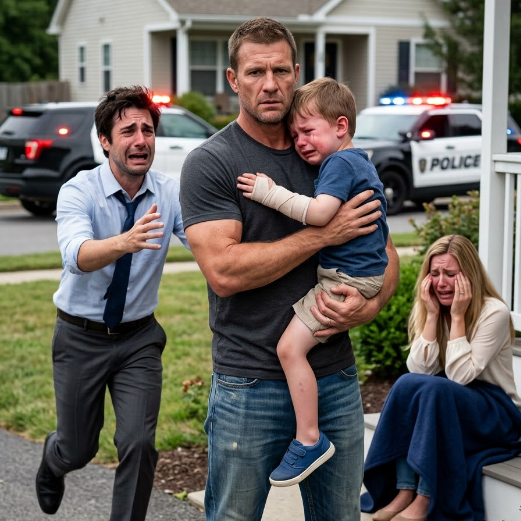
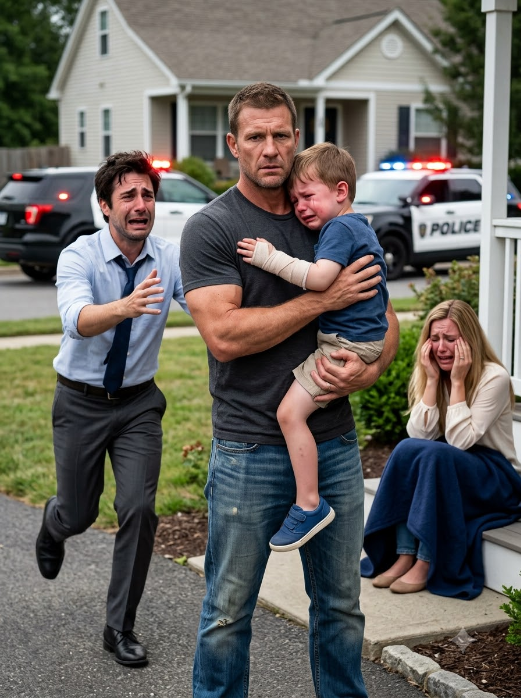
By the time I reached the street, two patrol cars sat outside Lena’s rental.
Red and blue light swept across the porch, the mailbox, the little American flag hanging crooked by the door.
A neighbor stood at the edge of her driveway, one hand pressed to her mouth.
Lena sat on the bottom porch step, shaking so hard an officer had draped a blanket over her shoulders despite the warm afternoon.
Derek stood near the walkway with Noah in his arms.
My son looked impossibly small against his chest.
One of his shoes was missing.
His face was wet.
His left arm was tucked against him in a way that turned my stomach.
But his eyes found me.
“Daddy,” he cried.
I don’t remember crossing the yard.
I remember Derek carefully passing him into my arms.
I remember Noah gripping my shirt with one hand.
I remember trying not to hold him too tight because I didn’t know where he was hurt.
“I’m here,” I kept saying. “I’m here. I’ve got you.”
A paramedic knelt beside us and asked Noah if he could wiggle his fingers.
He tried.
His lower lip trembled.
“It hurts.”
“I know, buddy,” the paramedic said. “We’re going to help.”
Lena crawled toward us more than walked.
“Noah,” she sobbed. “Baby, I’m sorry. I’m so sorry.”
Noah looked at her, his small face twisting with confusion.
He loved her.
He was afraid of what had happened.
No child should have to hold both feelings at once.
I looked at Lena and wanted to say every harsh thing that had built up in me during that drive.
I wanted to ask how she hadn’t seen it.
I wanted to ask why Travis was ever alone with him.
I wanted to punish her with words because I couldn’t undo what had already happened.
But Noah was watching us.
So I held it back.
Not forgiveness.
Not yet.
Just control.
“Ride with us to the hospital,” I said. “We’ll talk after Noah’s safe.”
She nodded as though she deserved nothing more than instructions.
At the hospital intake desk, I gave Noah’s name, birth date, and insurance details while he sat curled against my chest in the wheelchair, refusing to let me set him down.
The nurse fastened a plastic wristband around his tiny wrist.
A doctor ordered X-rays.
A police officer met us in the exam room and explained they’d need statements.
He used words like incident report, protective order, and child services notification.
The words sounded cold.
They also sounded necessary.
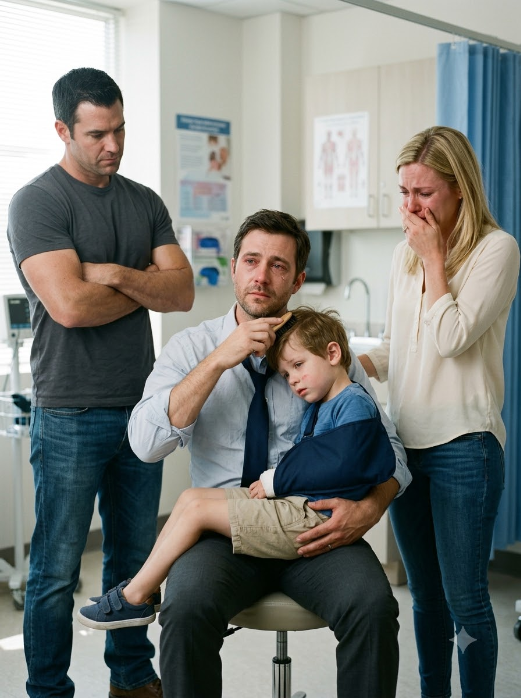
At 3:04 p.m., the X-ray technician positioned Noah’s arm with a gentleness that nearly broke me more than the injury had.
Noah asked if he was in trouble.
Every adult in the room froze.
“No,” I said instantly. “No, buddy. You did exactly the right thing. You called me.”
“He said boys don’t cry.”
Derek, leaning against the curtain with his arms crossed, looked away toward the wall.
Lena covered her mouth.
I smoothed Noah’s hair back from his forehead.
“He was wrong,” I said. “Crying is what let us know you needed help.”
Noah considered that.
Then he whispered, “Uncle Derek came fast.”
Derek cleared his throat.
“Always will,” he said.
The X-ray showed no complete break, but there was deep bruising and a sprain that would need a sling, follow-up visits, and time.
The doctor documented the marks.
The nurse photographed what needed to be recorded for the medical file.
The officer took statements from me, from Derek, and from Lena.
Lena didn’t defend Travis.
That mattered.
It didn’t undo what had happened, but it mattered.
She told the officer she’d gone to the grocery store and left Noah with Travis for under thirty minutes.
She said she’d never seen him strike Noah before.
Then her voice broke and she added, “But he scared him. I knew he scared him sometimes. I told myself I was overreacting.”
That sentence hung in the room longer than anything else that day.
Because there it was.
The small door adults open when they’d rather not see the whole hallway behind it.
I knew.
I told myself.
I was overreacting.
By evening, Travis was in custody, and an emergency protective order was being processed.
I took Noah home with me.
Lena didn’t object.
She asked if she could kiss his forehead before we left.
I looked at Noah.
He nodded.
She leaned down and kissed him so carefully it seemed she was afraid even love could hurt him now.
“I’m going to fix this,” she whispered.
Noah said nothing back.
That silence wounded her more than anger would have.
At my house, Derek carried Noah inside since he’d fallen asleep in the car.
The porch light was on.
The street was quiet.
Inside, Derek laid him on the couch while I found the soft blanket with the faded rockets on it.
For a few minutes, neither of us said anything.
Then Derek went to the kitchen and came back with two glasses of water.
His hands were steady now.
Mine weren’t.
“You made it there,” I said.
He looked over at Noah sleeping on the couch.
“He called you,” Derek said. “That’s what matters. He knew exactly who’d come.”
That sentence landed hard.
All day I’d been circling the same twenty minutes I hadn’t been there.
The distance.
The traffic.
The red lights.
The brutal math of being too far away when your child needs you.
But Derek was right.
Noah had called.
Scared as he was, he’d reached for the one rule stronger than fear.
Call Dad.
I sat on the floor beside the couch and watched him breathe.
Every few minutes he stirred and reached for me with his good hand.
Every time, I took his fingers and said, “I’m here.”
The next morning, an officer returned some items from the porch, and I found his blue sneaker sealed in a plastic evidence bag.
It looked absurd in there.
So small.
So ordinary.
A child’s shoe inside an official bag, labeled with a date and a case number, because an ordinary afternoon had turned into something documented, processed, and filed away.
I set it on the kitchen counter and stared at it for a long while.
Not to hold on to the fear.
To never lose the lesson.
Trust after divorce is complicated.
Co-parenting is complicated.
New relationships are complicated.
But a child saying he’s scared is not complicated.
A child whispering for help is not complicated.
A child calling twice from a house where he’s been told not to cry is not complicated.
That’s the alarm.
You answer it.
Weeks later, Noah began sleeping through the night again.
Not every night.
But more often than not.
He wore his sling longer than the doctor said he needed to, because it made him feel protected.
Derek showed up every Saturday morning with donuts and let Noah beat him at board games without making it obvious.
Lena started supervised visits and parenting counseling, and to her credit, she never asked me to make it easier on her than it was on Noah.
She had consequences to face.
So did I.
Because I had to live with the fact that I’d disliked Travis but stayed quiet to avoid conflict.
Peace isn’t always peace.
Sometimes it’s just fear dressed up politely.
I don’t ignore a second call anymore.
Not from Noah.
Not from anyone I love.
The first buzz might mean nothing.
The second one might be the whole world asking whether you’re paying attention.
That afternoon, I was twenty minutes away.
My brother was fifteen.
The police were close behind.
But the bravest person in this whole story was a four-year-old boy who held on long enough to call his father and tell the truth.
He saved himself before any of us made it to the door.
We just ran the rest of the way.
