The ache in my lower back had become a dull, constant grind by the time I finally shuffled onto Flight 482 bound for Chicago. At eight months pregnant, each step down the narrow jet bridge felt like a marathon in itself. My ankles were swollen to the size of softballs, and my son was currently treating my ribs like a personal kickboxing bag. All I wanted was to sink into seat 3A, close my eyes, and pretend the next four hours didn’t exist.
I reached my row in the First Class cabin, carefully lowered my heavy body into the window seat, and released a long, shaky breath. One hand rested on my belly as I felt the steady thump of my son’s heartbeat beneath my palm. Just a little longer, baby, I thought, eyes slipping shut. We’re almost home.
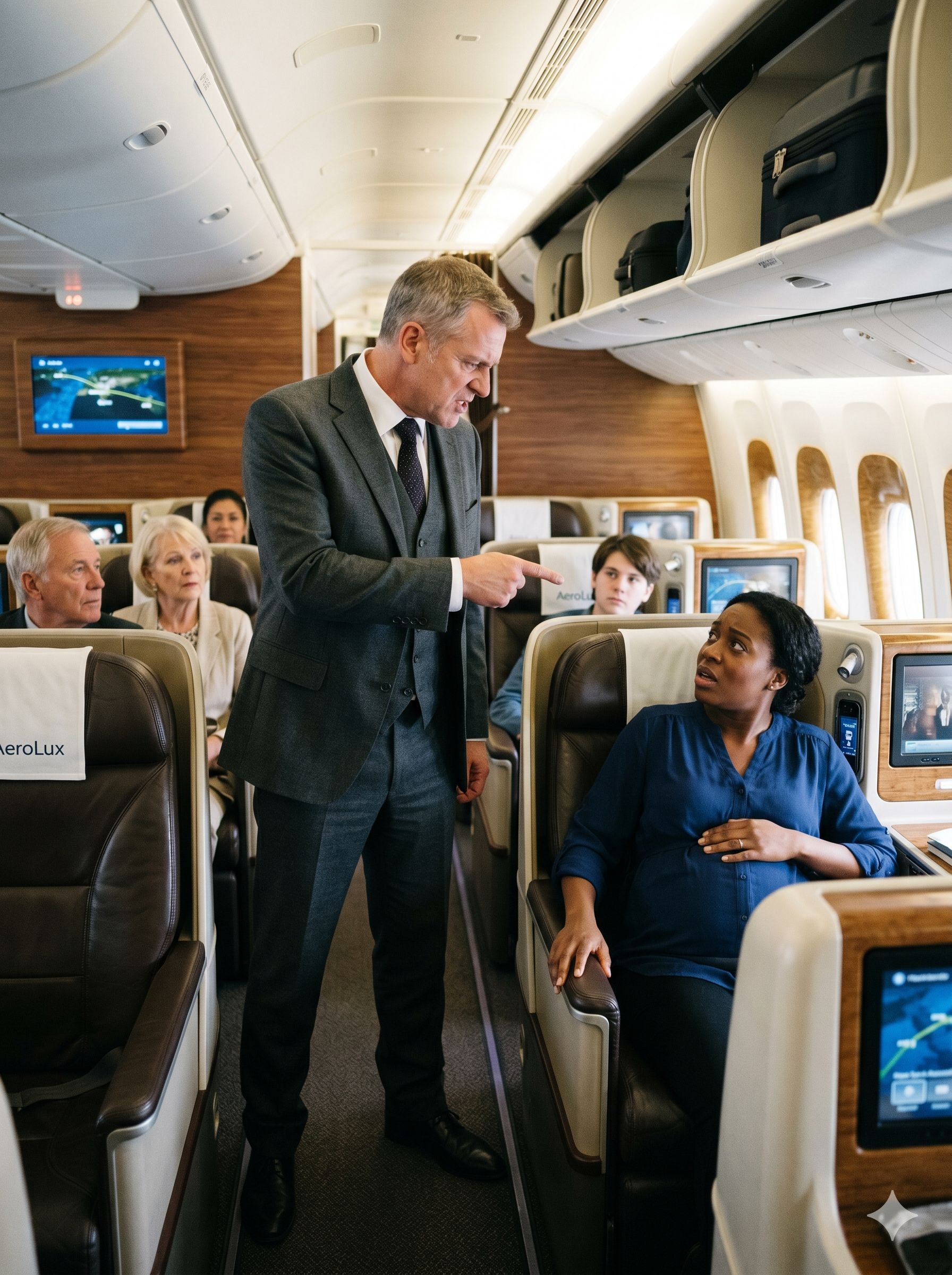
That brief peace didn’t last. Before boarding had even finished, a shadow loomed over me, carrying the sharp scent of expensive scotch and arrogant cologne. I opened my eyes to find a man in his late fifties in a tailored navy suit that practically screamed Wall Street. His face was flushed, his jaw locked with the kind of impatience reserved for those who believe the world exists for them alone.
“You’re in my seat,” he barked.
I glanced again at my boarding pass. “I’m sorry, sir. I’m 3A. This is the window seat”.
He let out a scoff, leaning heavily on the armrest and invading my space. “I don’t care what your little piece of paper says,” he sneered, his voice carrying far enough to cut through the surrounding rows. “I have a multi-million dollar merger to discuss. You’re going back to coach”.
The blatant disrespect landed like a physical blow. My husband, Marcus, always said I had two settings: warm honey, and absolute zero. Right now, 3A was freezing fast.
“Sir,” I said, my voice dropping an octave, steady and dangerously calm. “I am thirty-four weeks pregnant, and I am not moving to the back of the plane so you can have a meeting”.
What Richard Vance and the visibly shaken flight attendant didn’t realize was that I wasn’t just another passenger. I was the FAA’s Senior Aviation Inspector, and this crew was currently under my undercover evaluation.
Part 2
The silence in the cabin was no longer merely awkward; it had become suffocating. It hung in the air like the moment before impact in a car crash—everyone could see what was coming, yet no one could move. Richard Vance stood over me, his shadow pinning me against the window, his breath thick with expensive scotch and an even costlier ego. He was no longer just a man demanding a seat; he had become a living symbol of every bully I had faced in my decade with the FAA.
“I am a Diamond Medallion member,” Richard said, carefully enunciating each word as though speaking to a child. “I spend more on airfare in a month than you probably make in a year. You are sitting in a seat that I need. I am telling you to move”.
I looked up at him, my spine pressing into the seat I had paid for with my own hard-earned money. My husband, Marcus, always said I had a “titanium spine,” forged from years of being a Black woman in federal spaces where I was often the only one who looked like me. Right then, that spine was the only thing holding me together under the weight of his entitlement and the dull, grinding pain in my lower back.
“And I am telling you,” I replied, my voice turning to ice, “that your frequent flyer status does not give you authority to take my seat or invade my space. Move out of my personal space”.
The confrontation had drawn the attention of the entire First Class cabin. Across the aisle, a college student named Sam sat frozen, thumb hovering over a recording button. In front of me, a woman named Eleanor, wrapped in silk and old-money composure, turned magazine pages with tense, shaking fingers, desperate to ignore the scene. No one intervened. No one spoke.
Then David arrived, the Chief Purser. A seasoned veteran of the skies, just months from retirement, he approached with the calm of routine—but his eyes told a different story. He didn’t see a pregnant woman being harassed; he saw a disruption threatening a VIP and his departure metrics.
“Ma’am,” David said gently, but with practiced authority. “Mr. Vance is a highly valued customer. I’ve arranged a very comfortable aisle seat for you in row 18”.
The implication landed like a blow. Row 18. An aisle seat by the lavatory in exchange for the First Class window seat I needed at thirty-four weeks pregnant.
“No,” I said.
David’s expression tightened. “Ma’am, that is a lawful crew instruction. If you refuse, you are violating federal aviation regulations. I don’t want to have to deplane you”.
There it was—the authority card. He was using the very regulations I enforced to serve a billionaire’s demand. My internal inspector was already cataloging violations with clinical precision.
Richard smirked. “You heard him. Move. You’re holding up the plane”.
My son kicked hard against my ribs, as if protesting alongside me. I slowly reached into my tote bag, my fingers brushing past prenatal vitamins until they closed around a heavy blue leather case. I didn’t pull it out yet. David deserved one last chance.
“David,” I said quietly, my voice stripped of warmth. “Are you certain you want to take this position? Because once you do, it cannot be undone”.
He hesitated—just a fraction of a second too long.
But Richard lost patience. His hand slammed into the back of my seat. “Enough! Get her out of here! Call security!”
“Stop.”
The word cut through the cabin like a blade. The cockpit door opened.
Captain Thomas Miller stepped into the aisle.
He walked forward slowly, face set, having already reviewed the passenger manifest David had neglected. His eyes scanned the scene once—then landed on me.
The realization hit him instantly.
“Is there a problem here?” the Captain asked.
Richard immediately straightened. “Captain, finally. This passenger is refusing to move, and your Purser is incapable of handling it. I demand she be removed”.
The Captain didn’t respond to him. He looked at me.
“Ma’am… may I see your boarding pass?”
This time, I didn’t hand over a paper ticket. I opened the blue leather case and revealed the silver badge inside. It caught the cabin lights.
“Thank you, Captain,” I said, my voice steady, authoritative. “I am Senior Aviation Inspector Maya Jenkins. And this flight is officially grounded”.
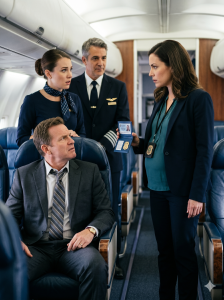
The cabin seemed to recoil.
Richard’s expression faltered. “Grounded? You can’t ground a plane. I have a meeting…”
“Mr. Vance,” I cut in sharply, “do not speak further. Everything is being documented for a federal incident report”.
I turned back to the Captain. “Under Title 14 of the Code of Federal Regulations, I am declaring this aircraft unfit for departure due to a breakdown in crew resource management and a hostile cabin environment”.
Captain Miller nodded, pale. “Understood, Inspector Jenkins. I will request a return to gate”.
The consequences settled over the cabin like a falling curtain. Richard’s confidence collapsed in real time as he realized the woman he had been dismissing was the authority that could end the flight.
But even as control shifted, a new pressure built inside me—sharp, urgent, impossible to ignore. I had won the confrontation, but the most critical battle had only just begun: my son’s safety.
Part 3
The silence inside the first-class cabin was no longer merely heavy; it was absolute. It had the suffocating stillness of the moment after a thunderclap, when the air still rings and tastes faintly metallic, as if the sky itself has been burned. A dropped pin would have sounded like a gunshot on the blue carpeted aisle. I remained seated there, thirty-four weeks pregnant, ankles swollen and my lower back throbbing in a steady, punishing ache, holding my silver federal badge up toward the overhead reading lights. The polished metal caught the artificial glare and threw it back into the stunned, drained faces of the men who had spent the last ten minutes trying to make me invisible.
The engraved words—FEDERAL AVIATION ADMINISTRATION, SENIOR INSPECTOR—were not just identification; they were the collapse of Richard Vance’s ego and David’s career in real time. For five long seconds, nothing moved. The scene was locked in place. Captain Miller stood rigid, eyes fixed on the badge, his expression tight with professional dread. Beside him, David, the Chief Purser, looked as if the strength had been drained out of him entirely. He wasn’t breathing properly—just staring at the blue leather case as his pension, his daughter’s wedding, and his career seemed to evaporate into the cabin air.
Then there was Richard Vance. A man built on control and dominance, he could not process the sudden reversal of power. His mind simply stalled. The deep red flush that had covered his face and neck drained away, replaced by a pale, sickly gray. His jaw went slack, and his hand—once pressed aggressively against my seat—slipped away and fell uselessly to his side.
“Grounded?” Richard finally choked out, the word thin and brittle, stripped of all its earlier arrogance. He blinked fast, as though trying to clear an illusion. “What… what do you mean, grounded? You can’t ground a plane. I have a meeting in Chicago. I have a multi-million—”.
“Mr. Vance,” I cut in, my voice steady and razor-sharp, not rising at all. “I strongly suggest you stop speaking. Every word from this point forward is being recorded for a federal incident report”. I didn’t look at him anymore; he was no longer relevant in my assessment.
I turned back to Captain Miller. He swallowed hard, his Adam’s apple visibly moving under his collar. “Captain Miller,” I said, calm, formal, and unwavering. “Under Title 14 of the Code of Federal Regulations, Part 121, I am officially declaring this aircraft unfit for departure due to a severe breakdown in crew resource management, failure to follow passenger safety protocols, and the creation of a hostile and unsafe cabin environment by senior flight personnel”.
Captain Miller nodded slowly, the weight of the situation settling across his face. He was experienced—twenty years in the air—but he understood the culture he worked within: the pressure, the VIP exceptions, the quiet compromises. “I understand, Inspector Jenkins,” he replied, voice steady despite the strain. “I will inform the tower and request a tow back to the gate. What are your immediate instructions?”
“Keep the cabin doors closed for now,” I said, pushing myself carefully up from the window seat. The movement took effort, my balance shifted by pregnancy and pain, but I refused to falter. I stood fully. At barely five-foot-four, I still commanded the aisle. “I want Airport Police and federal marshals at the jet bridge,” I continued, adjusting my cardigan. “No one deplanes until law enforcement secures the aircraft and takes statements”.
“Marshals?” David’s voice cracked, high and panicked. “Inspector… ma’am… please. We can fix this. Mr. Vance was out of line, I see that now. There’s no need to escalate this… to ruin everything”.
I slowly turned my head toward him. The coldness in my eyes made him physically recoil. “Fix this?” I repeated. “Ten minutes ago, you threatened to remove a pregnant woman from an aircraft for refusing to surrender a paid seat because a wealthy passenger demanded it. You used federal regulations as leverage to intimidate me. You ignored every de-escalation protocol in your training”.
David tried to speak again, insisting it was to prevent disruption, but no one was with him anymore. Eleanor, the woman in 2B, slowly closed her magazine, her hands trembling. The discomfort she felt was not altitude sickness—it was recognition of her silence. She had watched and done nothing.
Across the aisle, Sam’s phone was still recording, the small red light steady. His earlier fear had shifted into disbelief and vindication. He had spoken up when no one else did, and now he watched the consequences unfold with quiet awe.
“You weren’t preventing a disturbance, David,” I said, voice carrying through the cabin. “You were enabling one. You allowed a passenger to corner me and issue threats while your junior flight attendant stood frozen because she knows your airline protects status over safety”. From the galley, Chloe’s suppressed sob broke through.
I continued, exposing the system beneath it all—the ignored reports, the selective enforcement, the silence around VIP misconduct. I told him why Director Henderson had assigned me to this route. David’s composure finally cracked; a tear slipped down his face as years of routine and compromise collapsed at once.
But Richard Vance wasn’t finished.
As shock faded, his ego reasserted itself. “Now listen to me,” he snapped, stepping forward again. “I don’t care what badge you have. I know the CEO of this airline personally. I play golf with senators. You are overstepping your authority. I will sue you, your department, and the federal government. You’ll be scanning groceries by Monday”.
A collective gasp moved through the cabin.
Before I could respond, a man in seat 1D stood. He had been quiet the entire time. He stepped into the aisle with controlled calm, pulled out a leather wallet, and revealed a gold star.
“Federal Air Marshal,” he said quietly. “Sir, step back. Now. If you take another step toward Inspector Jenkins, you will be restrained and charged with assaulting a federal officer”.
Richard froze mid-motion.
Marshal Jake didn’t move, his posture relaxed but ready. He had been there the entire time.
I gave him a small nod. He returned it.
Turning back to Richard, I said, “You are not suing anyone. You will sit in seat 3B and remain silent until law enforcement removes you. You will be placed on the federal no-fly list. And your CEO will receive a direct report from my office about this incident”.
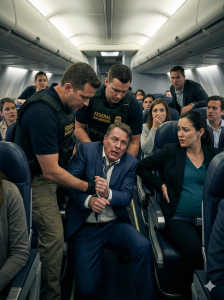
For illustrative purposes only
His mouth opened, then closed again. The reality finally began to break through. “I… I’m sorry,” he stammered, but it was hollow, panicked.
“Save it for law enforcement,” I said.
As the aircraft taxied back, Captain Miller announced their return to the gate for federal intervention. David stood near the bulkhead, hollowed out. “You had a choice today,” I said quietly to him. “You chose power over safety. You enforced hierarchy instead of law”.
“I have a family,” he whispered. “I was just trying to keep my job”.
“And Chloe?” I replied sharply. “You abandoned her the moment pressure arrived. That’s the system you upheld”.
He broke down, hands over his face.
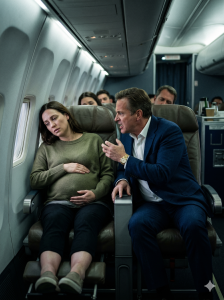
Then a sharp pain tore through my abdomen. I inhaled sharply, one hand gripping my belly. This wasn’t just discomfort anymore. It was tightening—rhythmic, real.
Marshal Jake noticed instantly. “Inspector? Are you alright?”
“I’m fine,” I said, though my breath betrayed me.
“Sit down,” he said firmly, but gently.
I lowered myself into 3A, my strength suddenly fading. Across the aisle, Sam watched me with quiet admiration. I managed a small smile and slid a mint toward him.
“You did good,” I said. “You didn’t stay silent”.
The jet bridge connected with a heavy thud. Boots echoed down the aisle—law enforcement arriving at last.
But another wave of pain hit harder than before. I gripped the armrests, knuckles white.
This wasn’t Braxton Hicks.
I was thirty-four weeks pregnant—and I was going into labor.
Part 4
The heavy metallic click of the cabin door unlocking sounded like a guillotine being released. For the past ten minutes, Flight 482 had existed in an uneasy, suspended silence. When the door finally swung open, the stale recycled air was cut through by the sharp, fuel-heavy breath of the Atlanta terminal. Then came the boots—two Atlanta Police Department officers stepping aboard, followed closely by two federal marshals in tactical vests over dress shirts, badges hanging from chains at their necks.
Air Marshal Jake, who had been standing as a quiet barrier between me and Richard Vance, immediately stepped forward to meet them. He flashed his credentials and delivered a rapid briefing to the lead marshal, a graying man with a granite-set jaw. Jake pointed directly at Richard Vance, slumped in seat 3B like a deflated shell. Then he gestured toward me. The marshal’s eyes landed on my thirty-four-week pregnant frame and the blue credential case in my lap. He gave a short, respectful nod—an unspoken acknowledgment between professionals who understood what the badge meant.
“Richard Vance,” the lead marshal said, his voice carrying cleanly to the back of the aircraft.
Richard jolted as his name was spoken by federal law enforcement, the last illusion of control collapsing instantly. He rose too quickly, smoothing his bespoke navy jacket with shaking hands.
“Officers,” he began, forcing a brittle smile as he reached inside his jacket, likely for his phone. “I can call the Chief of—”
“Hands where I can see them. Now!” an APD officer barked, dropping his hand to his weapon.
Richard froze, both hands shooting into the air. His face drained of color. For the first time, there was real fear in it.
“Step into the aisle,” the marshal ordered.
Richard tried to speak about Chicago, about his merger, but the marshal seized his arm with controlled force. “You are under federal investigation for threatening a federal officer and violating Title 14 of the Code of Federal Regulations,” he said.
Click. Ratchet. Click.
The sound of cuffs locking around Richard Vance’s wrists echoed through the cabin like a verdict.
As he was led forward, Richard turned his head to look at me. I didn’t react. I simply sat there, one hand over my belly, expression calm and unreadable. No triumph. No emotion. Just finality. That was the part that broke him most.
When Richard was removed, the marshal turned toward the galley. David Collins didn’t argue. He quietly unclipped his airline badge and placed it on the cart. The decision had already been made for him.
But the moment the immediate chaos began to settle, my body betrayed me.
The adrenaline dropped all at once, and pain followed—tight, rhythmic, inescapable. A hard band of pressure wrapped around my abdomen.
I gasped.
“My stomach… it’s contracting,” I managed. “I think I’m going into labor.”
“Inspector?” Jake moved instantly. “Medical team, now!”
The cabin shifted into controlled urgency.
But it was Eleanor Vance-Stratton who reached me first. She dropped to her knees beside my seat, all her earlier distance gone.
“Look at me,” she said firmly, taking my hands. “You’re going to be okay.”
“I’m scared,” I whispered. “It’s too early.”
“You are not losing him,” Eleanor said, voice steady. “You stood up to him. You can do this. Breathe with me.”
I focused on her eyes and tried to follow her breathing.
“Why didn’t you say anything before?” I asked faintly.
Her face tightened with shame. “Because I was a coward,” she admitted. “But I’m here now. I’m not leaving you.”
Paramedics arrived moments later and transferred me into a transport chair. As they moved me down the aisle, Sam lifted my bag carefully.
“I’ve got it, Inspector,” he said.
I gave him a weak nod as the cabin blurred past.
At the Atlanta Medical Center maternity ward, fluorescent lights streaked overhead as I was rushed into a private room. Magnesium sulfate entered my IV to slow the contractions.
“Your son is a fighter,” Dr. Aris Thorne said.
The words broke something open in me, and I cried—no longer an inspector, just a frightened mother holding on.
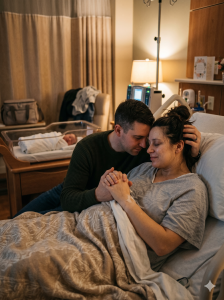
Two hours later, Marcus arrived.
He crossed the room in a few strides and pulled me into him, holding me tightly.
“I’ve got you,” he said.
I buried my face in his chest, breathing in cedarwood and chalk dust.
I told him everything.
He rested his hand over my belly as the baby kicked. “He’s safe,” Marcus said. “You protected him.”
He told me Director Henderson had called. “He said you dismantled an entire toxic structure in minutes,” Marcus added, pride thick in his voice.
I listened to the monitor—steady, strong.
Two weeks later, the aftermath of Flight 482 had spread everywhere.
Sam’s video had gone viral, reaching tens of millions of views. Richard Vance was removed from his firm, his merger collapsed, and he was placed on the TSA no-fly list. The airline faced massive penalties, and its CEO stepped down.
In a sunlit nursery, I rested on bed rest as emails and news alerts continued to arrive. One message came from Eleanor—she had resigned from her country club and sent a handmade baby blanket.
Marcus sat beside my chair, leaning his head against my knee.
“You changed everything,” he said.
I looked out the window at the quiet trees.
“I didn’t change the world,” I said softly. “I just reminded them it doesn’t belong to them.”