

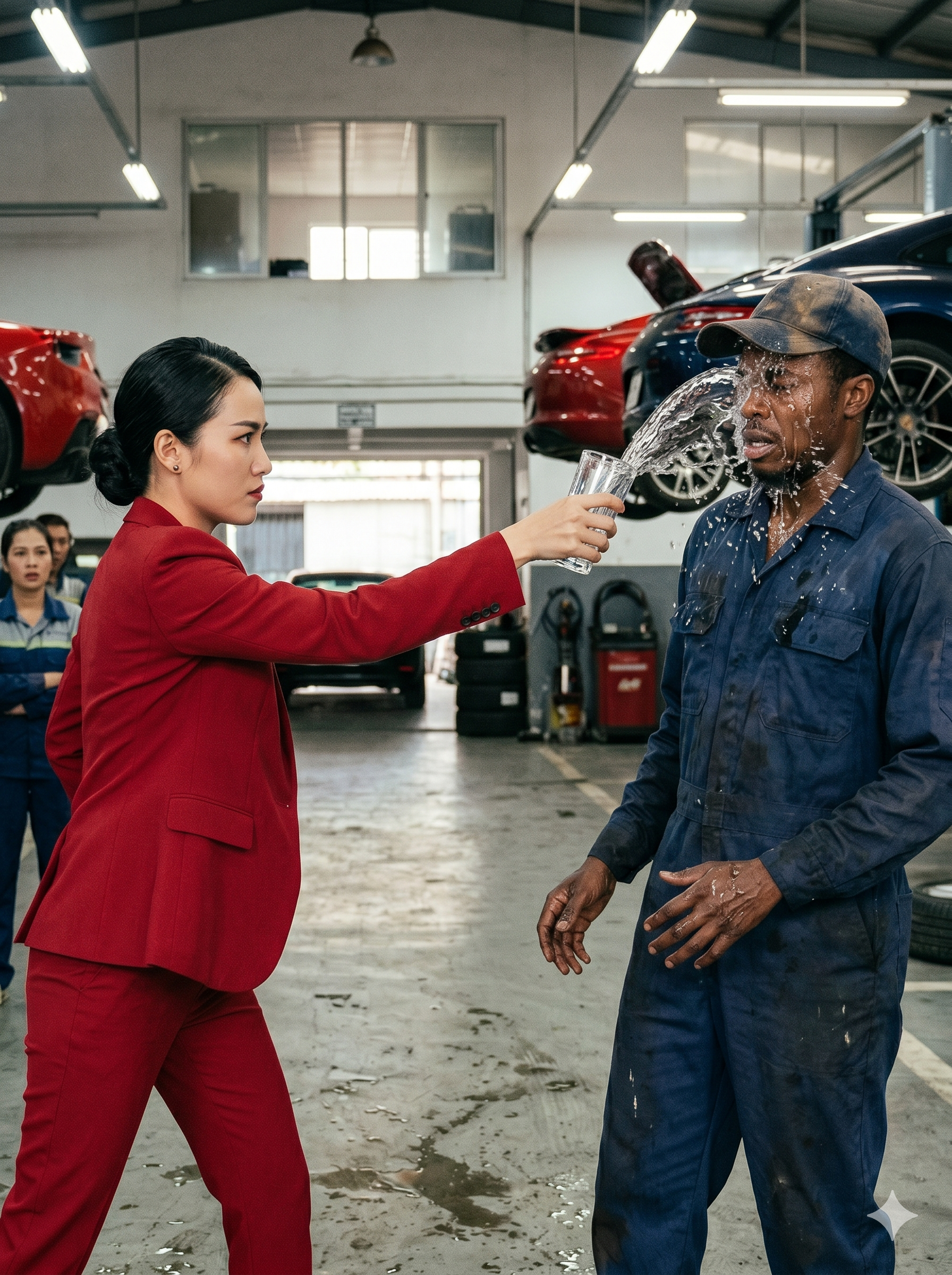
The water hit my face so quickly I didn’t even blink.
One moment I was standing beside the disabled V12 prototype in the center bay of Halstead Performance, grease on my hands and a diagnostic tablet in my pocket. The next, cold water streamed down my cheeks, dripping from my chin and soaking the front of my work shirt while half the shop stared like they had just seen a fight break out in church.
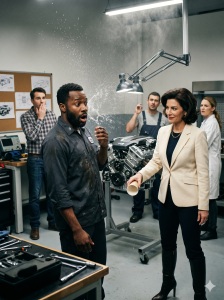
Vanessa Calloway, CEO of Calloway Automotive Group, lowered the empty paper cup and locked eyes with me.
“Fix this engine,” she said, her voice sharp enough to cut steel, “and I’ll marry you.”
A few people laughed. Not because it was funny. Because no one in that room knew how else to react.
I didn’t move. I let the silence settle.
Vanessa had walked in that morning in heels, a cream blazer, and the kind of confidence money gives people when they haven’t heard no in a long time. Her company had bought Halstead Performance two months earlier, and since then the shop had been packed with consultants, auditors, and executives who spoke as if engines were just numbers on a spreadsheet.
I’m Marcus Reed, thirty-four, lead mechanic, born and raised in Columbus, Ohio. I’d spent fifteen years earning respect one repair at a time. I knew engines by sound, by smell, by vibration. But none of that mattered to Vanessa. To her, I was just the Black mechanic in a stained uniform standing beside a million-dollar prototype her own engineers couldn’t bring back to life.
She turned to the room. “My senior team has spent three days on this. We’ve flown in specialists from Detroit. But apparently the shop keeps telling me Marcus here has a feel for engines.” Then she looked back at me with that same smile. “So go ahead. Impress us.”
I wiped my face with a rag and stepped toward the engine bay.
No speech. No anger. No pride.
Just work.
The prototype had been misfiring, overheating, and stalling under load. The consultants kept blaming software. The engineers had swapped coils, injectors, sensors, and half the wiring harness. I checked the basics first, then the things people overlook when they’re too eager to sound smart. Fuel pressure. Compression. Timing values. Vacuum behavior under heat.
Then I found it.
A hairline crack in a custom manifold housing, nearly invisible unless you checked it hot and under pressure. A tiny flaw with expensive consequences. Enough to distort airflow readings, trigger bad corrections, and make every high-end computer in the room lie.
I looked up. Vanessa folded her arms. “Well?”
I set my jaw, grabbed the tools I needed, and said, “Don’t touch anything.”
The room went still as I made the swap, reset the system, and slid into the driver’s seat.
Then I turned the key.
The engine roared to life with a deep, violent thunder that rattled the windows.
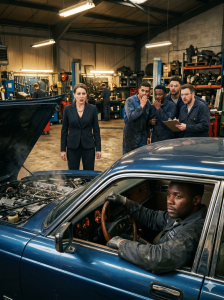
And when the sound settled, I looked through the windshield and saw something I hadn’t expected on Vanessa Calloway’s face.
It wasn’t anger.
It was fear.
Part 2
The entire shop stood frozen for two long seconds after the engine came to life.
Then the sound rolled over everyone at once.
That V12 didn’t simply start. It awakened. It settled into a clean, aggressive idle—so smooth it almost felt unreal after three days of failure, blame-shifting, and corporate tension. A few of the guys in the back let out low whistles. One of the engineers murmured, “No way,” under his breath. Someone near the tool wall even started to clap before remembering Vanessa was still standing there.
I killed the engine and stepped out slowly.
Vanessa hadn’t moved. Her arms were still crossed, but something in her stance had shifted. The act was gone. So was that polished executive smile. She looked less like a CEO and more like someone who had just realized she’d made a very public mistake.
I tossed the rag onto my toolbox.
“There,” I said. “Your engine is fixed.”
Her chief operations officer, a jittery man named Bradley Sykes, hurried forward with the diagnostic tablet. “That’s impossible. We ran every system twice.”
“You ran the systems,” I replied. “You didn’t test the housing under heat expansion. The crack only opens once the metal reaches operating temperature.”
Bradley glanced at the live readings, then at the manifold, then back at me. “That’s… actually right.”
A ripple of murmurs spread across the shop floor.
Vanessa’s expression tightened. For a moment, I thought she might apologize—not because she wanted to, but because everyone had seen it. The insult. The water. The challenge. The outcome.
Instead, she squared her blazer and said, “Fine. Good work.”
Fine.
Good work.
That was all.
A short laugh escaped me before I could stop it. “That’s it?”
Her eyes sharpened. “Excuse me?”
“You threw water in my face in front of my coworkers,” I said. “You turned me into a joke because you expected me to fail. So no, ‘good work’ doesn’t really cover it.”
Silence swallowed the room. Even the air felt tense.
Vanessa stepped closer. “You are an employee of a company I own. Watch your tone.”
“And you’re standing in a shop you don’t understand,” I shot back. “Watch yours.”
Bradley looked like he wanted to sink into the floor.
Vanessa’s voice dropped. “Do you have any idea how much this company is worth?”
I didn’t break eye contact. “Do you have any idea how many people keep it running while executives walk in acting like they built it themselves?”
That hit harder than I expected.
Because it wasn’t just about the engine. It was every meeting where the shop crew got talked over, every decision made by people who’d never worked a twelve-hour shift, every polished outsider who assumed skill only came in a suit.
Vanessa glanced around and realized the room was no longer on her side.
The engineers were watching me.
The mechanics were watching me.
Even Bradley was staring at the floor.
Then one of the younger techs, Luis, spoke quietly. “He’s right.”
That was the first crack.
Vanessa heard it too.
Her chin lifted, but some of the edge left her voice. “Marcus. My office. Now.”
I should have refused.
Part of me wanted to.
But I followed her upstairs anyway—soaked shirt, dirty boots, dignity held together by discipline. She shut the glass door behind us, turned to face me, and for the first time all day, her expression wasn’t harsh.
It was shaken.
Then she said something I never expected.
“I need you to understand,” she said, “I was already under attack before I walked into that shop.”
Part 3
I remained standing while Vanessa moved behind her desk, but she didn’t sit. That caught me off guard. Most executives take a seat when they want to claim control of the room. Vanessa looked like she had lost track of the script.
She let out a slow breath. “The prototype you fixed was supposed to secure a contract worth eighty million dollars. The board gave me one week to prove this acquisition wasn’t a mistake. I have investors questioning my judgment, senior engineers covering errors, and a press event in forty-eight hours. When I walked into that garage, I was already angry before I ever saw you.”
I let her words settle for a moment.
Then I said, “That explains pressure. It doesn’t justify disrespect.”
She gave a single nod. No excuses. No interruption.
“You’re right.”
It was the first truly honest thing she’d said to me all day.
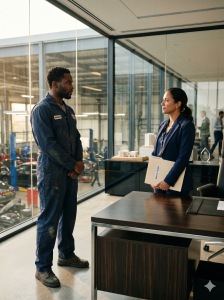
She glanced down at the empty cup still in her hand, as if only just realizing she was holding it. Then she dropped it in the trash and met my gaze again.
“What I did was humiliating,” she said. “It was reckless, arrogant, and beneath the position I hold. I was trying to control a room I felt slipping away, and I chose the worst possible target. You didn’t deserve that.”
The apology wasn’t polished. That’s how I knew it was genuine.
I folded my arms. “You didn’t pick me by accident.”
Her expression tightened slightly. “No. I didn’t.”
We both understood why. Maybe she hadn’t walked in thinking about race. Maybe she had. But she saw a man in work clothes, hands marked by labor, standing outside the circle of people she considered important—and decided he was safe to belittle. People in power do that all the time. They call it stress. Everyone else calls it character.
“What now?” I asked.
She reached to the side of her desk and picked up a folder. “Now I fix this the only way that matters.”
Inside was a revised leadership plan for the press event. My name was on it.
Not as decoration. Not as a feel-good gesture.
As Director of Performance Diagnostics for the prototype program.
I looked up. “You’re serious?”
“I should have listened to the people who understand the work instead of the people fluent in presentations,” she said. “You saw in twenty minutes what my entire executive team missed. I can’t undo what happened downstairs. But I can stop acting like talent only counts when it comes packaged the way I’m used to.”
I didn’t respond right away.
Then I said, “If I take this, I do it my way. Shop floor and engineering work side by side. No more talking down to techs. No more decisions without the people who actually turn the wrenches.”
Vanessa gave a tight, almost weary smile. “That sounds like a better company than the one I walked in with.”
Three months later, the prototype launch was a success. The contract held. Half the people who used to overlook the shop started asking better questions. Vanessa and I never became friends—and no, she didn’t marry me. That line died the moment she said it. But she did something rarer than charm. She changed.
And me? I stopped waiting for respect to be handed to me by people who had never earned mine.
Sometimes the loudest victory isn’t the engine roaring back to life. It’s the moment the room is finally forced to see you clearly.
If this story resonated with you, share a comment about the moment you realized someone underestimated the wrong person. And if you believe skill, dignity, and hard work still matter in America, pass this along to someone who needs that reminder today.
