

My name is Nia Parker. I had spent my entire life training for the chance to earn that navy-blue academy sweatshirt. I was twenty-four, ranked at the top of my incoming class, and determined to be recognized for my performance—not my surname.
But at the Mid-Atlantic Metro Police Academy, that kind of distinction was nearly impossible.
From the very first week, Sergeant Trent Maddox ensured I felt the pressure of every gaze in the room. He treated tactical training like a performance—loud, humiliating, and carefully engineered to break anyone who didn’t fit his narrow definition of “real police”. To him, a young Black woman excelling under his command wasn’t just unexpected; it was an offense he couldn’t accept.
When I finished a sprint drill first, he smirked and said, “Congratulations, princess. You want a tiara with that time?”. When I corrected a range-safety call, he leaned in and whispered, “You talk too much for someone built like a receipt”.
I endured it. I had been taught discipline in silence—jaw clenched, eyes forward, hands steady. I absolutely refused to give Maddox the satisfaction of seeing me break.
Week seven came with a heat that made the hallways reek of bleach and sweat. After defensive tactics, I stepped into the women’s restroom to rinse my face. The academy’s fluorescent lights buzzed overhead like trapped insects. The sinks were empty. The stalls were quiet.
Then the door closed behind me.
I turned and saw Maddox.
“You think you’re special,” he said, as if delivering a diagnosis. “You think you can make me look stupid in front of my recruits”.
I backed toward the sinks. “Sergeant, you’re not allowed in here,” I warned him.
His smile didn’t reach his eyes. “Watch me”.
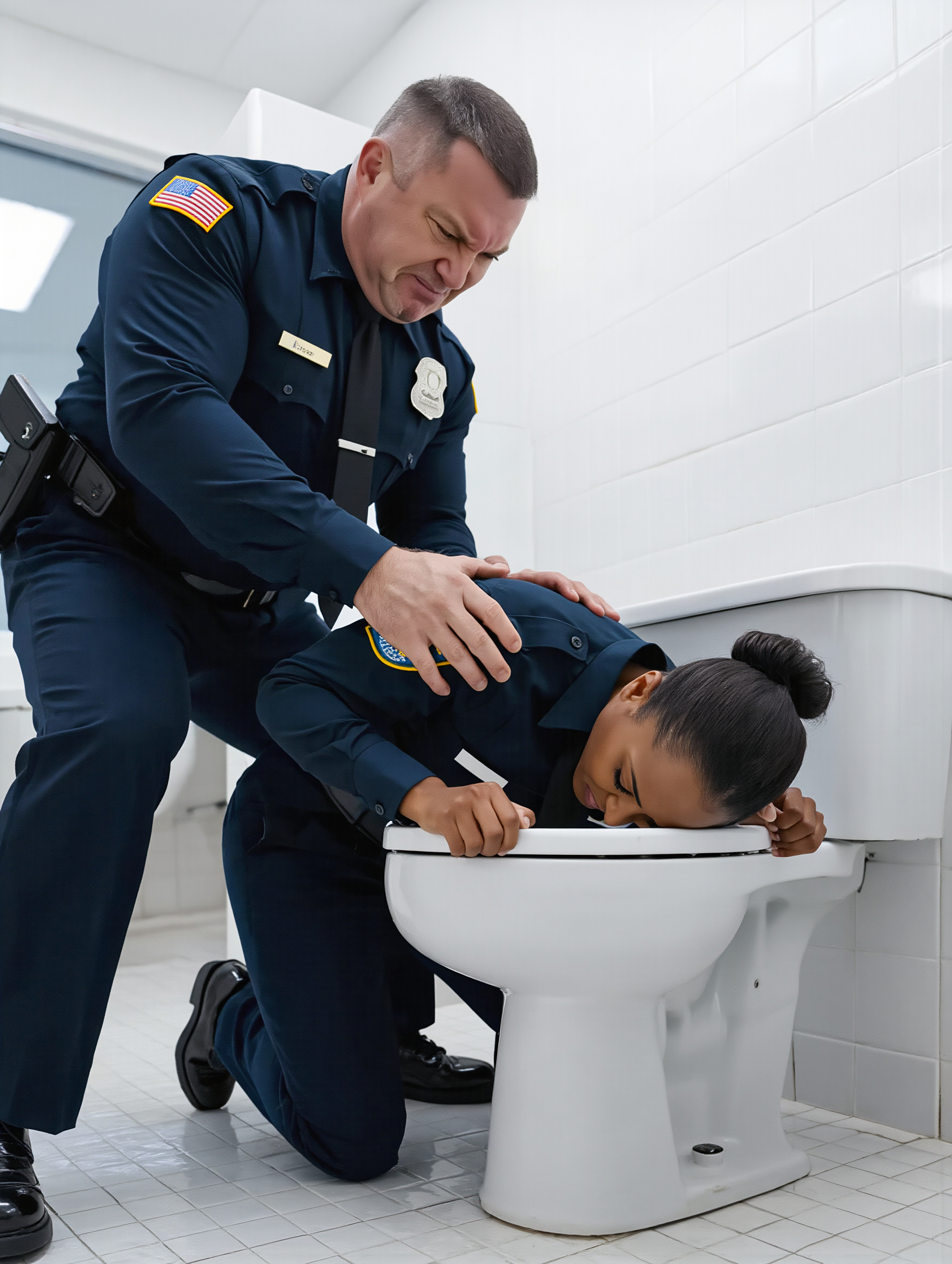
In moments, his heavy hand locked onto the back of my neck. He drove me forward, and the stall door crashed open. I reached for my radio, but he pinned my wrist against the divider.
“This is what happens when you forget your place,” he hissed.
I fought—hard—but the stall was too confined, his grip too practiced. He forced me down, pressing my face toward the toilet bowl. The water was freezing, the porcelain biting into my cheek. I twisted, coughing, trying to breathe, trying to get my knees beneath me.
When he finally released me, I stumbled out of the stall soaked and shaking, rage pulsing through my body. Maddox adjusted his belt as if he had just finished routine paperwork. “You’ll keep your mouth shut,” he said calmly. “You’ll graduate, and you’ll thank me for toughening you up”.
My vision blurred—not from fear, but from sudden clarity: this wasn’t “one bad moment”. It was a corrupt system that expected a Black woman like me to vanish.
I wiped my face with trembling fingers and walked out of the restroom, water dripping onto the tile behind me, leaving a trail no one could ignore. As I passed the hallway camera, I noticed something that made my stomach tighten: the red recording light was off.
Who turned it off—and what else had been erased before I ever stepped into this academy?
PART 2: The Investigation
I didn’t return to the dorms.
The water from the restroom still dripped from my chin, soaking into the thick navy fabric of my academy collar. Each step I took down the long linoleum hallway of the academy felt weighted, slow, and unreal. My wrist throbbed with a sharp, burning pain where Sergeant Maddox had forced it hard against the cold metal of the stall partition. Yet the physical injury was not what overwhelmed me. It was the sheer arrogance of what had just occurred. The absolute, unchallenged entitlement. He had looked at me—a twenty-four-year-old Black woman consistently outperforming his favored recruits—and decided my existence alone was something that needed to be punished.
I went directly to the infirmary.
The fluorescent lighting in the medical wing buzzed faintly, a low, irritating sound that matched the ringing in my ears. The air carried the sharp scent of disinfectant and waxed floors. I pushed open the heavy door, my wet boots squeaking against the polished surface.
The medic on duty, Officer-Paramedic Lyle Benton, sat at a small metal desk sorting through physical evaluation forms. He was an older man with thinning hair and the tired posture of someone who had seen decades of academy injuries—sprains, fractures, and broken pride. He looked up. His eyes immediately moved to my soaked uniform, then down to my wrist. The bruising was already spreading, a deep, angry purple against my skin.
For several seconds, the room stayed silent. Benton didn’t reach for his kit. He didn’t ask me to sit. He simply observed, reading the severity of what had been done.
“What happened?” he finally asked. His voice was controlled, careful, stripped of assumption.
My mouth opened, then closed, then opened again. The words felt heavy, stuck in my throat. Humiliation tasted metallic on my tongue. I forced myself upright, steadying my shaking knees.
“I need this documented,” I said, my voice unusually even. “Exactly as it is. Photos. Notes. Time stamp.”
Benton hesitated. I caught the brief calculation in his expression. The unspoken rule of the academy surfaced in that pause: avoid trouble. Within this environment, trouble spread fast, and documenting something like this meant stepping directly into it.
I held his gaze without looking away, refusing to let him deny what was plainly visible.
Then he nodded once. “Sit. I’ll do it right.”
I sat on the edge of the paper-covered exam table. Benton retrieved a digital camera from a locked drawer. He didn’t ask who had done it. He didn’t need to. In a system like this, names were rarely spoken out loud.
Each camera flash cut through the dim room like a strike of light. I stared at the blank wall ahead and controlled my breathing—inhale for four seconds, hold for four, exhale for four. The tactical breathing we were taught for crisis scenarios now kept me from unraveling.
The urge to downplay everything was strong. A voice in my mind pushed me to make it smaller, easier. Say I slipped. Say it was an accident. If I reported him, everything would turn against me. The pressure to stay silent, to survive by disappearing, was intense.
But I had seen too many women erase themselves in that same way. Officers who became shadows of their former selves, who traded truth for survival, slowly hollowed out by what they endured in silence. I refused to become that.
When Benton finished photographing, he printed the files, attached them to a formal incident report, and slid the document toward me.
He leaned closer, checking the hallway through the small window before speaking. “If you file, they’ll come for you,” he warned quietly. His tone wasn’t threatening—it was protective. “Not with fists. With paperwork. With evaluations. With ‘concerns.’”
He was describing the system exactly as it functioned. They wouldn’t attack me openly. They would dismantle me on paper until I no longer qualified to exist here.
I picked up the pen. My hand remained steady as I signed.
“Then let them,” I said.
Next, I walked toward the administrative wing. The air was colder here, the floors polished to a reflective shine, stripped of the grit and noise of training. I headed for Deputy Chief Graham Reddick’s office. He was second in command at the academy, known for his precise appearance and strict control over institutional image.
As I approached, another recruit emerged from a side hallway. It was Tasha Lin. She grabbed my sleeve briefly, her fingers tense and unsteady. Her expression was tight with fear.
Tasha’s eyes flicked over my soaked uniform and visible bruising. She looked shaken.
“I heard… something,” she said quietly. “I didn’t see. But I heard the stall door. And you—”
She stopped, unable to finish. She had been close enough to know. She had heard enough to understand. But she had stayed frozen, like so many others, afraid of what speaking up would cost her.
I didn’t blame her. The system was designed to isolate moments like this, to make intervention feel impossible.
“If anyone asks,” I said gently but firmly, “tell the truth. That’s all.”
I released her sleeve, gave a small nod, and turned toward Reddick’s office. I knocked twice.
“Enter,” a sharp voice called.
Inside, the office was immaculate, almost staged in its perfection. Deputy Chief Reddick sat behind a large mahogany desk, posture rigid. His eyes scanned my appearance immediately, assessing rather than empathizing. His expression carried controlled annoyance, as if I were an administrative disruption.
“Recruit Parker,” he said, leaning back slightly. “You’re alleging misconduct by a decorated instructor,” he said.
The phrasing was intentional. Every word shaped perception before I even spoke.
I stood at attention, refusing the chair.
“I’m reporting an assault,” I corrected him. I made sure to emphasize the legal classification. “In the women’s restroom. Today. Approximately 14:18.”
Reddick’s jaw tightened. He didn’t like being corrected, especially by a recruit.
“You understand the implications of this?” he asked, voice lowering. “You are a legacy recruit, Parker. Your father’s position complicates this. Making an accusation of this magnitude against a veteran sergeant… it doesn’t just impact you. It impacts the integrity of this entire institution.”
He was attempting to leverage my father’s influence as pressure. He assumed it would make me hesitate.
“I understand the injuries,” I said coldly, stepping forward and sliding the manila folder across his desk. “And I understand what happens when people stay quiet.”
Reddick stared at the folder but didn’t open it. He sighed heavily, as if inconvenienced.
“Internal Affairs will have to review this, of course,” he said dismissively. Then he shifted tone slightly. “In the meantime, given the emotional distress of the situation, I can recommend you transfer to a different cohort. A clean reset. You’d start over with a new class, new instructors. No friction.”
It sounded like an option. It wasn’t. It was removal disguised as mercy.
If I left, I would lose my ranking. I would be labeled unstable. Maddox would remain untouched.
“No,” I said flatly. “I’m not leaving. He should.”
Reddick’s eyes hardened. The silence that followed was sharp and deliberate. He slid the folder aside.
“Dismissed, Recruit.”
The backlash didn’t take long. It spread through the academy quietly at first, then all at once—like contamination.
Within days, the environment shifted. Fellow recruits avoided me. Instructors graded me harder. Conversations stopped when I entered rooms.
Two days later, the pressure became direct again.
I stood on the asphalt drill field, sweat soaking my uniform after training. Heat rose from the ground in waves.
Sergeant Maddox walked past with two instructors. As he neared, he slowed and leaned slightly toward me.
“You really want a war?” he murmured. “You’re not built for it.”
He continued walking, leaving me frozen in the heat, fists clenched so tightly my nails cut into my palms. He believed I would eventually break.
That night, the intimidation escalated again.
At 2:15 AM, I heard movement at my dorm door. A folded white paper slid underneath.
I opened it under the dim desk light.
DROP IT. YOU’LL NEVER WORK IN THIS CITY.
I stared at it for a long time. My heartbeat was loud in my chest. They weren’t trying to confront me—they were trying to exhaust me into disappearance.
I didn’t sleep.
Instead, I sat on my bunk and accessed the academy intranet. I read policies, camera logs, maintenance records, access protocols. I searched for inconsistencies, anything that didn’t align.
Not because I doubted myself, but because I understood institutions. They didn’t just protect people—they erased problems.
The breakthrough didn’t come from me.
The next morning, behind the administration building, a woman stepped out from behind a utility unit.
She showed her badge briefly before concealing it. “Erin Caldwell. Internal Affairs.”
I froze.
Caldwell didn’t soften her approach.
“I believe you,” she said.
The words hit harder than anything else so far.
“But believing isn’t evidence,” she continued. “I need the timeline. I need the environmental factors. Tell me everything, twice. I want you to tell it to me once with emotion, letting me know exactly how it felt. Then, I want you to tell it to me again, completely without emotion—just the raw, clinical facts.”
We stood in the hidden alley. I told her everything—each detail, each sensation, each moment. Then I repeated it again, stripped of emotion.
She didn’t interrupt.
When I finished, she finally spoke.
“The restroom hallway camera was disabled exactly fourteen minutes before you entered. The electronic work order claims it was for ‘routine maintenance.’ It was filed under an employee ID and name that doesn’t exist anywhere in the city payroll.”
Ice crawled through me.
“So he planned it,” I whispered.
Caldwell shook her head slightly.
“Or someone planned it for him,” she said quietly.
Over the following week, Caldwell uncovered what had been buried for years—complaints, reports, erased files, and ignored testimonies. Eleven prior cases. Most involving women. Many of them Black or Latina. All resolved internally.
When she finally met me again off-site, she placed a thick folder on the table.
“You’re not his first, Nia,” she said. “You’re just the first one who absolutely refuses to go away.”
I exhaled slowly.
“Then we don’t let it get buried,” I said.
But the system was already moving against me.
A union spokesman publicly attacked my credibility, framing everything as politically motivated. Online, my photo circulated under a mocking caption. Inside the academy, rumors spread, and hostility grew.
The pressure intensified daily.
Yet they underestimated what Caldwell had found—and they underestimated me.
PART 3: The Awakening
The suffocating isolation of the academy was designed to break you, but nothing could have prepared me for the deafening silence that followed my refusal to disappear. For days, the air inside the Mid-Atlantic Metro Police Academy carried a thick, venomous tension. I had become a pariah. Every time I entered the mess hall, the loud chatter of two hundred recruits faded into low whispers and sidelong glances. Instructors—men who built their authority on rigid control and unchecked aggression—began grading my drills with deliberate, malicious scrutiny. They were waiting for me to crack. Waiting for the Black female recruit who had dared challenge one of their favored instructors to finally collapse under the weight of the blue wall of silence.
But I didn’t crack. I kept my jaw set, my boots polished, and my uniform crisp. I was running on pure adrenaline and the cold, accumulating facts Investigator Erin Caldwell was quietly gathering in the shadows.
Then, everything shifted.
It didn’t begin with an announcement, or a press conference from the union spokesman trying to control the narrative. It began with something no one—least of all Sergeant Trent Maddox or the academy leadership—expected.
I was sitting on my dorm bunk, unlacing my tactical boots after a long afternoon of defensive driving drills. My roommate, a nervous recruit who had stopped speaking to me since the rumors started, was out. The room was quiet except for the faint hum of an aging air conditioning unit.
Then my phone vibrated. Again. And again. Within seconds, it became a relentless buzz—constant, urgent, overwhelming.
My stomach tightened. I crossed the room and picked it up. The lock screen was flooded with notifications—unknown numbers, missed calls, social media alerts pouring in faster than I could read them.
I unlocked it.
The first headline I tapped was not what I expected.
It wasn’t a smear campaign.
It was a video.
A local independent blogger known for exposing institutional corruption had posted a short clip. My breath caught as it played.
The footage showed the hallway outside the women’s restroom—the same location where everything had happened. The timestamp matched. And there was Sergeant Trent Maddox, walking with a confident, unbothered stride.
He lingered outside the restroom door. He checked the hallway. He positioned himself with deliberate precision.
The caption beneath the video was simple:
WHY IS A MALE INSTRUCTOR NEAR THE WOMEN’S RESTROOM DURING TRAINING HOURS?
My hands trembled as I watched it again. The evidence was undeniable. He hadn’t just been there—he had been waiting.
Within hours, the video spread everywhere.
It jumped past local media and exploded across national platforms. The academy lost control of the narrative almost instantly.
My phone wouldn’t stop vibrating. I sat back on the bunk, overwhelmed, watching the situation unfold in real time.
The response was split in two extremes.
Some messages were vicious. Threats. Racist insults. Attacks on my credibility, my intelligence, my right to wear the uniform. They echoed everything Maddox had always implied—that I didn’t belong, that I couldn’t endure, that I was disposable.
But beneath the hate, something else emerged.
Support.
At first, it was hesitant. Then it became a wave.
Messages came from women—former recruits, officers, women who had already left the profession behind. Some apologized for staying silent. Others were angry they had ever been forced into silence at all.
“He did the same thing to me in 2019,” one message read. “I was too scared to report it. I’ll testify.”
“I filed a complaint,” another wrote. “They buried it. I’m done being quiet.”
One after another, their stories aligned. Same patterns. Same behavior. Same system protecting him.
And then I saw it.
A hashtag started by local activists, quickly spreading nationwide.
#StandWithNiaParker
It wasn’t just trending locally anymore. It was everywhere. Civil rights attorneys, journalists, and millions of strangers were watching the same footage and drawing the same conclusion.
The academy’s biggest fear wasn’t internal unrest.
It was exposure.
It was sunlight.
And now, the entire country was watching.
Miles away, in the police headquarters, Commissioner Malcolm Parker—my father—learned about the video in the most abrupt way possible: a junior aide rushing into a closed meeting and pressing a phone into his hand.
“Sir, it’s national,” the aide whispered. “You need to see this.”
He watched.
The hallway. The timestamp. Maddox.
His expression tightened. The room around him faded as he stared at the screen.
For a brief moment, the Commissioner disappeared.
What remained was a father.
Anger. Shock. Shame.
Then control returned—but fractured.
He ended his meetings, left the room, and locked himself in his office.
That night, he called me.
I let it ring before answering.
When I finally picked up, I didn’t speak first.
“I heard,” he said.
His voice was heavy—stripped of authority.
“You heard what you couldn’t ignore,” I replied.
Silence stretched between us.
Then his voice broke slightly.
“You’re right.”
That admission changed something.
It meant he knew. Always had. It meant he understood how deeply the system protected itself, how easily it dismissed people like me when it was convenient. And it meant he had allowed it to continue—until it reached me.
“I thought I could fix it from the inside,” he said quietly. “I thought reform would be enough. I was wrong.”
My grip tightened on the phone.
“You were,” I said.
No comfort. No softness.
Just truth.
He didn’t argue.
When he spoke again, his voice had shifted—hardened.
“I’m done protecting the institution over you,” he said. “Tell me what you want.”
I looked at the ceiling, breathing slowly.
“I want accountability,” I said. “Public. Permanent. Criminal charges. No transfers. No quiet exits. And I want the system that allowed this to be rebuilt so it can’t happen again.”
A pause.
Then:
“Then we do it publicly,” he said.
The hearing was set.
The academy tried to downplay it—call it a policy review, an internal matter. But it was already too late.
Erin Caldwell made sure of that.
She ensured the evidence couldn’t be contained.
And as the date approached, one truth became unavoidable:
This was no longer a disciplinary case.
It was a reckoning.
And I was going to be the one to stand in the center of it.
PART 4: The Reckoning
The morning of May 15th arrived under a clear, indifferent light that felt completely detached from the political rupture about to unfold beneath the city’s foundations. I woke hours before my alarm and lay still in the silence of my academy dorm, watching pale sunlight crawl across the cracked ceiling. Today was the hearing. The City Council had tried to frame it as a routine “review of training policies,” burying it in sterile memorandums and bureaucratic language designed to make it sound harmless.
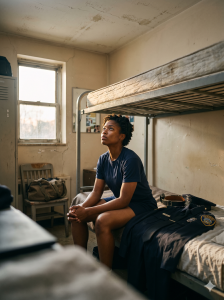
They were wrong.
I pushed the blanket aside and stood. My body felt different—not because the pain was gone, but because it no longer mattered in the same way. The bruising on my wrist had faded into dull yellow-green shadows, but something heavier had replaced the pain: focus. I looked into the mirror above the sink and didn’t see the recruit who had walked out of that restroom shaking and soaked. I saw someone who had survived everything meant to erase her.
I pulled out my Class A uniform. Not as a symbol of loyalty, but as evidence. I wanted them to see exactly who they had tried to break. I buttoned the navy jacket, polished the brass until it reflected light like glass, and tied my hair into a tight regulation bun. Every movement was intentional.
The drive to City Hall blurred past traffic lights and anxious radio chatter. By the time I arrived, the scale of it was undeniable.
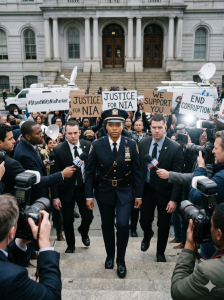
The plaza was packed—news vans lined the streets, reporters shouted into live cameras, and crowds stretched across the steps holding signs marked with a single phrase:
#StandWithNiaParker
Camera flashes hit me the moment I stepped out of my car. I kept my gaze forward as I climbed the granite steps, flanked by two plainclothes officers assigned for protection.
Inside, the council chamber was already overflowing. The air felt heavy, trapped beneath layers of bodies and tension. Every seat was filled.
As I walked down the aisle, I took in the room.
On one side sat retired officers—still, closed off, arms folded tightly, faces hardened with silent loyalty. On the other, near the back, sat women. Dozens of them. Former recruits. Former officers. Women who had lived versions of what I had survived. Some wore uniforms. Some wore civilian clothes. All of them watched quietly, acknowledging me as I passed.
It wasn’t just a crowd. It was testimony.
At the front sat Sergeant Trent Maddox.
He looked composed. Confident. Too comfortable. Beside him, his union attorney leaned in, whispering strategy. Maddox smirked faintly, like none of this could touch him.
That illusion broke the moment Investigator Erin Caldwell entered.
She didn’t acknowledge anyone on the way in. No hesitation. No performance. Just precision. She sat, opened her laptop, and faced the council.
A gavel struck.
“This emergency public hearing is now in session,” the chair announced. “Investigator Caldwell, you may proceed.”
The union attorney immediately stood. “Madam Chair, we object—this is a politically motivated proceeding based on unverified allegations—”
“Overruled,” the chair cut in sharply. “Sit down.”
Caldwell leaned forward.
“We recovered the deleted footage,” she said.
The room changed instantly.
Not metaphorically—physically. A wave of sound moved through the chamber: gasps, chair shifts, sudden silence. Maddox’s expression collapsed in real time. His lawyer stopped moving altogether.
“Play it,” the chair ordered.
The screens lit up.
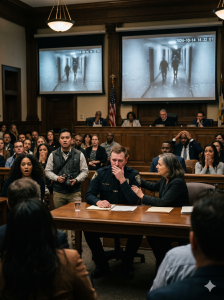
What followed was not interpretation. Not debate. Not argument.
It was evidence.
The hallway outside the women’s restroom. The timestamp. Maddox entering the restricted area. His hand reaching up toward the disabled camera panel. The moment he positioned himself. The moment I entered frame.
Then the assault.
The grip on my neck. The forced movement. The stall door slamming open. The struggle. The imbalance of force. The impossibility of escape.
And then—calm.
Maddox stepping back out. Adjusting his uniform. Walking away as if nothing had happened.
No one in the room spoke.
Even after the video ended, the silence remained.
Someone forgot to turn off their microphone.
“Jesus,” a council member whispered.
No one responded.
When I was called, I stood.
Each step to the witness stand felt deliberate, controlled. I sat, pulled the microphone closer, and looked across the room—reporters, officers, council members, survivors, and finally, Maddox.
I didn’t look away.
“This wasn’t about training,” I said. “It was about control. About a system that teaches recruits—especially women of color—that power can do whatever it wants to you, and survival depends on silence.”
No one interrupted me. No one tried.
Then the room shifted again.
A woman stood from the audience.
Tasha Lin.
She walked to the microphone shaking. Her voice broke immediately.
“I heard it,” she said. “And I did nothing. Because I thought if I moved, I’d be next.”
The weight of her words settled across the chamber.
Then another woman followed. Then another.
Maribel Santos described her prior report being buried and turned against her. Another recruit described punishment drills. Another described forced transfers and silenced complaints.
The pattern was no longer hidden. It was repeated, confirmed, multiplied.
Then DeShawn Harris stepped forward.
“They called it training,” he said. “But it was punishment. And it only happened when we challenged him.”
The system wasn’t defended anymore. It was exposed.
Finally, Caldwell entered the full record into evidence.
Seventeen documented incidents.
Hundreds of thousands in settlements.
Multiple falsified maintenance logs tied to disabled surveillance systems.
The chamber no longer felt like a hearing.
It felt like collapse.
Then my father stood.
Commissioner Malcolm Parker approached the microphone slowly. No political posture. No controlled expression. Just weight.
“I failed to see the pattern,” he said. “Because I chose stability over truth. And I was wrong.”
He paused.
“I was wrong.”
That was the moment everything changed—not because it excused anything, but because it confirmed it had been known, and ignored, at the highest level.
The consequences came quickly.
Maddox resigned within forty-eight hours. Criminal charges followed immediately. His pension was frozen.
Reddick was removed for suppression and mishandling of complaints.
The union faced federal scrutiny.
But the deeper changes mattered more.
Independent oversight was mandated.
Surveillance systems were rebuilt with secure, tamper-proof backups.
Anonymous reporting channels were created outside the chain of command.
Psychological evaluations for instructors became mandatory and enforceable.
The structure that enabled silence began to fracture.
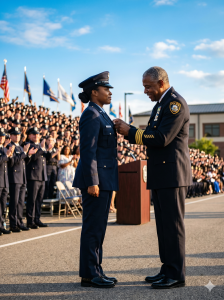
Graduation came three months later.
The sky above the parade grounds was clear. The air felt lighter than it ever had before.
I stood in formation in a pressed uniform, holding steady.
When my father walked down the line to pin badges onto recruits, the crowd cheered behind us.
When he reached me, he paused—not as Commissioner first, but as something older than that.
A father.
He pinned the badge carefully.
“I’m proud of you,” he said quietly. “For choosing the hard right.”
I closed my eyes for a moment.
The weight on my chest wasn’t pressure anymore. It was grounding.
I didn’t take the easy assignments afterward. I chose community policing. I built mentorship programs for recruits who would follow, so they wouldn’t have to face silence alone.
I visited the academy twice a year—not as a warning, not as a symbol, but as proof that things could be different.
And on my first day at my new precinct, a veteran desk sergeant looked up from his desk, studied me for a moment, and nodded.
“Welcome, Officer Parker,” he said.
Not legacy.
Not story.
Officer.
