


David Sterling said nothing.
For a man who always had something to say, the quiet was striking.
He stood twenty feet off, still gripping the silver keys to his Porsche, while every employee in view had given up pretending not to stare.
My mother rushed toward me.
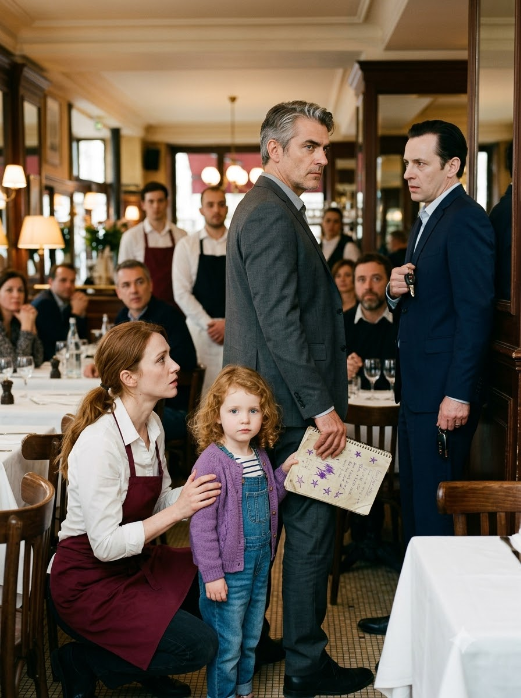
“Rory!”
She dropped beside my chair so fast her knees hit the floor.
“What are you doing here?”
Her hands ran over my shoulders, my arms, my face, checking me like I might have broken something just from crossing the restaurant.
“I needed help.”
“You were supposed to stay in the office.”
“I did for a while.”
“Rory.”
“I brought your paper.”
Mom’s eyes shifted to Vincent.
Then to the folded work log in his hand.
The color drained from her face.
“Oh.”
That single sound seemed to hold eleven weeks of exhaustion inside it.
Vincent studied her closely.
“Emily Carter?”
She stood.
“Yes.”
He raised the work log.
“Is this yours?”
She nodded.
Sterling finally moved forward.
“Mr. Kane, Emily’s payroll situation is already being handled.”
Vincent didn’t look at him.
“How much have you paid her over the last eleven weeks?”
Mom swallowed.
“Nothing.”
The restaurant seemed to go quieter still.
Sterling gave a light laugh.
It wasn’t real.
“That’s technically true, but misleading.”
Vincent turned.
“Explain.”
“We’re switching payroll processors.”
“For eleven weeks?”
“There were complications.”
“What complications?”
Sterling’s eyes cut toward a few servers near the kitchen.
“This isn’t really the place.”
Vincent glanced around the dining room.
“Then perhaps we should go somewhere private.”
Sterling eased up a little.
“Good.”
Vincent added, “Emily comes with us.”
Sterling’s jaw tightened.
Mom touched my shoulder.
“I need to finish my shift.”
“No,” Sterling said quickly. “Actually, Emily should keep working while we figure this out.”
I looked at Mom.
She looked exhausted enough to fall asleep standing.
Vincent asked, “When does her shift end?”
Sterling hesitated.
Mom answered.
“Seven minutes ago.”
Vincent looked at her.
“Then why are you still here?”
Mom started to speak.
Sterling cut in.
“She offered to help close.”
Mom looked at him.
Something shifted in her expression.
Not a lot.
Just enough.
“I didn’t offer.”
Sterling frowned.
“Emily.”
“You said if I left before the kitchen was done, there might not be shifts for me next week.”
Sterling’s face sharpened.
“That’s not what I meant.”
“It’s exactly what you said.”
The words seemed to catch Mom off guard as much as anyone.
I squeezed her hand.
Vincent noticed.
“Private room,” he said.
No one objected.
We went into a small dining room behind the main one.
I’d been there once before, back when the manager let me color while Mom worked a double.
Vincent took the seat at the head of the table.
Mom sat next to me.
Sterling sat across from us.
Two of Vincent’s men stayed by the door.
Silent.
That made them look even bigger.
Vincent set the log on the table.
“Five thousand four hundred thirty dollars and thirty cents.”
Sterling folded his hands.
“Like I said, payroll’s being corrected.”
“When?”
“Soon.”
Vincent waited.
Sterling shifted in his seat.
“Within days.”
“Which day?”
“I can’t give you an exact date.”
“You’ve had seventy-seven of them.”
Sterling’s expression hardened.
“You’re oversimplifying.”
Vincent looked to Mom.
“Are you the only one who hasn’t been paid?”
She hesitated.
“I don’t know.”
Sterling jumped in.
“Most of the staff got their normal wages.”
“Most?”
Vincent’s tone stayed even.
Sterling seemed to catch his own mistake.
“There were scattered delays.”
“How many employees?”
Sterling didn’t respond.
Vincent opened the log again.
“Emily, why did you record every shift?”
Mom looked embarrassed.
“Because my paychecks kept coming out wrong.”
Sterling leaned back.
“There were occasional discrepancies.”
“How often?” Vincent asked.
Mom stared at the table.
“Almost every check since January.”
Vincent turned to Sterling.
“You said eleven weeks.”
“That’s the longest gap.”
Mom spoke up suddenly.
“No.”
Everyone turned.
She swallowed.
“The eleven weeks are the part he didn’t pay at all.”
Vincent’s attention came back to her.
“What happened before that?”
Mom rubbed her hands together.
“The checks were short.”
“How short?”
“Sometimes fifty dollars. Sometimes two hundred.”
“Why?”
“David said it was taxes.”
Sterling interrupted.
“Payroll withholding fluctuates.”
Mom shook her head.
“I called the payroll company once.”
Sterling went still.
Vincent caught it.
“What did they tell you?”
“They said the amount deposited matched what they’d been instructed to send.”
Sterling sighed.
“Emily misunderstood.”
“I didn’t.”
“Accounting gets complicated.”
Mom looked at him.
“I can read.”
He went quiet.
I looked back and forth between them.
Sometimes grown-ups argued without ever raising their voices.
This felt like one of those times.
Vincent asked, “Do you have pay stubs?”
“Some.”
“Bank records?”
“Yes.”
“Texts about the missing pay?”
Mom nodded.
“A lot.”
Sterling’s face grew worse with every answer.
Vincent turned to one of his men.
“Get Martin.”
The man nodded and left.
Sterling frowned.
“Who’s Martin?”
“My accountant.”
Sterling’s expression changed.
That caught my attention.
Grown-ups never seemed to like accountants when they were hiding something.
At least, that’s what I decided at the time.
Vincent turned back to Mom.
“Did Sterling ever explain why your checks were short?”
She nodded.
“Uniform deductions.”
Sterling said, “Standard.”
“Broken dishes.”
“Also standard.”
“Food waste.”
Sterling shrugged.
“Employees are responsible for preventable losses.”
Mom looked at Vincent.
“Once they took three hundred dollars because a refrigerator broke down.”
Vincent stared at Sterling.
“Did she break the refrigerator?”
“It failed during her closing shift.”
“That’s not what I asked.”
Sterling had no answer.
I raised my hand.
Mom shut her eyes.
“Rory.”
Vincent looked at me.
“Yes?”
“Mom can’t break a refrigerator.”
Sterling looked annoyed.
Vincent asked, “How do you know?”
“She can’t even fix our lamp.”
Mom whispered, “Please stop helping.”
One of Vincent’s men looked down to hide a smile.
Vincent nearly smiled too.
Then the door opened.
A thin man carrying a laptop walked in.
“Martin Hale,” Vincent said. “Sit.”
Martin sat.
Vincent slid him the work log.
“Payroll review.”
Martin skimmed it fast.
Then looked at Mom.
“Do you have your employee ID?”
She handed it over.
He typed.
Sterling shifted.
“You can’t pull our payroll records without authorization.”
Martin glanced up.
“Actually, I can pull the lender reporting package your company filed last quarter.”
Sterling froze.
Mom looked lost.
Vincent explained.
“I financed part of Sterling Bistro’s renovation.”
Mom stared at him.
“You invested in this place?”
“Indirectly.”
I nodded.
“So you’re the boss.”
“No.”
“Almost?”
Vincent glanced at Sterling.
“Today, maybe.”
Sterling didn’t seem to appreciate the comment.
Martin pulled up several files.
“Labor expense gets reported monthly.”
Vincent asked, “Does it list Emily as paid?”
Martin searched.
“Yes.”
Mom stared.
“What?”
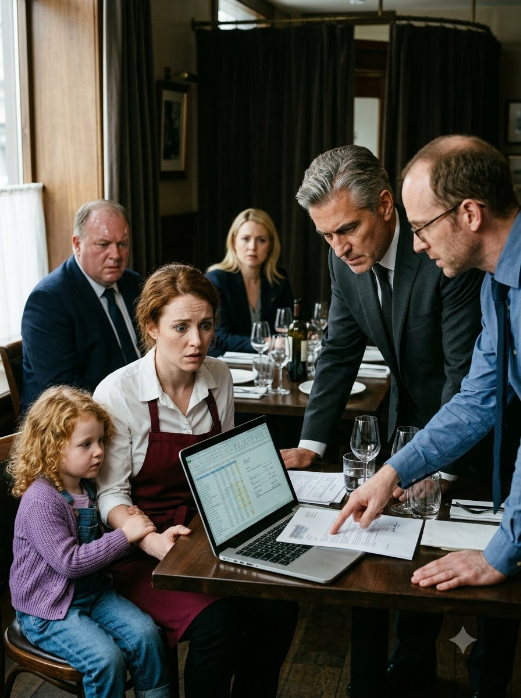
Martin turned the laptop her way.
Rows of numbers covered the screen.
I understood none of it.
Mom did.
Her mouth fell open.
“That says I got paid.”
“Yes.”
“But I didn’t.”
Martin looked at Sterling.
“Then something’s off.”
Sterling leaned in.
“The financial reports summarize accruals.”
Martin nodded.
“Correct.”
Sterling relaxed a little.
Then Martin kept going.
“But your bank reconciliation shows actual disbursements.”
Sterling’s ease vanished.
Vincent asked, “Meaning?”
“The statements indicate wages actually went out.”
Mom whispered, “To who?”
Martin typed again.
“That’s what I’m working to find out.”
Sterling stood.
His chair scraped back.
“I’m calling my lawyer.”
Vincent nodded.
“You should.”
Sterling looked surprised.
Vincent went on.
“Have them come here.”
Sterling stepped into the hallway.
Mom stared at Vincent.
“You’re not stopping him?”
“Why would I?”
“I thought…”
She stopped herself.
“What?”
Mom looked embarrassed.
“People talk about you.”
“They usually do.”
I leaned toward him.
“Are you a bad guy?”
Mom whispered, “Rory!”
Vincent looked at me for a few seconds.
“I’m a businessman.”
“That’s not what I asked.”
Martin coughed.
Vincent’s mouth twitched.
“Your mother’s going to have an exhausting life.”
“She already does.”
That wiped away his almost-smile.
The room fell quiet again.
Mom squeezed my hand.
Vincent glanced at the purple stars.
Then back at her.
“Why didn’t you speak up sooner?”
Mom looked toward the door.
“I did.”
“To Sterling?”
“Yes.”
“What happened?”
“He said there was a payroll issue.”
“And weeks later?”
“He said the bank was holding funds.”
“And after that?”
“He told me the restaurant was struggling.”
Vincent frowned.
“You believed him?”
Mom gave a tired laugh.
“I wanted to.”
“Why?”
“Because the other option was admitting my employer knew I couldn’t afford groceries and didn’t care.”
That quieted the room.
Mom looked down at her hands.
“I kept thinking one more shift and I’d finally get paid.”
Sterling came back twenty minutes later with a lawyer named Rebecca Shaw.
She talked with him privately before sitting down.
“My client wants to resolve legitimate wage discrepancies.”
Mom flinched at the word legitimate.
Vincent noticed.
“So do I.”
Rebecca looked at him.
“Then maybe we can avoid escalating this unnecessarily.”
Martin turned his laptop toward her.
“These financial reports show payroll disbursements that don’t match Ms. Carter’s bank deposits.”
Rebecca’s expression turned wary.
“Preliminary reports can be misread.”
“Agreed,” Martin said. “Which is why I want the raw payroll data.”
Sterling said immediately, “No.”
Everyone turned.
Rebecca closed her eyes.
Vincent leaned back.
“Interesting.”
Sterling realized what he’d just done.
“My employees’ private information is protected.”
“Then give us only Emily’s records.”
“No.”
Rebecca murmured, “David.”
He rubbed his forehead.
Mom looked at him.
“Why don’t you want them seeing mine?”
Sterling stayed silent.
That was the moment Mom’s fear started turning into something else.
She’d spent eleven weeks asking for money.
Now she was asking for the truth.
The difference came through in her voice.
“Where did my money go?”
Sterling glanced at Rebecca.
She shook her head slightly.
Mom kept going.
“You told me payroll processed it.”
Silence.
“You told me the bank delayed it.”
Silence.
“You told me I had deductions.”
Nothing.
Mom’s voice shook.
“Where did it go?”
Sterling finally said, “The restaurant needed liquidity.”
Martin’s head snapped up.
Rebecca whispered, “Stop talking.”
But Sterling had already started.
“We had bills.”
Mom stared.
“So you used my pay?”
“Temporarily.”
“For eleven weeks?”
“It was supposed to get fixed.”
Vincent asked, “How many other employees?”
Sterling looked down.
Martin leaned forward.
“How many?”
“Six.”
Mom whispered, “Six?”
Sterling said, “Not all for eleven weeks.”
Somehow that made it worse.
Martin started taking notes.
Vincent’s expression stayed nearly blank.
“What did the financial statements show?”
Sterling answered quietly.
“That everyone was paid.”
Mom got it before I did.
“You told people we were paid.”
Sterling said nothing.
Vincent asked, “Why?”
Sterling looked at the table.
“The restaurant was applying for expansion financing.”
Martin stopped writing.
“What expansion?”
Sterling’s face changed again.
Vincent caught it.
“David.”
Sterling glanced at his attorney.
She said, “Don’t answer that.”
Vincent nodded.
“Fine.”
He turned to Martin.
“Find the proposal.”
Martin typed.
It took under two minutes.
Then he stopped.
Vincent noticed.
“What?”
Martin turned the screen.
“There’s an expansion package already filed.”
Vincent leaned in.
“For how much?”
“One point eight million.”
Sterling looked at the floor.
Vincent’s eyes narrowed.
“Who signed it?”
Martin didn’t answer right away.
Then he turned the laptop fully toward Vincent.
A scanned signature sat at the bottom of a financing commitment letter.
Vincent Kane.
Vincent stared at it.
Mom’s eyes went from the screen to him.
“Is that yours?”
“No.”
For the first time all evening, Vincent’s calm cracked.
Not much.
Just enough.
Sterling’s attorney rose.
“I think we’re done here.”
Vincent looked at her.
“Maybe.”
Then Martin opened another attached file.
“Wait.”
He scrolled.
His expression shifted.
“What?”
Martin looked at Mom.
“There’s an employee certification attached to the application.”
Mom frowned.
“What’s that mean?”
“A statement supposedly confirming regular payroll and staffing levels.”
He turned the screen.
Emily Carter.
Her name.
Her employee number.
Her address.
And below it—
a signature.
Mom leaned toward the laptop.
“That’s not mine.”
Vincent’s eyes moved to Sterling.
Sterling said nothing.
Martin opened the document properties.
“This came from an internal computer.”
“Whose?” Vincent asked.
Martin checked the device registration.
Then looked at Sterling.
“David’s office.”
Mom sank back like the chair had vanished beneath her.
She stared at her own name.
Then at the purple stars still sitting on the table.
Vincent turned toward Sterling.
“You didn’t just withhold her wages.”
His voice was quieter now.
“You used her employment record to back a loan application she knew nothing about.”
Sterling’s attorney put a hand on his arm.
“Don’t respond.”
Vincent picked up the work log.
“Emily, you said you have older pay records at home?”
“Yes.”
“Keep them.”
“I will.”
“Every text too.”
“Yes.”
“And anything Sterling ever had you sign.”
Mom’s expression changed.
“What?”
Vincent stopped.
She’d gone pale.
“There were forms.”
Martin looked at her.
“What kind?”
“I don’t know.”
“When?”
“Last summer.”
Sterling stared at her.
Mom noticed.
That look told her something.
She stood.
“You said those were insurance forms.”
Rebecca whispered, “David, don’t.”
Mom’s voice dropped.
“What did I sign?”
Sterling looked away.
Vincent closed the folder.
“Emily.”
She turned.
“Do you still have copies?”
“No.”
“Were you given any?”
“No.”
Vincent looked at Sterling.
Then at Martin.
“Find them.”
Martin nodded.
Sterling’s attorney immediately asked that all future communication go through counsel.
The meeting ended.
But just before we left, Martin’s phone buzzed.
He looked down.
Then went still.
Vincent noticed.
“What?”
Martin turned the phone toward him.
“I found one of the forms.”
Mom stared.
“What is it?”
Martin’s face went carefully blank.
“A beneficiary designation.”
Mom frowned.
“For what?”
Martin looked at her.
Then at me.
“A life-insurance policy.”
Mom went completely still.
“I don’t have life insurance through Sterling’s.”
Martin swallowed.
“According to this, you do.”
“How much?”
He read the number.
“Five hundred thousand dollars.”
Mom’s hand closed around mine.
“Who’s the beneficiary?”
Martin checked the page again.
Then raised his eyes.
“Not Rory.”
The room had already been full of secrets, but the insurance form reshaped every question in it.
My mother stared at Martin Hale.
“If Rory isn’t the beneficiary, who is?”
Martin didn’t answer right away.
That was what scared me.
Even at four and a half, I understood that grown-ups only paused like that when the answer was bad.
Vincent reached for the document.
“Let me see.”
Martin handed him the phone.
Vincent read.
His face went still.
Mom stood.
“Who?”
Vincent looked at her.
“The restaurant.”
She frowned.
“What?”
“Sterling Bistro LLC is listed as beneficiary.”
Mom laughed once.
Not because anything was funny.
“That makes no sense.”
Martin nodded.
“No. It doesn’t.”
Sterling and his attorney had already stepped into the hallway.
Vincent’s guard moved toward the door.
Vincent raised a hand.
“Don’t.”
The guard stopped.
Mom looked at him.
“You’re just going to let him leave?”
“For now.”
“Why?”
“Because we have paperwork, not conclusions.”
Mom stared.
Vincent’s voice softened.
“A strange document can mean several things. We figure out which before we decide what it means.”
That was the first lesson Vincent Kane ever gave my mother.
Don’t let fear finish a story before the facts do.
We went home that night.
Vincent arranged a car.
Mom turned down money.
He didn’t push.
Instead he told Martin to send her a written list of what records they needed.
That mattered to Mom.
Everything on paper.
No more promises muttered across restaurant counters.
No more “trust me.”
No more “later.”
The apartment was cold when we got in.
Mom checked the thermostat.
Then the fridge.
I followed her.
“You’re looking for dinner.”
She turned.
“I’m always looking for dinner.”
Half a loaf of bread.
A jar of peanut butter.
Two apples.
Mom stared at them.
Then at me.
“Sandwiches?”
“With apple?”
“With apple.”
I nodded.
That night, we both ate.
Mom finished hers.
I watched.
She noticed.
“What?”
“You’re hungry.”
“Yes.”
“You used to say you weren’t.”
“I lied.”
“You tell me not to lie.”
“I know.”
“Why did you?”
She looked at her sandwich.
“Because sometimes parents try to make a bad situation seem smaller so their kids won’t be scared.”
“Did it work?”
“No.”
I took another bite.
“I already knew.”
She looked at me a long while.
“I know that now.”
The next morning, Martin called.
The policy was real.
It had been set up seven months earlier through a small commercial insurance package the restaurant carried.
Mom was listed as a “key employee.”
She nearly laughed at that.
“Key employee?”
“Yes,” Martin said.
“I wait tables.”
“Apparently Sterling’s application called you an operations coordinator.”
“I’ve never been an operations coordinator.”
“Did you ever handle inventory paperwork?”
“Yes.”
“Schedule staff?”
“Sometimes when Jason was out.”
“Train new servers?”
“Yes.”
Martin sighed.
“He may have stretched those duties to justify the title.”
Mom pressed the phone closer.
“Why would he insure me?”
“Some businesses take out policies on genuinely essential employees.”
“But five hundred thousand dollars?”
“That number raises questions.”
“What happens if I quit?”
“The policy might lapse depending on how it’s structured.”
“And who paid the premium?”
“Sterling Bistro.”
Mom closed her eyes.
“Did I sign it?”
“We found a signature.”
“That’s not what I asked.”
Martin paused.
“Then no. We don’t yet know if you signed it.”
Mom looked over at me.
I was coloring on the kitchen floor.
Purple stars.
She turned away.
“Find the original.”
They did.
Two days later.
The original signature packet had been signed electronically.
Verification came through a code texted to a phone.
Mom’s phone.
That sounded bad.
Until Martin checked the timestamp.
The confirmation code went out at 1:14 on a Tuesday afternoon.
Mom pulled out her work log.
That Tuesday, she’d been on shift.
She remembered because Rory’s preschool had called about a fever.
Her phone had stayed in her locker.
“Who could have gotten to it?”
Martin asked.
Mom thought it over.
“Employees can’t carry phones on the floor.”
“Where do they keep them?”
“Lockers.”
“Locked?”
She shook her head.
“The locker room doesn’t have locks.”
Martin went quiet.
“Did Sterling know your passcode?”
“No.”
“Was it hard to guess?”
Mom looked embarrassed.
“Rory’s birthday.”
Martin looked at me.
I waved.
He sighed.
“Change that.”
Mom did.
Then came the detail that turned suspicion into something solid.
Security footage.
The restaurant kept thirty days on-site but archived more through a cloud service the insurer required.
Martin got the recording.
At 1:11 that afternoon, Sterling walked into the employee locker room.
At 1:16, he left.
Mom watched without blinking.
“That’s when the code came in.”
“Yes.”
Vincent stood beside her.
“Still not absolute proof he used the phone.”
Mom nodded.
“But?”
“But enough to keep digging.”
She looked at him.
“I’m starting to hate that word.”
“Digging?”
“No. Enough.”
Vincent nearly smiled.
The further Martin dug, the stranger the payroll system looked.
Mom wasn’t the only one with an inflated title.
Four other employees showed up in financial reports under roles they didn’t recognize.
A dishwasher had become “facility supervisor.”
A server had become “guest relations director.”
Jason, the floor manager, was listed as “regional operations manager.”
There was no region.
Just one restaurant.
The titles propped up the financing pitch.
The inflated payroll backed up the story of a bigger operation.
The life-insurance policies told a different story altogether.
Three employees had them.
Mom.
Jason.
And Sterling’s head chef, Ana’s husband Luis.
All three were labeled essential staff.
All three said they’d never knowingly agreed to the policies.
All three named Sterling Bistro as beneficiary.
Mom sat with Jason and Luis in Vincent’s office while Martin walked them through it.
Jason looked sick.
“Is this even legal?”
Martin chose his words carefully.
“Business-owned life insurance can be legal under the right conditions, including required notice and consent. The question is whether those were actually met.”
Luis crossed his arms.
“I never agreed to this.”
“Then that matters.”
Mom looked at Vincent.
“Why would David want these policies?”
Vincent answered.
“Possibly because a lender asked if key personnel were insured.”
Martin nodded.
“That’s common enough in some financing deals.”
Mom frowned.
“So maybe he did this for the loan.”
“Possibly.”
That word again.
Possibly.
Mom hated it.
I preferred it to grown-ups pretending certainty they didn’t have.
The investigation grew beyond Mom.
Nine employees came forward with wage complaints.
Four had deductions they never understood.
Two had overtime hours altered.
One, a dishwasher named Carla, had apparently signed a disciplinary form on a day she was in the hospital.
Carla cried when Martin showed her.
“I thought I was losing my mind.”
Mom took her hand.
“No.”
That word had become easier for her.
No.
You’re not imagining it.
No.
You didn’t sign that.
No.
You don’t have to accept someone else’s version just because they say it with confidence.
The restaurant shut down for a while.
Not because Vincent staged some dramatic closure.
Because the payroll provider froze certain services during the review, several employees stopped taking shifts until their records were fixed, and Sterling’s lawyer told him to step back from daily operations.
Sterling didn’t vanish.
He stayed in Chicago.
That surprised everyone.
He brought in accountants.
He produced paperwork.
He kept insisting the restaurant’s troubles came from cash shortages and administrative errors.
Some records backed up parts of that.
Others didn’t.
That made the story more complicated.
Sterling hadn’t just pocketed every dollar and spent it on a Porsche.
The Porsche, it turned out, was leased under his own name.
The restaurant really had been struggling.
Food costs had climbed.
A renovation had run over budget.
A failed catering contract had left invoices unpaid.
For a while, Sterling had used incoming revenue to cover the most urgent bills.
Then he started delaying payroll.
Then altering records to hide it.
Then borrowing.
Then creating paperwork to support more borrowing.
Each bad call made the next one easier.
Mom listened to Martin lay it out.
“So he was desperate.”
“Yes.”
“That doesn’t excuse anything.”
“No.”
She seemed almost relieved to hear him say it.
Understanding wasn’t the same as forgiveness.
A reason wasn’t permission.
That distinction mattered.
Then came something none of us saw coming.
Sterling asked to meet with Mom.
Vincent told her she didn’t have to.
Martin suggested her lawyer be present if she agreed.
Mom said yes.
I stayed downstairs with Mrs. Alvarez.
Mom told me everything afterward.
The meeting took place in Vincent’s office.
Sterling looked different without the restaurant around him.
No expensive suit.
No Porsche keys.
Just a tired man in a gray sweater.
He didn’t look powerful.
He looked scared.
Mom sat across from him.
“You withheld my pay.”
“Yes.”
“You changed records.”
“Yes.”
“You used my employment record for a financing application.”
Sterling looked at his hands.
“Yes.”
“The life-insurance policy?”
He looked up.
“I didn’t mean anything sinister by it.”
Mom’s face hardened.
“That’s not an answer.”
“I was trying to meet the lender’s requirements.”
“Did you ask me?”
“No.”
“Did you use my phone to authorize it?”
Sterling closed his eyes.
His attorney murmured something.
He answered anyway.
“Yes.”
Mom sat back.
“And the forged signature?”
“I copied it from another form.”
His attorney looked livid.
Mom was quiet for a few seconds.
Then she asked the question that mattered most to her.
“Why didn’t you just tell me you couldn’t pay me?”
Sterling looked almost offended by how simple that sounded.
“I would have lost employees.”
“You lost them anyway.”
“I thought I could fix it.”
“When?”
“The next week.”
“And when you couldn’t?”
“The week after.”
“And then?”
Sterling rubbed his face.
“I kept moving the line.”
Mom understood that.
She’d done something similar with fear.
Tomorrow I’ll complain.
Next paycheck I’ll quit.
One more shift.
One more week.
Sterling went on.
“I told myself no one was really losing money because I meant to pay it all back.”
Mom leaned forward.
“We went without dinner.”
Sterling stopped.
“My daughter counted.”
He looked away.
“She counted the nights I didn’t eat.”
“I’m sorry.”
Mom stared at him.
“I wanted those words for months.”
Sterling looked up.
“They don’t feel very useful now.”
“No.”
He looked surprised.
Mom continued.
“I’m not here to punish you.”
Vincent sat silent near the window.
“I’m here to see whether you actually understand what you did.”
Sterling’s eyes welled up.
“I do.”
Mom shook her head.
“No.”
His face tightened.
“What do you mean?”
“You understand the accounting problem.”
She leaned in.
“You still don’t understand that you looked at people who needed their wages and decided your business mattered more.”
Sterling said nothing.
“That’s the part you haven’t gotten yet.”
Mom stood.
The meeting was over.
No shouting.
No threats.
Just one sentence Sterling couldn’t talk his way around.
That evening, Mom came home lighter.
Not happy.
Lighter.
She sat on the floor with me.
“What did he say?”
“He said sorry.”
“Did you forgive him?”
She thought about it.
“No.”
“Are you going to?”
“I don’t know.”
I nodded.
That seemed fair enough.
Then I handed her a purple crayon.
“For what?”
“Tomorrow.”
“Tomorrow what?”
“You can draw your own star.”
She smiled.
The next twist came the following morning.
Martin called before breakfast.
He’d been going through the life-insurance applications.
One of the three policies had been canceled.
Not Mom’s.
Jason’s.
Canceled two months earlier.
“Why?” Mom asked.
“Sterling filed a change form.”
“Why?”
Martin hesitated.
“Because Jason was no longer listed as essential personnel.”
“That sounds normal.”
“It would.”
“But?”
“There was a replacement.”
Mom’s grip tightened on the phone.
“Who?”
Martin sent the document.
Mom opened it.
The replacement wasn’t a manager.
Not the chef.
Not even an adult.
The application listed a dependent tied to one of the restaurant’s workers.
Name:
Aurora Carter.
Mom stopped breathing.
My full name.
The one almost no one used.
Aurora Elise Carter.
The proposed coverage:
$250,000.
Mom stared at the page.
Then whispered, “When was this filed?”
Martin answered.
“Three weeks ago.”
Three weeks before I walked into the dining room.
Three weeks before Vincent noticed the purple stars.
Three weeks before anyone knew about the work log I’d found.
Mom’s voice went cold.
“Was it approved?”
“No.”
“Why not?”
“The insurer asked for more consent documentation.”
“And David?”
“He never finished it.”
Mom shut her eyes.
The application was incomplete.
No policy had ever been issued.
No premium paid.
No coverage existed.
But one question remained.
Why had David Sterling put a four-year-old’s name on it at all?
By then, my mother had learned not to let the worst possibility become the only one.
That didn’t mean she stayed calm seeing my full name on the unfinished form.
It meant she asked questions before letting fear answer them for her.
“How did David get Aurora’s information?”
Martin Hale looked at the form.
“From your benefits paperwork, most likely.”
“Why was she listed?”
“We need to trace the application’s history.”
Vincent stood by the window.
Mom looked at him.
“You think David was trying to insure Rory.”
“I think he entered her information into a system.”
“That’s not comforting.”
“It isn’t meant to be.”
Mom crossed her arms.
“Then find out why.”
Martin did.
It took two days.
And when the answer came, it was less sinister than Mom had feared—but more telling about how far Sterling had drifted from seeing people as people.
The lender behind Sterling’s expansion financing wanted several forms of risk coverage.
His insurance broker had sent a checklist.
One line asked for contingent coverage for dependents of employees under a proposed childcare benefit.
There was supposed to be a separate consent process.
Sterling never built the benefit.
Never told the employees about it.
Instead, scrambling to make the expansion package look finished, he’d filled in fields with whatever was already sitting in the personnel files.
My name had gone in as a placeholder.
A placeholder.
Mom repeated the word three times.
“He used my child as a placeholder?”
Martin nodded.
“Looks that way.”
“He wasn’t planning to collect if something happened to her?”
“Nothing suggests that.”
Mom closed her eyes.
Relief came first.
Then anger.
Not explosive anger.
Tired anger.
The kind that no longer wanted a dramatic finish.
Just distance.
“He didn’t even think of her as a person.”
Vincent looked at her.
“That might be the more accurate problem.”
Sterling had built his restaurant one rationalization at a time.
A late paycheck was temporary.
A changed timecard was bookkeeping.
A forged signature was paperwork.
An employee’s passcode was convenient.
A child’s identity was a field on a form.
Nothing looked large when he examined each choice on its own.
Together, they’d become a life.
Ours.
And plenty of others.
The legal process dragged on for months.
That disappointed me, because kids expect stories to wrap up quickly once the secret’s out.
Grown-ups know better.
There were meetings.
Records requests.
Corrected payroll statements.
Employment lawyers.
Insurance investigators.
Tax accountants.
Sterling’s expansion financing fell through.
The life-insurance policies were canceled.
The false employee certifications were corrected.
My name got pulled from every system it had touched.
Mom checked that herself.
Twice.
Then a third time.
Vincent didn’t tell her to stop.
“I’d check four times,” he said.
So she did.
Mom got back all eleven weeks of unpaid wages.
Plus additional compensation once the improper deductions and overtime claims were verified.
The amount mattered.
Just not the way I’d pictured.
I’d figured the money would transform our whole life.
Maybe a giant house.
Maybe a new car.
Maybe endless cereal.
Instead Mom paid the overdue rent.
Then electricity.
Then preschool.
Then she stocked the fridge.
She stood in the grocery store staring at the coffee for almost a full minute.
I tugged her sleeve.
“Are we getting it?”
She picked up the cheap one.
Put it back.
Chose the brand she actually liked.
“Yes.”
I grinned.
That was one of the first small luxuries we got back.
Not extravagance.
Preference.
The freedom to pick something because she liked it, not just because it was cheapest.
Sterling eventually reached settlements with several employees.
Some disputes stayed unresolved.
Some claims were sorted out through employment and financial proceedings.
Mom stopped following every detail.
At first I thought that meant she’d stopped caring.
Years later, she explained it.
“I realized I was letting him keep taking my time even after I’d stopped working for him.”
She didn’t want Sterling’s consequences to turn into a family hobby.
So she stopped tracking every update.
Her lawyer handled most of it.
She answered questions when she had to.
Then she came home.
That was its own kind of victory.
The restaurant stayed closed for almost a month.
The staff didn’t know what would happen next.
Many needed work right away.
Mom worried about all of them constantly.
Vincent finally asked her, “Why are you carrying twenty-three people?”
She frowned.
“I’m not.”
“You know everyone’s rent date.”
“I care about them.”
“That’s different.”
“What are you saying?”
“That caring about people doesn’t mean you’re responsible for every outcome.”
Mom stared at him.
“You’re starting to sound like a therapist.”
“I’m offended.”
“You should be.”
I was nearby drawing.
“What’s a therapist?”
“Someone useful,” Mom said.
Vincent sighed.
“Apparently not me.”
The employees worked out a plan.
A local restaurant owner named Maria Santos had been looking for a second location.
Vincent knew her through commercial real estate.
He connected her with the staff.
No hidden deals.
No favors buried in contracts.
Everyone knew exactly who she was.
Maria spent a week watching the kitchen.
Then offered to lease the space and rehire most of the old staff.
New ownership.
New payroll.
New accounting.
New rules.
Jason became floor manager.
Luis stayed in the kitchen.
Ana came back as a server.
Carla the dishwasher returned only after seeing the payroll schedule in writing.
Mom didn’t go back.
Maria offered.
Mom thanked her.
Then said no.
I was stunned.
“Why?”
We were walking home when she told me.
“Because I don’t want to spend every day remembering the worst eleven weeks of my life.”
“But the restaurant’s different now.”
“Yes.”
“So why not?”
She thought about it.
“Because different isn’t always the same as mine.”
I frowned.
“What does that mean?”
“It means I want to choose what comes next instead of only patching up what came before.”
I didn’t fully get it then.
I remembered it anyway.
Mom took a job with a small event catering company called Green Table.
The owner, Helen Morrison, interviewed her for forty minutes.
At the end, Helen asked, “Any questions?”
Old Mom might have said no.
New Mom pulled out a notebook.
“When do employees get paid?”
Helen smiled.
“Every other Friday.”
“Direct deposit?”
“Yes.”
“Overtime?”
“Time and a half past forty hours.”
“Tip policy?”
Helen explained.
“Deductions?”
Helen covered those too.
“Who’s allowed to change timecards?”
“Payroll manager, with documented supervisor approval.”
“What happens if there’s a mistake?”
Helen told her.
Mom kept asking.
I sat in the lobby coloring so long I finished three pictures.
When Mom came out, she looked nervous.
“I asked too many questions.”
Helen opened the office door behind her.
“No, you didn’t.”
Mom turned.
Helen smiled.
“You asked exactly enough.”
Mom started the following Monday.
Mostly day shifts.
Three evenings a month.
No more seven closes in a row.
No more sleeping in her uniform because she had to wake up and put the same clothes right back on.
On her first payday, she opened the banking app before breakfast.
The full amount was there.
She stared.
Then laughed.
“What?” I asked.
“Nothing.”
“Why are you laughing?”
“Because I forgot money could actually show up when someone says it will.”
I looked at the phone.
“That’s funny?”
“To me.”
Grown-ups have strange jokes.
Vincent stayed in our lives.
Not constantly.
That would’ve made the story unrealistic.
He had his own businesses.
His own family.
His own complications.
But every few weeks, he checked in.
Sometimes through Martin.
Sometimes directly.
He never asked Mom to pay him back for helping with the investigation.
She eventually found out why.
Sterling’s false financing paperwork had used Kane Holdings’ name.
Vincent had his own stake in getting the records corrected.
That mattered to Mom.
“So you didn’t do all this for us.”
Vincent looked at her over coffee.
“No.”
She smiled.
“Good.”
He raised an eyebrow.
“Good?”
“I don’t want to owe anyone my whole life.”
“You don’t.”
“That’s exactly what I mean.”
He thought about that.
Then nodded.
Their relationship stayed simple after that.
He’d helped because our interests lined up.
Then he kept helping in smaller ways because he cared.
Mom could live with that.
No debt.
No pedestal.
No mysterious protector.
Just two adults who’d ended up on the same side of a bad situation.
One afternoon, Vincent handed me a purple crayon.
“You dropped this.”
I looked at it.
“I have more now.”
“How many?”
“Forty-three.”
He looked genuinely worried.
“That seems like a lot.”
“It’s not.”
“Why not?”
“There are lots of purple things.”
“Name ten.”
“Stars.”
“One.”
“Grapes.”
“Two.”
“Dresses.”
“Three.”
“Dragons.”
He paused.
“Purple dragons?”
“Yes.”
“Go on.”
We became friends after that.
Not ordinary friends.
He was probably the only man in Chicago who’d wear a suit while arguing with a five-year-old about imaginary reptiles.
But I liked him.
Mom trusted him carefully.
Carefully became one of her favorite ways to trust.
A year went by.
Sterling sold the Porsche.
I only found out because Jason mentioned it once.
Mom shrugged.
I’d thought the car mattered when I was four and a half.
It had looked like proof.
He had a shiny car.
We had no cereal.
So the shiny car must have caused the empty cereal box.
Real life was messier than that.
Sterling’s business had really been struggling.
The car lease was reckless.
The payroll records were dishonest.
The missing wages were real.
But no single thing explained all of it.
The purple stars came closer to it.
Nine little marks.
They didn’t explain accounting.
They explained consequences.
That’s why people remembered them.
On my fifth birthday, Mom surprised me with a small cake.
Purple frosting.
Of course.
Helen came.
Jason came.
Mrs. Alvarez came.
Martin showed up late.
Vincent arrived last, carrying a box almost as tall as I was.
Mom groaned.
“What did you buy her?”
“A modest gift.”
“It’s taller than she is.”
“Packaging.”
Inside was an art easel.
Mom looked at him.
“Modest?”
“I got bad advice.”
I hugged it.
“Good advice.”
After cake, I drew a picture.
Our apartment.
Mom.
Me.
A table.
Two bowls.
Above us, purple stars.
Mom saw them.
For a second, her smile faded.
“What do those mean?”
“The nights we ate.”
She stared.
I added one.
Then another.
“Every night?”
“Yes.”
“That’s a lot of stars.”
“I have lots of purple crayons.”
Mom laughed.
Then hugged me from behind.
Her face pressed into my hair.
I felt something wet.
“Are you crying?”
“No.”
“You are.”
“A little.”
“Why?”
“Because sometimes happy things hurt too.”
That made no sense to me.
I accepted it anyway.
Years later, I’d understand.
Relief can hurt.
Safety can hurt when you remember how long you went without it.
Getting paid on time can hurt when you remember begging for it.
A full fridge can make you cry if you’ve ever counted crackers.
Mom kept the original work log.
After everything settled, Martin returned it in a clear protective sleeve.
The paper still had creases from being folded into my red hoodie.
Mom’s handwriting covered both sides.
Seventy-seven days.
Eleven weeks.
$5,430.30.
And nine purple stars.
She put it in a box with the important papers.
Not hidden ones.
Important ones.
There was a difference.
Her bank statements.
My birth certificate.
Our lease.
Her new employment agreement.
Everything labeled.
Everything within reach.
She never signed anything again without reading it first.
She never again let an employer decide whether she was allowed to ask questions.
And she never again told me she wasn’t hungry when she was.
That became a family rule.
No pretending not to be hungry.
If food was scarce, we said so.
If Mom was worried, she used grown-up words without making it my job to fix grown-up problems.
If I was scared, I said so too.
The hardest thing for Mom to accept was that I’d walked into Vincent’s dining room because I felt responsible for fixing her problem.
For years, people told the story as if I’d been brave.
Maybe I had.
But Mom always added something.
“She should never have needed to be brave about my paycheck.”
At first that bothered me.
“I helped.”
“You did.”
“So it was good.”
“What you did was loving.”
“That means good.”
She smiled.
“It does.”
“Then why do you look sad?”
“Because I’m proud of you and still wish you’d never had to do it.”
That was another thing I understood later.
Two feelings can live in the same place.
Pride and regret.
Love and anger.
Relief and grief.
Forgiveness and caution.
Sterling eventually sent Mom a written apology.
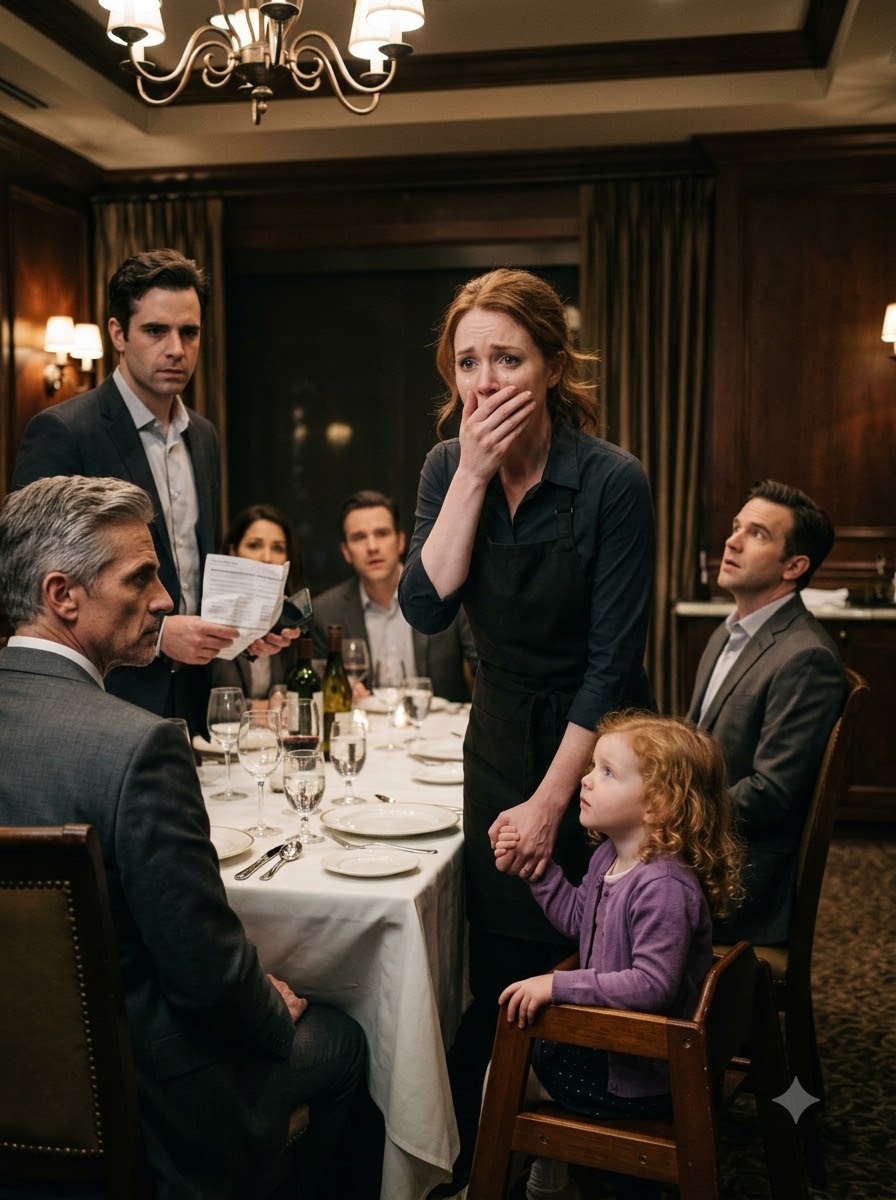
A real one.
Not “mistakes were made.”
Not “if you felt hurt.”
His lawyer probably had a hand in it.
Mom still appreciated it.
He admitted to withholding wages.
He admitted to altering records.
He admitted to using signatures and personnel information without proper authorization.
He acknowledged that financial pressure didn’t excuse any of it.
Mom read the letter once.
Then filed it in the box.
“Do you forgive him?” I asked.
She thought about it.
“I don’t know if forgiveness happens all at once.”
“What is it, then?”
“Maybe it’s deciding you don’t want to carry someone around every day.”
“Are you carrying him?”
“Less.”
That seemed like progress.
A few years later, Green Table promoted Mom.
Not because Vincent made a call.
He never did.
Not because Martin stepped in.
He didn’t.
Helen promoted her because Mom was excellent at catching details.
Hours.
Deliveries.
Costs.
Schedules.
The same habit that once made her track every unpaid shift had turned into a strength.
She became operations coordinator.
The real kind.
With the title in writing.
And a raise.
When she got the offer, she laughed for almost five minutes.
“What?”
I asked.
“Nothing.”
“You always say that right before something.”
She handed me the letter.
I could read well enough by then.
OPERATIONS COORDINATOR.
I looked at her.
“Didn’t Sterling call you that once?”
“Yes.”
“But you weren’t really one.”
“No.”
“And now you are.”
“Yes.”
“That’s weird.”
“It really is.”
We celebrated with pizza.
Coffee for Mom.
Chocolate milk for me.
That night, I drew a purple star.
Mom watched.
“What’s this one for?”
I wrote beside it in careful letters:
PROMOTION.
She smiled.
Years passed.
The work log stayed in the box.
Then one day, once I was old enough to understand the numbers, Mom showed it to me again.
“This is what started everything,” I said.
“No.”
I frowned.
“It literally is.”
She shook her head.
“Everything started long before you carried that paper across the dining room.”
“Then what did I start?”
Mom touched one purple star.
“You started the part where somebody stopped pretending.”
I looked at the sheet.
Nine marks.
I couldn’t remember most of the meals clearly.
I remembered Mom saying she wasn’t hungry.
I remembered Sterling’s voice through the phone.
I remembered Vincent’s finger stopping on the first star.
I remembered the silence.
Then I remembered what came after.
Questions.
Records.
Truth.
Dinner.
That mattered more.
The last time I saw that old work log before leaving for college, Mom handed it back to me.
“You keep it.”
“Why?”
“Because it’s yours too.”
I traced the first purple star with my finger.
“It’s kind of ugly.”
“Your drawing skills improved.”
“Rude.”
She laughed.
I slid it back into the sleeve.
“Do you ever wish I’d stayed in the office that day?”
Mom looked at me for a long moment.
“Yes.”
I stared.
She smiled.
“And no.”
“Very helpful.”
“I wish you’d never had to solve a grown-up problem.”
She touched my cheek.
“But I’m glad you trusted what you saw.”
That stuck with me.
Not the picture of Vincent Kane as the feared man at the table.
Not the Porsche.
Not even Sterling.
What stuck with me was that one small truth could survive surrounded by bigger lies.
My mother worked.
She wasn’t paid.
We went hungry.
I drew stars.
Everything else got complicated.
That never did.
On the back of the work log, years after Sterling’s Bistro had become someone else’s restaurant, I finally wrote down what the stars meant now.
Not hunger.
Not fear.
Not eleven weeks of waiting.
I wrote:
They remind me that being small never meant I wasn’t seeing what was happening.
Then I added one last purple star.
Mom saw it.
“What’s that one?”
I smiled.
“Dinner.”
That night we ate together.
Mom cleared her whole plate.
So did I.
And for the first time in our story, no purple star meant anything was missing.
