

- The Invitation From The Hospital Room
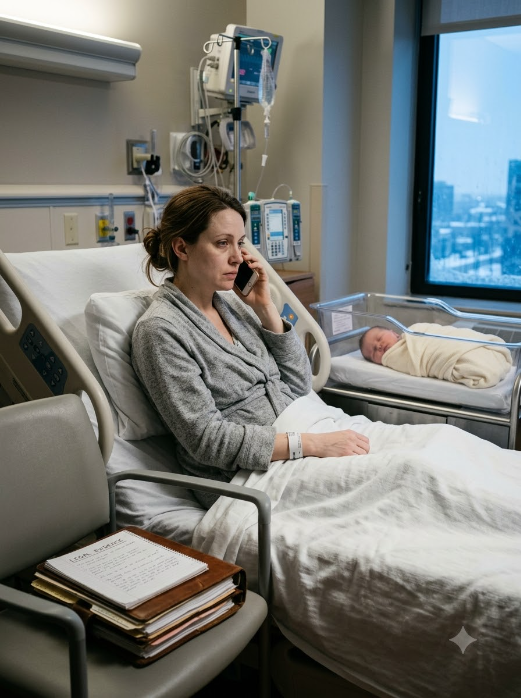
The call came while I was still lying in the hospital bed, my newborn asleep beside me and pain rolling through my body in slow, controlled waves.
The room carried the smell of antiseptic, warmed blankets, and a faint trace of baby lotion. Beyond the tall window, Chicago hung somewhere between winter and morning, all pale light and steel-gray sky. My daughter slept in the clear bassinet next to me, wrapped in a soft cream blanket I had bought months earlier without telling a soul why. Her tiny fist rested near her cheek, and every breath she took seemed to sharpen the whole world into focus.
The phone buzzed on the tray table.
Adrian Bell.
My ex-husband.
He hadn’t called once in eight months. He’d let silence do the cruel work for him, which was always his method of choice when no one else was around to see it. During our marriage, he’d used words like disappointment, strain, incompatibility, and reality, but toward the end he stopped bothering to dress up his contempt. After the second miscarriage, he began treating my grief as though it were some flaw in the household. After that loss, his mother called me barren over Sunday dinner while Adrian raised his wineglass and said nothing at all.
Then he left, for Elise Marlow, his polished operations director, the woman in white silk blouses who ran investor dinners and once sent me flowers with a card reading, Some women are simply meant for fuller lives.
I picked up the phone with a hand trembling from exhaustion.
Adrian’s voice was warm, measured, carrying the same confidence that used to open boardroom doors for him.
“Come to my wedding, Caroline.”
I looked down at my daughter.
He didn’t know she existed.
He didn’t know that while he was calling me useless, while his mother was comparing me to empty rooms, while Elise arranged herself beside him for photographs, I had been carrying the child he’d already decided I could never give him.
“Elise is pregnant,” Adrian went on. “Unlike you, she understands what it means to build a real family.”
A nurse passed quietly outside the door. The heart monitor beeped along with steady patience. My stitches throbbed. My daughter let out a small sigh in her sleep.
Something inside me went completely still.
“I will be there,” I said.
The silence on his end was the first gift he’d given me in years.
He’d been expecting tears. He’d been expecting rage, or begging, or humiliation, or some desperate question that would let him feel gracious for handling it badly. Instead all he got was his own breathing, the small stumble of a man whose script had just fallen apart.
“Good,” he said finally. “Wear something modest. Don’t make this harder on yourself in front of people who matter.”
I nearly smiled.
On the chair beside my bed sat a leather folder my attorney had dropped off the night before I went into labor. Inside were bank statements, corporate transfer records, sworn affidavits, copies of emails Adrian believed he’d deleted, and legal paternity papers filed under seal after the birth. There were also records tracking the money Elise had quietly funneled from Adrian’s corporate accounts into a private vehicle tied to her family’s struggling investment firm.
Adrian thought he was inviting his broken ex-wife to watch him win.
What he’d actually invited was the one witness who could end it all.
“I have never been afraid of people who matter, Adrian,” I said.
His voice hardened.
“You still think dignity makes you interesting.”
I brushed the back of one finger against my daughter’s cheek.
“No. Evidence does.”
He went quiet.
“What did you say?”
“Send the address.”
When the call ended, I sank back against the pillows and let the pain move through me instead of fighting it. I’d learned over the past year that certain kinds of pain turn dangerous only once you finally give them a purpose. Adrian had left me believing grief had hollowed me out. He had no idea grief had actually cleared space for precision.
My daughter’s eyes opened for one brief moment, dark and unfocused, then drifted shut again.
Her hospital bracelet didn’t carry his last name.
It carried mine.
Caroline Whitaker.
I’d chosen that before she was born, before the phone rang, before his voice came through dripping with satisfaction. She wouldn’t start her life wearing the name of a man who had discarded her before he even knew she existed.
I lifted her carefully and settled her against my chest.
“Your father invited us,” I whispered. “It would be rude not to attend.”
- What He Thought He Had Buried
Eight months earlier, Adrian stood in the marble foyer of our Lincoln Park house and told me the marriage had become embarrassing.
The word still cut.
Embarrassing.
Not painful. Not damaged. Not difficult. Embarrassing, as if my sorrow had simply gone out of style with the walls. He wore a navy suit and the look of a man already rehearsing other people’s sympathy. I sat on the staircase wrapped in a cardigan, three weeks past the second pregnancy loss, still moving like my body belonged to someone who’d dropped it.
“You need help,” he said. “I cannot keep organizing my life around your sadness.”
“We lost a child,” I said.
His jaw tightened.
“We lost the possibility of one. That is not the same as building a future.”
Looking at him then, I understood I’d been grieving alongside a man who had already left the funeral before it even started.
Elise entered his life officially two weeks later, though in truth she’d been there all along. There were emails sent past midnight, business trips with extra hotel charges, receipts from restaurants where Adrian claimed he’d been meeting investors alone. My attorney, Madeline Price, caught the first thread of it while going through our divorce disclosures. I caught the rest, because Adrian had always underestimated how closely I paid attention.
Before marrying him, I’d worked in financial compliance for private equity firms. I understood transfers, shell companies, and the quiet arrogance of people who assumed paperwork became invisible once no one emotionally stable enough to read it was left standing. Adrian told friends I’d grown fragile. He told his lawyers I was too overwhelmed to engage meaningfully with complex asset division. He told the court, in carefully chosen language, that my grief had clouded my judgment.
He forgot that judgment and happiness aren’t the same thing.
Madeline never forgot it.
“Caroline,” she told me in her office three days after the divorce filing, “he is moving faster than a man with clean books should move.”
She was right. Adrian pushed for a fast settlement that left his company holdings untouched and treated several corporate accounts as though they sat outside marital review. The first draft handed him control of the house sale, the retirement offsets, and residual investment income tied to assets my father had placed in trust before I ever married. It also included language waiving any future parental claim connected to embryos, stored genetic material, or an undisclosed pregnancy.
That line changed everything.
At the time, I wasn’t even certain I was pregnant. My body had let hope down twice already, and I didn’t dare trust a calendar. But I held off signing. I saw a specialist under my own name. I waited. When the test came back positive, I told only Madeline and my older sister, Claire.
By then Adrian was already appearing publicly with Elise.
He never asked if I was safe. He never asked if I needed anything. He sent exactly one message after the divorce finalized:
I hope you eventually find peace with reality.
I came to learn that reality is a word selfish people reach for once they’ve already arranged the facts in their own favor.
I moved into a small apartment near the lake and built a life out of silence, medical appointments, and paperwork. While my daughter grew inside me, Madeline and a forensic accountant traced the financial trail Adrian had tried to seal shut. Elise had been using her access at Bell Meridian Group, Adrian’s firm, to route consulting payments into entities her brother controlled. Those entities then bought up portions of distressed debt tied to my father’s old family trust, debt Adrian had tried to frame as marital leverage during negotiations.
It was elegant theft.
It was also careless.
People who mistake charm for intelligence tend to forget that numbers can’t be flattered.
By the time I gave birth, the complaint package was ready. Madeline had filed the paternity documents under seal, prepared a financial fraud referral, and arranged service in case Adrian tried to claim ignorance later on.
Then he called during his wedding week and handed me the perfect stage himself.
- The Wedding At Ashbourne Hall
Adrian and Elise picked Ashbourne Hall, a restored estate outside Lake Forest with glass conservatories, pale stone terraces, and enough chandeliers to make old money feel like a religion.
Two days after leaving the hospital, I stood in front of my mirror in a charcoal-gray dress, long-sleeved, cut clean and severe. It wasn’t funeral black, and it wasn’t wedding color either. It was the color of weather just before lightning. My hair was pinned low, my makeup simple. My daughter slept in her carrier, dressed in ivory, wearing a knitted bonnet my sister had made during the hours she’d spent sitting beside my hospital bed.
Madeline arrived at ten with the leather folder and a look that asked whether I could actually go through with this.
“You do not have to walk into that room yourself,” she said.
“Yes, I do.”
“Then we do it carefully. You speak only what we prepared. I handle the documents. If anyone touches you or the baby, security gets called first, not last.”
“Agreed.”
The drive north felt longer than the miles suggested. Bare trees lined the road, and the sky looked scrubbed clean by the cold. I sat in the back seat, one hand resting on the baby carrier, the other on the folder. My daughter slept through the whole ride, unaware that her existence was about to walk into a room built entirely around erasing her.
At the estate entrance, a security guard checked a list and frowned.
“Name?”
“Caroline Whitaker.”
His eyes flickered.
I could tell it registered. Ex-wives aren’t expected to arrive calmly at weddings where well-paying people have already purchased a clean narrative.
He spoke into his radio. After a short pause, a woman from the event staff came over, pale and jumpy.
“Mr. Bell said you may enter, but he asks that you avoid unnecessary disruption.”
“That will depend on him.”
She had no idea what to do with that, so she simply led me in.
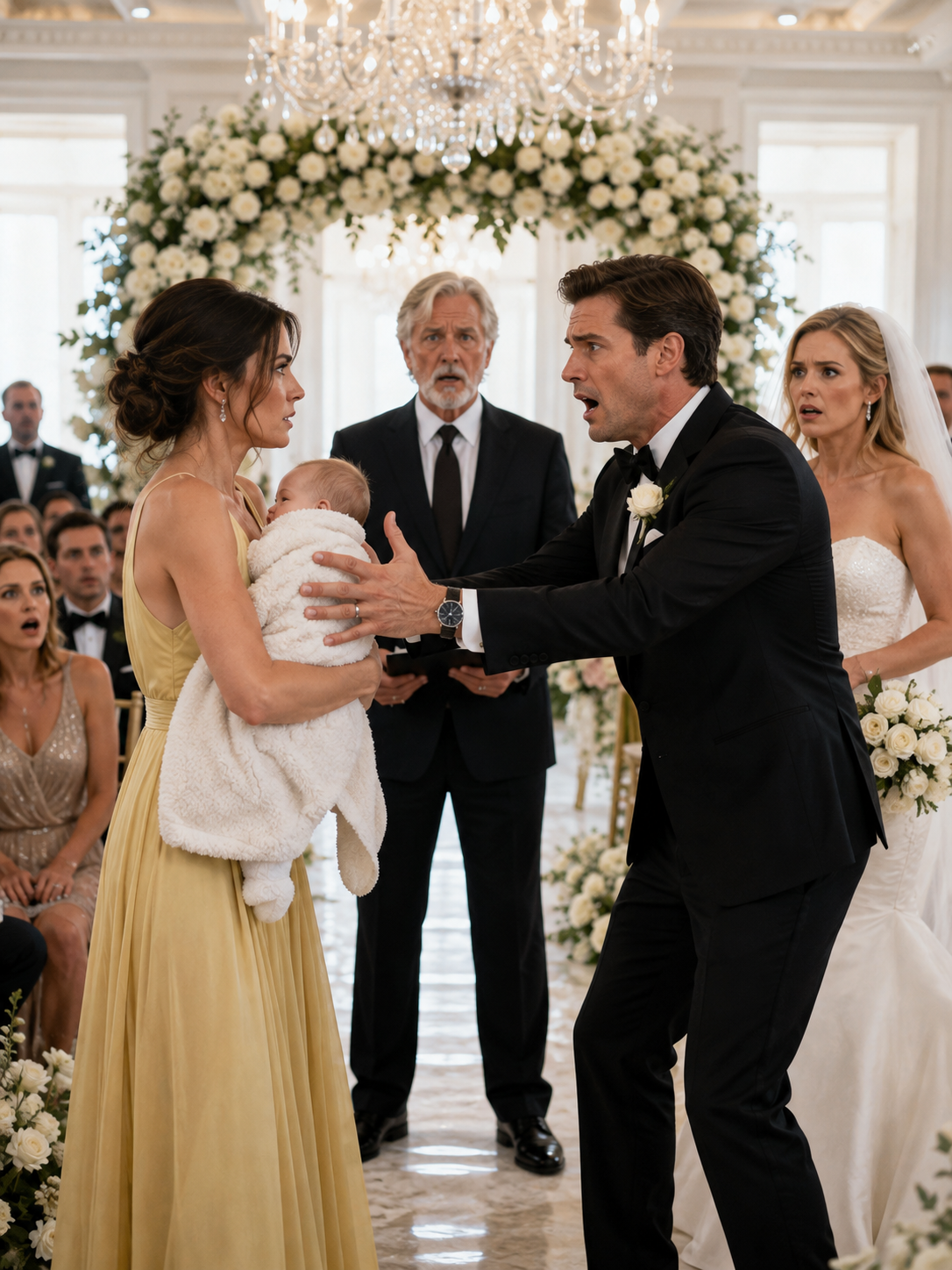
The main hall smelled of white roses and expensive candles. Guests turned as I walked in, their conversations thinning into whispers. I spotted Adrian near the front, under an arch of flowers, handsome and at ease in a black tuxedo. Elise stood beside him in a satin gown that made her look almost unreal, one hand resting lightly over the small curve of her pregnancy. Adrian’s mother sat in the front row wearing silver and satisfaction.
Then Adrian saw the carrier.
His face went rigid.
Not fear yet. Confusion first.
The ceremony began before he could make his way to me. I took a seat in the back row, set the carrier down carefully beside me, and waited. The officiant spoke about devotion, renewal, and the courage to build a future after hard seasons. Adrian nodded along solemnly, performing sincerity for a room that had paid its way in with reputation.
When the officiant reached the traditional pause, his voice carried clearly through the hall.
“If anyone present knows a reason these two should not be joined, speak now.”
I stood.
The chair legs scraped against the marble.
Every head turned.
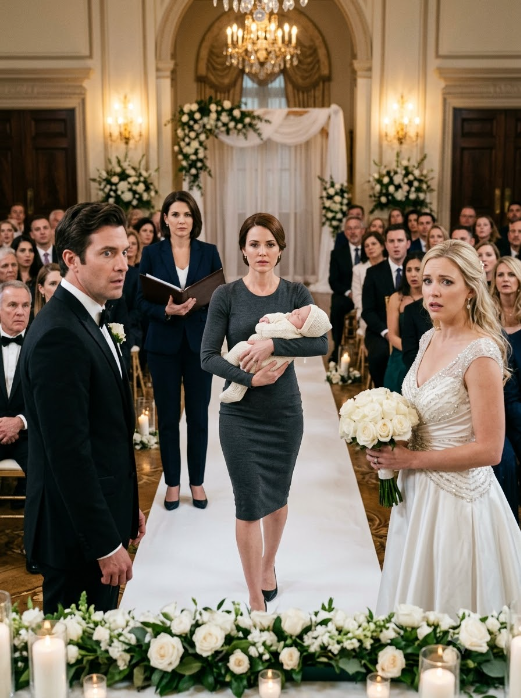
I lifted my daughter from the carrier and held her against my shoulder as I walked down the aisle. The room seemed to stretch with every step I took. Adrian stared at the baby, the color draining out of his face in stages. Elise’s hand tightened around her bouquet.
I stopped ten feet from the altar.
“I have a reason.”
Adrian’s mother half rose from her seat.
“This is obscene.”
Madeline’s voice came from behind me, calm and pitched to carry.
“Mrs. Bell, I strongly advise you to sit down.”
I looked at Adrian.
“You invited me here because you wanted witnesses. I brought them.”
His eyes moved from me to the baby and back again.
“Whose child is that?”
A murmur swept the room fast enough to stir the flowers.
I pulled my daughter closer.
“Yours.”
Elise made a small sound, something close to a laugh, and it died instantly.
“That is impossible,” Adrian said.

“No. It was inconvenient.”
Madeline stepped forward and opened the folder.
“Paternity documentation was filed under seal after the birth. Notice is being served today. There are also financial disclosures requiring Mr. Bell’s immediate response regarding asset transfers involving Bell Meridian Group and entities connected to Ms. Marlow.”
Elise turned toward Adrian.
“What is she talking about?”
I looked at Elise then, and for the first time I saw the panic underneath the polish.
“She is talking about the money you moved through your brother’s consulting company,” I said. “She is talking about the trust debt you tried to buy with corporate funds. She is talking about the accounts you thought no grieving woman would notice.”
Adrian took a step toward me.
Madeline moved between us.
“Do not.”
He stopped, because the room was full of cameras, donors, lawyers, and people whose money had no appetite for scandal.
“Caroline,” he said softly, reaching for a voice he’d once used to make me forgive smaller wounds, “this is not the place.”
I nearly laughed.
“You called my hospital room to make sure I came.”
The sentence landed on the room differently than any accusation could have. It was specific. It was ugly. It was true.
Elise’s father, seated near the front, rose slowly.
“Adrian, did you know about the child?”
“No,” Adrian said.
“Because you never asked,” I replied.
His mouth opened, then shut again.
I set a copy of the documents down on the small table beside the floral arch. The baby stirred against me, and that small movement seemed to undo Adrian more thoroughly than the paperwork had.
“You called me empty,” I said. “You called me an embarrassment. You let your mother call me barren at dinner while your daughter was already alive inside me. Today you can decide whether to keep lying in front of everyone you brought here to applaud you.”
The officiant stared down at his book as if wishing it might turn into a door.
Elise whispered, “Adrian.”
He didn’t answer her.
That silence marked the start of her education.
I turned to leave.
Adrian finally found his voice.
“Caroline, wait.”
I looked back once.
“No. I waited through seven years of marriage, two losses, one divorce, and an invitation built to humiliate me. I am done waiting.”
Then I walked down the aisle, my daughter breathing softly against my neck, the room breaking open behind me.
- The Price Of Their Elegant Lies
The story hit the news by morning, though not because I gave anyone an interview.
Someone at the wedding leaked enough to get the first headline going. Then the court filings took over. Bell Meridian Group put out a statement about an internal review. Elise’s family office quietly shelved its planned capital partnership. Adrian’s mother stopped showing up in photographs, which was as close as she’d ever come to public shame.
Adrian called from blocked numbers for two straight days. I let it ring.
His messages started angry, drifted into bargaining, and ended somewhere that wanted to sound like grief.
“You should have told me.”
“We could have handled this privately.”
“You turned my daughter into a weapon.”
That last one nearly got a response out of me.
Instead I forwarded it to Madeline.
She sent back one line.
“Weapons do not need feeding, diapers, and protection from men who call them inconvenient.”
The court process dragged on for months. Paternity was formally confirmed. Temporary support was ordered. Adrian requested visitation through his counsel, and I agreed only under structured terms recommended by child specialists and approved by the court. I didn’t want to use my daughter for revenge. She deserved a life bigger than his punishment. But I also wasn’t going to let biology get mistaken for entitlement.
The financial investigation widened further. Elise resigned from Bell Meridian before they could push her out. Her brother’s consulting company came under regulatory scrutiny. Adrian claimed he’d delegated too much and trusted the wrong person. Maybe that was partly true. It didn’t save him. He’d signed off on approvals, hidden conflicts, and tried to rush through a settlement that would have buried my rights before my daughter was even born.
In federal court, Adrian looked smaller than he had at the altar.
His suit still fit; his certainty didn’t. Elise sat at a separate table with separate counsel, a detail that seemed to wound him more than any accusation had. People who build relationships out of advantage often find out that advantage owes them nothing once the walls start coming down.
I testified for one afternoon.
Madeline asked me why I’d started digging through the financial records after the divorce.
“Because the settlement language tried to waive rights connected to a child he claimed could never exist,” I said. “That made me examine every sentence he wanted me to sign.”
The judge listened. The attorneys objected when it served them. The evidence moved forward slowly, document by document, the way truth usually does. There was no grand theatrical confession, no dramatic collapse in the courtroom, no single line that wrapped everything up. Real accountability tends to be quieter than people picture it. It’s signatures, timestamps, bank routes, sworn statements, and consequences that arrive through procedure instead of thunder.
Adrian eventually entered a negotiated settlement on the civil claims, while the financial matters tied to Elise’s transfers continued on separately. He lost his controlling stake at Bell Meridian once the board decided his conduct created too much exposure. He kept plenty of money, of course. Men like Adrian rarely lose everything. But he lost the illusion of being untouchable, and that had been the thing he valued most.
When the final custody order was entered, my daughter was six months old.
Adrian would get to know her gradually, supervised at first, with no access outside the agreed structure. His mother wasn’t included. The court had no interest in her dinner-table opinions, but it did care about her recorded statements calling me unfit and defective. Adrian didn’t look at me when that part was read aloud.
Outside the courthouse, reporters shouted questions.
I gave them one sentence.
“My daughter is safe, and that is the only victory that matters.”
Then I left before anyone could turn my life into a panel discussion.
- The Room Where Peace Returned
A year later, my daughter learned to stand by gripping the edge of my coffee table.
Her name was Nora, after my grandmother, who had once told me never to marry a man who needed witnesses to be kind. I hadn’t listened in time, but I remembered eventually. Nora’s laugh filled my apartment with a sound so bright that the old rooms of my marriage began to feel farther away, not gone, just contained.
We lived near the lake in a building with wide windows and a lobby that smelled faintly of old wood. My sister lived fifteen minutes away. My mother came by every Friday with groceries I hadn’t asked for and opinions I sometimes needed. I went back to compliance consulting under my own name, chose clients carefully, and kept hours that left room for morning walks, pediatric appointments, and the ordinary miracles of watching a child discover spoons, socks, and sunlight.
Adrian saw Nora twice a month at first.
He was awkward with her, which beat false confidence. He brought gifts too expensive for a baby and questions that came too late for a father. Over time he learned to sit on the floor, to let her come to him, to stop treating visits as proof of redemption. I didn’t make it easier for him than required. I didn’t sabotage him either. My daughter deserved truth with boundaries, not a mother still fighting a war in every room she entered.
Once, after a supervised visit, Adrian paused near the door.
“I am sorry for what I said in the hospital call.”
Nora was asleep against my shoulder.
I studied his face. The apology was imperfect, late, and smaller than the harm it addressed, but it wasn’t nothing.
“Which part?” I asked.
He looked down.
“All of it.”
“That is a beginning,” I said. “It is not a key.”
He nodded, understanding at last that some doors don’t open just because regret knocks.
Elise vanished from public life once the investigations picked up. I heard she’d moved to Arizona before her baby was born. I never found out whether the child was Adrian’s, and I never asked. Curiosity isn’t always a debt owed to the past. Sometimes freedom means letting unanswered questions stay outside the house.
On Nora’s first birthday, we held a small party in my mother’s backyard. There were white balloons, strawberry cake, and a ridiculous paper crown Nora tore off within three minutes. My mother cried during the song. My sister burned the first pot of coffee. The day was ordinary, and perfect in a way I once thought only foolish women wished for.
That evening, once everyone had left, I sat by the window with Nora asleep in her crib and a cup of tea going cold in my hands. The city lights shimmered beyond the glass. I thought back through the hospital room, the wedding aisle, the folder, the phone call, the moment I lifted my daughter into the light in front of a room full of people who’d been ready to erase us both.
For a long time I believed justice meant watching Adrian lose.
It didn’t.
Justice was my daughter’s name being protected. Justice was refusing to sign away rights I hadn’t even spoken aloud yet. Justice was discovering that motherhood hadn’t made me weak, sentimental, or easy to corner. It made me exacting. It made me patient. It made me unwilling to let powerful people decide which truths deserved witnesses.
Adrian invited me to his wedding because he wanted me small.
I showed up carrying the person who made my life larger than anything he’d ever taken from it.
That was enough.
THE END
