

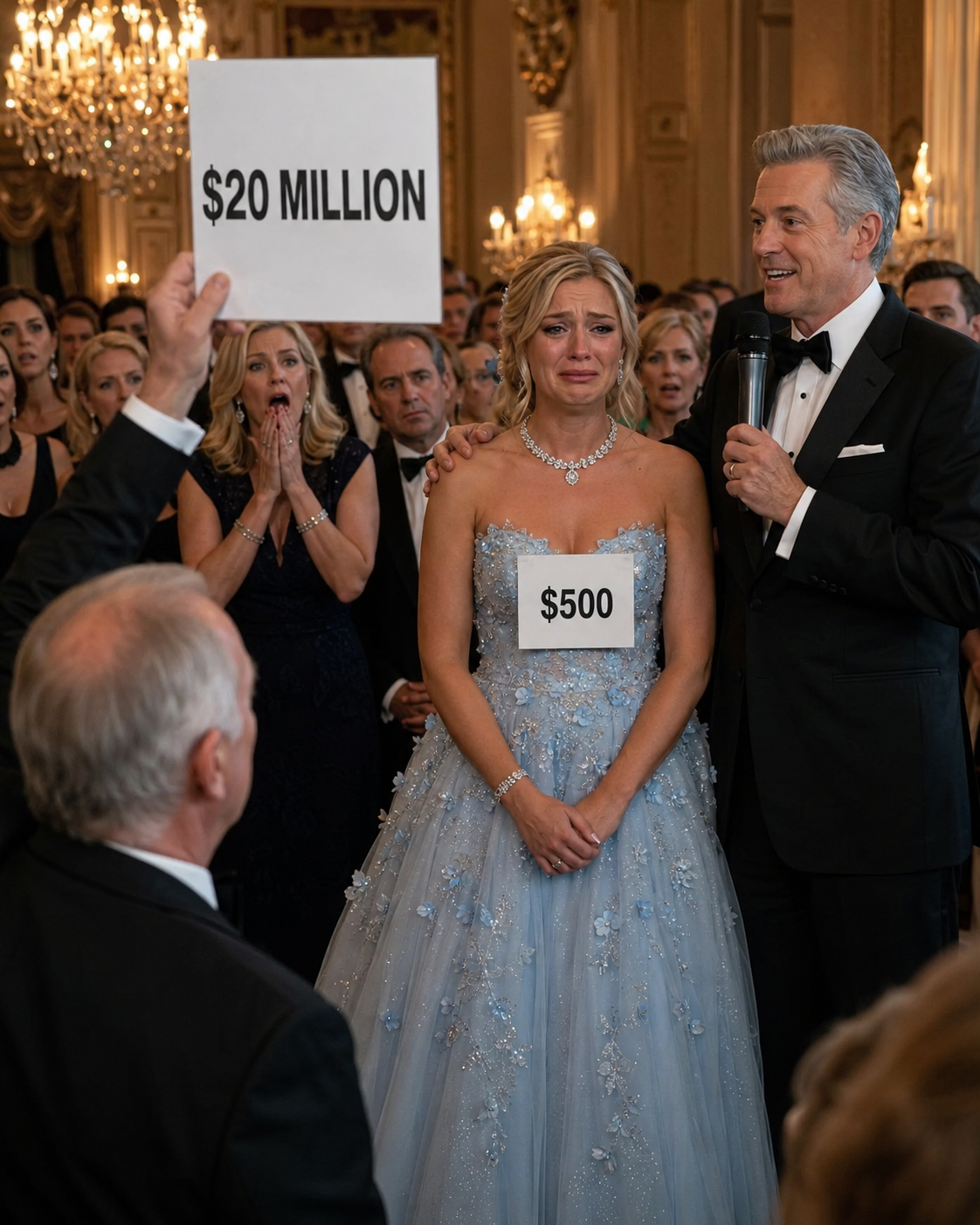
“We’ll open the bidding at twenty dollars!” my husband called into the microphone, pitching his voice over the noise of nearly three hundred guests. “Who wants to take this useless wife off my hands?”
The ballroom at the Grand Regency Hotel in downtown Chicago exploded with laughter.
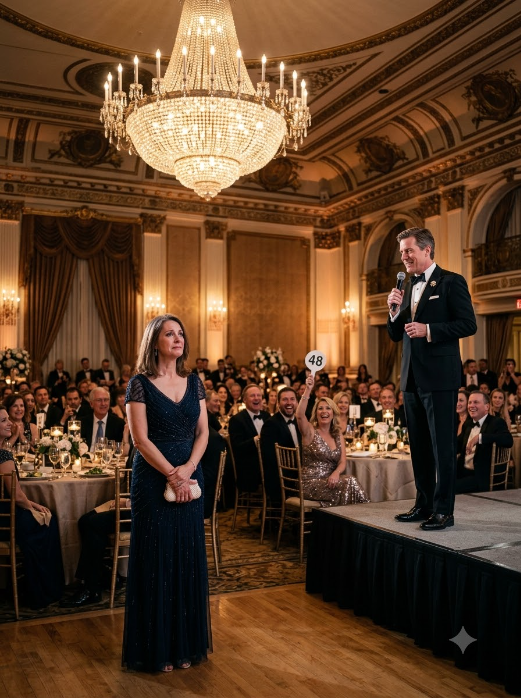
I stood frozen beneath the bright crystal chandeliers, wearing the navy-blue dress I’d bought just for that night, hands folded neatly in front of me. Julian Vance grinned like he’d just delivered the joke of the century. Near the bar, one of his senior partners lifted an auction paddle and shouted out twenty dollars, playing along.
I didn’t cry. I didn’t argue. I just looked at him.
That humiliation hadn’t started that night. It had been building for twenty-seven years — piece by piece, insult by insult, silence by silence — until I’d become almost invisible inside my own marriage.
I was the one who’d put together the entire annual gala for the Vance Foundation: the flowers, the guest list, the press coverage, the catering, the corporate sponsors, even the reserve wine Julian was currently boasting about picking out. For eleven years I’d handled every detail behind the scenes while he stepped up front to soak in the credit.
He’d shown up forty minutes late, kissed my cheek in front of the board members, and said smoothly, “My wife always makes these things look effortless.”
Then he spent the next hour taking full credit for every choice I’d made.
Over dinner, several scotches in, he launched into his usual routine — telling the table I was hopelessly old-fashioned, that I still kept our household budget in a paper ledger, that my idea of an exciting weekend was rearranging flowers in the dining room.
“Clara is easily the least interesting woman in this room,” he announced. “I say that with love, of course.”
The table laughed. I even managed a polite smile, because for years I’d confused quiet endurance with dignity.
Later that evening, one of his business associates proposed a spontaneous charity auction. Julian took my hand and pulled me up onto the stage. For a brief moment, I foolishly assumed he meant to thank me publicly.
Instead, he dropped a heavy hand onto my shoulder, displaying me like a used piece of furniture.
“Twenty dollars for my wife. She cooks, she organizes, and she almost never complains.”
The laughter rolled through the room again, even louder.
I scanned the crowd — people I’d hosted in my home, people I’d sent sympathy flowers to, people I’d sat beside in hospital waiting rooms and congratulated on their kids’ milestones. Every one of them was laughing while my husband turned my life into a punchline.
Then a calm, commanding voice cut through from the back of the room:
“Two million dollars.”
The room fell completely silent.
A tall man in a tailored charcoal suit stood near the entrance, somewhere in his early sixties. He wasn’t looking at Julian — he was looking straight at me, with an expression that was odd, almost grave.
Julian gave a short, nervous laugh into the mic. “Well, it seems we have a very generous donor in the room!”
The stranger walked steadily down the center aisle toward the stage. The crowd stepped back to let him through.
“My name is Arthur Sterling,” he said.
A few hushed gasps went up from the executive tables. I knew the name at once — a well-known venture capitalist, philanthropist, and head of one of the most powerful private equity firms in the state.
Julian reached out a hand as the man arrived at the stage. “Mr. Sterling, what an honor.”
Arthur didn’t take it.
“I didn’t come tonight for your foundation, Julian,” he said flatly. “I came because I knew your wife would be here.”
Julian’s smile slipped. “Do you two know each other?”
“I’ve never seen this man before in my life,” I said, and it was the truth.
Arthur held my eyes. “Mrs. Vance, I need to speak with you privately. Tomorrow morning. There’s something you should have been told years ago.”
I said yes before I even had a chance to think it over.
On the drive home, Julian’s hands were locked so tightly on the wheel his knuckles went white. “What the hell did you do to make a man like Arthur Sterling offer two million dollars for you?”
“Nothing,” I said quietly.
He didn’t believe it.
That same night, he called his executive assistant and had her run a full background check on Arthur Sterling. By morning, the preliminary file left him rattled: Arthur Sterling had spent years actively searching for a woman named Clara Vance.
And Julian understood, before I ever did, that the joke he’d made on stage had cracked open a door that could never be shut again.
Part 2
Arthur picked a quiet, unassuming restaurant in Lincoln Park for our meeting, far from the downtown steakhouses Julian usually favored for business. He rose the moment I reached the table and waited for the server to leave before speaking.
“I want to genuinely apologize for intruding last night,” he said quietly. “I couldn’t just stand there and watch those people treat you that way.”
“How do you know who I am, Mr. Sterling?”
Arthur exhaled slowly. “Thirty years ago, you taught primary school in a small town outside Philadelphia. On a cold, rainy November evening, you found a teenage girl sitting outside a long-distance bus station.”
The memory surfaced through thirty years of fog: a soaked, terrified girl in a thin jacket, clutching a torn canvas backpack, eyes wide with fear.
“Her name was Rachel,” I said softly.
Arthur nodded. “Rachel Sterling. My younger sister.”
She’d run from an abusive stepfather, planning to catch the first bus out of state and vanish. I’d bought her a hot meal, called a social worker, and stayed with her until three in the morning. Afterward I visited her at the temporary youth shelter and helped keep her enrolled in school.
Eventually, life pulled us apart.
“She grew up to be a civil rights attorney,” Arthur went on, his voice heavy. “She spent her whole career fighting for foster kids, running legal clinics, setting up educational trusts. She always said her whole life changed course because a total stranger stopped to ask if she was hungry.”
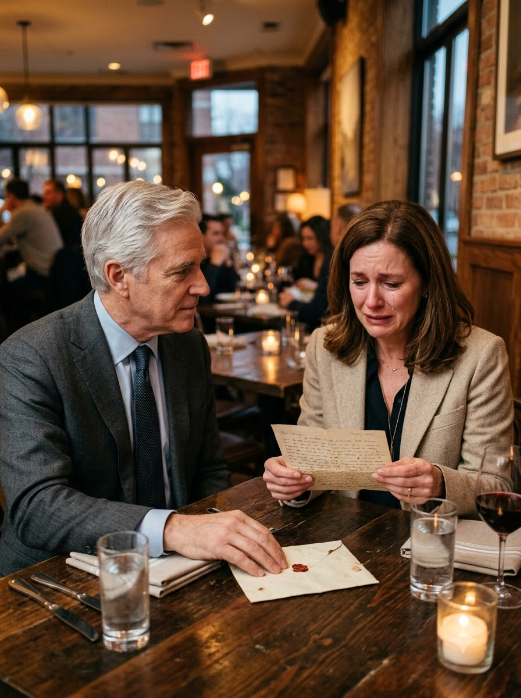
He drew a thick, cream-colored envelope from his jacket.
“Rachel died eight months ago, after fighting cancer. Before she passed, she made me promise I’d find you.”
The breath left my chest.
I read her letter that night, alone in the guest room. In it, Rachel thanked me for showing her that real human kindness existed even at her darkest moment. But she hadn’t left me only words — she’d named me a primary trustee of her charitable foundation, giving me real voting power over its endowment and its community programs.
While I was still absorbing the weight of her gift, Julian was busy hiring a private investigator, convinced Arthur and I were carrying on a secret affair.
The investigator turned up no romantic scandal at all.
What he found instead were decades of quiet acts of compassion my husband had never once asked about: school supplies I’d secretly bought for inner-city kids, widows in our neighborhood I checked on regularly, young people from local shelters whose trade-school graduations I’d attended, a homeless veteran I’d spent months helping navigate the VA system.
Around the same time, a video of Julian’s auction joke surfaced online. Within four days it had racked up millions of views. The public reaction was overwhelmingly harsh, branding him cruel and arrogant. Major sponsors pulled their backing from the Vance Foundation. Two commercial real estate deals fell through. The foundation board called an emergency meeting.
“Everything is falling apart,” Julian told me one evening in the kitchen. “I need you to sit down with a local news crew and say it was an inside joke between us.”
I looked at him steadily. “I’m not going to lie to protect your reputation.”
A few days later, Arthur took me to one of the women’s shelters funded by Rachel’s foundation. There I met a young mother named Sarah, who’d spent two months sleeping in her car with her two small kids. I sat with her, bought her family lunch, and listened to her story.
The foundation covered six months of her rent while she finished a nursing certification.
When I got home that evening, Julian noticed something had shifted in me.
“You don’t need any of this anymore, do you?” he asked, glancing around the living room. “Not the house, not my name, not me.”
Before I could answer, a courier arrived at the door with an envelope.
It was a formal invitation to the annual gala for the Rachel Sterling Foundation.
Under my printed name were three words: Keynote Speaker.
On the last page of the program was a note announcing that the terms of Rachel’s final estate would be formally revealed that evening — along with the real reason Arthur Sterling had bid two million dollars for me.
Julian read the invitation over my shoulder, his hand starting to shake.
“Clara,” he whispered, going pale. “There’s something I never told you about that foundation.”
That was the moment I understood the secret wasn’t only Arthur’s or Rachel’s.
My own husband had been sitting on part of the truth for years.
Part 3
“What do you know about that foundation, Julian?” I asked.
Julian shut the kitchen door behind him. For the first time in twenty-seven years, he didn’t look like a man trying to control a conversation — he looked like someone who’d just realized he’d broken something that couldn’t be fixed.
“Five years ago, my firm tried to buy a piece of commercial real estate downtown where one of their youth shelters was based,” he admitted, avoiding my eyes. “We wanted to clear the block for a luxury high-rise. The Sterling Foundation wouldn’t sell.”
“And what does that have to do with me?”
“Rachel Sterling led the legal fight against us. She filed injunctions, went public accusing my firm of predatory displacement.”
I suddenly remembered those weeks, years back, when Julian would come home furious about a “bitter, self-righteous lawyer” holding up a multi-million-dollar deal. He’d never once said her name. I’d never asked. By then we shared a roof but not a life.
“During discovery in that lawsuit, our legal team realized she was looking for you,” he continued. “One of my attorneys found your maiden name in her personal files.”
I stared at him. “You knew who Rachel Sterling was?”
“Yes.”
“How long have you known?”
“Four years,” he admitted.
I had to grip the kitchen counter to keep steady.
For four years, Julian had known that the terrified teenage girl I’d once helped had built a remarkable legacy protecting vulnerable young people. He’d known she was searching for me — and he’d stayed quiet because the truth might have gotten in the way of his real estate deals.
“Did letters come to the house?” I asked, my voice nearly gone.
He said nothing.
“Did you receive her letters, Julian?”
“Two. Maybe three. My assistant got them at the office. I told her to file them away and never send them to the house.”
I didn’t shout. I didn’t throw anything. What settled over me instead was something colder — a clear, complete understanding.
The cruel joke at the gala was no longer the worst thing he’d done to me. A public insult could be chalked up to alcohol or ego. But deliberately hiding a dying woman’s search for me, for four straight years, was a calculated decision meant to keep me boxed in.
“Rachel died thinking I’d chosen to ignore her,” I said quietly.
Julian stepped toward me. “I was protecting our finances, Clara! I was protecting the firm!”
“No,” I said. “You were protecting your hold over me. Because if I’d found out who she was, I’d have realized my life meant something far beyond your shadow.”
I went upstairs to the guest room, packed a single suitcase with essential clothes, my documents, and Rachel’s letter, and left the house that night. Two days later I signed a lease on a small, bright one-bedroom apartment in a quiet neighborhood — white walls, a big oak tree outside the window.
It wasn’t much. But it was mine.
When I told Arthur what Julian had done, he sat quietly for a long moment.
“Rachel suspected someone was intercepting her letters,” Arthur said gently. “That’s why she recorded a video message just for you before she went into hospice.”
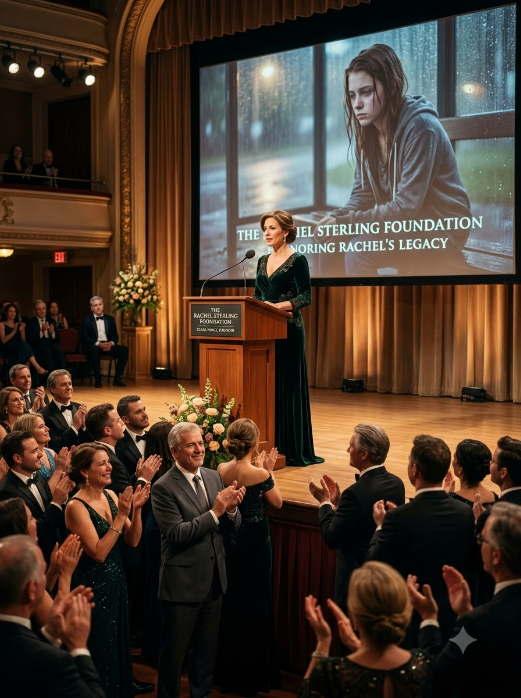
The Rachel Sterling Foundation Gala was held at the Art Institute of Chicago. The room filled with civic leaders, attorneys, shelter directors, scholarship recipients, and reporters drawn in by the public fallout from Julian’s joke.
I got ready alone that night. I picked a simple, elegant dark-green gown and did my own hair, without needing anyone’s approval. Looking in the mirror, I saw a woman who, for once in her life, felt fully at home in her own skin.
Arthur met me at the entrance. “You don’t have to prove anything tonight, Clara. Just tell your story.”
When my name was called, I walked to the podium with my heart pounding steadily. Julian sat alone in the very back row, stripped of the smug confidence he usually wore in public.
I opened by describing a cold, rainy November night outside a bus station thirty years earlier. I admitted I’d almost walked right past that girl — tired after a long day of teaching, with papers still to grade. She hadn’t asked me for money. I’d simply seen pure terror in her eyes and sat down beside her.
“For thirty years I thought I’d simply bought a runaway teenager a hot meal,” I told the quiet room. “Now I understand that the small, quiet choices we make out of basic kindness rarely show their full weight while we’re making them.”
The lights dimmed.
Rachel’s image filled the screen behind the stage. She looked frail, a scarf wrapped around her head, but her eyes still held a fierce, clear light.
“Clara,” Rachel’s recorded voice said. “You might not remember every detail of that night, but I do. I remember the hot soup, the warm bread I was too scared to finish, and that you never once asked what I’d done wrong to end up alone on the street. You only asked if I was safe.”
The whole room sat spellbound.
She described how that single act of grace had given her the courage to accept state help, finish school, and go on to earn a law degree.
“For years I searched for the woman who saved my life and never asked for anything back. When I finally found her, powerful people tried to bury my letters to protect their own business interests. But I didn’t record this out of revenge. I recorded this to show how much harm is done when arrogant men decide someone else’s worth can be hidden away for their own convenience.”
Exhibits appeared on screen: certified mail receipts sent to Julian’s headquarters, assistant logs, archived emails where Julian directly ordered staff to bury Rachel’s letters because my link to her foundation threatened his development plans.
A wave of stunned murmurs moved through the crowd.
Julian dropped his head into his hands.
“Clara,” Rachel’s voice continued warmly, “I’m leaving you a permanent seat on this foundation’s board, because you were part of its spirit long before it had a name. The two million dollars my brother pledged that night will be set up in your name, to build a new transitional housing center for women and children right here in the city.”
That was when I finally grasped what Arthur’s bid had really meant.
He hadn’t tried to “buy” me at that auction. He’d taken Julian’s cruel, humiliating joke and turned it into something lasting: for every dollar my husband used to shrink my worth, Arthur answered with millions to protect people who had none.
When the screen went dark, a woman in the front row rose and began clapping. Then another. Within seconds the whole room was on its feet in a roaring standing ovation.
I cried — for the frightened teenager who once thought no one cared, for the woman she’d become, for the years of silence I’d swallowed, and for myself, for letting a small man make me feel small for so long.
After the applause died down, more testimonies played on screen. A registered nurse spoke about the scholarship that let her leave a group home. A high school principal recalled the extra meals I used to quietly pack for hungry students. A veteran described me sitting with him for hours in government offices to secure his housing.
Sarah, the young mother I’d met at the shelter weeks earlier, appeared last with her two kids.
“Mrs. Vance sat down with us in the intake room,” she said simply. “She didn’t promise to fix everything in one afternoon. She just stayed until the future stopped feeling so terrifying.”
I looked back toward the rear of the hall.
Julian was still there. But for the first time in his life, he was the invisible one.
Near midnight, as the event wound down, Julian was waiting near the coat check.
“I saw all of it,” he said, his voice hollow. “Four years of knowing who Rachel was… and all I thought about was zoning permits, partners, the bottom line. I told myself I was protecting our lifestyle.”
“And now?” I asked evenly.
“Now I know I was protecting myself from realizing you never actually needed me.”
He didn’t reach for my arm or step closer.
“In twenty-seven years, Clara, I never once asked what you did on your Tuesday afternoons, why you kept children’s books in your car trunk, or how you knew so many people from parts of town I never went to. I assumed your whole life started the moment I walked into a room.”
I stood there, quiet and steady.
“I am truly sorry,” he added. “Not to save my firm, and not to talk you into coming home. I was married to an extraordinary woman for almost thirty years, and I only really saw her once someone else made the whole world look.”
I studied him and saw, for the first time, real remorse instead of a rehearsed performance.
“I forgive you, Julian,” I said gently. “But forgiving you doesn’t mean I’m coming back.”
Julian nodded slowly, stepped aside, and let me pass.
The fallout came fast. Julian’s firm launched an immediate ethics investigation into the buried correspondence and the predatory development practices. Records surfaced showing veiled legal threats and improper payments to city officials. Julian faced no criminal charges, but he was pushed out as managing partner and forced to sell off a large share of his equity to cover restitution.
Our divorce was quiet, businesslike. We sat across from a mediator downtown and split the marital assets like two partners closing down a company that had run its course.
Before signing the final papers, Julian looked up. “Do you think we could’ve been happy, if I’d actually paid attention sooner?”
“I don’t know,” I said honestly. “And I don’t need to know anymore.”
That quiet answer hurt him more than any outburst could have.
The months after reshaped my life in ways I never expected. New women’s shelters broke ground across the state. The foundation’s scholarship program grew from twelve grants to forty-five full-ride awards for underprivileged youth. We launched free legal aid for women trapped in financially abusive situations.
Sarah finished her nursing certification and landed a full-time job at a local hospital. The day she got her badge, she sent me a photo captioned: “My kids aren’t afraid of losing our home anymore.”
I framed that photo and set it beside Rachel’s letter.
That September, the new transitional housing center opened downtown. A simple brass plaque hung by the entrance:
RACHEL’S HOUSE
“Kindness is never lost. It always finds its way home.”
Arthur and I kept working closely together. We often shared dinner after long board meetings, talking about foundation business, books, the small choices that quietly shape a life. There was real warmth between us — maybe even the early stirrings of something more — but I felt no need to rush toward a label.
I no longer needed to be someone’s wife to know who I was.
On a crisp fall afternoon, Arthur took me to the cemetery where his sister was buried. He laid a bouquet of white lilies by her headstone and stepped back to give me space.
I knelt beside the stone.
“You thought I saved you all those years ago,” I said quietly. “But you came back to save me, when I didn’t even know I was lost. It took thirty years, Rachel. But you got here right on time.”
Walking back toward the gates, I spotted a young woman sitting alone on a stone bench near the entrance — maybe twenty, in a thin coat, a frayed backpack held against her knees, watching the traffic with the wary stillness of someone who’d learned that being noticed could be dangerous.
I knew that stillness instantly.
I’d seen it thirty years before, outside a rain-soaked bus station.
I walked over and sat at the far end of the bench, leaving space between us.
“Are you hungry?” I asked softly.
She hesitated before finally looking up. “Yes.”
Her name was Maya. She’d fled a dangerous home that morning with nowhere safe to go.
We walked to a diner across the street. I asked if I could reach out to the director of our new shelter, and I sat with her while she ate, listening whenever she was ready to talk.
The cycle started again — no cameras, no applause, no microphone.
Because a person’s worth is never set by a number some loud man shouts out in a crowded room.
Julian had tried to shrink my value down to twenty dollars to get a laugh from a room full of strangers. Arthur had answered with two million so the world would remember his cruelty.
But Rachel had shown me that no dollar figure could ever capture the truth.
A life’s real measure is found in a warm meal for a frightened girl, an empty chair filled beside a tired mother, an open door for someone with nowhere left to turn.
For twenty-seven years I’d let other people decide my worth — my husband, his wealthy colleagues, the crowd that laughed at his joke, even myself, every time I let myself be pushed to the background.
I won’t make that mistake again.
Kindness makes no noise when it begins. It asks for no audience and expects no return. Sometimes it takes decades to come back around, but when it does, it can undo a lie, build a refuge, and hand a woman back the name she’d almost forgotten how to say.
That night at the gala, when three hundred people laughed at my expense, it wasn’t the end of my dignity.
It was simply the last time I ever let anyone put a price on my life.
