

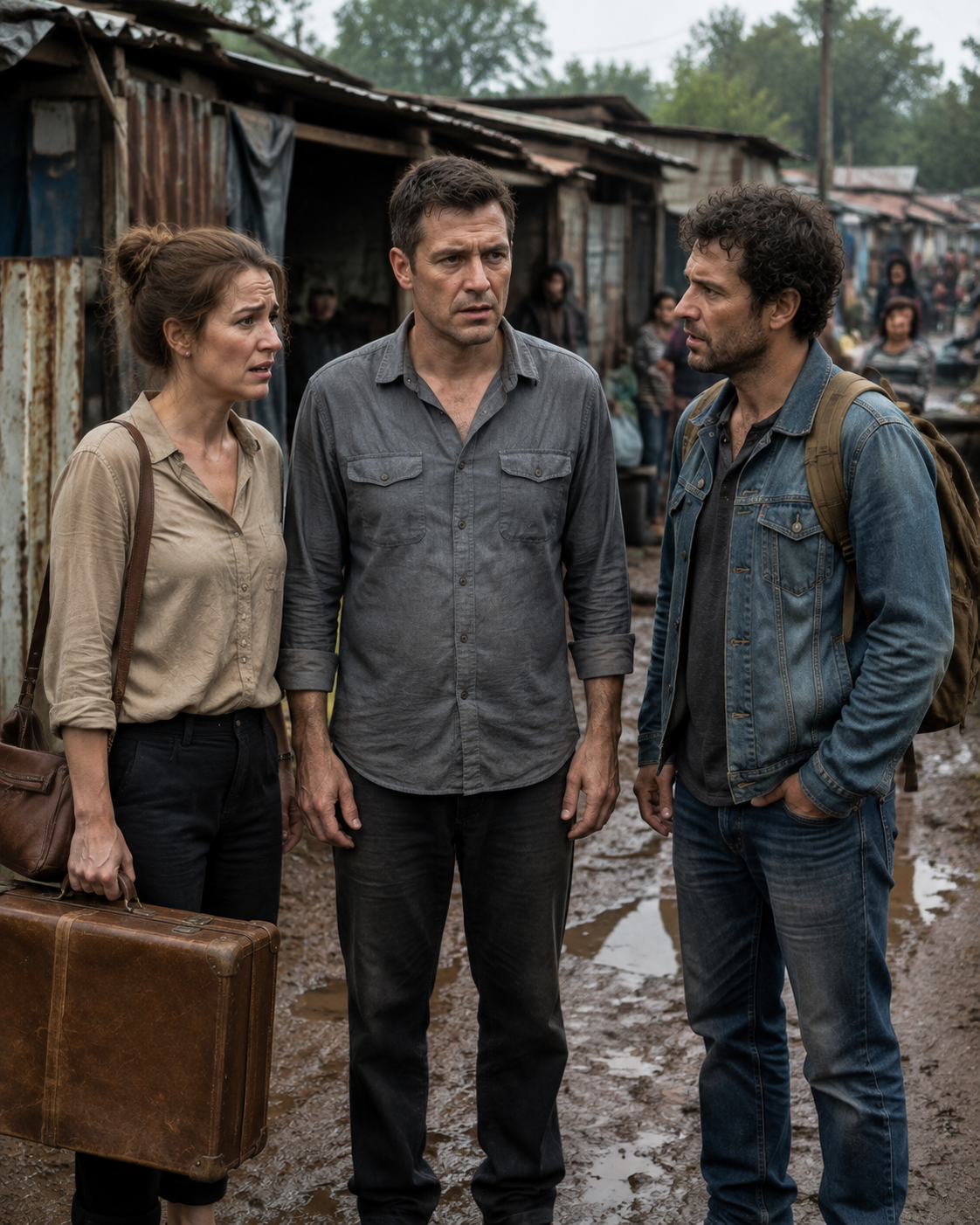
For years, we convinced ourselves that the money we sent was what kept her safe. That every transfer shielded her from cold, from hunger, from isolation. That it could turn into a roof over her head, food, medicine — and calm.
We told ourselves the money brought her comfort. That it eased her burdens. That it somehow bridged the gap we had created by leaving.
We believed it was enough. That being devoted children simply meant wiring money without fail, month after month.
We were mistaken.
For illustration purposes only
That day, the heat was crushing. It wasn’t only the sun beating down on the streets of Mexico City, reflecting off the pavement and searing our lungs — it was something more profound.
A tightness in my chest. A steady, nagging weight. As if the sky itself was calling in a debt — one year at a time — for every year we had spent away.
Five years.
Five years away from home. Five years without joining her at the table. Five years without genuinely meeting her gaze.
Five years believing that money could stand in for our presence. That a bank transfer could embrace her. That a receipt could speak the words, I love you.
I’m Ryan. Thirty-five years old, working as an engineer.
I spent years living in Dubai, encircled by towers that seem to slice through the sky — polished steel, spotless glass, exacting precision. There, everything gets measured: time, money, output.
There, I came to believe that anything unproductive holds no worth. And without realizing it, I started applying that same measure to life itself.
Hours clocked. Paycheck. Bonuses. Outcomes.
I convinced myself I was doing the right thing. I convinced myself I was providing for her.
I was mistaken.
I returned to Mexico with my two siblings: Melissa, the oldest — tough, reliable, always carrying more weight than anyone asked her to. And Miles, the youngest — soft-spoken and tender-hearted, with a heart too big to be contained.
The three of us got off the plane with packed suitcases and nervous smiles. There was something almost innocent passing between us — a feeling none of us had felt in a long while.
We wanted to catch Mom off guard. To embrace her without any warning. To witness her expression the second she saw us come through the door.
During the flight, we couldn’t stop bringing her up, as if repeating her name might somehow shrink the distance between us.
“She has to be doing better,” Melissa said. “With everything we send, she shouldn’t be wanting for anything.” Miles simply nodded, gazing out the window. I smiled —
— but something within me still wouldn’t settle.
For five years, we had sent money almost every single month. No excuses. No delays.
For illustration purposes only
I usually wired about two thousand dollars monthly — sometimes more when I worked overtime or received a bonus. Melissa sent between $1,200 and $2,500, depending on the month. Miles never skipped his contribution, even during months he earned less.
Christmas. Birthdays. Emergencies.
There was always a transfer.
In the taxi, we tallied it up like a game — rapid mental math, a figure that made us exchange glances filled with something close to pride.
More than $150,000 across five years.
In my head, Mom was living somewhere proper — sturdy walls, an actual bed. Hot meals. Medicine. Maybe even a bit of calm.
She had earned every bit of it. She had devoted her life to raising us on her own after Dad passed. She never complained. Never asked for a thing.
But as the taxi kept driving through the city, something began to change.
The wide streets disappeared. The buildings grew smaller. Then vanished altogether.
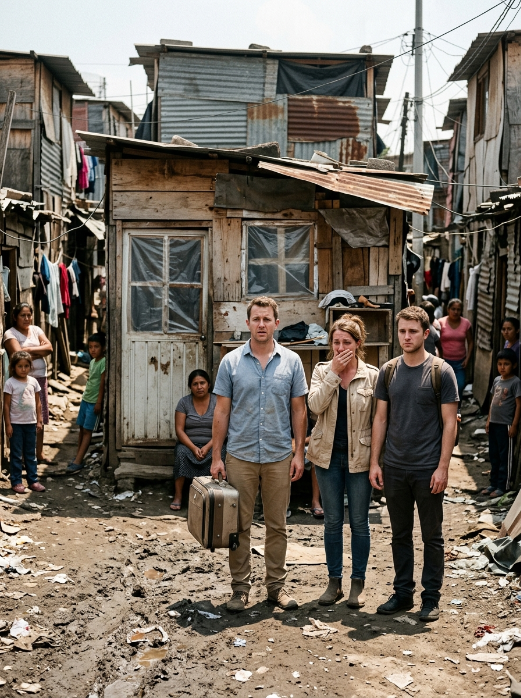
What remained were narrow alleys. Tin roofs. Walls made of wood and flattened cardboard. Murky puddles mirroring the sky. Trash heaped in corners. Children with bare feet playing in the mud like it was nothing out of the ordinary.
A knot tightened in my stomach — heavy, unshakeable.
“Are you certain this is the right address?” Miles asked, squinting through the window.
The driver nodded without looking back. “This is the location I was given.”
The taxi came to a stop.
We stepped out.
The heat hit us like a wall — dense, suffocating. The stench of sewage and abandonment. I looked around, unable to square what I was seeing with the life I had imagined.
Nothing — not one single thing — matched the picture I had painted of our mother’s life.
I approached an older woman seated outside a shack. The sun had etched itself into her skin, and her hands shook faintly.
“Excuse me… is this where Florence Sutton lives?” I asked.
The woman studied us — our faces, our clothing, our bags.
Her eyes welled up.
“Who are you?” she asked, her voice trembling.
“We’re her children.”
The woman broke down in tears.
“Oh God…” she sobbed. “What took you so long?”
Then she lowered her eyes and drew in a slow breath.
“Prepare yourselves,” she said. “What you’re about to witness won’t be easy.”
We didn’t hesitate.
We ran.
The house — the shack — seemed to be standing purely out of habit. The walls looked like nothing but years of endurance held them together. There was no door, just a curtain, tattered and stained.
Melissa yanked it open.
“MOM!”
And there she was.
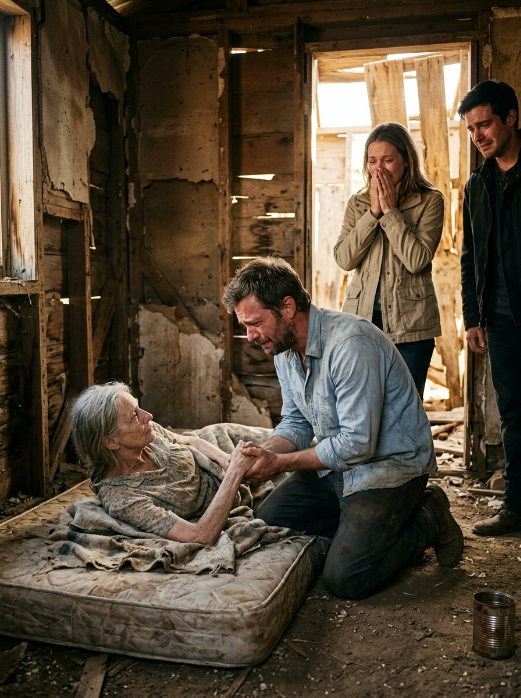
Our mother lay on a thin mat on the ground — so frail she seemed to be disappearing. Skin stretched tight over bone. Hollow eyes. Gray hair, brittle and dry.
When she caught sight of me, she tried to smile.
“Ryan…” she whispered.
Something inside me shattered. Something that would never mend again.
No furniture. No food. No medicine.
Just an empty sardine can resting in the corner.
I asked her when she’d last had something to eat.
For illustration purposes only
“Yesterday… a bit of bread,” she said softly, almost embarrassed.
It was two o’clock in the afternoon.
Miles’ hands clenched into fists, his entire body shaking. Melissa couldn’t hold back her tears.
I couldn’t catch my breath.
Everything I had built my confidence on — figures, plans, systems — fell apart in an instant.
And at that moment, we still had no idea —
— that every single cent of the money was gone.
Someone had been lying to us for years.
And it wasn’t a stranger.
Part 2
A neighbor stepped cautiously into the shack. Her face was calm, resolute — like someone who had held onto a truth too heavy to carry any longer.
“I’m going to tell you the truth,” she said. “Your money… it never got to her.”
The ground seemed to disappear beneath me — as if reality had cracked open and I was plunging through it.
“What do you mean it never got to her?” I asked, hardly recognizing my own voice.
The woman lowered her gaze, as though the truth carried a weight she couldn’t bear to hold up.
“For five years…” she said quietly, “your own relative took it all.”
The name hit like a physical blow.
Rudy.
The man we had trusted. The one who was “looking after” Mom. The one who claimed he had everything under control. The one who smiled through video calls, constantly assuring us she was fine.
Rudy.
He had taken everything.
Every dollar. Every sacrifice. Every hour worked far away from home in a foreign country.
He spent it on gambling. On drinking. On things that cost money and left nothing behind.
He lived comfortably while our mother starved.
The neighbor continued speaking, each sentence wounding deeper. She explained that Rudy had forced Mom to put on an act for the camera. That he had threatened her into staying quiet. That he kept warning her that if she said anything, we would stop sending help.
“They’ll abandon you,” he would tell her. “You’ll be all alone.”
Mom cried as she listened to this — quiet, exhausted tears, heavy with guilt.
“Forgive me…” she kept whispering. “I didn’t want you to worry. I thought eventually things would change. I thought he would keep his word.”
In that moment, I grasped something that shook me to my core:
Hunger wasn’t the worst part. Fear was.
The three of us carried her and rushed her to the hospital. I don’t remember the ride. I don’t remember the traffic. Only how light she felt in my arms.
The doctor didn’t hold back.
“She’s in critical condition,” he said. “Severe malnutrition. You arrived just in time.”
Just in time. That phrase still haunts me.
We reported Rudy. We turned over transfer records, messages, documentation — everything. Justice moved quicker than we anticipated.

He lost the house. The car. Everything he owned.
But no punishment could restore the years stolen from her. No verdict could reverse the damage.
Once she was finally released from the hospital, we made a choice that reshaped everything.
We stayed.
We quit our jobs abroad — walked away from the comfort and careers we had spent years building.
People told us we were making a mistake. That we were giving up everything for nothing. That it wasn’t worth it.
But every morning, watching her grow a little stronger — watching her smile without any fear hiding behind it —
we knew we had made the right call.
One night, Mom shared something that broke us apart all over again.
“What hurt the most,” she said, her voice barely steady, “wasn’t the hunger.”
She paused for a moment.
For illustration purposes only
“It was believing you had abandoned me.”
I held her as close as I could, as if one embrace could make up for five years of absence.
“We never abandoned you, Mom,” I whispered. “We just lost our way for a while.”
That day, I understood something that no tower of steel and glass had ever been able to teach me:
Success isn’t measured by how much money you send — it’s measured by who is still there waiting when you finally return.
Because if you come back too late, all you may find is an empty house — and a truth that can never be reversed.
