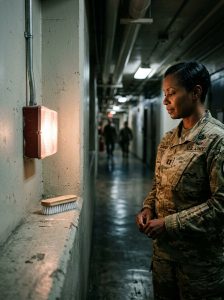
Act I: The Brush on the Floor
The hallway at Atlantic Naval Command Academy felt too bright for humiliation.
White overhead lighting bounced off waxed tile and polished brass plaques, turning every uniform button into a small mirror. The corridor stretched long and straight between dormitory wings and briefing rooms, wide enough for voices to carry and busy enough for shame to spread fast.
That afternoon, every eye in it was on me.
I had arrived directly from the lower maintenance decks in dark navy coveralls, the kind officers wore when inspections ran long and ceremonial appearances could wait. My name was stitched in black thread above the breast pocket: Claire Bennett.
That should have been enough.
I could have ended it then.
Not with anger. Not with noise. That was always their expectation—that pressure would make you fracture in a way they could measure, document, and later use against you.
Instead, I let the silence stretch.
Long enough for it to become uncomfortable.
Nolan’s smile tightened, just slightly. The kind of change most people wouldn’t notice unless they had learned to read men who were used to being obeyed.
“Still thinking?” he asked. “It’s a brush. Not a philosophical problem.”
A few of the cadets laughed again, but it was thinner this time. Less certain. Laughter that needed permission to continue.
I finally moved.
Not toward the brush.
Toward him.
Two steps. Measured. Controlled.
The hallway didn’t get louder the way they expected it to. It got quieter, like the building itself was deciding whether to pay attention.
I stopped just short of where he stood.
Close enough that he had to look up slightly to maintain his posture.
“You want me to pick it up,” I said evenly.
It wasn’t a question.
His eyes flicked over my face, searching for the familiar cues—hesitation, irritation, anything that could be shaped into submission. He didn’t find them.
That annoyed him more than defiance would have.
“I want you to follow instructions,” he said.
“Then give them properly,” I replied.
That landed differently.
I saw it in the shift along the wall. The cadets who had been leaning relaxed by a fraction. The ones who had been smiling stopped too late, as if their expressions had been caught mid-change and didn’t know what to become next.
Nolan let out a short breath through his nose.
“This is not a discussion,” he said.
“No,” I agreed. “It’s an audience.”
That word did it.
A flicker of something crossed his face—recognition, maybe, or irritation at being named too accurately.
Behind him, someone cleared their throat. Another cadet straightened away from the wall without meaning to.
The brush still lay between us on the tile, absurdly ordinary for something being used as a test of hierarchy.
Nolan looked down at it, then back at me.
For the first time, the performance wasn’t smooth.
“Pick it up,” he said again, but the command had lost some of its confidence on the way out.
The light above the elevator blinked once—red, steady, then red again—before the soft mechanical hum started to grow through the corridor.
It wasn’t loud. It didn’t need to be.
Even so, people noticed.
That’s what institutional spaces do. They teach you which sounds matter.
Nolan noticed last, which was exactly how men like him always lost control of a situation without realizing it.
He glanced over his shoulder. Just a quick check. Routine. Confident.
Then he saw the indicator.
And didn’t look away.
The laughter behind him died in uneven pieces, like it had been unplugged rather than stopped.
“What’s that?” someone muttered near the wall.
No one answered.
The elevator continued its slow descent, each floor marker ticking down in clean, indifferent light.
Nolan straightened slightly, as if posture could reassert authority over whatever was coming up from below. His hand tightened on the brush handle, still on instinct more than intent now.
“This corridor is restricted during training hours,” he said, louder than before. Not to me. To the space. To the idea that something outside his script was approaching.
But the corridor didn’t listen.
Neither did I.
The elevator chimed softly.
Once.
Then the doors slid open.
The change in air was immediate—not physically, but socially. Like the room had been holding its breath and finally decided it was no longer required to.
Bootsteps followed.
Measured. Unhurried.
Seven figures stepped out first, then a pause, then one more.
They didn’t rush. They didn’t look around like they belonged to the hallway.
They looked like the hallway belonged to them.
Nolan shifted his weight again, smaller this time. Less performative.
The lead officer didn’t speak at first. Just walked forward a few paces, scanning the corridor once, taking in the alignment of bodies, the brush on the floor, the silence where laughter had been.
Then his eyes found me.
And held.
That was when Nolan finally understood something had gone wrong.
Not because of what he saw.
But because of how everyone else reacted to what they saw next.
Act II: Why I Came Back in Coveralls
I had not intended to return to Atlantic Naval Command Academy.
Some places are too deeply etched into the bones to revisit without consequence. The academy was one of mine. It taught me celestial navigation, operational command, and the precise taste of loneliness that comes from being the first person in a room no one had ever imagined needing to accommodate.
At nineteen, I learned how to survive there.
At thirty-eight, I returned to decide whether it deserved to survive itself.
The orders came in on a Tuesday night in Norfolk while I was still in engine-room coveralls from a training review aboard the Halsey. The Secretary wanted a new command structure in place before the autumn intake. Officially, it was a leadership transition.
Unofficially, it was an intervention.
Complaints had been accumulating for months.
Racialized hazing reframed as “tradition.” Women in tactical tracks diverted from key assignments. Anonymous accounts of humiliation rituals in corridors, maintenance bays, and late-night drills. Nothing dramatic enough to make headlines. That was intentional. Institutions prefer their abuse procedural.
My name appeared because I carried two things the academy board both needed and feared.
A record they could not publicly undermine.
And a memory long enough to recognize old patterns in new uniforms.
I knew Nolan Pike before I ever met him.
Not personally.
By type.
Golden boy. Third-generation naval lineage. Strong evaluations from commanders who mistake confidence for leadership. Noted for presence, discipline, and “strong corridor control,” the kind of phrase written when intimidation is either unrecognized or ignored.
Three anonymous complaints referenced him directly.
One described him as “the man who turns hallways into little courts.”
Another said, “He humiliates people before he corrects them because the audience is the point.”
The third, written by someone who likely deleted and rewrote it repeatedly before submitting, stated simply: “He always chooses the person least likely to hit back.”
That last line stayed with me.
So when the academy scheduled a formal command welcome with dress whites, photography, speeches, and a donor luncheon I had no interest in attending, I changed the conditions. I informed them I would arrive early, conduct a quiet inspection, and enter the building on my own terms.
Hence the coveralls.
Hence the hallway.
Hence Nolan Pike, standing over a scrub brush he had dropped at my feet in front of cadets who needed to learn exactly what this institution had been rewarding in the absence of senior oversight.
The red light above the elevator belonged to the old command protocol system. It only activated for high-level arrival overrides or emergency access. Most cadets had never seen it outside drills. That was why the corridor shifted before the doors even opened.
The laughter stopped first.
Then posture changed.
Cadets who had been leaning against the wall straightened instinctively. One young ensign took an involuntary step back from Nolan, as if already sensing the geometry of the moment turning against him. Nolan himself glanced toward the elevator with irritation rather than concern.
He still believed there was time.
There wasn’t.
I watched the doors slide open beneath the red pulse and saw the command party reflected in the polished metal before I saw them directly. Dress whites. Medals. Caps. Authority carried not theatrically, but with quiet finality that emptied a room before a word was spoken.
At the center stood Admiral Thomas Reed.
White beard neatly trimmed. A face shaped by weather, age, and a career spent distinguishing between true sailors and decorated failures. He had known me since I was twenty-three and half-convinced the service would sooner exhaust me than promote me.
He stepped out first.
Then two rear admirals behind him.
Then the academy’s civilian oversight chair, who looked as if she had long since grown tired of the institution’s internal culture and finally run out of patience for restraint in language.
Their eyes moved down the corridor.
Found Nolan.
Found the brush on the floor.
Found me standing motionless in dark coveralls while a hallway of cadets worked hard not to look like witnesses.
And in that moment, I knew the situation no longer belonged to Lieutenant Pike.
It belonged to whatever Admiral Reed decided to say next.
Act III: The Name He Said Out Loud
Admiral Reed did not move quickly.
That was what broke Nolan first.
Men like him brace for impact. They train for shouting, sudden rage, visible condemnation. What they are never prepared for is restraint. Calm means the outcome has already been decided.
His shoes hit the tile in steady, measured steps as he crossed the corridor. The two officers behind him fanned out slightly, forming the kind of controlled geometry that signals this is no longer ordinary passage. No one dared breathe loudly enough to notice.
Nolan snapped to attention.
Too late.
He raised a salute so fast it looked almost like pain.
“Sir—”
Reed did not look at him.
He walked straight to me, stopped one step away, and inclined his head by the smallest margin. It was not performance. It was regulation—precise enough to remove ambiguity, restrained enough that everyone else had to interpret its meaning.
“Commander Bennett,” he said. “Stand. This hallway answers to you.”
Something in the corridor broke.
You could sense it immediately. The cadets along the wall were no longer looking at me, but at Nolan. The scrub brush on the floor stopped resembling a prop and became something else entirely. Even silence shifted, moving shame from one person to another without a sound being raised.
Nolan blinked.
Once.
Then again, harder, as if his vision itself had failed him. He looked at me, then at the name on my chest, then at Admiral Reed, then back again, as though rank might be some kind of illusion.
“What?” he said.
It came out the way it always does when someone realizes the structure they depended on is no longer stable.
Not strong.
Not defiant.
Small.
The cadets heard it.
That mattered more than he understood.
Admiral Reed finally turned fully toward Nolan. I had seen men break under fire with more composure than Nolan Pike managed under that gaze.
“Lieutenant,” Reed said, “explain the brush.”
No one spoke.
Not Nolan.
Not the cadets.
Not the female ensign at the wall whose face had gone nearly white.
The silence stretched. Reed understood silence as pressure when held long enough—it forces what people are trying to hide to surface on its own.
Nolan swallowed.
“Sir, I believed she was—”
He stopped.
Reed did not react.
“You believed Commander Bennett was what?”
Nolan looked at me again. The coveralls. The skin. The gender. The stillness. All the assumptions he had stacked into certainty without thinking.
He could not finish the sentence because, for the first time, he heard it the way everyone else would.
I watched realization move through the corridor.
Not about me.
About him.
That was what unsettled him most.
Admiral Reed looked at the brush, then back at Nolan. “Pick it up.”
Nolan complied immediately.
He bent down so quickly his cap nearly shifted.
The corridor might have laughed if it had not been so silent.
But Reed was not finished.
“You dropped that brush to humiliate an officer in front of subordinates,” he said. “Whether you knew her rank or not is not the most damning part. The most damning part is that you believed this behavior was acceptable toward anyone.”
The civilian oversight chair stepped forward, speaking for the first time. Her tone was flat and exact.
“Record every name in this corridor,” she said to the aide behind her. “Preserve camera footage. Freeze all pending evaluations tied to Lieutenant Pike’s supervisory authority.”
The fear expanded beyond Nolan.
Cadets who had laughed now stood inside consequences they had never considered possible. One looked ill. Another kept his eyes fixed on the floor. The female ensign at the wall closed her eyes briefly, and I could not tell if it was relief or shock.
Nolan stood again, holding the brush like it weighed more than wood.
Then he looked at me.
For the first time, he truly saw me.
And I let him.
Because now I needed him to understand that I had been standing there long enough to hear exactly what kind of institution he believed he served.
Act IV: What the Hallway Had Been Hiding
Admiral Reed asked if I wanted the corridor cleared.
I said no.
The response surprised some of them. Not Reed. He understood me well enough to know what I was observing. Hallways like this are never just passageways—they are systems. Ritual spaces. Places where institutional culture reveals itself in compressed form.
If I cleared it too quickly, they would leave with private interpretations.
If I kept them there, they would be forced to witness it.
“Lieutenant Pike,” I said, “who told you I was the new girl?”
His jaw tightened. He still held the brush.
“No one, ma’am.”
“Then why did you call me that?”
He didn’t answer.
Of course he didn’t. The honest answer was not procedural. It was reflex. He said it because something in him registered woman, Black, coveralls, unfamiliar—and translated that into permission.
I turned to the cadets along the wall.
“Anyone else?”
No one spoke at first.
Then, halfway down the corridor, the female ensign lifted her chin. She could not have been older than twenty-two. Her voice trembled only once.
“He does it to everyone he thinks he can, ma’am.”
Nolan snapped toward her so fast it looked like he might lose control of himself entirely.
“Ensign—”
“Stop,” I said.
He did.
That was the first time his obedience felt involuntary.
The ensign swallowed and continued. Once she began, the words seemed to outrun her fear. Late-night “corrective drills.” Public humiliation. Men targeted for speech patterns, women for tone, foreign cadets mocked under the guise of “discipline.” Nothing isolated enough to be reported cleanly. Everything corrosive over time.
One by one, others spoke.
Not all of them.
That would have been too simple.
But enough.
An engineering cadet admitted Pike forced repeat inspections in front of spectators to assert control. Another described corridor assignments designed to isolate individuals. A third, flushed with shame, said he had laughed when the brush was dropped because “that’s what everyone does when he starts.”
Reed listened without interruption.
So did I.
This was the real structure underneath it all—not a single aggressor, but the network of silence that formed around him. The institution renamed it resilience, then standards, then tradition. By the time senior leadership looked closely, humiliation had already become routine.
Nolan’s face had gone fully flushed under the fluorescent lights.
Not the controlled flush of embarrassment.
The unstable kind that comes when someone realizes the environment no longer belongs to them.
“I was maintaining discipline,” he said at last.
“No,” I said. “You were leasing authority from other people’s fear.”
That landed harder than the admiral’s presence had.
Because punishment can be reframed. Men like Nolan can narrate it as misunderstanding or politics. But precise description is harder to escape.
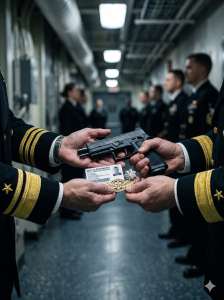
Reed requested his sidearm, access card, and corridor authority tabs.
Nolan surrendered them one by one.
Each exchange sounded louder than it should have—plastic, metal, small sounds marking the end of control.
Then Reed turned to me.
“Commander Bennett,” he said, “this academy is yours as of 1800. What are your first standing orders?”
The corridor went still again.
This was the pivot—not Nolan’s collapse, but the transfer of authority itself.
I thought of myself at nineteen in this same building, told by a senior midshipman that women like me existed only for optics. I thought of reports softened until they disappeared, of women who learned to smile first so their pain could not be used against them, of men who decided survival mattered more than decency.
Then I looked at the brush still in Nolan’s hand.
“First,” I said, “all unofficial corridor traditions are suspended pending review.”
A visible easing moved through the crowd.
“Second, anonymous reporting becomes protected reporting. Submissions come directly to me, not through the chain that buried them.”
Even the civilian oversight chair seemed satisfied.
“Third,” I said, “Lieutenant Pike will remain on administrative hold until I determine whether he remains fit for service.”
Nolan closed his eyes briefly.
Not quite collapse.
But close to it.
Then I added the order I had been carrying since the moment the brush hit the floor.
“And before he leaves this corridor, he will apologize to every officer he taught to mistake humiliation for leadership.”
Act V: The Smile He Couldn’t Bear
He did it.
Not well.
Not cleanly.
But he did it.
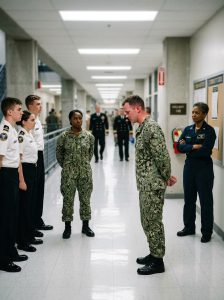
Nolan Pike stood in the same fluorescent corridor where he had tried to turn me into an example and delivered one uneven apology after another to the people he had trained to laugh, freeze, or look away. He apologized to the female ensign first because Reed ordered it. He apologized to the engineering cadet next. He apologized to me last.
“I was wrong, Commander,” he said, staring somewhere near my collar without meeting my eyes.
“Yes,” I said. “You were.”
I did not soften the truth for him. That would have served my comfort, not his accountability.
By 1800, his nameplate was removed from the corridor roster.
By 1900, the preserved footage had already entered command review.
By morning, nine additional statements were on my desk.
That was the nature of fear once it lost its most convenient target. It did not disappear immediately, but it stopped feeling untouchable. People began to imagine a life beyond it. Then they began to speak.
I assumed formal command in dress whites the following day.
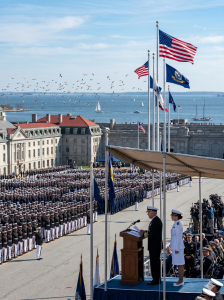
The academy assembled on the parade ground under a hard blue sky, gulls circling over the water beyond the eastern wall. Reed read the order. The colors moved. Cameras captured the record. All of it was correct, orderly, and delayed compared to what had already occurred.
Because the real ceremony had already taken place.
It happened in that hallway, when cadets watched a man like Nolan Pike stripped not of rank first, but of narrative. He was not revealed as a monster—that would have allowed others to distance themselves. He was revealed as something more ordinary and therefore more dangerous: a man the institution had rewarded until someone with authority finally named him accurately.
Later that evening, after the building had quieted and corridor lights shifted into night mode, I returned alone.
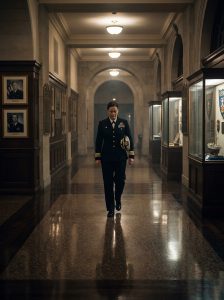
The brush was gone.
The walls were unchanged.
The floor still reflected light in the same way it had when it stopped at my feet.
But the air had shifted.
Places remember. And sometimes, if forced, they learn to hold something else.
I stopped where the brush had first come to rest and let myself register, briefly, what almost happened and what actually did. If Reed’s elevator had opened moments later, if I had entered in dress whites instead of coveralls, if I had announced myself immediately, Nolan would still have been Nolan. Only better concealed.
That was why I did not regret the hallway.
It was painful, but it was honest.
A knock came behind me.
The young ensign.
She looked hesitant to interrupt, then placed a small object on the ledge beneath the emergency light and stepped back.
A new scrub brush.
Unused.
Clean.
I lifted an eyebrow.
She offered a small smile. “Maintenance sent it up, ma’am. They said the old one finally ended up where it belonged.”
I laughed.
Quietly.
Just enough.
Her shoulders eased, something unclenching in her expression that had likely been tight for far too long.
When she left, I looked at the brush a moment longer, then turned toward the darkened window at the end of the corridor. My reflection looked older than I felt and steadier than I had been at nineteen.
Nolan’s final word in that hallway had been “What?”
People often assume that is the key moment in reversals like this—the shock, the collapse, the instant power realizes it has misread the room.
It isn’t.
The real moment comes after.
When the person who has been publicly stripped of certainty decides what expression to wear once the hierarchy breaks.
In the footage I reviewed alone just after midnight, it is clear. Nolan’s face is flushed and stunned. Reed’s command group stands near the elevator. The cadets are rigid against the wall.
And then the camera catches me in profile.
Calm.
Still.
A faint smile at the corner of my mouth.
Not triumph.
Not cruelty returned.
Something clearer than both.
Recognition.
Because the hallway no longer belonged to the man who dropped the brush. It belonged, finally, to the woman who never bent to pick it up.