

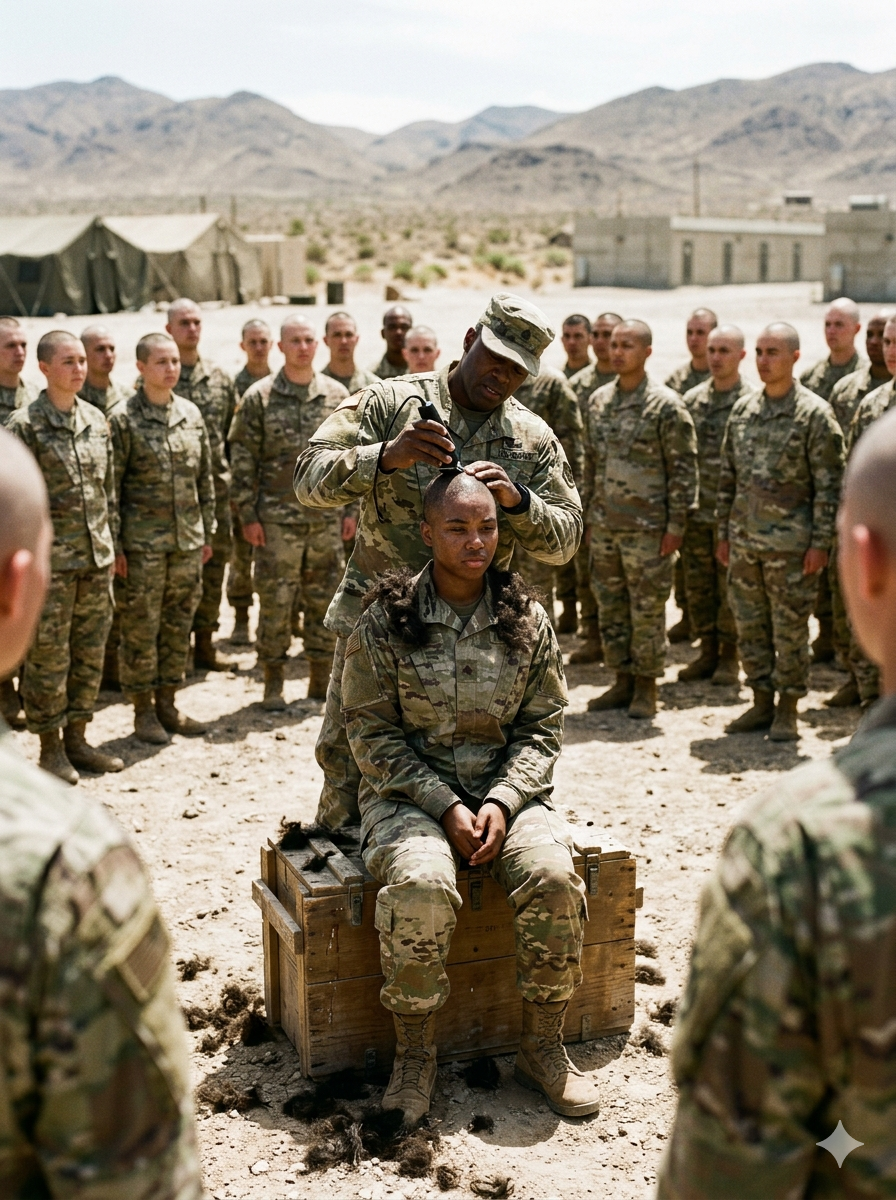
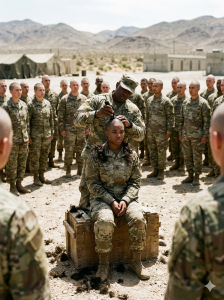
The clippers droned like a swarm of furious hornets as the brutal Nevada sun hammered down on Desert Ridge Training Post.
I sat on a flipped wooden crate, the scorching desert wind brushing my neck. Around me, a circle of drained trainees stood locked at attention. Their boots sank into the brittle dust, their faces fixed forward because even a glance away counted as “disrespect.”
At the center of this living cage, Sergeant First Class Brent Halvorsen loomed over me, smiling as if this were some twisted show. He looked at me with a bias I had known all my life. To him, my natural Black hair wasn’t merely out of regulation; it was something he wanted to erase.
“Shave it all off—she’s just a recruit,” he ordered, laughing alongside the other cadre members.
“This is for morale,” Halvorsen told the rigid formation. “Smile, Hart. You’re helping your team.”
I didn’t cry. I didn’t beg. I just fixed my gaze on the wavering horizon as dark, tight curls dropped onto the concrete in uneven, ugly clumps.
This wasn’t about military rules. It wasn’t about hygiene or uniform standards. It was humiliation—something the corrupt cadre would later replay on their phones, beers in hand.
Halvorsen bent in close, his breath thick with stale coffee, his voice lowering to something almost private. “Beauty doesn’t survive basic,” he sneered. “You’re nothing here.”
But “Lila Hart” wasn’t my real name. And “Private” wasn’t my true rank.
Inside me, anger burned—intense, but perfectly restrained. I was Major Natalie Cross, Army Intelligence. I was embedded under a tightly sealed CID assignment after anonymous reports labeled Desert Ridge a full-scale danger zone. There were whispers of illegal h*zing, altered medical records, recruits driven into severe heat injuries, and complaints that simply disappeared.
Every official inspection returned “within standard.” Every whistleblower who spoke up was quietly moved out. The only way to expose the decay was to become the target.
When the last strands of my hair fell away, the silence felt overwhelming. A few trainees flinched, but no one spoke. Halvorsen reveled in the fear he had trained into them. He believed he had crushed another Black woman who hadn’t bent quickly enough to his warped expectations.
That afternoon, he pushed the t*rment further. He gave me sixteen hours of punishing latrine duty. No water breaks, no medical checks, and no relief from the blazing sun. When I finally staggered, lightheaded and pale from heat exhaustion, Halvorsen only smirked and wrote on his clipboard.
“Heat sensitivity,” he declared loudly. “Self-inflicted. Weak mindset.”
I didn’t break character. I logged the exact time, the precise name on the form, and the glaring detail that he recorded a medical note without checking my pulse.
That night, my raw scalp burning against the thin pillow, I tapped once—softly—on the metal bedframe. It was instinct from years in covert intelligence. Somewhere beyond the perimeter, an encrypted packet was already in motion.
I truly didn’t know how many more days my body could endure Desert Ridge’s toxic “training culture.” But I knew one thing with certainty: Halvorsen couldn’t recognize apex predators when they wore trainee uniforms.
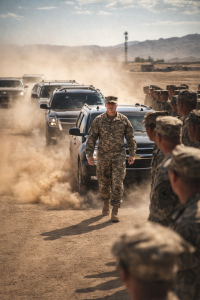
The next morning, the entire formation snapped to attention as a black government SUV rolled through the main gate without stopping. Halvorsen went rigid. The base fell into complete silence.
I kept my head lowered, lifting my eyes just enough to catch the command flag on the hood. The predator was about to learn what happens when you cross the wrong “recruit.”
Part 2: The General’s Audit (Rephrased)
The morning sun over the Nevada desert didn’t so much rise as it arrived—heavy and relentless—scorching the cracked ground of Desert Ridge Training Post before reveille had even faded. My scalp, shaved bare only a day ago, pulsed with a dull, spreading heat. The skin felt unfamiliar—raw, overly sensitive, and exposed not just to the elements, but to the harsher scrutiny of the cadre. I stood in formation, boots firm in the dust, eyes fixed on the back of the trainee ahead of me. I held the rigid stillness expected of a “recruit,” refusing to let even the smallest movement reveal the dehydration still tearing at my throat after yesterday’s forced sixteen-hour latrine duty.
The air across the company area carried its usual tension. Sergeant First Class Brent Halvorsen paced before the ranks, boots scraping dirt. He moved with the confidence of someone convinced he had won. In his mind, he had crushed another “problem recruit”—a Black woman who hadn’t adapted quickly enough to his warped, biased expectations. He had turned me into a spectacle. He had made my hair, my identity, into his tool for cruelty.
But Desert Ridge was about to be shaken at its core.
The first sign wasn’t noise—it was vibration. A deep, powerful rumble rolled toward the main gate. The black government SUV didn’t stop at headquarters. It didn’t pause for ID checks. It drove straight through, gravel snapping under its tires, heading directly for the training grounds as if guided by instinct.
The sight alone was jarring. Two more vehicles followed close behind—unmarked, windows dark as night. This wasn’t an arrival that waited for permission. In a place built on strict order and scheduling, this sudden intrusion struck like lightning.
Halvorsen froze mid-step. I saw the tension tighten across his shoulders. “Eyes front!” he barked, but his voice cracked, exposing the surge of adrenaline beneath it. He knew something was wrong. Desert Ridge depended on control—and control relied on predictability. This was neither.
The convoy stopped at the edge of the parade deck, kicking up a cloud of pale dust that drifted over the formation. Silence fell across the base. Even the wind seemed to still. Without breaking posture, I lifted my eyes just enough to catch the flag mounted on the lead vehicle—the unmistakable stars of a General Officer.
The doors opened. A tall officer stepped out first—Brigadier General Thomas Redford, broad and composed, his uniform immaculate. Authority radiated from him, quiet but overwhelming. Behind him came a civilian woman in sharp attire carrying a reinforced case—CID. Then a legal officer with thick binders, and a Command Sergeant Major whose expression suggested he had ended careers before breakfast.
Their approach across the gravel felt cinematic, yet brutally real. Halvorsen stood frozen, his smug grin gone, replaced by the pale look of a man realizing he was standing on a trapdoor.
General Redford skipped all formalities. He didn’t greet anyone. He didn’t wait for the base commander. His eyes swept over the exhausted recruits, then locked directly onto Halvorsen.
“Sergeant First Class,” Redford said evenly, “who authorized the shaving incident yesterday?”.
The question hung, heavy and dangerous. Halvorsen opened his mouth, then shut it again, struggling to process. He was used to operating in shadows; under a General’s gaze, he faltered.
“Sir—hair standards—” he began.
Redford cut him off immediately. “Don’t lie to me.”.
The formation froze. Heat shimmered off the ground, but the air felt cold. The trainee beside me trembled almost imperceptibly.
Halvorsen swallowed. “It was… corrective action.”.
Redford stepped closer, slow and deliberate. “Corrective for what infraction?”.
Halvorsen glanced toward the cadre line, searching for support. No one moved. No one wanted the spotlight.
Redford turned slightly. “Show him.”.
The CID agent opened her case and produced a rugged tablet. With a few taps, footage appeared—yesterday’s incident from multiple angles. A trainee’s shaky recording, a cadre member’s clearer clip, and the most damning of all: a high-definition security feed already secured before it could be erased.
Halvorsen’s own laughter echoed across the silent field.
“Shave it all off—she’s just a recruit.”. “This is for morale. Smile, Hart. You’re helping your team.”. “Beauty doesn’t survive basic. You’re nothing here.”.
Hearing the cruelty replayed in front of a General stripped away any illusion. It exposed everything.
Redford’s expression barely shifted, but his eyes hardened. “So not regulation. Entertainment.”.
Halvorsen scrambled. “Sir, recruits need discipline. The culture—”.
Redford’s tone remained calm—and cutting. “Discipline is not cruelty. Training is not abuse.”.
He turned away, dismissing Halvorsen entirely, and faced the formation.
“Where is Private Hart?”.
Halvorsen’s voice tightened. “Latrine duty, sir.”.
The Command Sergeant Major snapped his gaze toward him. “For sixteen hours?”.
“She was—”
The CID agent stepped in. “She collapsed at 1507. Your log states ‘self-inflicted heat sensitivity.’ Medical report confirms dehydration and heat stress.”.
Halvorsen flushed. “We—”.
Redford raised a hand. Silence returned. “Bring her.”.
Two cadre members ran toward the medical tent. My heart remained steady. I wasn’t there—I stood in the third rank. I had forced myself out of the infirmary at dawn, refusing to break cover too early. The mission demanded it.
I took a slow breath. The time for concealment was over.
Without waiting, I stepped out of formation.
A ripple of shock moved through the ranks. Breaking attention without orders was unthinkable. My boots crunched loudly as I walked forward, every eye following.
I passed the trainees, the stunned cadre. My body carried fatigue, not weakness. My head was shaved, my face calm, my gaze unwavering. Pain lingered, but my posture held firm.
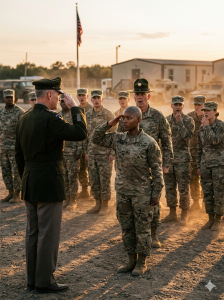
I stopped three paces before General Redford and snapped into a precise salute.
“Sir,” I said, my voice clear.
Halvorsen stared, stunned beyond comprehension. To him, I was still the broken recruit he had humiliated.
Redford studied me briefly, noting everything—the raw scalp, the exhaustion, the control. He returned the salute crisply.
Then he turned back to Halvorsen, pointing at me.
“You did this to her,” he said, voice low. “In public.”.
Halvorsen forced a strained grin. “Sir, she’s a problem recruit. Insubordinate. She doesn’t belong—”.
Redford cut in sharply. “She’s the only recruit here documenting your misconduct with timestamps.”.
Halvorsen froze. “What?”.
I lowered my salute and stood at parade rest, meeting his gaze.
The CID agent stepped forward, opening a folio. Her voice rang out across the field.
“Major Natalie Cross. Army Intelligence. Assigned to CID task force Ravenbridge.”.
Shock rippled through the formation. Breath hitched. Eyes widened. The recruits who had watched me suffer now saw the truth—a field-grade officer among them.
Even the cadre faltered. Their illusion of control shattered.
Halvorsen stumbled back. “That’s—no—she’s—”. Words failed him. The “worthless recruit” he had abused was his superior.
Redford stepped closer. “She outranks you. And she’s not the only one watching.”.
The trap closed.
The legal officer opened a folder and began reading—charges, removals, preservation orders. The words fell like judgment.
The unmarked vans opened. CID agents poured out, moving with precision. Phones were seized. Laptops secured. Offices locked down. Server rooms sealed.
Panic broke through the cadre. One corporal tried to slip away toward the motor pool. A CID agent stopped him with a single hand. “Don’t.”. He froze.
I kept my focus on Halvorsen. His eyes darted—then flicked toward a distant building. Barracks C.
Noted.
A golf cart sped toward us. Colonel Mark Vess arrived, breathless, forcing a strained smile. “General Redford, sir—if there’s an issue, it’s isolated—”.
Redford didn’t salute. “This isn’t isolated. It’s patterned.”.
He turned to me. “Major Cross, did you observe falsified logs?”.
I stood firm. “Yes, sir. Medical entries altered. Pages removed. Duty rosters adjusted to conceal personnel during unauthorized punishments.”.
Vess went pale.
“And Barracks C?”.
My voice remained steady. “Avoided by cadre at night. Feared by recruits. Used for off-the-books discipline. Statements prepared.”.
For the first time, anger flashed across Redford’s face.
“Then we’re going to open it.”
Halvorsen’s knees buckled. Everyone knew what that building meant.
CID agents secured the area. Halvorsen was detained, hands bound in front of the recruits he had terrorized.
Redford turned and began walking toward Barracks C. I stepped beside him, gravel crunching underfoot. The wind cooled my skin, brushing my shaved scalp.
I was exhausted. Injured. Worn down.
But walking toward the place where their secrets lived, I had never felt stronger.
The audit had only just begun.
PART 3: THE SECRETS OF BARRACKS C (Rephrased)
The heavy iron door of Barracks C didn’t simply creak—it groaned, a rusted protest that seemed to carry months of suffering trapped behind it. When the CID tactical team forced entry, the air that met us was stale, thick with old sweat, harsh cleaning chemicals, and the sharp metallic scent of fear.
I followed just behind General Redford, my steps steady and controlled. I was no longer the “broken recruit” with a shaved head and lowered gaze. I was Major Natalie Cross, and as I moved into the dim, flickering fluorescent corridor, the shift in power was undeniable. The same cadre who once watched me with predatory amusement now shrank back into the shadows, eyes fixed downward.
“Secure the administrative wing,” Redford ordered, his voice striking like a hammer. “I want every hard drive, every note, every piece of paper from that office. Now.”
I led a small team toward the North Wing—the section recruits spoke about only in whispers during rushed meals. We stopped at a door that didn’t exist on any official map. A heavy deadbolt reinforced it—completely out of place for standard barracks housing.
“Open it,” I said.
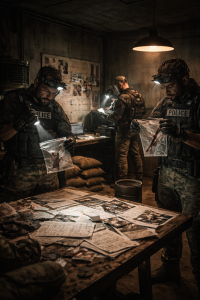
A CID agent forced the lock with a specialized tool. The door swung inward, revealing the “punishment room.” A bare concrete chamber. No windows. No beds. Only a few buckets, stacked sandbags, and a high-powered industrial heater in the corner—now silent, but its purpose unmistakable. This was where “problem” recruits—most of them minorities—were sent to “sweat out defiance” under brutal artificial heat, denied even basic hydration.
“Document everything,” I ordered, my tone sharp and controlled. Anger surged through me, but I forced it down. I needed precision. I needed discipline.
Behind the heater, inside a reinforced bin, we found shredded medical logs. They hadn’t managed to destroy them in time. I pulled out several strips—my alias stared back at me: “Hart, Lila,” linked with notes like “Unauthorized Water Intake” and “Corrective Heat Exposure.” It was all there—proof of systematic abuse carried out under the guise of discipline.
But the real evidence was hidden beneath the floor. I remembered Halvorsen’s nervous glance to a specific corner. I pointed toward a loose plank beneath a stack of crates.
“Check there.”
Under the board, we uncovered a leather-bound ledger. This went far beyond h*zing. It detailed the “Shadow Supply”—a two-year scheme where Colonel Vess and Halvorsen diverted thousands of dollars’ worth of military equipment—tactical gear, cold-weather clothing, medical supplies—selling them on the black market while marking them as “training losses.”
They weren’t just abusers.
They were criminals.
Two hours later, I stood inside the stark interrogation room of the base stockade. Across the metal table sat Brent Halvorsen. His campaign hat was gone. His sleeves rolled up. Sweat beaded across his forehead. Without his rank and his followers, he looked diminished—just a man who had built power on cruelty.
I sat down across from him and said nothing. For three full minutes, I let silence do the work. His fingers began tapping nervously against the table.
“You look different in that uniform, Major,” he sneered finally, clinging to a fragment of arrogance. “Guess going ‘undercover’ was the only way a woman like you could move up, huh?”
I leaned forward slightly, the overhead light reflecting off my shaved scalp—an unintended mark of defiance he had given me.
“Let’s talk about your ‘problem recruits,’ Brent,” I said quietly, my voice steady but heavy with authority. “I’ve reviewed your ledger. I’ve examined the medical logs you tried to destroy. And I’ve spoken with the three Black privates you discharged last month for ‘failure to adapt.’”
His eyes flickered. “They were weak. This is the Army, not a social club.”
“No,” I replied, sliding a photograph across the table—the heater in that concrete room. “This is an Article 15 violation. This is aggravated assault. And once we tie it to the $50,000 in stolen gear you routed through your brother’s surplus store in Vegas, it becomes federal racketeering.”
The color drained from his face. The bravado cracked completely. He stared at the image, then back at me, realization settling in.
“I was following orders,” he muttered, voice shrinking. “Colonel Vess… he knew. He took most of it. I just handled operations.”
“Then you’re going to give me Vess,” I said, leaning back. “You’ll explain the kickback system. You’ll name everyone involved in falsifying reports. And you’ll do it because if you don’t, I will personally make sure you spend the next twenty years in Leavenworth staring at a concrete wall like the one you put me in.”
Halvorsen sagged in his chair. The predator finally understood—he was trapped.
As I stepped out of the room, I saw Colonel Vess being escorted down the hall in restraints, his face hidden beneath his jacket from the cameras. The entire base was in chaos. Recruits were being transferred out for medical evaluation and debriefing.
I paused on the steps of headquarters, watching the sun dip low over the desert horizon. The evening air cooled my exposed scalp, steadying me. The truth of Barracks C was no longer buried. The corruption was being cut out.
But as I glanced at the list of names in my notebook—young soldiers whose spirits had been crushed before their careers even began—I knew recovery would take far longer than this single operation.
“Major Cross,” someone called.
It was the trainee who had stood beside me in formation—the one too afraid to meet my eyes during the shaving. He stood near a transport bus, his expression uncertain, eyes wet.
I walked over. “At ease, soldier.”
“I’m sorry, Ma’am,” he said quietly. “I wanted to speak up. I wanted to stop it.”
I placed a hand on his shoulder. “You were a recruit. I was the Major. It was my responsibility to carry that weight. You made it through. Now you’ll help rebuild this place.”
The battle wasn’t finished. But for the first time in a long while, the air at Desert Ridge felt like something you could finally breathe.
PART 4: THE COST OF INTEGRITY (Rephrased)
The desert at five in the morning carried a different edge—sharp, thin, and almost eerily quiet. I stood on the small concrete porch of the transient officer quarters, holding a plain mug of black coffee as steam curled into the cold air. My hand rose to my scalp. The skin was no longer raw; coarse stubble had begun to emerge, a stubborn layer of dark hair reclaiming what had been taken. It prickled under my fingertips—a reminder that time was moving forward and wounds were beginning to heal.
For the first time in six weeks, I wasn’t “Private Lila Hart.” I wasn’t hidden or diminished. I was Major Natalie Cross, and the weight of that identity felt heavier than any pack I had ever carried across the Nevada desert.
Behind me, the base stirred awake—but not in its usual rhythm. The steady cadence of marching boots was gone. In its place came the hum of idling Humvees and the distant, rhythmic thrum of a Black Hawk helicopter descending near headquarters. The “Audit” hadn’t been a routine visit—it had been a purge.
The day before, everything had unraveled. Colonel Vess—who had ruled this base like his personal domain—had been escorted out in handcuffs, his shame hidden beneath a jacket from the recruits he once controlled. Sergeant First Class Halvorsen was already detained at Fort Carson, his arrogance gone the moment he realized the “Black girl he broke” was the central witness in a federal case.
I took a slow sip of coffee and looked toward Barracks C. Yellow crime scene tape snapped in the wind. Inside, CID had uncovered more than records and stolen equipment. They found what they called the “Wall of Silence”—a corkboard covered in photos of recruits they had driven to quit or collapse. My picture—taken while the clippers still buzzed—had been pinned at the center. Their “trophy.”
I sensed someone step behind me. I didn’t need to turn. The scent of pressed fabric and tobacco made it obvious.
“You’re up early, Major,” General Redford said, stepping onto the porch. He looked worn—the kind of fatigue that comes from seeing something you trusted begin to rot.
“Habit, sir,” I replied, straightening instinctively.
“At ease, Natalie. Finish your coffee.” He rested against the railing, looking out over the same parade ground where I had stood two days ago, watching my hair fall into the dust. “JAG worked through the night on that ledger. It’s deeper than we thought. Vess wasn’t just moving basic gear—he was trafficking optics and night-vision components through a civilian contact in Vegas. This is a multi-state conspiracy.”
“And the recruits, sir?” I asked quietly.
Redford exhaled slowly. “Forty-two individuals were pushed out over the last eighteen months under falsified conditions. We’re initiating a full review—restoring records, offering reassignment for retraining. Medical teams are inbound to reassess every heat-related case that was buried.”
He studied me for a moment, his gaze settling on my shaved head. “You took a serious risk. If that heat exposure had gone any further… or if Halvorsen escalated things… this could’ve ended very differently.”
“The mission required someone inside, sir,” I answered. “Inspections wouldn’t have uncovered the ledger. Whistleblowers were being silenced. They had to believe I was powerless—so they would reveal everything.”
Redford nodded faintly. “And they did. You showed them what leadership actually looks like.”
He handed me a folder. “Your reassignment. Washington, D.C. You’ll lead a new Task Force on Training Integrity. The Chief of Staff wants you to design protocols for undercover oversight. You’ve set the standard, Major.”
I accepted the folder but didn’t open it. My thoughts weren’t on Washington. They were still here—on the formation, on the faces I couldn’t forget.
Later that morning, I crossed the parade ground one final time. I wore my Army Service Uniform—the blues. The gold oak leaves on my shoulders caught the sunlight, sharp and unmistakable. My ribbons told the story of years of service, but my shaved head told the story of the last six weeks. Together, they created a contrast that no one could ignore.
As I passed a group of trainees boarding a bus for transfer to Fort Moore, the line paused. The young man who had stood beside me stepped forward. He carried his bag tightly, his expression uncertain but determined.
Breaking formation, he approached and delivered a salute so precise it felt deliberate beyond training.
“Major Cross,” he said, voice unsteady. “I’m going to finish. I’m going to become a sergeant. And I’m going to lead the way you did.”
I returned the salute, holding it a moment longer than required. “I expect nothing less. Remember—rank doesn’t define the soldier. Integrity does.”
I watched as the bus pulled away, leaving a trail of dust behind it. This time, the dust didn’t feel suffocating—it felt like something being cleared away.
I drove toward the main gate in an unmarked SUV. At the checkpoint, a young corporal snapped to attention. He checked my ID, then looked up with quiet respect. Word had spread. In less than two days, the story had traveled across the base—the Major who had lived as a recruit.
“Safe travels, Ma’am,” he said, handing back my card. “And… thank you.”
I nodded and eased forward. In the rearview mirror, Desert Ridge faded—the towers, the barracks, the endless stretch of sand.
Vess and Halvorsen thought they could strip my dignity by cutting my hair. They believed targeting a Black woman made me an easy mark—someone the system would overlook. They never understood that my strength didn’t come from what could be taken.
It came from the oath. From the soldiers I stood for. From a core of integrity no blade could reach.
As the road opened ahead, I rolled down the window. The wind swept over my scalp—not burning anymore, but cool and steady. My hair would return. The base would recover. The names of the wronged would be restored.
But the lesson would remain.
There is no place for predators in the ranks. And those who hide in the shadows may not realize who is standing beside them, waiting for the light.
I pressed the accelerator, leaving the desert behind. I was heading home—to a world where my rank carried weight—but I would never forget where I had been. The overturned crate. The sound of clippers. The silence of the formation.
And I would never stop fighting for those still standing in the dust, waiting to be seen.
Integrity has a cost. It took my hair, strained my body, and tested my trust in others. But as the Nevada state line blurred past, I knew without hesitation—I would pay that price again.
Because some things matter more than rank. More than career.
Truth is the only thing that survives basic.
THE END.
