


The slap cracked louder than the orchestra.
Not the music.
Not the speeches.
My face.
That was the sound that silenced an entire ballroom of wealthy guests for exactly two seconds before the whispers began.
I was the girl in the old uniform.
She was the girl everyone called the future of the Ashford family.
And we were standing in the center of St. Bartholomew Academy’s one-hundredth anniversary gala, beneath crystal chandeliers, with half the city’s elite watching.
Her name was Vanessa Ashford.
Mine was Elena Ward.
At least, that was the name the school knew.
Vanessa had spent years treating the school like her personal domain. Her family’s name was engraved on buildings. Their foundation funded scholarships, staff housing, science labs, the music wing, even the ballroom we stood in.
She moved as if the marble floor was hers by right.
That night, she wore a silver gown that looked like it cost more than my mother earned in a year.
I wore my best pressed uniform jacket.
It was still old.
Still faded at the cuffs.
Still enough for people to judge my worth before I said a word.
Vanessa looked me up and down in front of a circle of donors and smiled the way cruel people do when they know no one will intervene.
“Did no one tell you this is a gala?” she said, loud enough for three tables to hear. “Not a charity bin.”
A few people laughed.
I felt that old familiar heat crawl up my neck.
I had learned a long time ago that humiliation has a sound. It is not always screaming. Sometimes it is jewelry clinking while people pretend not to notice.
I tried to step around her.
She blocked my path.
“Oh, don’t be shy now,” she said. “You’ve spent years hovering around this school like you belong here.”
I kept my voice even. “I do belong here.”
She tilted her head. “Scholarship girls always say that.”
Then she leaned closer, close enough for her perfume to sting my nose.
“My family built this place. Girls like you come here because families like mine allow it.”
That line drew more murmurs.
One of the trustees offered an awkward little smile, like he wanted the scene to end but not enough to risk offending the Ashfords.
A woman in pearls whispered, “Who invited her to the donor floor?”
Another answered, “Probably some pity seat.”
I should tell you something here.
I was not invited out of pity.
I was invited because, six hours earlier, one of the oldest family law firms in New York had filed amended succession papers under seal.
Six hours earlier, a bloodline correction had been recognized.
Six hours earlier, a private trust review had been completed.
And six hours earlier, the one man Vanessa believed would never claim me had landed back in the city.
I knew all of that.
Vanessa didn’t.
So when she lifted her chin and said, “Take your thrift-store pride and go stand with the service staff,” I stayed still.
That made her angrier.
Cruel people hate calm.
They need you to break first.
“I’m talking to you,” she snapped.
Still, I did not move.
Then she did it.
She slapped me.
Hard.
My head turned. My lip split against my teeth. A tiny metallic taste spread across my tongue.
Someone gasped.
Someone else said, “Oh my God.”
And all around us, phones came up.
That was the part that mattered.
Not because I wanted pity.
Because public arrogance is evidence.
Vanessa straightened her shoulders and gave me a cold smile, like she had just corrected a stain on a tablecloth.
“Now,” she said, “maybe you’ll remember your place.”

A dean rushed toward us, then slowed when he realized whose daughter’s table Vanessa had come from.
Cowardice looks very polished in tuxedos.
“Ladies,” he said weakly, “let’s keep this elegant.”
Elegant.
I was the one bleeding.
Vanessa laughed. “She should be grateful I didn’t have security drag her out.”
Then, because evil likes an audience, she turned to the room.
“Some people spend their whole lives trying to sneak into families that will never want them.”
That line landed exactly the way she wanted.
There had been rumors about me for years.
Why my tuition was always quietly handled.
Why the headmistress never let anyone remove me after donor complaints.
Why my records were sealed tighter than every other student’s.
The ugly version of the rumor was simple: somebody’s mistake, kept around for reasons no one respectable would explain.
Vanessa knew those rumors.
She fed them.
I looked at her and, for the first time, saw fear hiding under the performance.
Because people like Vanessa do not just insult.
They protect territory.
And that night, she was protecting something she thought was hers.
I dabbed the blood from my lip with a napkin.
Then I said the first words I had spoken to her all evening.
“You really should not have done that in public.”
Her smile flickered.
“Or what?”
I glanced toward the ballroom doors.
“Or now everyone will remember this part.”
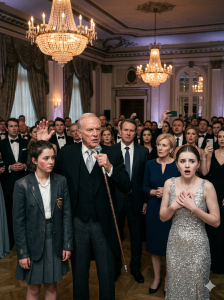
Before she could answer, the orchestra stopped.
Not faded.
Stopped.
Every head turned.
The grand doors at the end of the ballroom opened, and the room changed shape around the silence.
An elderly man entered, tall despite his cane, in a black formal coat, with two attorneys, a private trustee, and the school’s board chair walking half a step behind him like planets pulled by gravity.
Julian Ashford.
Vanessa’s grandfather.
The Ashford patriarch.
The man people called a myth when they wanted to sound casual about being terrified of him.
He almost never appeared in public anymore. Not after his health declined. Not after he stepped back from the companies and let the family office run through trustees.
The room exploded in whispers.
“Julian Ashford?”
“He came in person?”
“Why wasn’t this announced?”
Vanessa’s whole face changed.
Gone was the smug smile.
Gone was the glittering cruelty.
She looked suddenly young.
“Grandfather,” she said, stepping forward with relief so fast it was almost funny. “You arrived at the perfect time. There’s been a little disturbance—”
“Be silent,” he said.
Not loud.
Worse.
Controlled.
The kind of voice that had probably ended careers before dessert.
Vanessa froze.
He did not look at her first.
He looked at me.
At my cheek.
At the blood on my lip.
And in front of the entire ballroom, he crossed the floor and stopped beside me.
The old board chair was sweating now.
So was the dean.
Because this was the problem with rich families and secrets: people build their power on silence, then act surprised when silence expires.
Julian Ashford turned slowly to the crowd.
“I came tonight,” he said, “because a correction is overdue.”
Nobody moved.
Nobody even pretended to sip champagne.
Vanessa tried to recover. “Grandfather, she provoked—”
“I said,” he repeated, “be silent.”
Then one of the attorneys opened a leather portfolio.
Paper has a sound too.
That clean, final sound of consequence.
Julian extended his hand toward me.
I took it.
Gasps rippled through the room.
He did not hurry. Men like him never do when they know the law is standing behind them.
“This young woman,” he said, “is my granddaughter.”
Vanessa made a noise I will never forget.
Not a word.
A collapse.
The kind of sound a person makes when reality leaves without them.
Julian kept going.
“Not by rumor. Not by favor. By blood, by legal declaration, and by amended succession order executed this morning.”
The attorney handed copies to the trustees and the board chair.
Another copy went to Vanessa’s father, who had pushed through the crowd just in time to lose color in front of everyone.
You could see the math happening in his face.
The trust.
The holdings.
The donor power.
The inheritance ladder.
Every comfortable assumption he had built his life on was being kicked out from under him line by line.
Vanessa shook her head wildly. “No. No, that’s not possible.”
Oh, but it was.
Years earlier, my mother had worked briefly for one of the Ashford charitable foundations before she was quietly paid to disappear after becoming pregnant. She never took their hush money. Never sold her story. Never fought in public. She raised me alone, worked two jobs, and kept every letter, every medical record, every legal notice they sent through intermediaries.
She told me one thing over and over: “Truth can take a long time. But when it arrives, let it arrive with documents.”
After she died, I found the sealed file she had hidden.
DNA reports.
Signed correspondence.
A record of private settlements she refused.
Notes from one Ashford family attorney who had tried, years ago, to do the right thing before being pushed aside.
I did not storm the gates.
I did not sell a scandal.
I hired a lawyer through a clinic that handled estate fraud and suppressed paternity cases.
From there, the evidence pulled a thread through the whole lie.
Julian Ashford had never known the full truth.
His son did.
His daughter-in-law did.
The family office did.
And they buried it because an “unplanned granddaughter” from the wrong side of the city did not fit the image they wanted wrapped around their money.
Vanessa had been raised as the untouchable golden heir because the adults around her preferred comfort over truth.
Julian did not.
For all his flaws, he did not.
And when the proof reached him, he reopened every sealed instrument in the Ashford educational trust, the family succession structure, and the personal inheritance schedule.
That was the legal hammer.
Not revenge.
Correction.
The attorney spoke next, precise and merciless.
“Effective immediately, by order of the family office and pursuant to the revised succession declaration, all discretionary trust privileges previously extended to the Holden-Ashford branch are suspended pending forensic review.”
That branch was Vanessa’s.
Her father grabbed the papers. “Suspended?”
The trustee answered, “Every school endowment access, every family housing line, every discretionary transfer, every voting proxy attached to those trust instruments.”
A donor at the next table whispered, stunned, “That’s everything.”
Yes.
It was everything.
Julian looked at Vanessa’s father with the cold disappointment only old men from powerful families seem to perfect.
“You concealed lawful blood succession,” he said. “You falsified internal representations to trustees. And you allowed a child to be publicly degraded tonight by the very people who profited from that lie.”
Vanessa’s mother burst into tears.
Her father did something worse.
He tried to negotiate.
“In front of the school?” he hissed. “This can be handled privately.”
Julian’s expression did not move.
“It was hidden privately. That is why we are here publicly.”
That line hit the room like thunder.
Phones were definitely still up now.
The same crowd that watched me get slapped now watched a dynasty crack.
Vanessa stepped toward me, shaking. “You knew?”
I met her eyes.
“Yes.”
“And you stood there?”
“Yes.”
She looked almost offended by my calm, as if I had broken some social rule by refusing to save her from the consequences of her own cruelty.
“You let me—”
“No,” I said. “You chose.”
That was when the headmistress finally found her spine.
She approached the board chair and asked, in a voice everybody could hear, that campus security preserve all footage from the ballroom and donor reception.
Good.
Because Vanessa’s slap was no longer gossip.
It was evidence.
The board announced, before the night ended, that Vanessa was suspended pending disciplinary review for physical assault and conduct unbecoming of a student representative.
Three donors publicly withdrew support from her family’s vanity foundation and repledged it to a new scholarship program under revised governance.
The dean who looked away during the slap resigned two weeks later after parents demanded an inquiry into preferential discipline for donor families.
The trustees opened a formal investigation into years of concealed family disbursements.
And the sharpest cut of all?
Julian Ashford dissolved the future-control vehicle that had been quietly designed to hand Vanessa’s branch influence over the educational trust network. He replaced it with a legally restricted stewardship structure.
My name was written into it.
Not because I wanted revenge.
Because he said the family owed a debt bigger than money.
He was right.
Vanessa’s family did not go to prison. This was not that kind of ending.
Real justice is often less theatrical and more expensive.
Their accounts were frozen pending review.
Their social standing collapsed.
Their invitations dried up.
Their allies became “concerned acquaintances.”
Their house was put on the market within a year.
And the school stopped saying “legacy” like it was a moral achievement.
As for me, I did not suddenly become a different person because money found my name.
I was still the girl who knew how to keep receipts.
Still the girl who understood silence.
Still the girl who remembered what it felt like to be stared at like a stain.
But I was no longer alone in a room built to erase me.
Julian asked me, weeks later, why I had not exposed everything online the moment I found out.
I told him the truth.
“Because I didn’t want a scandal,” I said. “I wanted the truth to survive court.”
He nodded once.
That was the first moment I believed he might really be my grandfather.
We did not become a fairy tale family overnight.
He was an old man with regrets.
I was a girl with scars.
But regret can still do honest work when it is followed by action.
He funded the scholarship program in my mother’s name.
He personally testified in the trust correction hearings.
And on the first anniversary of that gala, he stood beside me while the school unveiled a plaque for students admitted on merit, not pedigree.

Vanessa was not there.
I heard she transferred.
I heard she tells people the family “misunderstood the documents.”
People always say that when the documents are exactly the problem.
The best part was not the inheritance.
Not the headlines.
Not even the look on Vanessa’s face when the room realized who I was.
The best part was this:
My mother had been right.
Truth did take a long time.
But when it arrived, it arrived with documents.
And when it did, the hand that slapped me lost the fortune it thought would protect it.
So here’s where I stand.
If a girl in an old uniform is humiliated in public while the wealthy smile and look away, the shame belongs to the people with the diamonds, not the girl with the bruise.
Stand with the one who stayed quiet, kept the proof, and let the law speak. Share this if you still believe dignity matters more than family money. ⚖️
