

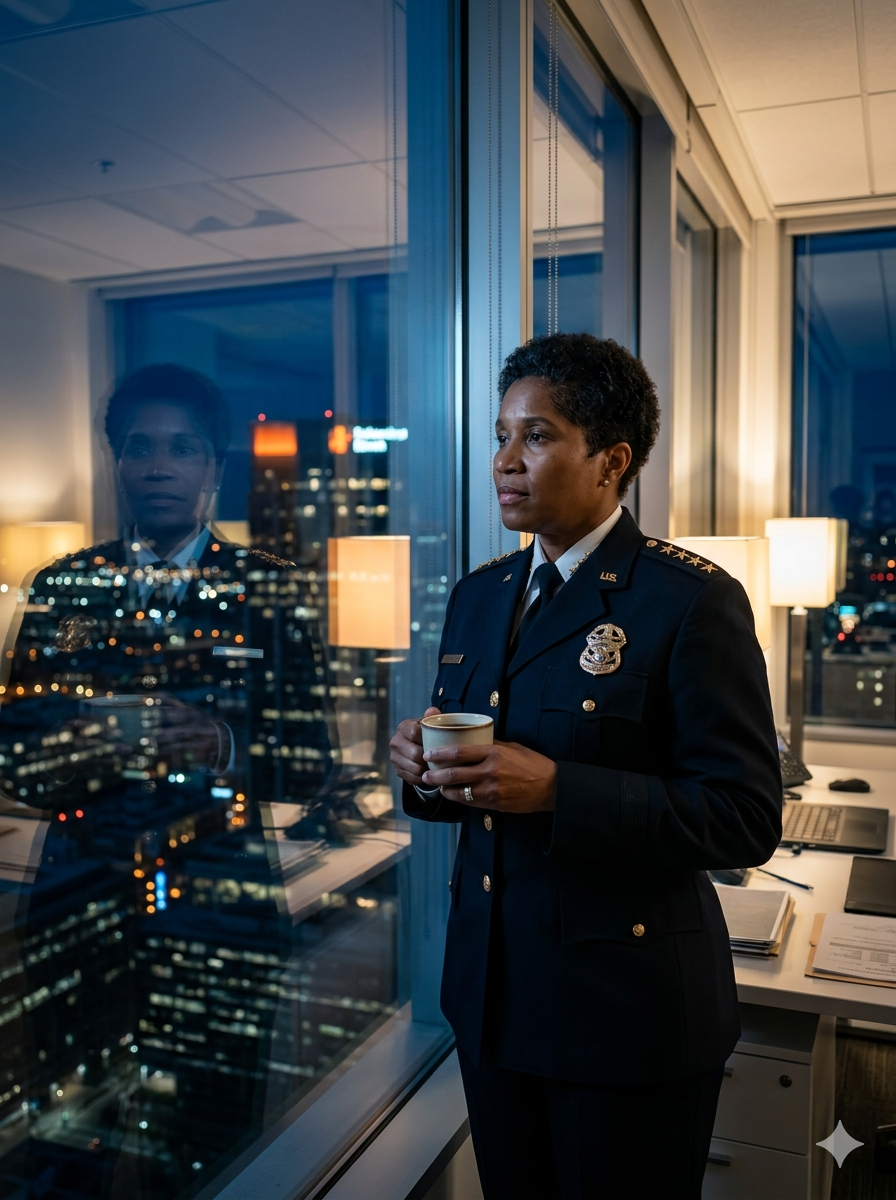
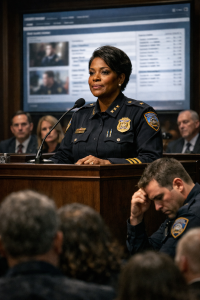
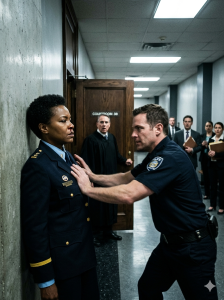
He shoved me into a courthouse wall before he even learned my name.
He called me “trash” outside a judge’s chambers as if I weren’t human.
And the instant he discovered I was the city’s new police chief, the entire hallway fell so quiet it felt like justice itself had stopped breathing.
I can still hear the sound of my head striking the concrete.
Not because it was loud, though it was. Not because it hurt, though it did. I remember it because of what came just before — the certainty in his grip. The certainty of a man who believed he could seize a Black woman by the throat inside a courthouse, slam her into a wall, and walk away without consequence.
That certainty wasn’t born from anger alone.
It came from habit.
In the week leading up to my official swearing-in, I had been moving through the building quietly, observing, listening, taking notes. I didn’t want the rehearsed version of the department. I didn’t want polished briefings, measured smiles, or staged professionalism. I wanted the truth. I wanted to see how officers behaved when they thought no one important was watching. How they addressed defendants. How they spoke to court staff. How quickly their tone hardened when they believed power belonged only to them.
That Friday afternoon, on the third-floor corridor of the municipal justice center, I got my answer.
I stood near a water fountain, notepad in hand, when Officer Derek Harrison turned the corner escorting a defendant. Broad-shouldered. Quick stride. The posture of someone used to people stepping aside before he had to ask twice. He glanced at me once and immediately decided I was in his way.
“Move,” he said.
No excuse me. No ma’am. Not even a warning softened by politeness.
Just one blunt word, thrown at me as if I were furniture.
When I didn’t move quickly enough for him, I saw the shift in his face — that split second when irritation turns into aggression. I began to introduce myself. Calmly. Professionally. I told him I was Chief Clare Bryant. I told him I would be taking command on Monday.
He laughed.
That laugh told me more about the department than any report ever could.
Because it wasn’t disbelief. It was contempt.
The kind of contempt that says a Black woman can call herself “Chief” all she wants, but in his mind she will never look like authority. Never sound like leadership. Never belong in command.
Then he put his hands on me.
Hard.
Fast.
Intentional.
He yanked my arm behind my back and drove me into the wall so violently my notes hit the floor before I did. For one brutal second, all I felt was pressure — his forearm across my collarbone, the cinder block against my cheek, the sickening force of someone trying not just to control me, but to diminish me. To teach me a lesson. To remind me where he believed I belonged.
What still chills me is that he wasn’t panicking.
He was at ease.
At ease using force. At ease humiliating me. At ease speaking to me as if I were disposable. Comfortable enough to say the ugliest things with the confidence of someone who had said them before and faced no real consequences.
That’s what stayed with me.
Not just one violent officer.
An entire culture that had made him fearless.
Then came the moment everything broke open.
A courtroom door swung wide. A judge stepped out. And within seconds, the air shifted. The officer who had just handled me like that suddenly looked like a man waking from a nightmare.
Because now someone important had seen it.
And when Judge Ellis spoke my name — my full name, my title, my role — I watched the color drain from Harrison’s face so completely it was almost unreal. There are moments in life when a person realizes not just that they were wrong, but that they chose the wrong target.
This was one of those moments.
But here’s what stayed with me the longest:
He kept saying he didn’t know who I was.
As if that were the tragedy.
As if the problem wasn’t the violence, the racism, the contempt, the years of instinct that made him think he could treat a Black woman that way — but simply that this time, the woman he shoved turned out to be his superior.
And that’s when I knew this would never be about one officer.
Because if he had known my title and treated me with respect, it still wouldn’t fix what was underneath. The real sickness was this: he believed dignity was earned through rank. That humanity depended on status. That the right name, the right office, the right badge could buy the respect he denied to women like me every other day.
I wasn’t angry because he didn’t know who I was.
I was angry because he didn’t need to know.
Any woman. Any citizen. Any mother walking her child through that courthouse. Any defendant waiting outside a hearing room. Any clerk, any witness, anyone without a title should have been safe from his hands.
That was the real story.
And once I started pulling that thread, the entire department began to unravel.
Because what happened in that hallway wasn’t an accident. It was a symptom. A glimpse. A crack in the wall that let the truth start pouring through. Buried complaints. Missing reports. “Lost” evidence. People pressured into silence. Victims who had spent years believing no one would ever listen.
He thought he had humiliated one Black woman.
What he actually did was expose an entire system.
I left that courthouse bruised, furious, and more certain than ever that Monday would not mark a ceremony. It would mark a reckoning.
And when the first piece of evidence surfaced — the one thing they thought they had buried, the recording that would force the entire city to see what had been hiding in the dark — even the officers who had protected him began to realize the old rules were collapsing.
What they didn’t realize yet… was how many names were buried beneath his.
And how many people were finally ready to speak.
The first thing Chief Clare Bryant registered was the sound.
Not the insult.
Not the impact.
The sound.
The third-floor hallway outside Judge Ellis’s chambers carried its own courthouse rhythm: shoes tapping across tile, a bailiff’s low murmur, the metallic cough of an elevator opening somewhere past the security doors, the faint electric buzz of fluorescent lights washing every face a shade paler. It was 2:44 on a Friday afternoon, and the building moved with the tired machinery of processed lives—public defenders rushing with files clutched to their ribs, clerks calling names, families waiting with rigid backs.
Then Officer Derek Harrison’s hand clamped around her throat, and all of it vanished.
What remained was the crack of the back of her head striking painted cinder block.
It was a flat, brutal sound, like something important dropped onto concrete.
For a moment she saw white. Then his face filled her vision—broad, flushed, already certain—and she felt the hot rush of blood spilling from her nose over her mouth and chin, dripping onto the collar of her blouse.
“Get away from my courtroom,” he snarled. “You hear me?”
Clare’s fingers closed around his wrist, not clawing, not frantic—measuring pressure and angle through the fog of pain. She had learned long ago that in violent moments the body wanted one thing and the mind required another. The body wanted air. The mind wanted record.
His thumb pressed under her jaw. The grip was wrong for restraint and perfect for intimidation. He used force the way some men used grammar.
She forced herself to take what breath she could.
“Officer,” she said, the word thin and strained beneath his grip, “I’m Chief Bryant.”
He let out a short, cold laugh.
“Chief,” he said. “Sure.”
He shoved harder, pinning her against the wall. Her shoulder blade scraped concrete. Her notepad slipped from her hand and slapped the floor, pages spreading across the tile like a white bird struck midflight.
The man Harrison had been escorting—thin, cuffed, barely twenty, eyes wide with the learned fear of someone who already knew how this usually ended—looked away.
That detail cut deeper than the pain.
Even the innocent knew when not to look.
“Listen to yourself,” Harrison said. “You people always got a title. Always got a story. Always think if you say the right thing, the rules don’t apply.”
Footsteps gathered behind him now. A sharp intake of breath. The air shifted with attention.
Then a door flew open.
“Harrison!”
Judge Raymond Ellis’s voice split the hallway like a breaking branch.
It changed everything and nothing. Harrison didn’t release her right away; he tightened first, instinctively, as if he could still force control back into the moment. Then he turned.
Judge Ellis stood in the doorway, silver-haired, tall despite age, his face drained into a cold, controlled fury.
“My God,” the judge said. “Release her.”
The grip disappeared from her throat.
Clare steadied herself with one hand against the wall. She didn’t cough, though her lungs demanded it. She didn’t bend. Blood dripped steadily from her nose, bright drops striking tile. She wiped once with the back of her hand and regarded the red with detached precision.
A circle had formed—bailiffs, assistant district attorneys, a court reporter, another officer down the hall frozen mid-step.
And near the elevator, a young clerk held a phone at chest height, recording.
Good, Clare thought.
Judge Ellis crossed to her in four brisk steps that cost him more effort than he allowed to show.
“Chief Bryant,” he said quietly, but the title carried through the corridor like a ruling. “Are you injured?”
“I’ll live,” she replied.
Her voice sounded steadier than she felt.
The judge turned to Harrison.
It was remarkable how quickly color could leave a man.
Harrison’s face drained from blotched red to a thin gray. He looked from Ellis to Clare and back again, and she saw the exact instant understanding split open inside him.
Judge Ellis let the silence stretch.
“Officer Harrison,” he said evenly, “allow me to make a proper introduction.”
No one moved.
“This,” Ellis continued, “is Chief Clare Bryant. Appointed by the city council three months ago. Formerly of the FBI Civil Rights Division. She assumes formal command of this department on Monday morning.”
The silence widened.
Then the judge added, “Which means she is your chief.”
Harrison stared at Clare as if her face itself had deceived him.
“I didn’t—” he began.
“No,” Clare said softly.
Blood still fell from her nose, spotting her blouse, the floor, the toe of her shoe.
“You didn’t know who I was,” she said. “That’s obvious.”
She bent, retrieved her notepad, and tucked a loose page back into place.
Then she met his eyes fully.
There is a kind of calm that arrives only after anger finds its shape. She had felt it before—in interrogation rooms, in review boards, once in a church basement in Ohio while a deputy lied about a teenager’s broken wrist and his mother cried so quietly the room seemed ashamed.
This was that calm.
“But that shouldn’t matter,” she said. “Should it?”
Harrison’s mouth opened. Nothing came.
“You didn’t need to know my title,” Clare said. “You only needed enough discipline to treat a stranger like a human being.”
Every officer within earshot had gone perfectly still.
The courthouse itself seemed to listen.
“Officer Harrison,” Clare said, “you will report to Internal Affairs at eight a.m. tomorrow morning. Lieutenant Amanda Foster will take your statement. You will provide a complete account of this incident. You will not contact witnesses. You will not attempt to alter any report, footage, or record connected to what happened here.”
He swallowed hard. “Yes, ma’am.”
She held his gaze one beat longer.
“And officer?”
He flinched.
“Don’t leave town.”
She turned away. There was nothing more to say in a hallway full of witnesses.
Judge Ellis stepped aside, his expression heavy with the end of plausible deniability. He had seen too much in his years on the bench not to recognize what it meant when truth finally stood in the open.
As Clare walked toward the elevators, the young clerk lowered his phone only after she passed. His hands trembled.
She didn’t yet know his name.
She would.
Behind her, under the fluorescent hum, Derek Harrison stood among his peers with blood on his cuff and the first cracks of ruin forming beneath his skin.
Three months earlier, the city council had met behind closed doors, blinds drawn, the mayor’s legal pad turned face down to keep notes from wandering into photographs.
They avoided the word crisis. They preferred “transition issue,” “public confidence concern,” “need for outside evaluation.”
But the numbers told their own story.
Four point eight million dollars in misconduct settlements over five years. Complaints rising. Sustained findings dropping. Entire neighborhoods refusing to call 911 unless someone was already bleeding. Federal scrutiny circling. A local paper beginning to say systemic failure without hesitation.
And beneath it all, a harder truth: the department no longer believed it answered to the city it served.
That was when Clare Bryant’s name surfaced.
Some recognized it immediately. Others pretended not to. Fifteen years in federal civil rights enforcement had made her known in precisely the circles that preferred anonymity. She had dismantled a sheriff’s office in rural Georgia where Black drivers were stopped so often one road earned the nickname “the tax line.” She had exposed a vice ring in Ohio where officers skimmed profits from illegal operations they publicly condemned. She was methodical, relentless, immune to flattery once evidence was in hand.
The mayor disliked how necessary she was.
Community groups had been asking for her for weeks.
Clare accepted the role with three conditions: full authority over Internal Affairs, independent access to departmental records, and one week before her swearing-in to observe without ceremony, escort, or staging.
She wanted seams, not polish.
So she rented a furnished apartment, reviewed disciplinary files remotely, and spent five days moving quietly through the courthouse, patrol units, holding cells, dispatch rooms, and waiting areas where people learned what kind of city they lived in by how they were treated.
By Friday afternoon, before Harrison ever touched her, she had already filled fourteen pages with notes.
Nothing dramatic. Nothing easy.
A patrol officer brushing off a mother asking why her son’s backpack had been searched.
A desk sergeant calling a Spanish-speaking complainant “sweetheart” instead of finding translation.
A bailiff using his body as a barrier until a public defender apologized for brushing past him.
Small things—if one refused to count erosion as damage.
Clare had spent too long studying broken trust not to recognize its structure.
Power rarely began with open cruelty. It began with casual contempt that no longer heard itself.
So when Harrison turned the corner that afternoon and saw her standing by the water fountain with a legal pad, she noticed the warning before the violence—the set of his jaw, the expectation that she would move simply because he occupied the space more fully in his own mind.
“Move,” he said.
Not a request. Not even rude enough to stand out.
She looked up. “I’m not in your way.”
His hand landed on her shoulder faster than reason allowed. Not yet an assault. A correction. Fingers tightening just enough to establish rank in his mind.
“I said move.”
The cuffed defendant glanced between them, then lowered his eyes, folding inward against the risk of being seen.
Clare noted it automatically.
Witness unwilling to witness.
Then she said, “Officer, I’m Chief Bryant. I’ll be assuming command Monday.”
And everything unfolded as systems like this always did when confidence met impunity.
Later, in her temporary apartment with ice pressed to her collarbone and dried blood stiff on her sleeve, the pain settled into meaning.
Not because Harrison had attacked a chief.
Because he hadn’t known she was one.
Because nothing in his instincts interrupted contempt when faced with a Black woman who didn’t immediately shrink.
That distinction mattered. It would become everything.
She documented the incident before showering. Time. Angles. The judge’s words. The number of witnesses. The clerk with the phone. Harrison’s exact phrase: You people always think you can talk your way out of everything.
At 9:17 p.m., her phone rang. Unknown number.
When she answered, a woman said, without introduction, “If you’re serious, meet me where cops don’t go unless their marriage is dying.”
“Who is this?”
“Lieutenant Amanda Foster. Internal Affairs.”
A pause.
“You’ll know the place when you see more books than windows.”
The café sat beside a used bookstore, in a neighborhood not yet fully claimed by gentrification. Amanda Foster waited in the back, dressed in civilian clothes, wearing the look of someone long accustomed to disappointment.
Forty-one. Brown-skinned. Composed. A scar on one forearm. Eyes that knew how to stay still while others lied.
She slid a folder across the table.
Inside: summaries. Timelines. Complaint numbers. Enough detail to make denial absurd.
“How many?” Clare asked.
Amanda stared into her coffee. “Forty-seven I can prove. More if I stop being careful.”
Page after page—same names, same language, same missing evidence, same quiet closures that seemed routine until they were stacked together.
“Harrison’s in twenty-three,” Amanda said. “Captain Gerald Winters signs off on most. Detective James Sullivan handles witness pressure dressed up as outreach. The rest shifts depending on the day.”
“Why keep this?”
Amanda gave a short, humorless laugh. “Because every time they told me to bury something, I needed to know at least one version of me didn’t agree.”
She rolled up her sleeve, showing a scar.
“Two years ago, someone slashed my tires and left a note telling me to mind my business. I filed a report. Sullivan investigated it.”
Clare met her eyes.
Amanda’s expression barely moved. “Exactly.”
Some alliances aren’t built on trust but recognition. Clare knew that look—the look of someone who stayed because leaving would make silence permanent.
“Lieutenant,” Clare said, “if I open this, there’s no halfway.”
“I know.”
“They’ll come for your job. Your name. Maybe your family.”
“I know.”
“And if the evidence isn’t overwhelming, they’ll survive it and punish everyone who spoke.”
“I know that too.”
Clare closed the folder.
“Good,” she said. “Then Monday, I want full access. Tuesday, you’re running Internal Affairs.”
Amanda blinked. “You can’t—”
“I can.”
“The union will explode.”
“Then we’ll find out where it hides the pieces.”
For the first time, Amanda smiled. Tired, but real.
“Alright,” she said. “Let’s see how much daylight this place can handle.”
That same night, at the Fraternal Order of Police lodge, Derek Harrison sat beneath a framed flag, trying not to show the cracks forming inside him.
Around him: Captain Gerald Winters, heavy and controlled; Detective James Sullivan, soft-spoken and patient; Maxwell Bennett, union counsel, polished and precise, the kind of man who called brutality cases “messaging problems.”
Others listened without speaking.
“What matters,” Bennett said, pacing, “is controlling sequence.”
Harrison stared at the table.
“Right now, the sequence is: officer uses force on unknown woman, woman turns out to be incoming chief, officer looks reckless and biased. That sequence ends careers—unless we interrupt it.”
“How?” Winters asked.
“We introduce doubt. Restricted area. Security concern. Failure to identify. Stress. Split-second decisions. We reframe Bryant as an outsider seeking confrontation. We slow everything through grievance. And we find out if there’s video.”
Harrison looked up. “There’s a clerk. By the elevators. He was recording.”
Bennett wrote it down. “Name?”
“I don’t know.”
“Sullivan will.”
Harrison swallowed. “What if she already knows about my file?”
Winters cut in. “Your file says what we say it says.”
The room accepted that easily.
But Harrison felt something shifting beneath it.
Twelve years on the force. Strong evaluations. Commendations. He had always been “hard, but effective.” Useful.
Now, for the first time, he wondered if usefulness would be enough.
“What if she goes after all of us?” a younger officer asked.
Bennett smiled faintly. “Then we show her how much resistance a department can generate before city hall loses its nerve.”
Heads nodded. Delay. Obscure. Exhaust. Wait out the reformer. It had worked before.
What none of them understood was that Clare Bryant had not come to be accepted.
And she did not mistake exhaustion for defeat.
At 6:45 Monday morning, before the building had fully come alive, she stepped into headquarters and stood in the lobby for a full minute, doing nothing except breathing in what the place smelled like.
Old coffee. Copier toner. Floor wax. Heat trapped too long in concrete. The faint metallic trace of gun oil clinging to officers coming in from the lot.
Every institution had a smell. It told you how long neglect had been allowed to settle into permanence.
Her office upstairs had been cleared exactly as instructed. The previous chief’s plaques and family photos were gone. Beige walls, bare and indifferent. A desk too large and too polished, trying to suggest continuity where none would exist.
She sat, opened her notebook, and wrote five names.
Harrison.
Winters.
Sullivan.
Bennett.
Foster.
Then she added a sixth: Daniel Cooper.
At 6:52, she sent three requests.
Complete personnel files for all sworn officers. All use-of-force reports for the past three years. Every pending and closed Internal Affairs investigation for the past five.
At 7:31, Captain Gerald Winters appeared in her doorway, his expression carefully arranged into respectful resistance.
“Chief Bryant.”
“Captain.”
He stayed standing. That, too, was deliberate.
“Your records request is extensive. Some of those files may take time to locate. The previous administration had certain—”
“Disorderly filing habits,” Clare said. “I noticed.”
He shifted slightly. “There are also contractual privacy concerns.”
“I read the contract this weekend.”
That slowed him.
Clare set her pen down and finally met his eyes.
“You’ll have the files on my desk by five.”
“Chief, with respect—”
“No,” she said. “Not with respect. If you respected this office, you wouldn’t be here negotiating my first lawful request.”
A flicker of irritation crossed his face.
“There are procedures—”
“Yes,” she said, opening a folder. “There are. There are also three complaint closures from the past two years bearing your signature despite recommendations for further investigation. Training contracts approved under your oversight while you accepted speaking fees from the same firm. There are already enough questions about your conduct, Captain. I wouldn’t suggest adding insubordination.”
For the first time, he went quiet in a way that wasn’t strategic.
Those weren’t the words he expected on day one.
When he left, the door closed more gently than it had opened.
At nine, she stood before the Third Precinct day shift in a room too small for the number of officers inside it.
Forty-five people, shoulder to shoulder. Arms crossed. Faces set. Some openly hostile, others disciplined into neutrality. Harrison sat in the back, a faint bruise still visible along one knuckle where her tooth had cut him. He hadn’t hidden it.
Good, she thought.
Let him carry something forward.
“I’m Clare Bryant,” she said. “I’m not here to make friends. I’m here because this department has confused solidarity with immunity, and that confusion is poisoning everything.”
No one spoke.
She didn’t raise her voice.
“When communities stop trusting police, they stop telling us what they know. They stop calling when they need help. They teach their children to survive us instead of seek us. That makes every honest officer here less effective—and more at risk.”
A few faces shifted at the word honest.
She let them.
“On Friday, Officer Derek Harrison assaulted me in a courthouse. That will proceed through formal channels. It is not the only issue that will.”
She moved once, just enough to change the room’s focus.
“I’ve reviewed three months of files and one week of operations. What I found is not courage. Not difficult policing. It is contempt. And a complaint system that functions less like oversight and more like disposal.”
Still, no one interrupted.
“Starting today,” she continued, “every use of force will be fully documented and reviewed. Every complaint will be investigated. Body camera failures will be treated as incidents, not routine excuses. If that feels restrictive, ask yourself why accountability feels like a limitation.”
When she finished, the silence remained—tight, controlled.
One officer, Jennifer Taylor, lingered as the room cleared.
“Chief,” she said quietly, eyes avoiding the others, “some of us have been waiting for this.”
Clare nodded once.
“Then stop waiting,” she said. “Start helping.”
That afternoon, Amanda Foster arrived with a storage key and a slip of paper listing a unit rented under her sister’s name.
The archive existed.
So did its scale.
Boxes stacked three high in dim, controlled air. Complaints copied before disappearance. Logs duplicated before alteration. Notes, photos, emails, witness statements.
By noon Tuesday, with help cataloging, Clare understood the depth of it.
Elena Rodriguez. Shoulder dislocated after a traffic stop despite passing a sobriety test. Complaint withdrawn after a visit.
Marcus Johnson. Collarbone broken during a stop based on a vague description. Eighteen months lost before footage cleared him.
Sarah Williams. Arrested trying to pull her son away during a noise complaint. Child now wakes at sirens.
The cases built on each other until paper felt insufficient for what it held.
Each followed the same pattern.
Aggressive contact. Standardized report language. Complaint filed. Managed investigation. Evidence failure. Closure.
By Wednesday, forty-seven cases mapped cleanly.
By Thursday, it was clear that number was only the beginning.
Then came the file buried inside the department’s server. Hidden under maintenance labels.
Two hundred seventeen entries.
Not suspects. Not warrants.
People.
Problem people.
Known complainant. Use caution.
Mother vocal. Monitor.
Associates with agitators.
Difficult. Document everything.
Names matched the cases.
Listed before the encounters.
Amanda stared at the screen. “This isn’t protection.”
“No,” Clare said. “It’s selection.”
Not reaction—anticipation.
That shifted everything.
From misconduct to design.
Following the money completed the picture.
Legal defense contracts. Training programs. Overlapping financial ties. Complaints feeding lawsuits feeding profit feeding protection.
Crude, but effective.
Clare compiled it into a report—structured, precise, undeniable.
Seventy-seven cases.
Two hundred seventeen flagged civilians.
Evidence manipulation.
Witness pressure.
Financial conflict.
Patterned language.
A system that had normalized abuse into routine.
Enough for federal oversight.
Not yet enough for public rupture.
For that, she needed the video.
It came three weeks later.
Daniel Cooper broke.
The texts had started first.
Saw you filming.
Delete it.
Last warning.
Then the break-in. Nothing taken. Just moved. Disturbed. A message without words.
He reported it. Nothing came of it.
That night, he uploaded the footage everywhere. Backups, copies, media outlets.
His caption was simple:
This is Chief Clare Bryant being assaulted in the courthouse where I work. She identified herself. He did it anyway. If he would do this to the incoming chief in public, imagine what he does to people without her power.
By morning, the city couldn’t look away.
Frame by frame, people watched.
And understood.
Elena Rodriguez agreed to speak.
“He did the same thing to me,” she said. “Only nobody important saw it.”
Marcus resisted. Then agreed.
“Do it for the next nineteen-year-old,” Amanda told him.
That reached him.
The city split.
Crowds gathered. Voices rose. Defenses hardened.
The mayor called for a public hearing.
Open. Recorded.
No more quiet resolutions.
For two weeks, Clare prepared.
Long days. Endless meetings. Witness coordination. Evidence review. Protection for Daniel. New information arriving from inside the department itself.
At night, she read transcripts until the words blurred.
Amanda brought food one evening.
“You can’t carry everyone,” she said.
Clare looked up. “No. But I can make sure they’re not alone this time.”
Amanda studied her. “Do you ever get tired of being this certain?”
Clare allowed a faint smile. “All the time.”
“Then why keep going?”
Clare thought of the cases.
“Because uncertainty never protected anyone who needed it,” she said.
The hearing began on a Friday morning.
The room overflowed. Media, citizens, officers. The city watching itself.
Judge Margaret Price presided.
Clare sat with counsel. Across from her—Harrison, Winters, Sullivan, Bennett.
Bennett spoke first. Controlled, persuasive. Framing the incident as stress, confusion, misjudgment.
Morales followed.
“This is not a single mistake,” he said. “It is a system revealed.”
Witnesses testified.
Daniel. The threats. The video.
Elena. The injury. The pressure.
Marcus. The lost time.
Sarah. The fear carried home.
Amanda. The numbers. The patterns.
Then the evidence technician. The records. The proof.
Piece by piece, the structure became visible.
Emails. Payments. Language. Patterns.
By evening, Harrison took the stand.
He spoke of confusion. Of procedure. Of fear.
The audio contradicted him.
Then the training materials surfaced.
Language taught. Narratives shaped.
And finally, the database.
Names projected.
Labels attached.
Lives prewritten.
“Officer Harrison,” Morales asked, “did you contribute to this?”
“It was for safety,” he said.
“From what?”
No answer.
He still didn’t understand—not the meaning, only the consequence.
That had defined him.
By closing arguments, the room felt heavy with something beyond anger.
Bennett stood one last time.
“Harrison made mistakes,” he said. “But do not sacrifice one officer to cleanse an entire city’s conscience.”
Morales answered with less polish and far more truth.
“No one here is asking this city to feel clean,” he said. “We’re asking it to stop calling dirt by softer names.”
Judge Price adjourned just after midnight, promising findings in the morning.
The crowd rose in a surge of noise, then thinned slowly.
Elena, Marcus, and Sarah stayed seated a while, as if leaving too soon might undo something fragile.
Amanda stepped beside Clare.
“That was brutal,” she said.
“That was necessary.”
Amanda glanced at the screen, still lit with the frozen image of the database.
“Do you think it’s enough?”
Clare looked across the room—scattered papers, half-empty cups, the spaces where people had sat all day because there was finally no polite excuse left not to see.
“It has to be.”
Judge Price returned at nine with written findings in a leather folder and the face of someone who had slept only as much as required.
The chamber felt smaller. Tighter.
She went straight to it.
First, Derek Harrison had violated policy and law: excessive force, false reporting, clear awareness of wrongdoing.
Second, the evidence showed systemic misconduct beyond one officer—buried complaints, patterned language, tampering, intimidation, tracking of complainants.
Third, supervision had not failed by accident. It had functioned that way. Captain Winters had enabled and benefited. Detective Sullivan had suppressed rather than investigated.
Then came the recommendations.
Termination of Harrison. Immediate.
Criminal referral.
Proceedings against Winters. Sanctions for Sullivan.
Federal oversight.
Independent Internal Affairs.
Public reporting of force incidents.
An early-warning system.
Civilian review with real authority.
Her voice stayed level. It didn’t need force.
Then she looked at Harrison.
“Officer Harrison,” she said, “you didn’t just assault Chief Bryant. You demonstrated the belief that a badge places you above restraint, above correction, above the equal dignity of the public.”
No one moved.
“And because it happened in the open, your actions became evidence too large to hide.”
When she turned to Clare, her tone softened only slightly.
“Chief Bryant, culture doesn’t change because of one hearing. It changes when silence becomes too costly to maintain.”
Clare nodded once. “I know.”
The room broke as soon as the judge stood.
Applause. Shouts. Cameras rushing out. Union voices rising. Someone crying openly.
Harrison stayed seated.
For a moment, he didn’t look dangerous or defiant. Just empty—like the version of himself he relied on had vanished.
Then he stood and approached Clare.
Security shifted. Amanda tensed. Clare raised a hand. They held.
He stopped a few feet away.
“This isn’t over,” he said quietly.
“No,” Clare replied. “It isn’t.”
A flicker crossed his face—hope, maybe.
Then she added, “It’s just not happening in the dark anymore.”
That landed harder than anger.
He looked away first.
Security escorted him out.
Outside, microphones crowded the air.
Elena spoke briefly. Marcus even less. Sarah said nothing.
By afternoon, the union condemned the process. By evening, the city divided itself along familiar lines—but now with evidence too visible to ignore.
On Monday, Clare stood before her command staff and began the work that mattered.
Not victory.
Consequence.
A third of the room had already changed—transfers, retirements, quiet exits. Those who remained watched her with a mix of resistance and relief.
“I’m not asking if this was comfortable,” she said. “It wasn’t. Accountability rarely feels fair to people who’ve mistaken comfort for it.”
Silence.
“From here on, every use of force is reviewed. Every complaint is investigated. Camera failures are incidents. Patterns will be identified early.”
Officer Jennifer Taylor raised a hand.
“How do we rebuild trust if they already hate us?”
Clare met her eyes.
“You don’t ask for trust. You act in ways that make distrust harder to justify.”
It wasn’t a comforting answer. Good.
In the weeks that followed, the department shifted.
Oversight arrived. Policies changed. Cameras became routine. Internal Affairs became real.
Complaints rose—proof that people believed reporting might matter.
Use of force declined—not because people changed, but because incentives did.
Some officers left.
Some adapted.
Some resisted and documented themselves doing it.
Elena began speaking publicly.
Marcus joined oversight.
Sarah’s son slowly stopped flinching at sirens.
Daniel moved on and learned that doing the right thing costs more than it pays.
Amanda built something functional out of what had been hollow.
Winters resigned.
Sullivan disappeared into paperwork.
History did not forget.
Six months later, Harrison stood trial.
The evidence held.
The pattern held.
The verdict came after seven hours. Guilty.
The sentence divided opinion. Clare made a short statement and returned to work.
Because systems don’t dismantle themselves out of embarrassment.
That winter, a new recruit paused outside her office.
“I joined because I saw what you did,” the young woman said.
Clare studied her.
“Remember this,” she said. “The badge isn’t permission. It’s restraint. The moment it feels like permission, you’re already a risk.”
The recruit nodded.
After she left, Clare sat alone for a moment.
Because the truth was, none of this had been done by one person.
It had taken many.
Amanda saving evidence.
Daniel refusing silence.
Elena speaking.
Marcus returning.
Sarah standing up.
Someone, somewhere, refusing to destroy proof.
A city finally recognizing itself.
Late one night, Amanda brought coffee.
“You think it sticks?” she asked.
Clare looked out over the city.
“That depends on whether people think reform is an event or a habit.”
Amanda smirked. “That’s very official.”
“It’s very tired,” Clare said.
They sat quietly.
Then Amanda mentioned a message—a woman in another state filing a complaint because of what she’d seen here.
“One at a time,” Clare said.
“That’s slow.”
“It’s the only pace institutions understand.”
Below them, recruits trained. Repetition. Restraint.
Clare watched for a moment.
The work ahead would stay long. Always.
There would be backlash. Adaptation. New disguises for old behavior.
But also—
one fewer hallway where harm could pass unnoticed.
one more officer learning restraint early.
one more child who might not fear a uniform.
one more witness willing to hold onto evidence.
Justice wasn’t the moment people reacted.
It was what came after—what they chose to do with what they had seen.
She finished her coffee and stood.
The city stretched below, uneven and alive. Distrust still present, and rightly earned. Change would take longer.
Still, she allowed herself one thing.
Not easy hope.
The difficult kind.
The kind built from proof, from people, from persistence.
She picked up her coat, switched off the light, and walked into the hallway.
Tomorrow would bring more complaints. More resistance. More work that no one celebrated.
Tomorrow would bring the real job.
And somewhere behind her, in a place that had once depended on darkness, the lights stayed on.
