


My fingers stayed inside my purse.
They found the hard plastic edge of my press credential, but I didn’t pull it out.
Not yet.
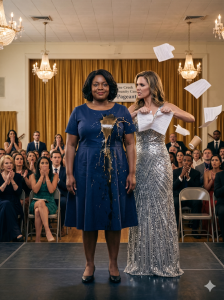
Coffee was still dripping down the front of the blue dress I had sewn myself on my kitchen table.
The shredded pieces of my application were still scattered around my shoes.
And the woman who had done it was still smiling under the lights like public humiliation was part of the entertainment.
That smile told me to wait.
Cruel people destroy themselves best when nobody interrupts them.
The room was so bright it almost hurt.
The Brookfield Community Hall was one of those places that tried very hard to feel important—gold curtain backdrop, folding chairs dressed up with satin bows, cheap chandeliers reflecting off a waxed floor, and a stage built for little girls with big dreams and adults with even bigger egos.
I was standing in the middle of it, fifty pounds heavier than the women on the posters, forty-two years old, and wearing a dress made out of navy fabric I had bought on clearance.
The chairwoman, Vanessa Kline, was everything the event worshiped.
Thin.
Polished.
Perfect blowout.
Diamond earrings that caught the stage light.
The kind of woman who spoke as if every room belonged to her before she even walked in.
And according to most people in Brookfield, it did.
She chaired the pageant board.
She chaired two charity luncheons.
She sat on the arts council.
She had mastered that small-town talent for smiling while crushing people flat.
I had known what she was the minute I met her three weeks earlier.
What she didn’t know was what I was.
To her, I was just Rebecca Hale.
Single mom.
Homemade dress.
“Backup contestant.”
A filler face for the “Mothers of Grace” segment of the pageant, where local women were paraded out as symbols of “community beauty” before the real prizes were handed to the donors’ daughters.
To the women backstage, I was harmless.
To Vanessa, I was embarrassing.
To The New York Times, I was the chief critic assigned to write a deep investigative column on the rot behind America’s “wholesome” local pageants.
Brookfield was supposed to be one stop in a larger piece.
Vanessa made sure it became the centerpiece.
When she threw the coffee, the room gasped.
When she tore up my application, a teenager near the aisle actually whispered, “No way.”
Then Vanessa lifted her chin and said, “We are trying to present excellence tonight, not desperation.”
That line landed harder than the coffee.
Because it wasn’t just about me.
It was about every woman who couldn’t afford a stylist.
Every body type people mocked while pretending to celebrate “confidence.”
Every mom who had ever been told she was lovable in private but unacceptable in public.
My daughter, Ellie, was standing near the curtain with her volunteer badge clipped to her blouse.
She had begged me to enter.
Not because she cared about a crown.
Because after years of watching me hide in family photos, step out of group pictures, and joke about “not being pageant material,” she wanted me to stand under lights one time and not apologize for existing.
That was the part Vanessa never understood.
She thought she was humiliating a contestant.
She was humiliating a mother in front of her child.
And people don’t forget that.
Ellie took one step toward me.
I gave her the smallest shake of my head.
Not because I was ashamed.
Because I was working.
Vanessa kept talking.
“That dress looks like curtains,” she said, loud enough for the judges’ table to hear.
A man in a tuxedo coughed to hide a laugh.
One of the assistant coordinators stared at the floor.
Someone else lifted a phone higher.
Good, I thought.
Let them film.
I bent down and picked up the torn pieces of my entry form one by one.
My hands were steady.
That shook Vanessa more than tears would have.
She wanted a scene.
She wanted pleading.
She wanted me grateful for scraps.
Instead, I was calm.
“Do you understand me?” she snapped.
“Oh, perfectly,” I said.
Her expression sharpened.
People like Vanessa hate calm when they are trying to create chaos.
She stepped closer, lowering her voice just enough to sound intimate, but not enough to escape the microphones clipped around the stage.
“You should’ve stayed in the audience,” she said. “Women like you make this whole thing look cheap.”
There it was.
Clear.
Ugly.
Useful.
I looked at her and asked the only question that mattered.
“Women like me?”
She crossed her arms.
“Ordinary. Unrefined. Unmarketable.”
There were a few soft, horrified sounds from the crowd.
Not enough.
Not yet.
Still, I had what I needed.
Weeks before that night, I had already gathered plenty.
Former contestants had sent me screenshots of messages from organizers promising higher scores to girls whose parents bought full-page ads in the pageant booklet.
A former treasurer had quietly shared copies of reimbursement requests—hotel stays, spa services, designer purchases—all charged to the pageant’s nonprofit scholarship fund.
One mother sent audio of a judge saying, “The big girls can enter if they want, but nobody wants them in the winner photos.”
I had public records.
I had tax filings.
I had donor lists.
I had interviews.
What I didn’t have until that moment was the cleanest, ugliest proof of the culture behind it all.
Public humiliation.
Open discrimination.
Witnesses.
Phones.
No plausible deniability.
Vanessa turned to the security volunteer and pointed at me.
“Remove her.”
The volunteer, a retired teacher in a navy blazer, looked sick.
“For what reason?” she asked.
Vanessa didn’t even hesitate.
“Because I said so.”
And there it was again.
Authority with no rule.
Power with no restraint.
Exactly the kind of thing that falls apart the second sunlight hits it.
I finally reached into my purse and pulled out the credential.
Not dramatically.
Not with a speech.
Just a small rectangular badge in a clear holder.
I held it between two fingers.
Vanessa looked at it first with annoyance, then confusion, then something much more interesting.
Fear.
I watched her read the words.
REBECCA HALE CHIEF CRITIC THE NEW YORK RUNTIME
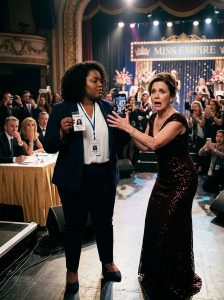
The air changed.
You could feel it.
Like a room before thunder.
One judge stood up too fast and knocked his chair backward.
A woman near the front said, “Oh my God,” and this time she wasn’t whispering.
Ellie pressed a hand over her mouth.
Vanessa’s lips parted, but nothing came out.
Then, because liars always try one lie before they collapse, she laughed.
A dry, ugly little laugh.
“Well,” she said, “that’s certainly theatrical.”
“It’s actually called documentation,” I replied.
I pulled my phone from my purse.
The screen was still recording.
Her voice.
Her words.
The coffee.
The order to remove me.
All of it.
She reached for the phone.
Bad move.
Three people saw it.
One was the retired teacher.
One was a local sponsor whose granddaughter had lost the crown two years in a row after refusing to buy another ad page.
And one was a young woman I had interviewed the week before, who had been quietly standing in the back, waiting to see whether Vanessa would behave differently with witnesses.
Vanessa didn’t.
That was her fatal mistake.
By midnight, I had sent the files to my editor.
By 2:00 a.m., our legal team had cross-checked the public records, matched the donor payments, verified the scholarship discrepancies, and confirmed the names of six former contestants willing to go on record.
At 7:10 the next morning, my column went live.
The headline was simple.
The Pretty Lie: How One Community Pageant Bought Silence, Sold Crowns, and Humiliated Women in Public.
I didn’t need to exaggerate.
Truth was already brutal enough.
The article included Vanessa’s quotes.
It included receipts from the scholarship fund.
It included screenshots of judges discussing which entrants were “camera-friendly” and which ones would “hurt the brand.”
It included testimony from women who had been mocked for their size, age, accent, budget, and social class.
It included a timeline of donor money lining up almost perfectly with final placements.
And it included the photo everyone kept sharing—
Vanessa in sequins.
Me in my coffee-stained handmade dress.
The torn application at my feet.
By noon, the pageant’s sponsors were dropping out one by one.
A regional bridal boutique posted a statement saying it had “no tolerance for discriminatory practices.”
The florist withdrew its donation.
The venue canceled the finals.
The mayor, who had happily posed with Vanessa the year before, suddenly called for “full transparency.”
By three that afternoon, the county prosecutor’s office confirmed a formal review of bribery allegations and nonprofit misuse.
By the end of the week, the state human rights commission had opened a discrimination inquiry.
Vanessa resigned “for personal reasons.”
Nobody believed that.
Two board members followed her out.
The treasurer hired an attorney.
Parents who had stayed quiet for years started talking all at once.
That is another thing bullies never understand.
The first truth is hard.
The second comes easier.
Then they all come.
A former judge admitted finalists had been reordered after private dinners with donors.
A seamstress said contestants from lower-income families were pushed into less flattering time slots and lighting.
A makeup artist described being told to make richer contestants “glow” and poorer ones “look natural,” which in pageant language meant invisible.
The investigation widened.
Bank records were subpoenaed.
Internal emails surfaced.
Vanessa’s name was everywhere.
So was her quote.
Women like you make this whole thing look cheap.
That sentence destroyed her more thoroughly than any insult ever could.
Because it showed the heart of the machine.
Not beauty.
Not community.
Contempt.
Ellie read the article at our kitchen table that night.
The same table where I had sewn the dress.
She sat there in silence for a long time.
Then she looked up at me and asked, “Why didn’t you yell back?”
I thought about it.
Then I told her the truth.
“Because some people mistake noise for power,” I said. “I wanted her own words to bury her.”
Ellie nodded slowly.
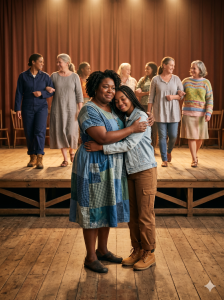
Then she got up, walked around the table, and hugged me so hard I felt all the air leave my chest.
“I’ve never been more proud of you,” she said.
That was the moment I finally let myself shake.
Not on the stage.
Not under the lights.
Not when Vanessa tried to reduce me to a joke.
At home.
In my daughter’s arms.
Where dignity belongs.
The strangest part came later.
After the article spread, I got messages from women everywhere.
A nurse from Ohio.
A grandmother from Georgia.
A divorced mom from Arizona.
A former contestant from Kentucky who said she had starved herself at sixteen because a judge once told her her hips looked “too honest.”
They weren’t just reacting to the scandal.
They were reacting to recognition.
They knew the room.
Maybe not that exact room.
But some version of it.
The place where polished people protect each other and call cruelty “standards.”
That was when I decided the story couldn’t end with Vanessa’s downfall.
Downfall matters.
Justice matters.
Consequences matter.
But repair matters too.
So three months later, with a portion of my speaking fees, donations from readers, and help from women who had reached out after the column, I launched Real Beauty.
Not a pageant.
Never a pageant.
A nonprofit.
No judges.
No crowns.
No sponsor tables.
We fund clothing grants for women who need outfits for interviews, court dates, graduations, and first public speeches.
We provide confidence workshops for women who’ve been told they are too big, too old, too poor, too plain, too loud, too quiet, too much, or not enough.
We pay photographers to take portraits of ordinary women exactly as they are—mothers, cashiers, teachers, caretakers, widows, survivors.
No retouching.
No ranking.
No permission slips from people like Vanessa.
Our first event was held in Brookfield.
In the very same community hall.
Same stage.
Same lights.
Different truth.
Ellie introduced me.
Not as a victim.
Not as a journalist.
As her mother.
Women walked that stage in work boots, church hats, sneakers, uniforms, handmade dresses, thrift-store blazers, and one woman’s old wedding shoes because she said they reminded her she had survived something and still stood upright.
Nobody got scored.
Everybody got seen.
That night, when the hall emptied, I stood alone for a minute in front of the stage.
I looked at the lights.
I remembered the coffee cooling on my skin.
I remembered the torn paper at my feet.
And I smiled.
Not because revenge is sweet.
Because truth is clean.
Because dignity, once claimed, does not beg to be returned.
If you believe beauty belongs only to the rich, defend what Vanessa built.
If you believe dignity belongs to every woman in every body, share this story and stand where it counts.
There is no honorable middle ground.
