


The Janitor They Tried to Discard Actually Owned the Entire School. But His True Secret Lay Hidden Beneath the Fountain.
Chapter 1
“The janitor doesn’t belong near our children.”
The words sliced through the courtyard so loudly that even the kids stopped playing.
Parents turned.
Teachers froze.
And every eye landed on me.
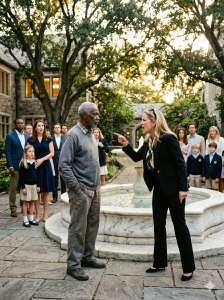
An old Black man in a faded gray sweater. Standing quietly beneath the oak trees.
I had built Oakridge Private Academy twenty-three years ago.
Brick by brick.
Scholarship by scholarship.
Dream by dream.
But Susan Holloway didn’t know that.
To her, I was just another “ghetto thug” ruining her perfect little world.
The morning had started peacefully enough.
Warm sunlight.
Fresh-cut grass.
Children laughing near the marble fountain in the center courtyard.
I stood with my hands in my pockets, simply watching them play.
Watching the school I had sacrificed everything to create.
Then I heard heels clicking fast behind me.
Sharp. Angry. Entitled.
I turned slowly.
A wealthy white woman stormed toward me carrying a designer handbag worth more than some people’s rent.
Perfect blonde hair. Giant sunglasses. Pure disgust painted across her face.
The kind of expression that said she had never once been told “no.”
“The trash cans are over there, boy,” she snapped.
Several nearby parents immediately looked uncomfortable.
But nobody said a word.
Nobody ever does.
Susan stepped closer, lowering her voice like poison dripping into my ear.
“People like you ruin the aesthetic of this academy.”
I felt that old familiar ache settle into my chest.
Heavy. Suffocating. Exhausting.
Doesn’t matter how much money you make.
Doesn’t matter what you accomplish.
For some people, your skin speaks louder than your legacy.
And they decide who you are before you even open your mouth.
Susan looked me up and down with open contempt.
“I pay fifty thousand dollars a year for my son to attend this school,” she sneered.
“Not to stare at ghetto trash hanging around the playground.”
She pointed toward the gate aggressively.
“Leave before I call the police and have you removed.”
The courtyard went quieter with every word.
Parents exchanged nervous glances.
A little girl stopped bouncing her ball.
Even the wind seemed to disappear.
Everyone was waiting to see what the old Black janitor would do.
Everyone except me.
I stayed calm.
Years teach you that anger only entertains people like Susan.
I slid my hands deeper into my pockets and looked her directly in the eye.
“You should teach your child respect, ma’am,” I said softly.
“Money doesn’t buy class.”
That only made her furious.
Her face twisted instantly.
Bright red.
Veins rising along her neck.
She clutched her designer purse like it was armor.
“I don’t need manners for thugs!” she shouted.
Then she screamed across the courtyard. “Headmaster!”
The reaction was immediate.
The school’s headmaster came sprinting across the stone pathway so fast he nearly slipped.
Two large security guards followed close behind him.
Parents began gathering in a loose circle around us.
Phones quietly appeared in hands.
People love public humiliation when they think they’re watching someone powerless.
Susan crossed her arms proudly.
Smug. Victorious.
“Finally,” she said loudly enough for everyone to hear.
“Throw this useless cleaner off campus.”
One of the guards glanced at me cautiously.
The other looked confused.
I noticed something Susan didn’t.
The headmaster wasn’t angry.
He wasn’t confident either.
He looked terrified.
Completely terrified.
Sweat covered his forehead despite the cool breeze.
His breathing was uneven.
And the second his eyes landed on me, all the color drained from his face.
Susan kept talking, practically vibrating with excitement.
“This man threatened me! He was lurking around the children!”
But the headmaster ignored every word she said.
Completely.
He rushed straight past her.
Straight through the crowd.
Straight toward me.
The entire courtyard held its breath.
Security froze.
Parents stared in confusion.
Susan’s arrogant smile slowly began to crack apart.
Because instead of grabbing my arm…
instead of calling the police…
instead of ordering me off campus…
The headmaster stopped directly in front of me.
And then he lowered his head.
Chapter 2
“Mr. Langston,” he whispered.
His voice shook so badly the first row of parents heard it.
“I am so sorry.”
The courtyard cracked open with silence.
Not noise.
Not gasps yet.
Just silence.
The kind that falls when people realize the world is not arranged the way they thought.
Susan blinked once.
Then twice.
Her finger slowly dropped from the air.
“Excuse me?” she said.
The headmaster swallowed.
“This is Mr. Elijah Langston,” he said, louder now.
“The founder and majority owner of Oakridge Private Academy.”
A sound moved through the parents.
Low. Stunned. Electric.
Phones lifted higher.
Security stepped back like they had almost touched fire.
Susan’s mouth opened, but nothing came out.
For the first time that morning, she looked small.
I looked at her calmly.
Not with anger.
Anger would have been too easy.
I looked at her the way a teacher looks at a student who has failed the simplest lesson.
“My son deserves better than this,” Susan finally snapped.
Her voice broke on the word deserves.
I turned toward the children near the fountain.
Some were afraid.
Some were confused.
One little boy in a navy blazer stared at his shoes.
Her son.
I knew him.
Quiet child.
Kind eyes.
Always sharing lunch with a scholarship student named Mateo.
“Your son does deserve better,” I said.
Susan exhaled in relief.
Then I finished.
“Better than your example.”
The crowd stirred.
Her face hardened.
“You can’t talk to me that way.”
“I can,” I said.
“Because this school was built to protect children from exactly this.”

The headmaster flinched.
That was when I turned to him.
“Dr. Mercer,” I said.
His name landed like a judge’s gavel.
“Why did you run here afraid?”
His lips parted.
Susan looked at him sharply.
The guards looked at each other.
I had known Mercer for eight years.
Polished resume.
Perfect smile.
Excellent at convincing donors he cared about children.
But numbers tell truths that smiles cannot.
And the school’s numbers had been screaming for months.
“I saw the alert,” Mercer said quietly.
“What alert?” Susan demanded.
I reached into my sweater pocket and pulled out my old phone.
One tap.
The courtyard fountain suddenly stopped flowing.
Every digital screen inside the glass hallways behind us flickered.
Then the school seal appeared.
Gold oak leaves.
Blue shield.
The words beneath it made the parents gasp.
FOUNDER’S EMERGENCY REVIEW INITIATED.
Chapter 3
Susan stepped backward.
“What is this?”
I didn’t answer her.
I looked at Mercer.
“Three years ago, I created a private fund for children who could never afford Oakridge.”
My voice stayed low.
But every parent leaned closer.
“Full tuition. Uniforms. Meals. Counseling. Transportation.”
A teacher covered her mouth.
She knew what was coming.
Mercer’s hands trembled at his sides.
I continued.
“That fund was supposed to carry forty students this year.”
I looked toward the scholarship children standing near the fountain.
“Only eleven were admitted.”
A murmur spread.
Sharp. Angry. Confused.
Susan suddenly laughed.
One quick, ugly sound.
“So this is about charity seats?”
A father beside her stepped away.
A mother whispered, “Susan, stop.”
But Susan couldn’t stop.
People like her never understand the cliff until the ground disappears.
I raised my phone higher.
“Yesterday, our auditors discovered where the money went.”
Mercer’s head snapped up.
His eyes begged me not to say it here.
Not in front of everyone.
Not in front of the children.
But he had protected his reputation while children lost chances they prayed for.
So I gave him the same mercy he gave them.
None.
“Luxury renovations,” I said.
“Fake consulting contracts.”
The crowd went cold.
“Private travel.”
Mercer closed his eyes.
“And special admission preferences for families who made unofficial payments.”
Susan’s face changed.
Not guilt.
Fear.
Real fear.
I noticed it immediately.
So did Mercer.
He looked at her.
She looked away.
That was the first crack.
I turned toward the security guards.
“Do not remove anyone,” I said.
“Lock the administrative wing.”
One guard nodded instantly.
The other reached for his radio.
Mercer panicked.
“Elijah, please.”
Susan grabbed his arm.
“Don’t say anything.”
Too late.
The entire courtyard heard her.
Every camera caught it.
I looked at her hand on his sleeve.
Then at Mercer’s face.
The truth sat between them, breathing.
“You two know each other better than parent and headmaster,” I said.
Susan went pale.
Mercer whispered, “Please.”
Chapter 4
A small voice cut through the courtyard.
“Mom?”
Everyone turned.
Susan’s son, Connor, stood near the fountain.
Nine years old.
Blond hair.
Navy blazer too big at the sleeves.
His eyes were wet.
Not because he understood money.
Not because he understood corruption.
Because he understood shame.
Susan rushed toward him.
“Connor, come here.”
He didn’t move.
He looked at me instead.
“You’re Mr. Elijah?” he asked.
I softened.
“Yes.”
His little hands twisted around his backpack straps.
“You helped Mateo stay in school?”
I nodded.
“I tried.”
Connor swallowed hard.
“Mom said Mateo didn’t belong here.”
The courtyard stopped breathing again.
Susan’s face shattered.
“Connor.”
He stepped back from her.
“She said his family was lucky people like us let him sit in the same classroom.”
A teacher began crying silently.
Mateo stood behind her, clutching his lunchbox.
His mother, a cafeteria worker, appeared at the edge of the crowd.
Still wearing her apron.
Still holding a tray towel.
She had probably come running when she heard the shouting.
Susan looked trapped now.
Not by me.
By her own child.
Connor pointed at Mercer.
“And I heard him at our house.”
Mercer froze.
“At night.”
Susan whispered, “Stop.”
Connor’s voice trembled.
“He told Mom the money problem would be gone after the fountain ceremony.”
I felt something cold move through my chest.
The fountain ceremony.
Tomorrow’s donor event.
The board.
The cameras.
The dedication plaque.
I turned slowly toward the marble fountain.
The centerpiece of Oakridge.
The one thing Susan had praised at every parent event.
The one renovation Mercer insisted was privately funded.
My phone vibrated.
A message from the auditor.
Five words.
CHECK THE FOUNTAIN BASE NOW.
Chapter 5
I walked toward the fountain.
Slowly.
Every step echoed against the stone.
Parents parted without being asked.
Mercer followed me with his eyes, his face gray.
Susan shook her head.
“No. No, this is ridiculous.”
But her voice had no strength left.
The guards moved closer.
One reached the fountain first and crouched at the base.
“There’s a service panel here,” he said.
Mercer suddenly lunged forward.
“Don’t touch that!”
The guard caught him before he made it two steps.
The courtyard erupted.
Parents gasped.
Children cried out.
Susan covered her mouth.
I stared at Mercer.
And in that moment, I saw the real story.
Not just stolen money.
Not just racism.
Not just arrogance.
Something deeper.
Something planned.
The guard opened the panel.
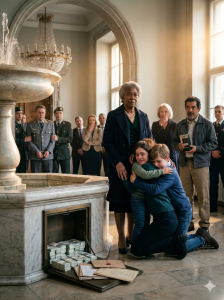
Inside was a sealed black case.
He pulled it out carefully and placed it on the stone edge.
No one spoke.
No one moved.
The headmaster’s knees buckled.
Susan whispered, “We were going to return it.”
Return it.
The words told the whole truth.
The guard opened the case.
Stacks of documents.
Cash bundles.
External drives.
And a folder with the school seal.
I picked up the folder.
Inside were lists of children.
Scholarship applicants.
Names crossed out in red ink.
Beside each name, a reason.
Too urban.
Wrong image.
Parent occupation unsuitable.
Accent concern.
Hair policy risk.
My hand tightened around the paper.
Then I saw Mateo’s name.
Rejected.
But Mateo had been admitted.
Why?
I turned the page.
And there it was.
A second list.
Children admitted under fake scholarship accounts.
Children whose tuition had been secretly paid by wealthy families to hide donations.
Connor Holloway.
Susan’s son.
My eyes lifted to Susan.
Her lips trembled.
The crowd saw it too.
Susan Holloway had spent the morning calling scholarship children trash.
But her own child’s seat had been hidden under the very fund she mocked.
Chapter 6
Connor looked at his mother like he had never seen her before.
“Mom,” he whispered.
“Was I… was I one of them?”
Susan broke.
“Sweetheart, I was protecting you.”
“No,” I said quietly.
Everyone turned to me.
“You were protecting yourself.”
Mercer sank to the ground, handcuffed now, ruined beyond repair.
But Susan was still standing.
Barely.
Her designer bag hung from her arm like a costume after the play had ended.
I looked at Connor.
Then at Mateo.
Then at every frightened child watching adults teach them what power really means.
“This school will not punish children for their parents’ sins,” I said.
Connor began to cry.
Mateo’s mother pressed a hand to her chest.
“But it will no longer sell dignity to the highest bidder.”
Susan wiped at her face.
“I can pay anything.”
I almost smiled.
That was the saddest thing about her.
She still believed money was a key for every locked door.
“You already paid,” I said.
“And look what it bought you.”
Police sirens grew louder beyond the iron gates.
Mercer looked at Susan.
“You said he never came to campus.”
Susan looked at me with hatred and terror.
“How was I supposed to know who you were?”
I stepped closer.
Not angry.
Not loud.
Just close enough for her to hear every word.
“You weren’t.”
She blinked.
I reached into my pocket and pulled out the old brass key to the original schoolhouse.
“My mother cleaned classrooms at a school that never allowed me through the front door,” I said.
“So I built one where every child could enter with dignity.”
The courtyard blurred for a second.
Memory does that.
Turns sunlight into ghosts.
“She died before Oakridge opened,” I continued.
“But before she passed, she made me promise one thing.”
A teacher whispered, “What?”
I looked at the fountain.
Then at the children.
“She said, ‘Never trust a school that treats janitors like furniture. They hear everything.’”
A silence fell.
Then from the back of the crowd, the actual janitor stepped forward.
Mr. Alvarez.
Gray mustache.
Blue uniform.
Keys at his belt.
He held up a small recording device.
“I heard everything,” he said.
Susan staggered.
Mercer shut his eyes.
Mr. Alvarez looked at me.
“Three years of meetings, sir.”
The final twist hit the courtyard like thunder.
I had not come to Oakridge that morning by accident.
I had come because the janitor called me.
The man Susan thought I was had saved the school.
I turned to the crowd.
“Effective immediately, Mr. Alvarez is the new Director of Student Protection.”
The parents erupted.
Not in gossip.
Not in cruelty.
In applause.
Connor ran to Mateo and hugged him.
Susan watched, ruined by the one thing she could not buy.
Grace.
The police entered through the gates.
Mercer was taken first.
Then Susan.
As they led her past me, she stopped crying long enough to whisper, “You destroyed my life.”
I looked toward the children laughing again near the fountain.
“No,” I said.
“You finally met the people you stepped on.”
Then I walked to Mr. Alvarez and placed the brass key in his palm.
The school bell rang.
Clear. Loud. Unshaken.
And for the first time in twenty-three years, Oakridge sounded exactly like the dream my mother died believing in.
