


Chapter 1: Before Sunrise
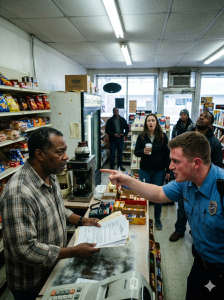
The officer gestured at me as if I were the criminal.
Not outside my house.
Not in an alley.
Not in someone else’s business.
Inside Brooks Corner Market, behind the counter I had opened before sunrise for twenty-one years.
My hand was still resting on the property deed.
His finger was still pointed at my chest.
And every customer in the store had stopped breathing.
That morning had started like any other.
Quiet streets.
Cold air.
Coffee too strong.
Keys heavy in my palm.
At 5:45 a.m., I raised the front gate and stepped into the market my father once dreamed about.
The old refrigerator hummed.
The floor smelled of bleach.
The pastry rack waited beneath warm yellow light.
For most people, it was only a corner store.
For me, it was a promise I had kept every single day.
My father bought the building when the block was still half boarded up.
He used to say, “Marcus, a store is not shelves. A store is a heartbeat.”
I did not understand that as a boy.
I understood it after I buried him.
I understood it after my mother cried in aisle three because she could still smell his aftershave near the coffee machine.
I understood it when neighbors came in not just to buy things, but to be seen.
At 6:10, Ronnie Ellis came in.
Construction vest.
Steel-toed boots.
Eyes half awake.
“Marcus,” he said, lifting his coffee cup, “if this coffee ever disappears, my whole crew quits.”
I smiled.
“You say that every morning.”
“Because every morning it stays true.”
Then Mrs. Wilkes came in for scratch-offs and peppermint gum.
She had been buying the same two things since before my beard turned gray.
Then Jaylen arrived.
Seventeen.
Hoodie up.
Backpack hanging from one shoulder.
“Morning, Mr. Brooks.”
“Morning, young man. School first. Chips second.”
He grinned.
“Orange juice makes it healthy.”
Everything felt normal.
Beautifully normal.
Until the patrol car pulled in crooked.
Chapter 2: The Officer at the Door
I noticed the car before I noticed the man.
It did not park.
It claimed space.
The front tire rested over the painted line.
The engine cut off sharply.
Then Officer Brandon Keene stepped out.
I had seen him around the district.
Young enough to still enjoy the shine of the badge.
Old enough to know better.
He entered without a nod.
The bell above the door gave a soft jingle.
That sound had welcomed thousands of people.
That morning, it sounded like a warning.
Keene looked past Ronnie.
Past Mrs. Wilkes.
Past Jaylen.
Straight at me.
“You work here?”
At first, I thought I misheard.
“I own it,” I said.
His expression did not change.
“Step out from behind the counter.”
The store went quiet.
Not ordinary quiet.
The kind of quiet that settles when people realize something ugly has entered the room.
Ronnie lowered his coffee.
Mrs. Wilkes clutched her wallet.
Jaylen’s hand moved slowly toward his phone.
I kept my voice steady.
“Why would I do that, Officer?”
“We received complaints,” Keene said.
“Complaints about what?”
“Possible trespassing. Unauthorized access. I need you outside while I inspect the business.”
For a second, I could only stare at him.
Trespassing.
In my own market.
Behind my own counter.
Under my own father’s faded photograph on the wall.
There are moments that do not shock you because they are new.
They shock you because they are familiar.
Because they carry the weight of every warning your parents ever gave you.
Keep your hands visible.
Keep your voice calm.
Do not give them a reason.
Even when they brought the reason with them.
Chapter 3: Papers on the Counter
I moved slowly.
Not because I was afraid.
Because I knew every motion had suddenly become evidence.
I reached under the counter and pulled out my wallet.
Keene’s hand shifted toward his belt.
Ronnie saw it.
“Easy,” Ronnie muttered.
Keene snapped his head toward him.
“Stay out of it.”
Ronnie’s jaw tightened, but he said nothing.
I placed my driver’s license on the counter.
Then my business license.
Then I reached into the lower drawer and took out the folded property deed.
I kept it there because my father had kept it there.
He always said, “Never let a man make you beg for what already has your name on it.”
I unfolded it carefully.
The county seal caught the fluorescent light.
“My name,” I said.
I tapped the license.
“My business.”
I tapped the city license.
“My property.”
I tapped the deed.
“Verify it.”
Keene looked down.
Not like a man checking facts.
Like a man offended that facts had interrupted him.
“Anybody can print paper.”
Mrs. Wilkes gasped.
Jaylen lifted his phone higher.
Ronnie’s voice came rough and low.
“Come on, man. You can see the seal.”
Keene turned on him.
“I said stay out of it.”
Then he leaned closer to me.
Close enough for only me to hear the weight beneath the procedure.
“You’re leaving that counter one way or another.”
There it was.
The truth beneath the uniform.
My chest burned.
But I did not move.
I thought of my father.
I thought of him standing behind this same counter in 1983, when men broke the front window and told him this neighborhood was not for him.
He replaced the glass the next morning.
Then opened on time.
So I placed both palms flat on the counter.
And I said, “No.”
Chapter 4: The Second Badge
The second cruiser arrived like thunder without sound.
Blue light flashed once across the front windows.
Keene glanced toward the door.
For the first time, uncertainty crossed his face.
The bell rang again.
Officer Marisol Vega stepped inside.
She was older than Keene.
Sharper.
The kind of person who looked once and missed nothing.
Her eyes moved from my hands to the papers.
From the customers to Jaylen’s phone.
Then to Keene.
“Brandon,” she said slowly, “what is this?”
“Routine inspection,” he said.
Her eyes dropped to the deed.
She picked it up before he could stop her.
Read the name.
Read the seal.
Read it again.
Then she looked at me.
“Mr. Marcus Brooks?”
“Yes, ma’am.”
Her expression shifted.
Not with surprise.
With recognition.
That unsettled me more than anything else.
She turned to Keene.
“Why is the owner’s deed being treated like contraband?”
The room froze.
Keene’s mouth opened, then closed.
“It was a complaint.”
“From who?”
He said nothing.
Vega’s hand moved to her radio.
And that was when I saw it.
Fear.
Not embarrassment.
Not irritation.
Fear.
The kind that shows up when a man realizes the lie he told is tied to something larger than him.
Vega pressed the radio.
“Dispatch, this is Vega. Confirm complaint source for Brooks Corner Market.”
Static cracked.
Keene stepped forward.
“Marisol, don’t.”
Ronnie muttered, “Oh, now we’ve got something.”
Vega did not look away from Keene.
“Dispatch, repeat. Confirm complaint source.”
A pause.
Then the radio answered.
“Complaint logged by Officer Brandon Keene. No civilian caller on record.”
The store erupted into silence.
A heavier silence than shouting.
Keene’s face drained.
Mrs. Wilkes covered her mouth.
Jaylen whispered, “I got that.”
Vega lowered the radio slowly.
“You called it in yourself?”
Keene said nothing.
I felt the floor shift beneath me.
Because that meant he had not come by mistake.
He had come with a plan.
Chapter 5: The Name Behind the Lie
Vega’s tone went cold.
“Brandon, step away from the counter.”
He let out a short laugh.
A small, desperate sound.
“You don’t know what you’re doing.”
“No,” she said. “I know exactly what I’m doing.”
He looked at me then.
And for the first time, he did not see a store owner.
He saw a problem that had survived.
“You should have signed,” he said.
My blood went cold.
“Signed what?”
His eyes flicked to the deed.
Vega caught it.
“Signed what, Brandon?”
Keene swallowed.
Outside, another car slowed near the curb.
Then another.
Unmarked.
Dark windows.
The neighborhood had begun to wake.
Vega’s radio crackled again.
“Unit advised. Internal Affairs en route. Detective Harlan also responding.”
At the name Harlan, Keene flinched.
I noticed.
So did Vega.
She looked at him like she had found the missing piece.
Then the front door opened again.
A tall man in a gray coat stepped in.
Not in uniform.
Badge clipped to his belt.
Detective Samuel Harlan.
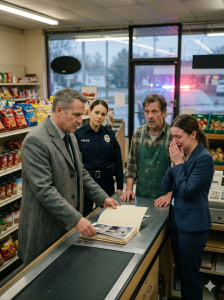
But behind him came a woman I had not seen in fourteen years.
My younger sister.
Denise.
I almost forgot how to breathe.
She stood in the doorway in a navy suit, hair pinned back, face tight with tears she refused to let fall.
“Marcus,” she said.
The room blurred.
Denise had left town after our mother died.
We had argued about selling the store.
She said the neighborhood was changing.
I said roots mattered.
We stopped calling.
Birthdays passed.
Holidays passed.
Pain turned into pride.
And pride turned into silence.
Now she stood in my market beside a detective.
“What are you doing here?” I asked.
Her eyes went to the deed.
Then to me.
“I’m sorry.”
Those two words hit harder than Keene’s order.
Chapter 6: The Offer
Detective Harlan stepped forward.
“Mr. Brooks, we have been investigating a property acquisition scheme in this district for nine months.”
My voice barely came out.
“What scheme?”
Harlan looked at Keene.
“Pressure owners. Create false complaints. Force citations. Trigger emergency inspections. Then investors make low offers when the property appears legally vulnerable.”
Ronnie cursed under his breath.
Mrs. Wilkes sat down on a crate of bottled water.
Vega’s eyes stayed locked on Keene.
“And my store?” I asked.
Harlan’s face softened.
“Your store sits on the last corner needed for a private development project.”
I looked at Denise.
She was crying now.
“I didn’t know about the threats,” she said quickly. “I swear I didn’t.”
“What did you know?”
Her lips trembled.
“I knew an investment group wanted the block. I knew they contacted me because my name was still tied to the family estate paperwork.”
My heart dropped.
“You talked to them?”
“They said you were drowning,” she whispered. “They said the store was failing. They said selling would save you.”
I shook my head.
“You never asked me.”
“I was ashamed,” she said. “After all these years, I didn’t know how to come back.”
Then Harlan placed a folder on the counter.
Inside were printed emails.
Names.
Payments.
Complaint logs.
And one signature that made Officer Keene turn pale as death.
His own.
But beneath it was another name.
A name stamped on every offer letter.
Caldwell Urban Renewal.
I knew that company.
Everyone on the block did.
They had bought the bakery.
The laundromat.
The barbershop.
They sent polite letters with cruel numbers.
But I had thrown every envelope away.
Harlan turned one page.
And then my world stopped.
The primary legal contact for Caldwell Urban Renewal was not a stranger.
It was Denise Brooks-Lawson.
My sister.
Chapter 7: Blood and Concrete
I stared at her name until the letters stopped making sense.
“You work for them?”
Denise covered her mouth.
“I handle contracts. I didn’t know about Keene. I didn’t know about police pressure.”
“But you knew they wanted my store.”
“Yes.”
“You knew Dad built this place.”
“Yes.”
“You knew Mom died believing we would protect it.”
She closed her eyes.
That hurt more than any answer.
Keene suddenly laughed.
Not loud.
Just enough to poison the room.
“Family always signs eventually.”
Vega grabbed his arm.
“Turn around.”
He jerked back.
“Don’t touch me.”
The room shifted.
Ronnie stepped forward.
Jaylen kept recording.
Mrs. Wilkes whispered, “Lord, protect us.”
Keene’s hand moved.
Not for his weapon.
For the folder.
He lunged toward the counter, trying to snatch the evidence.
I moved before thinking.
My palm slammed down on the folder.
“No.”
Keene’s eyes burned.
“You have no idea how big this is.”
I leaned closer.
“My father faced bigger men than you with less paper than this.”
For a moment, I saw him decide.
Fight.
Run.
Lie again.
Then Vega locked his wrist and turned him hard against the counter.
The same counter where he had ordered me out.
The irony was so sharp it almost felt holy.
“You are under arrest,” she said.
His badge scraped against the laminate.
His face pressed inches from my father’s deed.
And suddenly, all his power looked borrowed.
Chapter 8: The Last Page
Internal Affairs arrived within minutes.
Then city investigators.
Then neighbors.
Word traveled fast when truth finally had witnesses.
Jaylen’s video had already left his phone.
Ronnie called his crew.
Mrs. Wilkes called half the church.
By 8:00 a.m., the sidewalk outside Brooks Corner Market was full.
People stood with coffee cups, folded arms, and quiet fury.
Denise sat near the lottery machine, shaking.
For a long time, I could not look at her.
Then she walked to the counter and placed one more document in front of me.
“I came here to get you to sign,” she said.
My throat tightened.
She unfolded the paper.
“But not anymore.”
It was a contract.
A sale agreement.
My store.
My father’s land.
My life reduced to dollar signs.
At the bottom was a blank line for my signature.
Beside it was another signed approval.
Denise’s.
“I thought money would repair what I broke with you,” she whispered. “I thought if the deal went through, I could give you enough to start over.”
I looked around the store.
At the pastry rack.
At the old refrigerator.
At Ronnie.
At Mrs. Wilkes.
At Jaylen.
At the photograph of my father, smiling behind the counter in a brown suit too wide for his shoulders.
“Start over where?” I asked.
She had no answer.
Then Detective Harlan cleared his throat.
“There’s something else.”
He opened the final page in the folder.
“This property was never fully transferable through your sister’s approval.”
I frowned.
“What does that mean?”
Harlan looked toward my father’s photo.
“Your father filed a community protection covenant in 1992. Quietly. Legally. Permanently.”
Denise stared at him.
“I never saw that.”
“Most people didn’t,” Harlan said. “It was buried in county archives.”
He turned the document toward me.
My father’s signature sat at the bottom.
Strong.
Slanted.
Alive.
The covenant stated that Brooks Corner Market could not be sold to any outside developer unless the current owner and a neighborhood trust both approved.
And then Harlan pointed to the name of the trust’s original trustee.
My mother.
The successor trustee.
Me.
The final successor, if I died or became unable to serve.
Denise.
My father had not left us a building.
He had left us a shield.
And my sister, without knowing it, had almost helped them break it.
Chapter 9: The Store That Would Not Move
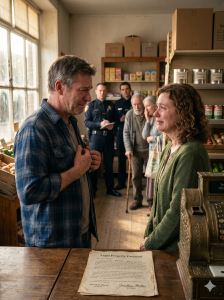
Denise broke down then.
Not gently.
Completely.
“I’m sorry,” she sobbed. “Marcus, I am so sorry.”
For years, I had imagined what I would say if she ever returned.
Hard words.
Sharp words.
Words meant to make her feel the empty chair she left at every holiday table.
But seeing her there, broken beside the candy rack we once stole bubble gum from as kids, I only felt tired.
And sad.
And still, somehow, hopeful.
I walked around the counter.
The whole store watched.
I stood in front of her.
She looked like a little girl again.
Like my sister before pride made strangers of us.
I said, “You should have called.”
She nodded through tears.
“I know.”
“You should have asked me.”
“I know.”
I looked at the deed.
At the contract.
At Keene being led outside in handcuffs.
At Vega standing near the door, steady and silent.
Then I looked at my sister.
“But you came before I signed.”
She looked up.
“And you told the truth.”
Her face crumpled.
That was not forgiveness.
Not yet.
But it was a door unlocked.
Outside, someone began clapping.
Then another.
Then another.
The sound grew until the whole block seemed to pulse with it.
Brooks Corner Market had become what my father always said it was.
A heartbeat.
Chapter 10: One Year Later
One year later, the old refrigerator finally died.
It went out at 5:43 a.m., two minutes before opening.
I stood in the quiet store and laughed until tears came.
Then Ronnie’s crew carried in a new one before noon.
Mrs. Wilkes brought pound cake.
Jaylen, now a freshman studying journalism, filmed the whole thing for a local news piece titled, “The Corner That Fought Back.”
Officer Vega came by too.
Not as a cop.
As a customer.
She bought coffee and peppermint gum.
“For Mrs. Wilkes?” I asked.
“For me,” she said. “That woman got me hooked.”
Denise came every Saturday now.
Sometimes we talked.
Sometimes we stocked shelves in silence.
Healing was not a movie scene.
It was slow.
Messy.
Ordinary.
But it was happening.
Caldwell Urban Renewal collapsed under federal investigation.
Four officers resigned.
Two council members were indicted.
Brandon Keene took a plea deal.
And the block survived.
Not unchanged.
Nothing survives unchanged.
But alive.
One morning, I found a small envelope taped beneath my father’s old photograph.
Denise had discovered it in a box of our mother’s things.
Inside was a note in my father’s handwriting.
Marcus, if they ever come for the store, remember this.
They are not after the building.
They are after the proof that we belonged here.
So stand behind the counter.
Put the deed where they can see it.
And make them say your name out loud.
I read it once.
Then again.
Then I folded it and placed it beneath the register.
Right beside the deed.
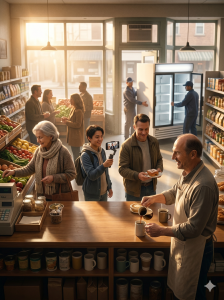
At 6:10, Ronnie walked in.
“Coffee ready?”
I smiled.
“Always.”
The bell jingled.
The lights hummed.
The neighborhood woke.
And I stood behind my counter.
Not because I owned the store.
Because after everything they tried to take…
the store still owned a piece of all of us.
