

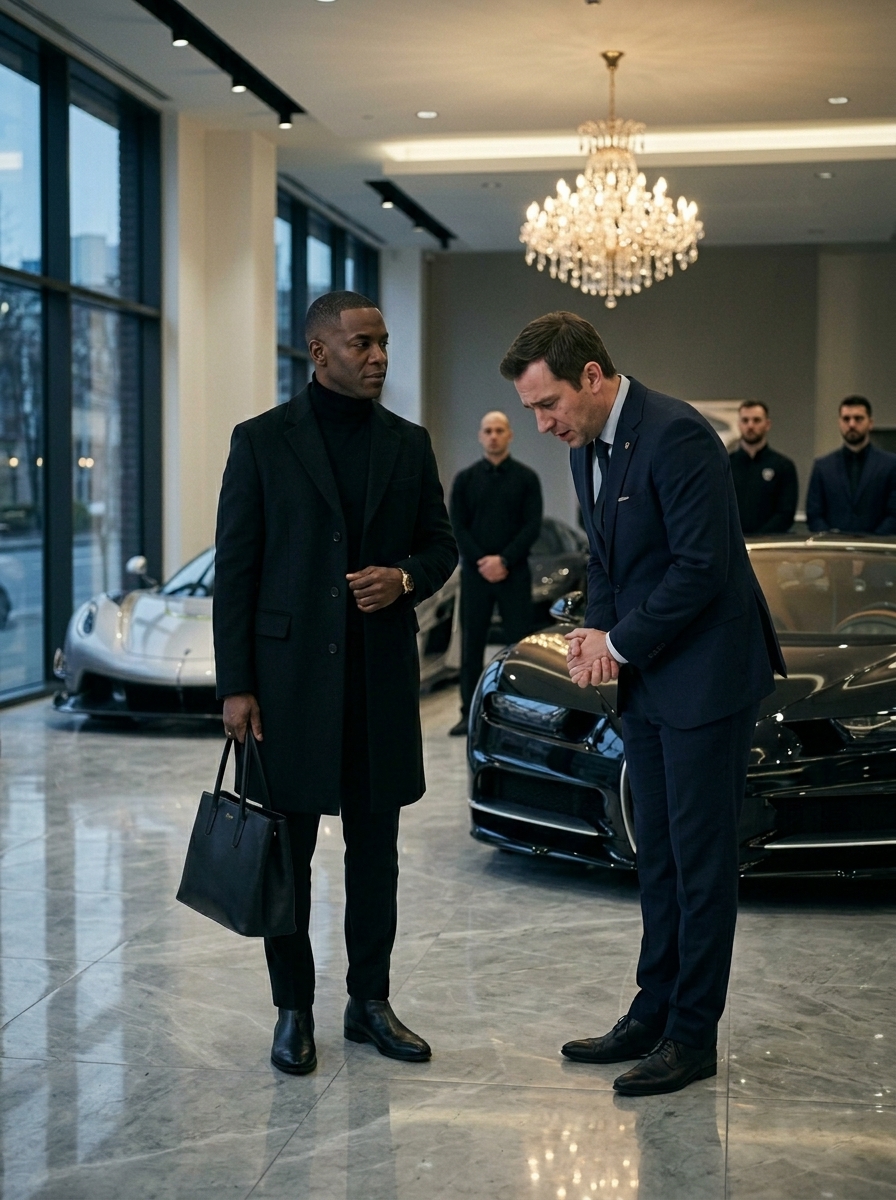
The luxury car showroom was designed to impress from the moment anyone stepped inside. Crystal chandeliers reflected across polished marble floors, expensive vehicles sat beneath perfect white lighting, and every polished surface seemed built around one message: wealth deserved admiration here.
Every car looked untouchable.

A silver supercar rested on a raised platform near the center of the room. Along the walls, limited-edition luxury sedans gleamed beneath spotlights while soft instrumental music drifted through hidden speakers. Employees moved carefully through the showroom in tailored black suits, greeting customers with polished smiles rehearsed through years of expensive sales training.
The dealership had a reputation across the city for serving celebrities, athletes, and executives who arrived carrying influence as naturally as they carried money.
And that afternoon, the manager intended to protect that image at all costs.
His name was Richard Hale, a man who believed appearances revealed everything worth knowing about a person. He judged watches before words, shoes before character, and clothing before intelligence. Years of dealing with wealthy clients had convinced him that expensive people always looked expensive.
So when the showroom doors quietly opened and a man stepped inside wearing dark, simple clothing, Richard noticed him immediately.
The customer looked calm.
He wore plain black jeans, a charcoal jacket, and simple sneakers with no visible designer labels. No jewelry. No luxury watch. No assistant following behind him. He looked more like someone stopping to escape the heat than someone shopping for million-dollar vehicles.
But there was one thing unusual about him.
He walked through the showroom slowly, carefully studying each car with genuine interest.
Not taking photos.
Not acting excited.
Simply observing.
He paused beside a midnight-blue hypercar and leaned slightly to examine the details near the wheel. His expression remained thoughtful, composed, almost analytical.
A younger sales employee noticed him and quietly approached.
“Good afternoon, sir,” the employee said politely. “Is there anything I can help you with today?”
Before the customer could answer, Richard stepped forward.
“I’ll handle this,” the manager said sharply.
The younger employee immediately stepped back.
Richard adjusted the cuffs of his expensive suit and walked toward the customer with a tight smile that barely concealed his irritation.
“Can I help you?” he asked, though his tone made it clear he did not want to.
The customer turned toward him calmly.
“Yes,” he said. “I’ve been looking at the new models. I wanted to compare a few options before making a decision.”
Richard glanced at the man’s clothes again.
Then he laughed softly under his breath.
“A decision?” he repeated.
Nearby employees exchanged uncomfortable glances.
The customer remained polite. “Yes.”
Richard folded his arms.
“You really think you can afford anything here dressed like that?”
The words landed harder than expected.
Several conversations in the showroom immediately quieted. A couple standing near a luxury SUV looked over. One employee froze while carrying coffee toward a client lounge.
The customer did not react emotionally.
Instead, he answered with calm restraint.
“I don’t believe clothing determines whether someone deserves respect.”
Richard smirked.
“That sounds like something people say when they can’t afford the merchandise.”
The insult hung heavily in the air.
Still, the customer remained composed.
“I came here to discuss vehicles,” he replied evenly. “Not defend how I dress.”
But Richard had already decided who the man was.
To him, this customer represented a problem. Someone wasting time. Someone walking through the showroom pretending to belong among buyers with real money.
Richard pointed toward the blue hypercar.
“That vehicle costs more than most houses,” he said loudly enough for others to hear. “People don’t just walk in off the street and buy cars like these.”
The customer looked directly at him.
“I’m aware of the price.”
“Are you?” Richard asked. “Because you don’t exactly look like our usual clientele.”
The younger sales employee from earlier shifted uncomfortably nearby. Even the security guard standing near the entrance now watched the situation carefully.
The customer took a slow breath.
“You are making a very expensive mistake by judging me like this in your own showroom.”
But Richard ignored the warning.
“Stop pretending you can buy anything here,” he snapped. “People like you only come in to look around and waste our time.”
The phrase people like you echoed through the showroom.
Everyone heard it.
And everyone understood exactly what he meant.
The customer’s face remained controlled, but disappointment appeared in his eyes for the first time.
This was no longer simple rudeness.
It had become humiliation.
Public humiliation.
Yet Richard continued.
“If you want pictures, go to a car museum,” he said coldly. “This is a luxury dealership.”
A woman near the reception desk lowered her eyes uncomfortably. Another employee quietly whispered, “He needs to stop.”
But nobody interrupted the manager.
Power protected arrogance surprisingly well.
The customer finally straightened fully and looked around the showroom one more time.
“It’s unfortunate,” he said quietly. “I was prepared to do significant business here today.”
Richard laughed openly now.
“Significant business?”
“Yes.”
“With what money?”
The customer held his gaze.
“With enough money to buy every car I originally planned to purchase.”
Richard shook his head dismissively.
“Sure you do.”
Then he took another step closer.
“Now leave before I have security throw you out onto the street.”
The entire showroom fell silent.
The security guard looked uncertain but did not move.
For one long moment, nobody spoke.
Then suddenly, footsteps hurried across the marble floor.
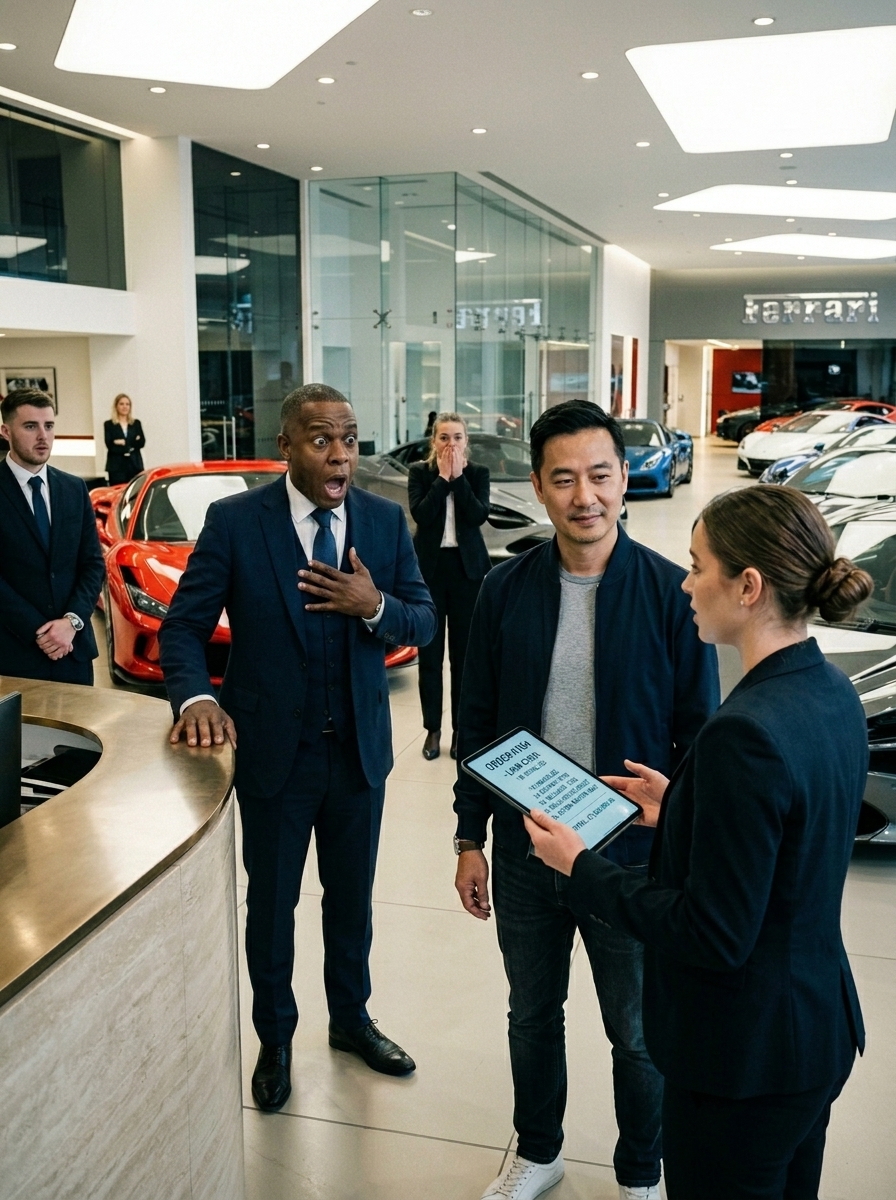
Another employee rushed toward them holding a tablet in both hands. Unlike the others, his expression looked alarmed.
He stopped directly beside the customer.
“Sir,” he said respectfully, slightly out of breath, “I’ve been looking everywhere for you.”
Richard frowned.
The employee continued carefully.
“Your ten-car order has been fully prepared. Delivery arrangements are ready whenever you would like to finalize them.”
Silence.
Complete silence.
The words hit the showroom like shattered glass.
Richard stared at the employee.
“What?”
The employee looked confused by the reaction.
“The custom order,” he explained. “The collection scheduled for overseas shipment next month.”
The younger sales associate nearby suddenly covered his mouth in shock.
The customer said nothing.
Richard blinked rapidly. “Wait… what order?”
The employee looked at him uncertainly.
“The order under Mr. Lawson’s account,” he answered carefully. “Ten vehicles.”
Richard’s face slowly drained of color.
Every employee in the showroom understood instantly.
The man standing before them was not a random visitor.
He was one of the largest clients the dealership had ever handled.
The customer Richard had mocked… was preparing to spend millions.
Richard’s confident posture collapsed almost immediately.
His voice changed.
“Sir,” he stammered, “I—I didn’t realize—”
The customer calmly raised a hand, stopping him.
“No,” he said quietly. “You realized exactly what you wanted to realize.”
Richard swallowed hard.
Around them, employees watched in absolute silence.
The customer turned slightly toward the employee with the tablet.
“Is everything ready?” he asked calmly.
“Yes, sir.”
The employee hesitated before adding, “The owner was planning to meet you personally this evening.”
Richard looked like he might faint.
The customer nodded once.
Then he slowly looked back at the manager.
“No,” he said.
Richard blinked. “Sir?”
“I don’t want to buy anymore.”
The words were soft.
But they carried devastating weight.
Richard immediately panicked.
“Please,” he said quickly, “there’s been a misunderstanding—”
“No,” the customer interrupted calmly. “There has been an accurate demonstration of your character.”
Richard’s breathing became shallow.
The customer stepped closer—not aggressively, but with quiet authority that suddenly filled the entire showroom.
“You judged me before speaking to me,” he said. “You decided I had no value because I didn’t dress the way you expected wealthy people to dress.”
Richard tried to speak again, but no words came out.
“You embarrassed me publicly,” the customer continued. “You assumed I did not belong here. And worst of all, you represented your business with arrogance instead of professionalism.”
Every employee listened carefully now.
Because nobody had ever spoken to Richard this way before.
“You know what the real problem is?” the customer asked quietly. “You only respect money after you can see it.”
Richard lowered his eyes.
“But true professionalism means respecting people before you know what they own.”
The younger employees nearby looked almost relieved hearing someone finally say it aloud.
The customer glanced around the showroom.
“These cars are beautiful,” he said. “But a luxury business is not built only on expensive products. It’s built on trust, dignity, and how clients are treated.”
Richard finally found his voice.
“Please, sir… let us make this right.”
The customer looked at him steadily.
“First teach your manager some manners,” he replied. “And teach him how to speak respectfully to every client who walks through these doors. Only then will I even consider doing business here again.”
No shouting followed.
No dramatic scene.
No threats.
The silence inside the showroom carried far more power than anger ever could.
Richard stood frozen while the reality settled around him.
One moment of arrogance had just cost the dealership millions.
But worse than the financial loss was the humiliation. Employees who once feared him now saw him clearly. Customers nearby looked at him with disgust rather than admiration.
For years, Richard had believed wealth could be identified by appearance.
Now he understood how dangerous that belief truly was.
The customer turned calmly toward the entrance.
The respectful employee quickly stepped aside for him.
Before leaving, the customer paused briefly beside the younger sales associate who had first tried to help him politely.
“What was your name?” he asked.
“Daniel, sir.”
The customer nodded.
“You were the only person here who treated me professionally from the beginning.”
Daniel looked stunned.
“Thank you, sir.”
Then the customer reached into his pocket, removed a business card, and handed it to him.
“If I decide to continue the purchase,” he said, “you’ll be the one handling it.”
Richard closed his eyes briefly.
Another painful lesson.
Respect mattered.
Not titles.
Not suits.
Not appearances.
The customer walked toward the glass doors while every employee silently watched him leave.
The moment the doors closed behind him, the atmosphere inside the showroom felt completely different.
The chandeliers still sparkled.
The marble floors still gleamed.
The luxury cars remained untouched beneath perfect lighting.
But suddenly, the building no longer felt impressive.
Because everyone inside had just witnessed something far more important than wealth.
They had witnessed the cost of disrespect.
And they had learned that dignity should never depend on clothing, status, or assumption.
True class revealed itself not through what someone wore…
…but through how they treated people who appeared to have nothing at all.
