

**The Boy Who Raised His Hand: A Story of Preparation Born from Loss**
At 35,000 feet, fear doesn’t arrive all at once. It creeps in like a shadow lengthening across the cabin floor. It begins with something small—a pause in the engines that feels wrong, a subtle shift in the aircraft’s rhythm that makes the air feel heavier. Passengers glance up from their phones and tablets, eyebrows furrowed, unsure why their chests suddenly feel tight. The usual hum of conversation and the clink of plastic cups fades into an uneasy hush.
Then someone screams.
A flight attendant sprints down the narrow aisle, barefoot, her uniform blouse untucked, eyes wide with raw terror she can no longer disguise. She is no longer the polished professional reciting safety instructions. She is human—terrified, breathless, desperate. Her voice cracks as she shouts the words no one on a commercial airliner ever wants to hear:
“Is there anyone here who can help us?”
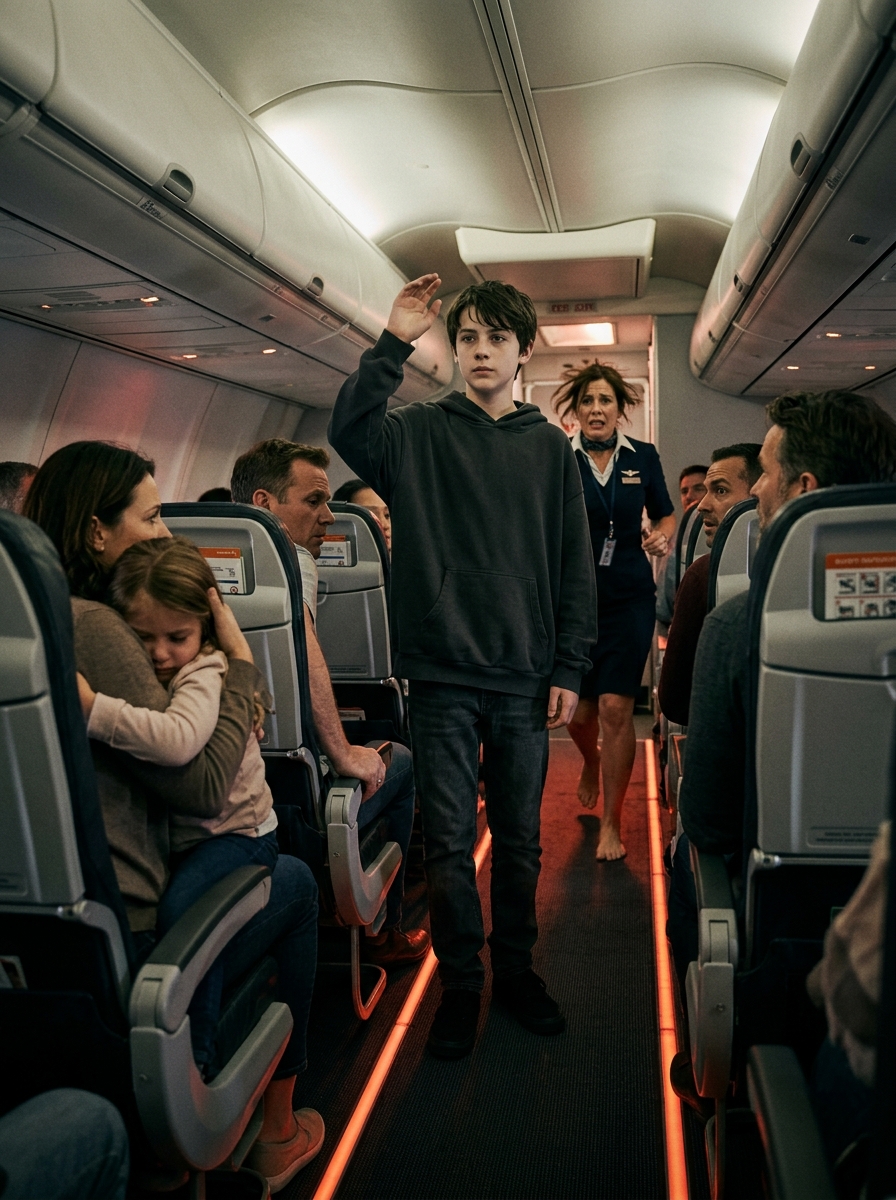
The cabin freezes. Time itself seems to stall. A mother clutches her toddler closer, burying the child’s face in her shoulder. An elderly man closes his eyes and begins to pray silently, lips moving without sound. Business travelers in window seats grip their armrests until their knuckles turn white. Everyone waits for someone else—someone older, someone more experienced, someone trained—to stand up. No one does.
The fear thickens, pressing down like the altitude outside the thin aluminum skin of the plane.
Then a small hand rises from seat 23C.
Not confident. Not dramatic. Just… small.
A boy—no older than fourteen—stands between the rows. His hoodie is too big, sleeves swallowing his wrists. His face is pale, almost ghostly under the harsh cabin lights, but his posture is steady. “I can,” he says quietly.
Nervous laughter ripples through the cabin like a nervous cough. Someone mutters, “We’re done for.” A woman two rows back shakes her head and whispers, “This is no time for jokes, kid.”
The flight attendant spins toward him, panic sharpening her voice into something almost cruel. “This is serious,” she snaps. “People’s lives are at stake. This isn’t a game.”
“I know,” the boy answers. His voice is calm, unnervingly so. Something in his tone—perhaps the absence of bravado, perhaps the quiet certainty—makes her pause mid-step. She studies his face for half a second longer than she can afford, then nods once.
She doesn’t have time to question anymore.
She takes his hand and pulls him forward through the aisle, past rows of wide-eyed passengers who watch in stunned silence. The boy’s sneakers squeak softly on the carpet. He doesn’t look back.
Inside the cockpit, the situation is far worse than the attendant imagined. Red warning lights flash across every panel. Alarms blare in competing tones—high-pitched, urgent, merciless. The captain is slumped in his seat, unconscious, blood trickling from a head wound sustained when the plane hit sudden, violent turbulence. The first officer is fighting to maintain control, sweat pouring down his face, hands shaking on the yoke.
“Systems are failing,” he gasps as the boy is ushered in. “Hydraulics are shot. We’ve lost autopilot. I need another set of hands—now.”
The flight attendant looks at the boy, her voice barely a whisper. “If you’re wrong about this…”
He nods once, eyes locked on the controls. “I know what that means.”
He doesn’t rush. He doesn’t panic. He slides into the jump seat, pulls the headset over his ears, and listens. His small hands move with surprising sureness as the first officer barks instructions. The boy adjusts switches, reads altitude numbers aloud in a steady monotone, and follows procedures as if he had memorized them years ago.
The plane shudders violently. Outside, dark clouds swirl past the windshield like angry ghosts. Oxygen masks drop in the cabin behind them. Screams echo through the intercom. But inside the cockpit, the boy remains focused. He recalls diagrams he studied late at night, simulations he ran on his computer when he should have been sleeping, conversations he replayed in his mind with a father who never came home.
Minutes stretch into what feels like hours. The first officer glances sideways at this unlikely co-pilot more than once, disbelief mixing with desperate hope. The boy’s voice never wavers. He anticipates the next command before it is fully spoken. When the runway finally appears through a break in the clouds, he helps guide the aircraft down with a precision that defies his age.
The wheels hit the tarmac hard—ugly, bouncing, screeching. The plane veers slightly, but the boy and the first officer correct it together. They slow. They stop.
For one impossible second, the entire world inside the cabin is silent.
Then it erupts. Crying. Laughing. Thunderous applause. Strangers hug each other. A man in first class openly weeps. The flight attendant returns to the cockpit, tears streaking her face, and throws her arms around the boy.
“You saved everyone,” she says, voice breaking.
He shakes his head slowly. “I just did what I practiced.”
Authorities board quickly. Paramedics attend to the captain. Investigators swarm the cockpit. A senior airline official kneels in front of the boy in the now-empty first-class cabin, voice gentle but probing.
“Where did you learn to stay that calm, son? Most adults would have frozen.”
The boy looks out the small window toward the terminal lights, gathering his thoughts. “My dad used to fly,” he says quietly. “He didn’t make it through his emergency.”
The flight attendant, standing nearby, catches her breath audibly.
The official leans in. “So you learned… for him?”
The boy shakes his head again, eyes distant. “No. I learned so it wouldn’t happen again.”

—
What followed was a media storm that no one—least of all the boy—expected. News outlets dubbed him “The Hero of Flight 472.” Social media exploded with hashtags and edited videos. Talk shows wanted him. Schools invited him to speak. Yet the boy, whose name is Ethan Caldwell, remained quiet and unassuming. He asked to go home to his mother and younger sister. He returned to school the following Monday as if nothing had changed.
But everything had.
To understand Ethan, one must go back six years. His father, Captain Michael Caldwell, was a seasoned commercial pilot with over 12,000 flight hours. On a stormy night much like this one, his aircraft encountered severe mechanical failure. Michael fought for control until the end, but the plane went down. There were no survivors. Ethan was eight years old when he watched the news report with his mother, the blue glow of the television illuminating their living room like a nightmare that refused to end.
Most children would have developed a fear of flying. Ethan developed an obsession with understanding it.
He began collecting manuals. He watched cockpit videos. He joined online flight simulator communities, logging hundreds of virtual hours in recreated emergency scenarios. He studied human factors in aviation—how stress affects decision-making, how crews communicate under pressure, how small actions compound into survival or tragedy. He did it quietly, in the hours after homework and before sleep, driven by a single, burning thought: *If I had been there, could I have helped?*
His mother worried at first. She found him asleep at his desk with headsets on, flight charts spread across the floor. But she also saw the determination in his eyes—the same quiet resolve his father once carried. She let him continue, quietly buying him better simulation software and even arranging occasional visits to aviation museums.
No one, not even Ethan, expected the knowledge to be tested in real life so soon.
In the weeks after the emergency landing, Ethan received letters from passengers. One woman wrote that she had been ready to give up until she saw a child stand up. Another passenger, a retired Air Force pilot, admitted he had frozen in fear and felt profound shame—and gratitude. A young girl who had been terrified of flying said Ethan gave her courage to board planes again.
Ethan read every letter. He kept them in a box beside his father’s old flight jacket.
When asked in a rare interview why he raised his hand, Ethan offered a simple answer: “Because someone had to. And I knew how.”
His story is more than a feel-good tale of a child prodigy. It is a powerful reminder of the quiet power of preparation. In an age that celebrates instant talent and viral fame, Ethan represents something deeper: the long, often invisible work of turning pain into purpose. He did not save the plane because he was exceptionally gifted. He saved it because he refused to let his father’s death be the end of the story. He turned grief into knowledge, fear into readiness.
Aviation experts later confirmed that Ethan’s actions—combined with the first officer’s efforts—prevented what could have been a catastrophic loss of life. The National Transportation Safety Board praised the “extraordinary composure of a minor passenger” in their preliminary report.
Yet Ethan himself remains unchanged. He still wears the oversized hoodie. He still sits in the back of the classroom. He still practices on his simulator most evenings—not for glory, but for peace of mind.
On the night of the landing, as the passengers cheered his name, Ethan walked down the aisle looking like any other kid. Most saw a hero. A few, perhaps, glimpsed the truth: this wasn’t luck. This wasn’t sudden inspiration. This was preparation, forged in loss and tempered by love.
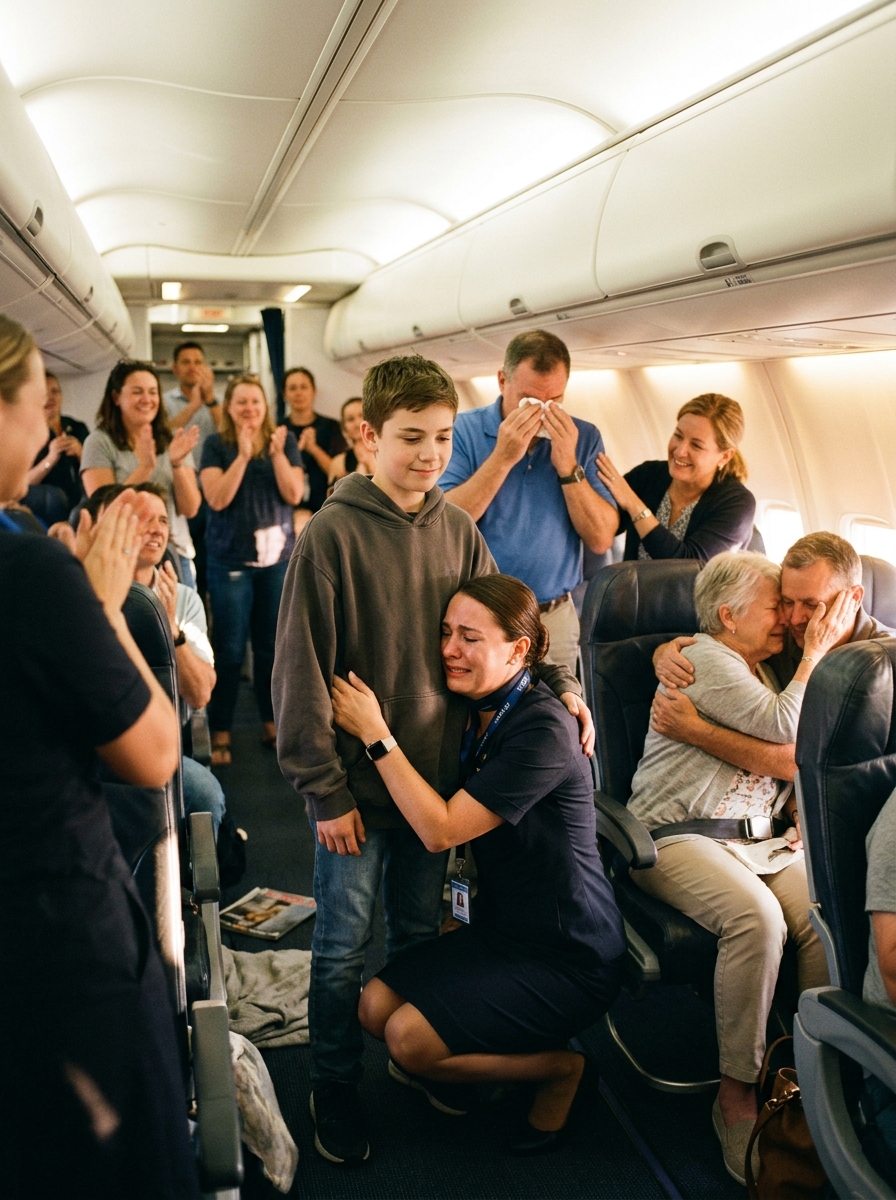
It started the moment a boy in an oversized hoodie raised his small hand and said, without hesitation, “I can.”
And in doing so, he reminded every person on that plane—and millions watching afterward—that courage is not the absence of fear. It is the decision to act anyway, armed with whatever knowledge and heart we have gathered along the way.
In a world full of uncertainty, Ethan Caldwell showed us that sometimes the person who saves the day is the one who prepared in silence, long before the emergency began.
