


Act I: The Woman on the Marble Floor
The first thing that caught my attention in the ballroom was the flowers.
White roses lined every table. White orchids draped across the room. White candlelight shimmered against the polished marble floors so flawlessly that the reception space felt less like reality and more like a carefully staged illusion of purity. Wealthy families have always mastered that art. They spend enormous amounts of money making cruelty appear elegant.
I came in through the side hallway, exactly as instructed.
No photographers. No media waiting outside. No formal introduction. Just an older Black woman wearing a navy church suit, sensible low heels, and carrying a small envelope tucked neatly inside her purse. That was the arrangement Adrian wanted. He had written to me personally three weeks earlier in a letter so thoughtful and earnest that it sat unanswered on my kitchen table for two full days before I found the strength to reply.
Please come before the ceremony, he wrote. There are things I need to know about my mother, and I think you’re the only person left who will tell me the truth.
I nearly chose not to come.
Not because I feared the family. Men like Charles Vale stopped frightening me a long time ago. But grief does something strange to old wounds. It turns humiliation into instinct. And twenty-two years earlier, the Vale family had shown me exactly how dangerous truth becomes when it walks into a room powerful people believe belongs to them.
But I came anyway.
And less than half a minute after my shoes touched that marble floor, the bride shoved me to the ground.
Her name had only been Celeste Rowan Vale for under an hour, though none of us understood the weight of that yet. She stood wrapped in white satin and generational wealth, her hair twisted into a flawless sculpted knot so precise it looked almost painted into place. She carried the faint scent of gardenias and anger.
“DON’T YOU DARE COME NEAR MY WEDDING AGAIN YOU FILTHY PIECE OF TRASH,” she screamed.
Her hand hit my shoulder with more force than she expected. People who enjoy humiliating others rarely think much about balance or consequence. I stumbled backward, reaching for nothing but empty air, and fell—one knee striking first, then both palms against the freezing marble.

For illustrative purposes only
The room inhaled sharply.
Somewhere to my left, a champagne glass slipped and shattered across the floor.
Not one person stepped forward to help me.
That didn’t surprise me. Rooms like that are always filled with people who think of themselves as decent until cruelty arrives dressed in designer fabric. Then they become statues. First shocked. Then silent. Then deeply occupied pretending not to see.
Celeste jabbed a finger toward me as I pushed myself halfway upright, one hand gripping the nearest chair for support.
“WOMEN LIKE YOU POISON A WEDDING LIKE THIS JUST BY STANDING IN IT.”
The guests around us tightened inward even as they subtly stepped back. Black tuxedos. Diamond necklaces. Silk gowns. Polite expressions hiding cowardice. No one interrupted her. No one asked my name. They accepted the social order she imposed because it was the one they were most comfortable believing.
Across the ballroom, I watched the color leave Adrian’s face.
He stood beside his father beneath the towering floral arch, a boutonniere pinned neatly against a tuxedo that made him resemble too much of the boy I once knew and not enough of the man he hoped to become. He instinctively moved toward me—one step only—before Charles Vale stopped him with a hand against his arm.
That was the moment everything became clear.
Charles had never told him I was coming.
Or perhaps worse, he had told the bride a lie before I ever arrived.
Celeste dismissed me with the casual finality of someone convinced the problem had already been erased. She had just begun turning back toward the altar when the low, controlled hum of engines rolled through the ballroom entrance.
One black SUV.
Then another.
Then the lead vehicle glided beneath the porte-cochère, its polished surface reflecting the lights like black glass.
The atmosphere shifted immediately.
Conversations died mid-sentence. Waitstaff froze in place. Guests stretched subtly for a better view. Wealthy people recognize power quickly when it arrives behind tinted windows and security details.
The rear passenger door opened.
Miguel stepped out first, exactly as he always had, wearing a dark suit tailored so sharply it made the nearby tuxedos seem like costumes. He crossed the ballroom without hesitation, scanning the room once before his eyes landed on me kneeling against the marble.
Then he did the one thing Charles Vale had spent more than twenty years ensuring nobody in that family would ever witness.
He bowed.
“Madam Founder,” he said quietly, grief and apology woven into every word. “Forgive us for arriving late.”
The silence afterward was not shock.
It was recognition.
Celeste’s face broke first. Her fury dissolved into something older and far more frightened. Charles became motionless in the way powerful men do when a buried lie suddenly stands up in front of an audience and speaks for itself.
I allowed Miguel to help me rise.
Then, for the first time in twenty-two years, I looked directly into Charles Vale’s eyes and understood from his expression that he knew exactly why I had come.
Act II: The Woman They Buried First
Before I became Madam President, I was simply Evelyn Brooks.
Before the state banquets, the armored convoys, and the speechwriters who learned how to soften my anger into language acceptable for television audiences, I was a teacher in West Baltimore with two practical dresses, a rusted old sedan, and an unshakable belief that children deserved libraries more than wealthy donors deserved their names carved into buildings.
That belief was what brought Grace Vale into my life.
Grace was Charles’s wife and Adrian’s mother, though back then she was still Grace Lattimer Vale, newly married and not yet skilled at standing beside corruption with a polished smile. She attended one of my literacy drives wearing a cream-colored suit and shoes far too expensive for the neighborhood, then stunned me by staying for six straight hours carrying boxes without asking for a single photograph.
Six months later, the two of us created The Harbor Initiative together.
It started with reading centers, scholarship programs, and legal aid clinics for mothers struggling through school systems designed to wear them down. It expanded because it worked. It expanded because Grace could open doors into powerful circles I never could have entered by myself, while I had the discipline to keep those circles from weakening the mission.
For three years, we built something extraordinary.
Then Charles started paying attention.
First he admired the tax structure. Then the donor publicity. Then the way a foundation helping poor Black and Latino neighborhoods could be reshaped into a legacy vehicle for wealthy families seeking moral admiration without moral sacrifice.
I pushed back.
Grace pushed back harder.
That was when the finances began shifting.
Administrative transfers that didn’t align with invoices. Emergency relief money rerouted through shell companies. Scholarship funds quietly drained to purchase properties later folded into the Vale philanthropic empire. Charles assumed I wouldn’t notice because he confused race, class, and lack of elite pedigree with incompetence.
Men like him always make that mistake.
Once.
Only once.
When Grace and I confronted him, he smiled with the calm precision polished men use when they decide to destroy someone methodically. He called Grace emotional. He called me confused. Within a month, rumors began spreading that I had mishandled finances and become unstable under pressure.
By the time the board gathered, the outcome had already been decided.
I was removed.
Grace was pushed aside.
The Harbor Initiative survived, but only after Charles erased my name from every founding document he could reach and reintroduced the organization to the public as a compassionate branch of the Vale family legacy. The media coverage made me sick. Photographs of Charles holding children whose names he never bothered learning. Magazine features praising the “visionary generosity” of a man who stole the foundation from the women who created it.
Grace tried to resist.
Then she vanished from public life for almost a year.
When she finally reappeared, she looked thinner, sadder, and dressed with far more careful precision. We met only one last time afterward, standing in a church parking lot at dusk while rain pounded against her windshield. She handed me copies of financial records and spoke in a voice so calm it unsettled me.
“Promise me something,” she said.
I agreed before I even heard what she wanted.
“If anything happens to me,” she said, “and Adrian ever asks for the truth, you tell him.”
Eight months later, she died in what newspapers described as a prescription interaction complication. Such a terrible phrase. Neat. Sterile. Convenient for families that prefer tragedy without questions.
I knew better.
But by then, survival required strategy more than fury. I took the records Grace entrusted to me and built my future quietly. First the state senate. Then the governor’s mansion. Then Washington. Then the White House itself, words that still feel unreal to me some mornings.
Meanwhile, Charles continued feeding his version of history to the world.
To the public, I became a respected stateswoman who had merely “launched” a foundation that Grace later “expanded.” Inside his private circles, I was something very different. An unstable former associate. A manipulative woman obsessed with rewriting the past. A dangerous ghost who could embarrass the family if not handled carefully.
That was why Celeste knew me only as scandal.
And why Adrian’s letter meant everything.
He had discovered something among his mother’s belongings. Letters. Originals. Her own handwriting naming me as co-founder, friend, and one of the last people she truly trusted. He wrote that he needed to apologize for not understanding earlier. He wrote that if I came, he wanted to see me before the ceremony began.
I told him I would arrive alone.
I had no idea his father had already poisoned the bride against me.
By the time these memories finished moving through my mind, Celeste had started shaking.
Charles did not shake. He did something far worse. He stepped forward with his composure restored and used the calm voice powerful men save for disasters they still believe can be contained privately.
“Evelyn,” he said, “surely there’s no need to turn this into a spectacle.”
And in that moment, I realized he still had no understanding of what waited inside my handbag.
Act III: The Envelope Grace Told Me to Keep
I had never cared about spectacle.
That was another truth Charles Vale failed to understand about me. Men like him believe visibility is the ultimate goal because it is the only thing they ever pursue. He could not comprehend that I hadn’t come for humiliation, or even revenge. I came because some stories demand an ending.
Grace’s envelope had stayed sealed for eighteen years.
She handed it to me on that same rainy night she passed over the copied financial records. “Only for Adrian,” she told me. “Only when he’s old enough to understand the kind of men who inherit polished lies.”
That envelope traveled with me through three political campaigns, two presidential inaugurations, one assassination threat, and more security checkpoints than I could possibly remember. First it stayed inside locked drawers, then secured safes, then eventually the private document room connected to the residence. Yet the moment Adrian wrote to me, I knew exactly where it was.
Now it sat inside my handbag only inches from my fingers while Charles attempted to reclaim control of the room.
“Privately,” he repeated.
Miguel shifted slightly beside me, recognizing the danger in Charles’s expression before most people around us even noticed it. By then the guests were no longer watching me. They were watching the bride. High society becomes most vicious when humiliation changes direction. A woman publicly insulting a stranger is one thing. A woman knocking the sitting President of the United States onto the floor belongs to an entirely different level of disgrace.
That was when Adrian walked across the ballroom.
Not toward his father.
Toward me.
His voice only cracked once. “Is it true?”
I looked at him and saw Grace so clearly it almost hurt. Not simply in his face, though he carried her eyes. It was in the restraint. The determination not to react too quickly while his entire understanding of the world shifted around him.
“Yes,” I answered. “Your mother founded Harbor with me. Your father stole it from us.”
Celeste looked at Adrian as though she expected him to save her from the consequences of what she had done. He never even turned toward her.
Charles stepped forward before his son could speak again. “You are not well enough informed to discuss family history in a room full of donors and press-adjacent guests.”
Family history.
Such an elegant phrase for theft.
I reached into my handbag and removed the envelope. Aged ivory paper. Grace’s initials pressed into the seal. The room noticed it before Adrian did, and every instinct inside Charles reacted immediately. He started toward me.
Miguel blocked him with nothing more than one hand and a single look.
“Sir,” Miguel said quietly. “Don’t.”
Charles stopped moving.
Adrian accepted the envelope from me carefully, as though the paper itself might wound him. For several seconds he only stared at his mother’s handwriting before finally breaking the seal.
There were six pages inside.
A letter written by Grace.
A notarized founding memorandum signed by both of us.
And a codicil attached to the Harbor trust that Charles never discovered because Grace kept the original hidden beyond his reach.
I watched Adrian read.
His face changed gradually, painfully, one emotion replacing another in sequence—confusion, disbelief, grief, and finally something colder. The kind of cold that settles into a man when he realizes the father he spent his life defending was never misunderstood.
Only protected.
“What is this?” Celeste whispered.
No one responded.
Adrian lifted the notarized memorandum first. It identified Grace Lattimer Vale and Evelyn Brooks as equal founders of Harbor. It also granted permanent moral and structural oversight authority to the surviving founder should either woman ever be removed through fraudulent board action.
Me.
The codicil damaged Charles even more.
If financial fraud or donor diversion involving any member of the Vale family were ever credibly proven, every honorary stewardship right connected to Harbor would terminate instantly and transfer to an independent trust overseen by the surviving founder and Grace’s biological heir.
Adrian.
Charles tried one final time to laugh.
The sound came out hollow.
“Those documents are outdated,” he said. “Symbolic. Half-drafted. Evelyn, you know as well as I do—”
I interrupted him for the first time.
“I know the Department of Justice opened a fraud review six weeks ago.”
That struck the room harder than the envelope itself.
The ballroom inhaled together like a single living thing.
Because yes, I had come to honor Grace. But I had also arrived carrying something Charles never anticipated: federal investigators waiting three blocks away for my signal, a package of newly authenticated financial ledgers already uploaded to the task force, and a bride’s public assault against a federally protected official now permanently tied to the family name he had hidden behind for more than twenty years.
Adrian slowly looked up from the letter.
“What did you do?” he asked his father.
And for the first time all day, Charles Vale had no answer prepared.
Act IV: The Wedding That Stopped Being a Wedding
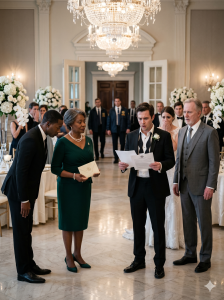
Wealthy rooms fall apart differently.
Poor families collapse out loud. Shouting. Slamming doors. Broken plates. Rich families unravel through whispers, careful phone calls, shifting glances, and alliances quietly reorganizing themselves under the disguise of concern. By the time the string quartet finally stopped pretending there was still a wedding to perform for, half the donors in the ballroom had already reached for their phones.
Charles noticed it too.
I was no longer his biggest problem.
Momentum was.
“What exactly is in those ledgers?” Adrian asked.
I could have given him the simple version. Donor fraud. Property schemes disguised as scholarship expansion. Shell organizations funneling money through family-controlled accounts. The kind of white-collar crime that destroys neighborhoods while never interrupting the wine service at charity events.
Instead, I told him the only part that truly mattered.
“Your mother begged him to stop.”
Adrian shut his eyes.
Celeste’s expression had moved past humiliation into something far more instinctive. Fear, certainly, but also fury at no longer being the center of attention. Women like her are raised to believe the room exists to preserve their importance. Twelve minutes earlier she had been the center of that ballroom. Now she was barely part of the story.
“This is insane,” she said. “You set us up.”
I looked directly at her.
“No,” I said. “I let you reveal yourself.”
Perhaps that was the cruelest thing I said the entire afternoon, and perhaps she earned it. Because even if Charles had lied to her—and I have no doubt he did—nothing forced her to act the way she had. Nothing compelled her to call an older Black woman trash and throw her onto the floor before hundreds of guests except the ugliness she already carried beneath all that elegance.
Miguel touched the earpiece hidden beneath his collar.
Then he glanced at me.
“They’re here,” he said.
I nodded once.
The ballroom doors opened again, though this time no motorcade followed. Two agents from the Financial Crimes Enforcement Network entered alongside a Justice Department attorney and my White House ethics liaison, who wore the exhausted expression of someone wishing desperately to be somewhere else. Their arrival changed the atmosphere instantly. The scandal had become official procedure.
Charles lost color immediately.
The liaison addressed me first. “Madam President.”
Then she turned toward Charles so every witness in the room could hear her clearly.
“Mr. Vale, we need to speak with you regarding records connected to the Harbor Initiative and associated donor structures.”
Celeste lowered herself into a chair so suddenly it seemed her legs had simply stopped supporting her.
Adrian stayed standing, his mother’s letter still in one hand and the memorandum in the other. He looked first at his father, then at the federal officials, and finally toward the floral arch where vows would now never be spoken.
“My mother knew,” he said quietly.
Nobody denied it.
One of the agents asked whether a private room was available.
Charles laughed then, a short damaged sound. “Of course there is. Everything in this building has always happened privately.”
It was the most honest thing he had said in years.
As the staff hurried guests toward cocktails and distant corners of the ballroom, Adrian walked to the center of the room beneath the chandelier and raised his hand for silence. He didn’t need the gesture. Silence already belonged to him.
“This wedding is over,” he said.
No one moved.
He turned toward Celeste. “Not because of her.”
He gestured toward me, and for the first time all afternoon I watched people in that ballroom truly look at me instead of the assumptions they had attached to me.
“Because anyone capable of doing what you just did to a woman you believed was powerless,” Adrian said, “would have eventually done it to the wrong person. Today it just happened to be my mother’s oldest friend.”
Celeste made a small sound, something between a protest and a plea. But Adrian was no longer talking to her.
He was addressing the room itself.
“To everyone here who donated to Harbor because you believed in my mother’s name,” he said, “you deserved better than the way this family handled it. And so did the children it was created to serve.”
He lowered his eyes to Grace’s letter one final time.
Then he spoke the sentence I think finally released her.
“My father has been living inside a stolen story.”
There are moments in public life when a room stops belonging to the person who paid for it.
This was one of those moments.
And while the agents escorted Charles toward a side chamber and guests slowly transformed themselves into witnesses, I understood that the final decision no longer rested with me.
It belonged to Adrian.
Act V: The Name Grace Wanted Returned
I waited in a smaller sitting room connected to the ballroom while officials collected statements.
Beyond the double doors, the wedding unraveled piece by piece. Makeup artists were quietly dismissed. The string quartet packed away their instruments in tense silence. Donors who had spent years praising Harbor from podiums suddenly remembered urgent appointments elsewhere. A society columnist I recognized from weekend profiles hurried out with a phone already pressed to her ear.

Miguel brought me tea I never drank.
Twenty minutes later, Adrian entered alone.
He no longer resembled a groom. The boutonniere had disappeared. His bow tie hung loosened at his collar. Grace’s letter rested folded carefully inside his jacket pocket, as though keeping it close might allow him one more hour with her.
He sat across from me without speaking.
Then he asked the question I had expected from the beginning.
“Why didn’t you tell me sooner?”
I could have answered with strategy. Politics. Security concerns. The near impossibility of approaching a grown man still trapped inside his father’s influence and asking him to choose evidence over legacy.
Instead, I gave him the truth.
“Because I wanted your invitation,” I said. “Not your father’s permission.”
For a long time he stared at the carpet.
“She wrote about you,” he said eventually. “Not like a colleague. Like family.”
I smiled, though the feeling hurt more than I expected.
“She saved my life more than once.”
Grace never saved me through dramatic heroics. She saved me through the quieter, more difficult kind of courage. The courage required to believe a Black woman could be right while every powerful room insisted otherwise. The courage to copy records. To sign affidavits. To guard a promise in silence for eighteen years because she knew her son might someday need something stronger than inheritance.
Adrian leaned back slowly.
“She knew he was stealing.”
“Yes.”
“She thought he could destroy Harbor completely.”
“Yes.”
“And she still stayed.”
There it was. The cruelest question carried by children raised inside compromised homes.
Why didn’t the good parent leave?
I allowed the silence to settle before answering.
“Because leaving a man like your father sounds simple in theory and catastrophic in timing. She was trying to protect you. She was trying to preserve enough evidence to matter. And she believed, perhaps wrongly, that she still had time.”
He nodded without lifting his eyes.
Then, in the same fragile tone a twelve-year-old might use after breaking a bone and wanting the truth before the doctor returned, he asked:
“What happens now?”
That answer, at least, I could give plainly.
“The trust reverts exactly the way Grace intended,” I told him. “Harbor leaves Vale control. You inherit her role as family representative, though not by yourself. Not until you decide whether you even want the responsibility. The audit moves forward. The press will be relentless. Your father will lie. Some people in that ballroom will suddenly discover principles they did not possess yesterday. And if you choose to fight for it, Harbor can still become what it was always meant to be.”
He absorbed every word without flinching.
Then he stood, walked to the window, and stared out at the driveway where my motorcade waited beneath the cold evening lights.
“My mother used to say power becomes most dangerous when it dresses itself as manners,” he said.
I laughed quietly.
“That sounds exactly like Grace.”
For the first time since I arrived, he smiled.
Only briefly.
But when he turned back toward me, something inside his expression had settled into place. Not peace. Not yet. But structure. The first outline of an adult decision forming where grief had been carrying the entire weight.
“I want my mother’s name restored to every document,” he said.
“Good.”
“I want yours restored publicly as founder.”
“That matters less.”
“It matters to me.”
That nearly shattered me.
I looked away toward the darkened windows because public office teaches you how to carry nations through disaster but not always how to survive private kindness. Sometimes one honest sentence from the right young man cuts deeper than decades of opposition ever could.
When we walked back into the ballroom together, most of the guests had already gone.
Celeste remained near the altar, alone except for one bridesmaid who clearly wanted to leave but lacked the courage to do it. Her makeup had started separating at the edges. Her veil rested on the floor where it had fallen, crushed partly beneath the leg of an abandoned chair.
Adrian approached her calmly.
“I’ll make sure your family isn’t humiliated in the press beyond what’s already happened,” he said. “But there won’t be a marriage.”
Celeste didn’t cry.
Instead, she looked at me with the stunned resentment of a woman still unable to decide whether she hated power itself or simply hated realizing too late that she had failed to recognize it.
I met her eyes steadily.
Then I bent down, picked up the fallen veil, and placed it gently on the nearest table.
Not for her.
For the woman she might have become three hours later if she had chosen decency over hierarchy.
Outside, the evening air had turned cool and sharp. The lights from the motorcade reflected across the wet stone driveway even though no rain had fallen. Somewhere farther up the road came the distant sounds of traffic and city sirens—ordinary noises, grounding noises, reminders that history never pauses simply because one family’s illusion finally collapsed.
At the car door, Adrian stopped me one final time.
“Did you ever hate her?” he asked, and I knew he meant Grace for staying, or perhaps me for waiting, or maybe even himself for failing to see the truth sooner.
“No,” I said. “But I learned that love without courage eventually becomes useful to terrible men.”
He absorbed that quietly.
Then, with the same deliberate care Grace once used whenever she wanted a sentence remembered, he said, “I won’t let that happen again.”
As the SUV pulled away, I looked back through the tinted glass and saw him still standing beneath the ruined white flowers, one hand resting inside his pocket over his mother’s letter.
The bride had shoved me to the floor believing she could erase an inconvenience.
Charles buried my name believing history itself could be forced into obedience.
Both of them were wrong.
Because the truth about stolen things—foundations, legacies, names, even love—is that they never remain obedient forever. They wait patiently. They gather witnesses. They survive the rooms designed to contain them.
And sometimes, when grace decides to be especially precise, they return wearing a navy suit, a presidential seal, and the exact face the guilty spent years praying they would never see again.
