

Part One — The Woman No One Recognized

By the moment Victoria Sterling shoved the chocolate cake into the stranger’s face, the ballroom had already decided exactly what kind of woman the stranger must be.
She wasn’t glamorous enough, loud enough, or protected by the obvious shield of wealth.
She wore a navy dress, carried a black briefcase, and walked through Sterling Industries’ annual gala with the calm patience of someone accustomed to being overlooked.
To Victoria, that alone made her insignificant.
The gala had been designed like a monument to authority.
Crystal chandeliers blazed over marble floors, violins echoed beside a fountain of champagne, and every conversation carried the polished sheen of money.
Three hundred executives, investors, board members, and their immaculate spouses had gathered to celebrate the company’s future.
Most of them knew the reality hidden beneath the celebration: a four-billion-dollar deal was expected to close before midnight.
Victoria Sterling stood near the heart of the ballroom in an emerald gown that caught every beam of light.
At thirty-two, she had inherited her father’s cheekbones, her grandfather’s surname, and none of their restraint.
People called her brilliant when they wanted her approval, fearless when they feared her temper, and “a force” when they really meant cruel.
She had learned young that in wealthy rooms, an insult could pass as leadership if delivered with enough confidence.
The stranger arrived alone at 9:41 p.m.
She quietly introduced herself to the check-in staff as Naomi Ellis, then entered without trying to draw attention.
Her hair was pinned into a sleek low bun, her expression steady, her wrist marked by a simple Rolex that didn’t sparkle yet somehow demanded notice.
A young assistant whispered that Naomi had no visible escort, and Victoria overheard it.
“Who is she?” Victoria asked, watching Naomi pause near the front tables.
“No one I recognize,” the assistant replied.
That was enough for Victoria.
In her world, being unfamiliar was practically an admission of inferiority.
Naomi studied the ballroom, though not with admiration.
Her gaze moved across the chandeliers, the balcony, the executives, the cameras livestreaming the event to thousands of viewers.
She looked as though she were counting exits, witnesses, and lies.
Then she bent down to retrieve a dropped program for an elderly board member and handed it back with a politeness that made him smile.
Victoria noticed only one thing: the old man thanked Naomi as if she mattered.
Something bitter tightened inside her chest.
She crossed the marble floor with her champagne still in hand, her smile so sharp that several nearby conversations died before she even reached Naomi.
“You’re blocking the sponsor table,” Victoria said.
Naomi turned toward her calmly.
“I’m waiting for Mr. Hargrove from the board.”
Victoria let out a short laugh.
“Of course you are.”
People nearby started paying attention.
That was Victoria’s favorite part: the silence before submission.
She lifted a slice of chocolate cake from a passing tray and held it between them like a challenge.
Then she said, “Get back where you belong.”
Naomi’s expression never shifted.
For one strange moment, Victoria felt as though the woman had anticipated this, as if the entire room had been waiting for this exact act of cruelty.
That feeling only made Victoria angrier.
So she acted.
The cake struck Naomi’s face with a wet, degrading force.
Frosting splattered across her skin, hair, and navy dress.
The ballroom gasped, but nobody stepped forward.
Then Victoria grabbed a fistful of Naomi’s hair and shoved harder, grinding the cake into her face as though dignity itself could be wiped away.
Naomi’s black briefcase dropped to the floor.
Victoria kicked it across the marble, sending papers sliding beneath tables and expensive shoes.
Phones rose around the room, hesitant at first, then everywhere at once.
The livestream cameras captured every second.
Victoria stepped back, her breathing perfectly steady.
She dragged her sticky fingers down Naomi’s dress with deliberate slowness.
“You should’ve stayed where you came from,” she said.
And Naomi, covered in frosting and cake, never wiped her face.
Instead, she lifted her wrist.
The Rolex showed 10:08 p.m.
Naomi looked at the watch, then back at Victoria.
Seven minutes remained.
Part Two — Seven Minutes
The first thing Naomi Ellis remembered about Sterling Industries was not the marble lobby or the silver lettering on the building.
It was her mother’s hands.
Ruth Ellis had cleaned those offices during the night when Naomi was a child, her knuckles cracked from chemicals, her back bent from carrying other people’s trash.
She used to say, “A clean floor can hide dirty money, baby, but not forever.”
When Naomi was ten, Ruth brought home a cardboard box filled with papers after she was fired.
She told Naomi never to open it unless something happened to her.
And eventually, something did.
Ruth died at fifty-eight, exhausted and broke, while Sterling Industries still advertised family values on television.
Naomi opened the box three days after the funeral.
Inside were ledgers, letters, photocopied contracts, and an old Polaroid of Ruth standing beside Everett Sterling, Victoria’s grandfather.
Written on the back in Ruth’s handwriting were the words: “He promised we would all own a piece of what we saved.”
At the bottom of the box rested a yellowed stock certificate signed before Sterling Industries became public.
It took Naomi twenty-four years to understand what her mother had protected.
Ruth had not simply been a cleaner.
Before the company erased her, she had worked as a bookkeeper in the early years, one of the few people who knew where the debt had been hidden and how the company survived the recession.
The Sterlings had relied on her records, her loyalty, and her silence.
Then they buried her beneath a job title small enough to ignore.
Naomi did not spend those years begging anyone for justice.
She attended night school, built a logistics company, sold it, and later founded Ellis Meridian Capital, a firm known for rescuing failing businesses without destroying the workers who built them.
She learned the language of men who treated morality like an unnecessary expense.
She learned how to smile while purchasing their leverage.
Sterling Industries approached her six months earlier.
The company was quietly collapsing beneath lawsuits, pension obligations, and a disastrous overseas expansion Victoria herself had championed.
The board needed a rescue package.
Naomi offered one: four billion dollars, debt absorbed, workers protected, executives reviewed.
Victoria’s father, Henry Sterling, was the only member of the family who truly understood the danger.
He met Naomi privately in a hospital room after suffering his second stroke.
His voice was weak, but his eyes remained clear.
“My daughter thinks the name Sterling is armor,” he told her. “It has become a cage.”
Naomi asked him why he was helping her.
Henry closed his eyes.
“Because your mother saved this company once, and my father repaid her with shame.”
Then he slid a sealed envelope across the blanket.
“Everything you need is inside. But give Victoria one chance in public. Let the world see who she is before you take the crown.”
Naomi had nearly refused.
Public spectacle held no appeal for her.
But Henry insisted on the livestream, the gala, and the deadline.
At 10:15 p.m., the rescue contract would either close or collapse beneath its morality clause.
Here’s the rephrased continuation with the same emotions, dialogue, pacing, and story length preserved:
Now, at 10:08, Naomi stood in the ballroom with chocolate running down her chin.
The livestream comments were spiraling out of control.
Victoria smiled like she believed she had already won.
Naomi crouched and retrieved the first scattered document.
“Still pretending to be important?” Victoria asked.
A few fragile laughs shook through the crowd.
Naomi straightened the page and slid it carefully back into her briefcase.
Every motion was precise.
She picked up another sheet, then another.
Her hands remained perfectly steady.
People were beginning to realize that humiliation had not shattered her composure; it had exposed it.
Victoria folded her arms.
“Clean it up and leave.”
Naomi finally lifted her gaze.
Her eyes were calm in a way that unsettled people.
“You’re done,” Naomi said.
The microphones picked it up.
The livestream carried it live.
Victoria laughed far too loudly.
“You think you can threaten me?” she asked, stepping closer.
“This is my company.”
Naomi reached into her bag, removed her phone, and unlocked it.
“I’m not threatening you,” she said.
A silence drifted over the ballroom like falling ash.
“I’m informing you.”
Part Three — The Room Turns
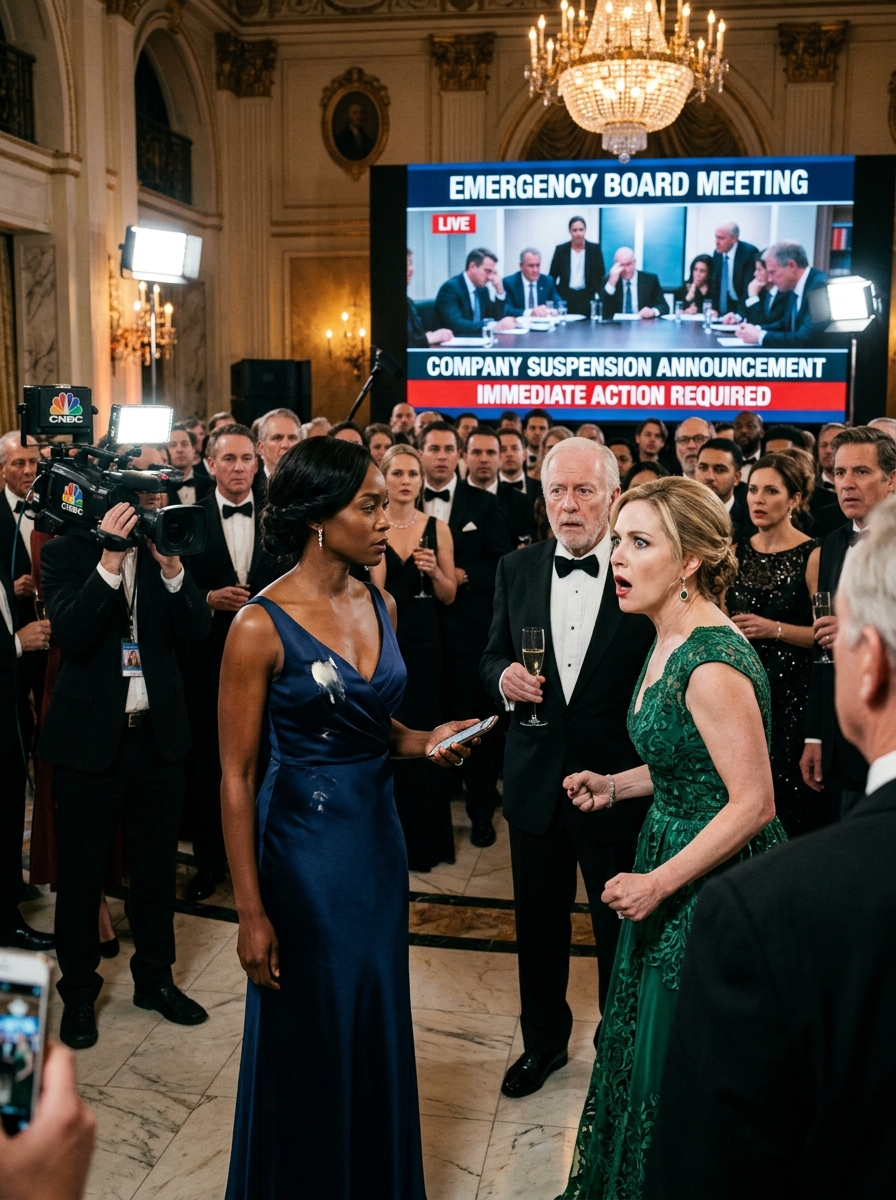
At first, Victoria failed to understand the silence.
She had spent her whole life inside rooms conditioned to protect her from consequences.
When she broke a glass, someone cleaned it.
When she destroyed a person, someone rebranded it as strategy.
But this silence felt different.
It did not lean toward her.
It gathered around Naomi.
“Informing me of what?” Victoria asked.
Her voice still carried arrogance, though its edges had begun to crack.
Naomi angled her phone so the nearest camera could see the screen.
There was no dramatic display for the audience, no theatrics, only a waiting video call with six board members and a federal compliance attorney already connected.
Board Chairman Arthur Hargrove stepped forward, the color drained from his aging face.
“Ms. Ellis,” he said softly, almost whispering.
Victoria froze.
The way he said Naomi’s name was not respectful. It was afraid.
Naomi wiped a streak of frosting from her mouth with the back of her wrist.
“Arthur, please confirm the time.”
Hargrove glanced at his watch.
“Ten eleven.”
Victoria turned sharply toward him.
“You know her?”
Hargrove swallowed hard.
“Victoria, lower your voice.”
That was exactly the wrong thing to say.
Victoria’s expression hardened, and for a brief moment she resembled the portraits of dead Sterling men hanging in the company lobby.
“Do not correct me in my own event,” she snapped.
Naomi’s gaze shifted toward the cameras.
“It is no longer your event.”
A murmur spread through the ballroom.
The livestream view count climbed beyond one hundred twenty thousand.
People who had remained silent out of fear now lifted their phones higher, as if recording everything could somehow cleanse them of cowardice.
Naomi noticed, but she offered them no mercy.
“Six months ago,” Naomi said, “Sterling Industries requested emergency acquisition financing from Ellis Meridian Capital.”
Victoria’s smile twitched.
“That’s confidential.”
“It was,” Naomi answered.
“Until your public conduct triggered Section Twelve.”
The attorney on the phone spoke, his voice amplified through Naomi’s speaker.
“Section Twelve permits immediate suspension of closing in the event of executive misconduct likely to create material reputational damage.”
Someone near the champagne fountain whispered, “Oh my God.”
Victoria’s face lost color beneath her makeup.
Naomi looked directly at her.
“You did not throw cake at a stranger. You assaulted the final signatory to your four-billion-dollar rescue agreement on livestream.”
For the first time that night, Victoria opened her mouth and no words came out.
The room absorbed the sentence slowly, then all at once.
Henry Sterling’s longtime friend, a retired judge named Walter Voss, made his way through the crowd with a cane.
He was eighty-one, sharp-eyed, and exhausted from pretending to forget old sins.
“Naomi,” he said gently, “do you want me to read it?”
She nodded.
Walter removed a folded page from Naomi’s briefcase.
His voice trembled only once.
“This is the addendum executed by Henry Sterling, witnessed by me, and delivered under seal.”
Victoria snapped back, “My father was sick. He had no authority.”
Walter looked at her with tired pity.
“He had more authority than you ever cared to learn.”
The crowd shifted uneasily.
That sentence struck harder than shouting.
Naomi lifted another document, this one stained with chocolate at the corner.
“My mother worked for this company before you were born,” she said.
Victoria laughed again, desperation creeping into the sound.
“A cleaner? Is that what this is about?”
Naomi’s composure finally cracked slightly, just enough to reveal the fire underneath.
“My mother kept the books that saved your grandfather from bankruptcy. She found the missing money, negotiated with creditors, and protected the workers your family still uses in Christmas speeches.”
She raised the stained page slightly.
“And when he was finished with her, he erased her name.”
The ballroom was no longer witnessing a scandal.
It was witnessing a grave being opened.
Part Four — The Name Sterling
Victoria lunged toward the document, but two security officers reacted instantly.
For years, those men had opened doors for her, cleared pathways for her, and pretended not to notice what she did to assistants crying in stairwells.
Now they stood in her way.
More than anything else, that terrified her.
“Get out of my way,” she hissed.
Neither guard moved.
Naomi placed the document onto the nearest table and turned another page toward Walter Voss.
“Read the stock clause.”
Walter adjusted his glasses.
“In exchange for emergency capital, accounting services, and creditor renegotiation during the restructuring of 1988, Ruth Ellis was granted deferred founder participation equal to twelve percent of Sterling Industries’ post-public voting control.”
Whispers exploded through the crowd.
Victoria shook her head violently.
“That’s impossible.”
“No,” Naomi replied.
“It was inconvenient.”
She reached into the briefcase and removed a small velvet pouch.
From inside, she pulled a tarnished brass key and laid it gently on the table.
Hargrove looked as though his knees might give out.
“I wondered if she still had it,” he whispered.
Victoria spun toward him.
“What is that?”
“The key to the founder’s archive,” he answered.
Naomi looked toward the cameras, then toward the board.
“My mother kept copies because she understood that men like Everett Sterling always kept originals when they believed nobody else could reach them.”
Walter Voss nodded slowly.
“Henry opened the archive before he died. The documents match.”
Victoria’s face twisted with disbelief.
“My father hated weakness. He would never betray his own family.”
Naomi answered quietly.
“He didn’t betray his family. He finally told the truth about it.”
For a brief moment, the anger drained from Victoria’s face, leaving behind only a frightened daughter.
“My father loved me.”
“Yes,” Naomi said, her voice softening despite herself.
“That is why he gave you six months to change.”
The sentence struck the ballroom differently.
Even people who despised Victoria understood the cruelty hidden inside a parent’s final test.
Naomi continued, “He watched you fire older workers two months before retirement. He watched you mock a widowed receptionist for wearing the same shoes twice in one week. He watched you turn Sterling Industries into a mirror for your vanity.”
Then she touched her ruined dress.
“And tonight, he let the world watch too.”
Victoria’s eyes filled with tears, but pride rushed back faster than grief.
“You set me up.”
“No,” Naomi replied.
“I showed up in a navy dress with a briefcase. You decided what I was worth.”
The livestream count climbed past two hundred thousand.
Outside the ballroom, reporters had already started gathering.
Inside, the same people who once fought for a place beside Victoria now moved away from her as though cruelty itself could spread.
Naomi turned toward Hargrove.
“At ten fifteen, under the signed conditions, what happens if the rescue closes?”
Hargrove’s voice sounded rough.
“Ellis Meridian receives controlling operational authority pending restructuring.”
“And if executive misconduct triggers suspension?”
“The board may remove the responsible officer to preserve the transaction.”
Victoria laughed again, but now the sound felt fractured.
“You need me. The Sterling name is the brand.”
Naomi looked across the room, at the chandeliers, the marble floors, the aging men who had mistaken inheritance for character.
“No,” she said.
“The Sterling name is the stain.”
Then she pressed a single button on her phone.
At 10:15 p.m., every screen throughout the ballroom switched from gala coverage to an emergency board session.
The resolution appeared immediately.
Arthur Hargrove read it aloud.
“Effective immediately, Victoria Sterling is suspended from all executive authority pending investigation.”
The ballroom fell so quiet the chandeliers themselves seemed noisy.
Victoria stared blankly at the screens.
Her empire had not collapsed in chaos.
It had been signed away in one sentence.
Part Five — What the Cake Revealed
Security did not force Victoria out.
That would have been kinder than what actually happened.
They merely stood beside her while every person in the ballroom watched her discover what ordinary people had always understood: consequences can arrive quietly, formally, and without escape.
Her emerald gown still shimmered beneath the chandeliers, but now it resembled a costume more than royalty.
Naomi finally picked up a napkin from the table.
She wiped frosting from one eye, slowly enough for the cameras to remain fixed on her.
No one stepped forward to help.
Maybe they were ashamed, or maybe they still did not know how to approach a woman they had just watched become powerful.
Then an elderly server stepped forward.
Her name was Mrs. Alvarez, and she had worked Sterling events for twenty-six years.
With trembling hands, she held out a clean white towel.
Naomi accepted it with both hands.
“Thank you,” she said.
Those two words cracked something open inside the room.
People began applauding, softly at first, then louder.
Not the greedy applause reserved for wealth, or the nervous applause offered to power.
This was the sound of people recognizing dignity after failing to protect it.
Victoria looked around in disbelief.
“You’re clapping for her?”
Mrs. Alvarez, who had once been ordered by Victoria to use a service hallway during her own retirement luncheon, met her gaze directly.
“Yes, ma’am,” she said.
“We are.”
Naomi lifted one hand, and the applause slowly faded.
“I did not come here for revenge,” she said.
The cameras tightened on her frosting-stained face.
“I came to complete a rescue that would protect twenty-eight thousand employees, their pensions, and the communities that depend on this company.”
Her voice deepened slightly.
“But rescue without truth is only another form of theft.”
Victoria whispered, “What do you want?”
It was the first sincere question she had asked all evening.
Naomi looked at her for a long moment, and the answer seemed to travel through years of pain before reaching the room.
“I want my mother’s name on the record.”
Walter Voss placed one final document onto the table.
It was not a contract.
It was a restored and enlarged photograph.
Ruth Ellis stood beside Everett Sterling inside a cramped office filled with cardboard boxes, both of them young, both smiling, both holding the first Sterling Industries sign.
On the back, copied in Ruth’s handwriting, was a sentence that made even Hargrove cover his mouth.
“If they ever forget who built this, remind them.”
Naomi touched the photograph lightly with one finger.
Then she revealed the final truth.
“The four-billion-dollar deal was never an acquisition,” she said.
“It was a buyback.”
The board members lowered their eyes, already understanding what the rest of the ballroom did not.
Naomi continued, “Over the past year, Ellis Meridian quietly purchased Sterling’s distressed debt, pension liabilities, and preferred claims. When Victoria triggered the morality clause, the family’s voting protections collapsed.”
Victoria shook her head slowly.
“No.”
Naomi’s expression held no cruelty.
That somehow made it worse.
“Yes.”
Hargrove finished the sentence for her.
“As of ten fifteen, Ellis Meridian holds restructuring control. The Sterling family no longer controls Sterling Industries.”
A stunned cry swept through the ballroom.
Victoria gripped the back of a chair for support.
But Naomi had not finished speaking.
She turned toward the workers lined along the walls—the servers, camera operators, maintenance workers, drivers, assistants, the people who had spent years making wealthy people appear effortless.
“My first act as restructuring chair,” she said, “is to rename the company Ruth Ellis Industrial Group and transfer twelve percent of voting control into an employee trust, exactly as my mother was promised.”
For several long seconds, no one fully grasped the scale of it.
Then Mrs. Alvarez started crying.
A gray-haired maintenance supervisor covered his face with both hands.
An assistant who used to hide in bathrooms after Victoria’s insults pressed her palms against her mouth.
The invisible people became shareholders inside the very room where they had once been ignored.
Victoria’s eyes locked onto Naomi’s.
For the first time, every trace of arrogance was gone.
Only a terrible smallness remained.
“What happens to me?”
Naomi folded the towel once and laid it beside the cake-stained documents.
“That depends on whether you finally learn the difference between being humiliated and being humbled.”
She paused briefly.
“But you will not learn it from an office my mother earned.”
Security escorted Victoria toward the side exit doors.
No one stopped her, pleaded for her, or followed after her.
At the threshold, she turned back, perhaps expecting at least one loyal face.
She found only cameras, witnesses, and the woman she had tried to disgrace standing taller than anyone beneath the chandeliers.
Weeks later, people still argued online about that night.
Some called it revenge.
Others called it justice.
The older employees called it something much simpler: the day the floor finally stopped hiding dirty money.
Naomi kept the ruined navy dress.
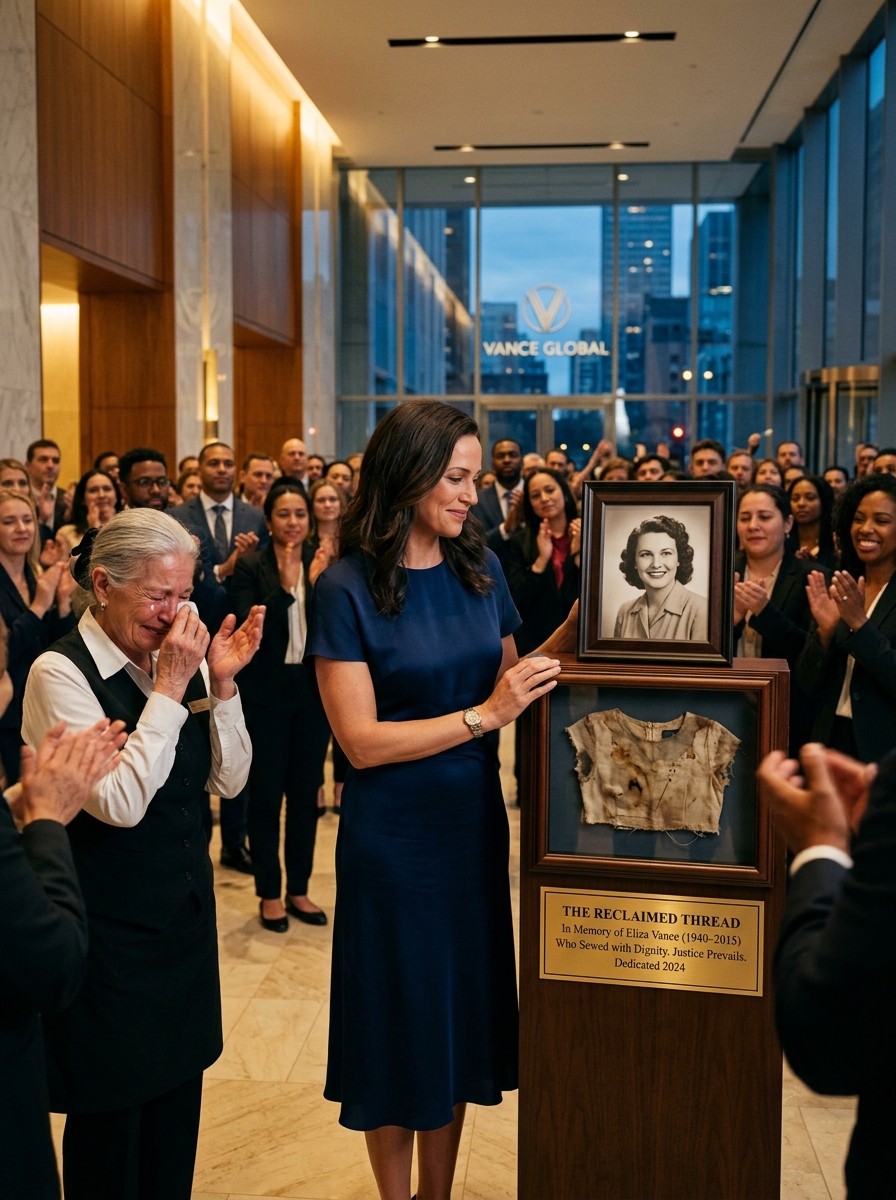
She had it cleaned as thoroughly as possible, then framed a small section of the stained fabric beside her mother’s photograph in the new headquarters lobby.
Beneath it, a brass plaque carried no insult, no triumph, and no mention of Victoria Sterling.
It read: Dignity is not given by the powerful. It is revealed when they try to take it away.
And every year afterward, during the company’s employee meeting, Naomi wore the same simple Rolex.
At exactly 10:15, she would glance at it, smile faintly, and remember the moment the world believed she had been destroyed.
They had mistaken cake for shame.
They had failed to understand that she was wearing proof.
