


The frosting felt icy against my cheek, cooling as it stiffened beneath the relentless heat of the chandeliers.
I remained still at the center of the Hamilton Foundation Gala, a shrine to privilege with its vaulted ceilings and gleaming marble floors. The string quartet faltered mid-note, leaving a heavy silence drifting through the golden light. Eleanor, the poised, sculpted hostess in a striking red silk dress, had just flung a slice of frosted cake straight into my face. The hit was sharp. White frosting exploded across my jaw, sliding down my chin and splattering my pristine coral dress in pale streaks.
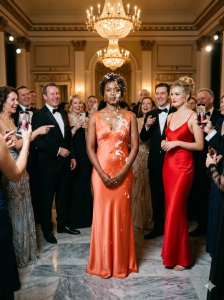
I tasted artificial vanilla and bitter humiliation. My heart, though, beat in a slow, terrifying rhythm. I didn’t flinch. I didn’t cry.
For a suspended second, the entire ballroom drew breath. Then came the laughter—sharp, uneasy, relieved, like a crowd thankful they weren’t the target. Phones rose into the air, glasses chimed, and the red recording lights of countless cameras flickered across the sea of tuxedos, capturing my public ex*cution from every angle.
Eleanor tipped her head, soaking in the cruel chorus, her laughter spilling out like the champagne in her glass.
“Money doesn’t buy class,” she declared, her voice cutting through the swelling noise. She leaned closer, her smile honed into a w*apon. “Some doors are meant to stay closed”.
They believed I was shattered. They believed I was nothing more than an impostor who had paid her way in, a target for the gatekeeper’s cruelty. The coral fabric of my dress, ruined by cream stains, clung to me like a banner of endurance.
I raised my hand, slow and deliberate. I wiped the frosting from my cheek with two fingers, examined it, then let it fall. The cream struck the marble with the faintest splatter, yet the sound echoed like a judge’s gavel.
I met Eleanor’s arrogant gaze without blinking. What she didn’t know—what none of these laughing cowards knew—was that the very ground beneath their feet, the foundation they were celebrating, was funded by me. I had poured $4.2 billion into her fragile empire.
And I was about to tear it down.
WHO WILL SURVIVE THE STORM?
PART 2: THE CHORUS OF COWARDS
The drop of frosting touched the marble floor. It was barely audible, a soft, wet tap, yet in my mind, it rang like a gavel in a silent courtroom.
I didn’t blink. I didn’t breathe. I simply stood there, letting the sticky, artificial vanilla scent of the ruined cake crawl into my lungs.
The ballroom, an immense monument to extreme wealth, with its cherub-painted ceilings and chandeliers pouring molten gold over us, seemed to close in. The air thickened, suffocating, charged with something raw and ugly. For a split second, the string quartet in the corner had gone completely still, their bows frozen midair. The silence stretched like an ocean, and I stood drowning at its center.
Then the tide came crashing back.
The laughter didn’t just return—it surged. It grew louder with each passing second, feeding on itself. It was sharp, uneasy, relieved—the sound of a crowd grateful they weren’t the ones bleeding.
“Unbelievable,” I heard a man in a white tuxedo murmur to my left. He shook his head, staring at my frosting-stained chest, carefully avoiding my eyes.
“She shouldn’t have come,” a woman beside him whispered. Her voice was quiet but cutting, as if my humiliation were something I had invited.
I recognized her. Cynthia Vance. Third-generation wealth, a woman whose boutique real estate firm I had kept alive during the last market crash. She wore a diamond necklace worth more than the average American home, yet here she was, shrinking into the background, giggling behind a manicured hand. Cowardice has no price tag.
At the center of it all stood Eleanor.
She moved through the room in her scarlet dress, each step striking the marble like punctuation. She was a predator intoxicated by the scent of fear. Her circle—heirs, tech elites, trust-fund socialites—revolved around her as if pulled by gravity. To them, she wasn’t just a hostess; she was a gatekeeper, and tonight she was asserting her power to decide who belonged in their world and who was merely tr*sh meant for the curb.
“See? Proof that money can buy you a ticket in,” Eleanor’s voice cut through the murmurs, amplified by her arrogance. She raised her champagne glass, pointing its crystal rim directly at me. “But it can’t buy you belonging!”.
The crowd erupted. Some applauded. Others simply smirked. No one stepped forward. Not a single hand offered a napkin.
A cold bead of sweat traced down my spine, hidden beneath the ruined coral silk of my dress. The gown had been custom-made in Milan, a delicate, unembellished piece designed to drape my form with precise elegance. Now it was smeared with chalk-white frosting, a canvas of public humiliation.
My heart pounded against my ribs like a trapped bird—thump, thump, thump—but I forced my body to reveal nothing. My posture stayed intact. My chin remained lifted. My shoulders held firm.
I looked out at the sea of blinking red recording lights. Phones gleamed in raised hands across the crowd of tuxedos and gowns. They were documenting my nightmare from every angle. Somewhere to my right, a young influencer with a ring light clipped to her phone whispered excitedly to her followers.
“You guys, you’re not going to believe what just happened at the Hamilton gala,” she giggled, turning the lens back toward Eleanor. “Wait till you see this!”.
The cruelty was intoxicating them. To stand with the humiliated meant risking exile from their elite circle. Loyalty to the gatekeeper, silence toward the victim—that was their unspoken rule.
A waiter in a crisp white vest hurried past me, his eyes wide with panic. On his tray sat a flawless stack of chocolate éclairs. For a brief, desperate second, a false hope flickered in my chest. Maybe he’ll offer me a towel. Maybe one working-class person in this room of billionaires will show a trace of humanity. He didn’t. He nearly ran past me, eager to escape the blast zone.
Eleanor, spotting the waiter, casually picked an éclair from the tray. She studied it, her crimson lips curling into a wicked smile. With a dramatic flick, she tossed the pastry straight at my feet.
Smash. The éclair burst into dark crumbs and cream across the polished marble, splattering the hem of my dress.
“Oops,” Eleanor feigned innocence, placing a hand over her chest while her inner circle erupted with laughter. “Oh, darling,” she purred, stepping closer, her heels striking sharply. “Coral is such a delicate color. Pity it stained so easily”.
A young socialite near the front whispered, “This is savage,” her hands trembling as she filmed me. An older matriarch, pearls gleaming at her throat, chuckled softly into her wine glass, choosing amusement over conscience.
They were waiting for me to crack. They wanted tears. They wanted me to scream, to lash out, to turn and run through those heavy mahogany doors like a beaten dog. They wanted proof that their bloodline outranked my bank account.
“Imagine thinking she could fit in here,” a man in a navy tuxedo sneered to his date, projecting his voice so I would hear. “It’s laughable.”
“She should be grateful she was even invited,” another guest muttered from the shadows. “Some people just don’t know their place”.
My place. The words echoed in my mind, hot and venomous.
Inside, my thoughts weren’t chaos. They were sharp, crystal clear. As the frosting cooled and hardened on my skin like war paint, a memory rose.
I saw my grandmother’s kitchen, filled with the scent of warm cornbread and harsh lye soap. I saw her rough, calloused hands—hands that had scrubbed floors for people just like those in this room.
“The world will test you, Maya,” she had whispered years ago. “Not with fire, but with ice. They will freeze you out, make you feel invisible, humiliate you in public.”
I closed my eyes for a fraction of a second.
“But dignity is not a voice you raise. It’s a silence you master.”
I drew in a breath. Slow. Controlled. The air filled my lungs, pressing against my ribs beneath the sticky silk. I had fought wars in corporate boardrooms far more ruthless than a slice of cake. I had survived rooms colder, crowds harsher, and hands far rougher than this.
My silence wasn’t surrender. It was strategy. Every smear of cream across my chest was a tally, a precise record of arrogance I was calculating with compounding interest.
Eleanor circled me like a predator. Her red silk dress gleamed like a bl*de. She lifted her champagne flute toward the crowd.
“Let tonight be a reminder,” she declared, her voice echoing beneath the painted cherubs. “That lineage, heritage, and elegance cannot be imitated. They are born, not bought!”.
Her words lingered in the air like suffocating perfume, intoxicating to those desperate to belong, and poisonous to me.
“You should be grateful, you know,” Eleanor whispered, leaning close enough that I could smell the expensive gin on her breath. She made sure her voice was just loud enough for nearby microphones. “I’ve given you more attention tonight than you’ll ever deserve in a lifetime”.
Someone at the back began a slow, mocking clap.
Then a male voice cut through the room, shouting the words that lit the fuse: “Show her the door!”.
It began as a murmur. A low, rhythmic hum.
Out. Out. Out..
Then it swelled. The cowards who had lingered in the back suddenly found courage in the safety of the crowd. The chant bounced off marble and glass. Out! Out! Out!. It thundered like a grim verdict, growing louder with every repetition, shaking the very foundation of the ballroom.
Eleanor stretched her arms wide, her crimson dress blazing as she turned slowly. She conducted the symphony of my humiliation. She was a maestro of d*struction, displaying the crowd’s loyalty as if their cruel laughter were jewels draped around her neck.
“See?!” she shouted over the deafening roar, pointing at me. “This is what happens when pretenders try to wear crowns!”.
The chant slammed into me like waves. Out! Out! Out! Faces twisted into harsh, feral sneers. The polished mask of the elite had slipped, revealing the savage pack beneath. Sweat glistened on their foreheads under the chandeliers.
But they didn’t realize their fatal error.
They thought they were forcing me out. They thought they had reduced me to an object, a pitiful prop in their display of superiority.
They didn’t realize they were building my stage. They had handed me a microphone without wires.
I looked at Eleanor. I saw her wide, triumphant smile. But beneath the flashing teeth and alcohol-fueled bravado, my trained eyes caught it—a tiny tremor in her hand. A flicker of deep, unshakable insecurity. Because real power doesn’t need to throw cake. Real power doesn’t need a chorus.
The storm building inside my chest had become impossible to ignore.
The cruelty had peaked at its absolute height.
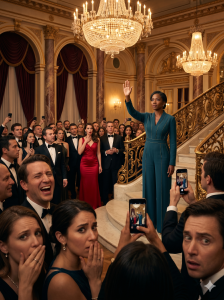
I slowly loosened my fingers. I lifted my right hand into the air.
I didn’t move fast. I didn’t move in desperation. I raised it with the cold, measured authority of a supreme court judge silencing a riot. My palm was steady, my fingers perfectly aligned.
The gesture was so out of place, so charged with raw, undeniable authority, that it cut straight through the chanting crowd.
The chant faltered.
A wave of confusion rippled outward from where I stood. Voices stumbled. The rhythm shattered. Phones that had been shaking with excitement suddenly steadied as cameras zoomed in on my face.
The deafening roar of five hundred people collapsed within seconds, replaced by a suffocating, terrifying silence.
Eleanor blinked. Her victorious smile twitched, the corners of her lips weakening.
“Oh?” she sneered, stepping closer, trying desperately to reclaim the room’s energy. “Finally found your voice?”.
I didn’t answer. Not yet.
I simply reached up, wiped away one last streak of thick white frosting from my collarbone, held it between two fingers so every camera in the room could capture it, and released it.
The room froze.
For the first time that night, the hostess no longer held control. I did.
And the storm was about to break.
PART 3: BILLION-DOLLAR BLOOMBERG
The silence I commanded was dense, nearly unbearable. It wasn’t the polite quiet of an attentive audience; it was the suffocating, panicked stillness of a room that suddenly realized the air had been stripped away. Five hundred faces stared at me. Five hundred members of the American elite, frozen in their tailored tuxedos and designer gowns, watching the tiny drop of vanilla frosting I had just flicked from my fingers strike the polished marble floor.
The frosting clung to my cheek like a mark of battle. The coral fabric of my dress was ruined, but my presence remained untouchable. The air felt impossibly heavy, each second stretching into something painfully long. I didn’t break eye contact with Eleanor. Her triumphant smile was trembling at the edges now. The conductor of this cruel orchestra was losing her control.
At last, I spoke.
I didn’t shout. I didn’t raise my tone. My voice was calm, steady, and carried without a microphone, slicing through the vast ballroom like a blade.
“Are you certain you want to do this?”.
The question wasn’t loud, but it struck like thunder. It wasn’t anger. It wasn’t a plea. It was a warning.
Eleanor’s breath caught. She let out a strained laugh, her crystal champagne glass trembling in her manicured hand. She tried to cover her sudden, inexplicable fear with bravado, tossing her curled blonde hair back over her bare shoulder.
“Do what?” Eleanor sneered, though her voice had noticeably softened. “Remind everyone who doesn’t belong?”.
My gaze stayed locked on her, steady and unblinking. I allowed the silence to stretch again, heavier now, until even the violins in the corner seemed to hesitate mid-bow, unsure if they were allowed to breathe. The crowd shifted uneasily. A man in the front slowly lowered his phone, the red recording light disappearing. A woman to my right pressed her enhanced lips together, suddenly uncertain of her cruel smirk. The certainty that had fueled their chant of “Out, out, out!” moments ago began to fracture under the crushing weight of a calm they couldn’t explain.
Eleanor forced another laugh, louder, sharper, desperate to regain control. But beneath it was something fragile—something the entire room was beginning to hear. Because for the first time that night, it was becoming painfully clear that I was not the victim they believed I was. I was the storm they had mistaken for silence.
Then the whispers began.
They didn’t start at the front. They rose from the back, slithering through the crowd like a venomous snake through tall grass.
“Who is she?” a young tech executive muttered, lowering his phone as he stared at me in confusion.
“I’ve seen her before,” an older woman whispered, her heavy diamond earrings catching the chandelier light as she leaned toward her husband. “She was on the cover of Forbes, wasn’t she?”.
“No, that can’t be,” came a doubtful reply from a banking heir nearby. “If she were that woman, she wouldn’t be standing here alone, taking this”.
But uncertainty spreads like tiny cracks across a frozen lake. The vicious chant had completely vanished. The laughter had faded. In its place, murmurs multiplied, questions threading through the ballroom as the collective awareness of the room finally awakened.
Eleanor tried to seize control again. She could feel it slipping. She raised her glass once more, forcing a painfully wide smile.
“Don’t be fooled!” she sneered, projecting her voice across the room. “A fancy headline doesn’t make you royalty! This is my house, my city, my world!”. She pointed a lacquered fingernail at me. “She’s just another outsider trying to sneak through the door!”.
But her voice no longer held the same authority. It wavered beneath the rising, unstoppable tide of recognition. Guests were no longer following her blindly; their minds were racing, recalling business headlines, late-night financial interviews, and boardroom photos. They had seen my face before. Not smeared with cheap cake, but framed in bold headlines that spoke of billions.
I remained still, letting my silence speak louder than Eleanor’s desperate words. My eyes moved slowly across the crowd, passing from face to face. I let my gaze linger on those whispering the most, holding eye contact just long enough for them to drop their eyes in visible shame. They were realizing they had just humiliated a titan.
Then I spoke again. Quiet, steady, each word landing like a verdict.
“You think I’m here because I needed your invitation?”.
Gasps rolled through the hall in visible waves. The stark simplicity of my tone struck harder than any insult I could have thrown. It wasn’t defiance; defiance suggests pushing against a stronger force. It was total certainty.
A man near the front—a well-known venture capitalist whose face I recognized from a pitch meeting years ago—shifted uncomfortably, yanking at his expensive cufflinks.
“Wait,” he whispered urgently to his wife, his face draining of color. “Isn’t she the one who…?”. His voice faded, but the implication lingered like a shadow in the air.
Across the ballroom, phones stopped recording the “spectacle” and began searching instead. Guests scrolled frantically, thumbs tapping against glass screens, the cold blue glow reflecting on their pale, anxious faces beneath the dim golden light.
And there it was. My face, clean, composed. My name, printed beside figures so vast they made even the richest, most arrogant old-money elites in the room seem small.
A woman gasped, clapping a hand over her mouth. Another guest whispered, pure shock in her voice: “Oh my god”.
Eleanor saw it. Panic flickered across her perfectly sculpted face before she quickly buried it under a strained, high-pitched laugh.
“Don’t let her fool you!” she shouted, her voice edging toward hysteria. “She’s no one! Nothing!”. Yet even as she spoke, her eyes darted across the crowd, reading their shifting expressions, sensing her control slipping apart.
I didn’t need to raise my voice. I let the murmurs do the damage. I let recognition spread like wildfire through dry grass. I had always known the rule of this world: power isn’t about speaking louder. It’s about making others fall silent. The tide was turning fast, and the hostess could feel her kingdom slipping from her grasp.
The humiliation had been hers to orchestrate, but the revelation was no longer hers to control. The storm was about to break.
The ballroom buzzed with whispers, tense and electric. Screens glowed everywhere as people scrolled, faces draining to ash as the truth cut through every rumor. They had come to the Hamilton Gala expecting entertainment, gossip, a safe spectacle of tearing down a stranger. Instead, they found themselves staring directly at a woman whose name was carved into the very industries their inherited wealth depended on.
I let them whisper. I stood perfectly still in my ruined coral dress, the frosting hardened on my cheek, my silence commanding obedience.
When I finally spoke again, my voice was low but razor-sharp, slicing through the noise like glass through silk.
“Some of you here,” I said, my eyes sweeping slowly across the room, locking onto the venture capitalist, then a real estate mogul, then a banking executive. “Sign my contracts without even reading them. Some of you cash massive dividends from the companies I own”.
Gasps.
A phone slipped from someone’s damp hand and shattered against the marble floor. Crack. No one moved to retrieve it.
A man in the second row stiffened as if struck, his face draining of all color. He recognized my name now. He knew it because my signature sat at the bottom of the checks his firm received every quarter.
Eleanor let out a laugh, brittle and sharp like snapping plastic. “She’s bluffing! This is just a performance! Don’t listen to her!”. She lifted her champagne glass in a mocking toast, but her hand shook so badly that droplets of gold liquid spilled down her wrist, staining her red silk.
I turned fully toward her. Calm. Unshaken. Dangerous.
“You call this your house. Your city. Your world,” I said quietly. I paused, letting each word carry more weight. “But tell me, Eleanor… what happens when the loans behind your private galleries, your luxury boutiques, your prime real estate… vanish overnight?”.
The words landed like stone.
Silence swallowed the last traces of laughter. Guests shifted uneasily, exchanging frightened glances. Some already understood. Others were only just realizing that their comfort, their generational wealth, their untouchable status—rested on fragile threads woven into a vast financial system I had the power to sever.
“Enough!” Eleanor snapped, her voice cracking against the marble walls. “You don’t scare anyone here!”.
But even her own friends looked sick. The same people who had laughed at my ruined dress now wore strained expressions, their amusement gone.
“She controls the tech fund, doesn’t she?” one man muttered, wiping sweat from his brow.
Another whispered, fear seeping into her voice, “And the airline shares… God, she’s that woman”.
I took a slow breath, as if time belonged to me. I lifted my hand again, palm outward—not to silence them now, but to steady the room before delivering the final blow. The entire ballroom leaned forward, drawn in despite themselves.
“Are you certain?” I repeated softly, echoing the warning I had given before. “That this is the stage you want to stand on with me?”.
The words didn’t just fill the space. They shifted it. The unseen axis of power tilted, subtle yet undeniable, like the first tremor before an earthquake.
Eleanor tried to laugh again, louder this time—a hollow, desperate sound. Her crimson dress still shimmered under the chandeliers, but it no longer commanded attention. The crowd had turned away from her.
They were watching me instead—the woman she had tried to destroy, standing calm in ruined coral and hardened cream, radiating a storm no one in that room could escape.
And for the first time that night, pure, unfiltered fear flickered—not in the victim’s eyes, but in the hostess’s.
Her laughter rang out again, thin and fragile, the tremor unmistakable to everyone listening. The crowd sensed it. Eyes that had moments ago gleamed with cruel amusement now shifted uneasily, searching for an escape. Champagne glasses were quickly set down. Phones slipped out of recording mode and disappeared into tuxedo pockets. No one wanted to be caught on the wrong side of this shift. The humiliation that had felt entertaining, communal, was suddenly dangerous.
“She’s bluffing,” Eleanor insisted again, her voice cracking at the edges. She turned from side to side, desperately looking for validation, almost pleading for the crowd’s cruel chorus to return. “She’s nothing! Just a pretender who bought her way in!”.
No one responded. Not a single laugh followed.
Instead, the whispers grew louder than any applause.
“She controls the fund backing the Hamilton endowment,” someone muttered.
“Wait, I think she’s on the airline’s board,” another gasped.
“My husband… my husband closed a huge deal with her holding company last quarter,” a woman near the front whispered shakily.
Recognition spread through the room like fire racing across dry paper. Faces drained of color. Diamonds shimmered nervously as women touched their necklaces for reassurance. Powerful men tugged at collars that suddenly felt too tight.
And still, I didn’t move. The frosting had hardened on my skin like armor. My coral dress was ruined, but I wore it like something regal. I didn’t need to raise my voice. The heavy silence surrounding me had become its own weapon.
Eleanor’s eyes darted wildly across her guests, searching for a single ally. But the same people who had laughed the loudest now avoided her gaze. A powerful man she had embraced earlier turned his back, pretending to focus on his drink. The young socialite who had shouted “Savage!” was now glued to her phone, scrolling frantically as if searching for reassurance she wouldn’t be caught in the fallout.
It wasn’t safe anymore. None of them were.
I finally moved.
Just one step. Slow. Deliberate. But it was enough to shift the entire balance of the room. My heels clicked sharply against the marble.
My eyes locked onto Eleanor, holding her in place. My voice was quiet, but merciless.
“Power doesn’t need a stage,” I whispered, the acoustics carrying it across the room. “But tonight… you gave me one”.
The crowd inhaled as one, a sharp, collective gasp.
Eleanor made one final attempt, desperation breaking through her polished facade. “This is my city! My gala! You—” Her voice snapped. The champagne glass in her hand trembled so violently that golden liquid spilled over her wrist and down her dress. She tightened her grip, knuckles whitening, as if holding onto the glass could keep her world from slipping away.
But the truth was undeniable. Her control was fracturing, splintering like fragile glass under pressure. The smile she forced was too wide, too strained. Her eyes moved like those of trapped prey, no longer a predator. And around her, the crowd leaned back, instinctively distancing themselves, afraid of being caught in her collapse.
The balance had shifted for good. The humiliation no longer belonged to me. It clung to the hostess, staining her crimson dress far deeper than frosting ever could stain my coral silk.
The fall had begun.
Eleanor’s smile finally broke beyond repair. Her lips stretched unnaturally wide, trembling at the edges. The laughter she tried to summon died in her throat, swallowed by the crushing silence closing in on her. Her dress still glowed beneath the chandeliers, but it carried no power. It clung to her shaking frame like desperation itself.
I stepped forward again. The marble floor gleamed beneath my heels, the dried frosting marking my chest like pale scars. Yet I seemed to rise taller with every second, my presence filling the vast ballroom more than the chandeliers or orchestra ever could.
I was about to make the sacrifice. I was about to step out from the safety of the boardroom shadows and reveal my full leverage to everyone. But the punishment demanded it.
My voice remained steady, each word measured, every syllable carrying the weight of inevitability.
“This foundation you celebrate tonight,” I said, my gaze locked onto hers. “This massive endowment you all just raised your glasses to toast…”
I let the pause linger. I let her hold onto her last moment of relevance.
“…runs entirely on my funding”.
A massive gasp ripped through the crowd—sharp, violent, and unified. Five hundred heads snapped toward Eleanor, whose flawless face drained to a ghostly white, as if my words had struck her outright.
“I’ve invested four point two billion dollars into the very structure you claim as your family’s empire,” I continued, my tone precise and clinical. No arrogance. Just cold, undeniable numbers.
“And tonight,” I said, lifting my voice just enough for every microphone to catch it. “In front of all your allies… your patrons… your cameras…”
Eleanor shook her head frantically. No, no, no.
“…I withdraw it”.
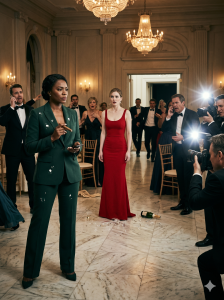
Silence.
Then, complete and uncontrollable panic.
Guests cried out. Phones lit up instantly as trembling hands dialed brokers, lawyers, and financial advisors. Conversations erupted into a deafening storm of urgent whispers.
An older man to my right clutched his chest, his face turning purple as he muttered to his wife, “That’s the Foundation’s entire lifeline! It’s gone!”.
Another man hissed to his associate, eyes wide with fear, “Without her funding, they collapse immediately!”.
Eleanor stumbled backward. Her shaking fingers failed her.
CRASH. The crystal champagne flute slipped from her grip and shattered across the marble floor. Vintage champagne spilled like liquid gold, pooling at her silver heels.
“You… you can’t,” Eleanor stammered, her voice small now, stripped of all arrogance, sounding like a frightened child. “This is my family’s legacy!”.
“It was,” I interrupted, my tone calm and final. “But now, it ends”.
The weight of my words crushed the room. The same guests who had laughed at me moments earlier now stood pale and silent, watching their futures unravel in seconds.
The glamour of the gala dissolved instantly, replaced by suffocating dread. The whispers swelled into an unstoppable wave.
“She just pulled billions.” “The gala, the foundation… it’s finished.” “They’ll lose everything.”
And for the first time that night, every eye in the ballroom turned fully toward me. Not with mockery. Not with disdain.
But with fear.
Eleanor tried to speak again, but her voice collapsed into a whisper, swallowed by the storm she had unleashed herself. Her inherited authority, the invisible crown she had worn so confidently, shattered completely, its fragments scattered at her feet for everyone to see.
I lifted my chin, steady and unbroken. The cake, the cruelty—none of it had touched me. I let the silence linger just long enough to seal the truth into the memory of this city.
The humiliation had reversed. The gala no longer belonged to its hostess. It belonged to the woman she had tried to destroy.
And the empire that had mocked me was collapsing before their eyes.
The ballroom exploded into chaos. What had been unified laughter moments ago fractured into shouting, rushing footsteps, and frantic calls. Diamond-clad guests turned pale, clutching their phones as if the 4.2 billion had been pulled directly from their own accounts.
“Check the markets!” one man barked to his assistant, his voice tight with panic. “They’ll announce the withdrawal by morning! We need to dump the stock!”.
Another guest cursed under his breath, his eyes darting toward the heavy doors as if distance alone could protect him from the fallout.
Eleanor stood frozen, unable to move, champagne still pooling around the shattered glass at her feet. Her red dress no longer radiated power. It looked excessive now, almost cheap against the scale of what she had lost. The collapse had only just begun.
PART 4: THE WEIGHT OF THE CROWN
The ballroom descended into chaos.
It wasn’t gradual—it was immediate, a violent fracture of reality. The unified laughter from minutes before shattered into panic, movement, and noise. The illusion of untouchable aristocracy vanished in an instant, undone by a single statement. The shock was so intense it felt visible, like waves moving through the heavy, perfumed air.
I remained at the center, my breathing slow and controlled, watching their world unravel.
Diamond-adorned guests turned pale, clutching their phones as if billions had been taken from them personally. And in a way, they had. The Hamilton Foundation wasn’t just a charity; it was the financial backbone of their entire ecosystem. It supported their galleries, shielded their wealth, and funded the institutions that upheld their status. By pulling that one lever, I hadn’t just humiliated Eleanor—I had detonated something catastrophic at the core of their world.
“Check the markets!” one man snapped to his assistant, his voice tight with fear. His face, once flushed with the thrill of my humiliation, had turned the color of ash. “They’ll announce it by morning!”.
“Dump the tech shares,” another muttered, his eyes darting toward the heavy mahogany doors as if distance alone could protect him. “Dump everything tied to the Hamilton board. Do you hear me? Right now!”.
The panic was almost pathetic. These were the so-called masters of the universe, titans of industry, legacy elites who believed they were born to rule. Yet at the first sign of real danger, they abandoned all composure, nearly trampling each other to reach the exits.
The hostess remained frozen, champagne pooling around the jagged shards of her shattered glass.
Eleanor stood like a monument to ruin. Her breathing was shallow and uneven, her chest rising and falling against the tight bodice of her scarlet gown. Minutes ago, that dress had symbolized her power. Now it no longer gleamed. Under the chandeliers, it looked garish—cheap against the scale of what she had lost.
Guests she had once called friends, allies, donors—one by one, they stepped away. The retreat was unmistakable. No one reached for her shaking hand. No one offered comfort. There was no loyalty here, only leverage. And hers had vanished.
Instead, they turned away, eager to distance themselves from the collapse unfolding before them. They treated her like contamination.
“She’s finished,” a socialite muttered, pulling her cashmere shawl tighter, refusing to look at Eleanor.
“We should leave before we’re photographed beside her,” another woman whispered urgently to her husband.
Their abandonment was colder than the frosting on my skin. They hadn’t chanted “Out, out, out!” out of belief—they had done it out of fear, aligning with whoever held power. Now that power had shifted, they fled.
Then came the vultures.
Photographers gathered at the edges of the ballroom, drawn by the unmistakable scent of collapse. Security at the doors had abandoned their posts, too busy checking their own portfolios to stop the press from entering.
Cameras flashed relentlessly, capturing Eleanor’s unraveling—her authority stripped away, her composure shattered. The strobes carved the room into harsh contrasts.
And in every frame, just beyond her trembling figure, stood the Black CEO—calm, composed, frosting still marking her ruined coral dress like proof of survival.
At the same time, a sharp, synchronized sound spread through the hall.
Ping. Ping. Ping. Notifications lit up across hundreds of phones. The financial world had already reacted. The scale of my withdrawal had triggered alerts across every major terminal.
Headlines scrolled faster than they could process them.
BLACK CEO WITHDRAWS $4.2 BILLION FROM HAMILTON FOUNDATION.. SHOCK AT GALA: HOSTESS PUBLICLY HUMILIATED AS FUNDING PULLED.. POWER SHIFT: BILLION-DOLLAR EMPIRE COLLAPSES OVERNIGHT..
Eleanor saw the glow of screens reflecting in the faces of those abandoning her. Reality broke through. She moved.
“Oh…” she tried, stepping forward, her silver heels slipping slightly in the spilled champagne.
“This is my family’s legacy!” she cried, her voice cracking into a desperate sob as she looked at the crowd. “You can’t do this! You can’t let her do this!”.
No one responded.
Her words dissolved into the noise—reporters murmuring, guests arranging rides, lawyers whispering urgently. The woman who had ruled the room minutes ago was now invisible.
The Black CEO hadn’t moved.
I didn’t need to. My silence carried more weight than the chaos around me. My stillness pulled every eye, every headline, every shifting alliance toward me.
I lifted my gaze above the room. High on the wall, Eleanor’s father’s portrait loomed, painted decades ago—a symbol of inherited power, stern and unyielding.
Tonight, it seemed to mock her. Beneath his painted stare, her legacy collapsed in real time, abandoned by the very people who had applauded her cruelty.
The chant of “Out, out, out!” lingered—but no longer aimed at me. It hovered over her, unspoken yet undeniable in every turned back, every avoided glance, every hurried step toward the exit.
Her kingdom had fallen. And at its center stood the woman she had tried to humiliate. I was no longer the target—I was the force behind their collapse.
The Hamilton ballroom was no longer a place of glamour. It was a battlefield. Crimson silk trembling, champagne staining marble, whispers cutting sharper than any violin ever could.
The hostess stood alone, her empire crumbling under the harsh glow of screens and cameras.
And at the center of it all, calm and unbroken, stood the Black CEO.
I didn’t rush. I didn’t gloat. That belongs to those surprised by their own victories. I had known the outcome the moment the cake left her hand.
I simply adjusted the ruined coral dress clinging to me. The frosting had hardened into pale marks across the fabric, like battle scars. My hand rose, brushing away the last streak from my cheek—not to hide it, but to reveal the steady, unshaken gaze beneath.
The media sensed blood in the water. Reporters surged forward, pushing through the fleeing billionaires, their voices sharp and relentless, hungry for a story.
“Is it true you’ve pulled the entire endowment?!” one journalist shouted, thrusting a microphone past a retreating tech executive.
“Will the Hamilton Foundation collapse tonight?!” another called out, a flash bursting directly in my eyes.
“What message are you sending with this decision?!”.
I didn’t react to the blinding lights. I lifted my hand—just as I had before when silencing the crowd.
Instantly, the reporters fell quiet.
The power in the room no longer belonged to the hostess’s crimson gown or her family’s name. It stood here, rooted in a presence that required no raised voice to command silence.
I faced the nearest camera. My voice was steady, deliberate, carrying through the microphones and out to millions watching.
“Dignity is not for sale,” I said.
The silence was so complete the faint hum of camera lenses adjusting could be heard.
“Power is not a crown you wear,” I continued, my gaze briefly shifting toward Eleanor, who trembled near the shattered glass. “It is the truth you stand on when the world tries to break you”.
The words settled over the room, cutting through the silence. No reporter interrupted. No guest moved. Even the cameras seemed to pause, as if aware they were recording something permanent.
Eleanor sank deeper into isolation. Once radiant, she now looked small beneath the towering chandeliers. Her beauty felt empty, her allies gone.
Every eye had turned away from her. Even her father’s portrait seemed to loom in silent judgment above.
I held the camera’s gaze for a moment longer. Then I turned.
My heels struck the marble in calm, even rhythm.
I walked toward the grand doors, and the crowd parted instantly, forming a wide path. Instinct alone seemed to guide them.
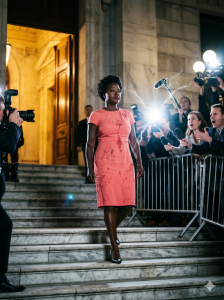
Men in tailored tuxedos stepped back quickly, pressing against tables. Women adorned in diamonds lowered their eyes, avoiding mine. Even the waitstaff froze, trays suspended midair.
I didn’t look back as I passed through the doors. There was nothing left to see.
My voice carried one final time into the silent room.
“Humiliation does not weaken us,” I said. “It reveals who truly holds the crown”.
The words echoed long after I was gone.
I stepped into the cool night air. Cameras outside erupted in flashes like lightning. Reporters pressed against barricades, broadcasting my measured walk down the steps as if it were a coronation.
By morning, the headlines were already written in every editor’s mind. But the truth went beyond words or screens. It lived in the image of a woman who endured their cruelty, absorbed their scorn, and walked away untouchable.
Inside the ballroom, silence lingered like a funeral.
The hostess collapsed into a velvet chair, her scarlet dress pooling around her like the remnants of a fallen throne. She covered her face, shoulders shaking with quiet sobs.
No one came to her. The chant of “Out, out, out” echoed only in her memory now.
Across the city—in boardrooms, homes, and hushed conversations—the lesson spread.
Power does not need noise. Justice does not need a crown. And dignity cannot be erased by a slice of cheap frosting on silk.
The Black CEO left her mark—not on the ruined dress, but on the world that finally understood.
The gala was over. The empire was gone.
